REVIEW 5 major objections 3 minor 10 references
CausalRAG2: Hierarchical Causal Knowledge Graph Design for RAG
T0 review · 5 major / 3 minor · reviewed 2026-08-03 · deepseek-v4-flash
Pith's one-line read The paper claims that adding LLM-verified causal gates between modules of a knowledge graph lets retrieval-augmented generation raise both recall and precision, not trade one for the other.
desk verdict Good idea, useful benchmark, but the headline empirical claim overreaches: the shared-root-KG baseline setup and the authors' own Table 4 both undercut 'consistently outperforms.' read the letter →
The pith
A machine-rendered reading of the paper's core claim, the machinery that carries it, and where it could break.
The reading
What carries the argument
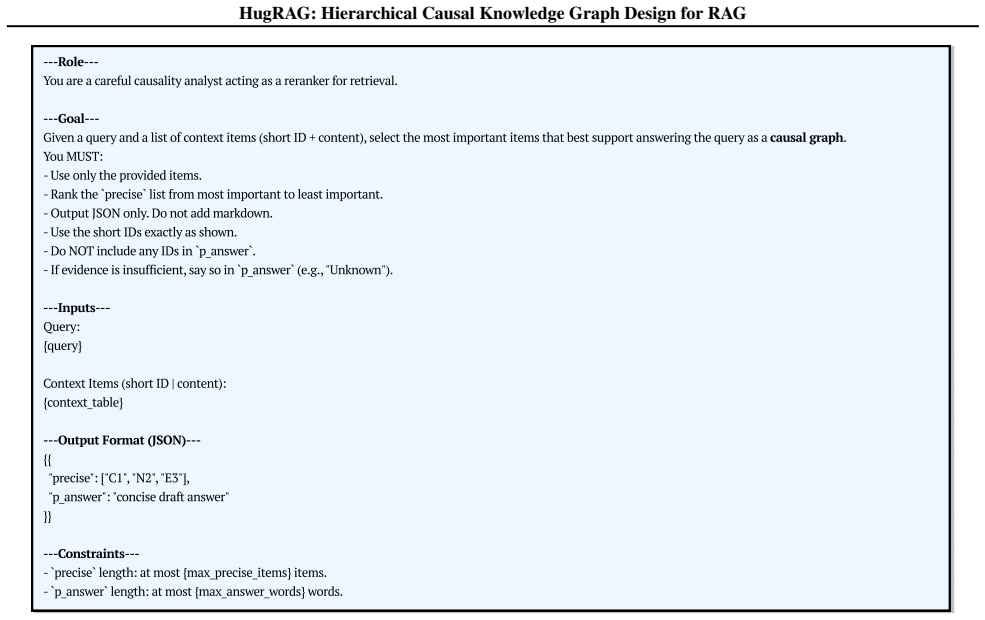
The central object is the causal gate set Gc: sparse directed edges between modules placed only where an LLM judges a plausible causal link between module summaries. A top-down pruning routine builds the gates layer by layer, pruned by assuming causality is transitive across abstraction levels, which keeps construction near-linear instead of quadratic. At query time, the unified edge space Euni = Estruc ∪ Ehier ∪ Gc is traversed by a best-first search whose gain function favors causal gates and hierarchical links over structural edges; then the raw subgraph is linearized into a token-efficient table and an LLM-causality-analyst prompt returns the subset of identifiers that form causal paths,
What would settle it
Take a sample of gate candidates and compare the LLM's verdicts with human-domain-expert labels on the same module pairs; if agreement is low, or if replacing the LLM's gate set with randomized gates does not measurably reduce context recall, the claimed causal mechanism is not the active ingredient. Conversely, a dataset with known ground-truth causal chains would show whether gate pruning discards chains the retrieval needs.
Extended reading notes
Core claim
The paper's central claim is that the bottleneck in graph-based RAG is graph organization, not query policy: intrinsic modularity keeps retrieval confined to dense communities, and semantic matching pulls in topically similar but causally irrelevant nodes. To fix both, HugRAG builds a multi-level hierarchy with a modularity-maximizing partition and augments it with a sparse set of causal gates—edges between module summaries that an LLM verifies as plausibly causal. Online retrieval seeds from multiple levels, expands through a unified edge space (structural, hierarchical, and gate edges) with best-first search, and then a spurious-aware LLM prompt prunes the raw subgraph to the causal paths
Load-bearing premise
The load-bearing premise is that an LLM's yes/no judgment on module-summary pairs reliably captures genuine causal links, and that those links are transitive enough that pruning a parent's children via top-down gate construction does not cut off the bridges retrieval needs; if the judgments are noisy or transitivity fails, the recall gain can collapse.
Editorial extensions
If this is right
- If the central claim holds, graph-based RAG systems can add a sparse causal-gate layer without rebuilding their index, and thereby recover evidence that modular structure currently hides.
- The explicit causal-path filter gives a token-efficient reranking step, so longer or more complex queries need not blow the context budget.
- The near-linear gate construction means the approach is intended to stay tractable as knowledge bases scale to millions of characters.
- HolisQA offers a reusable protocol: questions that require integrating at least three sentences and a necessity check on supporting evidence, making entity-centric node-finding insufficient.
Reading between the lines
- Editorial inference: if gate quality rather than search policy is the binding constraint, the next bottleneck is LLM causal judgment; future work could calibrate gate decisions against human causal labels or use structured causal discovery to validate them.
- Editorial inference: the same two-stage design has a natural extension to temporal and counterfactual retrieval, where the distinction between genuine causal links and coincidental co-occurrence is even starker; the paper does not test this.
- Editorial inference: the HolisQA construction could be reused to audit any RAG system for holistic comprehension, independent of HugRAG, by checking whether retrieved evidence actually forms a support chain.
- Editorial inference: the paper's claim that gates break isolation without semantic drift implies that gate placement—not query expansion—is what controls the recall-precision frontier; a direct comparison of gate-placement strategies would be a sharper test than the current ablation.
Editorial analysis
A structured set of objections, weighed in public.
Referee Report
Summary. The paper, arXiv:2602.05143, proposes HugRAG (also titled CausalRAG2 in the abstract and metadata), a graph-based retrieval-augmented generation framework that organizes a knowledge graph into a hierarchy of modules and adds LLM-constructed 'causal gates' between modules to break information isolation. During retrieval, it performs multi-granular hybrid seeding, best-first traversal over structural, hierarchical, and causal edges, and then an LLM-based causal path filtering stage to remove spurious context. The authors also introduce HolisQA, a new benchmark of holistic-comprehension question-answer triples generated from recent academic papers. The central empirical claim, repeated in the abstract and Section 5.2, is that HugRAG 'consistently outperforms competitive graph-based RAG baselines across multiple datasets and evaluation metrics.' The full text includes implementation details, ablation studies, scalability plots, and an appendix on causal-gate effectiveness.
Significance. The core idea — using sparse, LLM-verified causal gates across hierarchical modules as retrieval shortcuts — is a plausible and interesting contribution to graph-based RAG. If the reported gains hold under fair baseline configuration and statistical testing, the framework would offer a concrete mechanism for reconciling global recall with local precision. The release of code and the HolisQA benchmark is a strength, as is the A/B causal-gate experiment in Appendix E with bootstrap confidence intervals. However, the main empirical support is weakened by the use of a shared root knowledge graph for all graph baselines, the absence of error bars or significance tests in Tables 3-4, and an over-broad 'consistently outperforms' claim that is contradicted by several entries in Table 4. The causal-gate construction also relies on an unverified transitivity assumption (Algorithm 2). These issues are load-bearing for the headline claim, so the paper requires substantive revision.
major comments (5)
- [Appendix F.3, B.1] All graph-based RAG baselines (GraphRAG, LightRAG, HippoRAG2, LeanRAG) are evaluated on a single 'unified root knowledge graph' built with HugRAG's own entity extraction and Leiden partitioning pipeline. Each of these methods defines a native index — community summaries, dual-level entity/relation key-value storage, phrase/passage nodes with PPR, and GMM semantic trees — and their retrieval algorithms depend on those structures. Running them on HugRAG's graph can handicap them independently of retrieval quality. This directly threatens the central 'consistently outperforms' claim. Please rerun each baseline on its native graph construction, or provide a concrete justification for why the unified substrate is neutral.
- [Tables 3-4, Section 5.1] The main results report only point estimates. No error bars, standard deviations, or significance tests are given for the F1, Context Recall, or Answer Relevancy columns. Several differences are small (e.g., QASC F1: HugRAG 13.35 vs. LeanRAG 13.19; AR: 49.40 vs. 46.59) and may be within noise. Given that the paper's title claim is 'consistently outperforms', it is essential to report variance across runs or subsets and to test whether the wins are statistically reliable. Appendix E's bootstrap intervals for the gate A/B test do not cover the main tables.
- [Table 4, 2WikiMultiHopQA and HotpotQA] The abstract and Section 5.2 state that HugRAG 'consistently outperforms competitive graph-based RAG baselines across multiple datasets and evaluation metrics.' This is not supported by the paper's own numbers: on 2WikiMultiHopQA, HugRAG's Context Recall is 41.95 vs. HippoRAG2's 55.53; on HotpotQA, HugRAG's Context Recall is 40.30 vs. LightRAG's 48.17. The claim should be restricted to 'most metrics' or 'average performance', or the exceptions should be explicitly acknowledged and explained.
- [Appendix B.1, Algorithm 2] The Top-Down Hierarchical Pruning strategy assumes transitivity of causality across hierarchy levels: when a causal link u→v is established, children of v are pruned from further verification (lines 18-20) on the assumption that the high-level connection covers the relationship. This is a load-bearing assumption for gate completeness and hence for the reported recall gains. The paper provides no evidence that LLM 'yes/no' causal judgments are transitive or stable across abstraction levels, and no sensitivity analysis comparing pruned gates against exhaustive pairwise verification on a sample. Please add such a comparison and discuss the consequences of noisy gate judgments.
- [Section 5.1, Appendix F.2] HolisQA is generated by an LLM pipeline, and the same LLM family (gpt-5-nano) is used for causal gate construction, causal path filtering, and final answer generation. The paper mentions 'cross-domain expert review' but provides no protocol, sample size, or inter-annotator agreement. This creates a risk that HolisQA results partly reflect self-consistency between the generation/retrieval model and the benchmark construction model, rather than genuine retrieval quality. Please either evaluate with a different generation/evaluation LLM family or provide detailed expert-validation statistics, and make the validation data available.
minor comments (3)
- [Title/Abstract] The abstract and arXiv metadata use 'CausalRAG2', while the full text title and body use 'HugRAG'. Please align these names throughout to avoid confusion with the prior CausalRAG work.
- [Figure 4] The text refers to 'HugRAG (red line)', but the figure uses grayscale-like markers. Use explicit marker styles or a legend key to identify all methods clearly.
- [Appendix B.1] The claim that hierarchical pruning reduces complexity 'from quadratic to near-linear in practice' is not substantiated by runtime measurements. Please report actual gate-construction wall-clock times or counts of LLM calls.
Circularity Check
No significant circularity: the claims are empirical and anchored to external benchmarks; self-citations and shared LLM components create confounds, not definitional reductions.
full rationale
The paper's central claim is empirical—that HugRAG outperforms graph-based RAG baselines—and is supported by experiments on standard QA datasets (MS MARCO, NQ, 2WikiMultiHopQA, QASC, HotpotQA) and on HolisQA, with metrics computed against external gold contexts and an external evaluator (Ragas with Gemini-2.5-Flash-Lite). The causal-gate construction (Eq. 1) and causal-path filtering (Eq. 4) are separate stages; neither is fitted to the reported evaluation metrics, and their effectiveness is tested against gold-node reachability in Appendix E, which is external to the LLM's gate judgments. The self-citations (CausalRAG, Wang et al. 2025a; Ma 2024) support the auxiliary premise that LLMs can identify causal relations, but they are not the only support—independent citations (Dong et al. 2025; Saklad et al. 2026) and the asserted cross-domain expert review are also invoked—so this is not a load-bearing self-citation chain. The use of a 'unified root knowledge graph' for all graph-based baselines (Appendix F.3) and the generation of HolisQA by an LLM of the same family used for HugRAG's causal judgments and answer generation are legitimate experimental-design and leakage concerns, and Table 4 already undercuts the 'across metrics' wording; however, these are correctness/fairness risks rather than demonstrations that any result equals its input by construction. No Eq. X = Eq. Y reduction or fitted-parameter-renamed-as-prediction pattern was identified, so per the strict circularity standard the paper receives score 0.
Assumptions & free parameters
free parameters (4)
- Hybrid scoring weight α =
0.7
- Edge-type traversal weights w =
causal=1.2, hierarchical=1.0, structural=0.8
- Retrieval hyperparameters (γ, hop h, gate threshold τ, token budgets) =
unspecified
- Seed budgets K_L, K_0 =
K_L=3, K_0=3
assumptions (5)
- domain assumption LLM causal identification is reliable enough for gate construction and path filtering
- ad hoc to paper Causal transitivity across hierarchy levels
- domain assumption Leiden modularity creates information isolation that causal gates can bridge without semantic drift
- ad hoc to paper A unified root KG is a fair neutral substrate for all graph baselines
- domain assumption HolisQA triples are valid holistic-comprehension ground truth
invented entities (1)
-
Causal gate (Gc)
Cite this review
Pith. "Pith review of CausalRAG2: Hierarchical Causal Knowledge Graph Design for RAG." pith.science (2026). https://pith.science/paper/UX7H5747
@misc{pith2026260205143,
  author       = {Pith},
  title        = {Pith review of: CausalRAG2: Hierarchical Causal Knowledge Graph Design for RAG},
  year         = {2026},
  howpublished = {\url{https://pith.science/paper/UX7H5747}},
  note         = {Machine review of arXiv:2602.05143}
}
read the original abstract
Retrieval augmented generation (RAG) has enhanced large language models by enabling access to external knowledge, with graph-based RAG emerging as a powerful paradigm for structured retrieval and reasoning. However, existing graph-based methods often over-rely on entity-centric node matching and lack explicit causal modeling, leading to unfaithful or spurious answers. Prior attempts to incorporate causality are typically limited to local or single-document contexts and also suffer from information isolation that arises from modular graph structures, which hinders scalability and cross-module causal reasoning. To address these challenges, we propose CausalRAG2, a framework that rethinks knowledge organization for graph-based RAG through causal gating across hierarchical modules. CausalRAG2 explicitly models causal relationships to suppress spurious correlations while enabling scalable reasoning over large-scale knowledge graphs. We also introduce HolisQA, a benchmark for holistic comprehension beyond entity-centric matching. Extensive experiments demonstrate that CausalRAG2 consistently outperforms competitive graph-based RAG baselines across multiple datasets and evaluation metrics. Our work establishes a principled foundation for structured, scalable, and causally grounded RAG systems. Our code and HolisQA benchmark are available at https://github.com/Pwnb/CausalRAG2.
Figures


Figures from the paper (12 more)




Reference graph
Works this paper leans on
-
[1]
Identify all entities. For each identified entity, extract the following information: - entity_name: Name of the entity, capitalized - entity_type: One of the following types: [{entity_types}] - entity_description: Comprehensive description of the entity's attributes and activities Format each entity as ("entity"{tuple_delimiter}<entity_name>{tuple_delimi...
-
[2]
relationship
From the entities identified in step 1, identify all pairs of (source_entity, target_entity) that are *clearly related* to each other. For each pair of related entities, extract the following information: - source_entity: name of the source entity, as identified in step 1 - target_entity: name of the target entity, as identified in step 1 - relationship_d...
-
[3]
N1: [Entity Description]
Inter-layer Look-Ahead Pruning:When searching for connections between a module u (current layer) and modules in the next lower layer (l−1), we prune the search space by: • Excludingu’s own children (handled by hierarchical inclusion). • Excluding children of modules already causally connected to u.If u→v is established, we assume the high-level connection...
-
[4]
Gold Nodes
When finished, output {completion_delimiter} ###################### -Examples- Example 1: Entity_types: ORGANIZA TION,PERSON Text: The V erdantis's C................. Output: ("entity"{tuple_delimiter}CENTRAL INSTITUTION{tuple_delimiter}ORGANIZA TION{tuple_delimiter}The Central Institution is the Federal Reserve of V erdantis, which.................. Exam...
2024
-
[7]
Use **{record_delimiter}** as the list delimiter
Return output in English as a single list of all the entities and relationships identified in steps 1 and 2. Use **{record_delimiter}** as the list delimiter
-
[9]
We explicitly reject trivia-style questions that can be answered by a single named entity (e.g., ”Who founded X?”)
Integration Constraint:The question must require integrating information from at least three distinct sentences. We explicitly reject trivia-style questions that can be answered by a single named entity (e.g., ”Who founded X?”)
-
[10]
question
Evidence Verification:The generation process must output the IDs of all supporting sentences. We validate the dataset via a necessity check, verifying that the correct answer cannot be derived if any of the cited sentences are removed. Through this strict construction pipeline, HolisQA effectively evaluates the model’s ability to perform holistic comprehe...
2019
-
[2019]
Association for Computational Linguistics. doi: 10.18653/v1/D19-1410. Saklad, R., Chadha, A., Pavlov, O., and Moraffah, R. Can Large Language Models Infer Causal Relationships from Real-World Text?, January 2026. Traag, V ., Waltman, L., and van Eck, N. J. From Louvain to Leiden: Guaranteeing well-connected communities. Scientific Reports, 9(1):5233, Marc...
Show all 10 references
-
[2024]
doi: 10.18653/v1/2024.eacl-demo.16
Association for Computational Linguistics. doi: 10.18653/v1/2024.eacl-demo.16. Fortunato, S. and Barth ´elemy, M. Resolution limit in community detection.Proceedings of the National Academy of Sciences, 104(1):36–41, January 2007. doi: 10.1073/pnas.0605965104. Guo, Z., Xia, L....
2024
-
[2322]
causality analyst
doi: 10.1038/s41598-019-41695-z. Walker, C. and Ewetz, R. Explaining the Reasoning of Large Language Models Using Attribution Graphs, December 2025. Wang, N., Han, X., Singh, J., Ma, J., and Chaudhary, V . CausalRAG: Integrating Causal Graphs into Retrieval- Augmented Generati...
2025 doi
Reviewed August 3, 2026 · model on record in the stance chip above.
Discussion (0). Continue with ORCID to comment.