REVIEW 3 major objections 5 minor 55 references
DYNUS: Uncertainty-aware Trajectory Planner in Dynamic Unknown Environments
T0 review · 3 major / 5 minor · reviewed 2026-08-16 · deepseek-v4-flash
Pith's one-line read DYNUS makes hard-constraint, collision-free navigation practical in dynamic unknown 3D spaces.
desk verdict A serious systems paper with a genuine temporal-safety gap: the corridors are spatial snapshots, not space-time certificates, so the hard-constraint claim is ahead of the math. read the letter →
The pith
A machine-rendered reading of the paper's core claim, the machinery that carries it, and where it could break.
The reading
What carries the argument
The central mechanism is the variable-eliminated MIQP: a composite cubic Bezier trajectory in which continuity and boundary conditions are solved symbolically, leaving only one free variable per axis per segment, so the hard collision and dynamic constraints can be optimized with far fewer decision variables and no equality constraints. Around this sits a global-local loop: DGP, a hybrid of JPS and time-aware Dynamic A*, produces a path that avoids timestamped obstacle predictions; safe corridor generation converts that path into overlapping convex polyhedra in space-time; and the planning framework prepackages exploratory, safe, and contingency trajectories. On the perception side, an Adaptive Extended Kalman Filter continuously re-estimates process and measurement noise, and a constant-acceleration model projects obstacle positions into the future with a covariance that the planner uses to set safety margins and yaw priorities.
What would settle it
Run DYNUS with a tracked obstacle that deliberately waits until the agent commits to a safe trajectory and then accelerates perpendicular to its predicted path or reverses; if the agent collides or must emergency-stop inside a supposedly safe corridor, the safety guarantee is shown to depend on the motion-consistency assumption.
Extended reading notes
Core claim
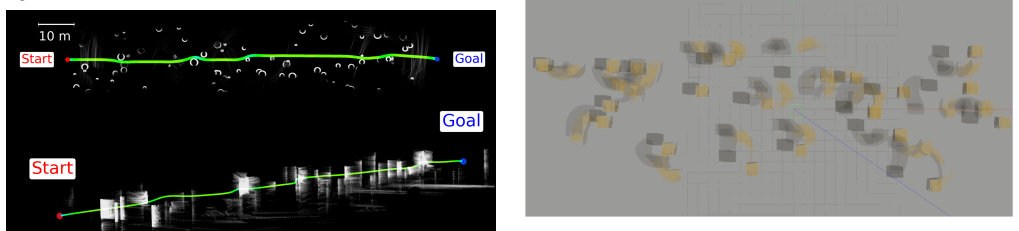
On its own terms, the paper's discovery is that the long computation time of hard-constraint trajectory optimization can be attacked at three levels at once: choose a global path that deconflicts with predicted obstacle trajectories only where needed; express the local optimization so most variables are eliminated up front; and keep a stock of quickly generated safe backup trajectories so that when a dynamic obstacle misbehaves the robot can switch without restarting from scratch. The result is a planner that reports collision-free navigation in dynamic unknown 3D environments with 100% success in the tested simulations and about 25% faster travel time than comparison planners, while still using hard constraints rather than soft penalties. DYNUS also runs on three robot types in hardware, with all perception, planning, control, and localization modules onboard.
Load-bearing premise
The load-bearing premise is that moving obstacles keep relatively consistent motion, so their future positions are captured by a constant-acceleration model and an adaptive uncertainty bubble; if an obstacle turns, speeds up, or reverses more abruptly than that bubble grows, the trajectory labeled safe may no longer be collision-free.
Editorial extensions
If this is right
- If DYNUS's claims hold, hard-constraint safety guarantees can be offered at replan rates comparable to soft-constraint planners, removing a major reason practitioners use soft penalties.
- The same architecture should transfer to any vehicle with a tracking controller and onboard sensing; the paper demonstrates this on three platform types.
- The contingency-trajectory layer gives a graceful degradation path: when predicted collisions appear, the robot can switch to a precomputed safe trajectory or emergency stop instead of replanning from zero.
- Because the global planner only invokes the expensive time-aware search when the cheap JPS path meets a dynamic obstacle, computation scales with the number of actually threatening obstacles rather than with environment size.
Reading between the lines
- If the variable-elimination structure generalizes to non-cubic splines or higher-order dynamics, the same speedup should apply to manipulator or legged-robot motion planning; that is an untested extension.
- The safety claim is only as strong as the constant-acceleration prediction model; pairing DYNUS with a learned or reachability-based predictor could turn the claimed empirical success into a verifiable guarantee under larger disturbance classes.
- One could stress-test the framework by measuring its replan rate and collision count as obstacle density and speed grow, since the 100% figure is reported on the tested scenarios rather than on all possible dynamic environments.
Signed reviews
Editorial analysis
A structured set of objections, weighed in public.
Referee Report
Summary. DYNUS is a trajectory planning framework for autonomous vehicles operating in dynamic, unknown, 3D environments. The paper proposes three main components: (i) the DYNUS Global Planner (DGP), a hybrid of JPS and a time-aware Dynamic A* that plans in spatio-temporal space, together with a temporal safe corridor generator; (ii) a three-tier trajectory framework using exploratory, safe, and contingency trajectories to react to unpredictable dynamic obstacles; and (iii) a hard-constraint MIQP local trajectory formulation that uses a claimed variable-elimination technique to speed up computation. The authors report 100% success in several simulation settings, travel times about 25% faster than state-of-the-art methods, and demonstrate the system in simulation and hardware on a quadrotor, a wheeled robot, and a quadruped robot.
Significance. If the safety and speed claims are substantiated, DYNUS would be a meaningful advance: it targets a harder operating regime than most existing planners, namely dynamic, unknown, confined 3D spaces, while retaining hard-constraint collision avoidance. The paper is also unusually strong in empirical breadth, with open-source code, video material, multiple simulation environments, and hardware experiments on three platform types. The decoupled yaw optimization and the AEKF-based uncertainty propagation are sensible components that are clearly described. However, the formal support for the central safety claim is incomplete: the temporal safe corridor is generated from a nominal timing model, but the trajectory optimization is not coupled to that timing, so the hard-constraint guarantee against dynamic obstacles is not actually established. The variable-elimination derivation, which underpins the computational speed advantage, is asserted rather than demonstrated, and the headline quantitative claims are reported without statistical measures. These issues are fixable, but they need to be addressed before the paper's main claims can be accepted.
major comments (3)
- [III-B and IV-A (Eqs. (5), (14)-(15))] The temporal safe corridor is generated from a spatial snapshot at a nominal double-integrator travel time, but the MIQP is free to rescale the total duration through the factor f in Eq. (15), and Eq. (5) only constrains the Bézier control points to lie inside the assigned polyhedron without tying the interval's actual time to the snapshot timestamp. Consequently, even with perfect obstacle prediction and perfect tracking, the executed trajectory can pass through a polyhedron at a time when the predicted obstacle is inside it; the corridor is a spatial containment region, not a space-time certificate. The hard-constraint collision-free claim in the abstract is therefore not established for dynamic obstacles. Please either add explicit time-coupling constraints (or a proof that the optimized timing always stays within the snapshot validity window), or revise the claims to state that safety is achieved by the replanning/contingency framework and provide a formal safety argument for that framework.
- [IV-A.1] The variable-elimination step is the computational core of the paper, but it is asserted rather than derived. For N=3 the text states that the system is fully determined, and for N=4 that 'symbolic elimination reveals' the single free parameter d3 per axis, with all remaining coefficients affine in d3; no elimination procedure, resulting coefficient formulas, or verification is given. Because Table II attributes the speed advantage over FASTER to this technique, please provide a complete derivation in an appendix (or a machine-checkable symbolic elimination script) and state explicitly the resulting reduced problem dimensions. This is needed to verify that the claim of 'pre-computing dependencies' is correct.
- [VII-A, Tables II-III] The headline quantitative claims (100% success, approximately 25% faster travel time) are reported as averages over 10 runs with no variance, and the table note 'excluding failed runs' means that baselines with 1/10 or 3/10 success are compared only on their successful subset, which biases the travel-time comparison. Please report per-run distributions or standard deviations/confidence intervals, specify the number of failures that are excluded from each average, and provide a significance test or at least a clear statement that the 25% figure is a point estimate rather than a demonstrated performance margin.
minor comments (5)
- [IV-A, Eq. (4)] The Bézier control-point formulas appear to have a typesetting error, as the denominator 3 is unclear in the inline rendering of pn1 and pn2; please reformat these equations so that the division is unambiguous.
- [III-A.3, Algorithm 3] Algorithm 3 does not handle the case where no occupied points are found (the mean of an empty set is undefined) and it only assigns values to Pnew for indices 0 through NLAD, leaving the rest of the path undefined; please clarify the initialization of Pnew and the behavior when |O| = 0.
- [IV-C.1 and III-B] There are typographical errors, including 'yaw angeles' in Section IV-C.1 and 'accouting' in Section III-B, and the abstract contains a stray space in 'F ast'; these should be corrected.
- [II-E and VII] The paper should explicitly tie the empirical success rates to the assumptions listed in Section II-E, especially Assumption 2 (perfect tracking of dynamically feasible trajectories) and Assumption 5 (dynamic obstacles have relatively consistent motion patterns), so that readers do not interpret the 100% success numbers as unconditional guarantees.
- [I-A, Table I] The related-work table lists FHD and STS as 2D dynamic-environment methods; a direct comparison against these methods in the 2D wheeled-robot or quadruped settings would strengthen the empirical evaluation, and the current absence of such a comparison should at least be acknowledged.
Circularity Check
No circular derivation: DYNUS's new components are specified by their own equations and algorithms; self-citations are background, not load-bearing reductions.
full rationale
DYNUS's claimed contributions (DGP, temporal safe corridors, safe/contingency framework, variable-elimination MIQP) are each independently specified. DGP is a concrete combination of JPS and the paper's own Dynamic A*, and Algorithm 1 gives self-contained time-estimation logic. The variable-elimination result is a mathematical reduction: the paper counts 4N decision variables and 3N+3 equality constraints per axis (Case Study 1 and 2) and reparameterizes the spline coefficients in terms of the surviving free variables, so no fitted quantity is renamed as a prediction. The safe-corridor generation builds on the cited convex-decomposition method [26] and adds snapshotting at double-integrator travel times, which is an independent construction rather than an echo of the output. Components inherited from the authors' prior work (FASTER, MADER, PUMA, Robust MADER) are cited as related work and are not used to justify uniqueness or to define the present algorithm by assumption. The one concern raised in review — that Eq. (5) constrains each Bézier interval to a polyhedron without enforcing that the interval's optimized time matches the snapshot timestamp used to generate that polyhedron — is a potential safety-consistency gap, not a circular reduction: the output is not equal to an input by construction. The paper also explicitly lists its assumptions in Section II-E, including non-adversarial and relatively-consistent-motion assumptions, rather than hiding them. Therefore no circularity score is warranted.
Assumptions & free parameters
free parameters (8)
- yaw utility weights w_i =
not reported
- frontier cost weights w_j =
not reported
- dynamic path adjustment constants k, alpha_P, clearance C =
not reported
- static path adjustment constants alpha_push, NLAD, d_disc =
not reported
- contingency distance bounds d_min and d_max =
not reported
- position objective weights w_ctrl and w_ref =
not reported
- EMA coefficient alpha_dtA =
not reported
- time allocation factor set f =
adaptive, not enumerated
assumptions (6)
- standard math Bezier curves lie inside the convex hull of their control points.
- domain assumption Dynamic obstacles are non-adversarial and have relatively consistent motion patterns.
- domain assumption Static and dynamic obstacles can be detected by onboard sensors.
- domain assumption The low-level controller can track trajectories that satisfy the planner's dynamic constraints.
- domain assumption Bug traps and dead ends are shallower than the local map sensing range.
- domain assumption The MIQP solver returns exact solutions to the formulated optimization problems.
Cite this review
Pith. "Pith review of DYNUS: Uncertainty-aware Trajectory Planner in Dynamic Unknown Environments." pith.science (2026). https://pith.science/paper/UXBXVIRK
@misc{pith2026250416734,
  author       = {Pith},
  title        = {Pith review of: DYNUS: Uncertainty-aware Trajectory Planner in Dynamic Unknown Environments},
  year         = {2026},
  howpublished = {\url{https://pith.science/paper/UXBXVIRK}},
  note         = {Machine review of arXiv:2504.16734}
}
read the original abstract
This paper introduces DYNUS, an uncertainty-aware trajectory planner designed for dynamic unknown environments. Operating in such settings presents many challenges -- most notably, because the agent cannot predict the ground-truth future paths of obstacles, a previously planned trajectory can become unsafe at any moment, requiring rapid replanning to avoid collisions. Recently developed planners have used soft-constraint approaches to achieve the necessary fast computation times; however, these methods do not guarantee collision-free paths even with static obstacles. In contrast, hard-constraint methods ensure collision-free safety, but typically have longer computation times. To address these issues, we propose three key contributions. First, the DYNUS Global Planner (DGP) and Temporal Safe Corridor Generation operate in spatio-temporal space and handle both static and dynamic obstacles in the 3D environment. Second, the Safe Planning Framework leverages a combination of exploratory, safe, and contingency trajectories to flexibly re-route when potential future collisions with dynamic obstacles are detected. Finally, the Fast Hard-Constraint Local Trajectory Formulation uses a variable elimination approach to reduce the problem size and enable faster computation by pre-computing dependencies between free and dependent variables while still ensuring collision-free trajectories. We evaluated DYNUS in a variety of simulations, including dense forests, confined office spaces, cave systems, and dynamic environments. Our experiments show that DYNUS achieves a success rate of 100% and travel times that are approximately 25.0% faster than state-of-the-art methods. We also evaluated DYNUS on multiple platforms -- a quadrotor, a wheeled robot, and a quadruped -- in both simulation and hardware experiments.
Figures


Figures from the paper (20 more)




Reference graph
Works this paper leans on
-
[1]
EGO-Planner: An ESDF-Free Gradient-Based Local Planner for Quadrotors,
X. Zhou, Z. Wang, H. Ye, C. Xu, and F. Gao, “EGO-Planner: An ESDF-Free Gradient-Based Local Planner for Quadrotors,” IEEE Robotics and Automation Letters , vol. 6, no. 2, pp. 478–485, 2021
work page 2021
-
[2]
Raptor: Robust and perception- aware trajectory replanning for quadrotor fast flight,
B. Zhou, J. Pan, F. Gao, and S. Shen, “Raptor: Robust and perception- aware trajectory replanning for quadrotor fast flight,” T-RO, vol. 37, no. 6, pp. 1992–2009, 2021
work page 1992
-
[3]
Faster: Fast and safe trajectory planner for navigation in unknown environments,
J. Tordesillas, B. T. Lopez, M. Everett, and J. P. How, “Faster: Fast and safe trajectory planner for navigation in unknown environments,” IEEE Transactions on Robotics , vol. 38, no. 2, pp. 922–938, 2022
2022
-
[4]
High-Speed Motion Planning for Aerial Swarms in Unknown and Cluttered Environments
C. Toumieh and D. Floreano, “High-speed motion planning for aerial swarms in unknown and cluttered environments,” arXiv preprint arXiv:2402.19033, 2024. Fig. 29. Wheeled Robot in Static Environment. Left: The wheeled robot platform. Right: The history of robot’s poses overlaid on the LiDAR point cloud, colored by height. Fig. 30. Quadruped Robot in Static...
work page Pith review arXiv 2024
-
[5]
Safety-assured high-speed navigation for mavs,
Y . Ren, F. Zhu, G. Lu, Y . Cai, L. Yin, F. Kong, J. Lin, N. Chen, and F. Zhang, “Safety-assured high-speed navigation for mavs,” Science Robotics, vol. 10, no. 98, p. eado6187, 2025
2025
-
[6]
Ego-swarm: A fully autonomous and decentralized quadrotor swarm system in cluttered environments,
X. Zhou, J. Zhu, H. Zhou, C. Xu, and F. Gao, “Ego-swarm: A fully autonomous and decentralized quadrotor swarm system in cluttered environments,” in 2021 IEEE ICRA . IEEE, 2021, pp. 4101–4107
work page 2021
-
[7]
M. Zhang, C. Feng, Z. Li, G. Zheng, Y . Luo, Z. Wang, J. Zhou, S. Shen, and B. Zhou, “Soar: Simultaneous exploration and pho- tographing with heterogeneous uavs for fast autonomous reconstruc- tion,” arXiv preprint arXiv:2409.02738 , 2024
work page Pith review arXiv 2024
-
[8]
Rapid quadrotor navigation in diverse environments using an onboard depth camera,
J. Lee, A. Rathod, K. Goel, J. Stecklein, and W. Tabib, “Rapid quadrotor navigation in diverse environments using an onboard depth camera,” in 2024 IEEE International Symposium on Safety Security Rescue Robotics (SSRR) , 2024, pp. 18–25
2024
Show all 55 references
-
[9]
Transformer-based model predictive control: Trajectory optimization via sequence modeling,
D. Celestini, D. Gammelli, T. Guffanti, S. D’Amico, E. Capello, and M. Pavone, “Transformer-based model predictive control: Trajectory optimization via sequence modeling,” RA-L, 2024
2024
-
[10]
Falcon: Fast autonomous aerial exploration using coverage path guidance,
Y . Zhang, X. Chen, C. Feng, B. Zhou, and S. Shen, “Falcon: Fast autonomous aerial exploration using coverage path guidance,” arXiv preprint arXiv:2407.00577, 2024
2024 arXiv
-
[11]
Learning agility adaptation for flight in clutter,
G. Zhao, T. Wu, Y . Chen, and F. Gao, “Learning agility adaptation for flight in clutter,” arXiv preprint arXiv:2403.04586 , 2024
2024 arXiv
-
[12]
MINER-RRT*: A hierarchical and fast trajectory planning framework in 3d cluttered environments,
P. Wang, J. Tang, H. W. Lin, F. Zhang, C. Wang, J. Wang, L. Shi, and M. Q.-H. Meng, “MINER-RRT*: A hierarchical and fast trajectory planning framework in 3d cluttered environments,” arXiv preprint arXiv:2406.00706, 2024
2024 arXiv
-
[13]
Trajectory optimiza- tion with global yaw parameterization for field-of-view constrained autonomous flight,
Y . Wu, Y . Tao, I. Spasojevic, and V . Kumar, “Trajectory optimiza- tion with global yaw parameterization for field-of-view constrained autonomous flight,” arXiv preprint arXiv:2403.17067 , 2024
2024 arXiv
-
[14]
Stitcher: Real-time trajectory planning with motion primitive search,
H. J. Levy and B. T. Lopez, “Stitcher: Real-time trajectory planning with motion primitive search,” arXiv preprint arXiv:2412.21180, 2024
2024
-
[15]
Navrl: Learning safe flight in dynamic environments,
Z. Xu, X. Han, H. Shen, H. Jin, and K. Shimada, “Navrl: Learning safe flight in dynamic environments,” arXiv preprint arXiv:2409.15634 , 2024
2024 arXiv
-
[16]
Monocular event-based vision for obstacle avoidance with a quadrotor,
A. Bhattacharya, M. Cannici, N. Rao, Y . Tao, V . Kumar, N. Matni, and D. Scaramuzza, “Monocular event-based vision for obstacle avoidance with a quadrotor,” arXiv preprint arXiv:2411.03303 , 2024
2024 arXiv
-
[17]
Lidar-based quadrotor for slope inspection in dense vegetation,
W. Liu, Y . Ren, R. Guo, V . W. Kong, A. S. Hung, F. Zhu, Y . Cai, Y . Zou, and F. Zhang, “Lidar-based quadrotor for slope inspection in dense vegetation,” arXiv preprint arXiv:2409.13985 , 2024
2024 arXiv
-
[18]
Safe interval motion planning for quadrotors in dynamic environments,
S. Huang, Y . Wu, Y . Tao, and V . Kumar, “Safe interval motion planning for quadrotors in dynamic environments,” arXiv preprint arXiv:2409.10647, 2024
2024 arXiv
-
[19]
Beyond a*: Better planning with transformers via search dynamics bootstrapping,
L. Lehnert, S. Sukhbaatar, D. Su, Q. Zheng, P. Mcvay, M. Rabbat, and Y . Tian, “Beyond a*: Better planning with transformers via search dynamics bootstrapping,” arXiv preprint arXiv:2402.14083 , 2024
2024 arXiv
-
[20]
Perception-aware planning for quadrotor flight in unknown and feature-limited environments,
C. Yu, Z. Lu, J. Mei, and B. Zhou, “Perception-aware planning for quadrotor flight in unknown and feature-limited environments,” arXiv preprint arXiv:2503.15273, 2025
2025 arXiv
-
[21]
Dynamic path planning for mobile robots based on improved rrt* and dwa algorithms,
Y . Su, J. Xin, and C. Sun, “Dynamic path planning for mobile robots based on improved rrt* and dwa algorithms,” IEEE Transactions on Industrial Electronics, pp. 1–10, 2025
2025
-
[22]
Flying in highly dynamic environments with end-to-end learning approach,
X. Fan, M. Lu, B. Xu, and P. Lu, “Flying in highly dynamic environments with end-to-end learning approach,” IEEE Robotics and Automation Letters, vol. 10, no. 4, pp. 3851–3858, 2025
2025
-
[23]
MADER: Trajectory planner in multi- agent and dynamic environments,
J. Tordesillas and J. P. How, “MADER: Trajectory planner in multi- agent and dynamic environments,” T-RO, 2021
2021
-
[24]
Panther: Perception-aware trajectory planner in dynamic envi- ronments,
——, “Panther: Perception-aware trajectory planner in dynamic envi- ronments,” IEEE Access, vol. 10, pp. 22 662–22 677, 2022
2022
-
[25]
A state-time space approach for local trajectory replanning of an mav in dynamic indoor environments,
F. Quan, Y . Shen, P. Liu, X. Lyu, and H. Chen, “A state-time space approach for local trajectory replanning of an mav in dynamic indoor environments,” IEEE Robotics and Automation Letters , 2025
2025
-
[26]
Planning dynamically feasible trajectories for quadrotors using safe flight corridors in 3-d complex environments,
S. Liu, M. Watterson, K. Mohta, K. Sun, S. Bhattacharya, C. J. Taylor, and V . Kumar, “Planning dynamically feasible trajectories for quadrotors using safe flight corridors in 3-d complex environments,” RA-L, vol. 2, no. 3, pp. 1688–1695, 2017
2017
-
[27]
Online graph pruning for pathfinding on grid maps,
D. Harabor and A. Grastien, “Online graph pruning for pathfinding on grid maps,” in Proceedings of the AAAI conference on artificial intelligence, 2011
2011
-
[28]
Optimization using boundary lookup jump point search,
J. Traish, J. Tulip, and W. Moore, “Optimization using boundary lookup jump point search,” IEEE Transactions on Computational Intelligence and AI in Games , vol. 8, no. 3, pp. 268–277, 2015
2015
-
[29]
Reducing redundant work in jump point search,
S. Zhao, D. Harabor, and P. J. Stuckey, “Reducing redundant work in jump point search,” in Proceedings of the International Symposium on Combinatorial Search, 2023
2023
-
[30]
Optimal and efficient path planning for partially-known environments,
A. Stentz, “Optimal and efficient path planning for partially-known environments,” in Proceedings of the 1994 IEEE international confer- ence on robotics and automation . IEEE, 1994, pp. 3310–3317
1994
-
[31]
Robust and efficient quadrotor trajectory generation for fast autonomous flight,
B. Zhou, F. Gao, L. Wang, C. Liu, and S. Shen, “Robust and efficient quadrotor trajectory generation for fast autonomous flight,” RA-L, vol. 4, no. 4, pp. 3529–3536, 2019
2019
-
[32]
Robust mader: Decentralized and asynchronous multiagent trajectory planner robust to communication delay,
K. Kondo, J. Tordesillas, R. Figueroa, J. Rached, J. Merkel, P. C. Lusk, and J. P. How, “Robust mader: Decentralized and asynchronous multiagent trajectory planner robust to communication delay,” in 2023 IEEE International Conference on Robotics and Automation (ICRA) , 2023, p...
2023
-
[33]
Pampc: Perception- aware model predictive control for quadrotors,
D. Falanga, P. Foehn, P. Lu, and D. Scaramuzza, “Pampc: Perception- aware model predictive control for quadrotors,” in 2018 IEEE/RSJ IROS. IEEE, 2018, pp. 1–8
2018
-
[34]
Puma: Fully decentralized uncertainty-aware multiagent trajectory planner with real-time image segmentation-based frame alignment,
K. Kondo, C. T. Tewari, M. B. Peterson, A. Thomas, J. Kin- nari, A. Tagliabue, and J. P. How, “Puma: Fully decentralized uncertainty-aware multiagent trajectory planner with real-time image segmentation-based frame alignment,” in 2024 IEEE International Conference on Robotics ...
2024
-
[35]
Perception-aware time optimal path parameterization for quadrotors,
I. Spasojevic, V . Murali, and S. Karaman, “Perception-aware time optimal path parameterization for quadrotors,” in ICRA, 2020
2020
-
[36]
Desire: Distant future prediction in dynamic scenes with in- teracting agents,
N. Lee, W. Choi, P. Vernaza, C. B. Choy, P. H. Torr, and M. Chan- draker, “Desire: Distant future prediction in dynamic scenes with in- teracting agents,” in Proceedings of the IEEE conference on computer vision and pattern recognition , 2017, pp. 336–345
2017
-
[37]
Spf- empc planner: A real-time multi-robot trajectory planner for complex environments with uncertainties,
P. Liu, P. Zhu, Z. Zeng, X. Qiu, Y . Wang, and H. Lu, “Spf- empc planner: A real-time multi-robot trajectory planner for complex environments with uncertainties,” arXiv preprint arXiv:2410.13573 , 2024
2024 arXiv
-
[38]
Dynamic obstacle avoidance for an mav using optimization-based trajectory prediction with a monocular camera,
M. Zhou and H. Lee, “Dynamic obstacle avoidance for an mav using optimization-based trajectory prediction with a monocular camera,” IEEE Access, 2024
2024
-
[39]
Raltper: A risk-aware local trajectory planner for complex environment with gaussian uncertainty,
C. Chi, “Raltper: A risk-aware local trajectory planner for complex environment with gaussian uncertainty,” arXiv preprint arXiv:2408.05838, 2024
2024 arXiv
-
[40]
Rapid exploration with multi-rotors: A frontier selection method for high speed flight,
T. Cieslewski, E. Kaufmann, and D. Scaramuzza, “Rapid exploration with multi-rotors: A frontier selection method for high speed flight,” in 2017 IEEE/RSJ IROS , 2017, pp. 2135–2142
2017
-
[41]
Fuel: Fast uav exploration using incremental frontier structure and hierarchical planning,
B. Zhou, Y . Zhang, X. Chen, and S. Shen, “Fuel: Fast uav exploration using incremental frontier structure and hierarchical planning,” RA-L, vol. 6, no. 2, pp. 779–786, 2021
2021
-
[42]
A multi-resolution frontier-based planner for autonomous 3d explo- ration,
A. Batinovic, T. Petrovic, A. Ivanovic, F. Petric, and S. Bogdan, “A multi-resolution frontier-based planner for autonomous 3d explo- ration,” RA-L, vol. 6, no. 3, pp. 4528–4535, 2021
2021
-
[43]
Octomap: An efficient probabilistic 3d mapping framework based on octrees,
A. Hornung, K. M. Wurm, M. Bennewitz, C. Stachniss, and W. Bur- gard, “Octomap: An efficient probabilistic 3d mapping framework based on octrees,” Autonomous robots, vol. 34, pp. 189–206, 2013
2013
-
[44]
Enhancing adaptability: Hierarchical frontier-based path planning for navigation in challenging environments,
L. Shi, W. Jiang, Z. Luo, L. Yang, and Y . Wang, “Enhancing adaptability: Hierarchical frontier-based path planning for navigation in challenging environments,” RA-L, 2024
2024
-
[45]
Oto planner: An efficient only travelling once exploration planner for complex and unknown environments,
B. Zhou, C. Lu, Y . Pan, and F. Chen, “Oto planner: An efficient only travelling once exploration planner for complex and unknown environments,” arXiv preprint arXiv:2406.07294 , 2024
2024 arXiv
-
[46]
Sampling-based algorithms for optimal motion planning,
S. Karaman and E. Frazzoli, “Sampling-based algorithms for optimal motion planning,” The International Journal of Robotics Research , vol. 30, no. 7, pp. 846–894, 2011
2011
-
[47]
Constrained time-optimal control of double-integrator system and its application in mpc,
M. Fehér, O. Straka, and V . Šmídl, “Constrained time-optimal control of double-integrator system and its application in mpc,” in Journal of physics: Conference series , 2017
2017
-
[48]
Gurobi Optimizer Reference Manual,
Gurobi Optimization, LLC, “Gurobi Optimizer Reference Manual,”
-
[49]
Adaptive adjustment of noise covariance in kalman filter for dynamic state estimation,
S. Akhlaghi, N. Zhou, and Z. Huang, “Adaptive adjustment of noise covariance in kalman filter for dynamic state estimation,” in2017 IEEE power & energy society general meeting . IEEE, 2017, pp. 1–5
2017
-
[50]
Yolov11: An overview of the key architectural enhancements,
R. Khanam and M. Hussain, “Yolov11: An overview of the key architectural enhancements,” arXiv preprint arXiv:2410.17725 , 2024
2024 arXiv
-
[51]
3d path following and l1 adaptive control for underwater vehicles,
N. Rober, M. Hammond, V . Cichella, J. E. Martin, and P. Carrica, “3d path following and l1 adaptive control for underwater vehicles,” Ocean Engineering, vol. 253, p. 110971, 2022
2022
-
[52]
Direct lidar-inertial odome- try: Lightweight lio with continuous-time motion correction,
K. Chen, R. Nemiroff, and B. T. Lopez, “Direct lidar-inertial odome- try: Lightweight lio with continuous-time motion correction,” in 2023 IEEE international conference on robotics and automation (ICRA) . IEEE, 2023, pp. 3983–3989
2023
-
[53]
Px4: A node-based multithreaded open source robotics framework for deeply embedded platforms,
L. Meier, D. Honegger, and M. Pollefeys, “Px4: A node-based multithreaded open source robotics framework for deeply embedded platforms,” in 2015 IEEE International Conference on Robotics and Automation (ICRA), 2015, pp. 6235–6240
2015
-
[54]
Pixhawk: A system for autonomous flight using onboard computer vision,
L. Meier, P. Tanskanen, F. Fraundorfer, and M. Pollefeys, “Pixhawk: A system for autonomous flight using onboard computer vision,” in 2011 IEEE International Conference on Robotics and Automation, 2011, pp. 2992–2997
2011
-
[2024]
Available: https://www.gurobi.com
[Online]. Available: https://www.gurobi.com
Reviewed August 16, 2026 · model on record in the stance chip above.
Discussion (0). Continue with ORCID to comment.