Light states in real 3HDMs with spontaneous CP violation and softly broken symmetries
Pith reviewed 2026-05-19 15:29 UTC · model grok-4.3
The pith
In three-Higgs-doublet models with spontaneous CP violation, new scalar masses stay near the electroweak scale once quartic couplings obey perturbativity.
A machine-rendered reading of the paper's core claim, the machinery that carries it, and where it could break.
Core claim
In the minimal three-Higgs-doublet model with spontaneous CP violation, the requirement that quartic couplings remain perturbative forces the masses of the new scalar particles to lie close to the electroweak scale, regardless of how large the free quadratic terms are made. The discrete symmetry that shapes the quartic part of the potential produces explicit mass relations and spectra that are examined both analytically and numerically.
What carries the argument
The quartic sector of the three-Higgs-doublet potential, constrained by a discrete symmetry, together with the CP-violating vacuum expectation values, which together generate the scalar mass matrix whose eigenvalues are bounded by perturbativity.
If this is right
- Additional scalars remain light enough to contribute to electroweak precision observables.
- The scalar spectrum exhibits specific mass patterns fixed by the discrete symmetry.
- Phenomenological predictions for Higgs decays and couplings follow directly from the scalar-sector properties.
- The model cannot decouple the extra states into a heavy, invisible sector.
Where Pith is reading between the lines
- Similar light-mass bounds may appear in 3HDMs without the discrete symmetry once the full set of quartic couplings is required to stay perturbative.
- The result could restrict the parameter space available for generating sufficient CP violation for electroweak baryogenesis within these models.
- Experimental searches for light additional scalars gain motivation independent of specific Yukawa textures.
Load-bearing premise
The quartic part of the Higgs potential must be shaped by a discrete symmetry.
What would settle it
An explicit parameter choice in which all quartic couplings stay below the perturbativity threshold yet at least one new scalar mass exceeds several TeV.
Figures
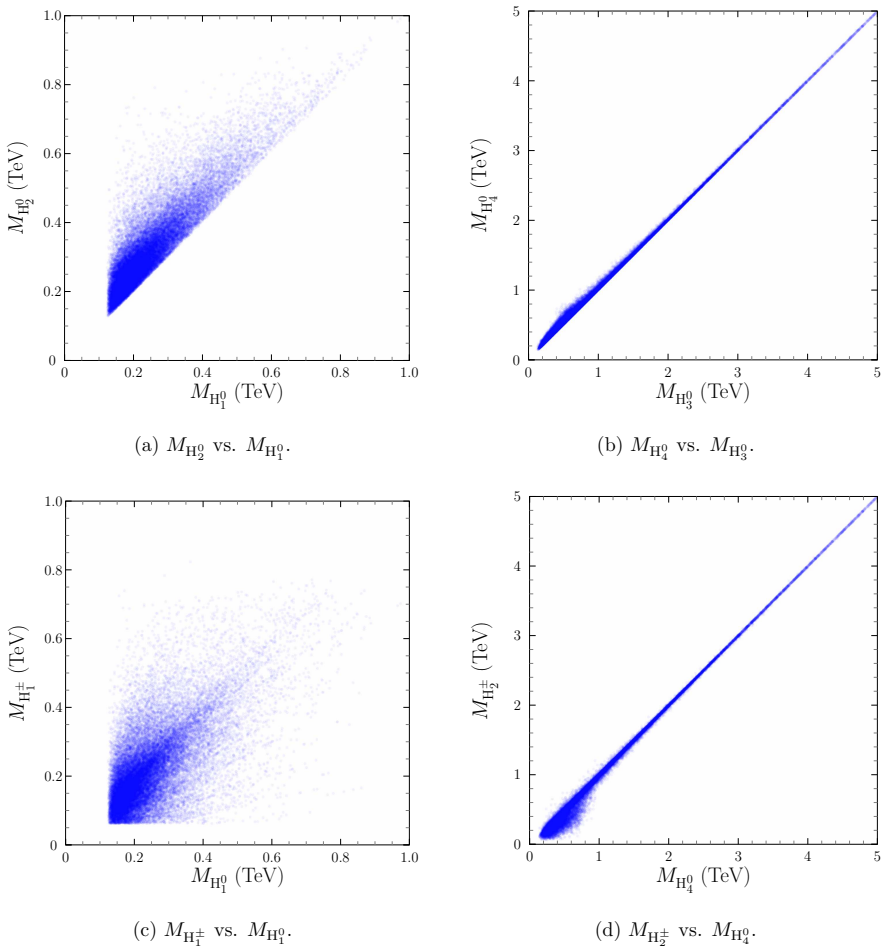


read the original abstract
Scalar sectors with several Higgs doublets, a CP invariant potential, and a CP violating vacuum, possess a mass spectrum in which, unexpectedly, new scalars cannot have masses much larger than the electroweak scale once perturbativity requirements are imposed on the quartic couplings of the Higgs potential and despite the presence of free quadratic (mass) terms that can be arbitrarily large. The minimal model in which this behavior is manifest involves 3 Higgs doublets. We analyze and illustrate in detail that kind of scenario including an additional simplifying assumption: the quartic part of the potential is shaped by some discrete symmetry. Besides analytic results, a numerical analysis is presented together with some phenomenological consequences derived only from the properties of the scalar sector alone.
Editorial analysis
A structured set of objections, weighed in public.
Referee Report
Summary. The manuscript examines real three-Higgs-doublet models (3HDMs) with a CP-conserving scalar potential but a spontaneously CP-violating vacuum. It argues that perturbativity constraints on the quartic couplings impose an upper bound on the masses of additional scalar states near the electroweak scale, even when the quadratic mass parameters are allowed to take arbitrarily large values. The analysis incorporates an additional discrete symmetry that shapes the quartic sector, presents both analytic derivations and numerical scans, and extracts phenomenological consequences from the scalar sector properties alone.
Significance. If the central mass bound holds under the stated assumptions, the result offers a mechanism for keeping extra scalars light in multi-Higgs models without fine-tuning the quadratic terms, which has direct implications for collider phenomenology and model building. The combination of spontaneous CP violation with softly broken symmetries and the provision of both analytic results and numerical evidence constitute clear strengths. The focus on falsifiable mass bounds derived solely from the scalar potential adds to the paper's value for the field.
major comments (1)
- [Abstract and §1] Abstract and §1: The lightness result is stated for CP-invariant potentials with CP-violating vacua in multi-Higgs models, yet the detailed analytic and numerical work is performed only after imposing an additional discrete symmetry on the quartic couplings. While the abstract notes this as a simplifying assumption, the manuscript should explicitly address whether the same upper bound on scalar masses survives in the general real 3HDM without this symmetry, where the larger number of independent quartic parameters could relax the perturbativity constraints while still satisfying bounded-from-below and unitarity conditions.
minor comments (3)
- [§3.2, Eq. (12)] §3.2, Eq. (12): the definition of the perturbativity criterion on the quartic couplings should include an explicit numerical threshold (e.g., |λ| < 4π or similar) and a brief justification for the choice, as this directly affects the reported mass upper bound.
- [Table 2] Table 2: the caption should specify the range of quadratic mass parameters scanned and whether any points violate tree-level unitarity, to allow readers to assess the robustness of the numerical results.
- [§4] §4: a short discussion of how the softly broken symmetry affects the CP-violating phases in the vacuum would improve clarity, even if the main focus remains on the mass spectrum.
Simulated Author's Rebuttal
We thank the referee for the positive assessment and recommendation for minor revision. We address the major comment below and will incorporate clarifications in the revised manuscript.
read point-by-point responses
-
Referee: [Abstract and §1] Abstract and §1: The lightness result is stated for CP-invariant potentials with CP-violating vacua in multi-Higgs models, yet the detailed analytic and numerical work is performed only after imposing an additional discrete symmetry on the quartic couplings. While the abstract notes this as a simplifying assumption, the manuscript should explicitly address whether the same upper bound on scalar masses survives in the general real 3HDM without this symmetry, where the larger number of independent quartic parameters could relax the perturbativity constraints while still satisfying bounded-from-below and unitarity conditions.
Authors: We agree that the role of the discrete symmetry should be addressed more explicitly. This symmetry is imposed on the quartic sector to reduce the number of independent parameters, enabling analytic derivations of the mass bounds and efficient numerical scans while preserving the spontaneous CP violation and the soft breaking of the symmetry by quadratic terms. In the general real 3HDM without the symmetry, additional quartic parameters exist. However, the unitarity constraints on 2-to-2 scalar scattering and the bounded-from-below conditions become correspondingly more restrictive, which does not relax but rather reinforces the upper bound on the masses of the additional scalars to maintain perturbativity up to high scales. We will add a clarifying paragraph at the end of §1 and a brief remark in the conclusions explaining that the lightness result is illustrated in the symmetric case but is expected to hold qualitatively in the general case, with a full exploration of the parameter space without the symmetry left for future work. This is a minor addition that clarifies the scope. revision: yes
Circularity Check
No circularity: mass bound follows from perturbativity on quartics independent of quadratic terms and explicit symmetry assumption
full rationale
The paper states that the lightness of new scalars follows from imposing perturbativity on the quartic couplings of a CP-invariant potential with a CP-violating vacuum, even when quadratic mass terms are free and arbitrarily large. The discrete symmetry is explicitly introduced as an 'additional simplifying assumption' for the numerical analysis rather than a hidden premise that forces the bound. No equations reduce a prediction to a fitted input by construction, no self-citation chain is load-bearing for the central claim, and the derivation remains self-contained once the stated assumptions (CP invariance, vacuum structure, and optional symmetry) are granted. This is the normal non-circular outcome for a paper whose result is an upper bound derived from unitarity/perturbativity constraints.
Axiom & Free-Parameter Ledger
free parameters (1)
- quadratic mass parameters
axioms (2)
- domain assumption Potential is CP invariant while vacuum spontaneously breaks CP
- ad hoc to paper Quartic part of the potential is shaped by a discrete symmetry
Lean theorems connected to this paper
-
IndisputableMonolith/Foundation/AlexanderDuality.leanalexander_duality_circle_linking unclear?
unclearRelation between the paper passage and the cited Recognition theorem.
real nHDMs with SCPV … new scalars cannot have masses much larger than the electroweak scale once perturbativity requirements are imposed on the quartic couplings … minimal model … 3 Higgs doublets … quartic part … shaped by some discrete symmetry
-
IndisputableMonolith/Foundation/AlexanderDuality.leanD3_admits_circle_linking unclear?
unclearRelation between the paper passage and the cited Recognition theorem.
stationarity conditions leave one unconstrained quadratic parameter … μ2 ≫ v2 induces (some) large masses … yet ½(λ4−λ3)v2 cannot be much larger … independent of μ2
What do these tags mean?
- matches
- The paper's claim is directly supported by a theorem in the formal canon.
- supports
- The theorem supports part of the paper's argument, but the paper may add assumptions or extra steps.
- extends
- The paper goes beyond the formal theorem; the theorem is a base layer rather than the whole result.
- uses
- The paper appears to rely on the theorem as machinery.
- contradicts
- The paper's claim conflicts with a theorem or certificate in the canon.
- unclear
- Pith found a possible connection, but the passage is too broad, indirect, or ambiguous to say the theorem truly supports the claim.
Reference graph
Works this paper leans on
-
[1]
Scalar potential The invariant quartic scalar potential is 1 V4|A4(Φ1,Φ 2,Φ 3) = λ1 2 3X a=1 Φ† aΦa !2 +λ 2 3X a=1 (Φ† aΦa)2 −λ 2 2X a=1 3X b=a+1 (Φ† aΦa)(Φ† bΦb) +λ 3 2X a=1 3X b=a+1 (Φ† aΦb)(Φ† bΦa) + λ4 2 2X a=1 3X b=a+1 (Φ† aΦb)2 + (Φ† bΦa)2 , (18) withλ j ∈R. With the vevs in Eq. (6) andv 2 ≡v 2 1 +v 2 2 +v 2 3, the stationarity conditions read ∂vaV ...
-
[2]
+λ 4(c2[12]v2 2 +c 2[13]v2 3) , ∂v2V =µ 2 2v2 + µ2 12 2 c[12]v1 + µ2 23 2 c[23]v3 (22) + v2 2 λ1v2 +λ 2(2v2 2 −v 2 1 −v 2
-
[3]
+λ 4(c2[12]v2 1 +c 2[23]v2 3) , ∂v3V =µ 2 3v3 + µ2 13 2 c[13]v1 + µ2 23 2 c[23]v2 (23) + v3 2 λ1v2 +λ 2(2v2 3 −v 2 1 −v 2
-
[4]
(3), it is more convenient to use in Eq
+λ 4(c2[13]v2 1 +c 2[23]v2 2) , 1 Rather than the notation in Eq. (3), it is more convenient to use in Eq. (18) quartic parameters associated to the different independentA 4 quartic invariants. 8 and ∂θ1V =− v1 2 µ2 12s[12]v2 +µ 2 13s[13]v3 − v2 1 2 λ4(s2[12]v2 2 +s 2[13]v2 3),(24) ∂θ2V = v2 2 µ2 12s[12]v1 −µ 2 23s[23]v3 + v2 2 2 λ4(s2[12]v2 1 −s 2[23]v2 ...
-
[5]
(21)-(23), one can also expressµ 2 1,µ 2 2 andµ 2 3 in terms of quartic parameters andµ 2 23
Then, with Eqs. (21)-(23), one can also expressµ 2 1,µ 2 2 andµ 2 3 in terms of quartic parameters andµ 2 23. That is,µ 2 23 is the only quadratic parameter left, in terms of which one can eventually analyze how a regime with large masses for the new scalars might be achieved. For later convenience, notice that the choice ofµ 2 23 explicitly breaks a symm...
-
[6]
Charged scalar sector The elements of the 3×3 hermitian charged mass matrix read (M 2 ±)aa =µ 2 a + 1 2(λ1 −λ 2)v2 + 3 2 λ2v2 a , (M 2 ±)ab = (M 2 ±)∗ ba = eiΘab 2 µ2 ab +v avb(e−iΘabλ3 +e iΘabλ4) , a < b , (M 2 ±)ab = (M 2 ±)∗ ba = eiΘba 2 µ2 ba +v avb(e−iΘbaλ3 +e iΘbaλ4) , a > b . (28) For compactness, the stationarity relations have not been used in Eq...
-
[7]
Neutral scalar sector The 6×6 real symmetric mass matrix in the neutral scalar sector is M 2 0 = M 2 RR M 2 RI M 2 IR M 2 II , M 2 RR =M 2T RR , M 2 II =M 2T II , M 2T RI =M 2 IR ,(33) where the 3×3 submatricesM 2 RR,M 2 II andM 2 RI have elements (M 2 RR)aa =µ 2 a + 1 2(λ1 −λ 2 +λ 3)v2 + 1 2(2λ1 + 7λ2 −λ 3)v2 a + λ4 2 X b̸=a c2[ab]v2 b , (M 2 RR)a...
-
[8]
As expected, there are 3 eigenvalues in Eqs. (43) and (44) that remain bounded even ifµ 2 ≫v 2 (they are indeed independent ofµ 2), while 2 eigenvalues, in Eq. (45), can be made arbitrarily large in that (partial) decoupling regime. One can now introduce [M 2 0 ]δ3 as a perturbation; it is to be noticed that the situation is simpler than in the discussion...
-
[9]
Addressing observational tensions in cosmology with systematics and fundamental physics (CosmoVerse)
The∆(3n 2)and∆(6n 2), withn >3, limit The potential corresponding to invariance under ∆(3n 2), ∆(6n2), withn >3, is simply obtained settingλ 4 →0 in Eq. (18). This change propagates straightforwardly to the charged scalar mass spectrum in Eq. (32). Concerning the neutral sector, the mass spectrum is again beyond analytic reach; the intermediate regime lea...
-
[10]
OneA 4 triplet In theA 4-invariant case, we have S[0,0] = DIAG S(1) [0,0], S(2) [0,0], S(2) [0,0], S(2) [0,0] , S(1) [0,0] = 3λ1 + 6λ2 2λ1 −2λ 2 +λ 3 2λ1 −2λ 2 +λ 3 2λ1 −2λ 2 +λ 3 3λ1 + 6λ2 2λ1 −2λ 2 +λ 3 2λ1 −2λ 2 +λ 3 2λ1 −2λ 2 +λ 3 3λ1 + 6λ2 , S(2) [0,0] = λ1 −λ 2 + 2λ3 3λ4 3λ∗ 4 λ1 −λ 2 + 2λ3 . (B1) 25 The eigenvalues ofS (1) [0,0...
-
[11]
One∆(27)triplet In the ∆(27)-invariant case, we show the scattering matrices withλ ∆ ∈C; requiring CP invariance we just need to set Im (λ ∆) = 0. We have S[0,0] = DIAG S(1) [0,0], S(2) [0,0], S(2) [0,0] , S(1) [0,0] = 3λ1 + 6λ2 + 6λ3 4λ2 + 2λ3 4λ2 + 2λ3 4λ2 + 2λ3 3λ1 + 6λ2 + 6λ3 4λ2 + 2λ3 4λ2 + 2λ3 4λ2 + 2λ3 3λ1 + 6λ2 + 6λ3 , S(2) [0,0] = ...
-
[12]
G. Aadet al.(ATLAS), Phys. Lett. B716, 1 (2012), arXiv:1207.7214 [hep-ex]
work page internal anchor Pith review Pith/arXiv arXiv 2012
-
[13]
Observation of a new boson at a mass of 125 GeV with the CMS experiment at the LHC
S. Chatrchyanet al.(CMS), Phys. Lett. B716, 30 (2012), arXiv:1207.7235 [hep-ex]
work page internal anchor Pith review Pith/arXiv arXiv 2012
-
[14]
B. W. Lee, C. Quigg, and H. B. Thacker, Phys. Rev. D16, 1519 (1977)
work page 1977
-
[15]
B. W. Lee, C. Quigg, and H. B. Thacker, Phys. Rev. Lett.38, 883 (1977)
work page 1977
-
[16]
D. A. Dicus and V. S. Mathur, Phys. Rev. D7, 3111 (1973)
work page 1973
- [17]
-
[18]
H. D. Politzer and S. Wolfram, Phys. Lett. B82, 242 (1979), [Erratum: Phys.Lett.B 83, 421 (1979)]
work page 1979
-
[19]
N. Cabibbo, L. Maiani, G. Parisi, and R. Petronzio, Nucl. Phys. B158, 295 (1979)
work page 1979
-
[20]
R. F. Dashen and H. Neuberger, Phys. Rev. Lett.50, 1897 (1983)
work page 1983
-
[21]
D. J. E. Callaway, Nucl. Phys. B233, 189 (1984)
work page 1984
-
[22]
H. A. Weldon, Phys. Lett. B146, 59 (1984)
work page 1984
- [23]
-
[24]
New limits on the mass of neutral Higgses in General Models
D. Comelli and J. R. Espinosa, Phys. Lett. B388, 793 (1996), arXiv:hep-ph/9607400
work page internal anchor Pith review Pith/arXiv arXiv 1996
-
[25]
J. R. Espinosa, Surveys High Energ. Phys.10, 279 (1997), arXiv:hep-ph/9606316
work page internal anchor Pith review Pith/arXiv arXiv 1997
-
[26]
I. P. Ivanov, Prog. Part. Nucl. Phys.95, 160 (2017), arXiv:1702.03776 [hep-ph]
work page internal anchor Pith review Pith/arXiv arXiv 2017
-
[27]
T. D. Lee, Phys. Rev. D8, 1226 (1973)
work page 1973
-
[28]
T. D. Lee, Phys. Rept.9, 143 (1974)
work page 1974
- [29]
-
[30]
R. Casalbuoni, D. Dominici, F. Feruglio, and R. Gatto, Nucl. Phys. B299, 117 (1988)
work page 1988
- [31]
-
[32]
S. Kanemura, T. Kubota, and E. Takasugi, Phys. Lett. B313, 155 (1993), arXiv:hep- ph/9303263
-
[33]
I. F. Ginzburg and I. P. Ivanov, Phys. Rev. D72, 115010 (2005), arXiv:hep-ph/0508020
work page internal anchor Pith review Pith/arXiv arXiv 2005
-
[34]
Tree-unitarity bounds for THDM Higgs masses revisited
J. Horejsi and M. Kladiva, Eur. Phys. J. C46, 81 (2006), arXiv:hep-ph/0510154
work page internal anchor Pith review Pith/arXiv arXiv 2006
-
[35]
Unitarity bound in the most general two Higgs doublet model
S. Kanemura and K. Yagyu, Phys. Lett. B751, 289 (2015), arXiv:1509.06060 [hep-ph]
work page internal anchor Pith review Pith/arXiv arXiv 2015
-
[36]
H. E. Haber and Y. Nir, Nucl. Phys. B335, 363 (1990)
work page 1990
-
[37]
G. Bhattacharyya and D. Das, Phys. Rev. D91, 015005 (2015), arXiv:1408.6133 [hep-ph]. 29
work page internal anchor Pith review Pith/arXiv arXiv 2015
- [38]
-
[39]
S. Carrolo, J. C. Romao, J. P. Silva, and F. Vazao, Phys. Rev. D103, 075026 (2021), arXiv:2102.11303 [hep-ph]
-
[40]
I. de Medeiros Varzielas, I. P. Ivanov, and M. Levy, Eur. Phys. J. C81, 918 (2021), arXiv:2107.08227 [hep-ph]
- [41]
- [42]
-
[43]
M. Nebot, Phys. Rev. D102, 115002 (2020), arXiv:1911.02266 [hep-ph]
-
[44]
U. Nierste, M. Tabet, and R. Ziegler, Phys. Rev. Lett.125, 031801 (2020), arXiv:1912.11501 [hep-ph]
-
[45]
Softly Broken A_4 Symmetry for Nearly Degenerate Neutrino Masses
E. Ma and G. Rajasekaran, Phys. Rev. D64, 113012 (2001), arXiv:hep-ph/0106291
work page internal anchor Pith review Pith/arXiv arXiv 2001
-
[46]
I. P. Ivanov and E. Vdovin, Eur. Phys. J. C73, 2309 (2013), arXiv:1210.6553 [hep-ph]
work page internal anchor Pith review Pith/arXiv arXiv 2013
-
[47]
I. de Medeiros Varzielas, S. F. King, C. Luhn, and T. Neder, JHEP11, 136, arXiv:1706.07606 [hep-ph]
work page internal anchor Pith review Pith/arXiv arXiv
-
[48]
T. Kobayashi, H. Ohki, H. Okada, Y. Shimizu, and M. Tanimoto,An Introduction to Non- Abelian Discrete Symmetries for Particle Physicists(2022)
work page 2022
-
[49]
A. M. Sirunyanet al.(CMS), Eur. Phys. J. C79, 421 (2019), arXiv:1809.10733 [hep-ex]
work page internal anchor Pith review Pith/arXiv arXiv 2019
-
[50]
G. Aadet al.(ATLAS), Phys. Rev. D101, 012002 (2020), arXiv:1909.02845 [hep-ex]
-
[51]
Navaset al.(Particle Data Group), Phys
S. Navaset al.(Particle Data Group), Phys. Rev. D110, 030001 (2024)
work page 2024
- [52]
-
[53]
M. E. Peskin and T. Takeuchi, Phys. Rev. D46, 381 (1992)
work page 1992
-
[54]
The oblique parameters in multi-Higgs-doublet models
W. Grimus, L. Lavoura, O. M. Ogreid, and P. Osland, Nucl. Phys. B801, 81 (2008), arXiv:0802.4353 [hep-ph]. 30
work page internal anchor Pith review Pith/arXiv arXiv 2008
discussion (0)
Sign in with ORCID, Apple, or X to comment. Anyone can read and Pith papers without signing in.