REVIEW 3 major objections 5 minor 58 references
Random Registers for Cross-Domain Few-Shot Learning
T0 review · 3 major / 5 minor · reviewed 2026-08-07 · deepseek-v4-flash
Pith's one-line read Random registers — Gaussian-noise tokens appended to a vision transformer — improve cross-domain few-shot transfer while learned prompts hurt it, because the noise perturbs attention maps like sharpness-aware minimization.
desk verdict A genuinely interesting empirical finding with a simple effective method, but the SAM-equivalence claim is an analogy that should be reframed, and the SOTA margins are thin. read the letter →
The pith
A machine-rendered reading of the paper's core claim, the machinery that carries it, and where it could break.
The reading
What carries the argument
The load-bearing object is the random register: a token of Gaussian noise, $T_R \sim \mathcal{N}(0, \tau^2)$ with a learnable scale $\tau$, appended to the ViT input token sequence. Inside the attention softmax its key vectors generate the random denominator term of Eq. 6, which the paper treats as the perturbation $\epsilon_R$ of a sharpness-aware minimization objective, the mechanism that supposedly flattens the loss landscape and pushes the model toward domain-agnostic features. The second component is cluster replacement: image patches are grouped by cosine similarity into clusters and a large portion of the clustered patches is replaced with random registers, so the perturbation strikes the semantic regions that dominate attention instead of being diluted across the whole image (Eq. 8). The third component is a two-stage use of the same tokens, random during source training and switched to learnable during target finetuning, so that the registers absorb target-domain information in the few-shot episode.
What would settle it
Train the same ViT under the same protocol four ways — learned registers, random registers, a fixed constant token of the same dimension, and true SAM applied to attention or weights — then compare target-domain accuracy and a direct curvature measurement such as the sharpness metric of Eq. 4. If the fixed constant token matches the random register's gains, randomness itself is not the mechanism; if true SAM does not reproduce the same flattening and transfer gains under a matched perturbation budget, the sharpness-aware-minimization interpretation is unsupported.
Extended reading notes
Core claim
The central claim is that random registers are not merely a harmless substitute for learned prompts but a transfer mechanism in their own right. Writing the attention softmax explicitly as in Eq. 6 of the paper, each query token multiplies random key vectors $\tilde{K}$ produced by the registers, so the denominator term $\sum_{k=1}^{\tilde{n}} e^{Q_i \tilde{K}_k^\top}$ is a random noise $\epsilon_R$ added to the attention map; the paper rewrites sharpness-aware minimization as $\min_\omega \max_\epsilon L(A + \epsilon_R)$ and identifies random registers with this SAM-style perturbation. The supporting evidence is threefold: measured sharpness of the attention loss landscape rises with learnable registers and falls with random registers; CKA similarity between source and target features falls with learnable registers and rises with random registers; and attention maps on target domains drift off the object with learnable registers but stay on it with random registers. The paper further claims that because ViT attention is driven by continuous semantic regions, replacing clustered image patches with random registers amplifies the perturbation so that 16 registers suffice where hundreds were needed, and that switching the registers to the learnable state during target finetuning exploits their tendency to absorb domain-specific information. The claimed outcome is the top average accuracy on four target benchmarks (ChestX, ISIC2018, EuroSAT, CropDiseases) under 1-shot and 5-shot settings, with and without finetuning.
Load-bearing premise
The identification of random registers with sharpness-aware minimization is an analogy: SAM maximizes the loss over a worst-case norm-constrained perturbation, while a random register is a single fixed draw of noise, so the paper's Eq. 7 drops the maximization step and the flat-minimum explanation rests on the assumption that the random draw behaves like the maximized perturbation.
Editorial extensions
If this is right
- Learned prompts should be dropped from the source-stage recipe for ViT-based cross-domain few-shot learning; random registers are a drop-in replacement that improves transfer without the extra optimization of true SAM.
- The dual-role recipe — random registers at source training, learnable registers at target finetuning — becomes a usable default for few-shot adaptation of ViT backbones.
- Cluster-based replacement of image patches makes the attention perturbation strong enough that only 16 appended registers are needed, against roughly a thousand for naive random registers.
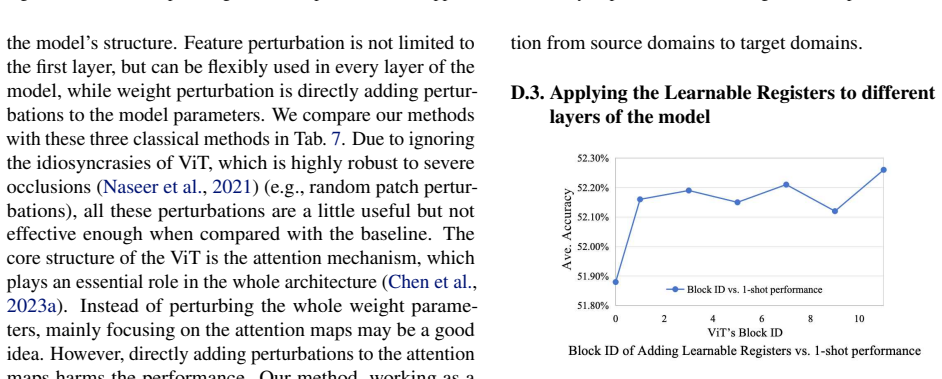
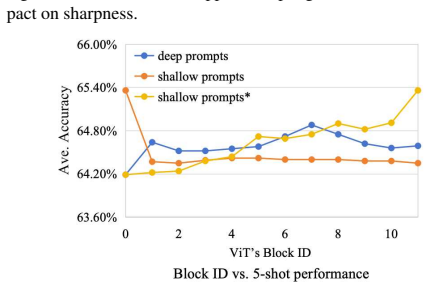
- The gains replicate across backbone initializations (DINO ViT-S, DINO ViT-B, iBOT, CLIP) and across shallow and deep register placements, so the effect is not tied to one architecture configuration.
- With finetuning, REAP achieves the top average accuracy on all four target datasets in both 1-shot and 5-shot evaluations.
Reading between the lines
- My inference: the same mechanism should transfer to domain generalization and unsupervised domain adaptation, where the failure mode — attention locked onto source-specific patterns — is identical; a cheap check is to run random-register perturbation on standard domain-generalization benchmarks.
- My inference: because the SAM identification drops the worst-case maximization, part of the gain may be plain stochastic regularization; ablating the noise distribution (Gaussian versus Bernoulli drop versus sign-flip) would reveal which property of randomness carries the effect.
- My inference: the cluster-replacement step is close in spirit to masked image modeling, so the method could double as a pretraining trick; a testable extension is whether the clustering constraint (semantic continuity) matters more than the masking ratio.
- My inference: if the flat-minimum mechanism is real, random registers should also improve robustness to corruption-style shifts such as ImageNet-C, which would be a fast and independent way to test the sharpness claim.
Editorial analysis
A structured set of objections, weighed in public.
Referee Report
Summary. The paper studies cross-domain few-shot learning (CDFSL) with ViT backbones and reports an empirical phenomenon: during source-domain training, learnable prompt tokens (registers) hurt target-domain transfer, while replacing them with random Gaussian registers consistently improves target accuracy, especially as the number of random registers grows. The authors interpret this via attention sharpness and CKA domain similarity, proposing that learnable registers absorb source-specific domain information and that random registers act as a form of sharpness-aware minimization (SAM) by perturbing attention maps. Based on this interpretation, they propose REAP, which, during source training, randomly clusters image patches and replaces selected clusters with random registers plus a small number of additional random registers, and, during target finetuning, switches to learnable registers. Experiments on four CDFSL benchmarks report state-of-the-art results under several settings, with ablations over the main components and additional results on multiple backbones.
Significance. If the empirical claims hold, the paper makes a useful and practical contribution: a cheap, architecture-agnostic way to improve ViT transfer under large domain gaps, with code and models released. The paper is also careful in several ways: it reports ablations of the main components, compares against many prior methods, groups comparisons by finetuning/transductive settings, and evaluates on multiple backbones. The sharpness and CKA analyses are valuable diagnostic evidence. However, the central mechanistic claim that random registers implement sharpness-aware minimization is not established by the formal argument in Section 2.3; as written, the SAM connection is an analogy rather than a derivation. Because this interpretation is listed as a contribution and motivates REAP, the paper needs either direct evidence for the SAM mechanism or a substantially softened framing. The empirical gains themselves are plausible and well supported, but the current contribution statement overstates the theoretical support.
major comments (3)
- The formal identification of random registers with SAM is not valid as stated. In Eq. (5), SAM maximizes L(ω+ε) over an adversarially chosen perturbation with ‖ε‖₂≤ρ, whereas in Eq. (7) the perturbation ε_R is a fixed random draw from the random registers. If ε_R is fixed, the max_ε operator is vacuous; if ε_R is intended to vary with ε, the notation is undefined. The text hedges with 'can be regarded as' and 'viewed as', but contribution (2) and Section 2.5 assert that random registers 'novelty perturb attention maps for sharpness-aware minimization,' so the central mechanistic claim rests on this identification. In addition, Eq. (6) shows only the softmax denominator; appended registers also contribute through their value vectors to the attention output, so the perturbation is not confined to attention maps. Please either reframe the SAM connection as a hypothesis and explicitly remove it from the claimed contributions, or provide direct evidence: for example, measure the alignment between register-induced noise and the SAM ascent direction, compare training trajectories against actual SAM, or show that random-register training reduces the sharpness measure in Eq. (4) more than an equivalent amount of input or feature noise. Without such evidence, the flat-minimum explanation remains correlational.
- The sharpness evidence is post hoc and does not by itself establish that random registers perform sharpness-aware minimization. Eq. (4) measures the sensitivity of a trained model to attention perturbations, and Fig. 3b shows that the random-register model has lower sharpness than the learnable-register model. This is consistent with the flat-minimum interpretation, but it could also arise from stochastic input/feature regularization, which is a distinct mechanism. The causal claim that training with random registers is 'a kind of SAM' requires a training-time comparison: for example, compare the loss-landscape sharpness reached by random-register training with that reached by actual SAM, and show that random-register noise is not merely equivalent to adding Gaussian noise to image features or weights. Without this, Sections 2.5 and 3.1 should be rephrased from 'is' to 'is hypothesized to be'.
- The starred REAP rows are placed in the transductive group, but the method description in Section 3 contains no transductive component: target finetuning is performed on the support set only, and no use of unlabeled query data is described. The meaning of REAP* must be stated explicitly. If it uses the query set or any additional unlabeled data, this changes the experimental setup and should be detailed; if it does not, the asterisk notation is misleading and should be removed or redefined. This matters because the SOTA claim in Table 1 relies on correctly grouping methods with and without transductive access.
minor comments (5)
- Please specify how the max is computed over Gaussian perturbations: the number of sampled perturbations, the variance schedule, and whether the max is taken over a finite sample or over the distribution. Without this, the sharpness values in Fig. 3b are not reproducible.
- The displayed equation has unbalanced parentheses, making the argument of Lcls ambiguous. Please rewrite the equation with all parentheses matched and the variables clearly separated.
- The notation in Eq. (8) introduces m, n−m, and ñ without first defining m in the surrounding text; the relationship between the anchor ratio a, the cluster size, and m should be stated before the equation. Also, when clusters are replaced by random tokens, the 'image perturbation' terms use the same notation as the original keys, which is confusing.
- The column heading 'Mark' is unexplained; it appears to denote venue and year, but the caption should state this explicitly.
- There are several typos and grammar issues, including 'as is explained as sharpness-aware minimization' (§2.4), 'By multiplied with randomized keys' (§3.1), and 'can be regarded asa novel way' (§2.3). A careful proofread is needed.
Circularity Check
No circularity found: the random-register transfer gains are empirically tested against external benchmarks, and the SAM interpretation, while under-derived, is not an input-to-output reduction.
full rationale
The central empirical claims—learnable registers hurt CDFSL transfer while random registers help, and REAP improves over baselines—are tested on four external target benchmarks (Tab. 1, Tabs. 5–6) with ablations (Tabs. 2–3), so no fitted parameter is relabeled as a prediction. The proposed SAM interpretation (Sec. 2.3, Eqs. 5–7) is an analogy rather than a derivation: epsilon_R in Eq. 6 is a fixed random draw from random-register keys, whereas SAM's epsilon in Eq. 5 is the norm-constrained maximizer of the loss; Eq. 7 therefore does not itself establish that random registers implement sharpness-aware minimization. That is a correctness/support weakness, not circularity, because the sharpness measurements (Fig. 3b, Sec. 2.2) and the benchmark comparisons stand independently of the Eq. 7 identification. Self-citations (Zou et al. 2024a; Zou et al. a,b) serve as baselines and as a source of the sharpness/CKA measurement tools, and none of them presupposes the random-register result. No circular step is exhibited.
Assumptions & free parameters
free parameters (4)
- anchor_ratio =
70% of patches
- replaced_ratio =
up to 70%
- extra_register_count =
16
- noise_std_tau =
initial 0.1, learnable
assumptions (5)
- domain assumption CKA similarity between source and target features measures the amount of domain-specific information in the backbone.
- domain assumption Loss-landscape sharpness under attention-map perturbation predicts cross-domain transferability.
- ad hoc to paper Random key noise from registers can be identified with the norm-constrained adversarial perturbation in SAM.
- domain assumption ViT is robust to severe occlusions and random patch perturbations.
- domain assumption The auto-computed cluster similarity threshold yields semantically coherent, contiguous regions worth perturbing.
Cite this review
Pith. "Pith review of Random Registers for Cross-Domain Few-Shot Learning." pith.science (2026). https://pith.science/paper/UXUJNLDH
@misc{pith2026250602843,
  author       = {Pith},
  title        = {Pith review of: Random Registers for Cross-Domain Few-Shot Learning},
  year         = {2026},
  howpublished = {\url{https://pith.science/paper/UXUJNLDH}},
  note         = {Machine review of arXiv:2506.02843}
}
read the original abstract
Cross-domain few-shot learning (CDFSL) aims to transfer knowledge from a data-sufficient source domain to data-scarce target domains. Although Vision Transformer (ViT) has shown superior capability in many vision tasks, its transferability against huge domain gaps in CDFSL is still under-explored. In this paper, we find an intriguing phenomenon: during the source-domain training, prompt tuning, as a common way to train ViT, could be harmful for the generalization of ViT in target domains, but setting them to random noises (i.e., random registers) could consistently improve target-domain performance. We then delve into this phenomenon for an interpretation. We find that learnable prompts capture domain information during the training on the source dataset, which views irrelevant visual patterns as vital cues for recognition. This can be viewed as a kind of overfitting and increases the sharpness of the loss landscapes. In contrast, random registers are essentially a novel way of perturbing attention for the sharpness-aware minimization, which helps the model find a flattened minimum in loss landscapes, increasing the transferability. Based on this phenomenon and interpretation, we further propose a simple but effective approach for CDFSL to enhance the perturbation on attention maps by adding random registers on the semantic regions of image tokens, improving the effectiveness and efficiency of random registers. Extensive experiments on four benchmarks validate our rationale and state-of-the-art performance. Codes and models are available at https://github.com/shuaiyi308/REAP.
Figures


Figures from the paper (10 more)



Reference graph
Works this paper leans on
-
[1]
write newline
" write newline "" before.all 'output.state := FUNCTION n.dashify 't := "" t empty not t #1 #1 substring "-" = t #1 #2 substring "--" = not "--" * t #2 global.max substring 't := t #1 #1 substring "-" = "-" * t #2 global.max substring 't := while if t #1 #1 substring * t #2 global.max substring 't := if while FUNCTION format.date year duplicate empty "emp...
-
[2]
Accumulated trivial attention matters in vision transformers on small datasets
Chen, X., Hu, Q., Li, K., Zhong, C., and Wang, G. Accumulated trivial attention matters in vision transformers on small datasets. In Proceedings of the IEEE/CVF Winter Conference on Applications of Computer Vision (WACV), pp.\ 3984--3992, January 2023 a
work page 2023
-
[3]
On separate normalization in self-supervised transformers, 2023 b
Chen, X., Wang, Y., Du, Y., Hassoun, S., and Liu, L.-P. On separate normalization in self-supervised transformers, 2023 b
work page 2023
-
[4]
Meta-baseline: Exploring simple meta-learning for few-shot learning, 2021
Chen, Y., Liu, Z., Xu, H., Darrell, T., and Wang, X. Meta-baseline: Exploring simple meta-learning for few-shot learning, 2021
work page 2021
-
[5]
E., Dusza, S., Gutman, D., Helba, B., Kalloo, A., Liopyris, K., Marchetti, M., Kittler, H., and Halpern, A
Codella, N., Rotemberg, V., Tschandl, P., Celebi, M. E., Dusza, S., Gutman, D., Helba, B., Kalloo, A., Liopyris, K., Marchetti, M., Kittler, H., and Halpern, A. Skin lesion analysis toward melanoma detection 2018: A challenge hosted by the international skin imaging collaboration (isic), 2019
2018
-
[6]
Vision transformers need registers
Darcet, T., Oquab, M., Mairal, J., and Bojanowski, P. Vision transformers need registers. In The Twelfth International Conference on Learning Representations, 2024. URL https://openreview.net/forum?id=2dnO3LLiJ1
2024
-
[7]
Confess: A framework for single source cross-domain few-shot learning
Das, D., Yun, S., and Porikli, F. Confess: A framework for single source cross-domain few-shot learning. In International Conference on Learning Representations, 2022
2022
-
[8]
Reliability of cka as a similarity measure in deep learning, 2022
Davari, M., Horoi, S., Natik, A., Lajoie, G., Wolf, G., and Belilovsky, E. Reliability of cka as a similarity measure in deep learning, 2022
2022
Show all 58 references
-
[9]
Imagenet: A large-scale hierarchical image database
Deng, J., Dong, W., Socher, R., Li, L.-J., Li, K., and Fei-Fei, L. Imagenet: A large-scale hierarchical image database. In Proceedings of the IEEE/CVF Conference on Computer Vision and Pattern Recognition, pp.\ 248--255. Ieee, 2009
2009
-
[10]
Sharpness-aware minimization for efficiently improving generalization, 2021
Foret, P., Kleiner, A., Mobahi, H., and Neyshabur, B. Sharpness-aware minimization for efficiently improving generalization, 2021
2021
-
[11]
Meta-fdmixup: Cross-domain few-shot learning guided by labeled target data
Fu, Y., Fu, Y., and Jiang, Y.-G. Meta-fdmixup: Cross-domain few-shot learning guided by labeled target data. In Proceedings of the 29th ACM international conference on multimedia, pp.\ 5326--5334, 2021
2021
-
[12]
Wave-san: Wavelet based style augmentation network for cross-domain few-shot learning, 2022
Fu, Y., Xie, Y., Fu, Y., Chen, J., and Jiang, Y.-G. Wave-san: Wavelet based style augmentation network for cross-domain few-shot learning, 2022
2022
-
[13]
Styleadv: Meta style adversarial training for cross-domain few-shot learning, 2023
Fu, Y., Xie, Y., Fu, Y., and Jiang, Y.-G. Styleadv: Meta style adversarial training for cross-domain few-shot learning, 2023
2023
-
[14]
C., Karlinsky, L., Codella, J
Guo, Y., Codella, N. C., Karlinsky, L., Codella, J. V., Smith, J. R., Saenko, K., Rosing, T., and Feris, R. A broader study of cross-domain few-shot learning. In Proceedings of the IEEE/CVF European Conference on Computer Vision, pp.\ 124--141. Springer, 2020
2020
-
[15]
Eurosat: A novel dataset and deep learning benchmark for land use and land cover classification, 2019
Helber, P., Bischke, B., Dengel, A., and Borth, D. Eurosat: A novel dataset and deep learning benchmark for land use and land cover classification, 2019
2019
-
[16]
and Ma, A
Hu, Y. and Ma, A. J. Adversarial feature augmentation for cross-domain few-shot classification, 2022
2022
-
[17]
Visual prompt tuning
Jia, M., Tang, L., Chen, B.-C., Cardie, C., Belongie, S., Hariharan, B., and Lim, S.-N. Visual prompt tuning. In European Conference on Computer Vision (ECCV), 2022
2022
-
[18]
and Han, B
Kim, D. and Han, B. On the stability-plasticity dilemma of class-incremental learning. In Proceedings of the IEEE/CVF Conference on Computer Vision and Pattern Recognition, pp.\ 20196--20204, 2023
2023
-
[19]
Kingma, D. P. and Ba, J. Adam: A method for stochastic optimization, 2017
2017
-
[20]
Similarity of neural network representations revisited
Kornblith, S., Norouzi, M., Lee, H., and Hinton, G. Similarity of neural network representations revisited. In International Conference on Machine Learning, pp.\ 3519--3529. PMLR, 2019
2019
-
[21]
Krizhevsky, A., Sutskever, I., and Hinton, G. E. Imagenet classification with deep convolutional neural networks. Communications of the ACM, 60 0 (6): 0 84--90, 2017
2017
-
[22]
Adversarial feature hallucination networks for few-shot learning
Li, K., Zhang, Y., Li, K., and Fu, Y. Adversarial feature hallucination networks for few-shot learning. In Proceedings of the IEEE/CVF Conference on Computer Vision and Pattern Recognition, pp.\ 13470--13479, 2020
2020
-
[23]
Ranking distance calibration for cross-domain few-shot learning, 2022
Li, P., Gong, S., Wang, C., and Fu, Y. Ranking distance calibration for cross-domain few-shot learning, 2022
2022
-
[24]
Learning multi-level weight-centric features for few-shot learning
Liang, M., Huang, S., Pan, S., Gong, M., and Liu, W. Learning multi-level weight-centric features for few-shot learning. Pattern Recognition, 128: 0 108662, 2022. ISSN 0031-3203. doi:https://doi.org/10.1016/j.patcog.2022.108662. URL https://www.sciencedirect.com/science/articl...
2022
-
[25]
Pre-train, prompt, and predict: A systematic survey of prompting methods in natural language processing
Liu, P., Yuan, W., Fu, J., Jiang, Z., Hayashi, H., and Neubig, G. Pre-train, prompt, and predict: A systematic survey of prompting methods in natural language processing. ACM Computing Surveys, 55 0 (9): 0 1--35, 2023
2023
-
[26]
Swin transformer: Hierarchical vision transformer using shifted windows
Liu, Z., Lin, Y., Cao, Y., Hu, H., Wei, Y., Zhang, Z., Lin, S., and Guo, B. Swin transformer: Hierarchical vision transformer using shifted windows. In Proceedings of the IEEE/CVF International Conference on Computer Vision (ICCV), 2021
2021
-
[27]
Reconstruction target matters in masked image modeling for cross-domain few-shot learning
Ma, R., Zou, Y., Li, Y., and Li, R. Reconstruction target matters in masked image modeling for cross-domain few-shot learning. arXiv preprint arXiv:2412.19101, 2024
2024 arXiv
-
[28]
Prod: Prompting-to-disentangle domain knowledge for cross-domain few-shot image classification
Ma, T., Sun, Y., Yang, Z., and Yang, Y. Prod: Prompting-to-disentangle domain knowledge for cross-domain few-shot image classification. In Proceedings of the IEEE/CVF Conference on Computer Vision and Pattern Recognition, pp.\ 19754--19763, 2023
2023
-
[29]
Using deep learning for image-based plant disease detection
Mohanty, S., Hughes, D., and Salath \'e , M. Using deep learning for image-based plant disease detection. Frontiers in Plant Science, 7 0 (September), September 2016. ISSN 1664-462X. doi:10.3389/fpls.2016.01419. Publisher Copyright: 2016 Mohanty, Hughes and Salath \'e
2016
-
[30]
M., Ranasinghe, K., Khan, S
Naseer, M. M., Ranasinghe, K., Khan, S. H., Hayat, M., Shahbaz Khan, F., and Yang, M.-H. Intriguing properties of vision transformers. In Ranzato, M., Beygelzimer, A., Dauphin, Y., Liang, P., and Vaughan, J. W. (eds.), Advances in Neural Information Processing Systems, volume ...
2021
-
[31]
A., Osowiechi, D., Ayed, I
Noori, M., Cheraghalikhani, M., Bahri, A., Vargas Hakim , G. A., Osowiechi, D., Ayed, I. B., and Desrosiers, C. Tfs-vit: Token-level feature stylization for domain generalization. Pattern Recognition, 149: 0 110213, 2024. ISSN 0031-3203. doi:https://doi.org/10.1016/j.patcog.20...
2024
-
[32]
Understanding cross-domain few-shot learning based on domain similarity and few-shot difficulty, 2022
Oh, J., Kim, S., Ho, N., Kim, J.-H., Song, H., and Yun, S.-Y. Understanding cross-domain few-shot learning based on domain similarity and few-shot difficulty, 2022
2022
-
[33]
W., Hallacy, C., Ramesh, A., Goh, G., Agarwal, S., Sastry, G., Askell, A., Mishkin, P., Clark, J., et al
Radford, A., Kim, J. W., Hallacy, C., Ramesh, A., Goh, G., Agarwal, S., Sastry, G., Askell, A., Mishkin, P., Clark, J., et al. Learning transferable visual models from natural language supervision. In International conference on machine learning, pp.\ 8748--8763. PMLR, 2021
2021
-
[34]
Shell Xu, Da Li, J. S. Pushing the limits of simple pipelines for few-shot learning: External data and fine-tuning make a difference, 2022
2022
-
[35]
Prototypical networks for few-shot learning
Snell, J., Swersky, K., and Zemel, R. Prototypical networks for few-shot learning. In Proceedings of the International Conference on Neural Information Processing Systems, pp.\ 4080--4090, 2017
2017
-
[36]
Visual prompt tuning for generative transfer learning
Sohn, K., Chang, H., Lezama, J., Polania, L., Zhang, H., Hao, Y., Essa, I., and Jiang, L. Visual prompt tuning for generative transfer learning. In Proceedings of the IEEE/CVF Conference on Computer Vision and Pattern Recognition, pp.\ 19840--19851, 2023
2023
-
[37]
Cross-domain few-shot classification via learned feature-wise transformation
Tseng, H.-Y., Lee, H.-Y., Huang, J.-B., and Yang, M.-H. Cross-domain few-shot classification via learned feature-wise transformation. In Proceedings of the International Conference on Learning Representations, 2020
2020
-
[38]
Matching networks for one shot learning
Vinyals, O., Blundell, C., Lillicrap, T., Kavukcuoglu, K., and Wierstra, D. Matching networks for one shot learning. In Proceedings of the International Conference on Neural Information Processing Systems, pp.\ 3637--3645, 2016
2016
-
[39]
Walsh, R., Osman, I., and Shehata, M. S. Masked embedding modeling with rapid domain adjustment for few-shot image classification. IEEE Transactions on Image Processing, 32: 0 4907--4920, 2023. doi:10.1109/TIP.2023.3306916
2023
-
[40]
and Deng, Z.-H
Wang, H. and Deng, Z.-H. Cross-domain few-shot classification via adversarial task augmentation, 2021
2021
-
[41]
Z., and Yan, S
Wang, J., Zhou, P., Shou, M. Z., and Yan, S. Position-guided text prompt for vision-language pre-training. In Proceedings of the IEEE/CVF Conference on Computer Vision and Pattern Recognition, pp.\ 23242--23251, 2023
2023
-
[42]
Wang, X., Peng, Y., Lu, L., Lu, Z., Bagheri, M., and Summers, R. M. Chestx-ray8: Hospital-scale chest x-ray database and benchmarks on weakly-supervised classification and localization of common thorax diseases. In 2017 IEEE Conference on Computer Vision and Pattern Recognitio...
2017 doi
-
[43]
Efficient vision-language pre-training by cluster masking
Wei, Z., Pan, Z., and Owens, A. Efficient vision-language pre-training by cluster masking. In Proceedings of the IEEE/CVF Conference on Computer Vision and Pattern Recognition, pp.\ 26815--26825, 2024
2024
-
[44]
White, J., Fu, Q., Hays, S., Sandborn, M., Olea, C., Gilbert, H., Elnashar, A., Spencer-Smith, J., and Schmidt, D. C. A prompt pattern catalog to enhance prompt engineering with chatgpt. arXiv preprint arXiv:2302.11382, 2023
2023 arXiv
-
[45]
M., and Liu, L
Xu, H., Zhi, S., Sun, S., Patel, V. M., and Liu, L. Deep learning for cross-domain few-shot visual recognition: A survey. arXiv preprint arXiv:2303.08557, 2023
2023 arXiv
-
[46]
Enhancing information maximization with distance-aware contrastive learning for source-free cross-domain few-shot learning
Xu, H., Liu, L., Zhi, S., Fu, S., Su, Z., Cheng, M.-M., and Liu, Y. Enhancing information maximization with distance-aware contrastive learning for source-free cross-domain few-shot learning. IEEE Transactions on Image Processing, 2024
2024
-
[47]
Visual-language prompt tuning with knowledge-guided context optimization
Yao, H., Zhang, R., and Xu, C. Visual-language prompt tuning with knowledge-guided context optimization. In Proceedings of the IEEE/CVF Conference on Computer Vision and Pattern Recognition, pp.\ 6757--6767, 2023
2023
-
[48]
Delving deep into the generalization of vision transformers under distribution shifts
Zhang, C., Zhang, M., Zhang, S., Jin, D., Zhou, Q., Cai, Z., Zhao, H., Liu, X., and Liu, Z. Delving deep into the generalization of vision transformers under distribution shifts. In 2022 IEEE/CVF Conference on Computer Vision and Pattern Recognition (CVPR), pp.\ 7267--7276, 20...
2022
-
[49]
M., and Shum, H.-Y
Zhang, H., Li, F., Liu, S., Zhang, L., Su, H., Zhu, J., Ni, L. M., and Shum, H.-Y. Dino: Detr with improved denoising anchor boxes for end-to-end object detection, 2022 b
2022
-
[50]
Free-lunch for cross-domain few-shot learning: Style-aware episodic training with robust contrastive learning
Zhang, J., Song, J., Gao, L., and Shen, H. Free-lunch for cross-domain few-shot learning: Style-aware episodic training with robust contrastive learning. In Proceedings of the 30th ACM International Conference on Multimedia, pp.\ 2586--2594, 2022 c
2022
-
[51]
Revisiting prototypical network for cross domain few-shot learning
Zhou, F., Wang, P., Zhang, L., Wei, W., and Zhang, Y. Revisiting prototypical network for cross domain few-shot learning. In Proceedings of the IEEE/CVF Conference on Computer Vision and Pattern Recognition (CVPR), pp.\ 20061--20070, June 2023
2023
-
[52]
ibot: Image bert pre-training with online tokenizer
Zhou, J., Wei, C., Wang, H., Shen, W., Xie, C., Yuille, A., and Kong, T. ibot: Image bert pre-training with online tokenizer. arXiv preprint arXiv:2111.07832, 2021
2021 arXiv
-
[53]
Attention temperature matters in vit-based cross-domain few-shot learning
Zou, Y., Ma, R., Li, Y., and Li, R. Attention temperature matters in vit-based cross-domain few-shot learning. In The Thirty-eighth Annual Conference on Neural Information Processing Systems, a
-
[54]
A closer look at the cls token for cross-domain few-shot learning
Zou, Y., Yi, S., Li, Y., and Li, R. A closer look at the cls token for cross-domain few-shot learning. In The Thirty-eighth Annual Conference on Neural Information Processing Systems, b
-
[55]
Zou, Y., Zhang, S., Yu, J., Tian, Y., and Moura, J. M. Revisiting mid-level patterns for cross-domain few-shot recognition. In Proceedings of the ACM International Conference on Multimedia, pp.\ 741--749, 2021
2021
-
[56]
Margin-based few-shot class-incremental learning with class-level overfitting mitigation
Zou, Y., Zhang, S., Li, Y., and Li, R. Margin-based few-shot class-incremental learning with class-level overfitting mitigation. Advances in neural information processing systems, 35: 0 27267--27279, 2022
2022
-
[57]
Flatten long-range loss landscapes for cross-domain few-shot learning, 2024 a
Zou, Y., Liu, Y., Hu, Y., Li, Y., and Li, R. Flatten long-range loss landscapes for cross-domain few-shot learning, 2024 a
2024
-
[58]
Compositional few-shot class-incremental learning
Zou, Y., Zhang, S., Zhou, H., Li, Y., and Li, R. Compositional few-shot class-incremental learning. arXiv preprint arXiv:2405.17022, 2024 b
2024 arXiv
Reviewed August 7, 2026 · model on record in the stance chip above.
Discussion (0). Sign in to comment.