Dissipative Dynamics and Active Stabilization of Linear and Nonlinear Waves in Non-PT-Symmetric Harmonic Traps
Pith reviewed 2026-05-14 20:22 UTC · model grok-4.3
The pith
Time-dependent modulation of nonlinearity stabilizes metastable states of nonlinear waves into robust non-equilibrium equilibria in non-Hermitian traps.
A machine-rendered reading of the paper's core claim, the machinery that carries it, and where it could break.
Core claim
Through an analytical mapping between real and complex Schrödinger equations combined with numerical simulations, the work shows that linear waves form a stationary state at the trap center, while nonlinear waves form metastable states prone to decay or collapse with static potentials. A time-dependent modulation of the nonlinearity converts these into robust non-equilibrium stationary states, establishing a strategy for active stabilization of nonlinear waves in non-Hermitian systems.
What carries the argument
Time-dependent modulation of the nonlinearity, which converts metastable configurations into non-equilibrium stationary states via the analytical mapping to complex potentials.
Load-bearing premise
The analytical mapping between real and complex Schrödinger equations plus numerical simulations capture the full long-term nonlinear dynamics without hidden instabilities.
What would settle it
A long-time simulation or experiment in which the modulated nonlinearity still leads to eventual decay or collapse of the wave would falsify the stabilization.
Figures


read the original abstract
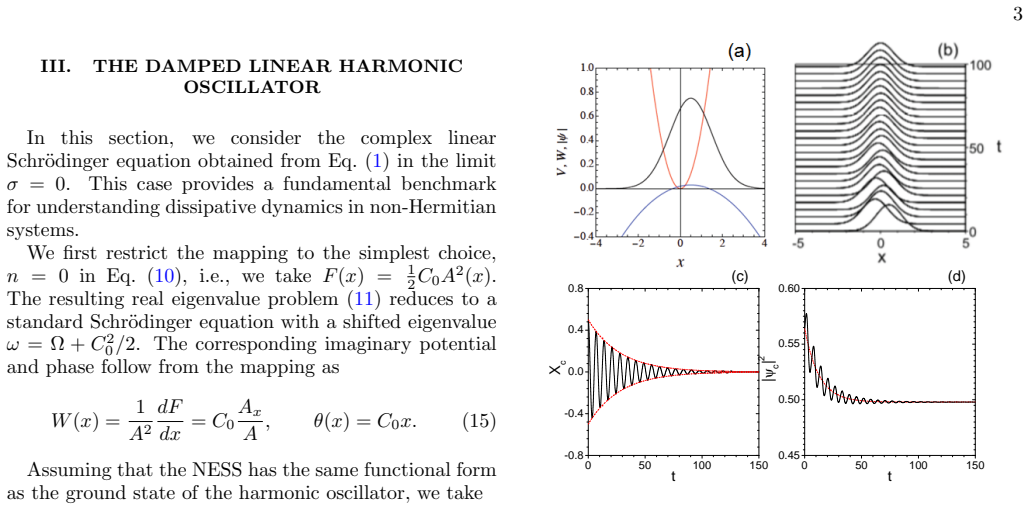
We investigate the dissipative dynamics of linear and nonlinear waves in harmonic traps by means of engineered complex non-Hermitian potentials. By combining an analytical mapping between real and complex Schr\"odinger equations with direct numerical simulations, we show that while in the linear case the damped motion leads to the formation of a stationary state at the trap center, in the nonlinear case a static potential design alone is insufficient to ensure long-term stability. Instead, the system relaxes toward a long-lived metastable configuration that eventually undergoes decay or collapse. To overcome this limitation, we introduce a time-dependent modulation of the nonlinearity that effectively converts these metastable states into robust non-equilibrium stationary states. This approach establishes a general strategy for controlling nonlinear waves in non-Hermitian systems, with potential applications in photonics and Bose--Einstein condensates.
Editorial analysis
A structured set of objections, weighed in public.
Referee Report
Summary. The paper investigates dissipative dynamics of linear and nonlinear waves in non-PT-symmetric harmonic traps using engineered complex non-Hermitian potentials. Combining an analytical mapping between real and complex Schrödinger equations with direct numerical simulations of the Gross-Pitaevskii equation, it shows that linear waves damp to a stationary state at the trap center, whereas nonlinear waves form long-lived metastable states that eventually decay or collapse. A time-dependent modulation of the nonlinearity is introduced to convert these metastable states into robust non-equilibrium stationary states, providing a general strategy for controlling nonlinear waves in non-Hermitian systems with applications in photonics and Bose-Einstein condensates.
Significance. If the central claim holds, the work supplies a concrete, experimentally relevant technique for active stabilization of nonlinear waves against decay and collapse in dissipative non-Hermitian traps. The analytical mapping plus numerical verification offers a clear route from linear damping to modulated nonlinear stationarity, which could be directly tested in optical or atomic systems. Credit is due for grounding the modulation form in the exact linear mapping and for demonstrating stationarity in finite-time simulations.
major comments (2)
- [nonlinear regime and numerical results] The claim that time-dependent nonlinearity modulation produces robust long-term stationary states rests on finite-time numerical integration of the modulated GPE. No Floquet analysis, Lyapunov function, or other analytical stability proof is supplied to exclude slow drift, parametric resonance, or collapse on timescales longer than the simulation window, particularly when modulation frequency or amplitude approaches internal resonances of the trap (see the nonlinear-dynamics section and associated figures).
- [analytical mapping] The analytical mapping between real and complex Schrödinger equations is exact for the linear problem but is used heuristically to motivate the specific form of the nonlinearity modulation in the nonlinear case. The manuscript should explicitly state the range of validity of this extension and verify that the mapping does not introduce uncontrolled approximations when the nonlinear term is active.
minor comments (2)
- Clarify the precise functional form and parameter values of the time-dependent nonlinearity modulation in the main text or a dedicated methods subsection so that the protocol can be reproduced without ambiguity.
- Add error bars or convergence checks on the numerical integration times and grid resolutions in the stability figures to strengthen the evidence that the observed stationarity is not an artifact of finite simulation duration.
Simulated Author's Rebuttal
We thank the referee for the detailed and constructive report. The comments highlight important limitations in the current presentation of the nonlinear stability results and the scope of the analytical mapping. We address each point below and have revised the manuscript to strengthen the discussion of these aspects without overstating the numerical evidence.
read point-by-point responses
-
Referee: [nonlinear regime and numerical results] The claim that time-dependent nonlinearity modulation produces robust long-term stationary states rests on finite-time numerical integration of the modulated GPE. No Floquet analysis, Lyapunov function, or other analytical stability proof is supplied to exclude slow drift, parametric resonance, or collapse on timescales longer than the simulation window, particularly when modulation frequency or amplitude approaches internal resonances of the trap (see the nonlinear-dynamics section and associated figures).
Authors: We agree that finite-time simulations alone cannot rigorously exclude slow instabilities or resonances on arbitrarily long timescales. In the revised manuscript we have extended several simulation runs to significantly longer times (up to 10^4 trap periods) and added an explicit discussion in the nonlinear-dynamics section acknowledging the absence of an analytical stability proof. We note that the modulated Gross-Pitaevskii equation is non-autonomous, rendering standard Floquet or Lyapunov methods non-trivial to apply; a full analytical treatment lies beyond the present scope. The numerical evidence is presented with the corresponding caveats, and we have clarified that the observed stationarity is robust within the simulated windows but does not constitute a mathematical proof of asymptotic stability. revision: partial
-
Referee: [analytical mapping] The analytical mapping between real and complex Schrödinger equations is exact for the linear problem but is used heuristically to motivate the specific form of the nonlinearity modulation in the nonlinear case. The manuscript should explicitly state the range of validity of this extension and verify that the mapping does not introduce uncontrolled approximations when the nonlinear term is active.
Authors: The referee is correct that the mapping is exact only in the linear regime. In the revised manuscript we have added a dedicated paragraph in the methods section that explicitly states the heuristic character of the extension to the nonlinear case: the modulation form is chosen to preserve the dissipative structure suggested by the linear mapping, but the nonlinear term is treated fully numerically. We verify consistency by direct comparison of the modulated nonlinear dynamics against the unmodulated case and against the linear limit, confirming that no additional uncontrolled approximations are introduced beyond the standard mean-field Gross-Pitaevskii description itself. revision: yes
Circularity Check
No circularity: analytical mapping and numerical integration are independent of target claims
full rationale
The paper's core chain—an exact analytical mapping from real to complex Schrödinger equations for the linear case, extended heuristically to motivate a time-dependent nonlinearity modulation in the nonlinear regime, followed by direct numerical integration of the GPE—does not reduce to its inputs by construction. No parameters are fitted to a data subset and then relabeled as predictions; no self-citations supply load-bearing uniqueness theorems or ansatzes; the modulation form is introduced as an engineering strategy after observing metastable decay in simulations, not derived tautologically. The finite-time numerics are presented as verification rather than a self-referential proof, leaving the derivation self-contained against external Schrödinger dynamics and standard integrators.
Axiom & Free-Parameter Ledger
axioms (1)
- domain assumption The Schrödinger equation with a complex potential accurately models dissipative wave dynamics
Reference graph
Works this paper leans on
-
[1]
I. S. Aranson and L. Kramer, The world of the complex Ginzburg-Landau equation, Reviews of Modern Physics 74, 99 (2002)
work page 2002
-
[2]
N. Akhmediev and A. Ankiewicz,Dissipative solitons: from optics to biology and medicine, Vol. 751 (Springer Science & Business Media, Berlin, Heidelberg, 2008)
work page 2008
-
[3]
Y. S. Kivshar and G. P. Agrawal,Optical solitons: from fibers to photonic crystals(Academic Press, San Diego, 2003)
work page 2003
-
[4]
L. Lugiato, F. Prati, and M. Brambilla,From Nonlinear Optics to Quantum Optics(Cambridge University Press, Cambridge, 2015)
work page 2015
-
[5]
H.-P. Breuer and F. Petruccione,The theory of open quantum systems(Oxford University Press, Oxford, 2002)
work page 2002
-
[6]
I. Rotter, A non-Hermitian Hamilton operator and the physics of open quantum systems, Journal of Physics A: Mathematical and Theoretical42, 153001 (2009)
work page 2009
-
[7]
G. Grynberg and C. Robilliard, Cold atoms in dissipative optical lattices, Physics Reports355, 335 (2001)
work page 2001
-
[8]
B. A. Malomed,Soliton Management in Periodic Sys- tems(Springer Science & Business Media, New York, 2006)
work page 2006
-
[9]
V. A. Brazhnyi and V. V. Konotop, Theory of nonlinear matter waves in optical lattices, Modern Physics Letters B18, 627 (2004)
work page 2004
-
[10]
O. Morsch and M. Oberthaler, Dynamics of bose-einstein condensates in optical lattices, Rev. Mod. Phys.78, 179 (2006)
work page 2006
-
[11]
R. El-Ganainy, K. G. Makris, M. Khajavikhan, Z. H. Musslimani, S. Rotter, and D. N. Christodoulides, Non- hermitian physics andPTsymmetry, Nature Physics14, 11 (2018)
work page 2018
-
[12]
L. Feng, R. El-Ganainy, and L. Ge, Non-hermitian pho- tonics based on parity-time symmetry, Nature Photon 11, 752 (2017)
work page 2017
-
[13]
C. M. Bender and S. Boettcher, Real spectra in non- Hermitian Hamiltonians havingPTsymmetry, Phys. Rev. Lett.80, 5243 (1998)
work page 1998
-
[14]
C. M. Bender, Making sense of non-Hermitian hamilto- nians, Rep. Prog. Phys.70, 947 (2007)
work page 2007
-
[15]
V. V. Konotop, J. Yang, and D. A. Zezyulin, Nonlinear waves inPT-symmetric systems, Rev. Mod. Phys.88, 035002 (2016)
work page 2016
-
[16]
Longhi, Bloch oscillations in complex crystals withPT symmetry, Phys
S. Longhi, Bloch oscillations in complex crystals withPT symmetry, Phys. Rev. Lett.103, 123601 (2009)
work page 2009
-
[17]
A. Guo, G. Salamo, D. Duchesne, R. Morandotti, M. Volatier-Ravat, V. Aimez, G. Siviloglou, and D. N. Christodoulides, Observation ofPT-symmetry breaking in complex optical potentials, Phys. Rev. Lett.103, 093902 (2009)
work page 2009
-
[18]
C. E. R¨ uter, K. G. Makris, R. El-Ganainy, D. N. Christodoulides, M. Segev, and D. Kip, Observation of parity-time symmetry in optics, Nat. Phys.6, 192 (2010). 7
work page 2010
-
[19]
M.-A. Miri and A. Al` u, Exceptional points in optics and photonics, Science363, eaar7709 (2019)
work page 2019
-
[20]
Z. H. Musslimani, K. G. Makris, R. El-Ganainy, and D. N. Christodoulides, Optical solitons inPTperiodic potentials, Phys. Rev. Lett.100, 030402 (2008)
work page 2008
-
[21]
F. K. Abdullaev, V. V. Konotop, M. Salerno, and A. V. Yulin, Dissipative periodic waves, solitons, and breathers of the nonlinear schr¨ odinger equation with complex po- tentials, Phys. Rev. E82, 056606 (2010)
work page 2010
-
[22]
D. A. Zezyulin and V. V. Konotop, Nonlinear modes in finite-dimensionalPT-symmetric systems, Phys. Rev. Lett.108, 213906 (2012)
work page 2012
-
[23]
S. V. Suchkov, A. A. Sukhorukov, J. Huang, S. V. Dmitriev, Y. S. Kivshar, and Y. D. Chong, Nonlinear waves inPT-symmetric systems, Reviews of Modern Physics88, 035002 (2016)
work page 2016
-
[24]
Graefe, Stationary states of aPTsymmetric Bose–Einstein condensate, J
E.-M. Graefe, Stationary states of aPTsymmetric Bose–Einstein condensate, J. Phys. A45, 444015 (2012)
work page 2012
-
[25]
Salerno, Mapping between nonlinear Schr¨ odinger equations with real and complex potentials, J Geom
M. Salerno, Mapping between nonlinear Schr¨ odinger equations with real and complex potentials, J Geom. Symm. Phys.32, 25 (2013)
work page 2013
-
[26]
T. Prosen, Openxxzspin chain: Nonequilibrium steady state and a strict bound on ballistic transport, Phys. Rev. Lett.106, 217206 (2011)
work page 2011
-
[27]
F. K. Abdullaev, J. G. Caputo, R. A. Kraenkel, and B. A. Malomed, Controlling collapse in Bose-Einstein conden- sates by temporal modulation of the scattering length, Phys. Rev. A67, 013605 (2003)
work page 2003
-
[28]
L. Pitaevskii and S. Stringari,Bose-Einstein Condensa- tion and Superfluidity(Oxford University Press, 2016)
work page 2016
-
[29]
M. Salerno, Macroscopic bound states and the Joseph- son effect in bose–einstein condensates in optical lattices, Laser Physics14, 620 (2005)
work page 2005
-
[30]
M. Centurion, M. A. Porter, P. G. Kevrekidis, and D. Psaltis, Nonlinearity management in optics: Exper- iment, theory, and simulation, Phys. Rev. Lett.97, 033903 (2006)
work page 2006
-
[31]
J. P. Torres, B. A. Malomed, D. Mihalache, and L. Torner, Dispersion management in nonlinear optical fibers, Pramana54, 33 (2000)
work page 2000
- [32]
-
[33]
V. Popkov and M. Salerno, Dissipative cooling towards phantom Bethe states in boundary-driven XXZ spin chain, Europhysics Letters140, 11004 (2022)
work page 2022
discussion (0)
Sign in with ORCID, Apple, or X to comment. Anyone can read and Pith papers without signing in.