REVIEW 3 major objections 6 minor 64 references
Spectral properties of spin-orbital polarons as a fingerprint of orbital order
T0 review · 3 major / 6 minor · reviewed 2026-08-14 · deepseek-v4-flash
Pith's one-line read The spectral function of a spin-orbital polaron carries a readable fingerprint of the orbital order: flat near the Kugel-Khomskii angle and asymmetric away from it.
desk verdict A careful MA calculation of spin-orbital polarons that contains a real crossover result, but whose headline orbital-order fingerprint at φ=π/6 is a kinematic zero of the free dispersion and is likely fragile to omitted couplings. read the letter →
The pith
A machine-rendered reading of the paper's core claim, the machinery that carries it, and where it could break.
The reading
What carries the argument
The argument is carried by a fermion-boson polaronic Hamiltonian obtained from the spin-orbital superexchange model by a Holstein-Primakoff slave-boson transformation, in which the doped hole is a spinless fermion coupled to magnons and orbitons. The load-bearing identity is the free-charge dispersion $\epsilon_{\mathbf{k}}^{\phi}=-(t/2)(1-2\sin\phi)(\cos k_x+\cos k_y)$, which vanishes at $\phi=\pi/6$ and controls how flat the quasiparticle band can become. The spectral functions are then computed with the momentum-average variational method in subspaces containing up to four bosons, a scheme that includes all fermion-boson coupling terms, including multiparticle processes, while respecting the single-boson-per-site constraints.
What would settle it
Angle-resolved photoemission or tunneling spectroscopy of a hole-doped material believed to realize the Kugel-Khomskii orbital order, such as KCuF3: if the quasiparticle band shows substantial dispersion or its DOS peak is broad and asymmetric, the proposed fingerprint fails. A calculation with full orbital fluctuations at $\phi=\pi/6$ that yields a quasiparticle bandwidth of order $J$ rather than a nearly flat band would equally refute the central claim.
Extended reading notes
Core claim
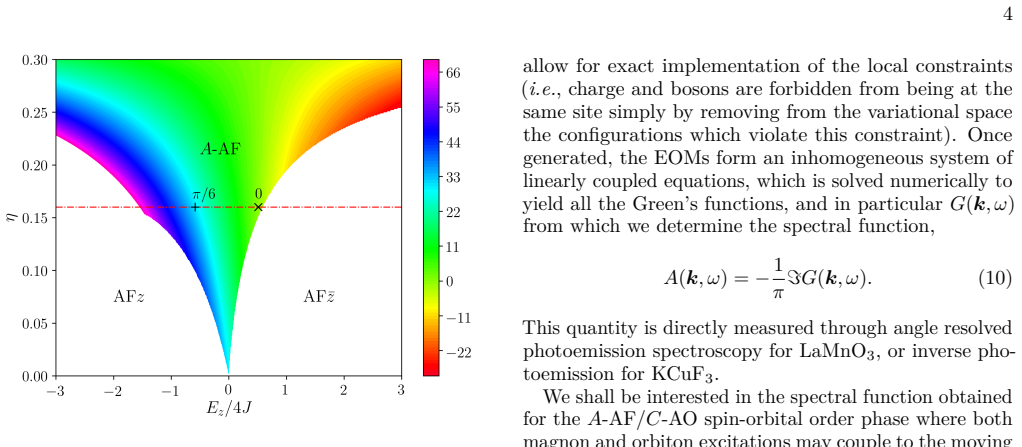
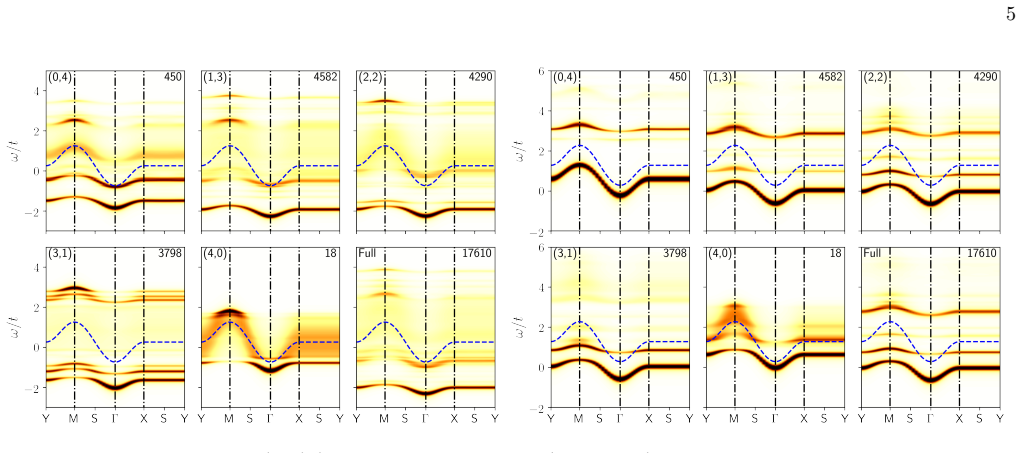
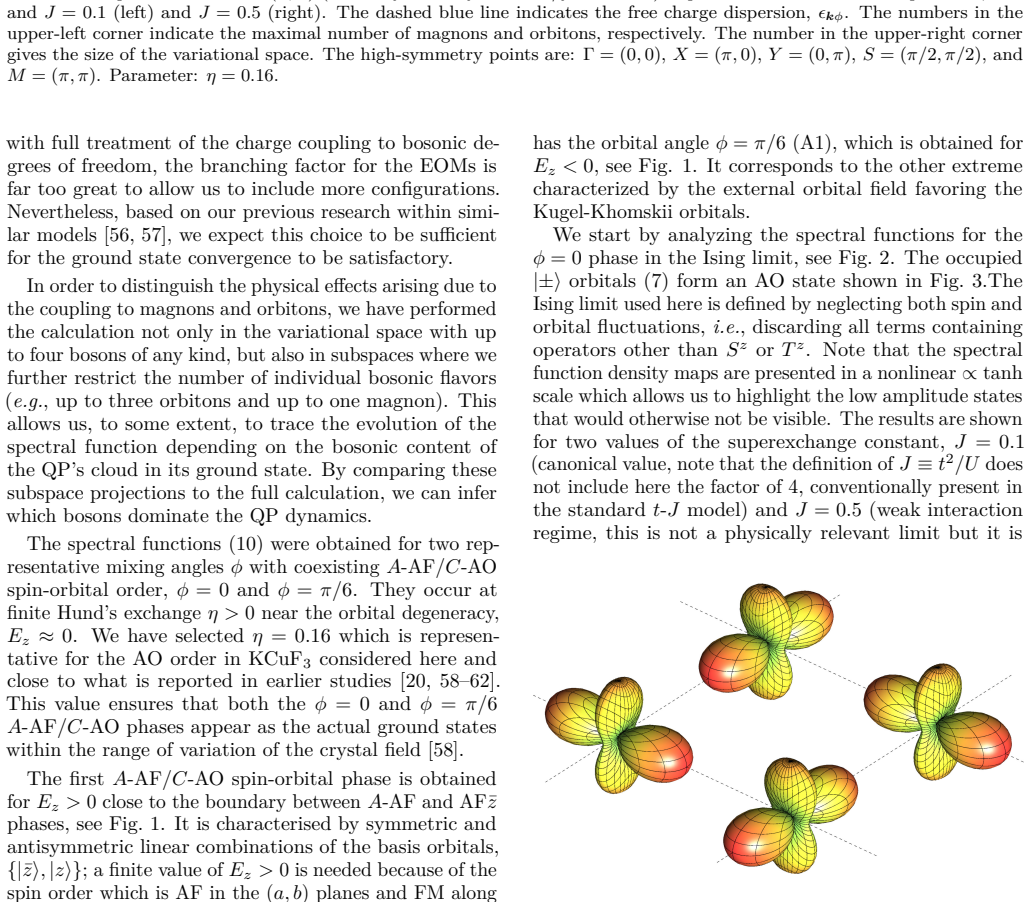
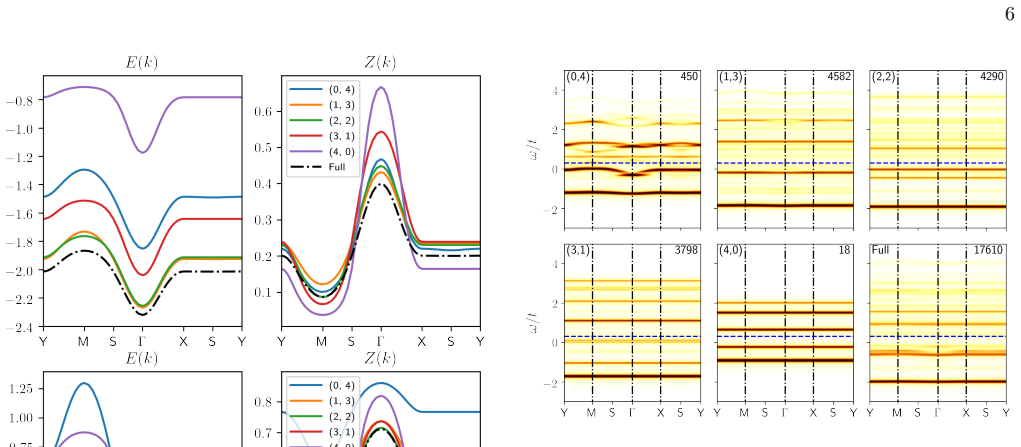
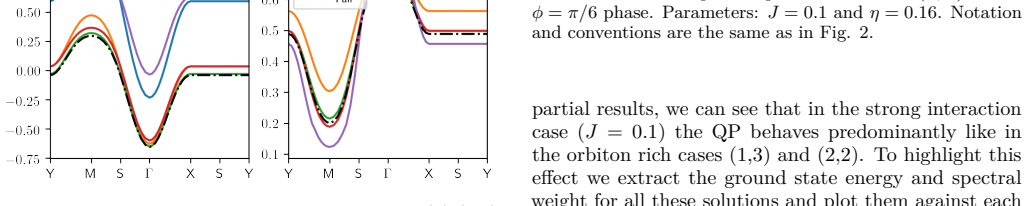
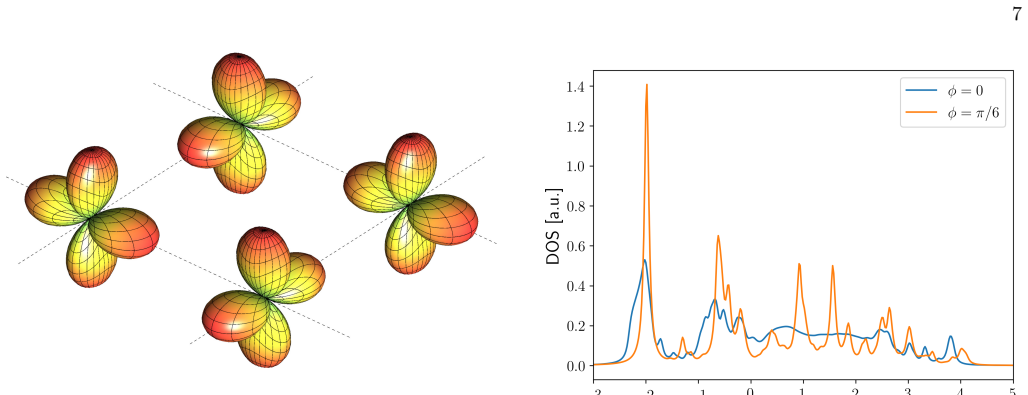
The central claim is that the spectral function of a spin-orbital polaron carries a readable signature of which orbitals are occupied. In the A-AF/C-AO phase, the orbital order is parametrized by a detuning angle $\phi$; the free charge dispersion vanishes for $\phi=\pi/6$ because a lobe of one occupied orbital points into the node of the next. The dressed quasiparticle inherits this: at $\phi=0$ the band disperses and the $\Gamma$-$M$ symmetry is suppressed, giving a broad asymmetric DOS, whereas at $\phi=\pi/6$ the band is essentially flat and the DOS is narrow, symmetric, and tall. The paper further claims that the polaron cloud crosses over from orbiton-dominated to magnon-dominated as the superexchange $J$ grows, and that magnetic fluctuations strengthen near $\phi=\pi/6$, pushing the magnetic subsystem toward one-dimensional chains; this is connected to the near-1D spin-liquid behavior reported for KCuF3.
Load-bearing premise
The calculation assumes the orbital order is a sharp classical (Ising-like) order and that quantum fluctuations around it, especially orbital fluctuations, can be neglected when computing the polaron spectrum; if those fluctuations or Jahn-Teller coupling are strong, the predicted flat band and symmetric DOS at $\phi=\pi/6$ could be washed out.
Editorial extensions
If this is right
- At $\phi=\pi/6$ the quasiparticle band is nearly dispersionless and the DOS peak is sharp, symmetric, and tall; at $\phi=0$ the band is dispersive and the DOS peak is asymmetric, so band flatness or DOS shape can discriminate the two orbital orders.
- The ratio of DOS amplitude to width, together with peak asymmetry, is proposed as a practical observable for the type of orbital order, with scanning tunneling spectroscopy suggested as a natural probe.
- The polaron cloud is orbiton-dominated for small superexchange $J$ and magnon-dominated for large $J$, so the orbital versus magnetic character of the quasiparticle is expected to vary between materials.
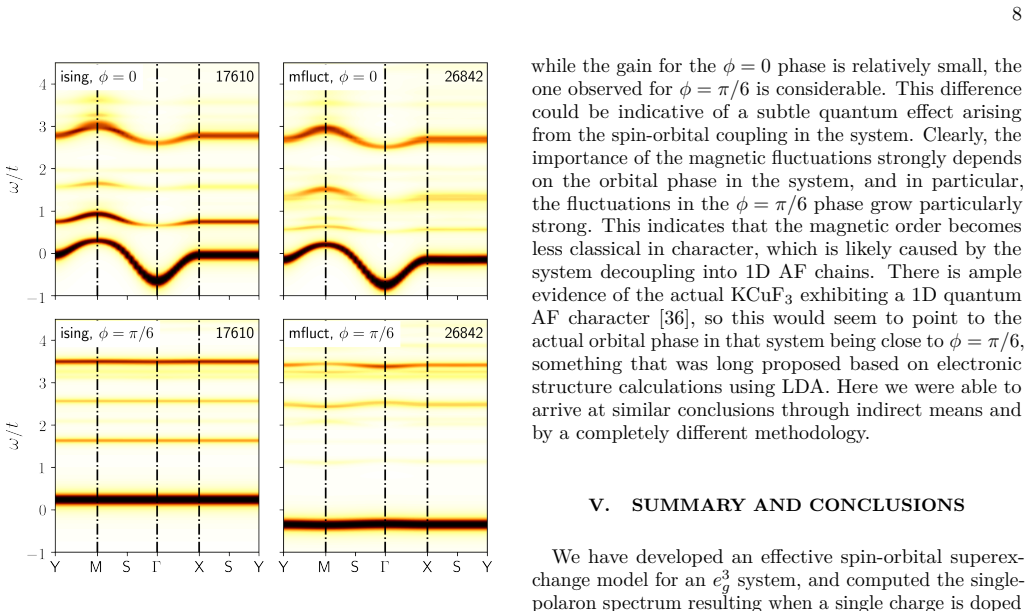
- Magnetic fluctuations grow strongly near $\phi=\pi/6$, indicating that the system decouples into one-dimensional antiferromagnetic chains; this supports assigning the orbital order of KCuF3 as close to the Kugel-Khomskii point.
- At $\phi=\pi/6$, only Trugman-loop processes, requiring three-boson clouds, generate any dispersion at all, and orbiton-magnon interference suppresses even those, making the flat band a persistent feature of the model.
Reading between the lines
- Because $\phi$ can be tuned by axial pressure, the DOS asymmetry could in principle serve as an in-situ probe of orbital order under strain, not only at the two special angles but for intermediate $\phi$.
- The vanishing of $\epsilon_{\mathbf{k}}^{\phi}$ at $\phi=\pi/6$ is a geometric cancellation independent of interaction strength; similar lobe-to-node cancellations might occur in other $e_g$-like lattices, suggesting a general orbital-selective localization mechanism.
- A direct extension would be to track the effective mass of the quasiparticle as a function of $\phi$: if the flat-band mechanism is the whole story, the inverse bandwidth should diverge as $\phi\to\pi/6$.
- The predicted growth of magnetic fluctuations toward $\phi=\pi/6$ could be tested by measuring the magnetic excitation spectrum as a function of strain or doping, since stronger 1D-chain behavior should accompany the flatter quasiparticle band.
Signed reviews
Editorial analysis
A structured set of objections, weighed in public.
Referee Report
Summary. The manuscript develops an effective spin-orbital superexchange model for e_g^3 systems in the A-AF/C-AO phase and computes the spectral function of a single injected hole using the momentum-average (MA) method with up to four bosons in the variational cloud. The central results are (i) an orbiton-to-magnon crossover in the quasiparticle cloud as the superexchange J increases, (ii) an almost perfectly flat quasiparticle band at the orbital detuning angle φ=π/6, which the authors trace to the vanishing of the free in-plane dispersion, and (iii) a proposed experimental fingerprint of orbital order based on the width and asymmetry of the quasiparticle density of states, with the φ=π/6 Kugel-Khomskii state producing a sharp symmetric DOS. The paper also argues that the φ=π/6 orbital order drives the magnetic subsystem towards a one-dimensional quantum spin-liquid behavior, consistent with neutron-scattering data on KCuF3. The derivation of the effective polaronic Hamiltonian and the MA equations is standard within the authors' prior framework, and the paper includes a systematic comparison of restricted boson-flavor subspaces to identify the nature of the quasiparticle cloud.
Significance. If the proposed fingerprint proves robust, the paper provides a conceptually simple way to distinguish orbital order in materials such as KCuF3 and LaMnO3 from photoemission or STM lineshapes, which is valuable because orbital order is notoriously difficult to measure. The MA treatment is systematic and includes higher-order boson processes and local constraints exactly, and the decomposition into restricted boson-flavor subspaces gives useful physical insight into the competing roles of orbitons and magnons. The main limitation is that the φ=π/6 fingerprint is largely a kinematic consequence of the free-electron dispersion zero in the idealized model, so the significance rests on the model's robustness to omitted couplings. The paper is honest about many of its idealizations but does not fully address the gap between the idealized model and the proposed experimental diagnostic.
major comments (3)
- [§IV, Fig. 5 and Appendix B, Eq. (B5a)] The flat quasiparticle band at φ=π/6 is a kinematic consequence of the vanishing free in-plane dispersion ϵ_k^φ = −(t/2)(1−2 sin φ)(cos k_x + cos k_y), as the authors state in the text. The subsequent claim that this flatness can serve as an experimental fingerprint of orbital order (§V) is therefore contingent on the absence of any term that restores in-plane hopping. The model neglects Jahn-Teller coupling and, in the Ising treatment, the transverse orbital terms of Eq. (A2) (e.g., T^x_i T^x_j and T^x_i T^z_j); either of these generically introduces an in-plane hopping on the order of the perturbation, which will broaden the flat band and alter the DOS asymmetry. Please quantify the sensitivity of the φ=π/6 fingerprint to such perturbations, or explicitly restrict the experimental claim to the idealized model.
- [§IV, paragraph 'In all of the above we have assumed an Ising interaction' and Eq. (A2)] The manuscript tests magnetic fluctuations (Fig. 8) but never includes the transverse orbital-exchange terms of Eq. (A2), even though the φ=π/6 fingerprint is defined by the orbital pattern. The argument that orbitons are gapped and therefore less important is plausible, but because the fingerprint relies on an exact cancellation in the in-plane hopping, a direct check of how the quasiparticle dispersion and DOS evolve when the transverse orbital terms are included is necessary to justify the neglect of orbital fluctuations as a matter of model robustness, not just prior plausibility.
- [§IV, 'We carry out the MA calculation in the variational space defined by configurations with up to 4 bosons present'] The four-boson cutoff is justified by earlier studies (Refs. [56,57]) rather than by a convergence test in the present three-dimensional spin-orbital model. Since the proposed DOS fingerprint is expressed through the amplitude-to-width ratio and the asymmetry of the quasiparticle peaks, the dependence of the quasiparticle bandwidth and DOS asymmetry on the maximum boson number (e.g., comparing full three-boson and full four-boson calculations) should be shown or at least reported.
minor comments (6)
- [Appendix B] In the discussion of linear spin-wave approximations, the word 'reetalying' appears to be a typo for 'relying'.
- [Eq. (B5a) and main text] The notation for the free dispersion is inconsistent: Eq. (B5a) writes ϵ_kφ while the main text uses ϵ_k^φ; please unify.
- [Fig. 7] The broadening parameter η used to generate the density of states is not stated in the caption; please include it.
- [§IV, discussion of Fig. 2] The phrase 'the QP behaves predominantly like in the orbiton rich cases' is a style issue; consider rewording to 'the QP behaves much as in the orbiton-rich cases.'
- [Fig. 8] The labels 'ising' and 'mfluct' in the figure should be typeset as 'Ising' and 'mfluct' for consistency.
- [Reference [51]] Reference [51] is cited as an arXiv preprint; if it has appeared in a journal, the full published reference should be given.
Circularity Check
No significant circularity: the φ=π/6 flat-band fingerprint is an explicitly acknowledged kinematic consequence of the input free dispersion, and the polaron, DOS-asymmetry, and fluctuation results are independent many-body outputs.
full rationale
The paper's derivation chain is self-contained and does not reduce to its inputs in a circular way. The spin-orbital superexchange model is defined in Sec. II, the mean-field phase diagram and the relation between E_z and φ are derived in Appendix A (Eqs. A4-A5), and the fermion-boson transformation leading to the kinetic term T and coupling vertices is derived in Appendix B. The MA Green's function calculation (Sec. III) is a standard variational method with no parameters fitted to the quantities being predicted. The central spectral features — the orbiton-rich to magnon-rich crossover with J, the Γ-M symmetry breaking that makes the φ=0 QP DOS asymmetric, and the robustness of the φ=π/6 flat band under magnetic fluctuations — are genuine many-body outputs of the calculation. The flatness at φ=π/6 is indeed a kinematic zero of the free dispersion ε_k^φ of Eq. (B5a), but the paper states this explicitly ('This is easily understood if we look at the free charge dispersion...') and does not present it as an emergent polaronic effect; the diagnostic proposal is a model consequence, not a hidden equivalence. The self-citations (e.g., Refs. [56,57] for convergence and for orbital-fluctuation suppression) are methodological and not load-bearing; they cite independent published calculations. The paper also candidly lists its idealizations (no Jahn-Teller coupling; Ising treatment of orbital fluctuations) and states the results are 'not meant to directly address the experimental results', which further reduces any impression of an overclaimed prediction. No circular step of the enumerated kinds is present.
Assumptions & free parameters
free parameters (5)
- Hund's coupling ratio eta =
0.16
- Superexchange coupling J (strong-coupling case) =
0.1
- Superexchange coupling J (weak-coupling case) =
0.5
- Orbital detuning angle phi =
0 and pi/6
- Maximum boson number in variational space =
4
assumptions (6)
- domain assumption Second-order perturbation theory in t/U maps the multiorbital Hubbard model to the Kugel-Khomskii superexchange Hamiltonian
- domain assumption The classical A-AF/C-AO order is the correct reference state for KCuF3 and LaMnO3
- domain assumption Orbital fluctuations are negligible and magnetic fluctuations matter only near the charge
- domain assumption Variational space with up to four bosons suffices for ground-state convergence
- standard math Holstein-Primakoff and slave-boson transformations with hard-core local constraints
- standard math Momentum-average EOM hierarchy truncates within the chosen variational space
Cite this review
Pith. "Pith review of Spectral properties of spin-orbital polarons as a fingerprint of orbital order." pith.science (2026). https://pith.science/paper/UY7TQ6XX
@misc{pith2026190802232,
  author       = {Pith},
  title        = {Pith review of: Spectral properties of spin-orbital polarons as a fingerprint of orbital order},
  year         = {2026},
  howpublished = {\url{https://pith.science/paper/UY7TQ6XX}},
  note         = {Machine review of arXiv:1908.02232}
}
abstract
Transition metal oxides are a rich group of materials with very interesting physical properties that arise from the interplay of the charge, spin, orbital, and lattice degrees of freedom. One interesting consequence of this, encountered in systems with orbital degeneracy, is the coexistence of long range magnetic and orbital order, and the coupling between them. In this paper we develop and study an effective spin-orbital superexchange model for $e_g^3$ systems and use it to investigate the spectral properties of a charge (hole) injected into the system, which is relevant for photoemission spectroscopy. Using an accurate, semi-analytical, magnon expansion method, we gain insight into various physical aspects of these systems and demonstrate a number of subtle effects, such as orbital to magnetic polaron crossover, the coupling between orbital and magnetic order, as well as the orbital order driving the system towards one-dimensional quantum spin liquid behavior. Our calculations also suggest a potentially simple experimental verification of the character of the orbital order in the system, something that is not easily accessible through most experimental techniques.
Figures
Figures from the paper (4 more)
Reference graph
Works this paper leans on
-
[1]
K. A. Chao, J. Spa/suppress lek, and A. M. Ole´ s, J. Phys. C10, L271 (1977)
work page 1977
-
[2]
S. A. Trugman, Phys. Rev. B 37, 1597 (1988)
work page 1988
- [3]
- [4]
- [5]
-
[6]
C. L. Kane, P. A. Lee, and N. Read, Phys. Rev. B 39, 6880 (1989)
work page 1989
- [7]
-
[8]
P. A. Lee, N. Nagaosa, and X.-G. Wen, Rev. Mod. Phys. 78, 17 (2006)
2006
Show all 64 references
-
[9]
K. I. Kugel and D. I. Khomskii, Sov. Phys. Usp. 25, 231 (1982)
1982
-
[10]
Tokura and N
Y. Tokura and N. Nagaosa, Science 288, 462 (2000)
2000
-
[11]
A. M. Ole´ s, Phys. Rev. B28, 327 (1983)
1983
-
[12]
Hoshino and P
S. Hoshino and P. Werner, Phys. Rev. B 93, 155161 (2016)
2016
-
[13]
L. F. Feiner, A. M. Ole´ s, and J. Zaanen, Phys. Rev. Lett. 78, 2799 (1997)
1997
-
[14]
Ishihara, J
S. Ishihara, J. Inoue, and S. Maekawa, Phys. Rev. B 55, 8280 (1997)
1997
-
[15]
L. F. Feiner and A. M. Ole´ s, Phys. Rev. B59, 3295 (1999)
1999
-
[16]
Snamina and A
M. Snamina and A. M. Ole´ s, Phys. Rev. B 97, 104417 (2018)
2018
-
[17]
Khaliullin and S
G. Khaliullin and S. Maekawa, Phys. Rev. Lett. 85, 3950 (2000). 12
2000
-
[18]
Khaliullin, P
G. Khaliullin, P. Horsch, and A. M. Ole´ s, Phys. Rev. Lett. 86, 3879 (2001); Phys. Rev. B 70, 195103 (2004)
2001
-
[19]
Khaliullin, Prog
G. Khaliullin, Prog. Theor. Phys. Suppl. 160, 155 (2005)
2005
-
[20]
A. M. Ole´ s, G. Khaliullin, P. Horsch, and L. F. Feiner, Phys. Rev. B 72, 214431 (2005)
2005
-
[21]
Chaloupka and G
J. Chaloupka and G. Khaliullin, Phys. Rev. Lett. 100, 016404 (2008)
2008
-
[22]
Horsch, A
P. Horsch, A. M. Ole´ s, L. F. Feiner, and G. Khaliullin, Phys. Rev. Lett. 100, 167205 (2008)
2008
-
[23]
Normand and A
B. Normand and A. M. Ole´ s, Phys. Rev. B 78, 094427 (2008); B. Normand, Phys. Rev. B 83, 064413 (2011); J. Chaloupka and A. M. Ole´ s, Phys. Rev. B83, 094406 (2011)
2008
-
[24]
Sirker, A
J. Sirker, A. Herzog, A. M. Ole´ s, and P. Horsch, Phys. Rev. Lett. 101, 157204 (2008); A. Herzog, P. Horsch, A. M. Ole´ s, and J. Sirker, Phys. Rev. B 83, 245130 (2011)
2008
-
[25]
Brzezicki, A
W. Brzezicki, A. M. Ole´ s, and M. Cuoco, Phys. Rev. X 5, 011037 (2015)
2015
- [26]
-
[27]
van den Brink, P
J. van den Brink, P. Horsch, and A. M. Ole´ s, Phys. Rev. Lett. 85, 5174 (2000)
2000
-
[28]
Ishihara, Y
S. Ishihara, Y. Murakami, T. Inami, K. Ishii, J. Mizuki, K. Hirota, S. Maekawa, and Y. Endoh, New J. Phys. 7, 119 (2005)
2005
-
[29]
Ishihara, Phys
S. Ishihara, Phys. Rev. Lett. 94, 156408 (2005)
2005
-
[30]
Daghofer, A
M. Daghofer, A. M. Ole´ s, and W. von der Linden, Phys. Rev. B 70, 184430 (2004)
2004
-
[31]
Wohlfeld, A
K. Wohlfeld, A. M. Ole´ s, and P. Horsch, Phys. Rev. B 79, 224433 (2009)
2009
-
[32]
Berciu, Physics 2, 55 (2009)
M. Berciu, Physics 2, 55 (2009)
2009
-
[33]
Okazaki and Y
A. Okazaki and Y. Suemune, J. Phys. Soc. Japan 16, 176 (1961)
1961
-
[34]
Zhou and J
J.-S. Zhou and J. B. Goodenough, Phys. Rev. Lett. 96, 247202 (2006)
2006
-
[35]
Kimura, S
T. Kimura, S. Ishihara, H. Shintani, T. Arima, K. T. Takahashi, K. Ishizaka, and Y. Tokura, Phys. Rev. B 68, 060403 (2003)
2003
-
[36]
B. Lake, D. A. Tennant, C. D. Frost, and S. E. Nagler, Nature Mat. 4, 329 (2005)
2005
-
[37]
B. Lake, D. A. Tennant, and S. E. Nagler, Phys. Rev. B 71, 134412 (2005)
2005
-
[38]
G. H. Jonker and J. H. van Santen, Physica 16, 337 (1950)
1950
-
[39]
Tokura, Reports on Progress in Physics 69, 797 (2006)
Y. Tokura, Reports on Progress in Physics 69, 797 (2006)
2006
-
[40]
Ro´ sciszewski and A
K. Ro´ sciszewski and A. M. Ole´ s, Phys. Rev. B99, 155108 (2019)
2019
-
[41]
Ba/suppress la, G
J. Ba/suppress la, G. A. Sawatzky, A. M. Ole´ s, and A. Macridin, Phys. Rev. Lett. 87, 067204 (2001)
2001
-
[42]
Kr¨ uger, B
R. Kr¨ uger, B. Schulz, S. Naler, R. Rauer, D. Budelmann, J. B¨ ackstr¨ om, K. H. Kim, S.-W. Cheong, V. Perebeinos, and M. R¨ ubhausen, Phys. Rev. Lett.92, 097203 (2004)
2004
-
[43]
M. W. Kim, J. H. Jung, K. H. Kim, H. J. Lee, J. Yu, T. W. Noh, and Y. Moritomo, Phys. Rev. Lett. 89, 016403 (2002)
2002
-
[44]
N. N. Kovaleva, A. M. Ole´ s, A. M. Balbashov, A. Maljuk, D. N. Argyriou, G. Khaliullin, and B. Keimer, Phys. Rev. B 81, 235130 (2010)
2010
-
[45]
Snamina and A
M. Snamina and A. M. Ole´ s, New Journal of Physics21, 023018 (2019)
2019
-
[46]
Kuneˇ s, I
J. Kuneˇ s, I. Leonov, M. Kollar, K. Byczuk, V. Anisimov, and D. Vollhardt, Eur. Phys. J. Special Topics 180, 5 (2010)
2010
-
[47]
L. F. Feiner and A. M. Ole´ s, Phys. Rev. B 71, 144422 (2005)
2005
-
[48]
A. M. Ole´ s, L. F. Feiner, and J. Zaanen, Phys. Rev. B 61, 6257 (2000)
2000
-
[49]
Brzezicki, J
W. Brzezicki, J. Dziarmaga, and A. M. Ole´ s, Phys. Rev. Lett. 109, 237201 (2012)
2012
-
[50]
Czarnik, J
P. Czarnik, J. Dziarmaga, and A. M. Ole´ s, Phys. Rev. B 96, 014420 (2017)
2017
-
[51]
Bieniasz, P
K. Bieniasz, P. Wrzosek, A. M. Ole´ s, and K. Wohlfeld, arXiv:1809.07120 (2018)
2018 arXiv
-
[52]
Berciu, Phys
M. Berciu, Phys. Rev. Lett. 97, 036402 (2006)
2006
-
[53]
D. J. J. Marchand, G. De Filippis, V. Cataudella, M. Berciu, N. Nagaosa, N. V. Prokof’ev, A. S. Mishchenko, and P. C. E. Stamp, Phys. Rev. Lett. 105, 266605 (2010)
2010
-
[54]
Berciu and H
M. Berciu and H. Fehske, Phys. Rev. B 84, 165104 (2011)
2011
-
[55]
Ebrahimnejad, G
H. Ebrahimnejad, G. A. Sawatzky, and M. Berciu, J. Phys.: Cond. Mat. 28, 105603 (2016)
2016
-
[56]
Bieniasz, M
K. Bieniasz, M. Berciu, M. Daghofer, and A. M. Ole´ s, Phys. Rev. B 94, 085117 (2016)
2016
-
[57]
Bieniasz, M
K. Bieniasz, M. Berciu, and A. M. Ole´ s, Phys. Rev. B 95, 235153 (2017)
2017
-
[58]
Brzezicki, J
W. Brzezicki, J. Dziarmaga, and A. M. Ole´ s, Phys. Rev. B 87, 064407 (2013)
2013
-
[59]
A. I. Liechtenstein, V. I. Anisimov, and J. Zaanen, Phys. Rev. B 52, R5467 (1995)
1995
-
[60]
Kataoka, J
M. Kataoka, J. Phys. Soc. Jpn. 73, 1326 (2004)
2004
-
[61]
Pavarini, E
E. Pavarini, E. Koch, and A. I. Lichtenstein, Phys. Rev. Lett. 101, 266405 (2008)
2008
-
[62]
Leonov, D
I. Leonov, D. Korotin, N. Binggeli, V. I. Anisimov, and D. Vollhardt, Phys. Rev. B 81, 075109 (2010)
2010
-
[63]
Binggeli and M
N. Binggeli and M. Altarelli, Phys. Rev. B 70, 085117 (2004)
2004
-
[64]
Pavarini and E
E. Pavarini and E. Koch, Phys. Rev. Lett. 104, 086402 (2010)
2010
Reviewed August 14, 2026 · model on record in the stance chip above.
Discussion (0). Continue with ORCID to comment.