When Agents Meet Electric Bus Fleet Operations: Pricing Behavior, Trade-offs, and Policy Implications in an Aggregator Framework
Pith reviewed 2026-06-26 01:20 UTC · model grok-4.3
The pith
Agentic aggregation maintains feasible electric bus schedules and activates selective re-optimization while profit-oriented pricing allows the aggregator to extract value from the public transport operator.
A machine-rendered reading of the paper's core claim, the machinery that carries it, and where it could break.
Core claim
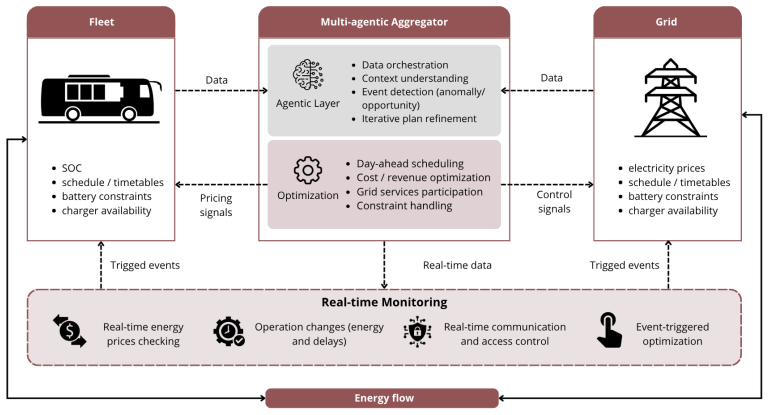
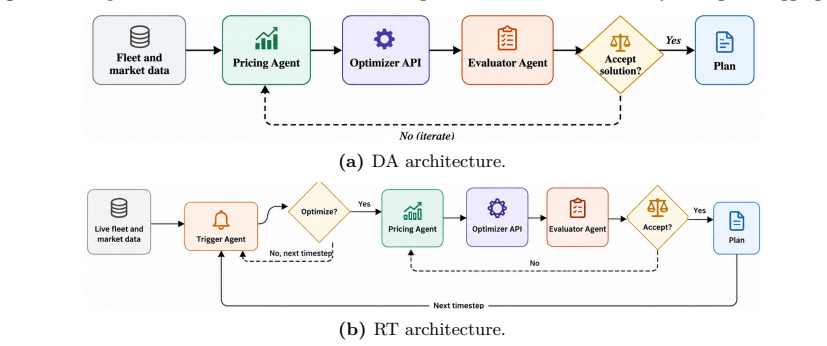
The central claim is that an agentic aggregator framework, by coupling an optimization-based electric bus scheduling model with supervisory agents for disturbance detection, tariff adaptation, and schedule evaluation, supports adaptive fleet-grid coordination that maintains physical feasibility and improves charging and V2G flexibility utilization, yet the same framework extracts value from the public transport operator when configured around profit-oriented pricing behaviors in realistic disturbance scenarios.
What carries the argument
The agentic aggregator framework that couples an optimization-based scheduling model enforcing route, charger, battery, and V2G feasibility with supervisory agents for disturbance detection, tariff adaptation, and schedule evaluation.
If this is right
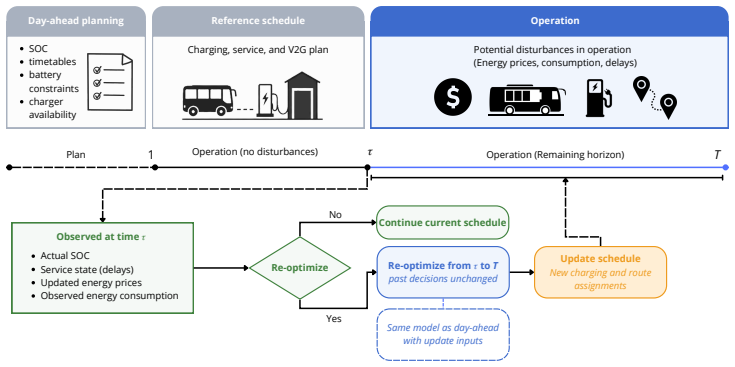
- Feasible schedules are maintained across routes, chargers, batteries, and V2G exchanges under day-ahead and real-time operations.
- Re-optimization is activated selectively based on detected disturbances rather than continuously.
- Use of charging and V2G flexibility improves when the agentic layer interprets changing conditions.
- Value allocation between the aggregator and the public transport operator shifts depending on whether coordination is set to profit-based or operation-based modes.
- Deployment in public-fleet contexts requires transparent coordination modes, auditable tariff-setting, and explicit value-sharing rules.
Where Pith is reading between the lines
- The framework's disturbance-handling logic could transfer to coordinating other electric vehicle fleets such as delivery vans with grid services.
- Public operators might require contract clauses that audit the aggregator's internal pricing algorithms before deployment.
- Field trials would need to compare simulated disturbance thresholds against actual operational triggers observed in live fleets.
- The value-extraction effect could shape how regulators design incentives for V2G participation by public fleets.
Load-bearing premise
The supervisory agents' tariff-adaptation and value-allocation rules accurately reflect real-world negotiation dynamics and that the simulated disturbances are representative of conditions that would trigger re-optimization.
What would settle it
A real-world deployment of the agentic aggregator on an electric bus fleet under profit-oriented pricing that records whether the public transport operator receives measurably lower net revenue from V2G flexibility compared with operation-based modes while schedules remain feasible during actual service delays and price shocks.
Figures
read the original abstract
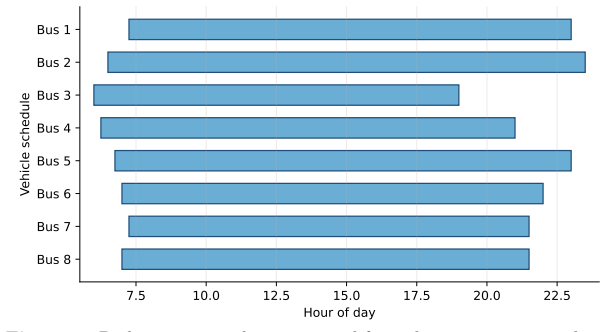
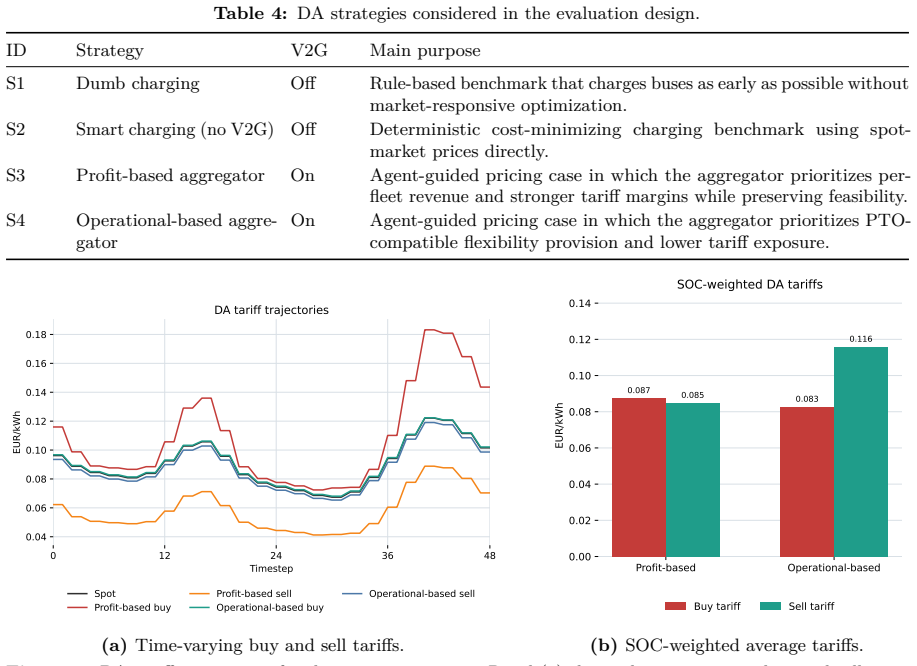
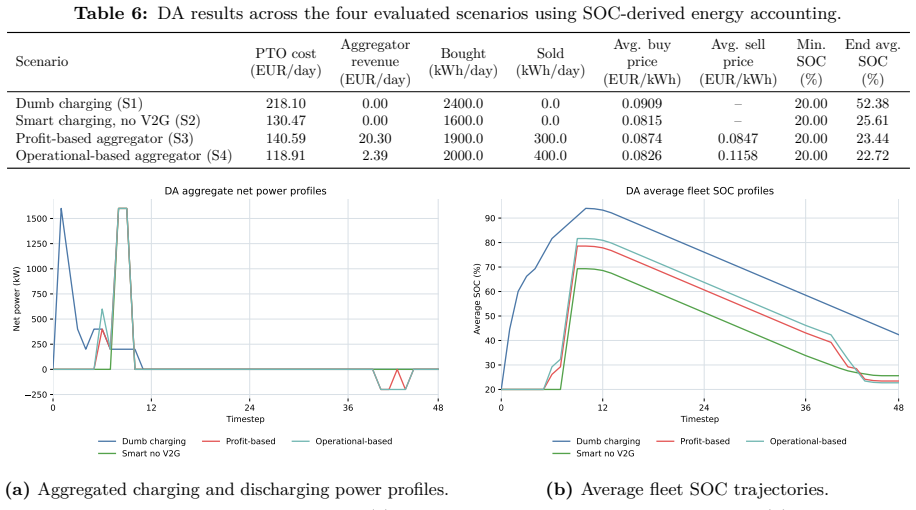
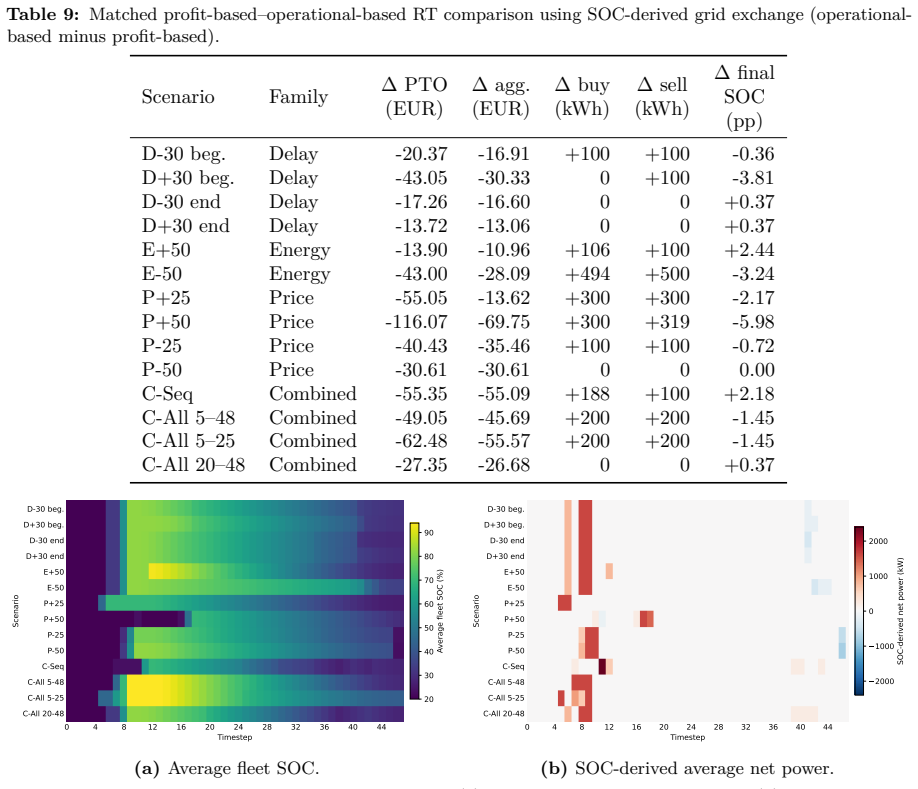
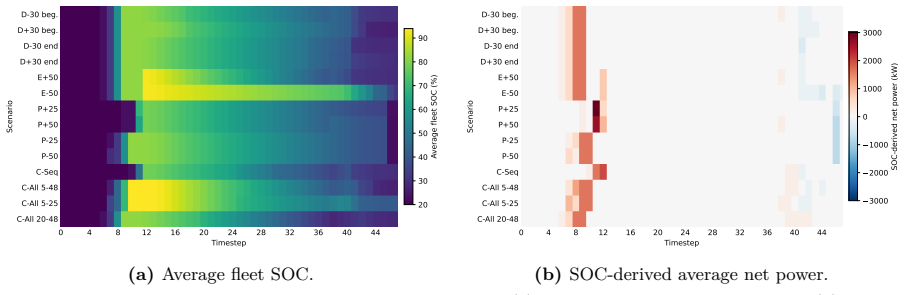
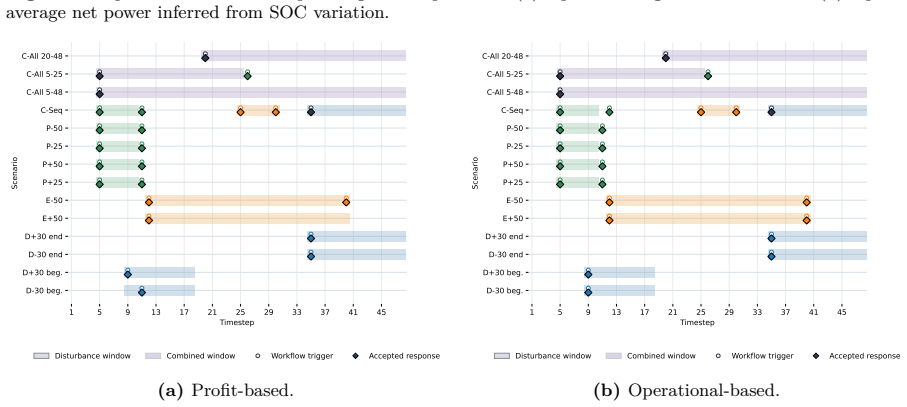
Agentic systems are changing how complex operational tasks are coordinated, introducing a new paradigm for connecting heterogeneous data sources and automating processes. Electric bus fleets provide a relevant test case. Their operation requires continuous coordination between service reliability, battery state-of-charge, charger availability, electricity prices, route-energy uncertainty, and vehicle-to-grid (V2G) opportunities. This paper proposes an agentic aggregator framework that streamlines this decision environment by coupling an optimization-based electric bus scheduling model with supervisory agents for disturbance detection, tariff adaptation, and schedule evaluation. The optimization core enforces physical feasibility across routes, chargers, batteries, and V2G exchanges, while the agentic layer interprets changing operating conditions, triggers real-time re-optimization when needed, and defines how flexibility value is allocated between the aggregator and the public transport operator (PTO). A realistic depot case study evaluates day-ahead and real-time operations under profit-based and operation-based coordination modes, considering service delays, route-energy deviations, electricity price shocks, and combined disturbances. The results show that agentic aggregation can support adaptive fleet-grid coordination by maintaining feasible schedules, activating re-optimization selectively, and improving the use of charging and V2G flexibility. However, they also reveal a critical trade-off: the same agentic capability that reduces operational complexity can extract value from the PTO when configured around profit-oriented pricing. These findings suggest that agentic aggregators can become useful for managing electric bus V2G operations, but their deployment in public-fleet contexts requires transparent coordination modes, auditable tariff-setting, and explicit value-sharing rules.
Editorial analysis
A structured set of objections, weighed in public.
Referee Report
Summary. The manuscript proposes an agentic aggregator framework that couples an optimization-based electric bus scheduling model (enforcing feasibility across routes, chargers, batteries, and V2G) with supervisory agents for disturbance detection, tariff adaptation, and schedule evaluation. A realistic depot case study evaluates day-ahead and real-time operations under profit-based and operation-based coordination modes, considering service delays, route-energy deviations, price shocks, and combined disturbances. The central claim is that the framework supports adaptive fleet-grid coordination while revealing a trade-off in which profit-oriented pricing can extract value from the PTO.
Significance. If the central trade-off result holds under the stated assumptions, the work is significant for highlighting both the operational benefits of agentic systems in electric bus V2G and the policy risks around value allocation. The explicit separation of coordination modes and the use of a realistic depot case study under multiple disturbance scenarios provide a concrete simulation testbed; the modeling choices rest on standard optimization plus agent rules rather than circular definitions.
major comments (2)
- Abstract and case-study description: the reported performance and trade-off are presented without quantitative metrics, error bars, baseline comparisons, or sensitivity analysis on parameter choices and post-hoc exclusions. This is load-bearing for the central claim that agentic aggregation 'improves the use of charging and V2G flexibility' while 'extract[ing] value from the PTO,' as the magnitude and robustness of these effects cannot be evaluated from the given information.
- Case-study section (disturbance scenarios): the claim that the supervisory agents' tariff-adaptation and value-allocation rules accurately reflect real-world negotiation dynamics rests on untested modeling assumptions; no validation against empirical PTO-aggregator data or alternative rule sets is provided, which directly affects the external validity of the profit-extraction trade-off.
minor comments (2)
- Notation for the optimization core and agent rules could be clarified with explicit variable definitions and pseudocode to improve reproducibility.
- The abstract and conclusion could more precisely state the scope limitations regarding the representativeness of the simulated disturbances.
Simulated Author's Rebuttal
We thank the referee for the constructive comments on our manuscript. We address each major comment below, agreeing on the need for greater quantitative rigor and explicit discussion of modeling assumptions. Revisions will be made accordingly where feasible.
read point-by-point responses
-
Referee: Abstract and case-study description: the reported performance and trade-off are presented without quantitative metrics, error bars, baseline comparisons, or sensitivity analysis on parameter choices and post-hoc exclusions. This is load-bearing for the central claim that agentic aggregation 'improves the use of charging and V2G flexibility' while 'extract[ing] value from the PTO,' as the magnitude and robustness of these effects cannot be evaluated from the given information.
Authors: We agree that the current presentation is qualitative and does not allow readers to assess effect magnitudes or robustness. In the revised manuscript we will add quantitative metrics from the depot case study (e.g., flexibility utilization rates, cost differentials between modes, and schedule feasibility percentages), report variability across disturbance scenarios, include baseline comparisons against non-agentic day-ahead scheduling, and conduct sensitivity analysis on parameters such as disturbance magnitude, price-shock size, and value-allocation coefficients. These additions will directly support evaluation of the central trade-off claim. revision: yes
-
Referee: Case-study section (disturbance scenarios): the claim that the supervisory agents' tariff-adaptation and value-allocation rules accurately reflect real-world negotiation dynamics rests on untested modeling assumptions; no validation against empirical PTO-aggregator data or alternative rule sets is provided, which directly affects the external validity of the profit-extraction trade-off.
Authors: The tariff-adaptation and value-allocation rules are stylized constructs chosen to illustrate profit-based versus operation-based coordination modes. We do not have access to empirical PTO-aggregator negotiation datasets that would permit direct validation. In the revision we will explicitly state these modeling assumptions, discuss their consequences for external validity, and add simulations using alternative rule sets (e.g., more conservative pricing or equal-split value allocation) to test whether the profit-extraction result is robust to different behavioral specifications. revision: partial
- Empirical validation of the tariff-adaptation and value-allocation rules against real-world PTO-aggregator negotiation data
Circularity Check
No significant circularity
full rationale
The paper describes an agentic aggregator framework that couples a standard optimization-based scheduling model with supervisory agents for disturbance detection and tariff adaptation. Results come from a simulation case study under explicit coordination modes and disturbance scenarios. No equations, parameters, or claims reduce by construction to fitted inputs, self-definitions, or self-citation chains; the central trade-off findings are conditional on the chosen agent rules and are presented as simulation outcomes rather than universal derivations. This matches the default expectation for non-circular simulation studies.
Axiom & Free-Parameter Ledger
Reference graph
Works this paper leans on
-
[1]
rep., International Energy Agency (2024)
International Energy Agency, Global ev outlook 2024, Tech. rep., International Energy Agency (2024). URLhttps://www.iea.org/reports/global-ev-outlook-2024
2024
-
[2]
J. A. Manzolli, J. P. Trovão, C. H. Antunes, A review of electric bus vehicles research topics – Methods and trends, Renewable and Sustainable Energy Reviews 159 (2022) 112211. doi: 10.1016/j.rser.2022.112211. URLhttps://linkinghub.elsevier.com/retrieve/pii/S1364032122001344
-
[3]
J. A. Manzolli, J. P. F. Trovão, C. H. Antunes, Electric bus fleet charging management: A robust optimisation framework addressing battery ageing, time-of-use tariffs, and energy consumption uncertainty, Applied Energy 381 (2025) 125137.doi:10.1016/j.apenergy.2024.125137. 26
-
[4]
Sadeghian, A
O. Sadeghian, A. Oshnoei, B. Mohammadi-Ivatloo, V. Vahidinasab, A. Anvari-Moghaddam, A comprehensive review on electric vehicles smart charging: Solutions, strategies, technologies, and challenges, Journal of Energy Storage 54 (2022) 105241
2022
-
[5]
Gkatzikis, I
L. Gkatzikis, I. Koutsopoulos, T. Salonidis, The role of aggregators in smart grid demand response markets, IEEE Journal on selected areas in communications 31 (7) (2013) 1247–1257
2013
-
[6]
Reviewofsummation-by-partsschemesforinitial-boundary- value problems
S. Burger, J. P. Chaves-Ávila, C. Batlle, I. J. Pérez-Arriaga, A review of the value of aggregators in electricity systems, Renewable and Sustainable Energy Reviews 77 (2017) 395–405.doi:10.1016/j. rser.2017.04.014
work page doi:10.1016/j 2017
-
[7]
Bruninx, H
K. Bruninx, H. Pandžić, H. Le Cadre, E. Delarue, On the interaction between aggregators, electricity markets and residential demand response providers, IEEE Transactions on Power Systems 35 (2) (2019) 840–853
2019
-
[8]
Amamra, J
S.-A. Amamra, J. Marco, Vehicle-to-grid aggregator to support power grid and reduce electric vehicle charging cost, IEEE Access 7 (2019) 178528–178538
2019
-
[9]
J. A. Manzolli, J. P. Trovão, C. H. Antunes, Electric bus smart charging under a bi-level optimisation model to set dynamic tariffs, in: IECON 2022 – 48th Annual Conference of the IEEE Industrial Electronics Society, 2022, pp. 1–6.doi:10.1109/IECON49645.2022.9969101
-
[10]
X. Tian, Integrated Analysis and Modeling of Energy Demand, Emissions, and Lifecycle Impacts of Bus Electrification Under Low-Carbon Electricity Scenarios, Phd thesis, Concordia University (Aug. 2025). URLhttps://spectrum.library.concordia.ca/id/eprint/996169/
2025
-
[11]
L. Zhao, S. Shen, Z. Zhao, Large-scale electric bus network transition planning via deep reinforcement learning, Transportation Research Part D: Transport and Environment 146 (2025) 104899.doi: 10.1016/j.trd.2025.104899. URLhttps://linkinghub.elsevier.com/retrieve/pii/S1361920925003098
-
[12]
Yu, Preparing for an agentic era of human-machine transportation systems: Opportunities, challenges, and policy recommendations, Transport Policy 171 (2025) 78–97
J. Yu, Preparing for an agentic era of human-machine transportation systems: Opportunities, challenges, and policy recommendations, Transport Policy 171 (2025) 78–97
2025
-
[13]
J. Yu, R. Frank, L. Miranda-Moreno, S. Jafarnejad, J. A. Manzolli, F. Liu, J. Wang, A. Eslami, Agentic vehicles for human-centered mobility: Definition, prospects, and synergistic co-development with vehicle autonomy, arXiv preprint:2507.04996 (2025)
Pith/arXiv arXiv 2025
-
[14]
A. Eslami, J. Yu, A Control-Theoretic Foundation for Agentic Systems, arXiv:2603.10779 [eess.SY] (Mar. 2026).doi:10.48550/arXiv.2603.10779. URLhttp://arxiv.org/abs/2603.10779
-
[15]
J. A. Manzolli, J. Yu, L. Miranda-Moreno, Synthetic multi-criteria decision analysis (S-MCDA): A new framework for participatory transportation planning, Transportation Research Interdisciplinary Perspectives 31 (2025) 101463.doi:10.1016/j.trip.2025.101463. URLhttps://linkinghub.elsevier.com/retrieve/pii/S2590198225001423
-
[16]
Y. Wang, F. Liao, C. Lu, Integrated optimization of charger deployment and fleet scheduling for battery electric buses, Transportation Research Part D: Transport and Environment 109 (2022) 103382.doi:10.1016/j.trd.2022.103382
-
[17]
Z. Bao, J. Li, X. Bai, C. Xie, Z. Chen, M. Xu, W.-L. Shang, H. Li, An optimal charging scheduling model and algorithm for electric buses, Applied Energy 332 (2023) 120512
2023
-
[18]
Y. Zhou, G. P. Ong, Q. Meng, H. Cui, Electric bus charging facility planning with uncertainties: Model formulation and algorithm design, Transportation Research Part C: Emerging Technologies 150 (2023) 104108.doi:10.1016/j.trc.2023.104108
-
[19]
X. Liu, X. Qu, X. Ma, Optimizing electric bus charging infrastructure considering power matching and seasonality, Transportation Research Part D: Transport and Environment 100 (2021) 103057. doi:10.1016/j.trd.2021.103057. 27
-
[20]
Ş. Yıldırım, B. Yıldız, Electric bus fleet composition and scheduling, Transportation Research Part C: Emerging Technologies 129 (2021) 103197.doi:10.1016/j.trc.2021.103197
-
[21]
Y. Zhou, Q. Meng, G. P. Ong, H. Wang, Electric bus charging scheduling on a bus network, Transportation Research Part C: Emerging Technologies 161 (2024) 104553
2024
-
[22]
Naeimian, G
B. Naeimian, G. Mohseni, V. Barzegari, M. Nourinejad, P. Y. Park, Public transportation fleet electrification and charger schedule optimization using a decomposition heuristic, Energy 333 (2025) 137135
2025
-
[23]
J. Wang, L. Kang, Y. Liu, Optimal scheduling for electric bus fleets based on dynamic programming approach by considering battery capacity fade, Renewable and Sustainable Energy Reviews 130 (2020) 109978
2020
-
[24]
J. A. Manzolli, J. P. Trovão, C. Henggeler Antunes, Optimisation of an electric bus charging strategy considering a semi-empirical battery degradation model and weather conditions, in: 2022 11th International Conference on Control, Automation and Information Sciences (ICCAIS), IEEE, Hanoi, Vietnam, 2022, pp. 298–303.doi:10.1109/ICCAIS56082.2022.9990180. U...
-
[25]
Ke, Y.-H
B.-R. Ke, Y.-H. Lin, H.-Z. Chen, S.-C. Fang, Battery charging and discharging scheduling with demand response for an electric bus public transportation system, Sustainable Energy Technologies and Assessments 40 (2020) 100741
2020
-
[26]
X. Hu, H. Li, C. Xie, Optimal charging scheduling of an electric bus fleet with photovoltaic-storage- charging stations, Applied Energy 390 (2025) 125714
2025
-
[27]
M. Pagliaro, F. Meneguzzo, Electric bus: A critical overview on the dawn of its widespread uptake, Advanced Sustainable Systems 3 (6) (2019) 1800151.doi:10.1002/adsu.201800151
-
[28]
M. Gallet, T. Massier, T. Hamacher, Estimation of the energy demand of electric buses based on real-world data for large-scale public transport networks, Applied Energy 230 (2018) 344–356. doi:10.1016/j.apenergy.2018.08.086
-
[29]
L. Zhang, Y. Han, J. Peng, Y. Wang, Vehicle and charging scheduling of electric bus fleets: A comprehensive review, Journal of Intelligent and Connected Vehicles 6 (3) (2023) 116–124.doi: 10.26599/JICV.2023.9210012
-
[30]
R. Faia, B. Ribeiro, C. Goncalves, L. Gomes, Z. Vale, Multi-agent based energy community cost optimization considering high electric vehicles penetration, Sustainable Energy Technologies and Assessments 59 (2023) 103402.doi:10.1016/j.seta.2023.103402. URLhttps://linkinghub.elsevier.com/retrieve/pii/S2213138823003958
-
[31]
A. M. Carreiro, H. M. Jorge, C. H. Antunes, Energy management systems aggregators: A literature survey, Renewable and Sustainable Energy Reviews 73 (2017) 1160–1172.doi:10.1016/j.rser.2 017.01.179
-
[32]
Y. Cao, L. Huang, Y. Li, K. Jermsittiparsert, H. Ahmadi-Nezamabad, S. Nojavan, Optimal scheduling of electric vehicles aggregator under market price uncertainty using robust optimization technique, International Journal of Electrical Power & Energy Systems 117 (2020) 105628
2020
-
[33]
Clairand, M
J.-M. Clairand, M. González-Rodríguez, I. Cedeño, G. Escrivá-Escrivá, A charging station planning model considering electric bus aggregators, Sustainable Energy, Grids and Networks 30 (2022) 100638
2022
-
[34]
J. Chen, K. Strunz, Optimal Electric Bus Charging and Battery Swapping With Renewable Energy and Frequency Control Ancillary Service Through Aggregator, IEEE Transactions on Transportation Electrification 11 (1) (2025) 3715–3729.doi:10.1109/TTE.2024.3445830. URLhttps://ieeexplore.ieee.org/document/10638650/
-
[35]
J. A. Manzolli, J. P. F. Trovão, C. H. Antunes, Aggregator-supported strategy for electric bus fleet charging: A hierarchical optimisation approach, Energy 307 (2024) 132497.doi:10.1016/j.energy .2024.132497. 28
-
[36]
Majumder, L
S. Majumder, L. Dong, F. Doudi, Y. Cai, C. Tian, D. Kalathil, K. Ding, A. A. Thatte, N. Li, L. Xie, Exploring the capabilities and limitations of large language models in the electric energy sector, Joule 8 (6) (2024) 1544–1549
2024
-
[37]
C. Zhang, J. Zhang, J. Lu, Y. Zhao, Large language models meet energy systems: Opportunities, challenges, and future perspectives, Applied Energy 403 (2026) 127076.doi:10.1016/j.apenergy .2025.127076
-
[38]
H. Shi, L. Fang, X. Chen, C. Gu, K. Ma, X. Zhang, Z. Zhang, J. Gu, E. G. Lim, Review of the opportunities and challenges to accelerate mass-scale application of smart grids with large-language models, IET Smart Grid 7 (6) (2024) 737–759.doi:10.1049/stg2.12191
-
[39]
G. Antonesi, T. Cioara, I. Anghel, V. Michalakopoulos, E. Sarmas, L. Toderean, From transformers to large language models: A systematic review of ai applications in the energy sector towards agentic digital twins, arXiv preprint arXiv:2506.06359 (2025)
arXiv 2025
-
[40]
A. Eslami, J. Yu, Stability without safety: Gain manipulation attacks on agentic cyber-physical systems, arXiv preprint arXiv:2606.07803 (2026)
Pith/arXiv arXiv 2026
- [41]
discussion (0)
Sign in with ORCID, Apple, or X to comment. Anyone can read and Pith papers without signing in.