Reservoir-independent lossless charging and protected storage of an open quantum battery
Pith reviewed 2026-06-29 02:11 UTC · model grok-4.3
The pith
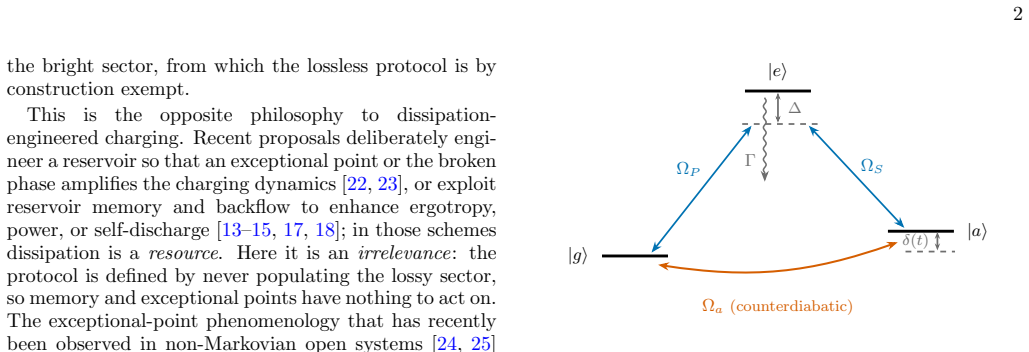
A counterdiabatic field empties the lossy intermediate state in a driven three-level cell, producing reservoir-independent lossless charging of an open quantum battery.
A machine-rendered reading of the paper's core claim, the machinery that carries it, and where it could break.
Core claim
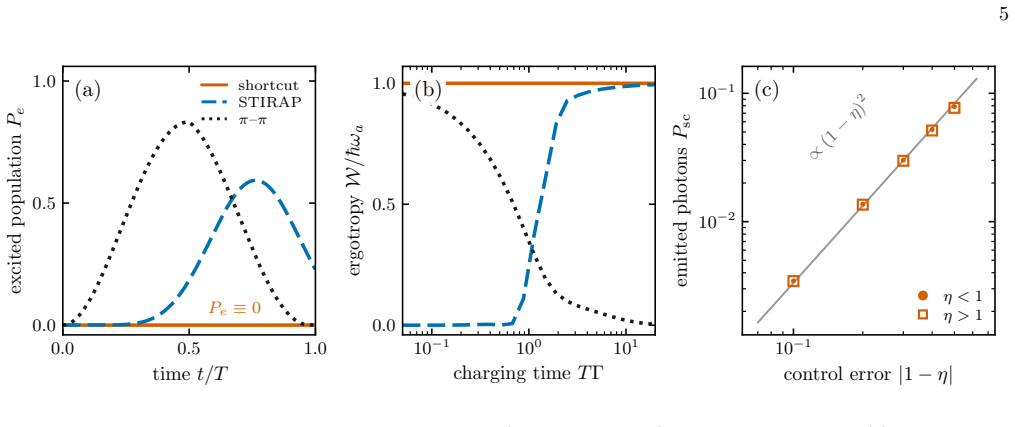
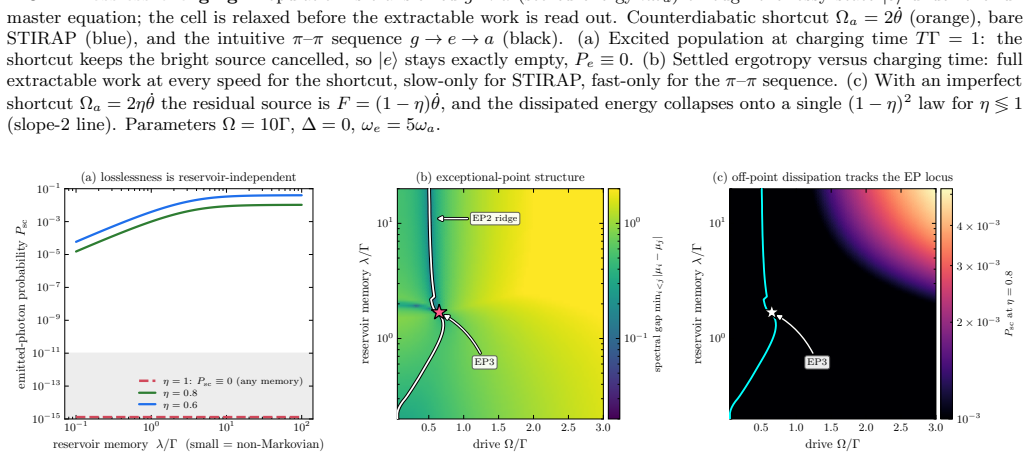
In the driven three-level cell the lossy state remains empty because a counterdiabatic field cancels the residual source that would otherwise populate it. Charging is therefore lossless for arbitrary one-photon detuning, coupling strength, linewidth, and speed, with no adiabatic elimination. The power is bounded by the drive amplitude rather than by dissipation. This reservoir independence follows because the dark sector never engages the system-bath coupling, verified to machine precision across all memory times. The entire non-Hermitian structure and dissipation phase diagram live only in the bright sector, from which the protocol is exempt by construction. The same dark-state structure co
What carries the argument
The counterdiabatic field that exactly cancels the residual drive into the lossy state, keeping the dark sector unpopulated and decoupled from the reservoir.
If this is right
- Charging power is bounded by the drive amplitude (quantum speed limit) rather than by dissipation.
- Losslessness holds for arbitrary reservoir spectral density, Markovian or non-Markovian.
- Stored charge is protected, converting fast radiative self-discharge into the slow metastable lifetime.
- The dissipation phase diagram and exceptional points reside entirely in the bright sector.
Where Pith is reading between the lines
- The protocol inverts the usual role of exceptional points or reservoir memory as resources in dissipation-engineered charging.
- Similar algebraic cancellation of lossy channels could be tested in other open quantum devices where population of decaying states limits performance.
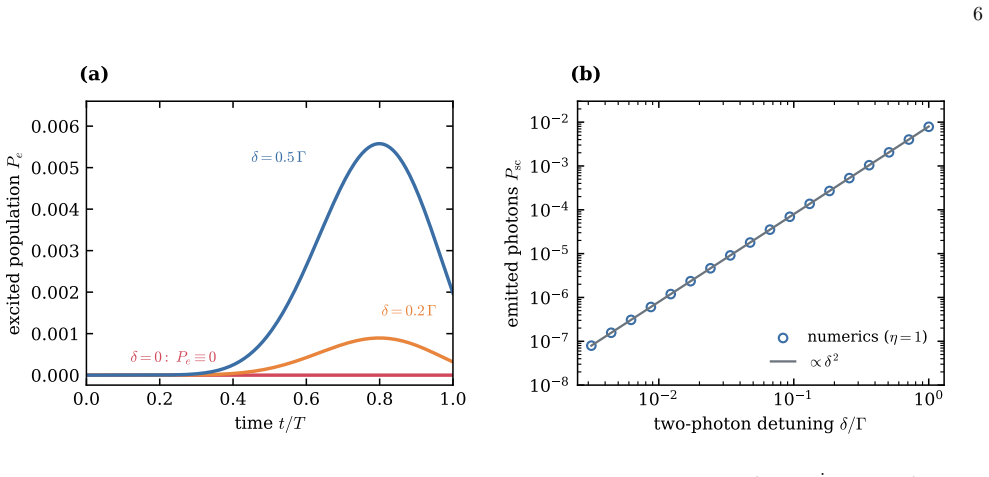
- Implementation in the suggested platforms would need control precision sufficient to keep residuals quadratic rather than linear in error.
Load-bearing premise
The counterdiabatic field can be applied exactly without introducing additional decoherence channels or control errors beyond quadratic residuals, and the system remains an ideal three-level cell.
What would settle it
Observation of nonzero population in the lossy state or emitted photons through the bridge when the counterdiabatic field is applied, at any detuning or speed, would falsify the lossless claim.
Figures


read the original abstract
A quantum battery charged through a lossy intermediate state faces a structural trade-off between charging speed and dissipation. We show that an exact algebraic cancellation removes it in a driven three-level cell: the radiatively decaying state is fed by a single bright amplitude, and a counterdiabatic field annuls the lone residual source that drives it, holding the lossy state identically empty. Charging is then lossless -- not one photon is emitted through the bridge -- at any one-photon detuning, coupling, linewidth, and speed down to the rotating-wave limit, with no adiabatic elimination, so the charging power is bounded by the drive amplitude (a quantum speed limit) rather than by dissipation. Crucially, this losslessness is independent of the reservoir: because the dark sector never engages the system-bath coupling, the emission vanishes exactly for an arbitrary spectral density, Markovian or not, as an exact damped-pseudomode treatment confirms to machine precision across all memory times. The entire non-Hermitian structure -- a Markovian second-order exceptional point that reservoir memory promotes to a third-order one, and the attendant dissipation phase diagram -- lives in the bright sector, from which the protocol is by construction exempt. This inverts dissipation-engineered charging, where an exceptional point or reservoir memory is a resource; here the lossy sector is never populated at all. The same dark-state structure protects the stored charge, converting fast radiative self-discharge into the slow metastable lifetime, with residuals quadratic in the control error. We detail experimental requirements and representative parameters for neutral alkaline-earth atoms, trapped ions, transmons, and defect centers.
Editorial analysis
A structured set of objections, weighed in public.
Referee Report
Summary. The manuscript claims that in a driven three-level quantum battery, an exact algebraic cancellation via a counterdiabatic field holds the radiatively decaying state identically empty for arbitrary detuning, coupling, linewidth, and speed (down to the RWA), yielding reservoir-independent lossless charging bounded only by the drive amplitude (a QSL) rather than dissipation; the same dark-state structure protects stored charge by converting fast radiative decay to the metastable lifetime, with the non-Hermitian structure confined to the bright sector; this is asserted to hold for arbitrary spectral densities (Markovian or not) and is confirmed to machine precision by a damped-pseudomode treatment.
Significance. If the central algebraic cancellation and its reservoir independence hold under the stated assumptions, the result would invert the usual role of dissipation in open quantum batteries, enabling charging at the quantum speed limit without photon emission through the lossy bridge and providing protected storage; this is a potentially high-impact finding for quantum thermodynamics and energy storage, with explicit experimental parameter estimates given for neutral atoms, ions, transmons, and defects.
major comments (2)
- [derivation of algebraic cancellation] The derivation of the exact cancellation that keeps the lossy state empty (described in the abstract and presumably detailed in the main text after the Hamiltonian introduction): the claim that this holds identically for arbitrary system-bath coupling operators and without the counterdiabatic term itself modifying the bath coupling requires an explicit proof that no new decoherence channels are introduced; any deviation from the ideal three-level cell would populate the lossy state and restore reservoir dependence, undermining the independence for general spectral densities.
- [damped-pseudomode numerics] The numerical confirmation via damped-pseudomode treatment (abstract): while machine-precision agreement is asserted across memory times, the manuscript must specify the exact form of the pseudomode equations used and demonstrate that the cancellation remains exact when the control field is included in the system-bath interaction Hamiltonian, rather than assuming the dark sector remains exempt by construction.
minor comments (2)
- [abstract] The abstract states the result holds 'down to the rotating-wave limit' without adiabatic elimination; clarify whether higher-order counter-rotating terms are retained in the full Hamiltonian or explicitly shown to be negligible.
- [experimental requirements] Experimental requirements section: the listed parameters for alkaline-earth atoms, ions, transmons, and defects should include quantitative estimates of the control error tolerance (quadratic residuals) needed to maintain the claimed protection.
Simulated Author's Rebuttal
We thank the referee for their careful reading and for identifying points where additional explicit derivations and specifications will strengthen the presentation. We address each major comment below and will revise the manuscript accordingly.
read point-by-point responses
-
Referee: [derivation of algebraic cancellation] The derivation of the exact cancellation that keeps the lossy state empty (described in the abstract and presumably detailed in the main text after the Hamiltonian introduction): the claim that this holds identically for arbitrary system-bath coupling operators and without the counterdiabatic term itself modifying the bath coupling requires an explicit proof that no new decoherence channels are introduced; any deviation from the ideal three-level cell would populate the lossy state and restore reservoir dependence, undermining the independence for general spectral densities.
Authors: The counterdiabatic term is a coherent drive appearing only in the system Hamiltonian; it does not alter the system-bath coupling operators, which remain strictly proportional to the dipole operator on the lossy state |e>. The algebraic cancellation is obtained by solving the Schrödinger equation in the three-level subspace and choosing the drive amplitude to null the sole matrix element feeding |e> from the bright combination. Because this nulling is exact and independent of the bath spectral density, the dark sector remains decoupled from the reservoir for any coupling operator that acts exclusively on |e>. We will add a dedicated subsection immediately after the Hamiltonian that derives this decoupling explicitly, including the commutation relations confirming that the counterdiabatic operator introduces no additional bath channels. revision: yes
-
Referee: [damped-pseudomode numerics] The numerical confirmation via damped-pseudomode treatment (abstract): while machine-precision agreement is asserted across memory times, the manuscript must specify the exact form of the pseudomode equations used and demonstrate that the cancellation remains exact when the control field is included in the system-bath interaction Hamiltonian, rather than assuming the dark sector remains exempt by construction.
Authors: We agree that the pseudomode equations and the inclusion of the control field must be stated explicitly. The damped-pseudomode model augments the system with auxiliary bosonic modes whose damping reproduces the desired spectral density; the total Hamiltonian is the sum of the three-level system Hamiltonian (including the counterdiabatic drive) and the system-pseudomode interaction, which couples only to |e>. Because the algebraic cancellation keeps the amplitude of |e> identically zero, the interaction term with the pseudomodes vanishes regardless of the drive. We will insert the explicit Lindblad-form pseudomode master equation in the methods section, together with a short numerical demonstration that the machine-precision agreement persists when the counterdiabatic term is retained in the system Hamiltonian. revision: yes
Circularity Check
No circularity: algebraic cancellation from three-level Hamiltonian is self-contained and numerically verified independently of reservoir details
full rationale
The derivation rests on an exact algebraic cancellation in the driven three-level Hamiltonian that holds the lossy state empty by construction, with the dark sector exempt from system-bath coupling. This is presented as independent of specific spectral density and confirmed via exact damped-pseudomode numerics to machine precision across memory times, without any fitting of parameters, self-citation chains, or renaming of known results. The central claim follows directly from the Hamiltonian structure and does not reduce to its inputs by definition or statistical forcing. No load-bearing steps match the enumerated circularity patterns.
Axiom & Free-Parameter Ledger
axioms (1)
- domain assumption Standard quantum optics assumptions for a driven three-level system in the rotating-wave limit hold without additional decoherence channels.
Reference graph
Works this paper leans on
-
[1]
Alicki and M
R. Alicki and M. Fannes,Entanglement boost for ex- tractable work from ensembles of quantum batteries, Phys. Rev. E87, 042123 (2013)
2013
-
[2]
Campaioli, F
F. Campaioli, F. A. Pollock, and S. Vinjanampathy, Quantum batteries, inThermodynamics in the Quantum Regime, edited by F. Binderet al.(Springer, Cham, 2018), pp. 207–225
2018
-
[3]
Campaioli, S
F. Campaioli, S. Gherardini, J. Q. Quach, M. Polini, and G. M. Andolina,Colloquium: Quantum batteries, Rev. Mod. Phys.96, 031001 (2024)
2024
-
[4]
A. E. Allahverdyan, R. Balian, and T. M. Nieuwenhuizen, Maximal work extraction from finite quantum systems, Europhys. Lett.67, 565 (2004)
2004
-
[5]
F. C. Binder, S. Vinjanampathy, K. Modi, and J. Goold, Quantacell: powerful charging of quantum batteries, New J. Phys.17, 075015 (2015)
2015
-
[6]
Campaioli, F
F. Campaioli, F. A. Pollock, F. C. Binder, L. C´ eleri, J. Goold, S. Vinjanampathy, and K. Modi,En- hancing the charging power of quantum batteries, Phys. Rev. Lett.118, 150601 (2017)
2017
-
[7]
Ferraro, M
D. Ferraro, M. Campisi, G. M. Andolina, V. Pellegrini, and M. Polini,High-power collective charging of a solid- state quantum battery, Phys. Rev. Lett.120, 117702 (2018)
2018
-
[8]
G. M. Andolina, M. Keck, A. Mari, M. Campisi, V. Gio- vannetti, and M. Polini,Extractable work, the role of cor- relations, and asymptotic freedom in quantum batteries, Phys. Rev. Lett.122, 047702 (2019)
2019
-
[9]
Farina, G
D. Farina, G. M. Andolina, A. Mari, M. Polini, and V. Giovannetti,Charger-mediated energy trans- fer for quantum batteries: An open-system approach, Phys. Rev. B99, 035421 (2019)
2019
-
[10]
Barra,Dissipative charging of a quantum battery, Phys
F. Barra,Dissipative charging of a quantum battery, Phys. Rev. Lett.122, 210601 (2019)
2019
-
[11]
Carrega, A
M. Carrega, A. Crescente, D. Ferraro, and M. Sassetti, Dissipative dynamics of an open quantum battery, New J. Phys.22, 083085 (2020)
2020
-
[12]
M. T. Mitchison, J. Goold, and J. Prior,Charging a quan- tum battery with linear feedback control, Quantum5, 500 (2021)
2021
-
[13]
J. L. Li, H. Z. Shen, and X. X. Yi,Quantum batteries in non-Markovian reservoirs, Opt. Lett.47, 5614 (2022)
2022
-
[14]
A. C. Santos,Quantum advantage of self-discharging and the non-Markovian charging of quantum batteries, New J. Phys.22, 083007 (2020)
2020
-
[15]
Xu, H.-J
K. Xu, H.-J. Zhu, G.-F. Zhang, and W.-M. Liu,Enhanc- ing the performance of an open quantum battery via envi- ronment engineering, Phys. Rev. E104, 064143 (2021)
2021
-
[16]
Morrone, M
D. Morrone, M. A. C. Rossi, A. Smirne, and M. G. Genoni,Charging a quantum battery in a non- Markovian environment: a collisional model approach, Quantum Sci. Technol.8, 035007 (2023)
2023
-
[17]
Xu, H.-G
K. Xu, H.-G. Li, H.-J. Zhu, and W.-M. Liu,Inhibiting the self-discharging process of quantum batteries in non- Markovian noises, Phys. Rev. E109, 054132 (2024)
2024
-
[18]
Barra, K
F. Barra, K. V. Hovhannisyan, and A. Imparato,Quan- tum batteries at the verge of a phase transition, New J. Phys.24, 015003 (2022)
2022
-
[19]
Mandelstam and I
L. Mandelstam and I. Tamm,The uncertainty relation between energy and time in non-relativistic quantum me- chanics, J. Phys. (USSR)9, 249 (1945)
1945
-
[20]
Margolus and L
N. Margolus and L. B. Levitin,The maximum speed of dynamical evolution, Physica D120, 188 (1998)
1998
-
[21]
Deffner and S
S. Deffner and S. Campbell,Quantum speed limits: from Heisenberg’s uncertainty principle to optimal quantum control, J. Phys. A50, 453001 (2017)
2017
- [22]
-
[23]
H.-Z. Wuet al.,Enhanced charging power in non- reciprocal quantum battery by reservoir engineering, arXiv:2512.07626
-
[24]
H.-L. Zhang, P.-R. Han, F. Wu, W. Ning, Z.-B. Yang, and S.-B. Zheng,Experimental observation of non-Markovian quantum exceptional points, arXiv:2503.06977
-
[25]
A. Ghosh and M. Bhattacharya,Non-Markovian renormalization of optomechanical exceptional points, arXiv:2603.22130
-
[26]
J. Q. Quach and W. J. Munro,Using dark states to charge and stabilize open quantum batteries, Phys. Rev. Applied 14, 024092 (2020)
2020
-
[27]
J. Liu, D. Segal, and G. Hanna,Loss-free excitonic quan- tum battery, J. Phys. Chem. C123, 18303 (2019)
2019
-
[28]
Loss-free excitonic quantum battery
´A. Tejero, J. Thingna, and D. Manzano,Comment on “Loss-free excitonic quantum battery”, J. Phys. Chem. C 125, 7518 (2021)
2021
-
[29]
A. C. Santos, B. C ¸ akmak, S. Campbell, and N. T. Zinner, Stable adiabatic quantum batteries, Phys. Rev. E100, 032107 (2019)
2019
-
[30]
A. C. Santos, A. Saguia, and M. S. Sarandy,Stable and charge-switchable quantum batteries, Phys. Rev. E101, 062114 (2020)
2020
-
[31]
Gaubatz, P
U. Gaubatz, P. Rudecki, S. Schiemann, and K. Bergmann,Population transfer between molecu- lar vibrational levels by stimulated Raman scattering with partially overlapping laser fields, J. Chem. Phys.92, 5363 (1990)
1990
-
[32]
N. V. Vitanov, A. A. Rangelov, B. W. Shore, and K. Bergmann,Stimulated Raman adiabatic passage in physics, chemistry, and beyond, Rev. Mod. Phys.89, 015006 (2017)
2017
-
[33]
Bergmannet al.,Roadmap on STIRAP applications, J
K. Bergmannet al.,Roadmap on STIRAP applications, J. Phys. B52, 202001 (2019)
2019
-
[34]
Demirplak and S
M. Demirplak and S. A. Rice,Adiabatic population trans- fer with control fields, J. Phys. Chem. A107, 9937 (2003)
2003
-
[35]
M. V. Berry,Transitionless quantum driving, J. Phys. A 42, 365303 (2009)
2009
-
[36]
X. Chen, I. Lizuain, A. Ruschhaupt, D. Gu´ ery-Odelin, and J. G. Muga,Shortcut to adiabatic passage in two- and three-level atoms, Phys. Rev. Lett.105, 123003 (2010)
2010
-
[37]
Giannelli and E
L. Giannelli and E. Arimondo,Three-level superadiabatic quantum driving, Phys. Rev. A89, 033419 (2014)
2014
-
[38]
Veps¨ al¨ ainen, S
A. Veps¨ al¨ ainen, S. Danilin, and G. S. Paraoanu,Supera- diabatic population transfer in a three-level superconduct- ing circuit, Sci. Adv.5, eaau5999 (2019)
2019
-
[39]
Gu´ ery-Odelin, A
D. Gu´ ery-Odelin, A. Ruschhaupt, A. Kiely, E. Tor- rontegui, S. Mart´ ınez-Garaot, and J. G. Muga,Short- cuts to adiabaticity: Concepts, methods, and applications, Rev. Mod. Phys.91, 045001 (2019)
2019
-
[40]
Pusz and S
W. Pusz and S. L. Woronowicz,Passive states and KMS states for general quantum systems, Com- mun. Math. Phys.58, 273 (1978)
1978
-
[41]
Lenard,Thermodynamical proof of the Gibbs formula for elementary quantum systems, J
A. Lenard,Thermodynamical proof of the Gibbs formula for elementary quantum systems, J. Stat. Phys.19, 575 (1978)
1978
-
[42]
M. B. Plenio and P. L. Knight,The quantum-jump approach to dissipative dynamics in quantum optics, Rev. Mod. Phys.70, 101 (1998)
1998
-
[43]
Breuer and F
H.-P. Breuer and F. Petruccione,The Theory of Open Quantum Systems(Oxford University Press, Oxford, 2002)
2002
-
[44]
B. M. Garraway,Nonperturbative decay of an atomic sys- tem in a cavity, Phys. Rev. A55, 2290 (1997)
1997
-
[45]
D. A. Lidar, I. L. Chuang, and K. B. Whaley, Decoherence-free subspaces for quantum computation, Phys. Rev. Lett.81, 2594 (1998)
1998
-
[46]
A. D. Ludlow, M. M. Boyd, J. Ye, E. Peik, and P. O. Schmidt,Optical atomic clocks, Rev. Mod. Phys.87, 637 (2015)
2015
-
[47]
C. D. Bruzewicz, J. Chiaverini, R. McConnell, and J. M. Sage,Trapped-ion quantum computing: Progress and challenges, Appl. Phys. Rev.6, 021314 (2019)
2019
-
[48]
K. S. Kumar, A. Veps¨ al¨ ainen, S. Danilin, and G. S. Paraoanu,Stimulated Raman adiabatic passage in a three-level superconducting circuit, Nat. Commun.7, 10628 (2016)
2016
-
[49]
Chenet al.,Efficient charging and discharging of a superconducting quantum battery through frequency- modulated driving, Appl
Z. Chenet al.,Efficient charging and discharging of a superconducting quantum battery through frequency- modulated driving, Appl. Phys. Lett.123, 154002 (2023)
2023
-
[50]
Krantz, M
P. Krantz, M. Kjaergaard, F. Yan, T. P. Orlando, S. Gus- tavsson, and W. D. Oliver,A quantum engineer’s guide to superconducting qubits, Appl. Phys. Rev.6, 021318 (2019)
2019
-
[51]
M. W. Doherty, N. B. Manson, P. Delaney, F. Jelezko, J. Wrachtrup, and L. C. L. Hollenberg,The nitrogen- vacancy colour centre in diamond, Phys. Rep.528, 1 (2013)
2013
-
[52]
W. D. Heiss,The physics of exceptional points, J. Phys. A 45, 444016 (2012)
2012
-
[53]
Miri and A
M.-A. Miri and A. Al` u,Exceptional points in optics and photonics, Science363, eaar7709 (2019)
2019
discussion (0)
Sign in with ORCID, Apple, or X to comment. Anyone can read and Pith papers without signing in.