REVIEW 3 major objections 5 minor 2 cited by
Radial Profiles of Radio Halos in Massive Galaxy Clusters: Diffuse Giants Over 2 Mpc
T0 review · 3 major / 5 minor · reviewed 2026-08-15 · deepseek-v4-flash
Pith's one-line read Radio halos in galaxy clusters can extend beyond 2 Mpc — and still show the same single-exponential radial profile as ordinary halos, with no separate outer component.
desk verdict Genuinely useful observations that reframe mega-halos as the bright tail of classical halos, with a strong cautionary tale about source subtraction, but the one-component claim still needs a formal model comparison on the same masked data. read the letter →
The pith
A machine-rendered reading of the paper's core claim, the machinery that carries it, and where it could break.
The reading
What carries the argument
The central object is the azimuthally averaged radial surface-brightness profile, fit to the exponential $I(r)=I_0e^{-r/r_e}$, with $r_e$ the e-folding radius and $I_0$ the central brightness. The paper's decisive diagnostic is a comparison of two source-removal strategies applied to these profiles: masking compact and extended unrelated sources on sensitive high-frequency maps, versus subtracting sources from the $uv$-data using an inner $uv$-cut. Masking yields single-component profiles at every frequency; $uv$-subtraction produces a spurious shallow outer component at large radii. Supporting machinery includes the emissivity estimate $\langle J\rangle\simeq 7.7\times10^{-41}(1+z)^{3-\alpha}I_0/r_e$, used with the $I_0$–$r_e$ plane to show that these halos occupy the same locus as classical halos.
What would settle it
Use a cluster with a reported two-component profile, build a high-frequency map deep enough that any unmasked compact source contributes below $3\sigma$ at $R_{500}$, mask sources from that map, and refit the radial profile; if a shallower outer component still persists at large radius, the paper's artifact explanation is ruled out for that cluster.
Extended reading notes
Core claim
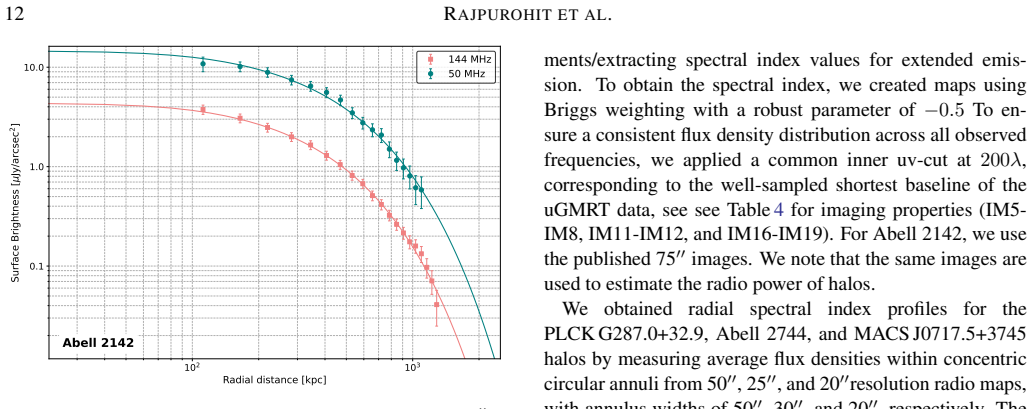
The central claim, stated on the paper's own terms, is that radio halos can extend to the cluster periphery—beyond 2 Mpc and out to $R_{500}$ (the radius within which the mean density is 500 times the critical density)—without transitioning into an observationally distinguishable outer component. After masking discrete sources with sensitive high-frequency maps, each halo's azimuthally averaged surface brightness follows a single component $I(r)=I_0 e^{-r/r_e}$, the spectral index steepens with radius, and the emissivity is about $10^{-42}\,\mathrm{erg\,s^{-1}\,cm^{-3}\,Hz^{-1}}$, the same as classical halos. The apparent shallow second component seen in some published profiles is reproduced in this paper when unrelated sources are subtracted from the $uv$-data rather than masked, and is traced to residual unmasked sources plus the choice of annulus geometry and center. The observable size of a halo is therefore set by image depth, $uv$-coverage, and radio power; PLCK G287.0+32.9 is reported as the first halo detected beyond about 2.5 Mpc at 2.4 GHz and extending to about 3.5 Mpc at lower high frequencies.
Load-bearing premise
The conclusion that no distinct outer component exists depends on the assumption that all unrelated radio sources embedded in the halo, including faint steep-spectrum filaments, are identifiable in sensitive high-frequency maps and can be masked out without removing genuine halo emission.
Editorial extensions
If this is right
- If the central claim is right, a two-component radial profile alone is not evidence for a new class of radio halos; classification needs high-frequency source masks plus independent diagnostics such as spectral index gradients and X-ray correlation.
- Observed halo sizes in flux-limited samples are biased by sensitivity and $uv$-coverage, so the frequency of >2 Mpc halos and the $P_{1.4\,\mathrm{GHz}}$–$M_{500}$ scaling relation should be re-derived with depth-matched observations.
- Relativistic electrons and magnetic fields must be present beyond $R_{500}$ in these systems, consistent with turbulence reacceleration acting throughout the cluster volume rather than only in the core.
- The first high-frequency halo exceeding 2 Mpc, in PLCK G287.0+32.9, implies that giant halos are not a low-frequency-only phenomenon and should be searched for in high-frequency surveys.
Reading between the lines
- Extension: if the sensitivity-limited picture is correct, the apparent scarcity of >2 Mpc halos in current samples may reflect flux limits rather than physics; deeper surveys should find more giant halos, potentially dissolving the mega-halo class without requiring a new emission mechanism.
- Extension: the same artifact mechanism implies that radial-profile decompositions of any faint extended radio source—not only cluster halos—should be validated by quantifying the completeness of the source catalogue as a function of radius.
- Extension: comparing the single-exponential fit at 2.4 GHz out to 2.5 Mpc with the steeper-spectrum outer regions could test whether in-situ reacceleration operates at large radii, since high-frequency synchrotron electrons lose energy quickly and would otherwise produce a sharper cutoff.
Signed reviews
Editorial analysis
A structured set of objections, weighed in public.
Referee Report
Summary. This paper presents new MeerKAT and uGMRT observations of three massive merging clusters (PLCK G287.0+32.9, Abell 2744, Bullet) and combines them with published LOFAR/MeerKAT data for MACS J0717+3745 and Abell 2142. The authors measure azimuthally averaged radial brightness profiles at multiple frequencies and report that all five halos, despite linear sizes exceeding 2 Mpc, are well described by a single-component exponential, show radial spectral steepening, and have emissivities near 10^-42 erg/s/cm3/Hz. They argue that the apparent two-component 'mega-halo' profiles reported elsewhere arise from incomplete subtraction of unrelated radio sources, and that the observable size of a halo is set by image depth, uv-coverage, and radio power rather than by a distinct outer physical component.
Significance. If correct, the result challenges the existence of a distinct 'mega-halo' class defined by two-component radial profiles and supports a unified picture of radio halos whose apparent extent is limited by sensitivity. The paper strengthens this case with explicit systematic tests: direct comparison of masking versus uv-subtraction (Figure 12), sector geometry and center choices (Figure 15), and a residual analysis for Abell 2142. It also compares its fitted parameters against an external literature sample (Murgia et al. 2024), avoiding circularity. The main unresolved risk is that the single-component conclusion rests on the completeness of the high-frequency source catalog, which is not quantified, and the contradiction with Bruno et al. (2023) for Abell 2142 is not resolved by formal model comparison.
major comments (3)
- [Section 5.1, Figure 12] The single-component conclusion is conditional on the completeness of the high-frequency source catalog used for masking. The paper shows that two-component profiles appear under low-frequency masking and under uv-subtraction, and attributes these to incomplete source subtraction, but no quantitative one- versus two-component fit comparison (e.g., Δχ² or AIC/BIC) is presented for the same masked data for any cluster. Because the same data can produce two-component profiles under a defensible processing choice, please provide formal fit statistics that test whether the single exponential is statistically preferred, or explicitly state the conditions under which the conclusion holds.
- [Section 4.1, Abell 2142] The paper contrasts its single-component fit with the two-component fit reported by Bruno et al. (2023) using the same images. This is a direct contradiction with a published analysis; the proposed resolution (masking differences) is plausible but not quantified. Please report the fit quality (e.g., reduced χ² or ΔBIC) for both single- and two-component models under the different masking choices, so that the reader can verify that the single-component description is actually favored by the data.
- [Section 5.1, Figure 13] The classification of the filamentary structures in PLCK G287.0+32.9 as unrelated to the halo is deferred to unpublished work (Rajpurohit et al. in prep). Since this classification is load-bearing for the central claim, please include the supporting evidence (e.g., spectral index or polarization measurements) or explicitly temper the corresponding statements in Sections 5 and 6.
minor comments (5)
- [Section 4.3, after Eq. (4)] The sentence stating that the fitted flux densities for PLCK G287.0+32.9 and Abell 2142 are 'lower than the measured values by a factor of two' is contradicted by Table 7, which lists S_fitted > S_measured for both clusters; please correct the direction of the comparison.
- [Section 4.1, PLCK G287.0+32.9 paragraph] The statement that the best-fit e-folding radius is 'smaller at lower frequencies' does not match Table 6 (re = 265, 325, 305, 227 kpc at 350, 815, 1280, 2400 MHz, respectively); the sentence should be clarified, including the sensitivity argument for the 350 MHz data.
- [Figure 12 caption] The description of the residual profile as 'obtained by subtracting the uv-subtracted sources profile from the masked out sources profile' is ambiguous; the text in Section 5.1 indicates the subtraction is between the high-frequency-masked and low-frequency-masked profiles, so the caption should be reworded.
- [Table 6] The column header 'rd' for the maximum detected radial distance is not defined; please spell it out or use a clearer label to avoid confusion with the e-folding radius re.
- [Throughout] The paper uses both 'mega-halos' and 'mega halos'; please adopt a single hyphenation convention.
Circularity Check
Mostly self-contained; the emissivity and single-exponential comparisons rest on external samples, but the PLCK G287.0+32.9 filament classification is deferred to a same-author unpublished work.
-
self citation load bearing
[Section 5.1, discussion of Figure 13 (PLCK G287.0+32.9 filaments)]
"These structures appear more diffuse at lower frequencies and are not associated with the halo emission but rather projected onto it (Rajpurohit et al. in prep)."
The paper's central negative claim for PLCK G287.0+32.9 is that the second radial component is an artifact of incomplete source subtraction rather than a real outer halo component. That claim depends on classifying the embedded filamentary structures as unrelated to the halo, and this classification is not demonstrated in the present paper but is cited to 'Rajpurohit et al. in prep,' an unpublished work with overlapping authorship. If the in-prep classification itself assumes that any extra component in the radial profile is contamination, the argument becomes circular; at minimum, the load-bearing evidence is a self-citation rather than an independent test. The rest of the analysis is self-contained against external data, so this is a minor, localized circularity rather than a global one.
full rationale
The paper's main quantitative results are not circular. The radial profiles are fitted to an exponential model, and the derived e-folding radii and central brightnesses are then compared with the external sample of Murgia et al. (2024) on the I0-re plane; the emissivity comparison is therefore an external benchmark, not a restatement of the fit inputs. The conclusion that the five large halos resemble classical halos is supported by this external comparison and by the observed spectral steepening, which is measured independently of the exponential fits. The single-component versus two-component issue is a correctness risk rather than a circularity: the paper shows that masking choices alter the apparent profile, but it does not report a formal one-component versus two-component model comparison, so the visual single-exponential description is not a quantitative rejection of an outer component. The one genuine circularity concern is the PLCK G287.0+32.9 filament classification, which is load-bearing for the claim that no distinct outer component exists in that cluster and is justified by an unpublished same-author work. Because the rest of the derivation is independent and the external emissivity comparison anchors the main claim, the overall circularity score is low.
Assumptions & free parameters
free parameters (3)
- I0 (central radio surface brightness) =
1.43 to 42.2 microJy/arcsec^2 depending on cluster and frequency (Table 6)
- re (e-folding radius) =
203 to 325 kpc depending on cluster and frequency (Table 6)
- Integrated spectral index alpha used for k-corrections =
-1.1 to -1.5 per cluster, adopted from previous literature
assumptions (5)
- domain assumption The exponential surface brightness model I(r) = I0 exp(-r/re) is adopted for comparison, although the paper states it is not physically motivated.
- domain assumption Spherical symmetry of halo emission when averaging in circular annuli and deriving emissivity.
- domain assumption Homogeneous emitting volume with filling factor f = 1 for emissivity.
- domain assumption All unrelated discrete and extended sources embedded in the halo are identifiable in high-frequency maps and can be masked without removing genuine halo emission.
- domain assumption Adopted flat LambdaCDM cosmology and literature spectral indices for distance and k-correction.
Cite this review
Pith. "Pith review of Radial Profiles of Radio Halos in Massive Galaxy Clusters: Diffuse Giants Over 2 Mpc." pith.science (2026). https://pith.science/paper/UYHZSBSC
@misc{pith2026250505415,
  author       = {Pith},
  title        = {Pith review of: Radial Profiles of Radio Halos in Massive Galaxy Clusters: Diffuse Giants Over 2 Mpc},
  year         = {2026},
  howpublished = {\url{https://pith.science/paper/UYHZSBSC}},
  note         = {Machine review of arXiv:2505.05415}
}
abstract
We present new, high frequency radio observations of the merging galaxy clusters PLCK G287.0+32.9, Abell 2744, and Bullet. These clusters are known to host $\sim$Mpc scale sources, known as radio halos, which are formed by the acceleration of cosmic rays by turbulence injected into the intracluster medium during cluster mergers. Our new images reveal previously undetected faint outermost regions of halos, extending to over 2 Mpc. This discovery highlights the presence of radio halos with large extents at high frequencies and suggests that their observable size depends on a combination of the observation sensitivity and uv-coverage, and their radio power. We additionally compare the properties of these three clusters with MACS J0717+3745 and Abell 2142, both of which are known to host prominent large radio halos. Remarkably, all five halos, despite their exceptionally large extents, exhibit properties similar to other classical halos: their radial profiles are described by a single-component exponential fit, they show radial spectral index steepening, and have an average radio emissivity of about $10^{-42}\, \mathrm{erg\,s^{-1}\,cm^{-3}\,Hz^{-1}}$. Our results demonstrate that radio halos can extend to the cluster periphery, without the transition to an observationally distinguishable different halo component in the outermost regions. Our findings highlight that careful subtraction of unrelated sources embedded in the halo is necessary to measure the radio surface brightness accurately, as incomplete subtraction can introduce an apparent secondary component in the peripheral regions.
Figures


Figures from the paper (12 more)




Forward citations
Cited by 2 Pith papers
-
Two-component large-scale radio emission in Abell 2244
Abell 2244 hosts a two-component radio halo whose outer part has a flatter spectral index than megahaloes and a weaker radio-X-ray correlation than the inner halo.
-
Multi-Wavelength Signatures of a Giant Cometary Radio Halo in MACSJ0417-1154
MACSJ0417’s giant radio halo shows spectral steepening and radio–X-ray correlation consistent with turbulence from a 6:1 off-axis merger that preserved the cool core; pure hadronic models are energetically excluded.
Reference graph
Works this paper leans on
-
[1]
Bagchi, J., Sirothia, S. K., Werner, N., et al. 2011, ApJL, 736, L8, doi: 10.1088/2041-8205/736/1/L8
-
[2]
2024, A&A, 686, A82, doi: 10.1051/0004-6361/202348045
Biava, N., Bonafede, A., Gastaldello, F., et al. 2024, A&A, 686, A82, doi: 10.1051/0004-6361/202348045
-
[3]
1999, Astroparticle Physics, 12, 169, doi: 10.1016/S0927-6505(99)00079-1
Blasi, P., & Colafrancesco, S. 1999, Astroparticle Physics, 12, 169, doi: 10.1016/S0927-6505(99)00079-1
-
[4]
Bonafede, A., Intema, H. T., Brüggen, M., et al. 2014, ApJ, 785, 1, doi: 10.1088/0004-637X/785/1/1
-
[5]
2009, A&A, 503, 707, doi: 10.1051/0004-6361/200912520
Bonafede, A., Feretti, L., Giovannini, G., et al. 2009, A&A, 503, 707, doi: 10.1051/0004-6361/200912520
-
[6]
2018, MNRAS, 478, 2927, doi: 10.1093/mnras/sty1121
Bonafede, A., Brüggen, M., Rafferty, D., et al. 2018, MNRAS, 478, 2927, doi: 10.1093/mnras/sty1121
-
[7]
2022, ApJ, 933, 218, doi: 10.3847/1538-4357/ac721d
Bonafede, A., Brunetti, G., Rudnick, L., et al. 2022, ApJ, 933, 218, doi: 10.3847/1538-4357/ac721d
-
[8]
Shimwell, T. W. 2023, A&A, 674, A53, doi: 10.1051/0004-6361/202346150
Show all 69 references
-
[9]
W., Bonafede, A., et al
Botteon, A., Shimwell, T. W., Bonafede, A., et al. 2018, MNRAS, 478, 885, doi: 10.1093/mnras/sty1102
2018 doi
-
[10]
J., et al
Botteon, A., Brunetti, G., van Weeren, R. J., et al. 2020, ApJ, 897, 93, doi: 10.3847/1538-4357/ab9a2f
2020 doi
-
[11]
W., Cassano, R., et al
Botteon, A., Shimwell, T. W., Cassano, R., et al. 2022a, A&A, 660, A78, doi: 10.1051/0004-6361/202143020
-
[12]
J., Brunetti, G., et al
Botteon, A., van Weeren, R. J., Brunetti, G., et al. 2022b, Science Advances, 8, eabq7623, doi: 10.1126/sciadv.abq7623
-
[13]
J., Eckert, D., et al
Botteon, A., van Weeren, R. J., Eckert, D., et al. 2024, A&A, 690, A222, doi: 10.1051/0004-6361/202451293
2024 doi
-
[14]
Brunetti, G., & Jones, T. W. 2014, International Journal of Modern Physics D, 23, 1430007, doi: 10.1142/S0218271814300079
2014 doi
-
[16]
2001, MNRAS, 320, 365, doi: 10.1046/j.1365-8711.2001.03978.x
Brunetti, G., Setti, G., Feretti, L., & Giovannini, G. 2001, MNRAS, 320, 365, doi: 10.1046/j.1365-8711.2001.03978.x
2001
-
[17]
2017, MNRAS, 472, 1506, doi: 10.1093/mnras/stx2092
Brunetti, G., Zimmer, S., & Zandanel, F. 2017, MNRAS, 472, 1506, doi: 10.1093/mnras/stx2092
2017 doi
-
[18]
2023, A&A, 678, A133, doi: 10.1051/0004-6361/202347245
Bruno, L., Botteon, A., Shimwell, T., et al. 2023, A&A, 678, A133, doi: 10.1051/0004-6361/202347245
2023 doi
-
[19]
2007, MNRAS, 378, 1565, doi: 10.1111/j.1365-2966.2007.11901.x
Cassano, R., Brunetti, G., Setti, G., Govoni, F., & Dolag, K. 2007, MNRAS, 378, 1565, doi: 10.1111/j.1365-2966.2007.11901.x
2007
-
[20]
2017, ApJ, 846, 111, doi: 10.3847/1538-4357/aa85a2
Chandra, P., & Kanekar, N. 2017, ApJ, 846, 111, doi: 10.3847/1538-4357/aa85a2
2017 doi
-
[21]
2021, A&A, 647, A51, doi: 10.1051/0004-6361/202039208
Cuciti, V ., Cassano, R., Brunetti, G., et al. 2021, A&A, 647, A51, doi: 10.1051/0004-6361/202039208
2021 doi
-
[22]
2022, Nature, 609, 911, doi: 10.1038/s41586-022-05149-3 Di Gennaro, G., van Weeren, R
Cuciti, V ., de Gasperin, F., Brüggen, M., et al. 2022, Nature, 609, 911, doi: 10.1038/s41586-022-05149-3 Di Gennaro, G., van Weeren, R. J., Hoeft, M., et al. 2018, ApJ, 865, 24, doi: 10.3847/1538-4357/aad738
2022 doi
-
[23]
Dolag, K., & Enßlin, T. A. 2000, A&A, 362, 151
2000
-
[24]
W., Botteon, A., Koribalski, B
Duchesne, S. W., Botteon, A., Koribalski, B. S., et al. 2024, PASA, 41, e026, doi: 10.1017/pasa.2024.10
2024 doi
-
[25]
2001, A&A, 373, 106, doi: 10.1051/0004-6361:20010581
Feretti, L., Fusco-Femiano, R., Giovannini, G., & Govoni, F. 2001, A&A, 373, 106, doi: 10.1051/0004-6361:20010581
2001 doi
-
[26]
T., Dwarakanath, K
George, L. T., Dwarakanath, K. S., Johnston-Hollitt, M., et al. 2017, MNRAS, 467, 936, doi: 10.1093/mnras/stx155
2017 doi
-
[27]
A., Wittman, D
Golovich, N., Dawson, W. A., Wittman, D. M., et al. 2019, ApJ, 882, 69, doi: 10.3847/1538-4357/ab2f90
2019 doi
-
[28]
A., Feretti, L., & Giovannini, G
Govoni, F., Enßlin, T. A., Feretti, L., & Giovannini, G. 2001, A&A, 369, 441, doi: 10.1051/0004-6361:20010115
2001 doi
-
[29]
N., Shimwell, T
Hoang, D. N., Shimwell, T. W., Stroe, A., et al. 2017, MNRAS, 471, 1107, doi: 10.1093/mnras/stx1645
2017 doi
-
[30]
Hunter, J. D. 2007, Computing in Science & Engineering, 9, 90, doi: 10.1109/MCSE.2007.55
2007 doi
-
[31]
T., van der Tol, S., Cotton, W
Intema, H. T., van der Tol, S., Cotton, W. D., et al. 2009, A&A, 501, 1185, doi: 10.1051/0004-6361/200811094
2009 doi
-
[32]
2018, MNRAS, 481, 2901, doi: 10.1093/mnras/sty2366 Józsa, G
Jauzac, M., Eckert, D., Schaller, M., et al. 2018, MNRAS, 481, 2901, doi: 10.1093/mnras/sty2366 Józsa, G. I. G., White, S. V ., Thorat, K., et al. 2020, CARACal: Containerized Automated Radio Astronomy Calibration pipeline, Astrophysics Source Code Library, record ascl:2006.01...
2018 doi
-
[33]
C., & David, L
Kempner, J. C., & David, L. P. 2004, MNRAS, 349, 385, doi: 10.1111/j.1365-2966.2004.07534.x
2004
-
[34]
S., Smirnov, O
Kenyon, J. S., Smirnov, O. M., Grobler, T. L., & Perkins, S. J. 2018, MNRAS, 478, 2399, doi: 10.1093/mnras/sty1221
2018 doi
-
[35]
D., Rudnick, L., et al
Knowles, K., Cotton, W. D., Rudnick, L., et al. 2022, A&A, 657, A56, doi: 10.1051/0004-6361/202141488
2022 doi
-
[36]
W., Birkinshaw, M., & Andreani, P
Liang, H., Hunstead, R. W., Birkinshaw, M., & Andreani, P. 2000, ApJ, 544, 686, doi: 10.1086/317223 RADIO HALOS OVER 2 M PC IN MASSIVE GALAXY CLUSTERS 21
2000 doi
-
[37]
H., David, L., et al
Markevitch, M., Gonzalez, A. H., David, L., et al. 2002, ApJL, 567, L27, doi: 10.1086/339619
2002 doi
-
[38]
2011, MNRAS, 417, 333, doi: 10.1111/j.1365-2966.2011.19266.x
Merten, J., Coe, D., Dupke, R., et al. 2011, MNRAS, 417, 333, doi: 10.1111/j.1365-2966.2011.19266.x
2011
-
[39]
2015, ApJ, 800, 60, doi: 10.1088/0004-637X/800/1/60
Miniati, F. 2015, ApJ, 800, 60, doi: 10.1088/0004-637X/800/1/60
2015 doi
-
[40]
2009, A&A, 499, 679, doi: 10.1051/0004-6361/200911659
Murgia, M., Govoni, F., Markevitch, M., et al. 2009, A&A, 499, 679, doi: 10.1051/0004-6361/200911659
2009 doi
-
[41]
2024, MNRAS, 528, 6470, doi: 10.1093/mnras/stae436
Murgia, M., Govoni, F., Vacca, V ., et al. 2024, MNRAS, 528, 6470, doi: 10.1093/mnras/stae436
2024 doi
-
[42]
R., de Bruyn, A
Offringa, A. R., de Bruyn, A. G., Biehl, M., et al. 2010, MNRAS, 405, 155, doi: 10.1111/j.1365-2966.2010.16471.x
2010
-
[43]
R., McKinley, B., Hurley-Walker, N., et al
Offringa, A. R., McKinley, B., Hurley-Walker, N., et al. 2014, MNRAS, 444, 606, doi: 10.1093/mnras/stu1368 Orrú, E., Murgia, M., Feretti, L., et al. 2007, A&A, 467, 943, doi: 10.1051/0004-6361:20066118
2014 doi
-
[44]
J., Brunetti, G., et al
Osinga, E., van Weeren, R. J., Brunetti, G., et al. 2024, A&A, 688, A175, doi: 10.1051/0004-6361/202348002
2024 doi
-
[45]
S., Randall, S
Owers, M. S., Randall, S. W., Nulsen, P. E. J., et al. 2011, ApJ, 728, 27, doi: 10.1088/0004-637X/728/1/27
2011 doi
-
[46]
Paul, S., Salunkhe, S., Datta, A., & Intema, H. T. 2019, MNRAS, 489, 446, doi: 10.1093/mnras/stz1965
2019 doi
-
[47]
Pearce, C. J. J., van Weeren, R. J., Andrade-Santos, F., et al. 2017, ApJ, 845, 81, doi: 10.3847/1538-4357/aa7e2f
2017 doi
-
[48]
A., & Butler, B
Perley, R. A., & Butler, B. J. 2013, ApJS, 204, 19, doi: 10.1088/0067-0049/204/2/19
2013 doi
-
[49]
2001, ApJ, 557, 560, doi: 10.1086/321557
Petrosian, V . 2001, ApJ, 557, 560, doi: 10.1086/321557
2001 doi
-
[50]
A., & Springel, V
Pfrommer, C., Enßlin, T. A., & Springel, V . 2008, MNRAS, 385, 1211, doi: 10.1111/j.1365-2966.2008.12956.x
2008
-
[51]
P., & Pfrommer, C
Pinzke, A., Oh, S. P., & Pfrommer, C. 2017, MNRAS, 465, 4800, doi: 10.1093/mnras/stw3024 Planck Collaboration, Ade, P. A. R., Aghanim, N., et al. 2016, A&A, 594, A13, doi: 10.1051/0004-6361/201525830
2017 doi
-
[52]
J., et al
Rajpurohit, K., Hoeft, M., van Weeren, R. J., et al. 2018, ApJ, 852, 65, doi: 10.3847/1538-4357/aa9f13
2018 doi
-
[53]
2020, A&A, 636, A30, doi: 10.1051/0004-6361/201937139
Rajpurohit, K., Hoeft, M., Vazza, F., et al. 2020, A&A, 636, A30, doi: 10.1051/0004-6361/201937139
2020 doi
-
[54]
J., et al
Rajpurohit, K., Vazza, F., van Weeren, R. J., et al. 2021a, A&A, 654, A41, doi: 10.1051/0004-6361/202141060
-
[55]
2021b, A&A, 646, A135, doi: 10.1051/0004-6361/202039591
Rajpurohit, K., Brunetti, G., Bonafede, A., et al. 2021b, A&A, 646, A135, doi: 10.1051/0004-6361/202039591
-
[56]
J., et al
Rajpurohit, K., Wittor, D., van Weeren, R. J., et al. 2021c, A&A, 646, A56, doi: 10.1051/0004-6361/202039428
-
[57]
2022a, A&A, 657, A2, doi: 10.1051/0004-6361/202142340
Rajpurohit, K., Hoeft, M., Wittor, D., et al. 2022a, A&A, 657, A2, doi: 10.1051/0004-6361/202142340
-
[58]
J., Hoeft, M., et al
Rajpurohit, K., van Weeren, R. J., Hoeft, M., et al. 2022b, ApJ, 927, 80, doi: 10.3847/1538-4357/ac4708
-
[59]
2023, A&A, 669, A1, doi: 10.1051/0004-6361/202244925
Rajpurohit, K., Osinga, E., Brienza, M., et al. 2023, A&A, 669, A1, doi: 10.1051/0004-6361/202244925
2023 doi
-
[60]
J., Bonafede, A., Bruno, L., et al
Riseley, C. J., Bonafede, A., Bruno, L., et al. 2024, A&A, 686, A44, doi: 10.1051/0004-6361/202348944
2024 doi
-
[61]
2012, APLpy: Astronomical Plotting Library in Python
Robitaille, T., & Bressert, E. 2012, APLpy: Astronomical Plotting Library in Python. http://ascl.net/1208.017
2012
-
[62]
2025, arXiv e-prints, arXiv:2503.12136
Salunkhe, S., Santra, R., & Kale, R. 2025, arXiv e-prints, arXiv:2503.12136. https://arxiv.org/abs/2503.12136
2025 arXiv
-
[63]
Scaife, A. M. M., & Heald, G. H. 2012, MNRAS, 423, L30, doi: 10.1111/j.1745-3933.2012.01251.x
2012
-
[64]
W., Brown, S., Feain, I
Shimwell, T. W., Brown, S., Feain, I. J., et al. 2014, MNRAS, 440, 2901, doi: 10.1093/mnras/stu467
2014 doi
-
[65]
W., Hardcastle, M
Shimwell, T. W., Hardcastle, M. J., Tasse, C., et al. 2022, A&A, 659, A1, doi: 10.1051/0004-6361/202142484
2022 doi
-
[66]
2020, ApJ, 897, 115, doi: 10.3847/1538-4357/ab962c
Shweta, A., Athreya, R., & Sekhar, S. 2020, ApJ, 897, 115, doi: 10.3847/1538-4357/ab962c
2020 doi
-
[67]
P., Knowles, K., Hilton, M., Moodley, K., & Murgia, M
Sikhosana, S. P., Knowles, K., Hilton, M., Moodley, K., & Murgia, M. 2023, MNRAS, 518, 4595, doi: 10.1093/mnras/stac3370
2023 doi
-
[68]
2011, A&A, 535, A82, doi: 10.1051/0004-6361/201117607 van Weeren, R
Vacca, V ., Govoni, F., Murgia, M., et al. 2011, A&A, 535, A82, doi: 10.1051/0004-6361/201117607 van Weeren, R. J., de Gasperin, F., Akamatsu, H., et al. 2019, SSRv, 215, 16, doi: 10.1007/s11214-019-0584-z van Weeren, R. J., Röttgering, H. J. A., Brüggen, M., & Cohen, A. 2009,...
2011 doi
-
[69]
2013, A&A, 551, A24, doi: 10.1051/0004-6361/201219872
Venturi, T., Giacintucci, S., Dallacasa, D., et al. 2013, A&A, 551, A24, doi: 10.1051/0004-6361/201219872
2013 doi
-
[70]
2017, A&A, 603, A125, doi: 10.1051/0004-6361/201630014
Venturi, T., Rossetti, M., Brunetti, G., et al. 2017, A&A, 603, A125, doi: 10.1051/0004-6361/201630014
2017 doi
Reviewed August 15, 2026 · model on record in the stance chip above.
Discussion (0). Continue with ORCID to comment.