Parameter estimation in a fully coupled partially observed Ornstein-Uhlenbeck process
Pith reviewed 2026-06-30 03:14 UTC · model grok-4.3
The pith
The maximum likelihood estimator for the coupling parameter in a partially observed two-dimensional Ornstein-Uhlenbeck process is consistent, asymptotically normal, and efficient as the time horizon tends to infinity.
A machine-rendered reading of the paper's core claim, the machinery that carries it, and where it could break.
Core claim
The likelihood for the partially observed fully coupled Ornstein-Uhlenbeck system is derived using linear filtering. The model satisfies local asymptotic normality in the Ibragimov-Hasminskii sense under stability and identifiability assumptions. As a result, the maximum likelihood estimator of the coupling parameter is consistent, asymptotically normal, has moments converging to those of the limit, and is asymptotically efficient as the time horizon tends to infinity.
What carries the argument
Linear filtering applied to the fully coupled partially observed two-dimensional Ornstein-Uhlenbeck process to derive the likelihood function that enables local asymptotic normality.
If this is right
- The maximum likelihood estimator converges to the true coupling parameter value.
- The estimator, scaled by the square root of the time horizon, converges in distribution to a normal law.
- All moments of the estimator converge to the moments of the limiting normal distribution.
- The estimator is asymptotically efficient, attaining the information bound from the local asymptotic normality.
Where Pith is reading between the lines
- The filtering derivation incorporates the feedback from the hidden coordinate into the observed drift, which is the source of the full coupling.
- The result justifies applying the estimator to long observation records of linear Gaussian systems that meet the stability conditions.
Load-bearing premise
The two-dimensional OU system must satisfy the stability and identifiability conditions so that the Ibragimov-Hasminskii local asymptotic normality framework applies under partial observation.
What would settle it
Generating long sample paths of the two-dimensional Ornstein-Uhlenbeck process under the stated assumptions and verifying whether the empirical distribution of the suitably normalized maximum likelihood estimator approaches the predicted normal distribution would confirm or refute the asymptotic claims.
Figures
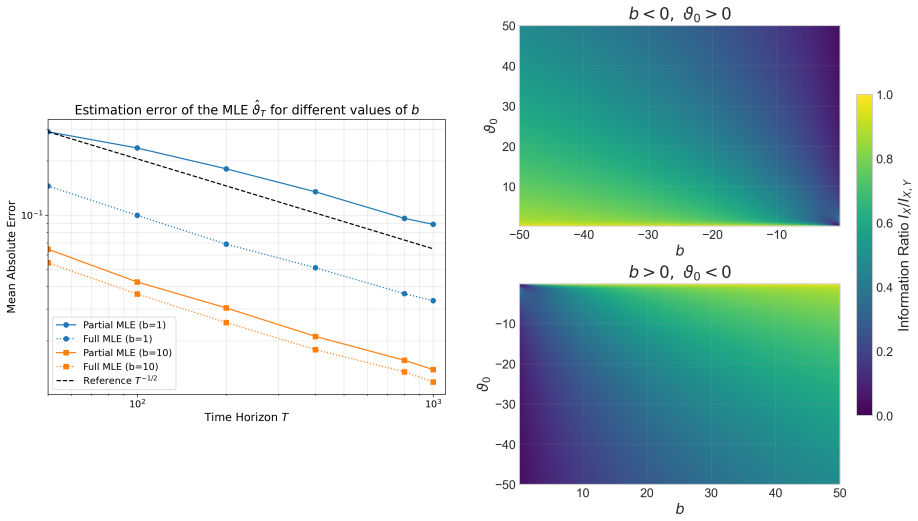
read the original abstract
We study a two-dimensional Ornstein-Uhlenbeck system where only the first coordinate is observed, whereas the second coordinate remains hidden. Our goal is the estimation of the coupling parameter in the drift of the observed coordinate. The core novelty lies in accounting for the influence of the observed component on the unobserved one, making the system fully coupled. Using linear filtering, we derive the likelihood under partial observation and establish local asymptotic normality of the statistical model. Within the Ibragimov-Hasminskii framework (1981), we prove consistency, asymptotic normality, convergence of moments and asymptotic efficiency of the MLE under stability and identifiability assumptions as the time horizon tends to infinity.
Editorial analysis
A structured set of objections, weighed in public.
Referee Report
Summary. The manuscript studies parameter estimation for the coupling parameter in a two-dimensional Ornstein-Uhlenbeck process with partial observation (only the first coordinate observed). It derives the exact innovation likelihood via the Kalman filter for the fully coupled linear system and invokes the Ibragimov-Hasminskii (1981) framework to establish local asymptotic normality, from which it deduces consistency, asymptotic normality, convergence of moments, and asymptotic efficiency of the MLE as the time horizon tends to infinity, under explicit stability and identifiability assumptions on the drift matrix.
Significance. If the derivations hold, the paper supplies a rigorous asymptotic theory for MLE in a partially observed, fully coupled linear Gaussian diffusion. The use of the exact filtered likelihood avoids approximation error, and the direct application of the established LAN framework yields standard efficiency results once the model is shown to satisfy the requisite conditions. This extends classical results for OU processes to the coupled partial-observation setting with transparent assumptions.
major comments (2)
- [Assumptions and main theorems] The central claims rest on the filtered process satisfying the Ibragimov-Hasminskii LAN conditions; the manuscript should explicitly verify (or give sufficient conditions for) that the innovation process inherits the required identifiability and stability properties from the original two-dimensional drift matrix when only one coordinate is observed.
- [Likelihood derivation] The derivation of the innovation likelihood via the Kalman filter is asserted but the explicit form of the filter equations (gain, Riccati equation, innovation variance) for the coupled system is not displayed; without these, it is impossible to confirm that the coupling term enters the likelihood in a way that preserves the LAN property.
minor comments (2)
- Notation for the drift matrix entries and the coupling parameter should be introduced once and used consistently throughout.
- The statement of the main theorem should list the precise stability and identifiability conditions rather than referring to them generically.
Simulated Author's Rebuttal
We thank the referee for the careful reading and constructive comments on our manuscript. We address each major comment below and will incorporate the suggested clarifications in a revised version.
read point-by-point responses
-
Referee: [Assumptions and main theorems] The central claims rest on the filtered process satisfying the Ibragimov-Hasminskii LAN conditions; the manuscript should explicitly verify (or give sufficient conditions for) that the innovation process inherits the required identifiability and stability properties from the original two-dimensional drift matrix when only one coordinate is observed.
Authors: We agree that an explicit link between the original drift-matrix assumptions and the innovation-process conditions is needed for full rigor. In the revision we will add a new subsection that derives sufficient conditions: under the standing assumption that the drift matrix has eigenvalues with strictly negative real parts and the coupling parameter satisfies the given identifiability condition, the Kalman-filter Riccati equation converges to a unique positive-definite steady-state covariance; the resulting innovation process then inherits the required ergodicity, positive information matrix, and LAN regularity conditions from Ibragimov-Hasminskii (1981). We will state these inherited properties as a lemma. revision: yes
-
Referee: [Likelihood derivation] The derivation of the innovation likelihood via the Kalman filter is asserted but the explicit form of the filter equations (gain, Riccati equation, innovation variance) for the coupled system is not displayed; without these, it is impossible to confirm that the coupling term enters the likelihood in a way that preserves the LAN property.
Authors: We accept that the explicit filter equations were omitted. The revised manuscript will display the full Kalman-filter recursion for the two-dimensional system: the Riccati ODE for the error-covariance matrix P(t), the Kalman gain K(t) = P(t) H^T R^{-1}, and the innovation variance V(t) = H P(t) H^T + R. We will then substitute the resulting innovation mean (which depends linearly on the coupling parameter) into the likelihood and verify that the LAN expansion remains valid because the parameter enters only through the conditional mean of the Gaussian innovations. revision: yes
Circularity Check
No significant circularity in derivation chain
full rationale
The paper obtains the exact innovation likelihood via the standard Kalman filter applied to the linear fully-coupled OU system, then invokes the external Ibragimov-Hasminskii (1981) LAN theorem on that filtered model under explicit stability and identifiability assumptions on the drift matrix. No load-bearing step reduces by construction to a fitted quantity defined inside the paper, no self-citation chain is used to justify uniqueness or the ansatz, and the asymptotic claims (consistency, normality, efficiency) remain conditional on independent external conditions rather than being tautological. The derivation is therefore self-contained against the cited benchmark.
Axiom & Free-Parameter Ledger
axioms (1)
- domain assumption The two-dimensional OU system satisfies stability and identifiability conditions required for the Ibragimov-Hasminskii framework under partial observation.
Reference graph
Works this paper leans on
-
[1]
Randolf Altmeyer, Till Bretschneider, Josef Janák, and Markus Reiß
doi: 10.1214/20-AIHP1144. Randolf Altmeyer, Till Bretschneider, Josef Janák, and Markus Reiß. Parameter estimation in an spde model for cell repolarization.SIAM/ASA Journal on Uncertainty Quantification, 10(1): 179–199,
-
[2]
Alan Bain and Dan Crisan.Fundamentals of Stochastic Filtering
doi: 10.1137/20M1373347. Alan Bain and Dan Crisan.Fundamentals of Stochastic Filtering. Stochastic Modelling and Applied Probability. Springer New York,
-
[3]
Jochen Blath, Adrián González Casanova, Noemi Kurt, and Maite Wilke-Berenguer
doi: 10.1137/16M1102707. Jochen Blath, Adrián González Casanova, Noemi Kurt, and Maite Wilke-Berenguer. A new coalescent for seed-bank models.The Annals of Applied Probability, 26(2),
-
[4]
Alexandre Brouste and Marina Kleptsyna
doi: 10.1214/15-AAP1106. Alexandre Brouste and Marina Kleptsyna. Asymptotic properties of mle for partially observed fractional diffusion system.Statistical Inference for Stochastic Processes, 13(1):1–13, April
-
[5]
doi: 10.1007/s11203-009-9035-x. 32 A Budhiraja. Asymptotic stability, ergodicity and other asymptotic properties of the nonlinear filter.Annales de l’Institut Henri Poincare (B) Probability and Statistics, 39(6):919–941,
-
[6]
doi: 10.1016/S0246-0203(03)00022-0
ISSN 02460203. doi: 10.1016/S0246-0203(03)00022-0. Olivier Cappé, Eric Moulines, and Tobias Rydén.Inference in Hidden Markov Models. Springer Series in Statistics. Springer New York, New York, NY,
-
[7]
ISBN 978-0-387-40264-2 978-0- 387-28982-3. doi: 10.1007/0-387-28982-8. Pavel Chigansky. Maximum likelihood estimator for hidden markov models in continuous time. Statistical Inference for Stochastic Processes, 12(2):139–163, July
-
[8]
doi: 10.1007/s11203-008-9025-4
ISSN 1572-9311. doi: 10.1007/s11203-008-9025-4. Giuseppe Da Prato and Jerzy Zabczyk.Stochastic Equations in Infinite Dimensions. Encyclopedia of Mathematics and its Applications. Cambridge University Press, 2 edition,
-
[9]
doi: 10.1016/0304-4149(86)90018-9
ISSN 03044149. doi: 10.1016/0304-4149(86)90018-9. Robert J. Elliott and Vikram Krishnamurthy. Exact Finite-Dimensional Filters for Maximum Likelihood Parameter Estimation of Continuous-time Linear Gaussian Systems.SIAM Journal on Control and Optimization, 35(6):1908–1923,
-
[10]
doi: 10.1016/S0006-3495(61)86902-6
ISSN 00063495. doi: 10.1016/S0006-3495(61)86902-6. Peter K. Friz and Nicolas B. Victoir.Multidimensional Stochastic Processes as Rough Paths: Theory and Applications. Cambridge Studies in Advanced Mathematics. Cambridge University Press,
-
[11]
doi: 10.1007/978-3-642-67016-9. M. Huebner and Boris L. Rozovskii. On asymptotic properties of maximum likelihood estimators for parabolic stochastic pdes.Probability Theory and Related Fields, 103:143–163,
-
[12]
doi: 10.1093/biomet/12.1-2.134
ISSN 0006-3444. doi: 10.1093/biomet/12.1-2.134. 33 G Kallianpur and R.S Selukar. Parameter estimation in linear filtering.Journal of Multivariate Analysis, 39(2):284–304,
-
[13]
doi: 10.1016/0047-259X(91)90102-8
ISSN 0047-259X. doi: 10.1016/0047-259X(91)90102-8. Hassan K. Khalil.Nonlinear Systems. Prentice Hall, Upper Saddle River, NJ, 3 edition,
-
[14]
doi: 10.1007/s11203-023-09288-w
ISSN 1387-0874, 1572-9311. doi: 10.1007/s11203-023-09288-w. Yu. A. Kutoyants.Parameter Estimation for Stochastic Processes, volume 6 ofResearch and Exposition in Mathematics. Heldermann Verlag, Berlin,
-
[15]
doi: 10.1007/978-0-387-40226-1
ISBN 0-387-40225-6. doi: 10.1007/978-0-387-40226-1. Yury A. Kutoyants. Onparameter estimation of thehidden ornstein–uhlenbeckprocess.Journal of Multivariate Analysis, 169:248–263, 2019a. ISSN 0047-259X. doi: 10.1016/j.jmva.2018.09.008. Yury A. Kutoyants. On parameter estimation of hidden ergodic Ornstein-Uhlenbeck process. Electronic Journal of Statistics...
-
[16]
Lucien Le Cam.Asymptotic Methods in Statistical Decision Theory
doi: 10.1214/20-EJS1788. Lucien Le Cam.Asymptotic Methods in Statistical Decision Theory. Springer Series in Statis- tics. Springer, New York, NY, 1 edition,
-
[17]
doi: 10.1038/s41467-021-24733-1
ISSN 2041-1723. doi: 10.1038/s41467-021-24733-1. R. S. Liptser and A. N. Shiryaev.Statistics of Random Processes I: General Theory. Springer- Verlag, Berlin, Heidelberg, 2nd edition,
-
[18]
ISSN 0899-7667, 1530-888X. doi: 10.1162/neco.2008. 10-06-351. José M. F. Moura and S. K. Mitter. Identification and filtering–optimal recursive maximum likelihood approach.Laboratory for Information and Decision Systems, Massachusetts Institute of Technology,
-
[19]
ISBN 978-0-387-95228-4 978-0-387-22438-1. doi: 10.1007/b98869. 34 Anastasia Papavasiliou. Parameter estimation and asymptotic stability in stochastic filtering. Stochastic Processes and their Applications, 116(7):1048–1065,
-
[20]
doi: 10.1016/j.spa.2006.01.002
ISSN 03044149. doi: 10.1016/j.spa.2006.01.002. J. Schur. Bemerkungen zur theorie der beschränkten bilinearformen mit unendlich vielen verän- derlichen.Journal für die reine und angewandte Mathematik, 140:1–28,
-
[21]
ISSN 0018-9286, 1558-2523, 2334-3303. doi: 10.1109/TAC.2018. 2880404. Gerald Teschl.Ordinary Differential Equations and Dynamical Systems, volume 140 ofGraduate Studies in Mathematics. American Mathematical Society, Providence, RI,
-
[22]
ISBN 978-0- 8218-8328-0. doi: 10.1090/gsm/140. Lukas Trottner, Cathrine Aeckerle-Willems, and Claudia Strauch. Concentration analysis of mul- tivariate elliptic diffusions.Journal of Machine Learning Research, 24(106):1–38,
-
[23]
doi: 10.5555/3648699.3648805. A. van der Vaart and J.A. Wellner.Weak Convergence and Empirical Processes. With Applications to Statistics. Springer New York,
discussion (0)
Sign in with ORCID, Apple, or X to comment. Anyone can read and Pith papers without signing in.