REVIEW 2 major objections 5 minor 47 references
Pareto-optimal work extraction and the thermodynamic cost of precision in quantum information engines
T0 review · 2 major / 5 minor · reviewed 2026-08-02 · deepseek-v4-flash
Pith's one-line read A measurement-driven quantum engine's work fluctuations have a thermal floor set by the qubit's own temperature.
desk verdict Solid analytic bound for the cold-meter limit, but the open-system assumption needs a quantitative check before the device claims stick. read the letter →
The pith
A machine-rendered reading of the paper's core claim, the machinery that carries it, and where it could break.
The reading
What carries the argument
The load-bearing object is the conditional ergotropy for a two-level system, W_ext(t_m|n)=ΔE Π_n(t_m)Θ(Π_n(t_m)), where Π_n is the conditional population inversion after projecting the oscillator onto energy eigenstate n. In the cold-meter limit the joint probabilities become P(0,n)=a δ_{n,0} and P(1,n)=b λ^n e^{-λ}/n!, which collapses the entire work statistics to a Bernoulli trial with success probability p=b(1-e^{-λ}). The Pareto front is then parametrised by two dimensionless combinations — the qubit gap ΔE/k_B T_S and the measurement strength λ=g²_eff(1-cos ωt_m)/(ℏω) — and the Fisher information matrix has rank at most two, so the four control parameters (temperature gap, oscillator fr
What would settle it
Measure the per-cycle work statistics of a qubit-oscillator information engine in the cold-meter limit with high statistics. If the noise-to-signal ratio drops below e^{ΔE/k_B T_S}, or if the work distribution deviates from a Bernoulli distribution (for instance, by showing partial work values or a success probability p different from b(1-e^{-λ})), then the central claim fails. This can be done by counting successful cycles over many runs and comparing q to b(1-e^{-λ}).
Extended reading notes
Core claim
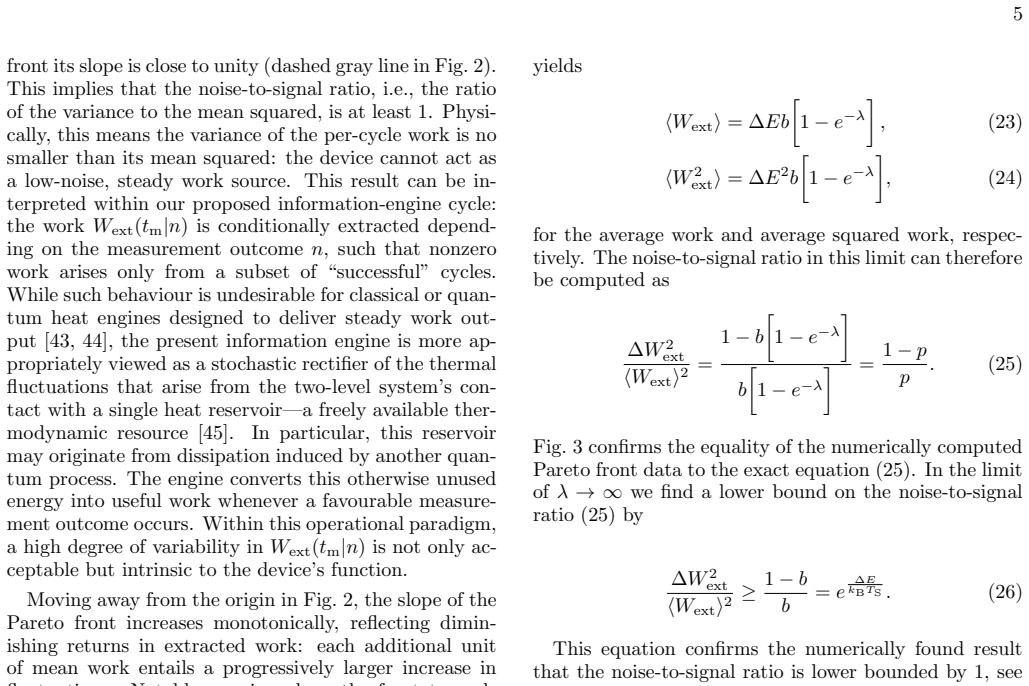
Working in the limit of a cold meter (ℏω/k_B T_M ≫ 1), the paper obtains the exact work distribution analytically: P(W_ext=ΔE)=p=b(1-e^{-λ}) and P(W_ext=0)=1-p, where b=(1+e^{-ΔE/k_B T_S})^{-1} is the qubit's thermal excited-state population and λ is the effective measurement strength set by coupling, oscillator frequency, and measurement time. From this Bernoulli distribution the noise-to-signal ratio follows as ΔW²_ext/⟨W_ext⟩²=(1-p)/p, and because p≤b it is never smaller than (1-b)/b=e^{ΔE/k_B T_S}. The paper's central claim is that this lower bound is a thermodynamic precision floor: it comes from the single bath that supplies the energy, not from measurement imperfection, and it cannot
Load-bearing premise
The argument assumes that during the measurement step the qubit and oscillator are perfectly isolated from their baths and evolve unitarily; if decoherence or relaxation acts during t_m, the conditional probabilities, the ergotropy, and the entire Pareto front would move.
Editorial extensions
If this is right
- If the bound holds, no improvement in meter accuracy can push the noise-to-signal ratio of this engine below e^{ΔE/k_B T_S}; output precision is fundamentally limited by the thermal bath from which work is drawn.
- Precision has a price: along the Pareto front, lower fluctuations require larger mutual information gain, higher measurement cost, more engine cycles, and a smaller average work output.
- The engine is fundamentally an intermittent converter, not a steady work source: its noise-to-signal ratio is always at least 1, and at the maximal-work point the success probability is around p≈0.218.
- Finite-sample resolution of the front needs N≳2p(1-p)/ε² ln(1/δ) cycles, giving a parameter-free overhead ratio N_0/N_*≈1.467 between the low-work and maximum-work regimes.
- The effective two-parameter control space means a shorter measurement time can be compensated by stronger coupling (and vice versa) without leaving the Pareto front.
Reading between the lines
- A direct experimental test: in a qubit-waveguide device operated in the cold-meter limit, the measured work distribution should be exactly two-valued with P(W=ΔE)=b(1-e^{-λ}); any partial-work events or deviations in the success fraction would reveal bath coupling during the measurement stage.
- If the precision floor is generic, similar Bernoulli-type bounds should appear for any information engine whose feedback is binary and whose success probability is bounded by a thermal occupation; examining other meters (e.g., a qubit meter) would show whether e^{ΔE/k_B T_S} is universal.
- The Fisher-information sloppiness result suggests a practical design principle: since only two parameter combinations matter, experimentalists can choose the most convenient hardware settings (coupling, frequency, time) as long as they preserve λ and a; this may generalise to other quantum control problems.
- The Cramér-Rao-type power bound ⟨W_ext⟩/t_m ≤ sqrt(⟨ΔW²_ext⟩⟨I⟩) implies that any attempt to boost output power must either accept larger fluctuations or increase the meter's sensitivity; this could be used to compare different feedback protocols beyond this specific engine.
Signed reviews
Editorial analysis
A structured set of objections, weighed in public.
Referee Report
Summary. The paper studies a finite-time quantum information engine consisting of a two-level system (system) and a quantum harmonic oscillator (meter), initially thermalized at temperatures T_S and T_M. After a unitary interaction of duration t_m, the meter is projectively measured; conditional on the outcome, work is extracted from the system by ergotropy. The authors use NSGA-II multi-objective optimization to map the trade-off between squared mean extractable work and its variance. In the cold-meter limit ℏω/k_B T_M ≫ 1 they derive an exact Bernoulli work distribution with success probability p = b(1−e^{−λ}), where b is the initial excited-state population and λ is the effective measurement strength. This yields the noise-to-signal ratio ΔW²/⟨W⟩² = (1−p)/p and the lower bound e^{ΔE/k_B T_S} in the perfect-measurement limit. They also derive information-theoretic quantities (mutual information, Fisher information) and finite-sample bounds on the number of cycles.
Significance. Under the model's stated unitary-measurement assumption, the central derivation is internally consistent and elegant: the work distribution in the cold-meter limit is exactly Bernoulli, and the bound (26) is parameter-free and independent of the meter. The paper gives a compact analytical result in a setting that is usually treated numerically. Reproducibility is supported by the Zenodo code, and the numerical collapse in Fig. 3 is a useful consistency check. If the underlying closed-system idealization is quantitatively justified, the result is a clean addition to the thermodynamics of information engines.
major comments (2)
- [Sec. III, Eq. (11); Sec. II, step b] The central Bernoulli result, Eqs. (22)–(26), assumes that system and meter are decoupled from their baths during 0 < t < t_m and evolve unitarily. The paper justifies this by stating that control is fast compared with relaxation and decoherence times, citing Ref. [40], but no quantitative condition is given. The cold-meter regime producing the analytic front requires large λ = g_eff²/(ℏω)(1−cos ωt_m); for fixed coupling this means t_m near π/ω, which must also satisfy the fast-control condition. A finite bath coupling during t_m will modify P(i,n,t_m), and the derivation of Eq. (22), the moments (23)–(24), and the bound (26) no longer applies. Please provide a quantitative validity criterion (e.g., explicit comparison of t_m with relaxation/decoherence times for the quoted qubit-waveguide platforms) or state clearly that the bound is for the idealized closed model. As written, the abstr
- [Sec. IV, Figs. 2–3] The global Pareto front is computed with NSGA-II, but the paper gives no information on the optimization setup: parameter ranges, population size, number of generations, crossover/mutation rates, or stopping criterion. The caption of Fig. 2 asserts that “all sub-optimal engine configurations lie above the front,” which is a global statement that cannot be verified from the presented data. Since the analytic cold-meter line Eq. (25) is the rigorous content, the numerical front is not strictly necessary for the lower bound, but the multi-objective claims and the finite-λ fronts in Fig. 4 depend on convergence. Please add the missing optimization details and a convergence check, or explicitly frame the numerical fronts as heuristic.
minor comments (5)
- [Eq. (15)] The typesetting of Eq. (15) is ambiguous: “α = g_eff√ 2ℏω [...]” should read α = g_eff/(√(2ℏω)) [...] to be consistent with λ = |α|² in Eq. (21).
- [Appendix B, Eq. (B4)] The Cauchy–Schwarz inequality should be applied to the difference d_tm⟨W⟩ − ⟨d_tm W⟩; the printed equation is only valid after the cold-meter argument. Please clarify the intermediate step.
- [Sec. V, Eq. (5)] The quantity I is an entropy reduction after projective measurement, not the standard quantum mutual information I(S:M). Since the paper calls it “mutual information,” a clarifying sentence would help.
- [Fig. 5] The text says mutual information is plotted “in nats,” but Eq. (31) includes k_B; if k_B = 1 is assumed, please state this explicitly.
- [Sec. IV, finite-sample analysis] Equation (28) is derived from the quadratic large-deviation expansion; stating that it is asymptotic or providing the exact Chernoff form would make the bound more precise. The numerical agreement N0 = 920, N* = 626 with Eq. (28) is reassuring.
Circularity Check
No significant circularity: analytic work statistics are derived from the stated model; self-citation [24] is context, not load-bearing.
full rationale
The paper's central analytic results (Eqs. 22-26) are obtained by evaluating the model's joint probabilities (Eqs. 13-14) in the cold-meter limit (ℏω/kBTM≫1, m=0), giving P(0,n)=aδ_{n,0} and P(1,n)=b λ^n e^{-λ}/n!. Because a>1/2>b, the n=0 conditional polarization is always negative, so only n≥1 outcomes yield work ΔE, with total probability p=b(1-e^{-λ}). The Bernoulli distribution (Eq. 22) and the moments (Eqs. 23-24) are direct consequences, not fits; Eq. (25) and the bound Eq. (26) follow algebraically. The numerical Pareto-front collapse in Fig. 3 is a consistency check of the same model's asymptotic limit, not a construction. The self-citation [24] is used only for the average-work information bound and as context; the new fluctuation result does not rest on it. No fitted parameter is relabeled as a prediction, and no uniqueness or ansatz is imported via self-citation. The only caveat is the unquantified unitary-evolution assumption during the measurement stage, but that is a physical approximation, not circular reasoning.
Assumptions & free parameters
assumptions (7)
- domain assumption Initial system and meter states are thermal and uncorrelated; during measurement they are decoupled from their baths and evolve unitarily under H_S + H_M + V_I(t).
- domain assumption The meter is projectively measured in energy eigenstates by a classical device (Heisenberg cut), and the Landauer erasure cost of resetting the classical readout is negligible at low temperature.
- standard math Work extraction is captured by ergotropy via outcome-conditioned unitaries, giving W_ext = Delta E * Pi_n * Theta(Pi_n) for a two-level system.
- domain assumption Cold-meter limit hbar omega >> k_B T_M, so the meter initially occupies only its ground state, P(0,n)=a delta_{n,0}, and the work distribution is Bernoulli with p=b(1-e^{-lambda}).
- ad hoc to paper NSGA-II genetic algorithm converges to the global Pareto front of the full model.
- standard math Large-deviation approximation for finite cycles uses Stirling's approximation and a quadratic rate function near q=p.
- standard math Cramer-Rao bound is applied to the derivative of mean work and then time-averaged.
Cite this review
Pith. "Pith review of Pareto-optimal work extraction and the thermodynamic cost of precision in quantum information engines." pith.science (2026). https://pith.science/paper/UYVJTD45
@misc{pith2026260714973,
  author       = {Pith},
  title        = {Pith review of: Pareto-optimal work extraction and the thermodynamic cost of precision in quantum information engines},
  year         = {2026},
  howpublished = {\url{https://pith.science/paper/UYVJTD45}},
  note         = {Machine review of arXiv:2607.14973}
}
read the original abstract
We study a finite-time quantum information engine in which a two-level system is measured by a quantum harmonic oscillator acting as a meter and where useful work is extracted conditionally on the measurement outcome. Using multi-objective optimisation, we find a Pareto-optimal trade-off between extractable work and its fluctuations and show that reducing fluctuations entails higher thermodynamic costs: greater information consumption, more engine cycles, longer operation time, and reduced average work output. In the limit of a highly accurate meter, we obtain the work distribution, its moments, and the Pareto front analytically. In this regime, the work statistics of the engine reduce to those of a qubit in contact with a single thermal bath. We further analyse the associated information flows by examining the mutual information and Fisher information, and show that the Pareto-optimal engine designs lie very close to local maxima of the latter with respect to the operation time of the device. Our results provide a compact description of the trade-offs between work, its fluctuations, and thermodynamic costs in quantum information engines.
Figures


Figures from the paper (3 more)


Reference graph
Works this paper leans on
-
[24]
Hagman, J
R. Hagman, J. Berx, J. Splettstoesser, and H. Kirchberg, New J. Phys.27, 114507 (2025)
2025
-
[40]
I. Yang, T. Agrenius, V. Usova, O. Romero-Isart, and G. Kirchmair, Sci. Adv.11, eadr4492 (2025)
2025
-
[1]
H. E. D. Scovil and E. O. Schulz-DuBois, Phys. Rev. Lett. 2, 262 (1959)
1959
-
[2]
Alicki, Journal of Physics A: Mathematical and Gen- eral12, L103 (1979)
R. Alicki, Journal of Physics A: Mathematical and Gen- eral12, L103 (1979)
1979
-
[3]
Kosloff, The Journal of Chemical Physics80, 1625 (1984)
R. Kosloff, The Journal of Chemical Physics80, 1625 (1984)
1984
-
[4]
Jarzynski, Phys
C. Jarzynski, Phys. Rev. Lett.78, 2690 (1997)
1997
-
[5]
Campisi, P
M. Campisi, P. Talkner, and P. H¨ anggi, Phys. Rev. Lett. 102, 210401 (2009)
2009
-
[6]
Szilard, Z
L. Szilard, Z. Phys.53, 840 (1929)
1929
Show all 47 references
-
[7]
Maruyama, F
K. Maruyama, F. Nori, and V. Vedral, Rev. Mod. Phys. 81, 1 (2009)
2009
-
[8]
A. d. O. Junior, J. B. Brask, and R. Chaves, PRX Quan- tum6, 030201 (2025)
2025
-
[9]
Sagawa and M
T. Sagawa and M. Ueda, Phys. Rev. Lett.100, 080403 (2008)
2008
-
[10]
Toyabe, T
S. Toyabe, T. Sagawa, M. Ueda, E. Muneyuki, and M. Sano, Nat. Phys.6, 988 (2010)
2010
-
[11]
J. V. Koski, V. F. Maisi, J. P. Pekola, and D. V. Averin, PNAS111, 13786 (2014)
2014
-
[12]
Monsel, M
J. Monsel, M. Acciai, R. S´ anchez, and J. Splettstoesser, Phys. Rev. B111, 045419 (2025)
2025
-
[13]
Kirchberg and A
H. Kirchberg and A. Nitzan, Phys. Rev. A112, 032201 (2025)
2025
-
[14]
H. J. D. Miller, M. Scandi, J. Anders, and M. Perarnau- Llobet, Phys. Rev. Lett.123, 230603 (2019)
2019
-
[15]
Kirchberg and A
H. Kirchberg and A. Nitzan, The Journal of Chemical Physics157, 184304 (2022)
2022
-
[16]
Tesser and J
L. Tesser and J. Splettstoesser, Phys. Rev. Lett.132, 186304 (2024)
2024
-
[17]
G. E. Crooks, Phys. Rev. E60, 2721 (1999)
1999
-
[18]
H¨ anggi and P
P. H¨ anggi and P. Talkner, Nature Physics11, 108 (2015)
2015
-
[19]
Spiecker, P
M. Spiecker, P. Paluch, N. Gosling, N. Drucker, S. Matityahu, D. Gusenkova, S. G¨ unzler, D. Rieger, I. Takmakov, F. Valenti, P. Winkel, R. Gebauer, O. Sander, G. Catelani, A. Shnirman, A. V. Ustinov, W. Wernsdorfer, Y. Cohen, and I. M. Pop, Nature Physics19, 1320 (2023)
2023
-
[20]
Zhang, P
J. Zhang, P. Wang, W. Chen, Z. Cai, M. Qiao, R. Li, Y. Huang, H. Tian, C. Luan, H. Tu, K. Cui, L. Yan, J. Zhang, J. Zhang, M. Yung, and K. Kim, Phys. Rev. Lett.135, 140403 (2025)
2025
-
[21]
Cottet, S
N. Cottet, S. Jezouin, L. Bretheau, P. Campagne-Ibarcq, Q. Ficheux, J. Anders, A. Auff` eves, R. Azouit, P. Rou- chon, and B. Huard, PNAS114, 7561 (2017)
2017
-
[22]
Masuyama, K
Y. Masuyama, K. Funo, Y. Murashita, A. Noguchi, S. Kono, Y. Tabuchi, R. Yamazaki, M. Ueda, and Y. Nakamura, Nature Communications9, 1291 (2018)
2018
-
[23]
Dassonneville, C
R. Dassonneville, C. Elouard, R. Cazali, R. Assouly, A. Bienfait, A. Auff` eves, and B. Huard, Phys. Rev. Res. 8, 013228 (2026)
2026
-
[25]
Deb,Multi-Objective Optimization using Evolution- ary Algorithms, Wiley Interscience Series in Systems and Optimization (Wiley-Blackwell, Hoboken, NJ, 2008)
K. Deb,Multi-Objective Optimization using Evolution- ary Algorithms, Wiley Interscience Series in Systems and Optimization (Wiley-Blackwell, Hoboken, NJ, 2008)
2008
-
[26]
Berx and K
J. Berx and K. Proesmans, EPL145, 51001 (2024)
2024
-
[27]
G. A. L. For˜ ao, J. Berx, and C. E. Fiore, New J. Phys. 27, 074605 (2025)
2025
-
[28]
J. Berx, P. Singh, and K. Proesmans, New J. Phys.27, 023034 (2025)
2025
-
[29]
P. A. Erdman, A. Rolandi, P. Abiuso, M. Perarnau- Llobet, and F. No´ e, Phys. Rev. Res.5, L022017 (2023)
2023
-
[30]
Taranto, F
P. Taranto, F. Bakhshinezhad, A. Bluhm, R. Silva, N. Friis, M. P. Lock, G. Vitagliano, F. C. Binder, T. De- barba, E. Schwarzhans, F. Clivaz, and M. Huber, PRX Quantum4, 010332 (2023)
2023
-
[31]
Heisenberg,The physical principles of the quantum theory / by Werner Heisenberg ; transl
W. Heisenberg,The physical principles of the quantum theory / by Werner Heisenberg ; transl. by Carl Eckart and Frank C. Hoyt.(Dover, 1949)
1949
-
[32]
Von Neumann,Mathematical Foundations of Quantum Mechanics(Princeton Univ
J. Von Neumann,Mathematical Foundations of Quantum Mechanics(Princeton Univ. Press., Princeton, NJ, 1955)
1955
-
[33]
Atmanspacher, World Futures49, 333 (1997)
H. Atmanspacher, World Futures49, 333 (1997)
1997
-
[34]
A. E. Allahverdyan, R. Balian, and T. M. Nieuwenhuizen, EPL67, 565 (2004)
2004
-
[35]
Francica, J
G. Francica, J. Goold, F. Plastina, and M. Paternostro, npj Quantum Inf.3, 1 (2017)
2017
-
[36]
Landauer, IBM J
R. Landauer, IBM J. Res. Dev.5, 183 (1961)
1961
-
[37]
Elouard, D
C. Elouard, D. Herrera-Mart ´ ı, B. Huard, and A. Auff` eves, Phys. Rev. Lett.118, 260603 (2017)
2017
-
[38]
Jordan, C
A. Jordan, C. Elouard, and A. Auff` eves, Quantum Stud- ies: Mathematics and Foundations7, 203 (2020)
2020
-
[39]
Janzen, X
N. Janzen, X. Dai, S. Ren, J. Shi, and A. Lupascu, Phys. Rev. Res.5, 033155 (2023)
2023
-
[41]
Magnus, F
W. Magnus, F. Oberhettinger, and R. P. Soni,Formu- las and theorems for the special functions of mathemati- cal physics, 1966th ed., Grundlehren der mathematischen Wissenschaften (Springer, Berlin, Germany, 2013)
2013
-
[42]
Seifert, Physica A504, 176 (2018)
U. Seifert, Physica A504, 176 (2018)
2018
-
[43]
M. F. Anka, T. R. de Oliveira, and D. Jonathan, Phys. Rev. E109, 064129 (2024)
2024
-
[44]
Bouton, J
Q. Bouton, J. Nettersheim, S. Burgardt, D. Adam, E. Lutz, and A. Widera, Nat. Commun.12, 2063 (2021)
-
[45]
Chitambar and G
E. Chitambar and G. Gour, Reviews of modern physics 91, 025001 (2019)
2019
-
[46]
Touchette, Phys
H. Touchette, Phys. Rep.478, 1 (2009)
2009
-
[47]
Juli` a-Farr´ e, T
S. Juli` a-Farr´ e, T. Salamon, A. Riera, M. N. Bera, and M. Lewenstein, Phys. Rev. Res.2, 023113 (2020)
2020
Reviewed August 2, 2026 · model on record in the stance chip above.
Discussion (0). Continue with ORCID to comment.