The Companions to B and A Stars Snapshot (C-BASS) Survey: I. Discovery of a Young Brown Dwarf Companion to HIP 17453
Pith reviewed 2026-07-01 02:02 UTC · model grok-4.3
The pith
A young L2 brown dwarf companion with 53 Jupiter masses has been discovered orbiting the A0V star HIP 17453.
A machine-rendered reading of the paper's core claim, the machinery that carries it, and where it could break.
Core claim
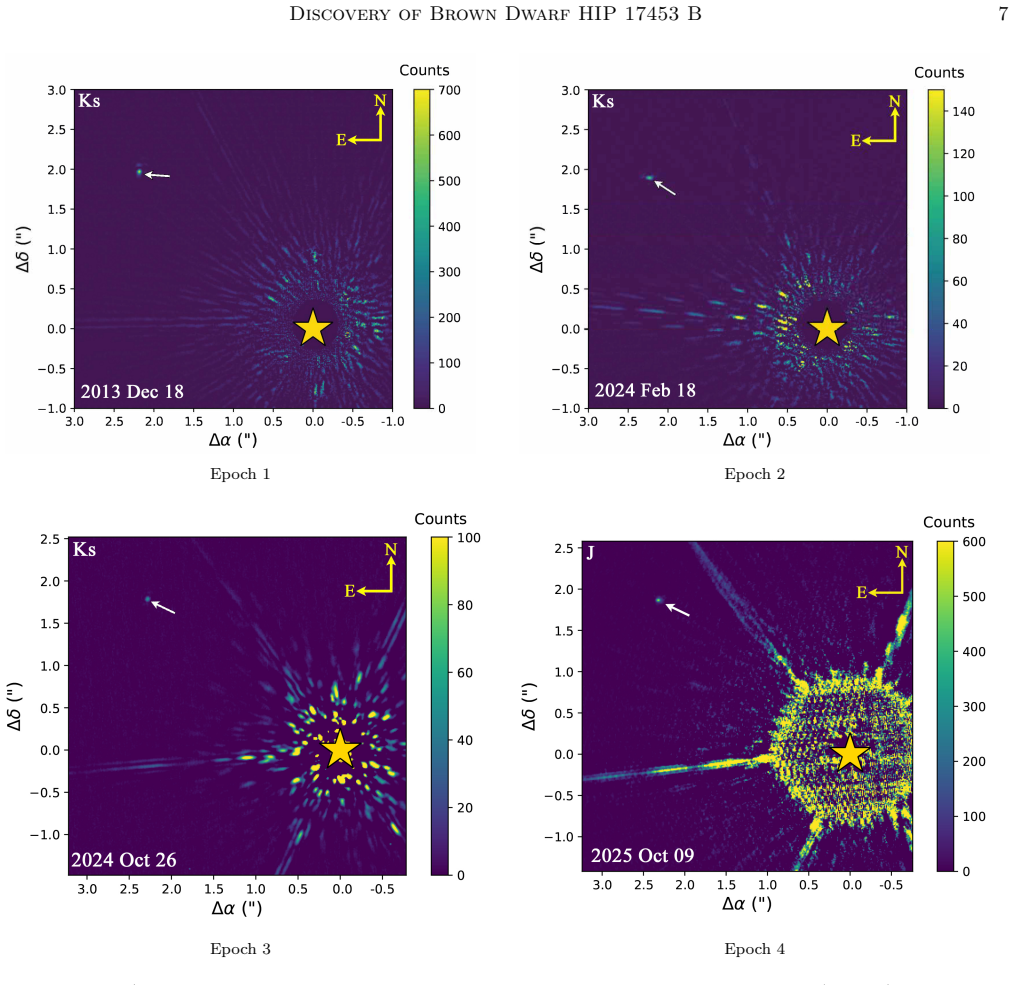
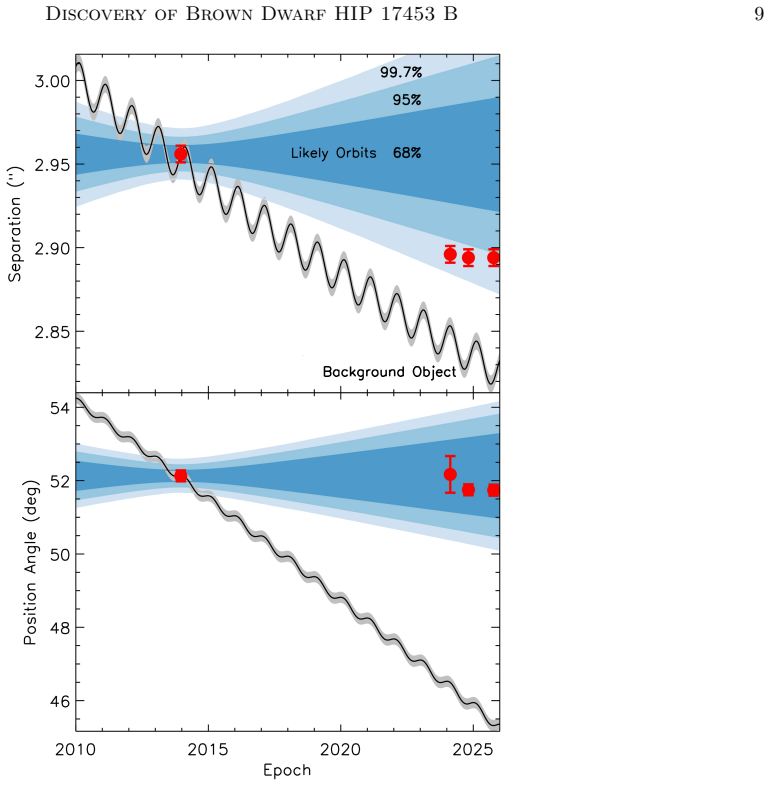
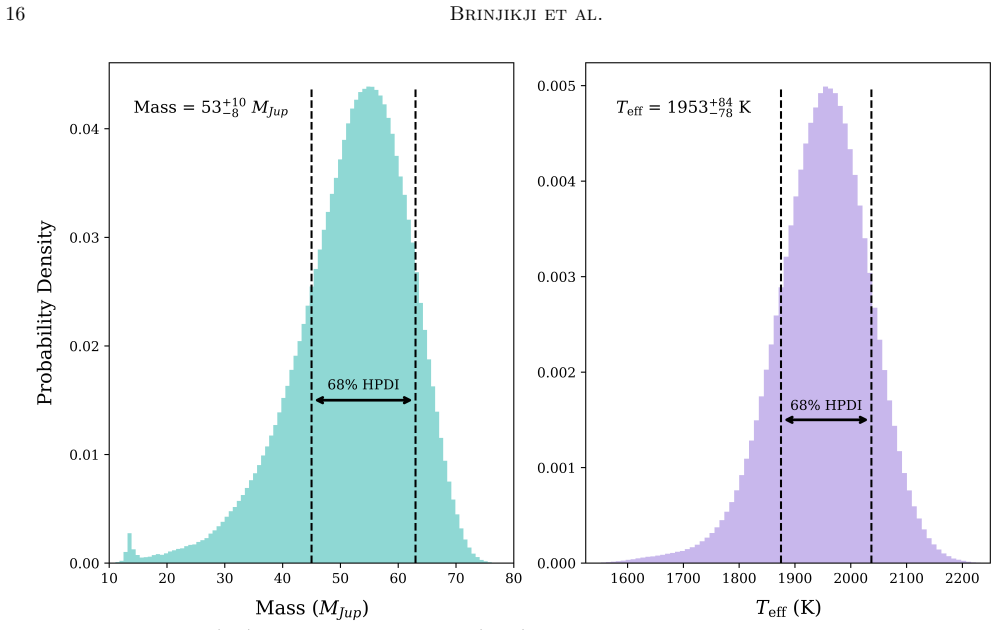
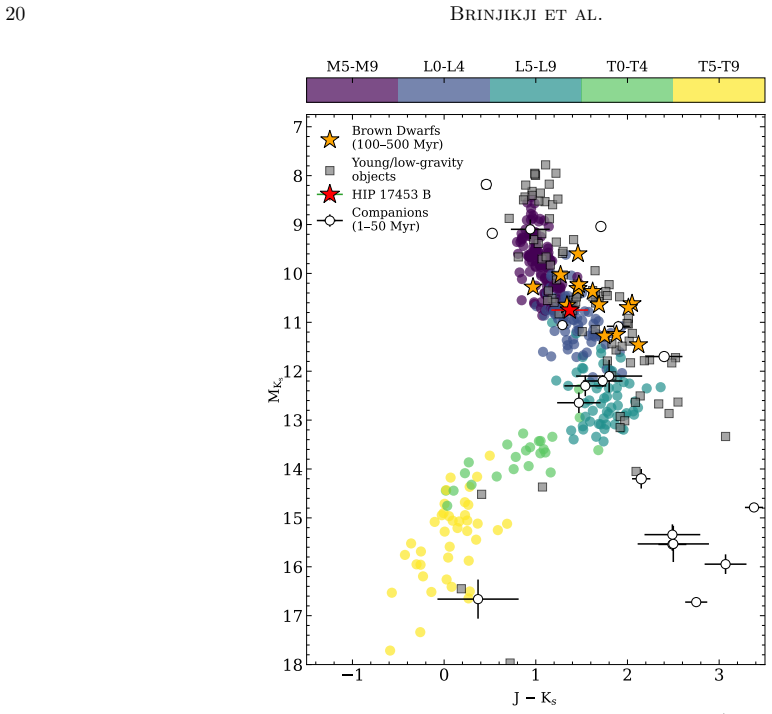
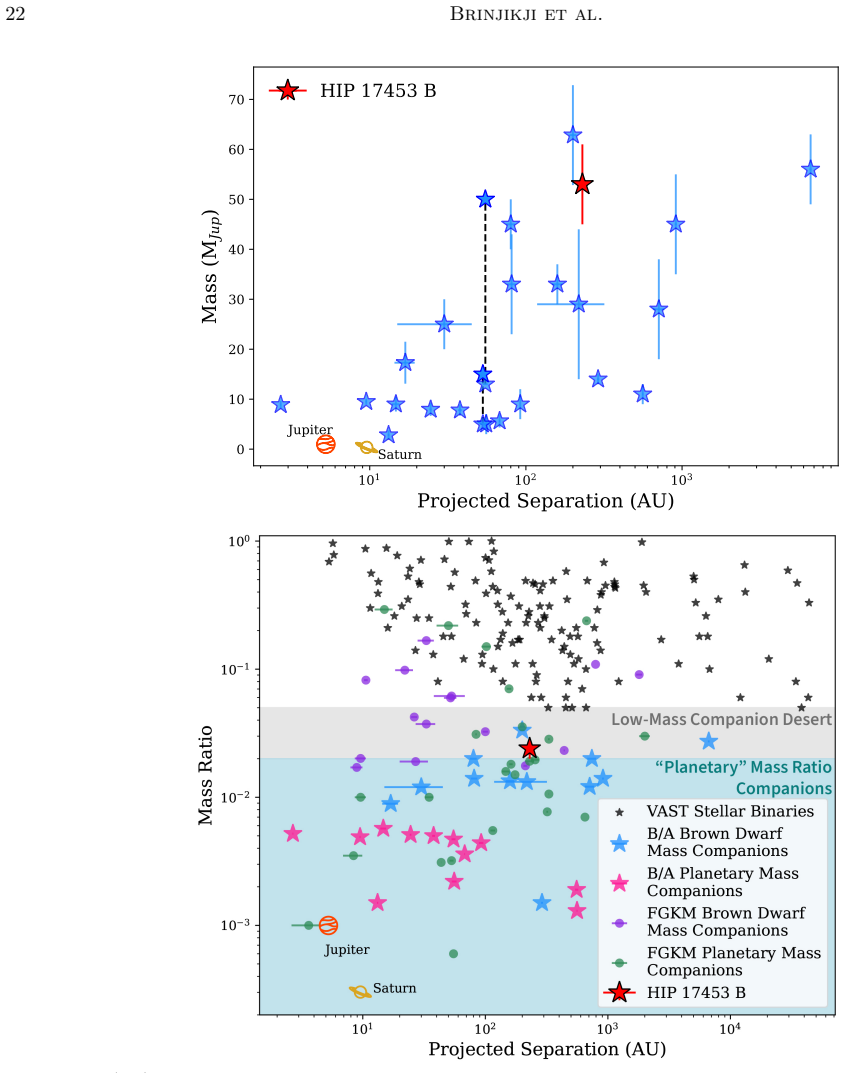
We report the detection of a new brown dwarf companion to HIP 17453 A with proper motion consistent with the primary. The companion has a spectral type of L2 ± 1, effective temperature of 1953 K, and mass of 53 M_Jup, corresponding to a mass ratio q = 0.024 ± 0.004. With its intermediate mass and young age, HIP 17453 B joins a small set of benchmark brown dwarf companions around early-type stars that are suitable for follow-up atmospheric and evolutionary studies.
What carries the argument
High-resolution adaptive optics imaging with Keck NIRC2 combined with intermediate-resolution near-infrared spectroscopy with Gemini GNIRS, interpreted through Sonora Diamondback evolutionary models using the system age.
Load-bearing premise
The age of the HIP 17453 system is accurately known as 280 ± 125 Myr for use in deriving mass and temperature from evolutionary models.
What would settle it
An independent age measurement for the system, such as from lithium abundance or isochrone fitting to the primary, that differs enough to shift the companion mass outside the reported 53 +10/-8 M_Jup range.
Figures
read the original abstract
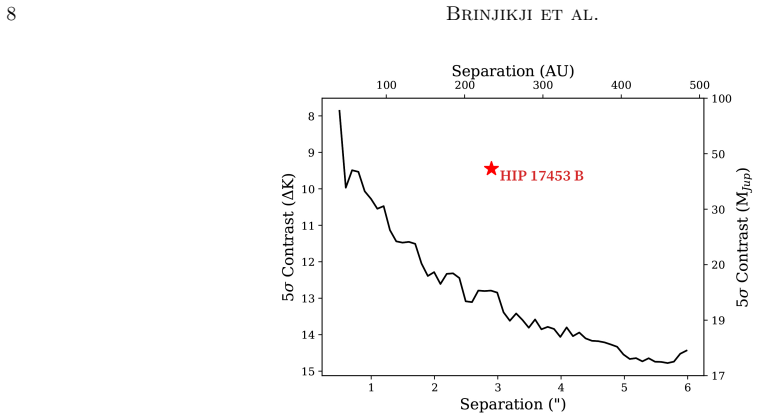
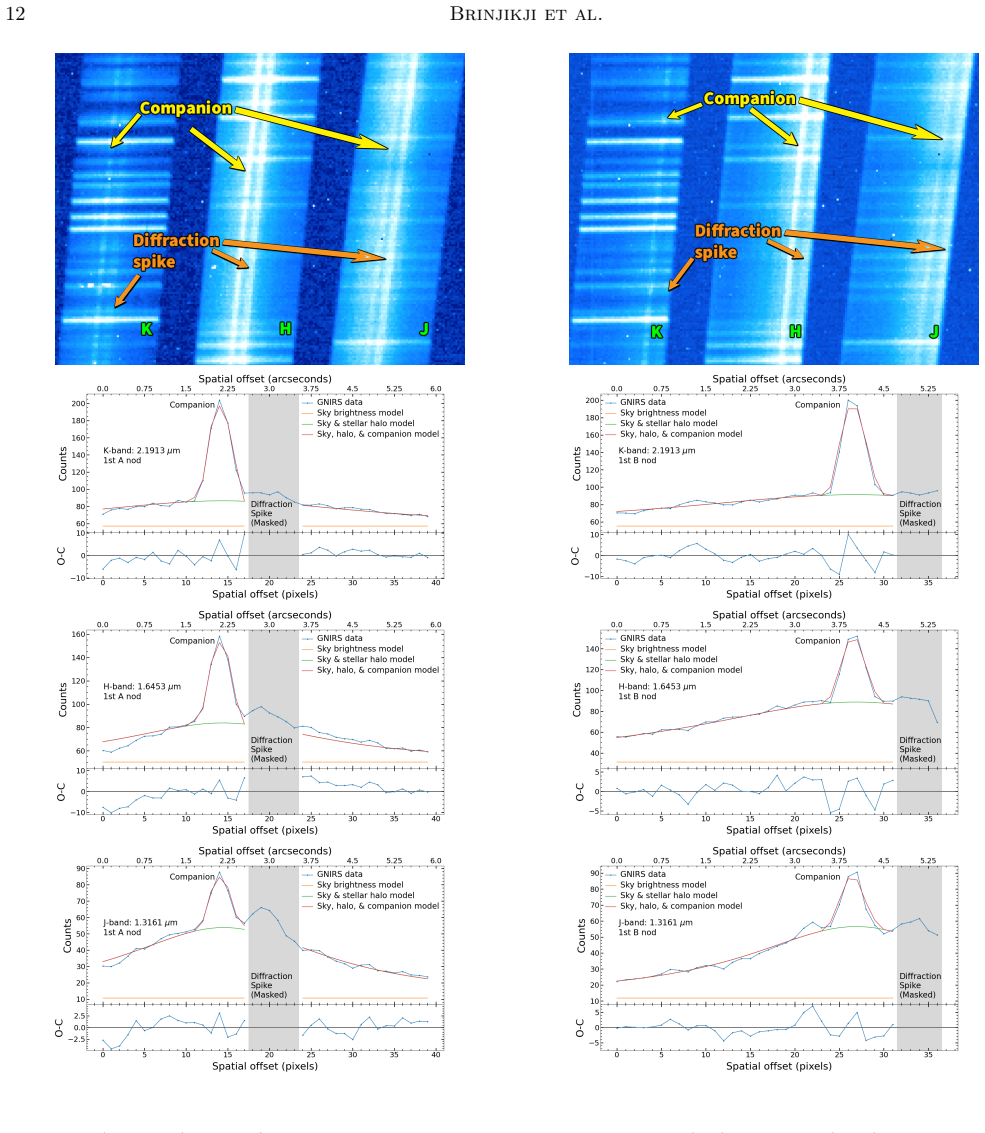
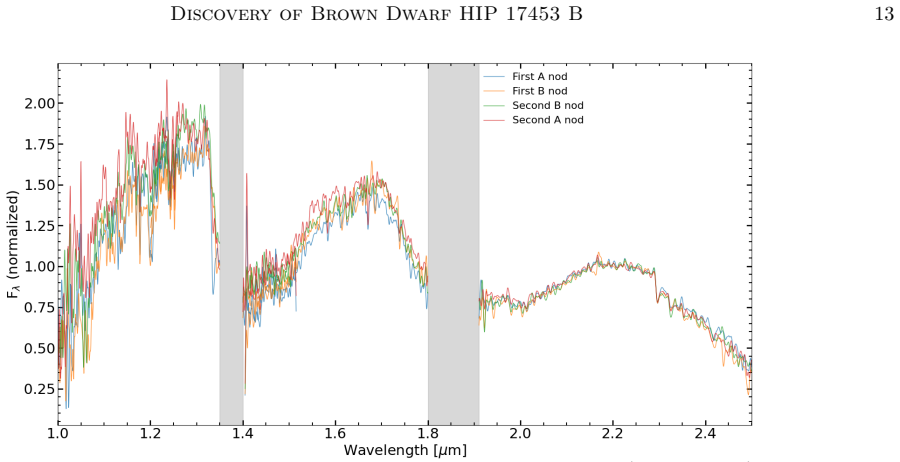
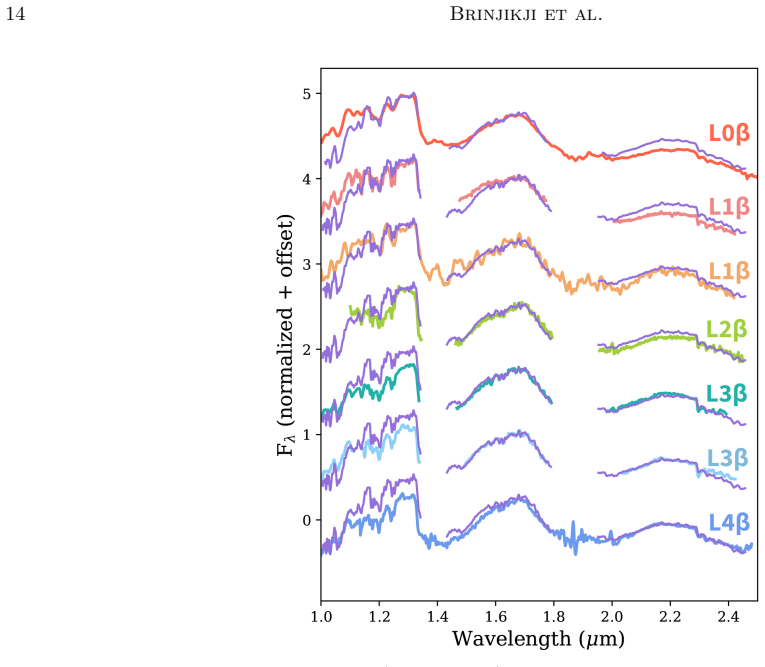
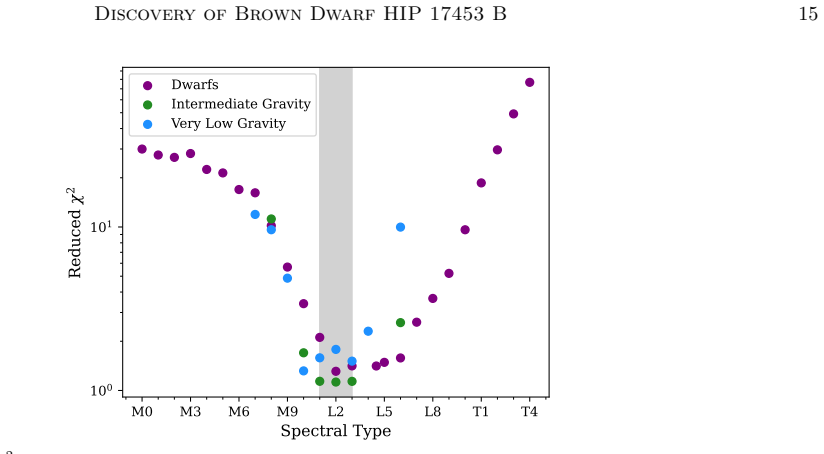
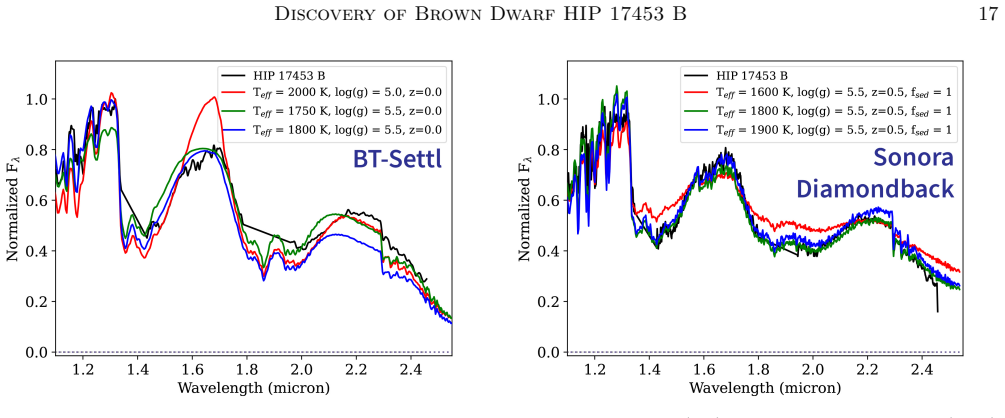
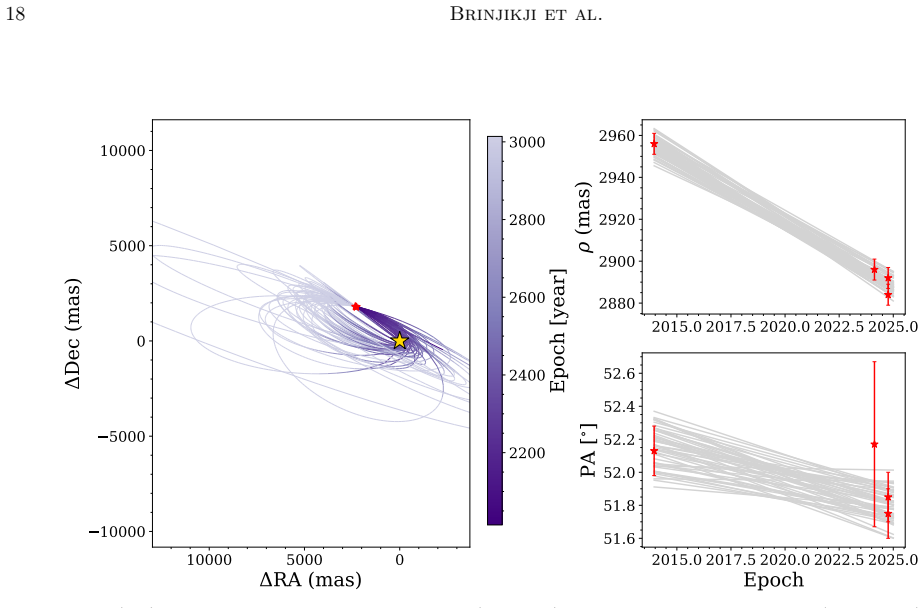
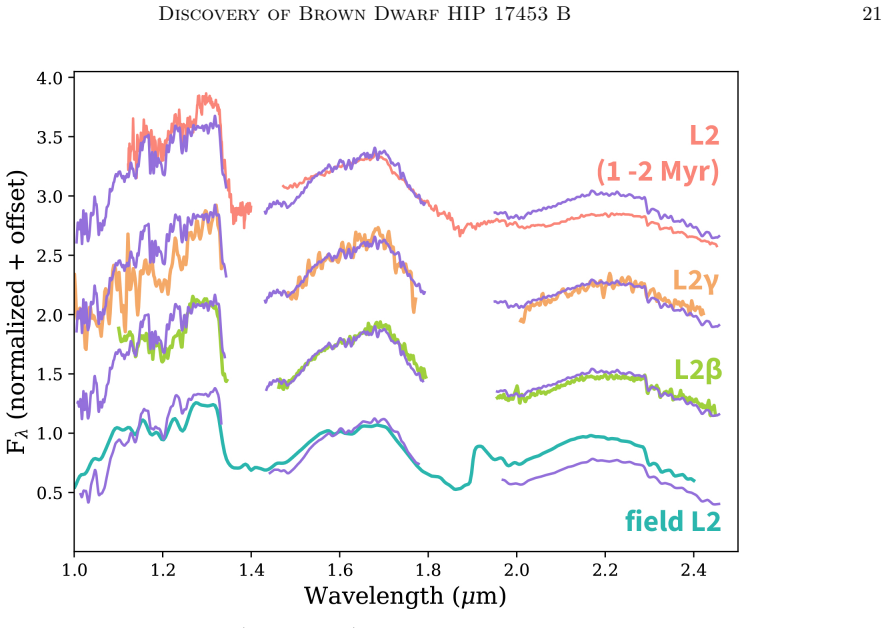
We report the detection of a new brown dwarf companion to HIP 17453 A, a chemically peculiar A0V star located at a distance of 81 pc. HIP 17453 A was observed with high-resolution adaptive optics imaging using the Near-Infrared Camera 2 on the Keck II telescope as part of the Companions to B and A Stars Snapshot (C-BASS) survey over a ten-year baseline, revealing the presence of a companion with proper motion consistent with the primary. We estimate the age of the HIP 17453 system as 280 $\pm$ 125 Myr, and with follow-up intermediate resolution (R~1800) spectroscopic observations with the Gemini Near Infra-Red Spectrograph (GNIRS) on the Gemini-North telescope, we found the spectrum of HIP 17453 B to be consistent with a spectral type of L2 $\pm$ 1. Through interpolation of Sonora Diamondback evolutionary models, we calculate an effective temperature of $1953^{+84}_{-78}$ K and mass of $53^{+10}_{-8}$ $M_{Jup}$ for HIP 17453 B, which corresponds to a mass ratio of $q = 0.024 \pm 0.004$ for the HIP 17453 system. With its intermediate mass and young age, HIP 17453 B joins a small set of benchmark brown dwarf companions around early-type stars that are suitable for follow-up atmospheric and evolutionary studies.
Editorial analysis
A structured set of objections, weighed in public.
Referee Report
Summary. The manuscript reports the discovery of a brown dwarf companion to the chemically peculiar A0V star HIP 17453 at 81 pc via Keck/NIRC2 adaptive optics imaging over a 10-year baseline as part of the C-BASS survey. Common proper motion confirms physical association. GNIRS spectroscopy (R~1800) yields a spectral type L2 ± 1. Adopting a system age of 280 ± 125 Myr, interpolation in the Sonora Diamondback evolutionary models produces Teff = 1953^{+84}_{-78} K and mass = 53^{+10}_{-8} M_Jup, implying q = 0.024 ± 0.004. The object is presented as a benchmark for follow-up studies.
Significance. If the reported parameters hold, the companion adds a valuable young benchmark brown dwarf orbiting an early-type star, a sparsely populated category that can test atmospheric and evolutionary models. The imaging detection and spectral classification rest on direct observational evidence (proper-motion consistency and GNIRS match), which is robust; the mass and temperature rest on external model interpolation at the adopted age.
major comments (2)
- [Age estimation section] Age estimation section: The age 280 ± 125 Myr is stated without an explicit derivation, isochrone-fitting procedure, or discussion of how the chemically peculiar nature of HIP 17453 A was handled. Because the companion's Teff and mass are obtained solely by interpolation in the Sonora Diamondback grid at this single age, and cooling tracks are steep below ~500 Myr, the lack of methodological detail makes it impossible to judge whether the quoted uncertainty fully captures systematics.
- [Physical parameters paragraph] Physical parameters paragraph (following spectroscopy): The reported Teff and mass uncertainties are stated to arise from the age range alone. The text does not clarify whether photometric uncertainties, distance (81 pc), or model-grid spacing were propagated, nor does it show the interpolation path on the model grid; this information is required to assess whether the ±10/-8 M_Jup range is realistic.
minor comments (1)
- [Abstract] Abstract: The phrase 'we estimate the age' could be expanded by one clause to indicate the basis (e.g., 'from isochrone fitting to the primary'), improving immediate clarity for readers.
Simulated Author's Rebuttal
We thank the referee for their careful reading and constructive comments on our manuscript. We address each major comment below and will revise the paper to improve clarity on the age and parameter derivations.
read point-by-point responses
-
Referee: [Age estimation section] Age estimation section: The age 280 ± 125 Myr is stated without an explicit derivation, isochrone-fitting procedure, or discussion of how the chemically peculiar nature of HIP 17453 A was handled. Because the companion's Teff and mass are obtained solely by interpolation in the Sonora Diamondback grid at this single age, and cooling tracks are steep below ~500 Myr, the lack of methodological detail makes it impossible to judge whether the quoted uncertainty fully captures systematics.
Authors: We agree that the current manuscript does not provide sufficient detail on the age derivation. The quoted age and uncertainty were obtained via isochrone fitting to the primary's photometry and spectroscopic parameters (with adjustments for chemical peculiarity drawn from prior literature on Ap stars), but this procedure was not described explicitly. In the revised manuscript we will add a dedicated subsection detailing the isochrone models employed, the fitting method, the treatment of the chemically peculiar abundances, and the sources of the ±125 Myr uncertainty. This will allow readers to evaluate whether the range adequately reflects systematics for the subsequent model interpolation. revision: yes
-
Referee: [Physical parameters paragraph] Physical parameters paragraph (following spectroscopy): The reported Teff and mass uncertainties are stated to arise from the age range alone. The text does not clarify whether photometric uncertainties, distance (81 pc), or model-grid spacing were propagated, nor does it show the interpolation path on the model grid; this information is required to assess whether the ±10/-8 M_Jup range is realistic.
Authors: We acknowledge that the manuscript attributes the Teff and mass uncertainties solely to the age range without explicitly stating whether additional contributions (photometry, distance, or grid spacing) were propagated or how the interpolation was performed. In the revision we will clarify the interpolation procedure, confirm that the dominant uncertainty source is the age range (with other terms sub-dominant), and either describe the grid path in text or add a supplementary figure showing the interpolation locus on the Sonora Diamondback tracks. This will make the quoted ±10/-8 M_Jup range more transparent. revision: yes
Circularity Check
No circularity: all reported quantities follow from direct observations plus external models.
full rationale
The derivation proceeds from Keck AO imaging (detection + proper-motion confirmation), GNIRS spectroscopy (L2 ±1 type), and an externally adopted system age (280 ±125 Myr) that is fed into Sonora Diamondback evolutionary models to obtain Teff and mass. The mass ratio q is then computed from the resulting companion mass and an independent primary mass. None of these steps redefines a fitted parameter as a prediction, invokes a self-citation as the sole justification for a uniqueness claim, or renames an input as an output. The age uncertainty is a genuine external limitation rather than an internal circularity. The chain is therefore self-contained against external benchmarks.
Axiom & Free-Parameter Ledger
free parameters (1)
- system age
axioms (2)
- domain assumption Proper motion consistency over a ten-year baseline indicates the companion is physically bound to the primary.
- domain assumption Sonora Diamondback evolutionary models correctly map age, effective temperature, and spectral type to mass for young L dwarfs.
Reference graph
Works this paper leans on
-
[1]
Powell, M. J. D. , title =. The Computer Journal , volume =. 1964 , month =. doi:10.1093/comjnl/7.2.155 , url =
-
[2]
Discovery of an -0.5ex 23 M _ Jup Brown Dwarf Orbiting -0.5ex 700 AU from the Massive Star HIP 78530 in Upper Scorpius. , keywords =. doi:10.1088/0004-637X/730/1/42 , archivePrefix =. 1101.4666 , primaryClass =
work page internal anchor Pith review Pith/arXiv arXiv doi:10.1088/0004-637x/730/1/42
-
[3]
Discovery of a brown dwarf companion to the star HIP 64892
Discovery of a brown dwarf companion to the star HIP 64892. , keywords =. doi:10.1051/0004-6361/201832650 , archivePrefix =. 1803.02725 , primaryClass =
work page internal anchor Pith review Pith/arXiv arXiv doi:10.1051/0004-6361/201832650
-
[4]
The Tucana/Horologium, Columba, AB Doradus, and Argus Associations: New Members and Dusty Debris Disks. , keywords =. doi:10.1088/0004-637X/732/2/61 , archivePrefix =. 1104.0284 , primaryClass =
work page internal anchor Pith review Pith/arXiv arXiv doi:10.1088/0004-637x/732/2/61
-
[5]
TESS Reveals that the Nearby Pisces-Eridanus Stellar Stream is only 120 Myr Old. , keywords =. doi:10.3847/1538-3881/ab2899 , archivePrefix =. 1905.10588 , primaryClass =
-
[6]
Direct-imaging Discovery of a Substellar Companion Orbiting the Accelerating Variable Star HIP 39017. , keywords =. doi:10.3847/1538-3881/ad3077 , archivePrefix =. 2403.04000 , primaryClass =
-
[7]
Direct imaging and astrometric detection of a gas giant planet orbiting an accelerating star. Science , keywords =. doi:10.1126/science.abo6192 , archivePrefix =. 2212.00034 , primaryClass =
-
[8]
A brown dwarf companion to the intermediate-mass star HR6037
A brown dwarf companion to the intermediate-mass star HR 6037. , keywords =. doi:10.1051/0004-6361/201015708 , archivePrefix =. 1009.4650 , primaryClass =
work page internal anchor Pith review Pith/arXiv arXiv doi:10.1051/0004-6361/201015708
-
[9]
A Candidate Substellar Companion to HR 7329
A Candidate Substellar Companion to HR 7329. , keywords =. doi:10.1086/309437 , archivePrefix =. astro-ph/0005047 , primaryClass =
work page internal anchor Pith review Pith/arXiv arXiv doi:10.1086/309437
-
[10]
Exploring the directly imaged HD 1160 system through spectroscopic characterization and high-cadence variability monitoring. , keywords =. doi:10.1093/mnras/stae1315 , archivePrefix =. 2405.12271 , primaryClass =
-
[11]
The search for disks or planetary objects around directly imaged companions: a candidate around DH Tauri B. , keywords =. doi:10.1051/0004-6361/201937290 , archivePrefix =. 2007.10097 , primaryClass =
-
[12]
The Gemini NICI Planet-Finding Campaign
The Gemini NICI Planet-Finding Campaign. Adaptive Optics Systems II , year = 2010, editor =. doi:10.1117/12.858358 , archivePrefix =. 1008.3900 , primaryClass =
work page internal anchor Pith review Pith/arXiv arXiv doi:10.1117/12.858358 2010
-
[13]
The Gemini NICI Planet-Finding Campaign: Discovery of a Multiple System Orbiting the Young A Star HD 1160. , keywords =. doi:10.1088/0004-637X/750/1/53 , archivePrefix =. 1202.2854 , primaryClass =
work page internal anchor Pith review Pith/arXiv arXiv doi:10.1088/0004-637x/750/1/53
-
[14]
Evidence that the Directly-Imaged Planet HD 131399 Ab is a Background Star
Evidence That the Directly Imaged Planet HD 131399 Ab Is a Background Star. , keywords =. doi:10.3847/1538-3881/aa8a69 , archivePrefix =. 1705.06851 , primaryClass =
work page internal anchor Pith review Pith/arXiv arXiv doi:10.3847/1538-3881/aa8a69
-
[15]
Discovery and spectroscopy of the young Jovian planet 51 Eri b with the Gemini Planet Imager
Discovery and spectroscopy of the young jovian planet 51 Eri b with the Gemini Planet Imager. Science , keywords =. doi:10.1126/science.aac5891 , archivePrefix =. 1508.03084 , primaryClass =
work page internal anchor Pith review Pith/arXiv arXiv doi:10.1126/science.aac5891
-
[16]
Population-level Eccentricity Distributions of Imaged Exoplanets and Brown Dwarf Companions: Dynamical Evidence for Distinct Formation Channels. , keywords =. doi:10.3847/1538-3881/ab5b11 , archivePrefix =. 1911.10569 , primaryClass =
-
[17]
The SPHERE infrared survey for exoplanets (SHINE). III. The demographics of young giant exoplanets below 300 au with SPHERE. , keywords =. doi:10.1051/0004-6361/202038107 , archivePrefix =. 2007.06573 , primaryClass =
-
[18]
The Astropy Project: Building an inclusive, open-science project and status of the v2.0 core package
The Astropy Project: Building an Open-science Project and Status of the v2.0 Core Package. , keywords =. doi:10.3847/1538-3881/aabc4f , archivePrefix =. 1801.02634 , primaryClass =
work page internal anchor Pith review Pith/arXiv arXiv doi:10.3847/1538-3881/aabc4f
-
[19]
Astropy: A Community Python Package for Astronomy
Astropy: A community Python package for astronomy. , keywords =. 2013. doi:10.1051/0004-6361/201322068 , archivePrefix =. 1307.6212 , primaryClass =
work page internal anchor Pith review Pith/arXiv arXiv doi:10.1051/0004-6361/201322068 2013
-
[20]
VizieR Online Data Catalog , keywords =
VizieR Online Data Catalog: 2MASS All-Sky Catalog of Point Sources (Cutri+ 2003). VizieR Online Data Catalog , keywords =
2003
-
[21]
Main source (Gaia Collaboration, 2022)
VizieR Online Data Catalog: Gaia DR3 Part 1. Main source (Gaia Collaboration, 2022). doi:10.26093/cds/vizier.1355 , adsurl =
-
[22]
A study of the bright A stars. I. A catalogue of spectral classifications. , year = 1969, month = apr, volume =. doi:10.1086/110819 , adsurl =
-
[23]
VizieR Online Data Catalog , keywords =
VizieR Online Data Catalog: Henry Draper Catalogue and Extension (Cannon+ 1918-1924; ADC 1989). VizieR Online Data Catalog , keywords =
1918
-
[24]
pyKLIP: PSF Subtraction for Exoplanets and Disks
-
[25]
, year = 2016, month = sep, volume =
A New Distortion Solution for NIRC2 on the Keck II Telescope. , year = 2016, month = sep, volume =. doi:10.1088/1538-3873/128/967/095004 , adsurl =
-
[26]
Improving Galactic Center Astrometry by Reducing the Effects of Geometric Distortion
Improving Galactic Center Astrometry by Reducing the Effects of Geometric Distortion. , keywords =. doi:10.1088/0004-637X/725/1/331 , archivePrefix =. 1010.0064 , primaryClass =
work page internal anchor Pith review Pith/arXiv arXiv doi:10.1088/0004-637x/725/1/331
-
[27]
The Relation between Rotational Velocities and Spectral Peculiarities among A-Type Stars. , keywords =. doi:10.1086/192182 , adsurl =
-
[28]
An Evaluation of the Membership Probability of 212 Boo Stars. I. A Catalogue. , keywords =. doi:10.1017/pasa.2015.34 , archivePrefix =. 1508.03633 , primaryClass =
work page internal anchor Pith review Pith/arXiv arXiv doi:10.1017/pasa.2015.34 2015
-
[29]
The Hipparcos-Gaia Catalog of Accelerations: Gaia EDR3 Edition. , keywords =. doi:10.3847/1538-4365/abf93c , archivePrefix =. 2105.11662 , primaryClass =
-
[30]
The PASTEL catalogue: 2016 version
The PASTEL catalogue: 2016 version. , keywords =. doi:10.1051/0004-6361/201628497 , archivePrefix =. 1605.07384 , primaryClass =
work page internal anchor Pith review Pith/arXiv arXiv doi:10.1051/0004-6361/201628497 2016
-
[31]
Fundamental parameters and infrared excesses of Hipparcos stars. , keywords =. doi:10.1111/j.1365-2966.2012.21873.x , archivePrefix =. 1208.2037 , primaryClass =
-
[32]
SB9: The Ninth Catalogue of Spectroscopic Binary Orbits
S _ B ^ 9 : The ninth catalogue of spectroscopic binary orbits. , keywords =. doi:10.1051/0004-6361:20041213 , archivePrefix =. astro-ph/0406573 , primaryClass =
work page internal anchor Pith review Pith/arXiv arXiv doi:10.1051/0004-6361:20041213
-
[33]
First Light Adaptive Optics Images from the Keck II Telescope: A New Era of High Angular Resolution Imagery. , keywords =. doi:10.1086/316543 , adsurl =
-
[34]
Instrumentation in astronomy VI , year = 1986, editor =
The IRAF Data Reduction and Analysis System. Instrumentation in astronomy VI , year = 1986, editor =. doi:10.1117/12.968154 , adsurl =
-
[35]
Astronomical Data Analysis Software and Systems II , year = 1993, editor =
IRAF in the Nineties. Astronomical Data Analysis Software and Systems II , year = 1993, editor =
1993
-
[36]
Modernizing IRAF to Support Gemini Data Reduction. arXiv e-prints , keywords =. doi:10.48550/arXiv.2401.01982 , archivePrefix =. 2401.01982 , primaryClass =
-
[37]
Orbits for the Impatient: A Bayesian Rejection-sampling Method for Quickly Fitting the Orbits of Long-period Exoplanets. , keywords =. doi:10.3847/1538-3881/aa6930 , archivePrefix =. 1703.10653 , primaryClass =
work page internal anchor Pith review Pith/arXiv arXiv doi:10.3847/1538-3881/aa6930
-
[38]
orbitize!: A Comprehensive Orbit-fitting Software Package for the High-contrast Imaging Community. , keywords =. doi:10.3847/1538-3881/ab6663 , archivePrefix =. 1910.01756 , primaryClass =
-
[39]
Evolutionary models for cool brown dwarfs and extrasolar giant planets. The case of HD 20945
Evolutionary models for cool brown dwarfs and extrasolar giant planets. The case of HD 209458. , keywords =. doi:10.1051/0004-6361:20030252 , archivePrefix =. astro-ph/0302293 , primaryClass =
work page internal anchor Pith review Pith/arXiv arXiv doi:10.1051/0004-6361:20030252
-
[40]
Evolutionary models for very-low-mass stars and brown dwarfs with dusty atmospheres
Evolutionary Models for Very Low-Mass Stars and Brown Dwarfs with Dusty Atmospheres. , keywords =. doi:10.1086/309513 , archivePrefix =. astro-ph/0005557 , primaryClass =
work page internal anchor Pith review Pith/arXiv arXiv doi:10.1086/309513
-
[41]
Evolutionary models for low-mass stars and brown dwarfs: uncertainties and limits at very young ages
Evolutionary models for low-mass stars and brown dwarfs: Uncertainties and limits at very young ages. , keywords =. doi:10.1051/0004-6361:20011638 , archivePrefix =. astro-ph/0111385 , primaryClass =
work page internal anchor Pith review Pith/arXiv arXiv doi:10.1051/0004-6361:20011638
-
[42]
A new extensive library of PHOENIX stellar atmospheres and synthetic spectra
A new extensive library of PHOENIX stellar atmospheres and synthetic spectra. , keywords =. doi:10.1051/0004-6361/201219058 , archivePrefix =. 1303.5632 , primaryClass =
work page internal anchor Pith review Pith/arXiv arXiv doi:10.1051/0004-6361/201219058
-
[43]
An Infrared Spectroscopic Sequence of M, L and T Dwarfs
An Infrared Spectroscopic Sequence of M, L, and T Dwarfs. , keywords =. doi:10.1086/428040 , archivePrefix =. astro-ph/0412313 , primaryClass =
work page internal anchor Pith review Pith/arXiv arXiv doi:10.1086/428040
-
[44]
The Infrared Telescope Facility (IRTF) Spectral Library: Cool Stars
The Infrared Telescope Facility (IRTF) Spectral Library: Cool Stars. , keywords =. doi:10.1088/0067-0049/185/2/289 , archivePrefix =. 0909.0818 , primaryClass =
work page internal anchor Pith review Pith/arXiv arXiv doi:10.1088/0067-0049/185/2/289
-
[45]
emcee: The MCMC Hammer. Publications of the Astronomical Society of the Pacific , keywords =. doi:10.1086/670067 , archivePrefix =. 1202.3665 , primaryClass =
work page internal anchor Pith review Pith/arXiv arXiv doi:10.1086/670067
-
[46]
The Origin and Evolution of Multiple Star Systems
The Origin and Evolution of Multiple Star Systems. Protostars and Planets VII , year = 2023, editor =. doi:10.48550/arXiv.2203.10066 , archivePrefix =. 2203.10066 , primaryClass =
work page internal anchor Pith review Pith/arXiv arXiv doi:10.48550/arxiv.2203.10066 2023
-
[47]
Exploring the Formation and Evolution of Planetary Systems , year = 2014, editor =
The BT-Settl Model Atmospheres for Stars, Brown Dwarfs and Planets. Exploring the Formation and Evolution of Planetary Systems , year = 2014, editor =. doi:10.1017/S1743921313008545 , adsurl =
-
[48]
Best, William M. J. and Dupuy, Trent J. and Liu, Michael C. and Sanghi, Aniket and Siverd, Robert J. and Zhang, Zhoujian , title =. doi:10.5281/zenodo.10573247 , url =
-
[49]
A lithium depletion boundary age of 21 Myr for the Beta Pictoris moving group
A lithium depletion boundary age of 21 Myr for the Beta Pictoris moving group. , keywords =. doi:10.1093/mnrasl/slt141 , archivePrefix =. 1310.2613 , primaryClass =
work page internal anchor Pith review Pith/arXiv arXiv doi:10.1093/mnrasl/slt141
-
[50]
A Revised Age for Upper Scorpius and the Star Formation History among the F-type Members of the Scorpius-Centaurus OB Association. , keywords =. doi:10.1088/0004-637X/746/2/154 , archivePrefix =. 1112.1695 , primaryClass =
work page internal anchor Pith review Pith/arXiv arXiv doi:10.1088/0004-637x/746/2/154
-
[51]
The Age of the Directly Imaged Planet Host Star Andromedae Determined from Interferometric Observations. , keywords =. doi:10.3847/2041-8205/822/1/L3 , archivePrefix =. 1604.02176 , primaryClass =
work page internal anchor Pith review Pith/arXiv arXiv doi:10.3847/2041-8205/822/1/l3 2041
-
[52]
Direct-imaging discovery of a 12-14 Jupiter-mass object orbiting a young binary system of very low-mass stars. , keywords =. doi:10.1051/0004-6361/201321169 , archivePrefix =. 1303.4525 , primaryClass =
work page internal anchor Pith review Pith/arXiv arXiv doi:10.1051/0004-6361/201321169
-
[53]
A Survey of Stellar Families: Multiplicity of Solar-Type Stars
A Survey of Stellar Families: Multiplicity of Solar-type Stars. , keywords =. doi:10.1088/0067-0049/190/1/1 , archivePrefix =. 1007.0414 , primaryClass =
work page internal anchor Pith review Pith/arXiv arXiv doi:10.1088/0067-0049/190/1/1
-
[54]
, year = 1995, month = nov, volume =
Discovery of a cool brown dwarf. , year = 1995, month = nov, volume =. doi:10.1038/378463a0 , adsurl =
-
[55]
Observations of Brown Dwarfs. , keywords =. doi:10.1146/annurev.astro.38.1.485 , adsurl =
-
[56]
species: Atmospheric characterization of directly imaged exoplanets
-
[57]
MIRACLES: atmospheric characterization of directly imaged planets and substellar companions at 4-5 m. I. Photometric analysis of Pic b, HIP 65426 b, PZ Tel B, and HD 206893 B. , keywords =. doi:10.1051/0004-6361/201937159 , archivePrefix =. 1912.13316 , primaryClass =
-
[58]
The Gemini NICI Planet-Finding Campaign: The Offset Ring of HR 4796 A
The Gemini NICI planet-finding campaign: The offset ring of HR 4796 A. , keywords =. doi:10.1051/0004-6361/201323335 , archivePrefix =. 1404.6525 , primaryClass =
work page internal anchor Pith review Pith/arXiv arXiv doi:10.1051/0004-6361/201323335
-
[59]
The Gemini NICI Planet-Finding Campaign: The Frequency of Giant Planets around Young B and A Stars
The Gemini NICI Planet-Finding Campaign: The Frequency of Giant Planets around Young B and A Stars. , keywords =. doi:10.1088/0004-637X/776/1/4 , archivePrefix =. 1306.1233 , primaryClass =
work page internal anchor Pith review Pith/arXiv arXiv doi:10.1088/0004-637x/776/1/4
-
[60]
The Gemini NICI Planet-Finding Campaign: The Orbit of the Young Exoplanet beta Pictoris b
The Gemini NICI Planet-Finding Campaign: The Orbit of the Young Exoplanet Pictoris b. , keywords =. doi:10.1088/0004-637X/794/2/158 , archivePrefix =. 1403.7195 , primaryClass =
work page internal anchor Pith review Pith/arXiv arXiv doi:10.1088/0004-637x/794/2/158
-
[61]
The Gemini NICI Planet-Finding Campaign: Asymmetries in the HD 141569 disc
The Gemini NICI Planet-Finding Campaign: asymmetries in the HD 141569 disc. , keywords =. doi:10.1093/mnras/stv870 , archivePrefix =. 1504.05224 , primaryClass =
work page internal anchor Pith review Pith/arXiv arXiv doi:10.1093/mnras/stv870
-
[62]
The Volume-limited A-Star (VAST) survey - I. Companions and the unexpected X-ray detection of B6-A7 stars. , keywords =. doi:10.1111/j.1365-2966.2011.18765.x , archivePrefix =. 1103.4363 , primaryClass =
-
[63]
The Volume-limited A-Star (VAST) survey - II. Orbital motion monitoring of A-type star multiples. , keywords =. doi:10.1111/j.1365-2966.2011.20397.x , archivePrefix =. 1112.3666 , primaryClass =
-
[64]
American Astronomical Society Meeting Abstracts \#221 , year = 2013, series =
The VAST Survey - On the Multiplicity of A-type Stars. American Astronomical Society Meeting Abstracts \#221 , year = 2013, series =
2013
-
[65]
The VAST Survey - IV. A wide brown dwarf companion to the A3V star $\zeta$ Delphini
The VAST Survey - IV. A wide brown dwarf companion to the A3V star Delphini. , keywords =. doi:10.1093/mnras/stu2018 , archivePrefix =. 1410.0005 , primaryClass =
work page internal anchor Pith review Pith/arXiv arXiv doi:10.1093/mnras/stu2018
-
[66]
The Gemini Planet Imager Exoplanet Survey: Giant Planet and Brown Dwarf Demographics From 10-100 AU
The Gemini Planet Imager Exoplanet Survey: Giant Planet and Brown Dwarf Demographics from 10 to 100 au. , keywords =. doi:10.3847/1538-3881/ab16e9 , archivePrefix =. 1904.05358 , primaryClass =
work page internal anchor Pith review Pith/arXiv arXiv doi:10.3847/1538-3881/ab16e9 1904
-
[67]
The elemental abundance pattern of twenty lambda Bootis candidate stars. , keywords =. doi:10.1051/0004-6361:20021423 , adsurl =
-
[68]
Rotational velocities of A-type stars. IV. Evolution of rotational velocities. , keywords =. doi:10.1051/0004-6361/201117691 , archivePrefix =. 1201.2052 , primaryClass =
work page internal anchor Pith review Pith/arXiv arXiv doi:10.1051/0004-6361/201117691 2052
-
[69]
Astronomy Letters , keywords =
Dependence of kinematics on the age of stars in the solar neighborhood. Astronomy Letters , keywords =. doi:10.1134/S1063773712120031 , archivePrefix =. 1606.08814 , primaryClass =
-
[70]
The Ages of Early-type Stars: Str \"o mgren Photometric Methods Calibrated, Validated, Tested, and Applied to Hosts and Prospective Hosts of Directly Imaged Exoplanets. , keywords =. doi:10.1088/0004-637X/804/2/146 , archivePrefix =. 1501.03154 , primaryClass =
work page internal anchor Pith review Pith/arXiv arXiv doi:10.1088/0004-637x/804/2/146
-
[71]
VizieR Online Data Catalog: The Washington Visual Double Star Catalog (Mason+ 2001-2020)
2001
-
[72]
Planets around Low-mass Stars (PALMS). IV. The Outer Architecture of M Dwarf Planetary Systems. , keywords =. doi:10.1088/0067-0049/216/1/7 , archivePrefix =. 1411.3722 , primaryClass =
work page internal anchor Pith review Pith/arXiv arXiv doi:10.1088/0067-0049/216/1/7
-
[73]
Detection and Characterization of Exoplanets and Disks Using Projections on Karhunen-Lo \`e ve Eigenimages. , keywords =. doi:10.1088/2041-8205/755/2/L28 , archivePrefix =. 1207.4197 , primaryClass =
work page internal anchor Pith review Pith/arXiv arXiv doi:10.1088/2041-8205/755/2/l28 2041
-
[74]
Angular Differential Imaging: a Powerful High-Contrast Imaging Technique
Angular Differential Imaging: A Powerful High-Contrast Imaging Technique. , keywords =. doi:10.1086/500401 , archivePrefix =. astro-ph/0512335 , primaryClass =
work page internal anchor Pith review Pith/arXiv arXiv doi:10.1086/500401
-
[75]
Orbital Motion of HR 8799 b, c, d Using Hubble Space Telescope Data from 1998: Constraints on Inclination, Eccentricity, and Stability. , keywords =. doi:10.1088/0004-637X/741/1/55 , archivePrefix =. 1110.1382 , primaryClass =
work page internal anchor Pith review Pith/arXiv arXiv doi:10.1088/0004-637x/741/1/55 1998
-
[76]
HST/NICMOS detection of HR 8799 b in 1998
HST/NICMOS Detection of HR 8799 b in 1998. , keywords =. doi:10.1088/0004-637X/694/2/L148 , archivePrefix =. 0902.3247 , primaryClass =
work page internal anchor Pith review Pith/arXiv arXiv doi:10.1088/0004-637x/694/2/l148 1998
-
[77]
High contrast imaging of exoplanets on ELTs using a super-Nyquist wavefront control scheme
High contrast imaging of exoplanets on ELTs using a super-Nyquist wavefront control scheme. Adaptive Optics Systems V , year = 2016, editor =. doi:10.1117/12.2231118 , archivePrefix =. 1607.06496 , primaryClass =
work page internal anchor Pith review Pith/arXiv arXiv doi:10.1117/12.2231118 2016
-
[78]
Spectroscopy across the brown dwarf/planetary mass boundary. I. Near-infrared JHK spectra. , keywords =. doi:10.1051/0004-6361/201118058 , archivePrefix =. 1201.3921 , primaryClass =
work page internal anchor Pith review Pith/arXiv arXiv doi:10.1051/0004-6361/201118058
-
[79]
The SpeX Prism Library Analysis Toolkit (SPLAT): A Data Curation Model
The SpeX Prism Library Analysis Toolkit (SPLAT): A Data Curation Model. Astronomical Society of India Conference Series , year = 2017, series =. doi:10.48550/arXiv.1707.00062 , archivePrefix =. 1707.00062 , primaryClass =
work page internal anchor Pith review Pith/arXiv arXiv doi:10.48550/arxiv.1707.00062 2017
-
[80]
A low-mass companion desert among intermediate-mass visual binaries: The scaled-up counterpart to the brown dwarf desert. , keywords =. doi:10.1093/mnras/stac3527 , archivePrefix =. 2211.17209 , primaryClass =
discussion (0)
Sign in with ORCID, Apple, or X to comment. Anyone can read and Pith papers without signing in.