REVIEW 4 major objections 5 minor 4 references
GeV ALP from TeV Vector-like leptons
T0 review · 4 major / 5 minor · reviewed 2026-08-12 · deepseek-v4-flash
Pith's one-line read A GeV-scale axion-like particle is the predicted consequence of a TeV-scale extension of the Standard Model built from vector-like leptons and explicit Peccei-Quinn breaking.
desk verdict A clean proceedings summary of the authors' own full paper; the model is interesting and honestly flagged, but the central loop formulas are asserted, not derived, so the real referee target is the parent paper. read the letter →
The pith
A machine-rendered reading of the paper's core claim, the machinery that carries it, and where it could break.
The reading
What carries the argument
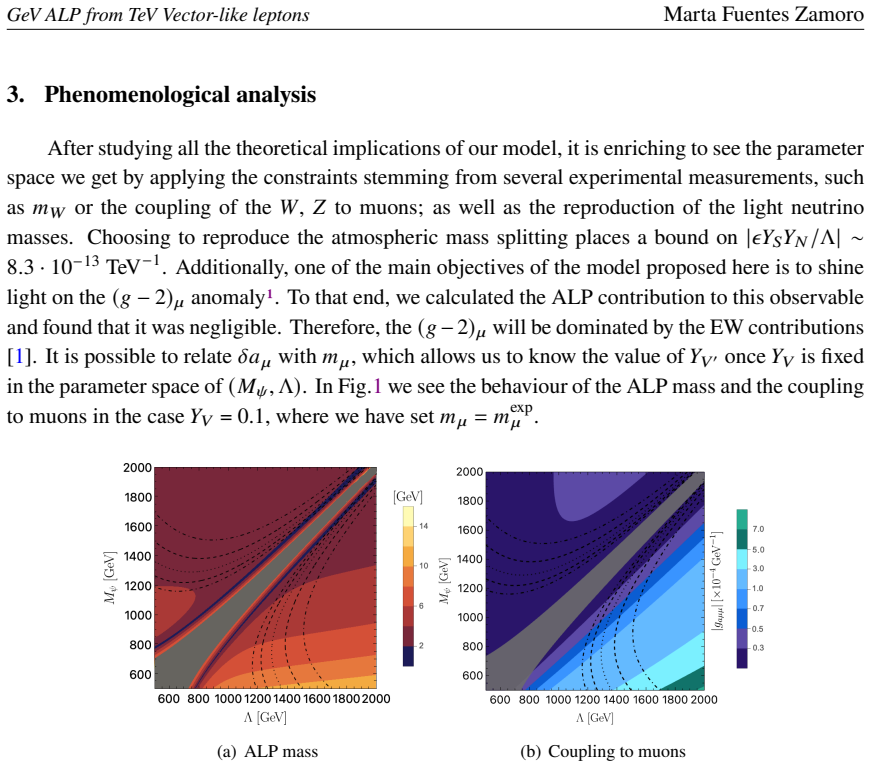
The argument is carried by the one-loop Coleman-Weinberg effective potential of the neutral sector, Eq. (5), which converts the explicit Peccei-Quinn breaking into a radiative ALP mass, and by the one-loop triangle diagrams that produce the ALP couplings to photons, $Z$, $W$, and muons, Eqs. (6) and (7). The mass formula vanishes at $M_\psi = \Lambda$, so the paper acknowledges that the next-to-leading order contribution becomes necessary there. The relation between $\delta a_\mu$ and the muon mass fixes one Yukawa coupling, $Y_V'$, once $Y_V$ is chosen in the $(M_\psi, \Lambda)$ parameter space.
What would settle it
Recompute the ALP mass from the full two-loop effective potential in Model B and check whether $m_a$ stays in the GeV range when $M_\psi \approx \Lambda$; if it does not, the predicted parameter space collapses. Independently, confirmation of the lattice value of the muon $g-2$ would remove the anomaly this model is built to explain, turning the claimed signature into a constraint.
Extended reading notes
Core claim
The central claim is that a GeV-scale ALP emerges naturally from a TeV-scale model where two heavy right-handed neutrinos and a vector-like electroweak lepton doublet are added to the Standard Model, together with a complex scalar singlet whose Peccei-Quinn symmetry is spontaneously broken. Explicit $U(1)_{\rm PQ}$-breaking terms in the heavy lepton sector generate the ALP mass radiatively, with $m_a \sim \mathcal{O}(\text{GeV})$ for $f_a \sim \text{TeV}$. The ALP couplings to gauge bosons and to muons are generated at one loop, and the ALP-muon coupling can span several orders of magnitude. The model also provides a linear seesaw origin for active neutrino masses and resolves the muon $g-2$ anomaly through electroweak vector-like lepton contributions, while the ALP contribution to $g-2$ itself is negligible.
Load-bearing premise
The prediction rests entirely on one-loop expressions for the ALP mass and couplings that are stated without derivation; if those calculations contain an error, or if the neglected higher-order terms become large where the two heavy masses are equal, the GeV ALP may not exist.
Editorial extensions
If this is right
- The ALP mass is radiatively generated and is not tied to $f_a$, so a TeV-scale $f_a$ naturally produces a GeV-scale ALP that is accessible to collider searches.
- The ALP couplings to $W$, $Z$, and photons are one-loop generated and suppressed by $f_a$, with non-resonant LHC searches bounding $f_{aWW} \geq 1.7$ GeV and $f_{aZZ} \geq 1.3$ GeV.
- The ALP-muon coupling $g_{a\mu\mu}$ can be continuously varied over many orders of magnitude, distinguishing this model from generic ultraviolet ALP constructions.
- The muon $(g-2)_\mu$ anomaly is resolved by electroweak contributions from the vector-like leptons, while the ALP contribution is negligible.
- Neutrino masses arise from the linear seesaw mechanism, tying the heavy neutral lepton scale to $\Lambda \sim \text{TeV}$.
Reading between the lines
- If the one-loop mass formula survives an independent check, the model predicts a concrete target region ($m_a \sim \text{GeV}$, $f_a \sim \text{TeV}$) that could be probed by beam-dump or forward-physics experiments, not only by LHC vector-boson-scattering searches.
- The continuous span of $g_{a\mu\mu}$ means the same model could be tuned to evade current direct searches while still producing visible signatures in loop-induced processes; a dedicated scan over $Y_V$ could reveal whether such tuning is required.
- If the lattice value of the muon $g-2$ is confirmed, the model's motivation shifts from explaining an anomaly to being constrained by it, and the ALP parameter space may become a target for exclusion rather than discovery.
- The vanishing of the mass formula at $M_\psi = \Lambda$ suggests an accidentally light ALP at that special point; a dedicated study of the NLO effective potential near this point could determine whether a large portion of parameter space actually contains a GeV ALP.
Editorial analysis
A structured set of objections, weighed in public.
Referee Report
Summary. This proceedings contribution presents an extension of the Standard Model with two right-handed neutrinos, a vector-like electroweak lepton doublet, and a complex scalar singlet φ carrying a U(1)PQ charge. The authors focus on 'Model B', in which the vector-like mass is generated dynamically from <φ>, while the HNL mass scale Λ remains a free parameter. They claim that explicit PQ-breaking terms in the Lagrangian generate, at one loop, an ALP mass of order GeV for f_a ~ TeV, with an ALP-muon coupling that can span many orders of magnitude. The model is also proposed as a solution to the muon g−2 anomaly and accommodates neutrino masses through the linear seesaw. The paper presents the relevant mass matrices, quotes one-loop formulas for the muon mass, ALP mass, ALP-gauge couplings, and ALP-muon coupling, and shows parameter-space regions satisfying perturbativity, neutrino-mass, and (g−2)_μ constraints, together with existing bounds from ALP searches.
Significance. If the quoted one-loop results are correct, the model is phenomenologically interesting: it connects a GeV-scale ALP with TeV-scale new fermions and a TeV-scale axion-decay constant, producing testable predictions for collider and beam-dump searches. The ALP mass and couplings are derived quantities rather than fits to ALP data, so the 'predicted mass' claim is not circular. The paper also makes good use of existing experimental limits and explicitly flags the caveat that lattice QCD may contradict the (g−2)_μ anomaly. However, the central one-loop formulas are quoted without derivation, and the admitted NLO sensitivity near Mψ=Λ leaves a part of the advertised parameter space uncontrolled; the manuscript is therefore not yet self-contained enough for the headline prediction to be independently validated.
major comments (4)
- [§2.2, Eq. (5)] The ALP mass formula is the load-bearing quantity for the headline claim of O(GeV) mass for f_a ~ TeV, but it is stated only as the result of an unspecified Coleman-Weinberg calculation. The expression depends on the renormalization scale μ_R, and the paper gives no choice of μ_R or an estimate of the associated uncertainty, so the contours in Figs. 1 and 2 cannot be reproduced from this text alone. More importantly, the authors note immediately after Eq. (5) that the leading-order result vanishes at Mψ = Λ; in any region of Fig. 1 near that diagonal, the entire ALP mass comes from an unspecified NLO contribution. Since the central claim is a prediction of the mass range, the authors should either provide the derivation or the precise corresponding equations in Ref. [2], specify the μ_R choice, and explain how the NLO region is handled, or restrict the claimed parameter space to where the leading-order expression is controlled.
- [§3, Fig. 1 and Eq. (7)] The value of Y_V' used in Eq. (7) is fixed by requiring the muon mass and the (g−2)_μ anomaly, so the plotted 'many orders of magnitude' range of g_{aμμ} is contingent on the anomaly being a real target. The footnote correctly acknowledges that recent lattice results contradict the anomaly, but if those results survive, the model no longer 'solves' (g−2)_μ and the dotted/dashed regions of Fig. 1 acquire a different meaning. The authors should present the allowed parameter space also under the alternative assumption that δaμ is only an upper bound, so that the ALP-coupling prediction is disentangled from the fate of the anomaly.
- [§2.1, Eq. (4)] The quoted one-loop muon pole mass contains an explicit dependence on μ_R. A physical pole mass should be renormalization-scale independent at the considered order after all contributions are included; if this expression is instead the running MS-bar mass or an approximation, that should be stated and the chosen scale given. This matters because the relation between m_μ and Y_V' determines a substantial part of the phenomenological analysis.
- [§2.2, Eq. (5)] The restriction of the Coleman-Weinberg computation to 'the neutral sector' is asserted but not justified. As printed in Table 1, the charged-sector operator Y_R ψ_L H μ_R in Eq. (1) carries a nonzero PQ charge (μ_R is assigned n_{ψ_L}), so it can in principle contribute to the ALP potential. Please state the PQ charge relations that make the charged sector PQ-invariant or negligible at one loop, or include its contribution in the quoted formula.
minor comments (5)
- [Eq. (1)] The notation φ^{(*)} is used without specifying the mapping between the sign of x or y and the choice of φ versus φ^*; please define this explicitly for each of the four realisations.
- [End of §2.2] The definition δ_{x,1} ≡ sgn(x) δ_{|x|,1} is nonstandard: since x ∈ {0, ±1}, this is simply x. The notation invites confusion with an ordinary Kronecker delta and should be simplified or clearly motivated.
- [Footnote 1] The statement that recent lattice calculations contradict the (g−2)_μ anomaly is made without a reference; please provide one so that the caveat can be checked.
- [Fig. 2 caption] The notation Y_{V,V'} ⊂ [0.05, 0.4] and α_{N,ψ} > 0.5 should use standard set-membership notation (e.g., ∈), and the caption should state whether all constraints are applied simultaneously.
- [Conclusions] The sentence 'the HNLs live in the TeV-scale' is imprecise: Λ is a free TeV-scale mass, but in the benchmark of Fig. 2 Mψ = 600 GeV. Please rephrase to distinguish the two mass scales.
Circularity Check
No circularity found: the GeV-ALP mass and couplings are one-loop derived outputs, not redefinitions of fitted inputs.
full rationale
The derivation chain is not circular. The ALP mass in Eq. (5) is presented as the result of a Coleman-Weinberg computation from the explicit U(1)_PQ-breaking terms of Eq. (1); it is a derived quantity, not a fitted input. Equation (7) is a one-loop triangle-diagram prediction whose dependence on Y_V' (fixed by the m_mu and (g-2)_mu relations) is an ordinary parameter constraint, not an identity: g_a_mu_mu is a new observable, and the paper does not rename the fitted Y_V' as the prediction. The statement that the ALP contribution to (g-2)_mu is negligible and that the EW contribution [1] dominates is a citation to prior work by overlapping authors, but it is used to select the Y_V' value, not to define the ALP mass or coupling; it is therefore a load-bearing external input at the level of model viability, not a circular self-reference. The paper's own caveat that Eq. (5) vanishes for M_psi = Lambda (so NLO terms would be necessary) is a validity limitation for that corner of parameter space, not a circular step. The one-loop formulas (5)-(7) are stated without derivation in this proceedings contribution, with the full analysis referred to [2]; a missing derivation is an omission of support, not circularity. I find no equation that is equivalent to its own input by construction and no fitted parameter that is renamed as a prediction.
Assumptions & free parameters
free parameters (7)
- Y_V =
0.1 (in Fig.1)
- Y_V' =
fixed by delta a_mu and m_mu
- M_psi =
scanned, e.g., 600 GeV benchmark
- Lambda =
scanned, e.g., 1500 GeV benchmark
- alpha_N =
scanned in [0.5, 1.25]
- epsilon*Y_S*Y_N / Lambda =
|...| ~ 8.3e-13 TeV^{-1}
- alpha_psi =
1 (by assumption)
assumptions (5)
- standard math The Standard Model gauge structure and quantum field theory are valid.
- domain assumption The linear seesaw mechanism with two right-handed neutrinos and a small parameter epsilon generates the observed neutrino masses.
- ad hoc to paper The U(1)_PQ charge assignments in Table 1 are consistent with anomaly cancellation and allow the explicit PQ-breaking terms in Eq. (1).
- ad hoc to paper The ALP mass is dominated by the one-loop Coleman-Weinberg potential of the neutral sector only.
- ad hoc to paper The next-to-leading order corrections to the ALP mass are negligible except where the leading term vanishes at M_psi = Lambda.
invented entities (2)
-
Complex scalar singlet phi (the Peccei-Quinn scalar)
-
Axion-like particle (ALP)
independent evidence
Cite this review
Pith. "Pith review of GeV ALP from TeV Vector-like leptons." pith.science (2026). https://pith.science/paper/UZ5LQIDJ
@misc{pith2026241118246,
  author       = {Pith},
  title        = {Pith review of: GeV ALP from TeV Vector-like leptons},
  year         = {2026},
  howpublished = {\url{https://pith.science/paper/UZ5LQIDJ}},
  note         = {Machine review of arXiv:2411.18246}
}
abstract
We present a model where a GeV axion-like-particle (ALP) is predicted in a large portion of the parameter space due to the presence of explicit Peccei-Quinn symmetry-breaking terms in an exotic leptonic sector. The latter provides a solution to the muon $g-2$ anomaly, within the framework of the Linear Seesaw neutrino mechanism. The spectrum is extended by a complex scalar singlet only transforming under the Peccei-Quinn symmetry, which generates the ALP. Its couplings with fermions can continuously span over many orders of magnitude, which constitutes a specific feature of this model in contrast to generic ultraviolet constructions. Interestingly, these couplings are suppressed by the ALP characteristic scale that can be as low as the TeV scale, which represents a novel feature of the model and opens up to several phenomenological consequences.
Figures

Reference graph
Works this paper leans on
-
[2]
A. de Giorgi, M.F. Zamoro, L. Merlo,GeV ALP from TeV Vector-like Leptons, [arXiv:2402.14059]
-
[1]
The Low-Scale Seesaw Solution to the $M_W$ and $(g-2)_\mu$ Anomalies
A. de Giorgi, L. Merlo and S. Pokorski,The Low-Scale Seesaw Solution to the𝑀𝑊 and(𝑔− 2)𝜇 Anomalies, Fortsch. Phys. 71 (2023), no. 4-5 2300020, [arXiv:2211.03797]
work page Pith review arXiv 2023
-
[3]
J. Bonilla, I. Brivio, J. Machado-Rodríguez and J. de Trocóniz,Nonresonant searches for axion-like particles in vector boson scattering processes at the LHC, JHEP 06 (2022) 113, [arXiv:2202.03450]
arXiv 2022
-
[4]
cajohare/axionlimits: Axionlimits
C. O’Hare, “cajohare/axionlimits: Axionlimits.”https://cajohare.github.io/AxionLimits/, July, 2020. 5
work page 2020
Reviewed August 12, 2026 · model on record in the stance chip above.
Discussion (0). Continue with ORCID to comment.