REVIEW 3 major objections 5 minor 73 references
Solar Alfvenic Pulses and Mesoscale Solar Wind
T0 review · 3 major / 5 minor · reviewed 2026-08-06 · deepseek-v4-flash
Pith's one-line read Photospheric bright-point motions can pack 10^25 erg into Alfvénic pulses, enough to seed solar-wind switchbacks.
desk verdict A genuine first measurement of individual Alfvénic pulse energies from network bright points, but the headline 'adequately higher than switchbacks' claim is not secure because the equipartition density assumption may overestimate the energies rather than give a lower limit. read the letter →
The pith
A machine-rendered reading of the paper's core claim, the machinery that carries it, and where it could break.
The reading
What carries the argument
The central object is the network bright point (NBP), a small magnetic feature at the chromospheric network boundary whose random motion agitates open flux tubes. The key identity is the pulse energy formula E = c tau E_perp phi_z / 8 pi, obtained by integrating the Alfvén wave flux over the flux-tube cross-section and the NBP lifetime, with the equipartition relation rho $u^{2}$ = $B_z^{2}$ / 4 pi used to replace the unmeasured mass density. The magnetic flux phi_z and convective electric field E_perp are measured from co-aligned magnetograms, while tau is the NBP lifetime; the formula converts these observable quantities into an energy that can be compared directly with switchback energies.
What would settle it
Measure the actual plasma density or plasma beta at network bright point heights in a coronal hole boundary; if the true density is more than about an order of magnitude lower than the equipartition value, the derived pulse energies would drop below the switchback energy range and the central comparison would fail.
Extended reading notes
Core claim
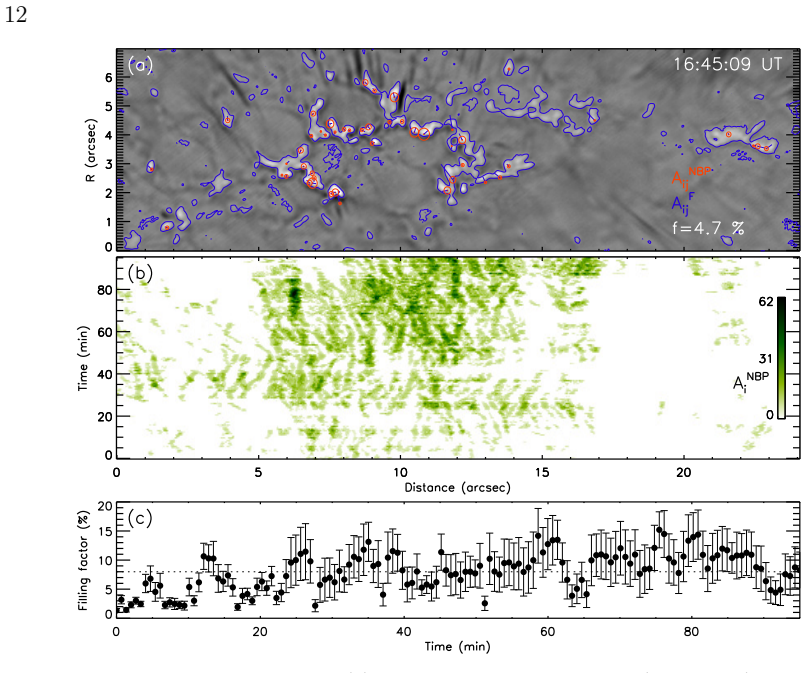
The central claim is that Alfvénic pulses generated by the transverse motions of network bright points at a coronal hole boundary carry enough energy to be viable seeds for magnetic switchbacks. Using the Southwest Automatic Magnetic Identification Suite to track the bright points, the authors measure each point's velocity, magnetic flux, and lifetime, then convert these into a pulse energy via an equipartition assumption. They find individual pulse energies clustered around 7 x $10^{24}$ erg and spanning $10^{23}$ to $10^{26}$ erg, which exceeds the 5 x $10^{21}$ to 3 x $10^{23}$ erg magnetic energies calculated for the six switchbacks from Laker et al. (2021). The paper further finds that the mobile bright points cover about 8% of the filigree area, a filling factor comparable to the 6% filling factor of PSP switchbacks. The authors interpret these results as support for the idea that photospheric convection, acting through Alfvénic pulses, provides a solar source for the mesoscale solar wind.
Load-bearing premise
The energy estimate depends on assuming the kinetic energy density of the plasma equals the magnetic energy density (rho $u^{2}$ = $B_z^{2}$/4 pi) because the mass density is not measured directly, and if the true density differs, the stated pulse energies and their comparison to switchbacks would shift.
Editorial extensions
If this is right
- If the central claim holds, photospheric granular and supergranular convection is a sufficient energy source for the mesoscale solar wind, not just for heating the corona.
- The Alfvénic pulse energy range of 10^23 to 10^26 erg, even after a 1-10% transmission through the transition region, still overlaps the switchback energy range of 10^22 to 10^23 erg.
- The measured filling factor of about 8% provides a solar-surface boundary condition that Alfvén wave/turbulence models of switchbacks must reproduce.
- The result strengthens the case that switchbacks are seeded by solar-origin Alfvénic pulses rather than formed entirely in situ in the solar wind.
- The comparison between pulse energies and switchback energies offers a new quantitative link between solar observations and PSP near-Sun measurements.
Reading between the lines
- A natural extension would be to map the same NBP-tracking analysis across multiple coronal hole boundaries to see whether the 8% filling factor and 10^25 erg pulse energy are typical or peculiar to this one region.
- The equipartition assumption could be tested directly by measuring the plasma density at NBP heights with spectropolarimetric inversions, which would either confirm the lower-limit interpretation or shift the energy scale.
- If solar convection indeed seeds switchbacks, similar Alfvénic pulse generation might be expected at the boundaries of coronal holes in other stars, making the filling factor a potentially observable stellar wind diagnostic.
- The authors' energy comparison assumes each pulse remains coherent; testing coherence by simulating propagation through a stratified atmosphere with the measured source parameters would clarify how much of the initial energy reaches 1 AU.
Editorial analysis
A structured set of objections, weighed in public.
Referee Report
Summary. The paper uses high-resolution Hα images and magnetograms from the GST at Big Bear Solar Observatory to track network bright points (NBPs) along a coronal hole boundary. It measures NBP motions, magnetic fluxes, and lifetimes to estimate the energy of individual Alfvénic pulses generated by these motions, finding energies in the range 10^23–10^26 erg with a peak near 7×10^24 erg. It also computes a filling factor of ~8% for mobile NBPs relative to the surrounding filigree area, which it compares to the ~6% filling factor of switchbacks reported by PSP. The authors argue that these pulses carry sufficient energy to seed mesoscale switchbacks, even after accounting for reflection at the transition region, and that their spatial distribution matches the granular/supergranular modulation of switchbacks.
Significance. If the energy and filling factor estimates were robust, the paper would provide a direct observational link between photospheric footpoint motions and the energy budget of switchbacks, addressing a central open question in the field. The work introduces a novel method for estimating individual Alfvénic pulse energies from NBP tracking, and the use of high-resolution GST data with a documented tracking tool (SW AMIS) is a strength. However, the central conclusions hinge on an assumed equipartition between kinetic and magnetic energy densities that is not directly measured, and on a filling factor definition that is not clearly equivalent to the PSP in-situ measurement. These caveats currently limit the strength of the claims.
major comments (3)
- [§3.3, Eq. (1)] The claim that the equipartition assumption ρu^2 = B_z^2/4π yields a lower limit on the pulse energy is not established. A plasma with β>1 implies thermal pressure exceeds magnetic pressure, but it does not constrain the mass density relative to ρ_eq = B^2/(4πu^2). At the Hα -1.0 Å formation height, standard models give densities 10^-8–10^-7 g/cm^3, while ρ_eq for B ~ 300 G and u ~ 1 km/s is ~7×10^-7 g/cm^3. If the true density is lower than ρ_eq, the actual energy is lower by a factor sqrt(ρ/ρ_eq), potentially ~0.1–0.4, which would shift a substantial fraction of the 10^23–10^26 erg distribution below the switchback energy band (10^22–10^23 erg). The paper's assertion that the result is a physically meaningful lower limit is therefore not robust to the choice of density. The authors should either provide an independent density constraint (e.g., from chromospheric modeling or co-observations) or present the energy results as explicitly conditional on the uncertain density, with the corresponding range of possible energies.
- [§3.4, Eq. (3)] The filling factor is defined as the ratio of mobile NBP area to filigree area, explicitly excluding field-free and closed-field regions. This choice inflates the filling factor relative to a definition based on the total area of the coronal hole boundary or the supergranule. Moreover, the PSP 'filling factor' of 6% is a time fraction of switchback occurrence along the spacecraft trajectory, not an area fraction on the solar surface. The conceptual equivalence of these two quantities is not justified, so the statement that the measured ~8% filling factor is 'comparable to' the PSP value is not quantitatively supported. Please clarify the correspondence between surface area filling and in-situ temporal filling, or rephrase the comparison to avoid implying a direct match.
- [Appendix A] The transmission coefficient of 1–10% is derived from a model with parameters (Alfvén speed contrast α, density scale height H_ρ) chosen from 'plausible ranges' rather than measured from the target region. Combined with the density uncertainty above, the final statement that transmitted pulse energies remain comparable to switchback energies is not robust across the plausible parameter space. For example, if the source density is at the lower end of the standard model range and the transmission is at the low end of the 1–10% range, the transmitted energies would fall below the switchback band for a large fraction of the pulse distribution. The authors should provide a propagation of uncertainties through the transmission calculation, or at least discuss the sensitivity of their conclusion to the assumed parameters.
minor comments (5)
- [§3.2] The intensity contrast threshold for NBP detection is set at ≥0.07, but no information is given on the sensitivity of the results to this threshold. The filling factor error bars are derived from a 2–3% contrast threshold for filigree, but the NBP threshold sensitivity is not discussed.
- [Abstract and §3.3] There are several typos: 'some of then' in the abstract, 'which is is' in §3.3, and 'a few 10 17 Mx' missing an exponent. Also, the title contains a stray accent: 'Alfv´enic'.
- [§4] The references to '§2.3', '§2.4', and '§2.5' in the Discussion do not match the actual section numbers; the corresponding material is in §3.3 and §3.4.
- [§3.2] The description of SW AMIS is brief; citing the algorithm's specific parameters or any validation performed for Hα images would help readers assess the tracking accuracy.
- [§3.3] The derivation of the switchback energy ΔE = αB^2D^3/32 is not shown; please provide the geometric steps or a reference that includes the derivation, and clarify whether the six selected switchbacks are representative of the overall PSP switchback population.
Circularity Check
No circularity: the Alfvenic pulse energy is computed from directly measured NBP motion, magnetic flux, and lifetime under an explicitly stated equipartition assumption, and the switchback comparison uses independent external PSP data without any fitted parameter forcing agreement.
full rationale
The paper's central derivation is self-contained. Section 3.3 integrates the Alfven wave flux F = 1/2 rho u^2 V_A over each NBP area and lifetime. Since the mass density is not directly observed, the authors explicitly assume equipartition, rho u^2 = B_z^2/4pi, which converts the energy integral into E = c tau E_perp phi_z / 8pi using measured quantities: the NBP velocity u, the line-of-sight magnetic flux phi_z, the convective electric field E_perp = u B_z / c, and the NBP lifetime tau. This is a stated physical modeling assumption, not a hidden fit. The comparison with switchback energies uses six PSP switchbacks from Laker et al. (2021) with independently obtained parameters, so the claimed 'adequately higher' energy range is not forced by construction. Likewise, the filling factor f = sum A_NBP / sum A_filigree (Eq. 3) is measured directly from the H-alpha images and magnetograms; the resulting ~8% value is compared with, rather than fitted to, the PSP value of ~6%. The self-citations (Lee et al. 2022, 2024; Georgoulis et al. 2012, 2025) provide context or explicitly deferred future work and are not load-bearing for the energy formula or the switchback comparison. Whether the equipartition assumption yields a true lower limit is a question of physical correctness, not circularity, since the assumption is openly stated and the derivation does not presuppose the switchback energies it aims to compare with.
Assumptions & free parameters
free parameters (4)
- Plasma density rho via equipartition =
inferred from rho u^2 = B_z^2/4pi
- NBP intensity contrast threshold =
0.07
- Filigree intensity contrast threshold =
2-3%
- Alfven speed contrast alpha and density scale height H_rho =
alpha=10-40, H_rho=200-400 km
assumptions (5)
- domain assumption Photospheric motions of network bright points agitate open flux tubes and generate propagating Alfvenic pulses.
- domain assumption Energy equipartition rho u^2 = B_z^2/4pi holds for the NBP environment.
- standard math The energy flux of the generated pulses is F = 1/2 rho u^2 V_A.
- standard math The classical stratified-atmosphere reflection model of Zhugzhda and Locans (1982) describes transmission through the transition region.
- domain assumption The vertical field B_z is obtained by dividing the LOS field by cos(theta) with theta = 39 degrees.
Cite this review
Pith. "Pith review of Solar Alfvenic Pulses and Mesoscale Solar Wind." pith.science (2026). https://pith.science/paper/UZ5YJSV3
@misc{pith2026250712658,
  author       = {Pith},
  title        = {Pith review of: Solar Alfvenic Pulses and Mesoscale Solar Wind},
  year         = {2026},
  howpublished = {\url{https://pith.science/paper/UZ5YJSV3}},
  note         = {Machine review of arXiv:2507.12658}
}
read the original abstract
Large-scale solar ejections are well understood, but the extent to which small-scale solar features directly influence the solar wind remains an open question, primarily due to the challenges of tracing these small-scale ejections and their impact. Here, we measure the fine-scale motions of network bright points along a coronal hole boundary in high-resolution H-alpha images from the 1.6m Goode Solar Telescope at Big Bear Solar Observatory to quantify the agitation of open flux tubes into generating Alfvenic pulses. We combine the motion, magnetic flux, and activity duration of the flux tubes to estimate the energy content carried by individual Alfvenic pulses, which is ~10+25 erg, adequately higher than the energies ~10+23 erg estimated for the magnetic switchbacks observed by the Parker Solar Probe (PSP). This implies the possibility that the surface-generated Alfvenic pulses could reach the solar wind with sufficient energy to generate switchbacks, even though some of then are expected to be reflected back in the stratified solar atmosphere. Alfvenic pulses further reproduce for the first time other properties of switchbacks, including the filling factor above ~8% at granular and supergranular scales, which correspond best to the lower end of the mesoscale structure. This quantitative result for solar energy output in the form of Alfvenic pulses through magnetic funnels provides a crucial clue to the ongoing debate about the dynamic cycle of energy exchange between the Sun and the mesoscale solar wind that has been raised, but has not been adequately addressed, by PSP near-Sun observations.
Figures


Figures from the paper (4 more)



Reference graph
Works this paper leans on
-
[1]
- [1] #1 = = ^ ^ ^ .\!\!^ d .\!\!^ h .\!\!^ m .\!\!^ s .\!\!^ @mss
thebibliography [1] 20pt to REFERENCES 6pt =0pt -12pt 10pt plus 3pt =0pt =0pt =1pt plus 1pt =0pt =0pt -12pt =13pt plus 1pt =20pt =13pt plus 1pt \@M =10000 =-1.0em =0pt =0pt 0pt =0pt =1.0em @enumiv\@empty 10000 10000 `\.\@m \@noitemerr \@latex@warning Empty `thebibliography' environment \@ifnextchar \@reference \@latexerr Missing key on reference command E...
2021
-
[2]
Abramenko , V. I., Zank , G. P., Dosch , A., et al. 2013, , 773, 167, 10.1088/0004-637X/773/2/167
-
[3]
Akhavan-Tafti , M., & Soni , S. L. 2024, , 970, L26, 10.3847/2041-8213/ad60bc
-
[4]
Asgari-Targhi , M., van Ballegooijen , A. A., Cranmer , S. R., & DeLuca , E. E. 2013, , 773, 111, 10.1088/0004-637X/773/2/111
-
[5]
Bale , S. D., Badman , S. T., Bonnell , J. W., et al. 2019, , 576, 237, 10.1038/s41586-019-1818-7
-
[6]
Bale , S. D., Horbury , T. S., Velli , M., et al. 2021, , 923, 174, 10.3847/1538-4357/ac2d8c
-
[7]
Bale , S. D., Drake , J. F., McManus , M. D., et al. 2023, , 618, 252, 10.1038/s41586-023-05955-3
-
[8]
Berberyan , A., Keys , P. H., Jess , D. B., & Christian , D. J. 2024, , 690, A363, 10.1051/0004-6361/202451199
Show all 73 references
-
[9]
S., Dudok de Wit , T., & Velli , M
Bizien , N., Froment , C., Madjarska , M. S., Dudok de Wit , T., & Velli , M. 2025, , 694, A181, 10.1051/0004-6361/202452140
2025 doi
- [10]
-
[11]
o ger , M. Collados Vera , H. Socas-Navarro , R. Schlichenmaier , M. Carlsson , T. Berger , A. Cadavid , P. R. Gilbert , P. R. Goode , & M. Kn \
Cao, W., Goode, P. R., Ahn, K., et al. 2012, in Astronomical Society of the Pacific Conference Series, Vol. 463, Second ATST-EAST Meeting: Magnetic Fields from the Photosphere to the Corona., ed. T. R. Rimmele , A. Tritschler , F. W \"o ger , M. Collados Vera , H. Socas-Navarr...
2012
-
[12]
2010, Astronomische Nachrichten, 331, 636, 10.1002/asna.201011390
Cao, W., Gorceix, N., Coulter, R., et al. 2010, Astronomische Nachrichten, 331, 636, 10.1002/asna.201011390
2010 doi
-
[13]
2022, , 924, L33, 10.3847/2041-8213/ac4015
Cattell , C., Breneman , A., Dombeck , J., et al. 2022, , 924, L33, 10.3847/2041-8213/ac4015
2022 doi
-
[14]
2023, , 954, 45, 10.3847/1538-4357/ace771
Chae , J., & Lee , K.-S. 2023, , 954, 45, 10.3847/1538-4357/ace771
2023 doi
-
[15]
P., van Ballegooijen , A
Chitta , L. P., van Ballegooijen , A. A., Rouppe van der Voort , L., DeLuca , E. E., & Kariyappa , R. 2012, , 752, 48, 10.1088/0004-637X/752/1/48
2012 doi
-
[16]
2024, , 971, 177, 10.3847/1538-4357/ad54c4
Choi , K.-E., Agapitov , O., Colomban , L., et al. 2024, , 971, 177, 10.3847/1538-4357/ad54c4
2024 doi
- [17]
-
[18]
R., & van Ballegooijen , A
Cranmer , S. R., & van Ballegooijen , A. A. 2005, , 156, 265, 10.1086/426507
2005 doi
-
[19]
R., & Winebarger , A
Cranmer , S. R., & Winebarger , A. R. 2019, , 57, 157, 10.1146/annurev-astro-091918-104416
2019 doi
-
[20]
E., Hagenaar , H
DeForest , C. E., Hagenaar , H. J., Lamb , D. A., Parnell , C. E., & Welsch , B. T. 2007, , 666, 576, 10.1086/518994
2007 doi
-
[21]
V., Bale , S
Dudok de Wit , T., Krasnoselskikh , V. V., Bale , S. D., et al. 2020, , 246, 39, 10.3847/1538-4365/ab5853
2020 doi
- [22]
-
[23]
P., et al
Fargette , N., Lavraud , B., Rouillard , A. P., et al. 2021, , 919, 96, 10.3847/1538-4357/ac1112
2021 doi
-
[24]
L., & Handy , B
Freeland , S. L., & Handy , B. N. 2012, SolarSoft: Programming and data analysis environment for solar physics , Astrophysics Source Code Library, record ascl:1208.013
2012
-
[25]
K., Li , Q., Lee , J., Wang , H., & Raouafi , N
Georgoulis , M. K., Li , Q., Lee , J., Wang , H., & Raouafi , N. 2025, , in preparation
2025
-
[26]
K., Titov , V
Georgoulis , M. K., Titov , V. S., & Miki \'c , Z. 2012, , 761, 61, 10.1088/0004-637X/761/1/61
2012 doi
-
[27]
R., & Cao, W
Goode, P. R., & Cao, W. 2012, in Society of Photo-Optical Instrumentation Engineers (SPIE) Conference Series, Vol. 8444, Ground-based and Airborne Telescopes IV, ed. L. M. Stepp , R. Gilmozzi , & H. J. Hall , 844403, 10.1117/12.925494
2012 doi
-
[28]
Hollweg , J. V. 1978, , 56, 305, 10.1007/BF00152474
1978 doi
-
[29]
A., Vourlidas , A., & Stenborg , G
Howard , R. A., Vourlidas , A., & Stenborg , G. 2023, Frontiers in Astronomy and Space Sciences, 10, 1264226, 10.3389/fspas.2023.1264226
2023
-
[30]
B., Pascoe , D
Jess , D. B., Pascoe , D. J., Christian , D. J., et al. 2012, , 744, L5, 10.1088/2041-8205/744/1/L5
2012 doi
-
[31]
2022, Physics of Plasmas, 29, 072902, 10.1063/5.0097983
Johnston , Z., Squire , J., Mallet , A., & Meyrand , R. 2022, Physics of Plasmas, 29, 072902, 10.1063/5.0097983
2022 doi
- [32]
-
[33]
C., Bale , S
Kasper , J. C., Bale , S. D., Belcher , J. W., et al. 2019, , 576, 228, 10.1038/s41586-019-1813-z
2019 doi
-
[34]
2020, , 893, 93, 10.3847/1538-4357/ab7f2d
Krasnoselskikh , V., Larosa , A., Agapitov , O., et al. 2020, , 893, 93, 10.3847/1538-4357/ab7f2d
2020 doi
-
[35]
S., Bale , S
Laker , R., Horbury , T. S., Bale , S. D., et al. 2021, , 650, A1, 10.1051/0004-6361/202039354
2021 doi
-
[36]
Larosa , A., Chen , C. H. K., McIntyre , J. R., Jagarlamudi , V. K., & Sorriso-Valvo , L. 2024, , 686, A238, 10.1051/0004-6361/202450030
2024 doi
-
[37]
2021, , 650, A3, 10.1051/0004-6361/202039442
Larosa , A., Krasnoselskikh , V., Dudok de Wit , T., et al. 2021, , 650, A3, 10.1051/0004-6361/202039442
2021 doi
-
[38]
2022, Reviews of Modern Plasma Physics, 6, 32, 10.1007/s41614-022-00096-y
Lee , J. 2022, Reviews of Modern Plasma Physics, 6, 32, 10.1007/s41614-022-00096-y
2022 doi
-
[39]
2024, , 963, 79, 10.3847/1538-4357/ad23e0
Lee , J., Wang , H., Wang , J., & Wang , M. 2024, , 963, 79, 10.3847/1538-4357/ad23e0
2024 doi
-
[40]
2022, , 935, L27, 10.3847/2041-8213/ac86bf
Lee , J., Yurchyshyn , V., Wang , H., et al. 2022, , 935, L27, 10.3847/2041-8213/ac86bf
2022 doi
-
[41]
2021, , 913, 19, 10.3847/1538-4357/abefd1
Mackenzie Dover , F., Sharma , R., & Erd \'e lyi , R. 2021, , 913, 19, 10.3847/1538-4357/abefd1
2021 doi
- [42]
-
[43]
Mallet , A., Squire , J., Chandran , B. D. G., Bowen , T., & Bale , S. D. 2021, , 918, 62, 10.3847/1538-4357/ac0c12
2021 doi
-
[44]
A., de Wijn , A
Nisenson , P., van Ballegooijen , A. A., de Wijn , A. G., & S \"u tterlin , P. 2003, , 587, 458, 10.1086/368067
2003 doi
-
[45]
J., & De Pontieu , B
Okamoto , T. J., & De Pontieu , B. 2011, , 736, L24, 10.1088/2041-8205/736/2/L24
2011 doi
-
[46]
Parker , E. N. 1958, , 128, 664, 10.1086/146579
1958 doi
- [47]
-
[48]
Parnell , C. E. 2002, , 335, 389, 10.1046/j.1365-8711.2002.05618.x
2002
-
[49]
E., DeForest , C
Parnell , C. E., DeForest , C. E., Hagenaar , H. J., et al. 2009, , 698, 75, 10.1088/0004-637X/698/1/75
2009 doi
-
[50]
E., Stenborg , G., Seaton , D
Raouafi , N. E., Stenborg , G., Seaton , D. B., et al. 2023 a , , 945, 28, 10.3847/1538-4357/acaf6c
2023 doi
-
[51]
E., Matteini , L., Squire , J., et al
Raouafi , N. E., Matteini , L., Squire , J., et al. 2023 b , , 219, 8, 10.1007/s11214-023-00952-4
2023 doi
-
[52]
J., Badman , S
Rivera , Y. J., Badman , S. T., Stevens , M. L., et al. 2024, Science, 385, 962, 10.1126/science.adk6953
2024 doi
-
[53]
J., & Bel , N
Schwartz , S. J., & Bel , N. 1984, , 137, 128
1984
-
[54]
1877, L'astronomia in Roma nel pontificato DI Pio IX
Secchi , A. 1877, L'astronomia in Roma nel pontificato DI Pio IX
-
[55]
Sharma , R., & Morton , R. J. 2023, Nature Astronomy, 7, 1301, 10.1038/s41550-023-02070-1
2023 doi
-
[56]
2022, , 934, 152, 10.3847/1538-4357/ac7c11
Shi , C., Panasenco , O., Velli , M., et al. 2022, , 934, 152, 10.3847/1538-4357/ac7c11
2022 doi
-
[57]
Shoda , M., Chandran , B. D. G., & Cranmer , S. R. 2021, , 915, 52, 10.3847/1538-4357/abfdbc
2021 doi
- [58]
-
[59]
Soler , R., Terradas , J., Oliver , R., & Ballester , J. L. 2019, , 871, 3, 10.3847/1538-4357/aaf64c
2019 doi
-
[60]
Squire , J., Chandran , B. D. G., & Meyrand , R. 2020, , 891, L2, 10.3847/2041-8213/ab74e1
2020 doi
-
[61]
2022, Physics of Plasmas, 29, 112903, 10.1063/5.0099924
Squire , J., Johnston , Z., Mallet , A., & Meyrand , R. 2022, Physics of Plasmas, 29, 112903, 10.1063/5.0099924
2022 doi
-
[62]
2004, The Sun: An Introduction
Stix , M. 2004, The Sun: An Introduction
2004
-
[63]
2024, , 692, A71, 10.1051/0004-6361/202452019
Touresse , J., Pariat , E., Froment , C., et al. 2024, , 692, A71, 10.1051/0004-6361/202452019
2024 doi
-
[64]
Ulmschneider , P., Zaehringer , K., & Musielak , Z. E. 1991, , 241, 625
1991
-
[65]
2010, , 511, A39, 10.1051/0004-6361/200913085
Utz , D., Hanslmeier , A., Muller , R., et al. 2010, , 511, A39, 10.1051/0004-6361/200913085
2010 doi
-
[66]
A., Nisenson , P., Noyes , R
van Ballegooijen , A. A., Nisenson , P., Noyes , R. W., et al. 1998, , 509, 435, 10.1086/306471
1998 doi
-
[67]
G., & Maruca , B
Verscharen , D., Klein , K. G., & Maruca , B. A. 2019, Living Reviews in Solar Physics, 16, 5, 10.1007/s41116-019-0021-0
2019 doi
-
[68]
M., DeForest , C
Viall , N. M., DeForest , C. E., & Kepko , L. 2021, Frontiers in Astronomy and Space Sciences, 8, 139, 10.3389/fspas.2021.735034
2021
- [69]
-
[70]
2012, , 486, 505, 10.1038/nature11202
Wedemeyer-B \"o hm , S., Scullion , E., Steiner , O., et al. 2012, , 486, 505, 10.1038/nature11202
2012 doi
-
[71]
F., Pariat , E., Squire , J., Touresse , J., & Matteini , L
Wyper , P. F., Pariat , E., Squire , J., Touresse , J., & Matteini , L. 2024, in AGU Fall Meeting Abstracts, Vol. 2024, SH24A--01
2024
- [72]
-
[73]
1988, Astrophysics of the sun
Zirin , H. 1988, Astrophysics of the sun
1988
Reviewed August 6, 2026 · model on record in the stance chip above.
Discussion (0). Continue with ORCID to comment.