REVIEW 3 major objections 4 minor 83 references
Uncertainty quantification with approximate variational learning for wearable photoplethysmography prediction tasks
T0 review · 3 major / 4 minor · reviewed 2026-08-15 · deepseek-v4-flash
Pith's one-line read For PPG heart predictions, sampling stochasticity controls which uncertainty you get and how well it is calibrated.
desk verdict Useful, honest empirical study of MCD/IVON hyperparameters for PPG uncertainty, but the headline 'composition' claim rests on a disentanglement method the authors themselves have not validated. read the letter →
The pith
A machine-rendered reading of the paper's core claim, the machinery that carries it, and where it could break.
The reading
What carries the argument
The central mechanism is the stochasticity of model parameter sampling at evaluation time. For Monte Carlo Dropout this is set by the dropout rate $p$; for Improved Variational Online Newton it is set by the Hessian initialisation $h_0$, which controls the width of the approximate Gaussian posterior. This single dial determines how much of the total predictive variance is labelled epistemic (model uncertainty) as opposed to aleatoric (inherent data noise), and it correlates with how well the final class probabilities are calibrated. The supporting machinery is the standard heteroscedastic likelihood modelling from Kendall and Gal (Gaussian negative log-likelihood for regression; Monte-Carlo-averaged softmax for classification), the law-of-total-variance decomposition for regression and the entropy-concavity decomposition $H_{\text{ale}}\le H_{\text{total}}$ for classification, and a multi-metric evaluation protocol (ECE, UCE, ENCE, CCE, bivariate error-vs-uncertainty histograms, per-class curves) that exposes where calibration fails locally.
What would settle it
Retrain the blood-pressure regression models on a VitalDB split in which no patient appears in more than one set, and recompute the ENCE and CCE orderings across dropout rates (1%, 5%, 40%). If the ordering of calibration quality with dropout rate changes or the local calibration differences vanish, the paper's regression conclusions describe per-patient adaptation rather than generalisable model behaviour.
Extended reading notes
Core claim
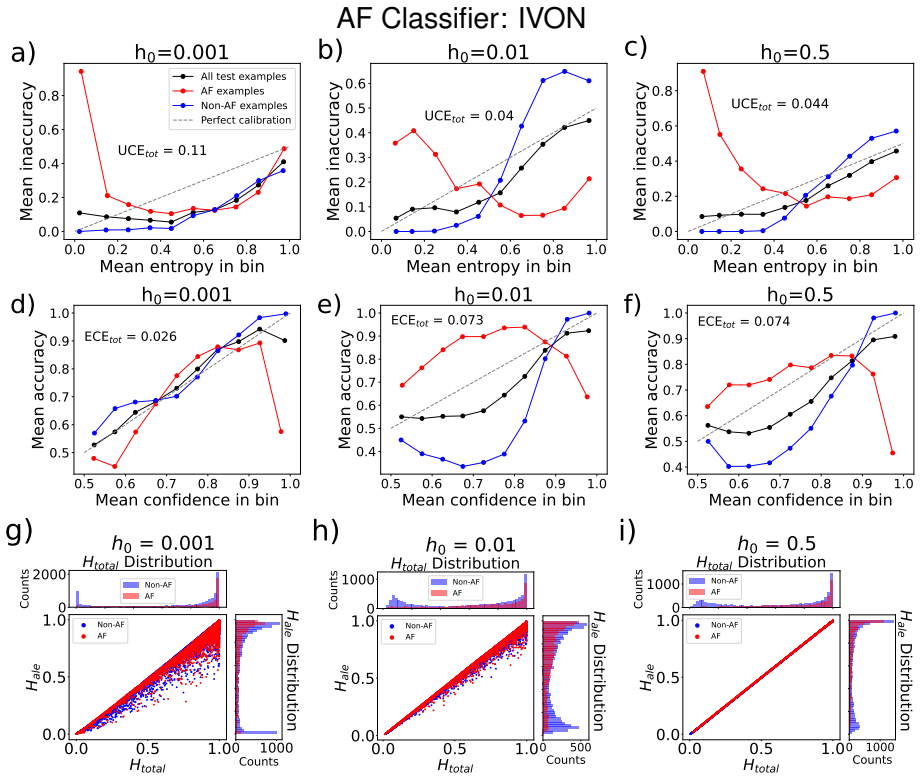
The central claim is that the reliability of uncertainty estimates from MCD and IVON on PPG prediction tasks is governed largely by the stochasticity of the parameter sampling, controlled by the dropout rate and by the Hessian initialisation respectively. Larger dropout rates (and smaller $h_0$ for IVON) increase the proportion of total uncertainty labelled epistemic and produce better-calibrated class probabilities as measured by the expected calibration error (ECE) over the whole test population, while the best predictive accuracy occurs at intermediate settings. The same stochasticity also shifts the balance between aleatoric and epistemic components, and the two components, when disentangled with standard formulas, turn out to be highly correlated, so the decomposition must be interpreted cautiously. Because per-class calibration curves diverge from global ones, the paper argues that evaluating uncertainty quality requires both individual and adaptive calibration metrics, not just aggregate scores.
Load-bearing premise
The blood-pressure regression results use the same 1,293 ICU patients in training, validation, and test sets, so the claims about "previously unseen test data" assume that this patient-overlapping split behaves like a true generalization test.
Editorial extensions
If this is right
- Uncertainty estimates from MCD and IVON on PPG tasks are not trustworthy as-is: the dropout rate and $h_0$ must be tuned on the chosen calibration metric, because the optimal setting for accuracy, for ECE, and for UCE are not the same.
- The proportion of predicted uncertainty attributed to epistemic versus aleatoric sources is largely an artefact of the sampling-stochasticity hyperparameter, not a stable property of the data or model.
- Whole-test-set calibration can hide severe per-class miscalibration; for AF screening, low-uncertainty predictions are predominantly non-AF, so a highly confident decision rule would produce many false negatives.
- For BP regression, the two disentangled uncertainty components are highly correlated, so users should not interpret the separated numbers as independent sources of doubt.
- Greater stochasticity in model sampling produced better whole-population calibration of class probabilities for both techniques, suggesting a common principle: more posterior exploration helps probability calibration on this task.
Reading between the lines
- If the sampling-stochasticity/ECE relationship holds on other physiological time-series tasks, hyperparameter scans for UQ should report both ECE and an entropy-based calibration metric such as UCE, because the two can rank configurations oppositely (in the AF results, dropout 40% had the best ECE but a worse UCE than dropout 10%).
- The high correlation between aleatoric and epistemic estimates hints that a single total-uncertainty score may be a more honest summary than the separated components for clinical use, until disentanglement methods are validated on physiological data.
- An external, patient-disjoint evaluation of the BP models would test whether the dropout-rate effects on regression calibration persist under true generalization; this follows naturally from the paper's current split, which shares all 1,293 patients across sets.
- A similar tuning of sampling stochasticity could be tried with other approximate Bayesian schemes, such as deep ensembles with different initialisations, to see whether calibration quality likewise improves with wider posterior sampling.
Signed reviews
Editorial analysis
A structured set of objections, weighed in public.
Referee Report
Summary. The paper evaluates two approximate variational uncertainty quantification techniques, Monte Carlo Dropout (MCD) and Improved Variational Online Newton (IVON), for deep learning models that detect atrial fibrillation from raw PPG time series and predict blood pressure from VitalDB PPG signals. The authors train AF classifiers with several MCD dropout rates and IVON Hessian initializations, and BP regression models with several MCD dropout rates, then assess predictive performance and calibration using ECE, UCE, ENCE, coverage calibration error, and per-class calibration curves. The central claims are that hyperparameter choices substantially affect both predictive performance and the quality and composition of predicted uncertainties, that the degree of sampling stochasticity determines the estimated aleatoric/epistemic split, and that per-class calibration differs meaningfully from population-level calibration. The manuscript also proposes a new entropy-based decomposition of classification uncertainty and cautions that standard disentanglement methods may not separate aleatoric from epistemic uncertainty.
Significance. If the central findings hold, the paper provides a practically useful, large-scale comparison of MCD and IVON on two clinically relevant PPG tasks and makes a strong case that calibration should be evaluated per class and with multiple metrics. The authors are explicit about several limitations, including the known entanglement of the regression disentanglement and the uncertainty about their own classification decomposition, which is a genuine strength. The novelty is incremental rather than foundational, but the empirical observations about hyperparameter sensitivity and adaptive calibration are valuable for practitioners building uncertainty-aware wearable-health models. The main contributions that would survive scrutiny are the evaluation protocol and the specific empirical comparisons; the compositional and generalization claims need additional support before they can be accepted.
major comments (3)
- [§3.4.3, Table 5, §7.1, §7.3] The compositional component of the headline claim, that sampling stochasticity determines the proportion of total uncertainty that is aleatoric, rests on the disentanglement procedures in Eqs. (3)-(4) and Algorithm 3, but these procedures are never validated against ground-truth aleatoric and epistemic components. The manuscript itself reports high Pearson correlations between the estimated components (0.72-0.81 in Table 5), states in §7.3 that "without verifying our method for disentangling uncertainties, we cannot be certain that the observed increases in our predicted epistemic uncertainty is truly epistemic uncertainty," and concludes in §7.1 that the estimates are "likely not completely disentangled." Because the classification decomposition in Algorithm 3 is a new construct and its interpretation as pure aleatoric uncertainty is not established, the composition results should be presented as properties of the decomposition formulas rather than as properties of the models unless a synthetic or otherwise ground-truth benchmark is provided.
- [§4.2, Table 2] The VitalDB blood pressure evaluation uses the same 1,293 patients in the training, validation, and test splits, as stated in §4.2 and Table 2. The BP regression performance and calibration numbers in Tables 3-4 and Fig. 2 therefore do not measure generalization to previously unseen patients; the text in §4.2 acknowledges this overlap, but Section 1's general framing about "poor generalisation to previously unseen test data" and the clinical motivation imply a generalization claim. Because within-patient correlation can inflate apparent performance and calibration, the authors should either add a patient-disjoint evaluation or explicitly reframe the BP results as describing a patient-specific calibration scenario.
- [Tables 3-9] All reported comparisons are single training/evaluation runs without repeated seeds, confidence intervals, or other variance estimates. Several differences that support the paper's central message are small in magnitude, such as the AF MCD AUC of 0.84 vs. 0.85 and F1 of 0.70 vs. 0.72 in Table 6, and the IVON total ECE of 0.073 vs. 0.074 in Table 9. Without repeated runs or interval estimates, the claim that hyperparameters have a "considerable effect" on predictive performance and calibration is not quantitatively supported for these close comparisons. At minimum, the key configurations should be repeated over multiple seeds and reported as means with standard deviations or confidence intervals.
minor comments (4)
- [Throughout] There are numerous typographical errors, including "sigificant" in §1.1, "a a single" in §1, "uncertainies" in §3.2.1, and "incompatable" in §6; a careful proofreading pass is needed.
- [§3.2.2, Algorithm 3] The entropy operator H is used in Algorithm 3 and Eqs. (5)-(6) but is not defined until after the algorithm; it would be clearer to define it immediately before the algorithm.
- [Figure 2] Several axis labels in Figure 2 are truncated or missing symbols, such as "DBP: vs. Error" and "Predicted " with no variance symbol shown; these should be corrected for readability.
- [§6.1] The decision not to train IVON on the BP regression task is explained, but the phrase "given our interest in comparing calibration quality... for similar model architectures" is a bit confusing because no IVON regression comparison is presented; consider clarifying that the comparison applies only to classification.
Circularity Check
The paper's headline composition-of-uncertainty claims reduce to its own entropy and variance decompositions; the calibration and performance findings remain empirical and non-circular.
-
self definitional
[Section 3.2.2, Algorithm 3 and Eqs. (5)-(6); Results Section 7.3]
"Hale = 1/K Σ H(¯pk) ... Htotal = H( 1/K Σ ¯pk). We note that Hale ≤ Htotal due to the concavity of the entropy function. ... The use of a higher dropout rate increases the proportion of the total uncertainty that is epistemic."
Under the paper's definitions, the quantity called epistemic uncertainty is Htotal - Hale, which is exactly the Jensen gap H(E[p]) - E[H(p)]. Increasing the dropout rate makes the per-pass probability vectors more variable, and Jensen's inequality mechanically increases this gap. Thus the abstract's statement that 'the stochasticity of the model parameter sampling determines the proportion of the total uncertainty that is aleatoric' is a mathematical consequence of the chosen decomposition, not an independently validated empirical property of the model's uncertainty sources.
-
self definitional
[Section 3.2.1, Eqs. (3)-(4); Results Section 7.1 and Table 5]
"the law of total variance can be applied to disentangle the uncertainties, where the epistemic uncertainty can be evaluated by computing the variance of the predicted means ... These results suggest that our own estimates are likely not completely disentangled."
In Eqs. (3)-(4), epistemic uncertainty is defined as the variance of predicted means across dropout passes and aleatoric uncertainty as the mean of the predicted variances; total variance is their sum. The dropout rate directly controls the magnitude of between-pass variation, so the finding that larger dropout rates make a larger share of total variance 'epistemic' is a restatement of the variance decomposition rather than a validated measurement of two independent sources. The paper's Section 7.1 explicitly warns that the disentangled estimates are 'likely not completely disentangled.' Hence the regression composition claim, like the classification one, is a definitional property of the formulas and the dropout mechanism, not an independent empirical result.
full rationale
The paper's strongest non-circular contributions are its empirical evaluations: predictive performance metrics, error-based calibration metrics (ECE, UCE, ENCE, CCE), per-class calibration curves, and the conclusion that greater sampling stochasticity improves ECE in the studied classification models. These are assessed against held-out labels and do not fit constants to the target conclusions, so they are not circular. The circularity arises specifically in the prominently featured composition-of-uncertainty claims. The classification disentanglement in Algorithm 3 / Eqs. (5)-(6) defines aleatoric and epistemic components via an entropy decomposition, making the observed dependence on dropout rate an algebraic outcome of Jensen's inequality. The regression disentanglement in Eqs. (3)-(4) is the standard law-of-total-variance decomposition, and the observed dependence on dropout rate is likewise built into the formulas. In both cases the paper itself flags the missing validation: Section 7.1 says the estimates are 'likely not completely disentangled,' and Section 7.3 says 'without verifying our method for disentangling uncertainties, we cannot be certain that the observed increases in our predicted epistemic uncertainty is truly epistemic uncertainty.' These admissions are weighed in the verdict and confirm that the composition claims are not independently established. Self-citations, including the use of the authors' own benchmark paper [62] for dataset splits, are not load-bearing in a circular sense: the splits are external data-processing choices, and the main hyperparameter sensitivity and calibration comparisons would stand or fall on their own experimental evidence. Overall, the abstract and conclusion give substantial weight to a composition claim that reduces by construction to the chosen decompositions, warranting a partial-circularity score of 6 rather than a clean bill.
Assumptions & free parameters
free parameters (5)
- MCD dropout rate (AF classification) =
5%, 10%, 40%
- MCD dropout rate (BP regression) =
1%, 5%, 40%
- IVON Hessian initialisation h0 =
0.001, 0.01, 0.5
- Monte Carlo evaluation sizes K, T, J =
K=100 (classification), K=50 (regression), T=100, J=100 at test and 60 at training for IVON
- Optimisation hyperparameters =
Learning rates 1e-3 (MCD SGD), 2e-2 (IVON), 5e-5 (BP Adam); weight decay 1e-10 or 1e-8; batch size 64 or 128; momentum…
assumptions (5)
- domain assumption PPG time series contain learnable information for AF detection and blood pressure estimation
- domain assumption The likelihood models are adequate: categorical distribution for AF logits and heteroscedastic Gaussian for SBP and DBP
- domain assumption Dropout and IVON sampling provide useful approximations to Bayesian posterior predictive distributions
- domain assumption The test labels, clinical AF labels and ICU blood pressure measurements, are accurate enough to serve as calibration ground truth
- ad hoc to paper The entropy-based decomposition H_ale = mean H(p_k) and H_total = H(mean p_k) separates aleatoric from epistemic uncertainty
invented entities (1)
-
Classification aleatoric and epistemic entropy decomposition (H_ale, H_total)
Cite this review
Pith. "Pith review of Uncertainty quantification with approximate variational learning for wearable photoplethysmography prediction tasks." pith.science (2026). https://pith.science/paper/UZES6TRO
@misc{pith2026250511412,
  author       = {Pith},
  title        = {Pith review of: Uncertainty quantification with approximate variational learning for wearable photoplethysmography prediction tasks},
  year         = {2026},
  howpublished = {\url{https://pith.science/paper/UZES6TRO}},
  note         = {Machine review of arXiv:2505.11412}
}
read the original abstract
Photoplethysmography (PPG) signals encode information about relative changes in blood volume that can be used to assess various aspects of cardiac health non-invasively, e.g.\ to detect atrial fibrillation (AF) or predict blood pressure (BP). Deep networks are well-equipped to handle the large quantities of data acquired from wearable measurement devices. However, they lack interpretability and are prone to overfitting, leaving considerable risk for poor performance on unseen data and misdiagnosis. Here, we describe the use of two scalable uncertainty quantification techniques: Monte Carlo Dropout and the recently proposed Improved Variational Online Newton. These techniques are used to assess the trustworthiness of models trained to perform AF classification and BP regression from raw PPG time series. We find that the choice of hyperparameters has a considerable effect on the predictive performance of the models and on the quality and composition of predicted uncertainties. E.g. the stochasticity of the model parameter sampling determines the proportion of the total uncertainty that is aleatoric, and has varying effects on predictive performance and calibration quality dependent on the chosen uncertainty quantification technique and the chosen expression of uncertainty. We find significant discrepancy in the quality of uncertainties over the predicted classes, emphasising the need for a thorough evaluation protocol that assesses local and adaptive calibration. This work suggests that the choice of hyperparameters must be carefully tuned to balance predictive performance and calibration quality, and that the optimal parameterisation may vary depending on the chosen expression of uncertainty.
Figures


Figures from the paper (2 more)

Reference graph
Works this paper leans on
-
[1]
Photoplethysmogram analysis and applications: an integrative review.Frontiers in Physiology, 12:808451, 2022
Junyung Park, Hyeon Seok Seok, Sang-Su Kim, and Hangsik Shin. Photoplethysmogram analysis and applications: an integrative review.Frontiers in Physiology, 12:808451, 2022
2022
-
[2]
Wearable photoplethysmography for cardiovascular monitoring.Proceedings of the IEEE, 110(3):355–381, 2022
Peter H Charlton, Panicos A Kyriacou, Jonathan Mant, Vaidotas Marozas, Phil Chowienczyk, and Jordi Alastruey. Wearable photoplethysmography for cardiovascular monitoring.Proceedings of the IEEE, 110(3):355–381, 2022
2022
-
[3]
Jessica Torres-Soto and Euan A. Ashley. Multi-task deep learning for cardiac rhythm detection in wearable devices.NPJ Digital Medicine, 3(1):116, September 2020
2020
-
[4]
Anna Shcherbina, C Mikael Mattsson, Daryl Waggott, Heidi Salisbury, Jeffrey W Christle, Trevor Hastie, Matthew T Wheeler, and Euan A Ashley. Accuracy in wrist-worn, sensor-based measurements of heart rate and energy expenditure in a diverse cohort.Journal of Personalized Medicine, 7(2):3, 2017
work page 2017
-
[5]
Jeremiah Wasserlauf, Cindy You, Ruchi Patel, Alexander Valys, David Albert, and Rod Passman. Smartwatch per- formance for the detection and quantification of Atrial Fibrillation.Circulation: Arrhythmia and Electrophysiology, 12(6):e006834, 2019
work page 2019
-
[6]
Lawrence R Krakoff. Blood pressure out of the office: its time has finally come.American Journal of Hypertension, 29(3):289–295, 2016
work page 2016
-
[7]
Eoin O’Brien. Ambulatory blood pressure measurement: the case for implementation in primary care.Hyperten- sion, 51(6):1435–1441, 2008
work page 2008
-
[8]
Margaret A Piper, Corinne V Evans, Brittany U Burda, Karen L Margolis, Elizabeth O’Connor, and Evelyn P Whitlock. Diagnostic and predictive accuracy of blood pressure screening methods with consideration of rescreening intervals: a systematic review for the US Preventive Services Task Force.Annals of Internal Medicine, 162(3):192–204, 2015
work page 2015
Show all 83 references
-
[9]
Gianfranco Parati, George S Stergiou, Roland Asmar, Grzegorz Bilo, Peter De Leeuw, Yutaka Imai, Kazuomi Kario, Empar Lurbe, Athanasios Manolis, Thomas Mengden, et al. European Society of Hypertension guidelines for blood pressure monitoring at home: a summary report of the Sec...
2008
-
[10]
Newer technologies for detection of Atrial Fibrillation.BMJ, 363, 2018
Nath Zungsontiporn and Mark S Link. Newer technologies for detection of Atrial Fibrillation.BMJ, 363, 2018. 22
2018
-
[11]
Emerging technologies for identifying Atrial Fibrillation
Eric Y Ding, Gregory M Marcus, and David D McManus. Emerging technologies for identifying Atrial Fibrillation. Circulation Research, 127(1):128–142, 2020
2020
-
[12]
Diagnostic features and potential applications of PPG signal in healthcare: A systematic review
Malak Abdullah Almarshad, Md Saiful Islam, Saad Al-Ahmadi, and Ahmed S BaHammam. Diagnostic features and potential applications of PPG signal in healthcare: A systematic review. InHealthcare, volume 10, page 547. MDPI, 2022
2022
-
[13]
Arterial stiffness indices in healthy volunteers using non-invasive digital photoplethysmography.Blood Pressure, 17(2):116–123, 2008
Divina G Brillante, Anthony J O’sullivan, and Laurence G Howes. Arterial stiffness indices in healthy volunteers using non-invasive digital photoplethysmography.Blood Pressure, 17(2):116–123, 2008
2008
-
[14]
Ruisheng Lei, Bingo Wing-Kuen Ling, Peihua Feng, and Jinrong Chen. Estimation of heart rate and respiratory rate from PPG signal using complementary ensemble empirical mode decomposition with both independent component analysis and non-negative matrix factorization.Sensors, 20...
2020
-
[15]
Calibration-free pulse oximetry based on two wavelengths in the infrared—A preliminary study.Sensors, 14(4):7420–7434, 2014
Meir Nitzan, Salman Noach, Elias Tobal, Yair Adar, Yaacov Miller, Eran Shalom, and Shlomo Engelberg. Calibration-free pulse oximetry based on two wavelengths in the infrared—A preliminary study.Sensors, 14(4):7420–7434, 2014
2014
-
[16]
A benchmark for machine-learning based non- invasive blood pressure estimation using photoplethysmogram.Scientific Data, 10(1):149, 2023
Sergio González, Wan-Ting Hsieh, and Trista Pei-Chun Chen. A benchmark for machine-learning based non- invasive blood pressure estimation using photoplethysmogram.Scientific Data, 10(1):149, 2023
2023
-
[17]
Chadi El-Hajj and Panayiotis A Kyriacou. A review of machine learning techniques in photoplethysmography for the non-invasive cuff-less measurement of blood pressure.Biomedical Signal Processing and Control, 58:101870, 2020
2020
-
[18]
A survey: From shallow to deep machine learning approaches for blood pressure estimation using biosensors.Expert Systems with Applications, 197:116788, 2022
Sumbal Maqsood, Shuxiang Xu, Son Tran, Saurabh Garg, Matthew Springer, Mohan Karunanithi, and Rami Mohawesh. A survey: From shallow to deep machine learning approaches for blood pressure estimation using biosensors.Expert Systems with Applications, 197:116788, 2022
2022
-
[19]
A comparison of deep learning techniques for arterial blood pressure prediction.Cognitive Computation, 14(5):1689– 1710, 2022
Annunziata Paviglianiti, Vincenzo Randazzo, Stefano Villata, Giansalvo Cirrincione, and Eros Pasero. A comparison of deep learning techniques for arterial blood pressure prediction.Cognitive Computation, 14(5):1689– 1710, 2022
2022
-
[20]
A deep learning approach to monitoring and detecting Atrial Fibrillation using wearable technology
Supreeth Prajwal Shashikumar, Amit J Shah, Qiao Li, Gari D Clifford, and Shamim Nemati. A deep learning approach to monitoring and detecting Atrial Fibrillation using wearable technology. In2017 IEEE EMBS International Conference on Biomedical & Health Informatics (BHI), pages...
2017
-
[21]
Passive detection of Atrial Fibrillation using a commercially available smartwatch.JAMA Cardiology, 3(5):409–416, 2018
Geoffrey H Tison, José M Sanchez, Brandon Ballinger, Avesh Singh, Jeffrey E Olgin, Mark J Pletcher, Eric Vittinghoff, Emily S Lee, Shannon M Fan, Rachel A Gladstone, et al. Passive detection of Atrial Fibrillation using a commercially available smartwatch.JAMA Cardiology, 3(5)...
2018
-
[22]
Ambulatory Atrial Fibrillation monitoring using wearable photoplethysmography with deep learning
Yichen Shen, Maxime V oisin, Alireza Aliamiri, Anand Avati, Awni Hannun, and Andrew Ng. Ambulatory Atrial Fibrillation monitoring using wearable photoplethysmography with deep learning. InProceedings of the 25th ACM SIGKDD International Conference on Knowledge Discovery & Data...
1909
-
[23]
End-to-end deep learning from raw sensor data: Atrial Fibrillation detection using wearables.arXiv preprint arXiv:1807.10707, 2018
Igor Gotlibovych, Stuart Crawford, Dileep Goyal, Jiaqi Liu, Yaniv Kerem, David Benaron, Defne Yilmaz, Gregory Marcus, and Yihan Li. End-to-end deep learning from raw sensor data: Atrial Fibrillation detection using wearables.arXiv preprint arXiv:1807.10707, 2018
2018 arXiv
-
[24]
A Neural Network-based method for continuous blood pressure estimation from a PPG signal
Yuriy Kurylyak, Francesco Lamonaca, and Domenico Grimaldi. A Neural Network-based method for continuous blood pressure estimation from a PPG signal. In2013 IEEE International Instrumentation and Measurement Technology Conference (I2MTC), pages 280–283. IEEE, 2013
2013
-
[25]
Brief overview of methods for measurement uncertainty analysis: GUM uncertainty framework, Monte Carlo method, characteristic function approach
V Witkovsk`y, G Wimmer, Z ˇDurišová, S ˇDuriš, and R Palenˇcár. Brief overview of methods for measurement uncertainty analysis: GUM uncertainty framework, Monte Carlo method, characteristic function approach. In 2017 11th International Conference on Measurement, pages 35–38. I...
2017
-
[26]
Dropout as a Bayesian approximation: Representing model uncertainty in deep learning
Yarin Gal and Zoubin Ghahramani. Dropout as a Bayesian approximation: Representing model uncertainty in deep learning. Ininternational conference on machine learning, pages 1050–1059. PMLR, 2016
2016
-
[27]
Aleatoric and epistemic uncertainty in machine learning: An introduc- tion to concepts and methods.Machine learning, 110(3):457–506, 2021
Eyke Hüllermeier and Willem Waegeman. Aleatoric and epistemic uncertainty in machine learning: An introduc- tion to concepts and methods.Machine learning, 110(3):457–506, 2021
2021
-
[28]
Sources of uncertainty in machine learning–a statisticians’ view.arXiv preprint arXiv:2305.16703, 2023
Cornelia Gruber, Patrick Oliver Schenk, Malte Schierholz, Frauke Kreuter, and Göran Kauermann. Sources of uncertainty in machine learning–a statisticians’ view.arXiv preprint arXiv:2305.16703, 2023
2023 arXiv
-
[29]
Benchmarking uncertainty disentanglement: Specialized uncertainties for specialized tasks.arXiv preprint arXiv:2402.19460, 2024
Bálint Mucsányi, Michael Kirchhof, and Seong Joon Oh. Benchmarking uncertainty disentanglement: Specialized uncertainties for specialized tasks.arXiv preprint arXiv:2402.19460, 2024
2024 arXiv
-
[30]
What uncertainties do we need in Bayesian deep learning for computer vision? Advances in neural information processing systems, 30, 2017
Alex Kendall and Yarin Gal. What uncertainties do we need in Bayesian deep learning for computer vision? Advances in neural information processing systems, 30, 2017. 23
2017
-
[31]
Simple and scalable predictive uncertainty estimation using deep ensembles.Advances in neural information processing systems, 30, 2017
Balaji Lakshminarayanan, Alexander Pritzel, and Charles Blundell. Simple and scalable predictive uncertainty estimation using deep ensembles.Advances in neural information processing systems, 30, 2017
2017
-
[32]
Hands-on Bayesian neural networks—A tutorial for deep learning users.IEEE Computational Intelligence Magazine, 17(2):29–48, 2022
Laurent Valentin Jospin, Hamid Laga, Farid Boussaid, Wray Buntine, and Mohammed Bennamoun. Hands-on Bayesian neural networks—A tutorial for deep learning users.IEEE Computational Intelligence Magazine, 17(2):29–48, 2022
2022
-
[33]
David JC MacKay. Bayesian neural networks and density networks.Nuclear Instruments and Methods in Physics Research Section A: Accelerators, Spectrometers, Detectors and Associated Equipment, 354(1):73–80, 1995
1995
-
[34]
A practical Bayesian framework for backpropagation networks.Neural Computation, 4(3):448–472, 1992
David JC MacKay. A practical Bayesian framework for backpropagation networks.Neural Computation, 4(3):448–472, 1992
1992
-
[35]
Scalable Bayesian Learning with posteriors.arXiv preprint arXiv:2406.00104, 2024
Samuel Duffield, Kaelan Donatella, Johnathan Chiu, Phoebe Klett, and Daniel Simpson. Scalable Bayesian Learning with posteriors.arXiv preprint arXiv:2406.00104, 2024
2024 arXiv
-
[36]
Practical deep learning with Bayesian principles.Advances in neural information processing systems, 32, 2019
Kazuki Osawa, Siddharth Swaroop, Mohammad Emtiyaz E Khan, Anirudh Jain, Runa Eschenhagen, Richard E Turner, and Rio Yokota. Practical deep learning with Bayesian principles.Advances in neural information processing systems, 32, 2019
2019
-
[37]
Adam: A method for stochastic optimization.arXiv preprint arXiv:1412.6980, 2014
Diederik P Kingma and Jimmy Ba. Adam: A method for stochastic optimization.arXiv preprint arXiv:1412.6980, 2014
2014 arXiv
-
[38]
Variational learning is effective for large deep networks.arXiv preprint arXiv:2402.17641, 2024
Yuesong Shen, Nico Daheim, Bai Cong, Peter Nickl, Gian Maria Marconi, Clement Bazan, Rio Yokota, Iryna Gurevych, Daniel Cremers, Mohammad Emtiyaz Khan, et al. Variational learning is effective for large deep networks.arXiv preprint arXiv:2402.17641, 2024
2024 arXiv
-
[39]
Bayesian SegNet: Model uncertainty in deep convolutional encoder-decoder architectures for scene understanding.arXiv preprint arXiv:1511.02680, 2015
Alex Kendall, Vijay Badrinarayanan, and Roberto Cipolla. Bayesian SegNet: Model uncertainty in deep convolutional encoder-decoder architectures for scene understanding.arXiv preprint arXiv:1511.02680, 2015
2015 arXiv
-
[40]
Deep ensembles: A loss landscape perspective.arXiv preprint arXiv:1912.02757, 2019
Stanislav Fort, Huiyi Hu, and Balaji Lakshminarayanan. Deep ensembles: A loss landscape perspective.arXiv preprint arXiv:1912.02757, 2019
1912 arXiv
-
[41]
Bayesian convolutional neural networks with Bernoulli approximate variational inference.arXiv preprint arXiv:1506.02158, 2015
Yarin Gal and Zoubin Ghahramani. Bayesian convolutional neural networks with Bernoulli approximate variational inference.arXiv preprint arXiv:1506.02158, 2015
2015 arXiv
-
[42]
Concrete dropout.Advances in Neural Information Processing Systems, 30, 2017
Yarin Gal, Jiri Hron, and Alex Kendall. Concrete dropout.Advances in Neural Information Processing Systems, 30, 2017
2017
-
[43]
Deep evidential regression.Advances in neural information processing systems, 33:14927–14937, 2020
Alexander Amini, Wilko Schwarting, Ava Soleimany, and Daniela Rus. Deep evidential regression.Advances in neural information processing systems, 33:14927–14937, 2020
2020
-
[44]
A Comprehensive Survey on Evidential Deep Learning and Its Applications.arXiv preprint arXiv:2409.04720, 2024
Junyu Gao, Mengyuan Chen, Liangyu Xiang, and Changsheng Xu. A Comprehensive Survey on Evidential Deep Learning and Its Applications.arXiv preprint arXiv:2409.04720, 2024
2024 arXiv
-
[45]
Bayesian deep learning and a probabilistic perspective of generalization
Andrew G Wilson and Pavel Izmailov. Bayesian deep learning and a probabilistic perspective of generalization. Advances in neural information processing systems, 33:4697–4708, 2020
2020
-
[46]
A deeper look into aleatoric and epistemic uncertainty disentanglement
Matias Valdenegro-Toro and Daniel Saromo Mori. A deeper look into aleatoric and epistemic uncertainty disentanglement. In2022 IEEE/CVF Conference on Computer Vision and Pattern Recognition Workshops (CVPRW), pages 1508–1516. IEEE, 2022
2022
-
[47]
Uncertainty quantification for deep learning-based remote photoplethysmography.IEEE Transactions on Instrumentation and Measurement, 2023
Rencheng Song, Han Wang, Haojie Xia, Juan Cheng, Chang Li, and Xun Chen. Uncertainty quantification for deep learning-based remote photoplethysmography.IEEE Transactions on Instrumentation and Measurement, 2023
2023
-
[48]
End-to-end prediction of emotion from heartbeat data collected by a consumer fitness tracker
Ross Harper and Joshua Southern. End-to-end prediction of emotion from heartbeat data collected by a consumer fitness tracker. In2019 8th International Conference on Affective Computing and ntelligent Interaction (ACII), pages 1–7. IEEE, 2019
2019
-
[49]
Quantifying Uncertainty in Blood Oxygen Estimation Models from Real-World Data
Gianluca Truda, Serafim Korovin, and Adam Kantorik. Quantifying Uncertainty in Blood Oxygen Estimation Models from Real-World Data
-
[50]
VideoCAD: an uncertainty-driven neural network for coronary artery disease screening from facial videos.IEEE Transactions on Instrumentation and Measurement, 72:1–12, 2022
Xuenan Liu, Xuezhi Yang, Rencheng Song, Jie Zhang, and Longwei Li. VideoCAD: an uncertainty-driven neural network for coronary artery disease screening from facial videos.IEEE Transactions on Instrumentation and Measurement, 72:1–12, 2022
2022
-
[51]
Improving PPG Signal Classification with Machine Learning: The Power of a Second Opinion
Hamzeh Asgharnezhad, Afshar Shamsi, Ivan Bakhshayeshi, Roohallah Alizadehsani, Somayyeh Chamaani, and Hamid Alinejad-Rokny. Improving PPG Signal Classification with Machine Learning: The Power of a Second Opinion. In2023 24th International Conference on Digital Signal Processi...
2023
-
[52]
Non-contact blood pressure estimation using BP-related cardiovascular knowledge: an uncalibrated method based on consumer-level camera
Xuesong Han, Xuezhi Yang, Shuai Fang, Rencheng Song, Longwei Li, and Jie Zhang. Non-contact blood pressure estimation using BP-related cardiovascular knowledge: an uncalibrated method based on consumer-level camera. IEEE Transactions on Instrumentation and Measurement, 2023
2023
-
[53]
Uncertainty estimation for deep learning-based automated analysis of 12-lead electrocardiograms.European Heart Journal-Digital Health, 2(3):401–415, 2021
Jeroen F Vranken, Rutger R van de Leur, Deepak K Gupta, Luis E Juarez Orozco, Rutger J Hassink, Pim van der Harst, Pieter A Doevendans, Sadaf Gulshad, and René van Es. Uncertainty estimation for deep learning-based automated analysis of 12-lead electrocardiograms.European Hear...
2021
-
[54]
Quantifying deep neural network uncertainty for Atrial Fibrillation detection with limited labels.Scientific Reports, 12(1):20140, 2022
Brian Chen, Golara Javadi, Alexander Hamilton, Stephanie Sibley, Philip Laird, Purang Abolmaesumi, David Maslove, and Parvin Mousavi. Quantifying deep neural network uncertainty for Atrial Fibrillation detection with limited labels.Scientific Reports, 12(1):20140, 2022
2022
-
[55]
BayesBeat: A Bayesian deep learning approach for Atrial Fibrillation detection from noisy photoplethysmography data.arXiv preprint arXiv:2011.00753, 2020
S Snigdha Sarathi Das, S Karmaker Shanto, Masum Rahman, M Islam, Atif Rahman, Mohammad Mehedy Masud, and Mohammed Eunus Ali. BayesBeat: A Bayesian deep learning approach for Atrial Fibrillation detection from noisy photoplethysmography data.arXiv preprint arXiv:2011.00753, 2020
2011 arXiv
-
[56]
Validation of uncertainty quantification metrics: a primer based on the consistency and adaptivity concepts
Pascal Pernot. Validation of uncertainty quantification metrics: a primer based on the consistency and adaptivity concepts. 2023
2023
-
[57]
Fast and scalable Bayesian deep learning by weight-perturbation in adam
Mohammad Khan, Didrik Nielsen, V oot Tangkaratt, Wu Lin, Yarin Gal, and Akash Srivastava. Fast and scalable Bayesian deep learning by weight-perturbation in adam. InInternational conference on machine learning, pages 2611–2620. PMLR, 2018
2018
-
[58]
Accurate uncertainties for deep learning using calibrated regression
V olodymyr Kuleshov, Nathan Fenner, and Stefano Ermon. Accurate uncertainties for deep learning using calibrated regression. InInternational conference on machine learning, pages 2796–2804. PMLR, 2018
2018
-
[59]
Evaluating and calibrating uncertainty prediction in regression tasks.Sensors, 22(15):5540, 2022
Dan Levi, Liran Gispan, Niv Giladi, and Ethan Fetaya. Evaluating and calibrating uncertainty prediction in regression tasks.Sensors, 22(15):5540, 2022
2022
-
[60]
On calibration of modern neural networks
Chuan Guo, Geoff Pleiss, Yu Sun, and Kilian Q Weinberger. On calibration of modern neural networks. In International conference on machine learning, pages 1321–1330. PMLR, 2017
2017
-
[61]
Calibration of model uncertainty for dropout variational inference.arXiv preprint arXiv:2006.11584, 2020
Max-Heinrich Laves, Sontje Ihler, Karl-Philipp Kortmann, and Tobias Ortmaier. Calibration of model uncertainty for dropout variational inference.arXiv preprint arXiv:2006.11584, 2020
2006 arXiv
-
[62]
Machine-learning for photoplethysmog- raphy analysis: Benchmarking feature, image, and signal-based approaches.arXiv preprint arXiv:2502.19949, 2025
Mohammad Moulaeifard, Loic Coquelin, Mantas Rinkeviˇcius, Andrius Sološenko, Oskar Pfeffer, Ciaran Bench, Nando Hegemann, Sara Vardanega, Manasi Nandi, Jordi Alastruey, et al. Machine-learning for photoplethysmog- raphy analysis: Benchmarking feature, image, and signal-based a...
2025
-
[63]
PulseDB: A large, cleaned dataset based on MIMIC-III and VitalDB for benchmarking cuff-less blood pressure estimation methods.Frontiers in Digital Health, 4:1090854, 2023
Weinan Wang, Pedram Mohseni, Kevin L Kilgore, and Laleh Najafizadeh. PulseDB: A large, cleaned dataset based on MIMIC-III and VitalDB for benchmarking cuff-less blood pressure estimation methods.Frontiers in Digital Health, 4:1090854, 2023
2023
-
[64]
Photoplethysmography based Atrial Fibrillation detection: a review.NPJ digital medicine, 3(1):1–12, 2020
Tania Pereira, Nate Tran, Kais Gadhoumi, Michele M Pelter, Duc H Do, Randall J Lee, Rene Colorado, Karl Meisel, and Xiao Hu. Photoplethysmography based Atrial Fibrillation detection: a review.NPJ digital medicine, 3(1):1–12, 2020
2020
-
[65]
Motion and noise artifact-resilient Atrial Fibrillation detection using a smartphone.IEEE journal on emerging and selected topics in circuits and systems, 8(2):230–239, 2018
Jo Woon Chong, Chae Ho Cho, Fatemehsadat Tabei, Duy Le-Anh, Nada Esa, David D McManus, and Ki H Chon. Motion and noise artifact-resilient Atrial Fibrillation detection using a smartphone.IEEE journal on emerging and selected topics in circuits and systems, 8(2):230–239, 2018
2018
-
[66]
Detection of Atrial Fibrillation episodes using a wristband device.Physiological measurement, 38(5):787, 2017
Valentina DA Corino, Rita Laureanti, Lorenzo Ferranti, Giorgio Scarpini, Federico Lombardi, and Luca T Mainardi. Detection of Atrial Fibrillation episodes using a wristband device.Physiological measurement, 38(5):787, 2017
2017
-
[67]
Identification of Atrial Fibrillation by quantitative analyses of fingertip photoplethysmogram.Scientific reports, 7(1):1–7, 2017
Sung-Chun Tang, Pei-Wen Huang, Chi-Sheng Hung, Shih-Ming Shan, Yen-Hung Lin, Jiann-Shing Shieh, Dar- Ming Lai, An-Yeu Wu, and Jiann-Shing Jeng. Identification of Atrial Fibrillation by quantitative analyses of fingertip photoplethysmogram.Scientific reports, 7(1):1–7, 2017
2017
-
[68]
On batch normalisation for approximate Bayesian inference.arXiv preprint arXiv:2012.13220, 2020
Jishnu Mukhoti, Puneet K Dokania, Philip HS Torr, and Yarin Gal. On batch normalisation for approximate Bayesian inference.arXiv preprint arXiv:2012.13220, 2020
2012 arXiv
-
[69]
Continuous PPG-based blood pressure monitoring using multi-linear regression.IEEE journal of biomedical and health informatics, 26(5):2096–2105, 2021
Serj Haddad, Assim Boukhayma, and Antonino Caizzone. Continuous PPG-based blood pressure monitoring using multi-linear regression.IEEE journal of biomedical and health informatics, 26(5):2096–2105, 2021
2021
-
[70]
Parametric estimation of pulse arrival time: a robust approach to pulse wave velocity.Physiological measurement, 30(7):603, 2009
Josep Sola, Rolf Vetter, Philippe Renevey, Olivier Chételat, Claudio Sartori, and Stefano F Rimoldi. Parametric estimation of pulse arrival time: a robust approach to pulse wave velocity.Physiological measurement, 30(7):603, 2009
2009
-
[71]
Cuffless blood pressure estimation based on data-oriented continuous health monitoring system.Computational and mathematical methods in medicine, 2017, 2017
Kengo Atomi, Haruki Kawanaka, Md Shoaib Bhuiyan, Koji Oguri, et al. Cuffless blood pressure estimation based on data-oriented continuous health monitoring system.Computational and mathematical methods in medicine, 2017, 2017. 25
2017
-
[72]
Can’t Take the Pressure?
Suril Mehta, Nipun Kwatra, Mohit Jain, and Daniel McDuff. "Can’t Take the Pressure?": Examining the Challenges of Blood Pressure Estimation via Pulse Wave Analysis.arXiv preprint arXiv:2304.14916, 2023
2023 arXiv
-
[73]
Cuffless and non-invasive systolic blood pressure estimation for aged class by using a photoplethysmograph
Satomi Suzuki and Koji Oguri. Cuffless and non-invasive systolic blood pressure estimation for aged class by using a photoplethysmograph. In2008 30th Annual International Conference of the IEEE Engineering in Medicine and Biology Society, pages 1327–1330. IEEE, 2008
2008
-
[74]
Central blood pressure estimation from distal PPG measurement using semiclassical signal analysis features.IEEE Access, 9:44963–44973, 2021
Peihao Li and Taous-Meriem Laleg-Kirati. Central blood pressure estimation from distal PPG measurement using semiclassical signal analysis features.IEEE Access, 9:44963–44973, 2021
2021
-
[75]
Cuffless blood pressure estimation using cardiovascular dynamics
Hamed Samimi and Hilmi R Dajani. Cuffless blood pressure estimation using cardiovascular dynamics. In2022 International Conference on Electrical, Computer and Energy Technologies (ICECET), pages 1–8. IEEE, 2022
2022
-
[76]
A PPG-based calibration-free cuffless blood pressure estimation method using cardiovascular dynamics.Sensors, 23(8):4145, 2023
Hamed Samimi and Hilmi R Dajani. A PPG-based calibration-free cuffless blood pressure estimation method using cardiovascular dynamics.Sensors, 23(8):4145, 2023
2023
-
[77]
Continuous cuffless blood pressure estimation using pulse transit time and photoplethysmogram intensity ratio.IEEE Transactions on Biomedical Engineering, 63(5):964–972, 2015
Xiao-Rong Ding, Yuan-Ting Zhang, Jing Liu, Wen-Xuan Dai, and Hon Ki Tsang. Continuous cuffless blood pressure estimation using pulse transit time and photoplethysmogram intensity ratio.IEEE Transactions on Biomedical Engineering, 63(5):964–972, 2015
2015
-
[78]
Blood pressure estimation using photoplethysmography only: comparison between different machine learning approaches.Journal of healthcare engineering, 2018, 2018
Syed Ghufran Khalid, Jufen Zhang, Fei Chen, Dingchang Zheng, et al. Blood pressure estimation using photoplethysmography only: comparison between different machine learning approaches.Journal of healthcare engineering, 2018, 2018
2018
-
[79]
Continuous blood pressure measurement by using the pulse transit time: comparison to a cuff-based method.European journal of applied physiology, 112(1):309–315, 2012
Heiko Gesche, Detlef Grosskurth, Gert Küchler, and Andreas Patzak. Continuous blood pressure measurement by using the pulse transit time: comparison to a cuff-based method.European journal of applied physiology, 112(1):309–315, 2012
2012
-
[80]
Feasibility of cuff-free measurement of systolic and diastolic arterial blood pressure.Journal of electrocardiology, 44(2):201–207, 2011
Michela Mase, Walter Mattei, Roberta Cucino, Luca Faes, and Giandomenico Nollo. Feasibility of cuff-free measurement of systolic and diastolic arterial blood pressure.Journal of electrocardiology, 44(2):201–207, 2011
2011
-
[81]
IEEE Standard for Wearable, Cuffless Blood Pressure Measuring Devices - Amendment 1.IEEE Std 1708a-2019 (Amendment to IEEE Std 1708-2014), pages 1–35, 2019
2019
-
[82]
Calibration in Machine Learning Uncertainty Quantification: beyond consistency to target adaptivity
Pascal Pernot. Calibration in Machine Learning Uncertainty Quantification: beyond consistency to target adaptivity. APL Machine Learning, 1(4), 2023
2023
-
[83]
Beyond deep ensembles: A Large- Scale Evaluation of Bayesian Deep Learning Under Distribution Shift.Advances in Neural Information Processing Systems, 36, 2024
Florian Seligmann, Philipp Becker, Michael V olpp, and Gerhard Neumann. Beyond deep ensembles: A Large- Scale Evaluation of Bayesian Deep Learning Under Distribution Shift.Advances in Neural Information Processing Systems, 36, 2024. 26
2024
Reviewed August 15, 2026 · model on record in the stance chip above.
Discussion (0). Continue with ORCID to comment.