REVIEW 3 major objections 6 minor 18 references
Patient Domain Supervised Contrastive Learning for Lung Sound Classification Using Mobile Phone
T0 review · 3 major / 6 minor · reviewed 2026-08-07 · deepseek-v4-flash
Pith's one-line read The paper claims that adding a patient-domain supervised contrastive loss to the Audio Spectrogram Transformer improves smartphone lung-sound classification by 2.4 points over the same model trained without it.
desk verdict A plausible but incremental contrastive-learning variant whose 2.4-point gain hinges on an ambiguous patient split that could easily be leakage; the loss equation is also ill-defined as written. read the letter →
The pith
A machine-rendered reading of the paper's core claim, the machinery that carries it, and where it could break.
The reading
What carries the argument
The load-bearing object is the PD-SCL loss, a supervised contrastive objective computed on L2-normalized feature vectors extracted from the AST model. The similarity between samples $i$ and $j$ is a temperature-scaled dot product $\mathrm{Sim}(i,j)=f_i^T f_j/\tau$, and positive pairs are defined as same-label pairs from different patients or domains while negative pairs have different labels. The loss contrasts the sum of positive similarities against the sum of negative similarities in a log-sum-exp form, and it is combined with cross-entropy as $L_{\mathrm{total}}=L_{\mathrm{CE}}+\lambda L_{\mathrm{PD\text{-}SCL}}$ with $\lambda=0.5$. The mechanism is meant to pull same-class representations together across devices and patients while pushing different classes apart, which is how it aims to reduce both the device gap and patient variability.
What would settle it
Implement equation (4) literally as printed: it cannot be evaluated because the denominator sums over $k$ with $k\neq j$ while $j$ is bound in the numerator, which would falsify the claim that the loss is fully specified. If the intended denominator is instead $k\neq i$, then the decisive check is whether the same leave-subject-out protocol reproduces Sc=86.3 and a 2.4-point gain over the 83.9 combined-data baseline; a smaller or vanished gap would show the printed definition does not support the claimed improvement.
Extended reading notes
Core claim
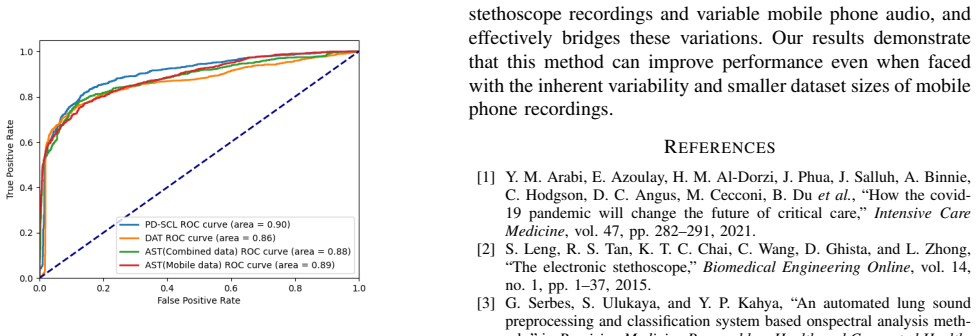
On the authors' terms, the discovery is that a supervised contrastive loss defined over patient and device domains transfers knowledge from abundant electronic-stethoscope recordings to scarce mobile-phone recordings without sacrificing sensitivity. In PD-SCL, two samples form a positive pair when they share a label but come from different patients or different recording devices, and different-label samples form negative pairs; the loss is added to the cross-entropy objective with weight $\lambda=0.5$ and temperature $\tau=0.5$. Under leave-subject-out 5-fold cross-validation, with both stethoscope and mobile recordings used for training but only mobile recordings used for validation, PD-SCL reaches $S_p=89.9$, $S_e=82.7$, $S_c=86.3$, outperforming AST fine-tuned on mobile data alone (84.1), AST fine-tuned on combined data (83.9), and a domain-adversarial training baseline (83.7).
Load-bearing premise
The reported 2.4-point gain depends on keeping every stethoscope recording of validation patients out of training and on implementing the PD-SCL loss in the intended form, because equation (4) as printed has a denominator whose summation variable is not defined.
Editorial extensions
If this is right
- If PD-SCL performs as reported, a model can be trained on stethoscope recordings and still classify smartphone recordings from patients whose stethoscope data was never seen.
- The evaluation protocol, with validation restricted to mobile recordings, means the reported Sc=86.3 estimates generalization to new patients rather than fit to known subjects.
- The loss recipe (cross-entropy plus a weighted PD-SCL term) gives other researchers a concrete starting point for combining multi-device medical audio.
- Treating crackle, wheeze, and both as a single abnormal class keeps the screening task simple enough for a phone-based tool.
Reading between the lines
- The paper leaves open how much of the 2.4-point gain comes from the contrastive loss itself versus the way positives are sampled by patient and device; an ablation swapping PD-SCL for standard supervised contrastive learning would separate these.
- A natural extension is to test PD-SCL on a public respiratory sound benchmark where patient identifiers are available, since the reported gain is demonstrated on one private pediatric dataset.
- Because the printed loss formula is not well-defined as written, a reader who reproduces the method will have to infer the intended denominator; if that denominator is the standard one over all other samples, then PD-SCL is best understood as a positive-pair sampling rule rather than a fundamentally new loss.
Editorial analysis
A structured set of objections, weighed in public.
Referee Report
Summary. The paper proposes Patient Domain Supervised Contrastive Learning (PD-SCL), an auxiliary loss for the Audio Spectrogram Transformer (AST) applied to binary lung-sound classification (normal vs. abnormal) from recordings made with a digital stethoscope and an iPhone microphone. The method adds a supervised contrastive term intended to pull together features from recordings that share a class label but come from different patients or recording domains. On a private pediatric dataset of 8,724 stethoscope and 2,701 mobile-phone recordings, the authors report that AST with PD-SCL achieves Sc=86.3 versus Sc=83.9 for AST fine-tuned on combined stethoscope+phone data, a claimed 2.4-point improvement, using leave-subject-out 5-fold cross-validation with mobile-phone recordings as the validation set.
Significance. If the reported result is valid, the paper would provide a practically relevant demonstration that a transformer-based audio model can be adapted from stethoscope recordings to smartphone recordings while controlling for patient-specific variability, which is useful for telemedicine and remote screening. The manuscript's strengths include a clinically collected paired dataset, a clear motivation for combining abundant stethoscope data with scarce mobile-phone data, and a direct comparison against a domain-adversarial baseline. However, the central empirical claim currently rests on an ambiguous data-split description and an ill-defined loss equation, and the quantitative comparison lacks error bars or significance testing. These issues are fixable but must be resolved before the claimed improvement can be taken as established.
major comments (3)
- [Section IV-A] The data-split description is ambiguous on the load-bearing point of patient-disjointness. The text states that 'using both stethoscope and mobile phone recordings for training, but using only mobile phone recordings for validation' and that leave-subject-out cross-validation was applied 'to the patients used in the test data so that they were not used in the training process.' Because every mobile-phone patient also has corresponding stethoscope recordings, this wording could mean that stethoscope recordings from the very patients whose mobile recordings form a validation fold are included in the training set of that fold. If so, the comparison measures adaptation to the recording device, not generalization to unseen patients, and PD-SCL, which explicitly uses patient/domain groupings, would benefit more than the plain cross-entropy baseline. The paper must state unambiguously that, for each fold, all stethoscope recordings from validation patients are excluded from training, or provide the exact patient-level fold construction.
- [Equation (4), Section III-C] Equation (4) is ill-defined as written. The numerator sums over j ∈ P(i), while the denominator sums over k with k ≠ j, but j is a bound variable in the numerator, so the denominator cannot reference it. The intended contrastive loss is inferable, but the actual implementation could differ from any reader's reconstruction. The authors should replace Eq. (4) with a standard supervised-contrastive form, for example, using a denominator that sums over all anchors k ≠ i (or over all non-positive samples k ∉ P(i)), and should state explicitly whether positive pairs require different patient IDs, different domain IDs, or both, and whether same-patient same-class pairs are treated as negatives or excluded.
- [Table II and Section IV-D] The central comparison is reported without any measure of variability. Only a single Sc value is given for each method across the 5-fold cross-validation, with no per-fold scores, standard deviation, confidence interval, or significance test. The claimed 2.4-point improvement (86.3 vs. 83.9) may be within fold-to-fold noise, especially given the small size of the mobile-phone validation set (2,701 recordings from 63 patients). The authors should report per-fold results and either confidence intervals or a paired significance test across folds.
minor comments (6)
- [Abstract and Section I] The word 'significantly' is used to describe the 2.4% improvement, but no statistical significance test is reported; please either add a test or rephrase to 'numerically improved.'
- [Section IV-A, last sentence] The paragraph ends with 'so that they were not used in the training process' and is missing a terminal period; the sentence should also be completed with a direct statement that this exclusion applies to stethoscope as well as mobile-phone recordings.
- [Section III-C, step 5] The description 'The sum of negative similarities is calculated and normalized by the number of pairs' is vague; please specify whether the normalization is by the number of negative pairs or by the total number of samples, and align it with the corrected equation.
- [Figure 1] The ROC curve figure is not described in the text beyond a single mention; the figure should include axis labels, the AUC for each model, and a legend identifying each curve, and the text should state what the figure demonstrates.
- [Section II-C and Reference [9]] Reference [9] describes 'Stethoscope-guided supervised contrastive learning,' which appears very closely related to the proposed method; the authors should explicitly state the differences in the positive-pair definition and in the use of patient identities, rather than only listing the reference.
- [Section IV-C] The evaluation metric section uses ICBHI terminology but only presents a binary normal/abnormal task; please clarify whether crackle, wheeze, and both are treated as a single abnormal class, and define the exact mapping from the four ICBHI labels to the two classes.
Circularity Check
No circularity: the reported 2.4% gain is an empirical cross-validation result, not a derivation from fitted inputs.
full rationale
The paper's central claim (PD-SCL reaches Sc=86.3 versus 83.9 for AST finetuned on combined data) is an observed training and evaluation outcome on a private dataset under 5-fold cross-validation. There is no derivation chain in which an output quantity is defined in terms of the target result. The hyperparameters λ=0.5 and τ=0.5 are fixed constants, not fitted to the test fold, and the PD-SCL loss combines cross-entropy with a supervised contrastive term whose positive and negative masks depend on class, patient, and domain labels. Nothing in the method reduces by construction to the reported accuracy. The two substantive reviewer concerns—the ambiguous leave-subject-out split in Section IV-A, which may allow same-patient stethoscope leakage, and the ill-defined denominator in Eq. (4)—are validity and reproducibility issues rather than circular reasoning. Same-patient leakage would make the comparison unfair, but it would not make the result true by construction. The paper also does not rely on a load-bearing self-citation or an imported uniqueness theorem; its references to prior contrastive learning and AST work are independent. Therefore no circular step is identified.
Assumptions & free parameters
free parameters (2)
- lambda (domain/contrastive balancing weight) =
0.5 for PD-SCL, 0.2 for DAT
- temperature tau =
0.5
assumptions (3)
- domain assumption The two-class 'abnormal' grouping (crackle, wheeze, both) is a valid clinical target for screening
- domain assumption AST pretrained on ImageNet/AudioSet provides useful features for lung sounds
- standard math The log-sum-exp trick and L2 normalization are applied correctly in the implementation
Cite this review
Pith. "Pith review of Patient Domain Supervised Contrastive Learning for Lung Sound Classification Using Mobile Phone." pith.science (2026). https://pith.science/paper/UZFRRZC7
@misc{pith2026250523132,
  author       = {Pith},
  title        = {Pith review of: Patient Domain Supervised Contrastive Learning for Lung Sound Classification Using Mobile Phone},
  year         = {2026},
  howpublished = {\url{https://pith.science/paper/UZFRRZC7}},
  note         = {Machine review of arXiv:2505.23132}
}
read the original abstract
Auscultation is crucial for diagnosing lung diseases. The COVID-19 pandemic has revealed the limitations of traditional, in-person lung sound assessments. To overcome these issues, advancements in digital stethoscopes and artificial intelligence (AI) have led to the development of new diagnostic methods. In this context, our study aims to use smartphone microphones to record and analyze lung sounds. We faced two major challenges: the difference in audio style between electronic stethoscopes and smartphone microphones, and the variability among patients. To address these challenges, we developed a method called Patient Domain Supervised Contrastive Learning (PD-SCL). By integrating this method with the Audio Spectrogram Transformer (AST) model, we significantly improved its performance by 2.4\% compared to the original AST model. This progress demonstrates that smartphones can effectively diagnose lung sounds, addressing inconsistencies in patient data and showing potential for broad use beyond traditional clinical settings. Our research contributes to making lung disease detection more accessible in the post-COVID-19 world.
Figures
Reference graph
Works this paper leans on
-
[9]
J.-W. Kim, S. Bae, W.-Y . Cho, B. Lee, and H.-Y . Jung, “Stethoscope- guided supervised contrastive learning for cross-domain adaptation on respiratory sound classification,” arXiv preprint arXiv:2312.09603 , 2023
arXiv 2023
-
[1]
How the covid- 19 pandemic will change the future of critical care,
Y . M. Arabi, E. Azoulay, H. M. Al-Dorzi, J. Phua, J. Salluh, A. Binnie, C. Hodgson, D. C. Angus, M. Cecconi, B. Du et al., “How the covid- 19 pandemic will change the future of critical care,” Intensive Care Medicine, vol. 47, pp. 282–291, 2021
work page 2021
-
[2]
S. Leng, R. S. Tan, K. T. C. Chai, C. Wang, D. Ghista, and L. Zhong, “The electronic stethoscope,” Biomedical Engineering Online , vol. 14, no. 1, pp. 1–37, 2015
work page 2015
-
[3]
An automated lung sound preprocessing and classification system based onspectral analysis meth- ods,
G. Serbes, S. Ulukaya, and Y . P. Kahya, “An automated lung sound preprocessing and classification system based onspectral analysis meth- ods,” in Precision Medicine Powered by pHealth and Connected Health: ICBHI 2017, Thessaloniki, Greece, 18-21 November 2017 . Springer, 2018, pp. 45–49
work page 2017
-
[4]
Automatic detec- tion of patient with respiratory diseases using lung sound analysis,
G. Chambres, P. Hanna, and M. Desainte-Catherine, “Automatic detec- tion of patient with respiratory diseases using lung sound analysis,” in 2018 International Conference on Content-Based Multimedia Indexing (CBMI). IEEE, 2018, pp. 1–6
work page 2018
-
[5]
Y . Kim, Y . Hyon, S. S. Jung, S. Lee, G. Yoo, C. Chung, and T. Ha, “Respiratory sound classification for crackles, wheezes, and rhonchi in the clinical field using deep learning,” Scientific Reports, vol. 11, no. 1, p. 17186, 2021
work page 2021
-
[6]
S. Gairola, F. Tom, N. Kwatra, and M. Jain, “Respirenet: A deep neural network for accurately detecting abnormal lung sounds in limited data setting,” in 2021 43rd Annual International Conference of the IEEE Engineering in Medicine & Biology Society (EMBC) . IEEE, 2021, pp. 527–530
work page 2021
-
[7]
Pretraining respiratory sound representa- tions using metadata and contrastive learning,
I. Moummad and N. Farrugia, “Pretraining respiratory sound representa- tions using metadata and contrastive learning,” in 2023 IEEE Workshop on Applications of Signal Processing to Audio and Acoustics (WASPAA). IEEE, 2023, pp. 1–5
work page 2023
Show all 18 references
-
[8]
Patch-mix contrastive learning with audio spectrogram transformer on respiratory sound classification,
S. Bae, J.-W. Kim, W.-Y . Cho, H. Baek, S. Son, B. Lee, C. Ha, K. Tae, S. Kim, and S.-Y . Yun, “Patch-mix contrastive learning with audio spectrogram transformer on respiratory sound classification,” arXiv preprint arXiv:2305.14032, 2023
2023 arXiv
-
[10]
Domain adaptation with struc- tural correspondence learning,
J. Blitzer, R. McDonald, and F. Pereira, “Domain adaptation with struc- tural correspondence learning,” in Proceedings of the 2006 Conference on Empirical Methods in Natural Language Processing , 2006, pp. 120– 128
2006
-
[11]
Asymmetric tri-training for unsu- pervised domain adaptation,
K. Saito, Y . Ushiku, and T. Harada, “Asymmetric tri-training for unsu- pervised domain adaptation,” in International Conference on Machine Learning. PMLR, 2017, pp. 2988–2997
2017
-
[12]
Deep visual domain adaptation: A survey,
M. Wang and W. Deng, “Deep visual domain adaptation: A survey,” Neurocomputing, vol. 312, pp. 135–153, 2018
2018
-
[13]
A survey of unsupervised deep domain adaptation,
G. Wilson and D. J. Cook, “A survey of unsupervised deep domain adaptation,” ACM Transactions on Intelligent Systems and Technology (TIST), vol. 11, no. 5, pp. 1–46, 2020
2020
-
[14]
Supervised contrastive learn- ing,
P. Khosla, P. Teterwak, C. Wang, A. Sarna, Y . Tian, P. Isola, A. Maschinot, C. Liu, and D. Krishnan, “Supervised contrastive learn- ing,” Advances in Neural Information Processing Systems , vol. 33, pp. 18 661–18 673, 2020
2020
-
[15]
A simple framework for contrastive learning of visual representations,
T. Chen, S. Kornblith, M. Norouzi, and G. Hinton, “A simple framework for contrastive learning of visual representations,” in International Conference on Machine Learning . PMLR, 2020, pp. 1597–1607
2020
-
[16]
Momentum contrast for unsupervised visual representation learning,
K. He, H. Fan, Y . Wu, S. Xie, and R. Girshick, “Momentum contrast for unsupervised visual representation learning,” in Proceedings of the IEEE/CVF Conference on Computer Vision and Pattern Recognition , 2020, pp. 9729–9738
2020
-
[17]
Ast: Audio spectrogram trans- former,
Y . Gong, Y .-A. Chung, and J. Glass, “Ast: Audio spectrogram trans- former,” arXiv preprint arXiv:2104.01778 , 2021
2021 arXiv
-
[18]
Unsupervised domain adaptation by backpropagation,
Y . Ganin and V . Lempitsky, “Unsupervised domain adaptation by backpropagation,” in International Conference on Machine Learning . PMLR, 2015, pp. 1180–1189
2015
Reviewed August 7, 2026 · model on record in the stance chip above.
Discussion (0). Continue with ORCID to comment.