Thickness-Independent Quantum Geometric Responses Driven by Interlayer Antiferroic Coupling
Pith reviewed 2026-06-27 06:20 UTC · model grok-4.3
The pith
Interlayer antiferroic coupling generates thickness-independent anomalous Hall responses without topological mechanisms.
A machine-rendered reading of the paper's core claim, the machinery that carries it, and where it could break.
Core claim
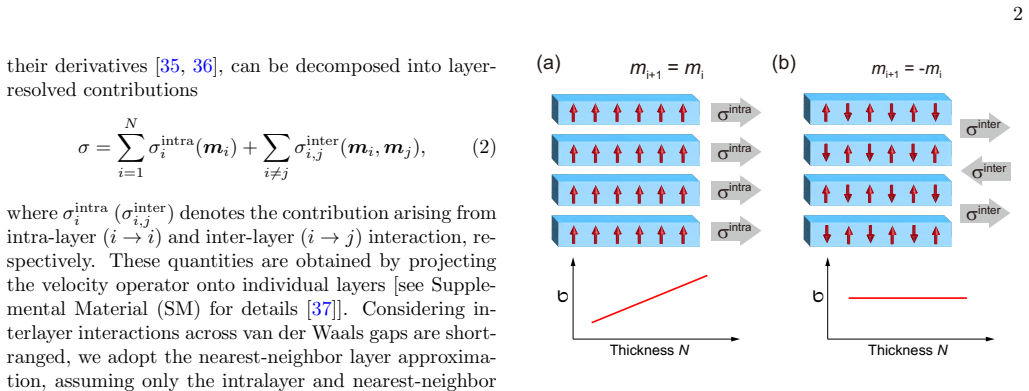
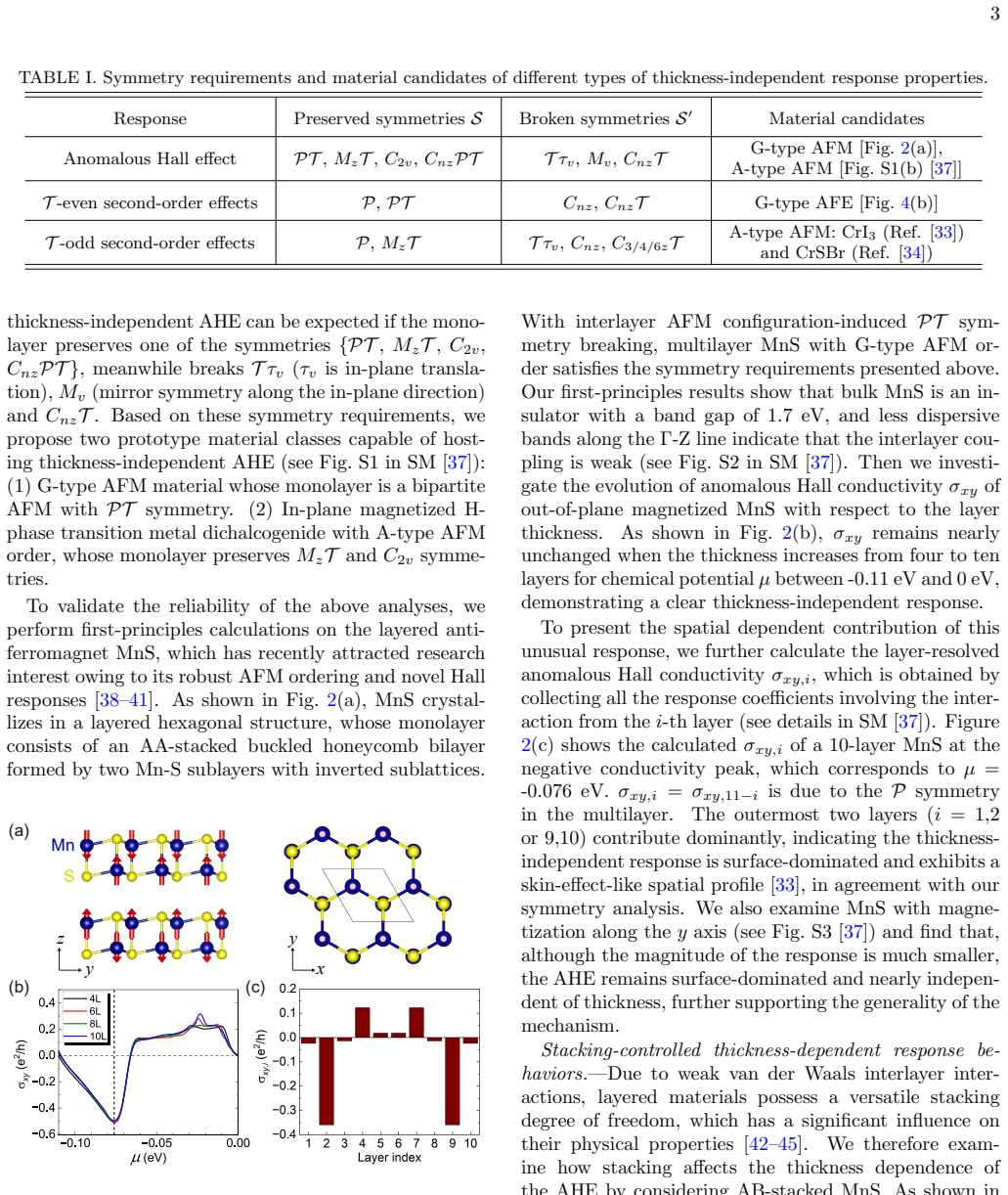
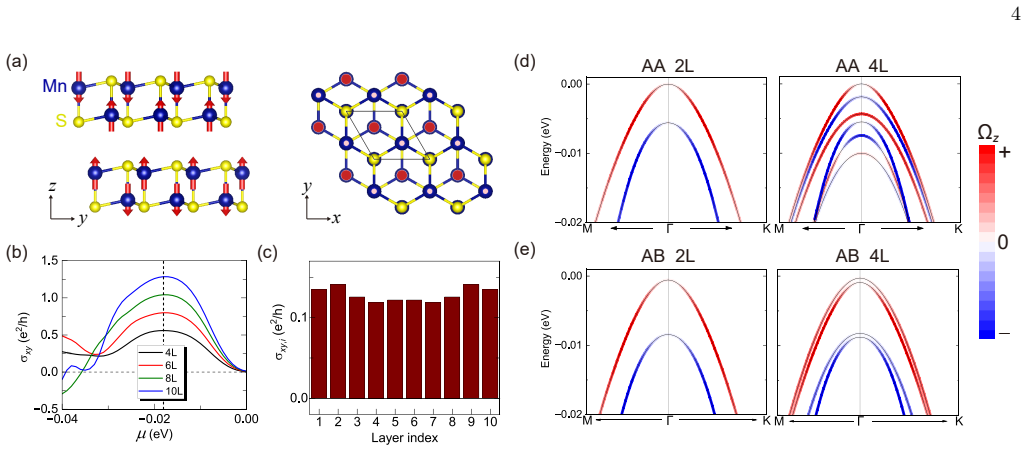
Thickness-independent quantum geometric responses emerge when the symmetry breaking required for a given response is generated by interlayer antiferromagnetic or antiferroelectric coupling, without invoking topological mechanisms. In multilayer MnS with G-type antiferromagnetic order the anomalous Hall effect is surface-dominated, remains constant with thickness, and is strongly modulated by the stacking sequence.
What carries the argument
Interlayer antiferroic coupling that supplies the symmetry breaking for the response.
If this is right
- Multilayer MnS in G-type AFM order exhibits a surface-dominated anomalous Hall effect whose size is independent of thickness.
- Stacking order can be used to tune the magnitude of this thickness-independent effect.
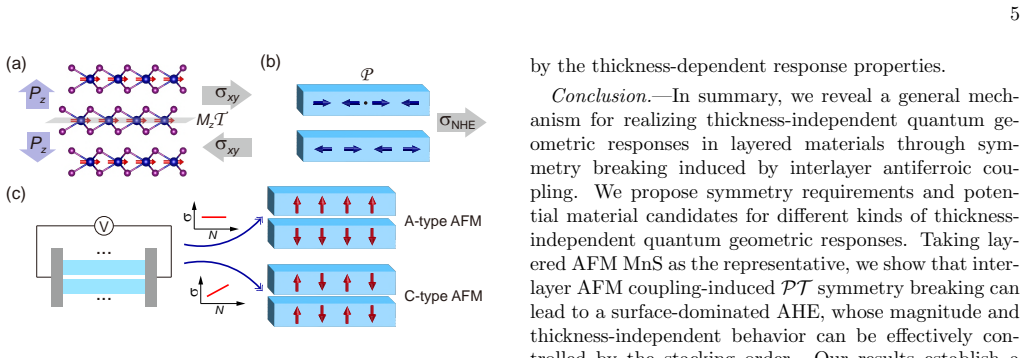
- Interlayer antiferroelectric coupling supplies design principles for thickness-independent anomalous and nonlinear Hall effects.
- The responses can serve to distinguish different magnetic structures.
Where Pith is reading between the lines
- Robust devices could be fabricated from antiferroic multilayers without requiring atomic-layer precision.
- The symmetry-engineering route may apply to other geometric responses beyond Hall effects in similar layered systems.
- Stacking-dependent measurements on few-layer samples could provide a direct experimental test of the thickness independence.
Load-bearing premise
The symmetry breaking needed for the response is produced entirely by interlayer antiferromagnetic or antiferroelectric coupling.
What would settle it
Observation that the anomalous Hall conductivity in G-type antiferromagnetic multilayer MnS changes measurably when the number of layers is increased.
Figures
read the original abstract
Two-dimensional ferroic materials exhibit rich and intriguing physical phenomena, but their response properties generally depend sensitively on thickness, requiring precise layer-number control and thereby limiting practical applications. Here, we propose a general strategy for realizing thickness-independent quantum geometric responses through symmetry engineering induced by interlayer antiferroic coupling. Using spatial-dependent symmetry analysis, we show that thickness-independent behavior emerges when the symmetry breaking required for a given response is generated by interlayer antiferromagnetic (AFM) or antiferroelectric (AFE) coupling, without invoking topological mechanisms. Our first-principles calculations predict that multilayer MnS in the G-type AFM configuration exhibits a surface-dominated anomalous Hall effect, whose thickness-independent behavior can be significantly influenced by the stacking order. We further propose design principles for achieving thickness-independent anomalous and nonlinear Hall effects driven by interlayer AFE coupling, and suggest potential applications in distinguishing magnetic structures. Our findings open a new route towards robust functional devices based on antiferroic materials.
Editorial analysis
A structured set of objections, weighed in public.
Referee Report
Summary. The manuscript proposes a general strategy for realizing thickness-independent quantum geometric responses in multilayer 2D materials through symmetry breaking induced by interlayer antiferromagnetic (AFM) or antiferroelectric (AFE) coupling. Spatial-dependent symmetry analysis is used to argue that such responses emerge without topological mechanisms when the required symmetry breaking is generated by interlayer coupling. First-principles calculations are presented for multilayer MnS in the G-type AFM configuration, predicting a surface-dominated anomalous Hall effect (AHE) whose thickness-independent behavior depends on stacking order. Design principles are outlined for thickness-independent AHE and nonlinear Hall effects driven by interlayer AFE coupling, with suggested applications in distinguishing magnetic structures.
Significance. If the central predictions are confirmed by detailed calculations, the work could identify a practical route to robust, thickness-independent responses in antiferroic materials, reducing the need for precise layer-number control in devices. The focus on stacking-order effects and design principles for AFE-driven responses adds potential utility for materials engineering. However, the repeated claim of operating 'without invoking topological mechanisms' appears internally inconsistent with the Berry-curvature origin of the AHE, which may reduce the claimed novelty relative to existing quantum-geometric approaches.
major comments (2)
- [Abstract] Abstract: the statement that thickness-independent behavior emerges 'without invoking topological mechanisms' is load-bearing for the novelty claim but conflicts with the standard microscopic origin of the anomalous Hall effect. The AHE is generated by the integral of Berry curvature (a topological geometric quantity) over occupied bands; interlayer AFM coupling may relax mirror or inversion symmetries to permit a nonzero response, but this does not constitute a distinct non-topological route.
- [Abstract] Abstract: the manuscript asserts 'first-principles calculations' that predict a surface-dominated, thickness-independent AHE in multilayer MnS whose magnitude 'can be significantly influenced by the stacking order,' yet supplies no equations, computational details, Hall-conductivity values, thickness dependence plots, or error estimates. Without these, the central thickness-independence claim cannot be evaluated.
minor comments (1)
- The abstract refers to 'quantum geometric responses' and 'design principles' but does not specify which geometric quantities (Berry curvature, quantum metric, etc.) enter the nonlinear Hall effect; a brief clarification would improve readability.
Simulated Author's Rebuttal
We thank the referee for their detailed review and constructive suggestions. We address each major comment below and outline the revisions we will make to strengthen the manuscript.
read point-by-point responses
-
Referee: [Abstract] Abstract: the statement that thickness-independent behavior emerges 'without invoking topological mechanisms' is load-bearing for the novelty claim but conflicts with the standard microscopic origin of the anomalous Hall effect. The AHE is generated by the integral of Berry curvature (a topological geometric quantity) over occupied bands; interlayer AFM coupling may relax mirror or inversion symmetries to permit a nonzero response, but this does not constitute a distinct non-topological route.
Authors: We agree that the phrasing in the abstract is imprecise and potentially misleading. The anomalous Hall effect does originate from the integral of Berry curvature. Our intended meaning was that the thickness independence is achieved through symmetry breaking by interlayer antiferroic coupling rather than through topological band invariants (such as nonzero Chern numbers) that would typically produce quantized responses or strong thickness dependence. We will revise the abstract and relevant sections to remove the 'without invoking topological mechanisms' claim and instead emphasize the symmetry-engineering route to finite, thickness-independent Berry curvature. revision: yes
-
Referee: [Abstract] Abstract: the manuscript asserts 'first-principles calculations' that predict a surface-dominated, thickness-independent AHE in multilayer MnS whose magnitude 'can be significantly influenced by the stacking order,' yet supplies no equations, computational details, Hall-conductivity values, thickness dependence plots, or error estimates. Without these, the central thickness-independence claim cannot be evaluated.
Authors: The full manuscript contains the requested details in the Methods section and Supplementary Information, including the DFT parameters, the explicit formula for the Hall conductivity, numerical values for different thicknesses and stackings, and plots demonstrating the thickness independence. However, we acknowledge that these elements are not referenced or summarized in the abstract or main text in a way that allows immediate evaluation. We will add a concise summary of the key computational results (including representative conductivity values and a reference to the relevant figure) to the main text near the discussion of MnS and ensure the abstract is consistent with the presented data. revision: partial
Circularity Check
No circularity detected; derivation self-contained
full rationale
The provided abstract and claims describe a symmetry-engineering strategy for thickness-independent responses via interlayer AFM/AFE coupling, supported by spatial-dependent symmetry analysis and first-principles calculations. No equations, fitted parameters, self-citations, or ansatzes are exhibited that reduce any prediction or result to the inputs by construction. The central claims rest on standard symmetry breaking and computational methods without load-bearing self-referential steps, making the derivation independent of the target outcomes.
Axiom & Free-Parameter Ledger
Reference graph
Works this paper leans on
-
[1]
Gong and X
C. Gong and X. Zhang, Two-dimensional magnetic crys- tals and emergent heterostructure devices, Science363, eaav4450 (2019)
2019
-
[2]
Huang, M
B. Huang, M. A. McGuire, A. F. May, D. Xiao, P. Jarillo- Herrero, and X. Xu, Emergent phenomena and proximity effects in two-dimensional magnets and heterostructures, Nat. Mater.19, 1276 (2020)
2020
-
[3]
Zhang, P
D. Zhang, P. Schoenherr, P. Sharma, and J. Seidel, Fer- roelectric order in van der Waals layered materials, Nat. Rev. Mater.8, 25 (2023)
2023
-
[4]
C. Wang, L. You, D. Cobden, and J. Wang, Towards two- dimensional van der Waals ferroelectrics, Nat. Mater.22, 542 (2023)
2023
-
[5]
Hu and E
T. Hu and E. Kan, Progress and prospects in low- dimensional multiferroic materials, WIREs Comput. Mol. Sci.9, e1409 (2019)
2019
-
[6]
P. Man, L. Huang, J. Zhao, and T. H. Ly, Ferroic phases in two-dimensional materials, Chem. Rev.123, 10990 (2023)
2023
-
[7]
Y. Deng, Y. Yu, Y. Song, J. Zhang, N. Z. Wang, Z. Sun, Y. Yi, Y. Z. Wu, S. Wu, J. Zhu,et al., Gate-tunable room-temperature ferromagnetism in two-dimensional Fe3GeTe2, Nature563, 94 (2018)
2018
-
[8]
Y. Deng, Y. Yu, M. Z. Shi, Z. Guo, Z. Xu, J. Wang, X. H. Chen, and Y. Zhang, Quantum anomalous Hall effect in intrinsic magnetic topological insulator MnBi 2Te4, Sci- ence367, 895 (2020)
2020
-
[9]
Jiang, D
J. Jiang, D. Xiao, F. Wang, J.-H. Shin, D. Andreoli, J. Zhang, R. Xiao, Y.-F. Zhao, M. Kayyalha, L. Zhang, et al., Concurrence of quantum anomalous Hall and topo- logical Hall effects in magnetic topological insulator sand- wich heterostructures, Nat. Mater.19, 732 (2020). 6
2020
-
[10]
Ma, S.-Y
Q. Ma, S.-Y. Xu, H. Shen, D. MacNeill, V. Fatemi, T.-R. Chang, A. M. Mier Valdivia, S. Wu, Z. Du, C.-H. Hsu, et al., Observation of the nonlinear Hall effect under time- reversal-symmetric conditions, Nature565, 337 (2019)
2019
-
[11]
K. Kang, T. Li, E. Sohn, J. Shan, and K. F. Mak, Nonlin- ear anomalous Hall effect in few-layer WTe2, Nat. Mater. 18, 324 (2019)
2019
-
[12]
N. Wang, D. Kaplan, Z. Zhang, T. Holder, N. Cao, A. Wang, X. Zhou, F. Zhou, Z. Jiang, C. Zhang,et al., Quantum-metric-induced nonlinear transport in a topo- logical antiferromagnet, Nature621, 487 (2023)
2023
-
[13]
Gao, Y.-F
A. Gao, Y.-F. Liu, J.-X. Qiu, B. Ghosh, T. V. Trevisan, Y. Onishi, C. Hu, T. Qian, H.-J. Tien, S.-W. Chen,et al., Quantum metric nonlinear Hall effect in a topological an- tiferromagnetic heterostructure, Science381, 181 (2023)
2023
-
[14]
H. Yu, X. Li, Y.-Q. Bie, L. Yan, L. Zhou, P. Yu, and G. Yang, Quantum metric third-order nonlinear Hall ef- fect in a non-centrosymmetric ferromagnet, Nat. Com- mun.16, 7698 (2025)
2025
-
[15]
Autere, H
A. Autere, H. Jussila, Y. Dai, Y. Wang, H. Lipsanen, and Z. Sun, Nonlinear optics with 2D layered materials, Adv. Mater.30, 1705963 (2018)
2018
-
[16]
Z. Sun, Y. Yi, T. Song, G. Clark, B. Huang, Y. Shan, S. Wu, D. Huang, C. Gao, Z. Chen,et al., Giant nonre- ciprocal second-harmonic generation from antiferromag- netic bilayer CrI3, Nature572, 497 (2019)
2019
-
[17]
S.-Y. Xu, Q. Ma, Y. Gao, A. Kogar, A. Zong, A. M. Mier Valdivia, T. H. Dinh, S.-M. Huang, B. Singh, C.-H. Hsu,et al., Spontaneous gyrotropic electronic order in a transition-metal dichalcogenide, Nature578, 545 (2020)
2020
-
[18]
F. Y. Gao, X. Peng, X. Cheng, E. Vi˜ nas Bostr¨ om, D. S. Kim, R. K. Jain, D. Vishnu, K. Raju, R. Sankar, S.-F. Lee,et al., Giant chiral magnetoelectric oscillations in a van der Waals multiferroic, Nature632, 273 (2024)
2024
-
[19]
S. Aoki, Y. Dong, Z. Wang, X. S. Huang, Y. M. Itahashi, N. Ogawa, T. Ideue, and Y. Iwasa, Giant Modulation of the Second Harmonic Generation by Magnetoelectricity in Two-Dimensional Multiferroic CuCrP2S6, Adv. Mater. 36, 2312781 (2024)
2024
-
[20]
Zhang, G
K.-X. Zhang, G. Park, Y. Lee, B. H. Kim, and J.-G. Park, Magnetoelectric effect in van der Waals magnets, npj Quantum Mater.10, 6 (2025)
2025
-
[21]
C. Gong, L. Li, Z. Li, H. Ji, A. Stern, Y. Xia, T. Cao, W. Bao, C. Wang, Y. Wang,et al., Discovery of intrinsic ferromagnetism in two-dimensional van der Waals crys- tals, Nature546, 265 (2017)
2017
-
[22]
Huang, G
B. Huang, G. Clark, E. Navarro-Moratalla, D. R. Klein, R. Cheng, K. L. Seyler, D. Zhong, E. Schmidgall, M. A. McGuire, D. H. Cobden,et al., Layer-dependent ferro- magnetism in a van der Waals crystal down to the mono- layer limit, Nature546, 270 (2017)
2017
-
[23]
H. Ju, Y. Lee, K.-T. Kim, I. H. Choi, C. J. Roh, S. Son, P. Park, J. H. Kim, T. S. Jung, J. H. Kim,et al., Possible persistence of multiferroic order down to bilayer limit of van der Waals material NiI2, Nano Lett.21, 5126 (2021)
2021
-
[24]
Pertsev, R
N. Pertsev, R. Dittmann, R. Plonka, and R. Waser, Thickness dependence of intrinsic dielectric response and apparent interfacial capacitance in ferroelectric thin films, J. Appl. Phys.101, 074102 (2007)
2007
-
[25]
Li, W.-P
X.-L. Li, W.-P. Han, J.-B. Wu, X.-F. Qiao, J. Zhang, and P.-H. Tan, Layer-number dependent optical proper- ties of 2D materials and their application for thickness determination, Adv. Func. Mater.27, 1604468 (2017)
2017
-
[26]
Y. Deng, Z. Xiang, B. Lei, K. Zhu, H. Mu, W. Zhuo, X. Hua, M. Wang, Z. Wang, G. Wang,et al., Layer- number-dependent magnetism and anomalous Hall effect in van der Waals ferromagnet Fe5GeTe2, Nano Lett.22, 9839 (2022)
2022
-
[27]
Bansal, Y
N. Bansal, Y. S. Kim, M. Brahlek, E. Edrey, and S. Oh, Thickness-Independent Transport Channels in Topolog- ical Insulator Bi 2Se3 Thin Films, Phys. Rev. Lett.109, 116804 (2012)
2012
-
[28]
M. Z. Hasan and C. L. Kane, Colloquium: Topological insulators, Rev. Mod. Phys.82, 3045 (2010)
2010
-
[29]
Qi and S.-C
X.-L. Qi and S.-C. Zhang, Topological insulators and su- perconductors, Rev. Mod. Phys.83, 1057 (2011)
2011
-
[30]
Chang, C.-X
C.-Z. Chang, C.-X. Liu, and A. H. MacDonald, Collo- quium: Quantum anomalous Hall effect, Rev. Mod. Phys. 95, 011002 (2023)
2023
-
[31]
L. Pan, X. Liu, Q. L. He, A. Stern, G. Yin, X. Che, Q. Shao, P. Zhang, P. Deng, C.-Y. Yang,et al., Prob- ing the low-temperature limit of the quantum anomalous Hall effect, Sci. Adv.6, eaaz3595 (2020)
2020
-
[32]
Liu and T
J. Liu and T. Hesjedal, Magnetic topological insulator heterostructures: A review, Adv. Mater.35, 2102427 (2023)
2023
-
[33]
Zhou, R.-C
H. Zhou, R.-C. Xiao, S.-H. Zhang, W. Gan, H. Han, H.- M. Zhao, W. Lu, C. Zhang, Y. Sun, H. Li, and D.-F. Shao, Skin Effect of Nonlinear Optical Responses in An- tiferromagnets, Phys. Rev. Lett.133, 236903 (2024)
2024
-
[34]
K. Das, Y. Zhao, and B. Yan, Surface-Dominated Quantum-Metric-Induced Nonlinear Transport in the Layered Antiferromagnet CrSBr, Nano Lett.25, 9189 (2025)
2025
-
[35]
J. Yu, B. A. Bernevig, R. Queiroz, E. Rossi, P. T¨ orm¨ a, and B.-J. Yang, Quantum geometry in quantum materi- als, npj Quantum Mater.10, 101 (2025)
2025
-
[36]
Liu, X.-B
T. Liu, X.-B. Qiang, H.-Z. Lu, and X. Xie, Quantum ge- ometry in condensed matter, Natl. Sci. Rev.12, nwae334 (2025)
2025
-
[37]
[33,34,38-40,48-54]
See Supplemental Material at http://link.aps.org/supplemental/xxx for more details about the layer projection method, first-principles com- putational methods, derivation of interlayer antiferroic coupling-induced symmetry breaking, prototype material classes capable of hosting thickness-independent anoma- lous Hall effect, band structures and partical ch...
-
[38]
Sattar, M
S. Sattar, M. F. Islam, and C. M. Canali, Monolayer MnXand JanusXMnY(X, Y= S, Se, Te): A fam- ily of two-dimensional antiferromagnetic semiconductors, Phys. Rev. B106, 085410 (2022)
2022
-
[39]
Aapro, M
M. Aapro, M. N. Huda, J. Karthikeyan, S. Kezilebieke, S. C. Ganguli, H. G. Herrero, X. Huang, P. Liljeroth, and H.-P. Komsa, Synthesis and Properties of Monolayer MnSe with Unusual Atomic Structure and Antiferromag- netic Ordering, ACS Nano15, 13794 (2021)
2021
-
[40]
J. Wang, H. Zeng, W. Duan, and H. Huang, Intrinsic Nonlinear Hall Detection of the N´ eel Vector for Two- Dimensional Antiferromagnetic Spintronics, Phys. Rev. Lett.131, 056401 (2023)
2023
-
[41]
Long and H
G. Long and H. Huang, Anomalous Hall effect driven by electric field and sliding ferroelectricity in two- dimensional compensated antiferromagnetic MnS, Phys. Rev. B112, 165136 (2025)
2025
-
[42]
Wu and J
M. Wu and J. Li, Sliding ferroelectricity in 2D van der 7 Waals materials: Related physics and future opportuni- ties, Proc. Natl. Acad. Sci.118, e2115703118 (2021)
2021
-
[43]
J. Ji, G. Yu, C. Xu, and H. J. Xiang, General Theory for Bilayer Stacking Ferroelectricity, Phys. Rev. Lett.130, 146801 (2023)
2023
-
[44]
B. Pan, P. Zhou, P. Lyu, H. Xiao, X. Yang, and L. Sun, General Stacking Theory for Altermagnetism in Bilayer Systems, Phys. Rev. Lett.133, 166701 (2024)
2024
-
[45]
R. He, H. Wang, F. Deng, Y. Gao, B. Zhang, Y. Shi, R.- W. Li, and Z. Zhong, Switching Two-Dimensional Sliding Ferroelectrics by Mechanical Bending, Phys. Rev. Lett. 134, 076101 (2025)
2025
-
[46]
Sodemann and L
I. Sodemann and L. Fu, Quantum Nonlinear Hall Effect Induced by Berry Curvature Dipole in Time-Reversal In- variant Materials, Phys. Rev. Lett.115, 216806 (2015)
2015
-
[47]
Fiebig, V
M. Fiebig, V. V. Pavlov, and R. V. Pisarev, Second- harmonic generation as a tool for studying electronic and magnetic structures of crystals: review, J. Opt. Soc. Am. B22, 96 (2005)
2005
-
[48]
T. c. v. Rauch, T. Olsen, D. Vanderbilt, and I. Souza, Geometric and nongeometric contributions to the surface anomalous Hall conductivity, Phys. Rev. B98, 115108 (2018)
2018
-
[49]
Kresse and J
G. Kresse and J. Furthm¨ uller, Efficient iterative schemes forab initiototal-energy calculations using a plane-wave basis set, Phys. Rev. B54, 11169 (1996)
1996
-
[50]
P. E. Bl¨ ochl, Projector augmented-wave method, Phys. Rev. B50, 17953 (1994)
1994
-
[51]
J. P. Perdew, K. Burke, and M. Ernzerhof, Generalized Gradient Approximation Made Simple, Phys. Rev. Lett. 77, 3865 (1996)
1996
-
[52]
S. L. Dudarev, G. A. Botton, S. Y. Savrasov, C. J. Humphreys, and A. P. Sutton, Electron-energy-loss spec- tra and the structural stability of nickel oxide: An LSDA+U study, Phys. Rev. B57, 1505 (1998)
1998
-
[53]
Pizzi, V
G. Pizzi, V. Vitale, R. Arita, S. Bl¨ ugel, F. Freimuth, G. G´ eranton, M. Gibertini, D. Gresch, C. Johnson, T. Koretsune,et al., Wannier90 as a community code: new features and applications, J. Phys. Condens. Matter 32, 165902 (2020)
2020
-
[54]
Q. Wu, S. Zhang, H.-F. Song, M. Troyer, and A. A. Soluyanov, WannierTools: An open-source software package for novel topological materials, Comput. Phys. Commun.224, 405 (2018)
2018
discussion (0)
Sign in with ORCID, Apple, or X to comment. Anyone can read and Pith papers without signing in.