Synthetic Audio Generation Framework for Air Traffic Control Speech Recognition
Pith reviewed 2026-06-26 14:33 UTC · model grok-4.3
The pith
Fine-tuning Whisper on synthetic ATC audio with accent simulation reduces word error rates compared to real-data baselines.
A machine-rendered reading of the paper's core claim, the machinery that carries it, and where it could break.
Core claim
The paper claims that its synthetic data generation pipeline, built from neural text-to-speech, voice conversion, L2-to-L1 accent conversion, and a novel controllable L1-to-L2 accent conversion, produces audio whose acoustic properties allow fine-tuning that significantly improves word error rate on the ATCO2 corpus over both out-of-the-box and real-data-only baselines.
What carries the argument
The synthetic audio generation pipeline that combines neural generation techniques with a controllable L1-to-L2 accent conversion framework to simulate channel noise and accent distributions.
If this is right
- Synthetic data alone improves performance over an out-of-the-box Whisper model.
- A mix of real and synthetic data improves performance over real data alone.
- The pipeline addresses both non-native accents and channel noise through targeted conversion steps.
- The improvements are demonstrated specifically on the Whisper model and ATCO2 corpus.
Where Pith is reading between the lines
- The same generation steps could be tested on other low-resource noisy domains such as medical dictation or emergency radio.
- If the controllable accent conversion proves robust, it might reduce reliance on expensive collection of real accented ATC recordings.
- Applying the pipeline to additional ASR architectures beyond Whisper would test whether the gains are model-specific.
Load-bearing premise
The synthetic audio must accurately reproduce the channel noise, accent distributions, and acoustic conditions of real ATC communications in the ATCO2 corpus.
What would settle it
Fine-tuning Whisper on the synthetic or mixed data and then measuring word error rate on a held-out real ATCO2 test set; if the rate shows no improvement or worsens versus the real-data-only baseline, the central claim is false.
Figures

read the original abstract
Automatic Speech Recognition (ASR) systems, despite achieving remarkable accuracy in general-purpose domains with native speech (L1), struggle in domains like Air Traffic Control (ATC) due to strong channel noise, a presence of non-native (L2) English accents, and data scarcity. We propose a synthetic data generation pipeline with acoustical properties simulations specifically designed to address this lack of real data to improve recognition accuracy in the ATC domain. Our approach leverages a combination of neural generation techniques, including Text-to-Speech, Voice Conversion, L2-to-L1 accent conversion, and a novel controllable L1-to-L2 accent conversion framework built to simulate accented speech. Our experiments with the Whisper model on the ATCO2 corpus demonstrate that fine-tuning with either synthetic data alone, or a mix of real and synthetic data, significantly improves the word error rate over out-of-the-box and real data only baselines respectively.
Editorial analysis
A structured set of objections, weighed in public.
Referee Report
Summary. The manuscript proposes a synthetic audio generation pipeline for ATC speech recognition that combines TTS, voice conversion, L2-to-L1 accent conversion, and a novel controllable L1-to-L2 accent conversion framework to simulate channel noise and non-native accents. Experiments fine-tune the Whisper model on the ATCO2 corpus and claim that synthetic data alone or mixed with real data yields significant WER improvements over out-of-the-box and real-data-only baselines.
Significance. If the synthetic samples faithfully reproduce ATCO2 acoustics, the framework could offer a practical route to mitigating data scarcity in noisy, accented, safety-critical ASR domains.
major comments (2)
- [Abstract] Abstract: the central claim that synthetic or mixed data 'significantly improves' WER is stated without any numerical results, confidence intervals, statistical tests, ablation tables, or baseline WER values, preventing assessment of effect size or robustness.
- [Abstract] Abstract (and implied experimental section): the pipeline's validity rests on the unverified assumption that generated audio matches ATCO2 channel noise, L2 accent distributions, and acoustic conditions, yet no objective metrics (SNR histograms, formant statistics, spectrogram distribution distances) or listening tests are referenced to confirm domain fidelity.
minor comments (1)
- The phrase 'acoustical properties simulations' is underspecified; a brief enumeration of the simulation parameters or modules would aid reproducibility.
Simulated Author's Rebuttal
We thank the referee for the constructive comments on the abstract and the need for stronger validation of the synthetic pipeline. We address each point below.
read point-by-point responses
-
Referee: [Abstract] Abstract: the central claim that synthetic or mixed data 'significantly improves' WER is stated without any numerical results, confidence intervals, statistical tests, ablation tables, or baseline WER values, preventing assessment of effect size or robustness.
Authors: We agree that the abstract should include concrete numerical support. The manuscript body reports the relevant WER figures, but the abstract does not. We will revise the abstract to state the baseline WER, the WER achieved with synthetic data alone, the WER with mixed data, and the magnitude of improvement. revision: yes
-
Referee: [Abstract] Abstract (and implied experimental section): the pipeline's validity rests on the unverified assumption that generated audio matches ATCO2 channel noise, L2 accent distributions, and acoustic conditions, yet no objective metrics (SNR histograms, formant statistics, spectrogram distribution distances) or listening tests are referenced to confirm domain fidelity.
Authors: The primary validation in the work is the measured WER reduction on the held-out ATCO2 test set when synthetic or mixed data is used for fine-tuning; this constitutes task-level evidence that the generated samples are useful under the target acoustic and accent conditions. We acknowledge that the manuscript does not report direct acoustic similarity metrics or listening tests. Adding such analyses would require additional experiments that are outside the current scope, so we will instead clarify in the text that downstream ASR performance is the intended validation criterion. revision: partial
Circularity Check
No circularity: empirical evaluation on external corpus
full rationale
The paper reports an empirical study: a synthetic audio pipeline (TTS, voice conversion, accent conversion) is used to fine-tune Whisper, with WER measured on the external ATCO2 corpus against out-of-the-box and real-data baselines. No equations, fitted parameters, self-definitional steps, or load-bearing self-citations are present that would reduce any claimed result to its inputs by construction. The evaluation is independently falsifiable via the public ATCO2 benchmark.
Axiom & Free-Parameter Ledger
axioms (1)
- domain assumption The ATCO2 corpus represents typical real-world ATC acoustic and accent conditions.
invented entities (1)
-
controllable L1-to-L2 accent conversion framework
no independent evidence
Reference graph
Works this paper leans on
-
[1]
Introduction Automatic Speech Recognition (ASR) systems have achieved remarkable accuracy in general-purpose domains [1]. However, deploying these systems in safety-critical environments like Air Traffic Control (ATC) remains a challenge. ATC communica- tions are characterized by acoustic and linguistic complexities: domain-specific phraseology, rapid spe...
Pith/arXiv arXiv 2026
-
[2]
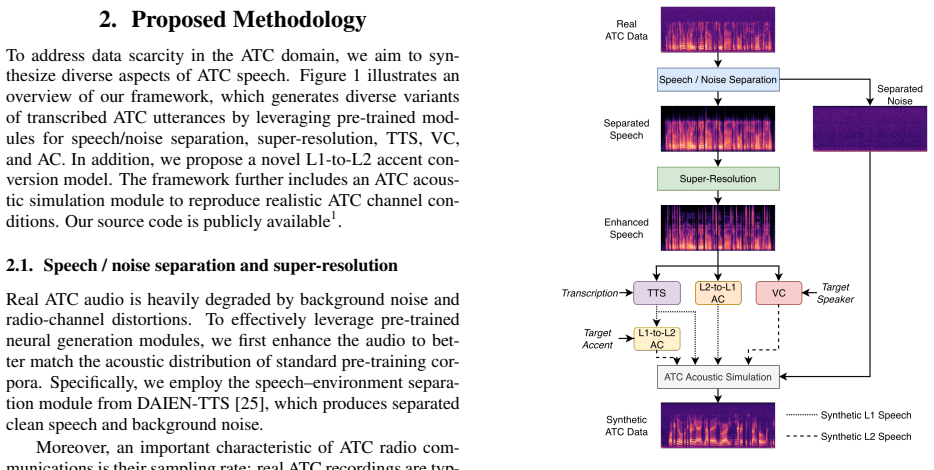
Proposed Methodology To address data scarcity in the ATC domain, we aim to syn- thesize diverse aspects of ATC speech. Figure 1 illustrates an overview of our framework, which generates diverse variants of transcribed ATC utterances by leveraging pre-trained mod- ules for speech/noise separation, super-resolution, TTS, VC, and AC. In addition, we propose ...
-
[3]
extracting discrete HuBERT tokens from input L2 speech
-
[4]
converting the L2 discrete HuBERT tokens into L1 tokens using a token-based accent conversion module, conditioned by the accent embedding computed from the input speech; 1https://gitlab.inria.fr/rbagat/atc_ generation Figure 1:Synthetic audio generation framework for ATC
-
[5]
synthesizing the Mel-spectrogram from the L1 tokens using a token-to-Mel synthesizer model, conditioned on a speaker embedding extracted from the input speech and the input ut- terance duration
-
[6]
L1-to-L2 accent conversion (ACL1→L2) —Our fourth gener- ative approach is L1-to-L2 accent conversion, i.e., generating non-native accented speech from native speech
synthesizing the L1 speech waveform from the generated Mel-spectrogram using a vocoder. L1-to-L2 accent conversion (ACL1→L2) —Our fourth gener- ative approach is L1-to-L2 accent conversion, i.e., generating non-native accented speech from native speech. By increas- ing accent diversity, we investigate whether exposure to a wider range of L2 accents improv...
-
[7]
radio-like
to leverage its learned representations and adapt it to ATC. TokAN’s token conversion module and token-to-mel synthe- sizer are the core components for accent conversion, and typ- ically require substantially less data to fine-tune than the Hu- BERT encoder or the vocoder. We therefore fine-tune these two modules for L1-to-L2 conversion. In the original T...
-
[8]
Datasets Real ATC data —Our experiments focus on the ATCO2 3 dataset [30]
Experimental Setup 3.1. Datasets Real ATC data —Our experiments focus on the ATCO2 3 dataset [30]. It consists of ATC communications recorded at seven airports. The dataset exhibits key characteristics of ATC speech, including non-native accents, strong channel noise, high speech rates, and domain-specific phraseology. In our experiments, we use only the ...
-
[9]
normalized
Results and Discussions Baselines —We consider two baselines (last two rows of Ta- ble 1): the out-of-the-box Whisper-small model (63.32% WER) and the same model fine-tuned exclusively on real ATCO2 data (22.69% WER). In-domain fine-tuning substantially im- proves performance, highlighting the importance of adapting ASR models to ATC-specific data. Fine-t...
-
[10]
We proposed a novel synthetic data genera- tion framework for ATC speech recognition that includes TTS, VC, AC, and domain-specific acoustical simulation
Conclusion We investigated generative data augmentation strategies to ad- dress data scarcity in Air Traffic Control (ATC) automatic speech recognition. We proposed a novel synthetic data genera- tion framework for ATC speech recognition that includes TTS, VC, AC, and domain-specific acoustical simulation. Further- more, this work introduced a novel contr...
-
[11]
The authors take the full responsibility for the con- tent of this manuscript
Use of Generative AI Disclosure Generative AI tools were solely used for polishing the manuscript. The authors take the full responsibility for the con- tent of this manuscript
-
[12]
It was granted access to the HPC resources of IDRIS under the allocation 2024-AD011015024 made by GENCI
Acknowledgments This work was funded by the DeepMAUVES project sup- ported by DGA of french MoD and CNRS, by the Inria-NII TrustedSpeech Associate Team, and MEXT KAKENHI Grants (24K21324). It was granted access to the HPC resources of IDRIS under the allocation 2024-AD011015024 made by GENCI. Authors would like to thank Ye-Xin Lu for giving us access to t...
2024
-
[13]
wav2vec 2.0: A framework for self-supervised learning of speech repre- sentations,
A. Baevski, Y . Zhou, A. Mohamed, and M. Auli, “wav2vec 2.0: A framework for self-supervised learning of speech repre- sentations,”Advances in Neural Information Processing Systems, vol. 33, pp. 12 449–12 460, 2020
2020
-
[14]
How does pre-trained wav2vec 2.0 perform on domain-shifted ASR? An extensive benchmark on air traffic control communi- cations,
J. Zuluaga-Gomez, A. Prasad, I. Nigmatulina, S. S. Sarfjoo, P. Motlicek, M. Kleinert, H. Helmke, O. Ohneiser, and Q. Zhan, “How does pre-trained wav2vec 2.0 perform on domain-shifted ASR? An extensive benchmark on air traffic control communi- cations,” in2022 IEEE Spoken Language Technology Workshop (SLT), 2023, pp. 205–212
2023
-
[15]
The air- bus air traffic control speech recognition 2018 challenge: Towards ATC automatic transcription and call sign detection,
T. Pellegrini, J. Farinas, E. Delpech, and F. Lancelot, “The air- bus air traffic control speech recognition 2018 challenge: Towards ATC automatic transcription and call sign detection,” inInter- speech, 2019, pp. 2993–2997
2018
-
[16]
Whisper-ATC open models for air traffic control automatic speech recognition with accuracy,
J. van Doorn, J. Sun, J. Hoekstra, P. Jonk, and V . de Vries, “Whisper-ATC open models for air traffic control automatic speech recognition with accuracy,” inInternational Conference on Research in Air Transportation (ICRAT), 2024
2024
-
[17]
In-domain SSL pre-training and streaming ASR: Application to air traffic control communications,
J. Duret, S. Mdhaffar, G. Laperri `ere, R. Whetten, A. Galametz, C. Kobus, M.-C. Martin, J. Oleiwan, and Y . Est `eve, “In-domain SSL pre-training and streaming ASR: Application to air traffic control communications,” inSpeech and Computer, 2026, pp. 3– 12
2026
-
[18]
BEST-RQ-based self- supervised learning for Whisper domain adaptation,
R. Bagat, I. Illina, and E. Vincent, “BEST-RQ-based self- supervised learning for Whisper domain adaptation,” in2026 IEEE International Conference on Acoustics, Speech and Signal Processing (ICASSP), 2026
2026
-
[19]
Audio augmen- tation for speech recognition,
T. Ko, V . Peddinti, D. Povey, and S. Khudanpur, “Audio augmen- tation for speech recognition,” inInterspeech, 2015, pp. 3586– 3589
2015
-
[20]
Deep Speech: Scaling up end-to-end speech recogni- tion,
A. Hannun, C. Case, J. Casper, B. Catanzaro, G. Diamos, E. Elsen, R. Prenger, S. Satheesh, S. Sengupta, A. Coates, and A. Y . Ng, “Deep Speech: Scaling up end-to-end speech recogni- tion,” 2014, arXiv preprint arXiv:1412.5567
Pith/arXiv arXiv 2014
-
[21]
Specaugment: A simple data augmentation method for automatic speech recognition,
D. S. Park, W. Chan, Y . Zhang, C.-C. Chiu, B. Zoph, E. D. Cubuk, and Q. V . Le, “Specaugment: A simple data augmentation method for automatic speech recognition,” inInterspeech, 2019, pp. 2613–2617
2019
-
[22]
Accentron: Foreign accent conversion to arbitrary non-native speakers using zero-shot learning,
S. Ding, G. Zhao, and R. Gutierrez-Osuna, “Accentron: Foreign accent conversion to arbitrary non-native speakers using zero-shot learning,”Computer Speech & Language, vol. 72, p. 101302, 2022
2022
-
[23]
AccentBox: Towards high-fidelity zero-shot accent generation,
J. Zhong, K. Richmond, Z. Su, and S. Sun, “AccentBox: Towards high-fidelity zero-shot accent generation,” in2025 IEEE Inter- national Conference on Acoustics, Speech and Signal Processing (ICASSP), 2025, pp. 1–5
2025
-
[24]
Par- rotron: An end-to-end speech-to-speech conversion model and its applications to hearing-impaired speech and speech separation,
F. Biadsy, R. J. Weiss, P. J. Moreno, D. Kanvesky, and Y . Jia, “Par- rotron: An end-to-end speech-to-speech conversion model and its applications to hearing-impaired speech and speech separation,” inInterspeech, 2019, pp. 4115–4119
2019
-
[25]
Accent modification for speech recognition of non-native speakers using neural style transfer,
K. Radzikowski, L. Wang, O. Yoshie, and R. Nowak, “Accent modification for speech recognition of non-native speakers using neural style transfer,”EURASIP Journal on Audio, Speech, and Music Processing, vol. 2021, no. 1, p. 11, 2021
2021
-
[26]
Accent conversion us- ing discrete units with parallel data synthesized from controllable accented TTS,
T.-N. Nguyen, Q. Pham, and A. Waibel, “Accent conversion us- ing discrete units with parallel data synthesized from controllable accented TTS,” inSynthetic Data’s Transformative Role in Foun- dational Speech Models, 2024, pp. 51–55
2024
-
[27]
Ac- cent normalization using self-supervised discrete tokens with non- parallel data,
Q. Bai, S. Inoue, S. Wang, Z. Jiang, Y . Wang, and H. Li, “Ac- cent normalization using self-supervised discrete tokens with non- parallel data,” inInterspeech, 2025, pp. 1618–1622
2025
-
[28]
Non-parallel voice conversion for ASR augmentation,
G. Wang, A. Rosenberg, B. Ramabhadran, F. Biadsy, J. Emond, Y . Huang, and P. J. Moreno, “Non-parallel voice conversion for ASR augmentation,” inInterspeech, 2022, pp. 3408–3412
2022
-
[29]
Fairness in automatic speech recognition isn’t a one-size-fits- all,
H. ElGhazaly, B. Mirheidari, H. Christensen, and N. S. Moosavi, “Fairness in automatic speech recognition isn’t a one-size-fits- all,” inFindings of the Association for Computational Linguistics: EMNLP 2025, 2025, pp. 19 169–19 178
2025
-
[30]
V oice conversion can improve ASR in very low-resource settings,
M. Baas and H. Kamper, “V oice conversion can improve ASR in very low-resource settings,” inInterspeech, 2022, pp. 3513–3517
2022
-
[31]
Speech recognition for air traf- fic control utilizing a multi-head state-space model and transfer learning,
H. Liang, H. Chang, and J. Kong, “Speech recognition for air traf- fic control utilizing a multi-head state-space model and transfer learning,”Aerospace, vol. 11, no. 5, p. 390, 2024
2024
-
[32]
Adapting auto- matic speech recognition for accented air traffic control commu- nications,
M. Y . Z. Wee, J. J. H. Wong, L. Lim, J. Y . W. Tan, P. Gupta, D. Lim, E. H. Tew, A. K. S. Han, and Y . Z. Lim, “Adapting auto- matic speech recognition for accented air traffic control commu- nications,” in2025 International Conference on Military Commu- nication and Information Systems (ICMCIS), 2025, pp. 1–10
2025
-
[33]
A unified frame- work for multilingual speech recognition in air traffic control sys- tems,
Y . Lin, D. Guo, J. Zhang, Z. Chen, and B. Yang, “A unified frame- work for multilingual speech recognition in air traffic control sys- tems,”IEEE Transactions on Neural Networks and Learning Sys- tems, vol. 32, no. 8, pp. 3608–3620, 2020
2020
-
[34]
Automatic speech recognition for air traffic control communications,
S. Badrinath and H. Balakrishnan, “Automatic speech recognition for air traffic control communications,”Transportation research record, vol. 2676, no. 1, pp. 798–810, 2022
2022
-
[35]
Improv- ing speech recognition models with small samples for air traffic control systems,
Y . Lin, Q. Li, B. Yang, Z. Yan, H. Tan, and Z. Chen, “Improv- ing speech recognition models with small samples for air traffic control systems,”Neurocomputing, vol. 445, pp. 287–297, 2021
2021
-
[36]
Exploring con- textual knowledge-enhanced speech recognition in air traffic con- trol communication: A comparative study,
D. Guo, S. Zhang, J. Zhang, B. Yang, and Y . Lin, “Exploring con- textual knowledge-enhanced speech recognition in air traffic con- trol communication: A comparative study,”IEEE Transactions on Neural Networks and Learning Systems, vol. 36, no. 9, pp. 16 085–16 099, 2025
2025
-
[37]
DAIEN-TTS: Disentangled audio infilling for environment- aware text-to-speech synthesis,
Y .-X. Lu, Y . Gu, K. Wei, H.-P. Du, Y . Ai, and Z.-H. Ling, “DAIEN-TTS: Disentangled audio infilling for environment- aware text-to-speech synthesis,” in2026 IEEE International Con- ference on Acoustics, Speech and Signal Processing (ICASSP), 2026
2026
-
[38]
Au- dioSR: Versatile audio super-resolution at scale,
H. Liu, K. Chen, Q. Tian, W. Wang, and M. D. Plumbley, “Au- dioSR: Versatile audio super-resolution at scale,” in2024 IEEE International Conference on Acoustics, Speech and Signal Pro- cessing (ICASSP), 2024, pp. 1076–1080
2024
-
[39]
F5-TTS: A fairytaler that fakes fluent and faithful speech with flow matching,
Y . Chen, Z. Niu, Z. Ma, K. Deng, C. Wang, J. JianZhao, K. Yu, and X. Chen, “F5-TTS: A fairytaler that fakes fluent and faithful speech with flow matching,” in63rd Annual Meeting of the ACL (Volume 1: Long Papers), 2025, pp. 6255–6271
2025
-
[40]
V oice conversion with just nearest neighbors,
M. Baas, B. van Niekerk, and H. Kamper, “V oice conversion with just nearest neighbors,” inInterspeech 2023, 2023, pp. 2053– 2057
2023
-
[41]
HuBERT: Self-supervised speech representation learning by masked prediction of hidden units,
W.-N. Hsu, B. Bolte, Y .-H. H. Tsai, K. Lakhotia, R. Salakhut- dinov, and A. Mohamed, “HuBERT: Self-supervised speech representation learning by masked prediction of hidden units,” IEEE/ACM Transactions on Audio, Speech, and Language Pro- cessing, vol. 29, pp. 3451–3460, 2021
2021
-
[42]
ATCO2 corpus: A large-scale dataset for research on automatic speech recognition and natural language understanding of air traffic control communications,
J. P. Z. Gomez, K. Vesel ´y, I. Sz¨oke, A. Blatt, P. Motlicek, M. Ko- cour, K. Choukri, I. Nigmatulina, C. Cevenini, A. Tart, J. Cer- nock´y, and D. Klakow, “ATCO2 corpus: A large-scale dataset for research on automatic speech recognition and natural language understanding of air traffic control communications,”Journal of Data-centric Machine Learning Res...
2024
-
[43]
L2-ARCTIC: A non-native English speech corpus,
G. Zhao, S. Sonsaat, A. Silpachai, I. Lucic, E. Chukharev- Hudilainen, J. Levis, and R. Gutierrez-Osuna, “L2-ARCTIC: A non-native English speech corpus,” inInterspeech, 2018, pp. 2783–2787
2018
-
[44]
Robust speech recognition via large-scale weak supervision,
A. Radford, J. Kim, T. Xu, G. Brockman, C. McLeavey, and I. Sutskever, “Robust speech recognition via large-scale weak supervision,” inInternational Conference on Machine Learning, 2023, pp. 28 492–28 518
2023
-
[45]
Non- native children speech recognition through transfer learning,
M. Matassoni, R. Gretter, D. Falavigna, and D. Giuliani, “Non- native children speech recognition through transfer learning,” in 2018 IEEE International Conference on Acoustics, Speech and Signal Processing (ICASSP), 2018, pp. 6229–6233
2018
-
[46]
NIST, “SCTK,” https://github.com/usnistgov/SCTK.git, 2024
2024
discussion (0)
Sign in with ORCID, Apple, or X to comment. Anyone can read and Pith papers without signing in.