REVIEW 2 major objections 5 minor 32 references
Attractors and asymptotic dynamics of open discrete-time quantum walks on cycles
T0 review · 2 major / 5 minor · reviewed 2026-08-14 · deepseek-v4-flash
Pith's one-line read This paper claims that a deliberately simple open quantum walk on a cycle can settle into an orbit of position-coin entangled states, even when it starts from a product state.
desk verdict Solid analytic classification of a minimal open DTQW; the general-n entanglement claim is not proven beyond the 3-cycle example. read the letter →
The pith
A machine-rendered reading of the paper's core claim, the machinery that carries it, and where it could break.
The reading
What carries the argument
The machinery is the spectral decomposition of a random unitary channel. Writing the step as $\rho(t+1)=(1-\eta)U_0\rho(t)U_0^\dagger + \eta U_1\rho(t)U_1^\dagger$ with $U_0=U$ and $U_1=VU$, where $V$ applies phases at site $n$, the asymptotic state is built from operators $X_\lambda$ obeying $U_0 X_\lambda U_0^\dagger = U_1 X_\lambda U_1^\dagger = \lambda X_\lambda$; only $|\lambda|=1$ terms survive. Solving those two equations reduces the problem to finding operators invariant under $V$ that are also eigenoperators of $U$. In the oscillatory phase the solutions are projectors and ladder operators built from the entangled vectors $|\phi_{k\pm}\rangle$, so the attractor is a subspace on which the channel acts unitarily. The determinant-purity calculation for the reduced coin state is what proves the attractor states are entangled.
What would settle it
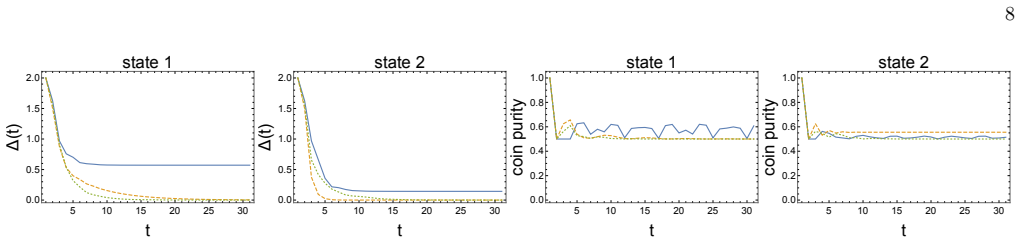
On the 3-cycle with $\eta=1/2$, $\phi_0=\pi$, $\phi_1=0$ and initial state $|3\rangle|1\rangle$, compute or measure the minimum eigenvalue of the partially transposed asymptotic state over time. The paper predicts negativity for most of the first 30 steps and a Bloch-vector ellipse in the XZ plane given by Eqs. (74)-(76); observing convergence to a stationary state, a product-state orbit, or a different Bloch geometry would falsify the central claim.
Extended reading notes
Core claim
The central claim is that a two-Kraus random-unitary walk on an $n$-cycle can exhibit the full menu of quantum Markov chain asymptotics, including a non-classical one. If the two phase shifts are both nonzero and unequal, the only attractor operator surviving is the identity, so the walk relaxes to the maximally mixed state. If the phases are equal and nonzero, the asymptotic state is a fixed point of the form $\rho_\infty = (X^{(1)}_{\lambda=1} + \xi X^{(2)}_{\lambda=1})/(2n)$, a separable mixture whose coin part points along $\sigma_y$ and whose weight $\xi$ depends on the initial state. If one phase is zero and the other nonzero, the attractor is spanned by the $U$-eigenstates $|\phi_{k\pm}\rangle$ constructed to vanish on the noisy site; these are entangled pure states because the reduced coin density matrix is mixed (determinant positive) exactly when $\cos^2(2\pi k/n)<1$, which holds for all $k$ on an odd cycle. Consequently, the long-time evolution is an oscillatory unitary rotation within an entangled subspace, so even a product initial state converges to a periodic family of position-coin entangled states.
Load-bearing premise
The argument depends on an external theorem saying that for a channel which randomly applies one of two unitaries, the long-time behaviour is fully determined by the eigenoperators whose eigenvalues have absolute value one; if that theorem does not cover this two-unitary channel, the predicted attractor and its entanglement no longer follow.
Editorial extensions
If this is right
- For odd $n$ and one phase set to zero, the walk never thermalizes; it keeps oscillating with a period set by ratios of the eigenvalues $\lambda_{k\pm}$, so asymptotic dynamics is genuinely unitary-like despite the open channel.
- Generic non-equal non-zero phases push every initial state to the maximally mixed state, matching the classical random walk on the cycle.
- Equal non-zero phases give a stationary state that is separable but initial-state dependent, with a coin Bloch vector along $\sigma_y$; this is a fixed point, not an orbit.
- Since the asymptotic orbit consists of entangled states reachable from product initial states, the open walk acts as a continuous source of sustained position-coin entanglement.
- The qubit reduced dynamics exhibits a closed attractive curve in the Bloch ball, but it is not an isolated limit cycle and the reduced evolution is non-Markovian, so the regime sits outside the usual quantum synchronization setting.
Reading between the lines
- Beyond the paper, this two-Kraus walk is a candidate minimal testbed for experimentally sustaining entanglement in a dissipative quantum system, since it needs only one noisy site and no measurement feedback.
- The paper notes an apparent clash with a published no-limit-cycle result for qubits with gain and loss; an implicit open problem is whether non-Markovian reduced dynamics of this kind can support genuine synchronization, which the authors do not claim to settle.
- A natural extension would be to map the attractor geometry as a function of the noise strength $\eta$, not just the phases; the paper fixes $\eta=1/2$ for examples but does not analyse whether the entangled orbit persists for all $\eta\in(0,1)$.
- Because the entanglement condition is $\cos^2(2\pi k/n)<1$, the same construction may yield purely product attractor sectors on even cycles where parity sectors decouple; the paper deliberately restricts to odd $n$.
Signed reviews
Editorial analysis
A structured set of objections, weighed in public.
Referee Report
Summary. The paper analyzes a discrete-time open quantum walk on an odd n-cycle with a random coin-dependent phase shift applied at a single position. The evolution is generated by two Kraus operators equivalent to randomly choosing between two unitaries. Using the spectral theory of random unitary channels, the authors classify the asymptotic dynamics into three regimes: relaxation to the maximally mixed state, relaxation to a partially mixed stationary state, and persistent oscillatory motion on an attractor. The oscillatory case (ϕ0≠0, ϕ1=0) is studied in detail: the attractor is related to eigenvectors |ϕk±⟩ of the unitary walk that are annihilated on the phase-shifted position-coin state |n,0⟩. These vectors are shown to be entangled. For the 3-cycle, explicit closed forms for the asymptotic state, the coin Bloch-vector dynamics, and a negativity witness are provided. The paper concludes that the model can sustain position-coin entanglement indefinitely from a product initial state.
Significance. If the general claims hold, the paper provides an unusually simple open quantum walk model exhibiting non-classical asymptotic behavior and persistent entanglement generated by noise, which is of clear interest for quantum information and open quantum systems. The analytical classification of the three asymptotic regimes is elegant, and the explicit 3-cycle solution is a useful benchmark. The results are parameter-free in the sense that η, ϕ0, ϕ1 are model inputs and no fitting is used; the numerical figures support the analytical attractor calculations. The main advertised novelty — an attractive asymptotic orbit containing entangled states — is rigorously established for the 3-cycle. However, as detailed below, the generalization of the entanglement claim to arbitrary odd cycles is not supported by the arguments presented, and this is central to the paper's stated scope.
major comments (2)
- [IV C and V B, Eqs. (52)-(53) and (72)-(73)] The general oscillatory asymptotic state is not supported in the subspace spanned by the entangled vectors |ϕk±⟩. For the 3-cycle this is explicit in Eq. (73), where the term (1-p+-p-)/4 \bar I with \bar I = I - |ϕ1+⟩⟨ϕ1+| - |ϕ1-⟩⟨ϕ1-| is present. The same complement projector appears for general odd n, so the asymptotic density matrix is a mixture of an oscillatory part built from |ϕk±⟩⟨ϕk'±| and a stationary complement component. Showing that each |ϕk±⟩ is entangled (Eqs. (54)-(59)) does not imply that this mixture is entangled, since mixtures with separable components can become separable even when the pure components are entangled. An entanglement witness (negativity of the partial transpose) is computed only for n=3 (Fig. 6). Therefore the abstract and conclusions claims about an attractive orbit 'made mostly of entangled states' are unsupported for general odd n; the authors should either provide a general entanglement witness or explicitly restrict the entanglement claim to the 3-cycle.
- [IV C, paragraph after Eq. (51)] The statement that 'the attractor space is a (n-1)-dimensional Hilbert subspace spanned by the vectors {|ϕk±⟩}' conflates a subspace of state vectors with the operator attractor of the channel. The asymptotic density matrix is not confined to that Hilbert subspace, because the identity operator and the complement projector \bar I are also peripheral eigenoperators of the channel and contribute to ρ∞(t). The phrase 'attractor space consists of' for the operators X_{k±,k'±} is also imprecise, since the stationary complement term is a linear combination of the identity and the projectors |ϕk±⟩⟨ϕk±|. This imprecision is not merely cosmetic: it is the source of the unsupported general entanglement conclusion.
minor comments (5)
- [V A, first paragraph] In the sentence 'If 0 < φ1 < φ0' the symbols φ1 and φ0 should be the model parameters ϕ1 and ϕ0; as written it introduces new notation.
- [IV A, Eq. (20)] The notation α_{Xλ}λ^t Xλ is slightly ambiguous. Please state explicitly that the sum runs over a complete set of peripheral eigenoperators normalized as Tr(X†X)=1, and that the coefficients are Tr(X†ρ(0)).
- [IV C, Eq. (52)] The phrase 'the attractor space consists of the following operators' should be 'is spanned by' or 'is generated by', because the set in Eq. (52) together with the identity generates the later combination in Eq. (53) and the complement projector.
- [Fig. 3 caption] The caption says 'XZ-section of the Bloch ball'; this should be 'XZ-plane' or 'projection onto the XZ-plane', since the plot shows a planar section of the Bloch ball.
- [References] Reference [17] has an inconsistent spacing in the author name ('V. Kendon , Math. Struct.'); please correct the typography.
Circularity Check
No circularity: the spectral analysis is grounded in an external theorem, and the only fitted expression is later derived analytically.
full rationale
The paper's central derivation is self-contained with respect to its own claims. The asymptotic dynamics are obtained from the random-unitary-channel spectral decomposition of Refs. [24,25], which is an external mathematical input authored by different researchers (Novotny, Alber, Jex), not by the present authors, and it is not used to smuggle in a conclusion. The model parameters eta, phi0, and phi1 are physical inputs that are swept across regimes, not fitted to data. The numerical fitting in Eq. (12) is explicitly identified as a fitting and is subsequently rederived analytically in Eqs. (61)-(62), so it is not a fitted input renamed as a prediction. The attractor operators in Section IV are obtained by solving the simultaneous eigenvalue equations (19), and the entanglement of the states |phi_k+/-} is proven independently via the purity criterion in Eqs. (54)-(59). Any concern that the asymptotic state for general odd n includes a stationary complement component beyond the span of |phi_k+/-} is a mathematical-completeness or correctness issue, not a circularity issue, because the paper does not define its conclusion into its assumptions. No self-citation is load-bearing, and no uniqueness theorem from the authors' own prior work is invoked. The derivation chain therefore does not reduce to its inputs by construction.
Assumptions & free parameters
free parameters (3)
- eta (mixing probability) =
0<eta<1, examples use 1/2
- phi0 =
e.g., pi/2 or pi
- phi1 =
varied over [0,pi] in examples
assumptions (4)
- standard math Random unitary channel attractor theorem: for Phi(rho)=(1-eta)U0 rho U0+ + eta U1 rho U1+, the asymptotic state is Sum_{|lambda|=1} Tr(X_lambda+ rho(0)) lambda^t X_lambda with X_lambda satisfying U0 X U0+ = U1 X U1+ = lambda X.
- domain assumption Odd cycle restriction
- domain assumption Mixing probability is non-trivial
- ad hoc to paper Cyclic position convention |0> identical to |n> in Eq. (35)
Cite this review
Pith. "Pith review of Attractors and asymptotic dynamics of open discrete-time quantum walks on cycles." pith.science (2026). https://pith.science/paper/UZRTOWR6
@misc{pith2026190801844,
  author       = {Pith},
  title        = {Pith review of: Attractors and asymptotic dynamics of open discrete-time quantum walks on cycles},
  year         = {2026},
  howpublished = {\url{https://pith.science/paper/UZRTOWR6}},
  note         = {Machine review of arXiv:1908.01844}
}
read the original abstract
Open quantum walks often lead to a classical asymptotic behavior. Here, we look for a simple open quantum walk whose asymptotic behavior can be non-classical. We consider a discrete-time quantum walk on n-cycle subject to a random coin-dependent phase shift at a single position. This finite system, whose evolution is described by only two Kraus operators, can exhibit all kinds of asymptotic behavior observable in quantum Markov chains: it either evolves towards a maximally mixed state, or partially mixed state, or tends to an oscillatory motion on an asymptotic orbit. We find that the asymptotic orbits do not have a product structure, therefore the corresponding states can manifest entanglement between the position and the coin degrees of freedom, even if the system started in a product state.
Figures


Figures from the paper (1 more)

Reference graph
Works this paper leans on
-
[1]
(17) In this case the following also holds [24, 25] σ =U0σU† 0 =U1σU†
-
[2]
(18) The above provides a substantial simplification of the asymptotic dynamics problem. In particular, we look for operators Xλ that are eigenvectors of both transforma- tions U0XλU† 0 =U1XλU† 1 =λXλ, (19) where λ is the eigenvalue. For random unitary channels these eigenvalues obey |λ|≤ 1 [24, 25]. For many steps (t→∞ ) the following holds ρ∞(t)≈ ∑ λ αXλ...
- [3]
- [4]
-
[5]
T. Toffoli and N. Margolus, Cellular Automata Machines, (The MIT Press, 1987)
work page 1987
- [6]
-
[7]
5), which confirms our previous numerical simulations
Therefore, the evolution takes place in the XZ-plane of the Bloch sphere and the path of the corresponding Bloch vector is ellipsoidal (see Fig. 5), which confirms our previous numerical simulations. Finally, let us discuss the position-coin entanglement in the asymptotic state. Since for a 3-cycle the system is made of a qubit (coin) and a qutrit (positio...
work page 2016
- [8]
Show all 32 references
-
[9]
D. A. Meyer, J. Stat. Phys. 85 551 (1996)
1996
-
[10]
Reitzner, D
D. Reitzner, D. Nagaj and V. Buzek, Acta Phys. Slov. 61 603 (2011)
2011
-
[11]
S. E. Venegas-Andraca, Quant. Inf. Proc. 11 1015 (2012)
2012
-
[12]
Romanelli, Phys
A. Romanelli, Phys. Rev. A 85 012319 (2012)
2012
-
[13]
Sinayskiy and F
I. Sinayskiy and F. Petruccione, Phys. Rev. A 92 032105 (2015)
2015
-
[14]
Attal, F
S. Attal, F. Petruccione, C. Sabot and I Sinayskiy, J. Stat. Phys. 147 832 (2012)
2012
-
[15]
Sinayskiy and F
I. Sinayskiy and F. Petruccione, J. Phys.: Conf. Ser. 442 012003 (2013)
2013
-
[16]
Sinayskiy and F
I. Sinayskiy and F. Petruccione, Phys. Scr. 151 014077 (2012)
2012
-
[17]
Attal, F
S. Attal, F. Petruccione, I Sinayskiy, Phys. Lett. A 376 1545 (2012)
2012
-
[18]
Kendon and B
V. Kendon and B. Tragenna, QCMC02 proceedings (2002)
2002
-
[19]
T. A. Brun, H. A. Carteret and A. Ambainis, Phys. Rev. A 67 032304 (2003)
2003
-
[20]
Kendon , Math
V. Kendon , Math. Struct. in Comp. Sci 17 1169 (2006)
2006
-
[21]
Leung, P
G. Leung, P. Knott, J. Bailey and V. Kendon, New J. Phys. 12 123018 (2010)
2010
-
[22]
Kollar, T
B. Kollar, T. Kiss, J. Novotny, and I. Jex, Phys. Rev. Lett. 108 230505 (2012)
2012
-
[23]
Kollar, J
B. Kollar, J. Novotny, T. Kiss, and I. Jex, Eur. Phys. J. Plus 129 103 (2014)
2014
-
[24]
Kollar, J
B. Kollar, J. Novotny, T. Kiss, and I. Jex, New J. Phys. 16 023002 (2014)
2014
-
[25]
Baumgartner and H
B. Baumgartner and H. Narnhofer, Rev. Math. Phys. 24 1250001 (2012)
2012
-
[26]
Novotny, J
J. Novotny, J. Maryska, and I. Jex, Eur. Phys. J. Plus 133 310 (2018)
2018
-
[27]
Novotny, G
J. Novotny, G. Alber, I. Jex, J. Phys. A: Math. Theor. 42 282003 (2009)
2009
-
[28]
Novotny, G
J. Novotny, G. Alber, I. Jex, Cent. Eur. J. Phys. 8 1001 (2010)
2010
-
[29]
Nahum, J
A. Nahum, J. Ruhman, S. Vijay, and J. Haah, Phys. Rev. X 7, 031016 (2017)
2017
-
[30]
Horodecki, P
R. Horodecki, P. Horodecki, M. Horodecki, and K. Horodecki, Rev. Mod. Phys. 81, 865 (2009)
2009
-
[31]
Roulet and C
A. Roulet and C. Bruder, Phys. Rev. Lett. 121, 053601 (2018)
2018
-
[32]
S. H. Strogatz, Nonlinear Dynamics and Chaos (Perseus Books, 1994), pp. 196
1994
Reviewed August 14, 2026 · model on record in the stance chip above.
Discussion (0). Continue with ORCID to comment.