REVIEW 1 major objections 7 minor 46 references
Semantic Estimation of 3D Body Shape and Pose using Minimal Cameras
T0 review · 1 major / 7 minor · reviewed 2026-08-14 · deepseek-v4-flash
Pith's one-line read A learned 3D body prior lets two cameras match eight-camera pose and volume accuracy
desk verdict The two-camera pose result is the hook, but the headline numbers in Tables 1 and 2 don't add up, so the central claim is shaky until the authors correct their mean computation or release per-frame errors. read the letter →
The pith
A machine-rendered reading of the paper's core claim, the machinery that carries it, and where it could break.
The reading
What carries the argument
The load-bearing object is the multi-channel probabilistic visual hull (PVH): a voxel grid in which each voxel stores foreground occupancy plus semantic 2D joint belief scores, back-projected from a small number of cameras. A symmetric 3D convolutional encoder-decoder maps this coarse PVH to a refined PVH, and at the bottleneck the latent code is split into a 78-dimensional skeleton vector (26 joints in 3D) and a 200-dimensional free embedding. A dual MSE loss supervises both outputs, a GAN discriminator judges the realism of the reconstructed volume, and LSTM layers smooth the joint sequence across time. This machinery is what lets the network inpaint phantom and missing voxels from a two-view hull and explain them with a plausible body.
What would settle it
Run the same two-camera pipeline on footage with a moving or textured background where no clean plate exists, or replace the clean-plate matte with a motion-based foreground estimator; if per-joint error on unseen subjects rises to or above the 29 mm eight-camera baseline, the clean-background assumption is carrying the result.
Extended reading notes
Core claim
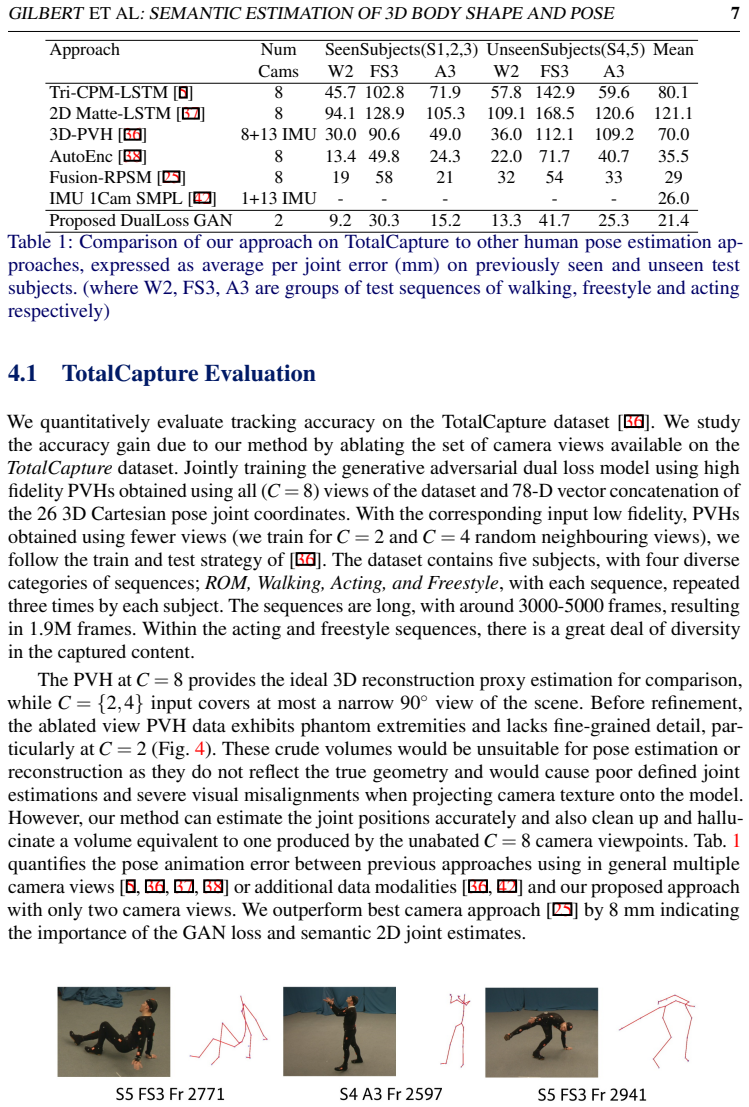
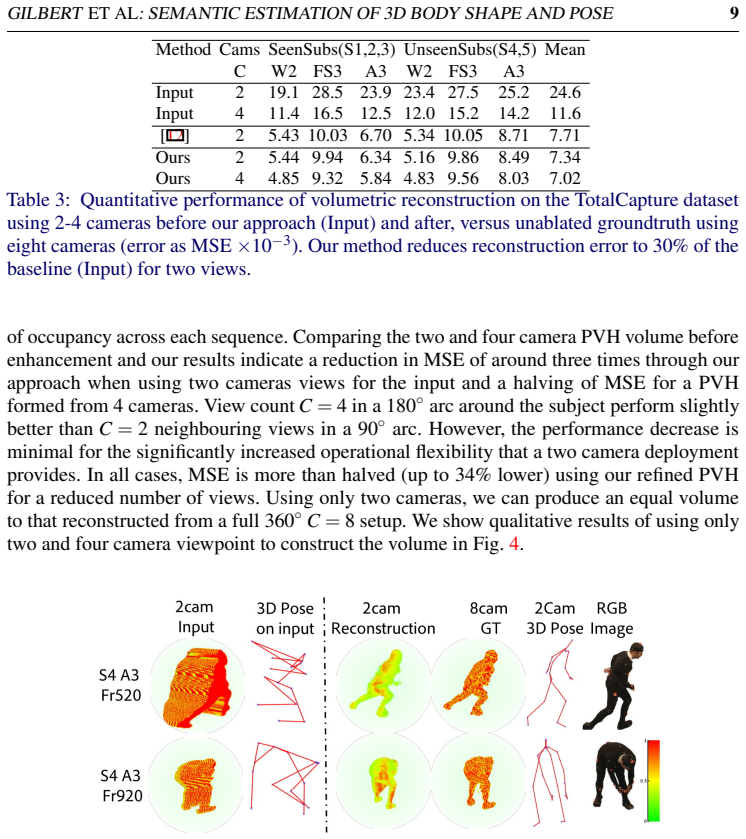
On its own terms, the discovery is that a low-fidelity multi-channel volumetric proxy computed from just two wide-baseline cameras is enough to drive a single learned network that simultaneously outputs skeletal joint positions and a high-fidelity body volume. The proxy is a probabilistic visual hull whose voxels carry both foreground occupancy and 2D semantic joint beliefs. A symmetric 3D convolutional encoder-decoder compresses this proxy into a latent vector that is partly forced to predict the 26-joint skeleton and partly left free, then decodes it into a refined volume; a GAN discriminator and LSTM layers over time regularise the output. On the TotalCapture benchmark the two-camera model achieves 21.4 mm mean per-joint error, below the 29 mm of the best eight-camera baseline, and volume-reconstruction MSE drops from $24.6 \times 10^{-3}$ to $7.34 \times 10^{-3}$. Fine-tuning the transferred model on Human3.6M brings mean per-joint error to 30.5 mm.
Load-bearing premise
The method assumes each camera has a clean, static background plate: the foreground matte is just the thresholded difference between the current frame and that plate, so moving backgrounds, changing light, or occluders corrupt the input volume before the network sees it.
Editorial extensions
If this is right
- Two-camera capture could replace eight-camera rigs in sports, security, and on-set settings where camera count or placement is restricted, at least for actions and subjects similar to the training data.
- The learned refinement turns a coarse two-view hull into a volume whose occupancy error is about 30 percent of the unrefined hull, making texture projection and free-viewpoint rendering feasible with far fewer cameras.
- Because the model produces body shape directly as occupancy rather than through a parametric body model, it may handle clothing, props, and body shapes that parametric models struggle to fit.
- Training on one multi-view dataset transfers to another with a different camera layout: the same model improves pose accuracy on Human3.6M, and a short fine-tune brings mean per-joint error to 30.5 mm.
- Each ablated component (temporal LSTM, dual loss, semantic 2D joint channel, GAN discriminator) reduces error, and the full two-camera model's 21.4 mm error is below the best prior eight-camera method's 29 mm.
Reading between the lines
- The same dual-loss latent design could be retrained for other articulated objects such as animals, robots, or hands, whenever a coarse multi-view occupancy proxy and 2D semantic keypoints are available; the human body prior is specific, but the architecture is not.
- The 200-dimensional unconstrained part of the latent embedding is never probed in the paper; a testable extension is to check whether it encodes identity, clothing, or action information independently of joint positions.
- The two-camera advantage likely depends on the cameras being wide-baseline: the paper uses two neighbouring views in roughly a 90-degree arc, so varying the angle between cameras would map where the learned prior stops being able to fill in phantom limbs.
- Since the clean-plate foreground matte is load-bearing, a robustness extension would train with synthetic corruption or dropout of the occupancy channel, revealing how much of the two-camera accuracy is carried by the semantic 2D joint channel instead.
Signed reviews
Editorial analysis
A structured set of objections, weighed in public.
Referee Report
Summary. The paper proposes a method for jointly estimating 3D articulated pose and high-fidelity volumetric occupancy from multi-view video using as few as two cameras. A coarse probabilistic visual hull (PVH) built from 2D foreground mattes and 2D joint belief maps is passed through a 3D convolutional encoder-decoder. The bottleneck produces a 78-D joint vector plus an unconstrained latent embedding; a dual loss supervises both the joint positions and the reconstructed volume, and a GAN discriminator regularizes the volume output. LSTM layers provide temporal smoothing of the joint estimates. The method is evaluated on TotalCapture for both pose and volume reconstruction and on Human3.6M for pose, reporting state-of-the-art two-camera pose error (21.4 mm mean per-joint error) and large MSE reductions in the reconstructed volume.
Significance. If the quantitative results are reliable, the paper would be an important step toward practical multi-view performance capture with very few cameras. The architecture is well motivated, and the ablation study attempts to isolate the contribution of each component (semantic channel, dual loss, LSTM, GAN). The demonstration that a model trained on TotalCapture can be transferred to Human3.6M with fine-tuning is useful. However, the internal inconsistency in the reported mean errors prevents a confident assessment of the headline improvement; the contribution is potentially solid but is not currently supported by the numbers as presented.
major comments (1)
- [Tables 1 and 2] The reported mean per-joint errors are not reproducible from the per-action errors, and the aggregation is not defined. For example, the proposed method's six Table 1 entries average 22.5 mm, not 21.4 mm, and Fusion-RPSM's entries average 36.2 mm, not 29 mm. In Table 2, the 2DJoint and Occ+2DJoint rows have identical per-action errors in five of six columns (and 21.2 vs 10.2 in the first column), yet report means of 41.2 and 31.1. Because the six columns are the same actions and subjects across all rows, any legitimate frame-weighted or sequence-weighted average must use a common set of weights; under any such weighting, changing one entry by 11.0 cannot shift the mean by 10.1 unless that entry carries more than 90% of the weight, which is incompatible with the other rows (e.g., the GAN2cam row would then have a mean near its first-column value of 9.2 rather than 21.4). The paper does not state the weighting scheme, and the apparent arithmetic inconsistencies mean the headline margin over the best eight-camera baseline (21.4 vs 29 mm) and the ablation ordering in Table 2 are not reliably established. Please specify the exact aggregation, provide per-frame or per-sequence error distributions, and correct the tables accordingly.
minor comments (7)
- [Sec. 3.1] The foreground matte is computed by thresholding the L2 HSV distance between the current frame and a predefined clean plate P, which assumes static background and stable illumination. The introduction motivates security and sports scenarios where such plates are often unavailable; the paper should acknowledge this limitation explicitly and ideally evaluate robustness to background changes.
- [Sec. 4.3, Table 3] The volume reconstruction evaluation treats the unablated C=8 PVH as ground truth. Since the C=8 PVH is itself a reconstruction, the claim of producing 'an equal volume' to the C=8 setup is stronger than the evidence; the reported MSE reduction is relative to a proxy, not to a true 3D ground-truth scan.
- [Eq. (6)] Equation (6) appears to have a typo in the second loss term: it reads 'λE(VL : φ )− ji‖2 2' and is missing an opening norm delimiter; it should likely be 'λ‖E(VL : φ )− ji‖2^2'.
- [Sec. 4.1] The test protocol for TotalCapture is only described as 'the train and test strategy of [36]'; the exact split of sequences into seen and unseen subjects, and the way the 2- and 4-camera subsets are selected (e.g., 'random neighbouring views'), should be specified so that the evaluation is reproducible.
- [Fig. 1 and Sec. 3.3] The caption of Fig. 1 says the input 'is passed through a decoder-encoder', but the architecture is an encoder-decoder; the discriminator (D) is mentioned but its architecture and optimization details are not given, which makes the GAN training hard to reproduce.
- [Tables 1-4] Several column abbreviations are undefined: W2, FS3, A3 in Tables 1-3, and Sit., Sit D, Smke in Table 4. Also, the IMU 1Cam SMPL row in Table 1 reports a single mean (26.0) with no per-action entries; it should be clarified whether this is a different evaluation protocol.
- [Sec. 3.1] There is a garbled text passage 'stageâ ˘A ´Zs' where 'stage\'s' is intended, which should be corrected.
Circularity Check
No material circularity: the pose and volume claims are evaluated on external public benchmarks with held-out subjects, and no prediction reduces to a fitted input or self-citation chain.
full rationale
The paper's central claim is an empirical improvement in 3D pose and volumetric reconstruction from minimal camera views, learned as a supervised encoder-decoder with a dual loss. The training target (Eq. 6) is a high-fidelity PVH from C=8 cameras and ground-truth joint positions, while the input is a low-fidelity PVH from C=2 or C=4 cameras; the evaluation in Tables 1-4 is performed on TotalCapture and Human 3.6M under the standard train/test protocols, including unseen subjects. There is no step where an output is defined in terms of the quantity it purports to predict, no fitted parameter is renamed as a prediction, and no load-bearing mathematical claim rests on a self-citation. The authors cite their own prior work [12, 38] as inspirations and baselines, but these citations are not used to justify the correctness of the current proposal; the improvements are measured against those baselines on public data. The volume-reconstruction comparison in Table 3 compares the network output against the same C=8 PVH representation used as the training target, but on unseen test subjects this is a standard generalization test rather than a circular construction. The skeptical reviewer's observation that some reported Mean columns in Tables 1 and 2 are not reproducible from the per-action entries is a data-consistency concern, not a circularity concern; it does not show that any result is equivalent to its input by definition. Accordingly, no circular steps are identified.
Assumptions & free parameters
free parameters (6)
- loss weight lambda =
1e-3
- latent embedding size e =
200
- encoder/decoder filter counts =
nE=[64,64,128,128,256], nD=[256,128,128,64,64], kernels 3, strides [0,1,0,1,0]
- LSTM cells and lookback =
two layers of 1024 cells, T=5
- sequence length T =
5
- fine-tuning epochs =
2
assumptions (5)
- domain assumption 2D joint belief maps from Convolutional Pose Machines (Wei et al. [6,44]) are reliable enough to serve as semantic voxel channels in the PVH.
- domain assumption The clean plate background subtraction yields a valid soft foreground occupancy.
- domain assumption The product of per-camera sigmoid occupancy probabilities in Eq. (5) is a valid fusion of multi-view evidence.
- domain assumption The 8-camera PVH is treated as ground truth volume for training and evaluating reconstruction (Sec. 4.3).
- domain assumption Volume MSE is a meaningful perceptual fidelity metric for reconstruction quality.
Cite this review
Pith. "Pith review of Semantic Estimation of 3D Body Shape and Pose using Minimal Cameras." pith.science (2026). https://pith.science/paper/V227QEM5
@misc{pith2026190803030,
  author       = {Pith},
  title        = {Pith review of: Semantic Estimation of 3D Body Shape and Pose using Minimal Cameras},
  year         = {2026},
  howpublished = {\url{https://pith.science/paper/V227QEM5}},
  note         = {Machine review of arXiv:1908.03030}
}
read the original abstract
We aim to simultaneously estimate the 3D articulated pose and high fidelity volumetric occupancy of human performance, from multiple viewpoint video (MVV) with as few as two views. We use a multi-channel symmetric 3D convolutional encoder-decoder with a dual loss to enforce the learning of a latent embedding that enables inference of skeletal joint positions and a volumetric reconstruction of the performance. The inference is regularised via a prior learned over a dataset of view-ablated multi-view video footage of a wide range of subjects and actions, and show this to generalise well across unseen subjects and actions. We demonstrate improved reconstruction accuracy and lower pose estimation error relative to prior work on two MVV performance capture datasets: Human 3.6M and TotalCapture.
Figures


Figures from the paper (1 more)
Reference graph
Works this paper leans on
-
[1]
S. Abrahamsson, H. Blom, and D. Jans. Multifocus structured illumination microscopy for fast volumetric super-resolution imaging. Biomedical Optics Express , 8(9):4135– GILBERT ET AL: SEMANTIC ESTIMA TION OF 3D BODY SHAPE AND POSE 11 4140, 2017
work page 2017
-
[2]
M. Andriluka, S. Roth, and B. Schiele. Pictoral structures revisited: People detection and articulated pose estimation. In Proc. Computer Vision and Pattern Recognition , 2009
work page 2009
-
[3]
2d human pose estimation: New benchmark and state of the art analysis
Mykhaylo Andriluka, Leonid Pishchulin, Peter Gehler, and Bernt Schiele. 2d human pose estimation: New benchmark and state of the art analysis. In Proceedings of the IEEE Conference on Computer Vision and Pattern Recognition, pages 3686–3693, 2014
work page 2014
-
[4]
Volumetric Super-Resolution of Multispectral Data
V . Aydin and H. Foroosh. V olumetric super-resolution of multispectral data. InCorr . arXiv:1705.05745v1, 2017
work page Pith review arXiv 2017
-
[5]
Realtime multi-person 2d pose estimation using part affinity fields
Zhe Cao, Tomas Simon, Shih-En Wei, and Yaser Sheikh. Realtime multi-person 2d pose estimation using part affinity fields. ECCV’16, 2016
work page 2016
-
[6]
Realtime multi-person 2d pose estimation using part affinity fields
Zhe Cao, Tomas Simon, Shih-En Wei, and Yaser Sheikh. Realtime multi-person 2d pose estimation using part affinity fields. In CVPR, 2017
2017
-
[7]
Surface-based Character Animation
Dan Casas, Peng Huang, and Adrian Hilton. Surface-based Character Animation. In Marcus Magnor, Oliver Grau, Olga Sorkine-Hornung, and Christian Theobalt, editors, Digital Representations of the Real World: How to Capture, Model, and Render Visual Reality, chapter 16, pages 239–252. CRC Press, April 2015. ISBN 9781482243819
work page 2015
-
[8]
High-quality streamable free-viewpoint video
Alvaro Collet, Ming Chuang, Pat Sweeney, Don Gillett, Dennis Evseev, David Calabrese, Hugues Hoppe, Adam Kirk, and Steve Sullivan. High-quality streamable free-viewpoint video. ACM Transactions on Graphics (TOG), 34(4):69, 2015
work page 2015
Show all 46 references
-
[9]
C. Dong, C. C. Loy, K. He, and X. Tang. Image super-resolution using deep convo- lutional networks. IEEE Trans. Pattern Anal. Machine Intelligence , 38(2):295–307, 2016
2016
-
[10]
Efficient ConvNet-based marker-less motion capture in general scenes with a low number of cameras
Ahmed Elhayek, Edilson de Aguiar, Arjun Jain, Jonathan Tompson, Leonid Pishchulin, Micha Andriluka, Chris Bregler, Bernt Schiele, and Christian Theobalt. Efficient ConvNet-based marker-less motion capture in general scenes with a low number of cameras. In Computer Vision and Pa...
2015
-
[11]
R. Fattal. Image upsampling via imposed edge statistics. In Proc. ACM SIGGRAPH, 2007
2007
-
[12]
V olumetric per- formance capture from minimal camera viewpoints
Andrew Gilbert, Marco V olino, John Collomosse, and Adrian Hilton. V olumetric per- formance capture from minimal camera viewpoints. In Proceedings of the European Conference on Computer Vision (ECCV), pages 566–581, 2018
2018
-
[13]
Glasner, S
D. Glasner, S. Bagon, and M. Irani. Super-resolution from a single image. In Proc. Intl. Conf. Computer Vision (ICCV), 2009
2009
-
[14]
Grauman, G
K. Grauman, G. Shakhnarovich, and T. Darrell. A bayesian approach to image-based visual hull reconstruction. In Proc. CVPR, 2003
2003
-
[15]
Long short-term memory
Sepp Hochreiter and Jürgen Schmidhuber. Long short-term memory. In Neural compu- tation, volume 9, pages 1735–1780. MIT Press, 1997. 12 GILBERT ET AL: SEMANTIC ESTIMA TION OF 3D BODY SHAPE AND POSE
1997
-
[16]
Exploiting temporal information for 3d human pose estimation
Mir Rayat Imtiaz Hossain and James J Little. Exploiting temporal information for 3d human pose estimation. In European Conference on Computer Vision , pages 69–86. Springer, 2018
2018
-
[17]
Gehler, Ijaz Akhter, and J
Yinghao Huang, Federica Bogo, Christoph Classner, Angjoo Kanazawa, Peter V . Gehler, Ijaz Akhter, and J. Black. Towards accurate markerless human shape and pose estima- tion over time. In 3DV, 2017
2017
-
[18]
Human3.6m: Large scale datasets and predictive methods for 3d human sensing in natural environ- ments
Catalin Ionescu, Dragos Papava, Vlad Olaru, and Cristian Sminchisescu. Human3.6m: Large scale datasets and predictive methods for 3d human sensing in natural environ- ments. IEEE Transactions on Pattern Analysis and Machine Intelligence , 36(7):1325– 1339, jul 2014
2014
-
[19]
Lan and D
X. Lan and D. Huttenlocher. A unified spatio-temporal articulated model for tracking. In Proc. Computer Vision and Pattern Recognition, volume 1, pages 722–729, 2004
2004
-
[20]
Maximum-margin structured learning with deep networks for 3d human pose estimation
Sijin Li, Weichen Zhang, and Antoni B Chan. Maximum-margin structured learning with deep networks for 3d human pose estimation. In Proceedings of the IEEE Interna- tional Conference on Computer Vision, pages 2848–2856, 2015
2015
-
[21]
Smpl: A skinned multi-person linear model
Matthew Loper, Naureen Mahmood, Javier Romero, Gerard Pons-Moll, and Michael J Black. Smpl: A skinned multi-person linear model. ACM Transactions on Graphics (TOG), 34(6):248, 2015
2015
-
[22]
Real-time full-body motion capture from video and imus
C Malleson, A Gilbert, M Trumble, J Collomosse, and A Hilton. Real-time full-body motion capture from video and imus. In 3DV, 2017
2017
-
[23]
Recurrent 3d pose sequence machines
Xiaodan Liang Keze Wang Mude Lin, Liang Lin and Hui Cheng. Recurrent 3d pose sequence machines. In CVPR, 2017
2017
-
[24]
Coarse-to-fine volumetric prediction for single-image 3D human pose
Georgios Pavlakos, Xiaowei Zhou, Konstantinos G Derpanis, and Kostas Daniilidis. Coarse-to-fine volumetric prediction for single-image 3D human pose. In CVPR, 2017
2017
-
[25]
Cross view fusion for 3d human pose estimation
Haibo Qiu, Chunyu Wang, Jingdong Wang, Naiyan Wang, and Wenjun Zeng. Cross view fusion for 3d human pose estimation. In Proceedings of the IEEE International Conference on Computer Vision, 2019
2019
-
[26]
Visual sentences for pose retrieval over low-resolution cross- media dance collections
R Ren and J Collomosse. Visual sentences for pose retrieval over low-resolution cross- media dance collections. IEEE Transactions on Multimedia, 2012
2012
-
[27]
X. Ren, E. Berg, and J. Malik. Recovering human body configurations using pairwise constraints between parts. In Proc. Intl. Conf. on Computer Vision , volume 1, pages 824–831, 2005
2005
-
[28]
General automatic human shape and motion capture using volu- metric contour cues
Helge Rhodin, Nadia Robertini, Dan Casas, Christian Richardt, Hans-Peter Seidel, and Christian Theobalt. General automatic human shape and motion capture using volu- metric contour cues. In European Conference on Computer Vision , pages 509–526. Springer, 2016
2016
-
[29]
L. I. Rudin, S. Osher, and E. Fatemi. Non-linear total variation based noise removal algorithms. Physics D, 60(1-4):259–268, 1992. GILBERT ET AL: SEMANTIC ESTIMA TION OF 3D BODY SHAPE AND POSE 13
1992
-
[30]
W. Shi, J. Caballero, F. Huszar, J. Totz, A. Aitken, R. Bishop, D. Rueckert, and Z. Wang. Real-time single image and video super-resolution using an efficient sub-pixel con- volutional neural network. In Proc. Comp. Vision and Pattern Recognition (CVPR) , 2016
2016
-
[31]
Srinivasan and J
P. Srinivasan and J. Shi. Bottom-up recognition and parsing of the human body. InProc. Computer Vision and Pattern Recognition, pages 1–8, 2007
2007
-
[32]
A free-viewpoint video renderer
Jonathan Starck, Joe Kilner, and Adrian Hilton. A free-viewpoint video renderer. Jour- nal of Graphics, GPU, and Game Tools , 14(3):57–72, 2009
2009
-
[33]
Indirect deep structured learning for 3d human body shape and pose prediction
J Tan, I Budvytis, and R Cipolla. Indirect deep structured learning for 3d human body shape and pose prediction. In BMVC, 2017
2017
-
[34]
Lifting from the deep: Convolutional 3d pose estimation from a single image
Denis Tome, Chris Russell, and Lourdes Agapito. Lifting from the deep: Convolutional 3d pose estimation from a single image. arXiv preprint arXiv:1701.00295, 2017
2017 arXiv
-
[35]
Toshev and C
A. Toshev and C. Szegedy. Deep pose: Human pose estimation via deep neural networks. In Proc. CVPR, 2014
2014
-
[36]
Total capture: 3d human pose estimation fusing video and inertial sen- sors
Matthew Trumble, Andrew Gilbert, Charles Malleson, Adrian Hilton, and John Col- lomosse. Total capture: 3d human pose estimation fusing video and inertial sen- sors. In Proceedings of 28th British Machine Vision Conference , pages 1–13. URL http://epubs.surrey.ac.uk/841740/
-
[37]
Deep con- volutional networks for marker-less human pose estimation from multiple views
Matthew Trumble, Andrew Gilbert, Adrian Hilton, and Collomosse John. Deep con- volutional networks for marker-less human pose estimation from multiple views. In Proceedings of the 13th European Conference on Visual Media Production (CVMP 2016), CVMP 2016, 2016
2016
-
[38]
Deep autoen- coder for combined human pose estimation and body model upscaling
Matthew Trumble, Andrew Gilbert, Adrian Hilton, and John Collomosse. Deep autoen- coder for combined human pose estimation and body model upscaling. In European Conference on Computer Vision (ECCV’18), 2018
2018
-
[40]
Russell, Jimei Yang, Ersin Yumer, Ivan Laptev, and Cordelia Schmid
Gül Varol, Duygu Ceylan, Bryan C. Russell, Jimei Yang, Ersin Yumer, Ivan Laptev, and Cordelia Schmid. Bodynet: V olumetric inference of 3d human body shapes. InIn ECCV’18, 2018
2018
-
[41]
Sparse inertial poser: Automatic 3d human pose estimation from sparse imus
Timo von Marcard, Bodo Rosenhahn, Michael Black, and Gerard Pons-Moll. Sparse inertial poser: Automatic 3d human pose estimation from sparse imus. Computer Graphics F orum 36(2), Proceedings of the 38th Annual Conference of the European Association for Computer Graphics (Eurog...
2017
-
[42]
Recovering accurate 3d human pose in the wild using imus and a moving camera
Timo von Marcard, Roberto Henschel, Michael J Black, Bodo Rosenhahn, and Gerard Pons-Moll. Recovering accurate 3d human pose in the wild using imus and a moving camera. In Proceedings of the European Conference on Computer Vision (ECCV) , pages 601–617, 2018
2018
-
[43]
Z. Wang, D. Liu, J. Yang, W. Han, and T. S. Huang. Deep networks for image super- resolution with sparse prior. In Proc. Intl. Conf. Computer Vision (ICCV) , pages 370– 378, 2015. 14 GILBERT ET AL: SEMANTIC ESTIMA TION OF 3D BODY SHAPE AND POSE
2015
-
[44]
Convolutional pose machines
Shih-En Wei, Varun Ramakrishna, Takeo Kanade, and Yaser Sheikh. Convolutional pose machines. In CVPR, 2016
2016
-
[45]
J. Xie, L. Xu, and E. Chen. Image denoising and inpainting with deep neural networks. In Proc. Neural Inf. Processing Systems (NIPS) , pages 350–358, 2012
2012
-
[46]
Deephuman: 3d human reconstruction from a single image
Zerong Zheng, Tao Yu, Yixuan Wei, Qionghai Dai, and Yebin Liu. Deephuman: 3d human reconstruction from a single image. In In ICCV’19, 2019
2019
-
[47]
Y . Zhu, Y . Zhang, and A. L. Yuille. Single image super-resolution using deformable patches. In Proc. Comp. Vision and Pattern Recognition (CVPR) , pages 2917–2924, 2014
2014
Reviewed August 14, 2026 · model on record in the stance chip above.
Discussion (0). Continue with ORCID to comment.