REVIEW 3 major objections 6 minor 16 references
Remarks on the energy inequality of a global $L^{\infty}$ solution to the compressible Euler equations for the isentropic nozzle flow
T0 review · 3 major / 6 minor · reviewed 2026-08-14 · deepseek-v4-flash
Pith's one-line read The paper proves a finite-energy inequality for global L∞ nozzle-flow solutions to the compressible Euler equations.
desk verdict Useful strengthening of the author's own existence theorem, but the energy inequality rests on an unproved proposition carried over from a different scheme. read the letter →
The pith
A machine-rendered reading of the paper's core claim, the machinery that carries it, and where it could break.
The reading
What carries the argument
The load-bearing object is the recurrence formula (4.1), obtained by applying Green's formula to the mechanical energy pair $(\eta_*, q_*)$ in each staggered cell of the modified Lax-Friedrichs scheme. The formula expresses the cell energy at the next time level in terms of the previous level plus flux-difference terms, source terms involving $A'/A$, and error terms $D_n+E_n$. Proposition 4.1 controls those error terms through two $L^2$ estimates on jumps between adjacent time levels and within time steps, with the proof deferred to an earlier paper. Jensen's inequality then converts the recurrence into a global weighted energy inequality, and compensated compactness carries it to the limiting weak solution; the Riemann-invariant bounds in (1.8) keep the approximate states inside the invariant region and away from vacuum pathologies.
What would settle it
Evaluate the two sums in (4.3) and (4.4) for the modified Lax-Friedrichs approximations in a non-monotone nozzle with admissible large data; if either sum exceeds the stated bound, the $o(1)$ error in (4.5) fails and the weighted energy inequality for the limiting weak solution cannot be concluded.
Extended reading notes
Core claim
The central claim is Theorem 1.2: whenever the initial weighted mechanical energy $\int_{\mathbb{R}} A(x)\eta_*(u_0(x))\,dx$ is finite, the global entropy weak solution from Theorem 1.1 satisfies $$\int_{\mathbb{R}} A(x)\eta_*(u(x,t))\,dx \le \int_{\mathbb{R}} A(x)\eta_*(u_0(x))\,dx$$ for almost every $t>0$. Here $A(x)$ is the nozzle cross-section and $\eta_* = \frac{m^2}{2\rho} + \frac{\rho^\gamma}{\gamma(\gamma-1)}$ is the mechanical energy. The proof works by first proving the same inequality for the modified Lax-Friedrichs approximations and then showing that the inequality survives the compensated-compactness limit, so the dissipative character of the approximate scheme is inherited by the weak solution itself.
Load-bearing premise
The proof depends on Proposition 4.1's two estimates, which are not proved in this paper; they are deferred to an earlier paper, and if either fails the error term in (4.5) is not small and the energy inequality does not follow.
Editorial extensions
If this is right
- If correct, the $L^\infty$ weak solutions of Theorem 1.1 have finite weighted mechanical energy at almost every time, bounded by the initial energy.
- The energy inequality survives the compensated-compactness limit, so the dissipativity of the modified Lax-Friedrichs scheme is a property of the limiting weak solution, not just of the approximations.
- Because the solution is $L^\infty$, finite energy is accompanied by finite propagation speed, giving the combination of physical properties that the paper identifies as essential.
- The paper states that the same recurrence-formula method applies to the earlier spherically symmetric, Laval-nozzle, and general $a\in L^1(\mathbb{R})$ cases, so a corresponding energy inequality should hold there as well.
Reading between the lines
- The strict convexity of $\eta_*$ means the weighted energy inequality supplies control beyond the $L^\infty$ bound, placing the constructed solutions in a natural weighted $L^1$ class that may support compactness or stability arguments unavailable for merely bounded entropy solutions.
- A testable consequence is that any numerical or analytical candidate for an admissible weak solution of the isentropic nozzle equations with finite initial energy should satisfy the same weighted inequality; a counterexample would indicate that the construction selects a particular admissible solution rather than all entropy solutions.
- The proof's error terms depend on regularity of $A$ through $A'/A$, so a natural extension is to determine the minimal nozzle regularity needed for the energy inequality to hold, and to check whether rougher nozzles admit solutions that violate it.
Signed reviews
Editorial analysis
A structured set of objections, weighed in public.
Referee Report
Summary. The paper studies the isentropic compressible Euler equations in a nozzle with variable cross-section A(x). It introduces a modified Lax-Friedrichs-type scheme with staggered cell averages and Riemann-solution building blocks, and claims in Theorem 1.2 that the global L∞ entropy weak solution obtained in Theorem 1.1 satisfies the mechanical-energy inequality (1.9) whenever the initial weighted energy is finite. The proof derives a discrete energy inequality (4.2) from a cell-wise Green formula, controls the accumulated errors by Proposition 4.1, and then passes to the limit via compensated compactness cited from [T6].
Significance. If the theorem is correct, it upgrades known large-data L∞ existence results for nozzle flows by adding finite mechanical energy and finite propagation, which are physically important properties. The paper's strategy of deriving the energy inequality at the discrete level from a recurrence formula is attractive and avoids assuming the inequality in the limit. The construction is presented in considerable detail. However, the main new estimate (Proposition 4.1) is not proved in the manuscript, and the convergence step is delegated to a prior paper for a different scheme; these are central gaps rather than presentation issues.
major comments (3)
- [§4, Proposition 4.1] The error control leading to (4.5) is not established. After summing (4.2), the proof needs ∑_{k=0}^n (D_k+E_k)=O(√Δx), and this follows only from the temporal oscillation estimates (4.3) and (4.4). The manuscript states that these can be obtained 'in a similar manner to [T1, (6.18)] and [T1, Lemma 7.1]', but those results are proved for the modified Godunov scheme in [T1]. The scheme here is a modified Lax-Friedrichs scheme with a staggered averaging operator E^n_j and recurrence (4.1), and in the near-vacuum cells (Appendix A) the approximate solution is either the exact Riemann solution or is defined by (A.1); no argument shows the L2 bounds survive these changes. If either (4.3) or (4.4) fails, the o(1) error in (4.5), and hence Theorem 1.2, is unsupported. This proposition must either be proved in full or the cited estimates must be verified line-by-line for the present scheme including the vacuum cells.
- [§4, convergence to the weak solution] The passage from the discrete inequality (4.8) to the limit inequality (4.9) is delegated to [T6] with the sentence 'By virtue of the methods of compensated compactness for the approximate solutions (see [T6])'. [T6] treats the modified Godunov scheme, not the modified Lax-Friedrichs scheme introduced here, and the paper does not show that the entropy dissipation measures for the new scheme are compact, nor that the approximate solutions converge almost everywhere to the solution of Theorem 1.1. Since the final inequality is obtained in the limit, this convergence is load-bearing and needs to be stated as a theorem with a proof or with a precise identification of which results in [T6] carry over and why.
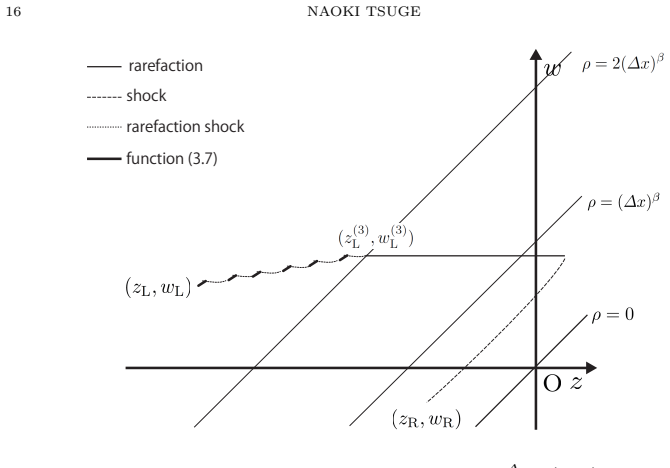
- [Appendix A] The near-vacuum construction is sketched rather than proved. In particular, the definition of the approximate solution in Case 1.2(ii) uses (A.1) and a Riemann solution with state u_L^{(4)}, and the text says 'otherwise, the definition of u_Δ is similar to Subsection 3.1', but it is not verified that this piecewise definition satisfies the entropy condition along discontinuities, which is needed for (4.1), nor that the estimates (4.3) and (4.4) hold for these cells. The reference to [T1, Appendix A] is to the construction for the Godunov-type scheme, not to the current Lax-Friedrichs-type scheme. This gap is connected to the previous one, but deserves separate statement because vacuum cells are exactly where the L^2-oscillation estimates are least routine.
minor comments (6)
- [Abstract] The abstract contains two typos: 'comparetively' should be 'comparatively' and 'we drive' should be 'we derive'.
- [§4] The sentence 'Then, we introduce the following proposition:' places Proposition 4.1 after the inequality it is meant to justify; reordering or an explicit forward reference would improve readability.
- [§4, Proposition 4.1] The constant C in (4.3) and the O(Δx) in (4.4) are not qualified as uniform in Δx, in X, and in the cut-off R_T; the text should state the required uniformity explicitly.
- [References] The abstract cites [T6] as 'Nonlinear Anal. Real World Appl. 209: 217-238 (2017)', while the reference list gives volume 37, pages 217-238; the citation needs to be made consistent.
- [§2] The sentence 'η_* should be a strictly convex weak entropy pair' should read 'η_* is a strictly convex weak entropy'; this is a minor wording issue.
- [§4] In the display after (4.2), the accumulated error is written as D_n+E_n, while Proposition 4.1 uses the index k; the notation should be unified to avoid confusion.
Circularity Check
No significant circularity: the energy inequality is derived from a discrete recurrence and initial energy; cited prior estimates are external and do not contain the target result.
full rationale
The central derivation in Section 4 obtains (1.9) from the discrete inequality (4.1), Jensen's inequality, and the error bound sum(D_n+E_n)=O(sqrt(Delta x)) via Proposition 4.1. The target energy inequality is not an input: it is not assumed in the construction of the modified Lax-Friedrichs scheme, nor is it one of the cited results from [T1] or [T6]. The paper does rely heavily on the author's own prior work: Theorem 1.1 is taken from [T6], the entropy admissibility along discontinuities is cited to [T1, Lemmas 5.1-5.4], and Proposition 4.1 is asserted as 'obtained in a similar manner to [T1, (6.18)] and [T1, Lemma 7.1]' rather than proved. These are self-citations, and the omitted proof of Proposition 4.1 is a genuine correctness gap, but they are not circular in the sense used here: [T1] and [T6] do not assume or contain Theorem 1.2, the estimates are parameter-free with stated assumptions, and no fitted value is renamed as a prediction. There is no equation in the paper that reduces to its own input by construction. The appropriate verdict is therefore no significant circularity (score 0), with the Proposition 4.1 issue flagged as a completeness and correctness risk.
Assumptions & free parameters
free parameters (3)
- M
- b(x)
- delta, alpha, beta
assumptions (6)
- domain assumption The nozzle cross-section satisfies A in C^2(R), a = -A'/A is in L^1(R), and there exists a bounded integrable weight b satisfying (1.7).
- domain assumption Initial data satisfy the weighted bounds (1.8) for some finite M, and the weighted initial energy integral of eta* is finite.
- domain assumption The cross-section A(x) is constant outside a large interval |x|>X, and the result is obtained by letting X tend to infinity.
- standard math The compensated compactness framework of Tartar-DiPerna, as implemented in [T6], yields a.e. convergence of the modified Lax-Friedrichs approximations to a weak solution.
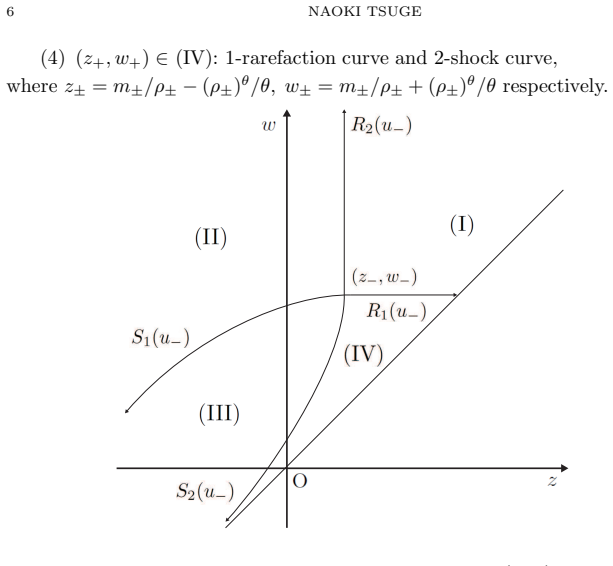
- standard math The isentropic Euler Riemann problem for gamma in (1,5/3] has the four-wave structure with rarefaction and shock curves as summarized in Section 2.
- ad hoc to paper The estimates (4.3) and (4.4) in Proposition 4.1 hold.
Cite this review
Pith. "Pith review of Remarks on the energy inequality of a global $L^{\infty}$ solution to the compressible Euler equations for the isentropic nozzle flow." pith.science (2026). https://pith.science/paper/V2CCBWLT
@misc{pith2026190803209,
  author       = {Pith},
  title        = {Pith review of: Remarks on the energy inequality of a global $L^\infty$ solution to the compressible Euler equations for the isentropic nozzle flow},
  year         = {2026},
  howpublished = {\url{https://pith.science/paper/V2CCBWLT}},
  note         = {Machine review of arXiv:1908.03209}
}
abstract
We study the compressible Euler equations in the isentropic nozzle flow. The global existence of an $L^{\infty}$ solution has been proved in (Tsuge in Nonlinear Anal. Real World Appl. 209: 217-238 (2017)) for large data and general nozzle. However, unfortunately, this solution does not possess finiteness of energy. Although the modified Godunov scheme is introduced in this paper, we cannot deduce the energy inequality for the approximate solutions. Therefore, our aim in the present paper is to derive the energy inequality for an $L^{\infty}$ solution. To do this, we introduce the modified Lax Friedrichs scheme, which has a recurrence formula consisting of discretized approximate solutions. We shall first deduce from the formula the energy inequality. Next, applying the compensated compactness method, the approximate solution converges to a weak solution. The energy inequality also holds for the solution as the limit. As a result, since our solutions are $L^{\infty}$, they possess finite energy and propagation, which are essential to physics.
Figures


Figures from the paper (2 more)

Reference graph
Works this paper leans on
-
[1]
Chen G.-Q., Schrecker Matthew R. I.: Vanishing Viscosity Approach to the Compressible Euler Equations for Transonic Nozzle and Spherically Symmetric Flows. Arch. Ration. Mech. Anal. 229, 1239--1279 (2018)
work page 2018
-
[2]
Liu, T.-P.: Quasilinear hyperbolic systems. Commun. Math. Phys. 68, 141--172 (1979)
work page 1979
-
[3]
Lu, Y.-G.: Global existence of solutions to resonant system of isentropic gas dynamics. Nonlinear Anal. Real World Appl. 12, 2802--2810 (2011)
work page 2011
-
[4]
Lu, Yun-guang, Gu, F.: Existence of global entropy solutions to the isentropic Euler equations with geometric effects. Nonlinear Anal. Real World Appl. 14, 990–996 (2013)
work page 2013
-
[5]
Philippe G. LeFloch, Michael Westdickenberg: Finite energy solutions to the isentropic Euler equations with geometric effects. J. Math. Pures Appl. 88, 389-429 (2007)
work page 2007
-
[6]
and Takeno,S.: Initial-boundary value problem for the spherical symmetric motion of isentropic gas
Makino, T. and Takeno,S.: Initial-boundary value problem for the spherical symmetric motion of isentropic gas. Jpn J. Ind. Appl. Math. 11, 171--183 (1994)
work page 1994
-
[7]
Tsuge, N.: Global L^ solutions of the compressible Euler equations with spherical symmetry. J. Math. Kyoto Univ. 46, 457--524 (2006)
work page 2006
-
[8]
Tsuge, N.: Large time decay of solutions to isentropic gas dynamics. Quart. Appl. Math. 65, 135–143 (2007)
work page 2007
Show all 16 references
-
[9]
Tsuge, N.: Large time decay of solutions to isentropic gas dynamics with spherical symmetry. J. Hyperbolic Differ. Equ. 6, 371–387 (2009)
2009
-
[10]
Tsuge, N.: Existence of global solutions for unsteady isentropic gas flow in a Laval nozzle. Arch. Ration. Mech. Anal. 205, 151--193 (2012)
2012
-
[11]
Tsuge, N.: Isentropic gas flow for the compressible Euler equation in a nozzle. Arch. Ration. Mech. Anal. 209, 365–400 (2013)
2013
-
[12]
Tsuge, N.: Existence of a global solution to a scalar conservation law with a source term for large data. J. Math
-
[13]
Tsuge, N.: Existence and Stability of Solutions to the Compressible Euler Equations with an
-
[14]
Acta Appl
Tsuge, N.: Existence of a Global Solution for a Scalar Conservation Law with a Source Term. Acta Appl. Math
-
[15]
Nonlinear Anal
Tsuge, N.: Global entropy solutions to the compressible Euler equations in the isentropic nozzle flow for large data: Application of the generalized invariant regions and the modified Godunov scheme. Nonlinear Anal. Real World Appl. 37, 217--238 (2017)
2017
-
[16]
RIMS Kôkyûroku 2070, 150--162 (2016) http://www.kurims.kyoto-u.ac.jp/ kyodo/kokyuroku/contents/2070.html
Tsuge, N.: Isentropic Gas Flow in a Laval Nozzle: Physical Phenomena of Steady Flow and Time Global Existence of Solutions. RIMS Kôkyûroku 2070, 150--162 (2016) http://www.kurims.kyoto-u.ac.jp/ kyodo/kokyuroku/contents/2070.html
2016
Reviewed August 14, 2026 · model on record in the stance chip above.
Discussion (0). Continue with ORCID to comment.