REVIEW 3 major objections 5 minor 94 references
Effects of uniform acceleration on quantum states and vacuum entanglement in relativistic quantum information
T0 review · 3 major / 5 minor · reviewed 2026-08-14 · deepseek-v4-flash
Pith's one-line read This thesis argues that a uniformly accelerating particle-decay clock ticks at a rate deviating from the special-relativistic prediction, and that accelerated observers see more vacuum entanglement as their acceleration grows and their…
desk verdict A solid doctoral thesis that repackages peer-reviewed RQI results with a few genuinely new extensions; the ideal-clock claim is the one place where the conclusion visibly outruns the calculation. read the letter →
The pith
A machine-rendered reading of the paper's core claim, the machinery that carries it, and where it could break.
The reading
What carries the argument
The load-bearing object is the Gaussian quantum channel defined by (7.20)-(7.21), in which the output covariance matrix is $\sigma^{(d)} = M \sigma^{(f)} M^T + N$. Here $M$ encodes the inevitable mismatch between inertial and accelerated localized modes through Bogolyubov overlaps, and $N$ is the noise matrix obtained by tracing the modes outside the two observers' wavepackets; both are built from the decomposition of the Minkowski vacuum as a product of two-mode squeezed states in Rindler wedges. Modified Rindler coordinates with an independent wedge separation $D$ disentangle the observers' accelerations from their distance. In the cavity part, the same covariance-matrix formalism is run non-perturbatively, with the Unruh-DeWitt interaction written as a quadratic phase-space Hamiltonian, and genuine tripartite entanglement is detected through unitary localization followed by logarithmic negativity across each bipartition.
What would settle it
For the clock claim, measure muon decay rates in storage rings at accelerations where the Unruh temperature approaches the muon rest energy and compare with the special-relativistic prediction; exact agreement would falsify the deviation, while a deviation matching the computed rate would support it. For the boundary-condition claim, a cavity-QED experiment harvesting two- and three-detector entanglement should show earlier and stronger entanglement with periodic walls than with Dirichlet walls.
Extended reading notes
Core claim
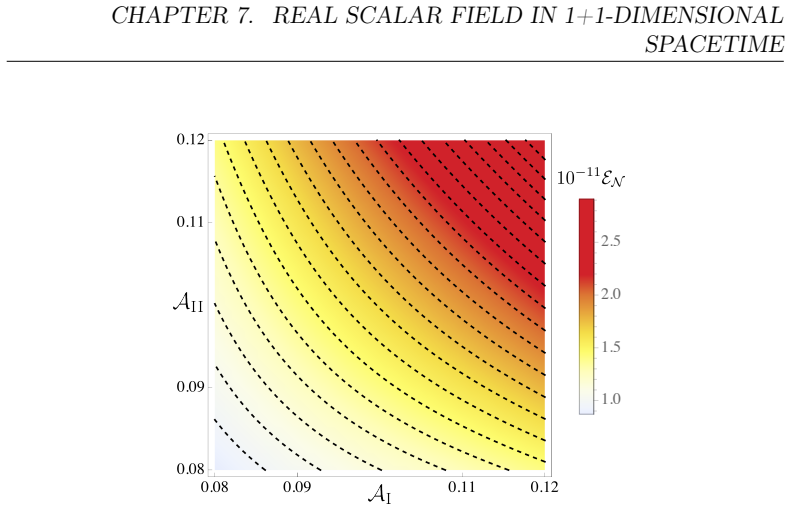
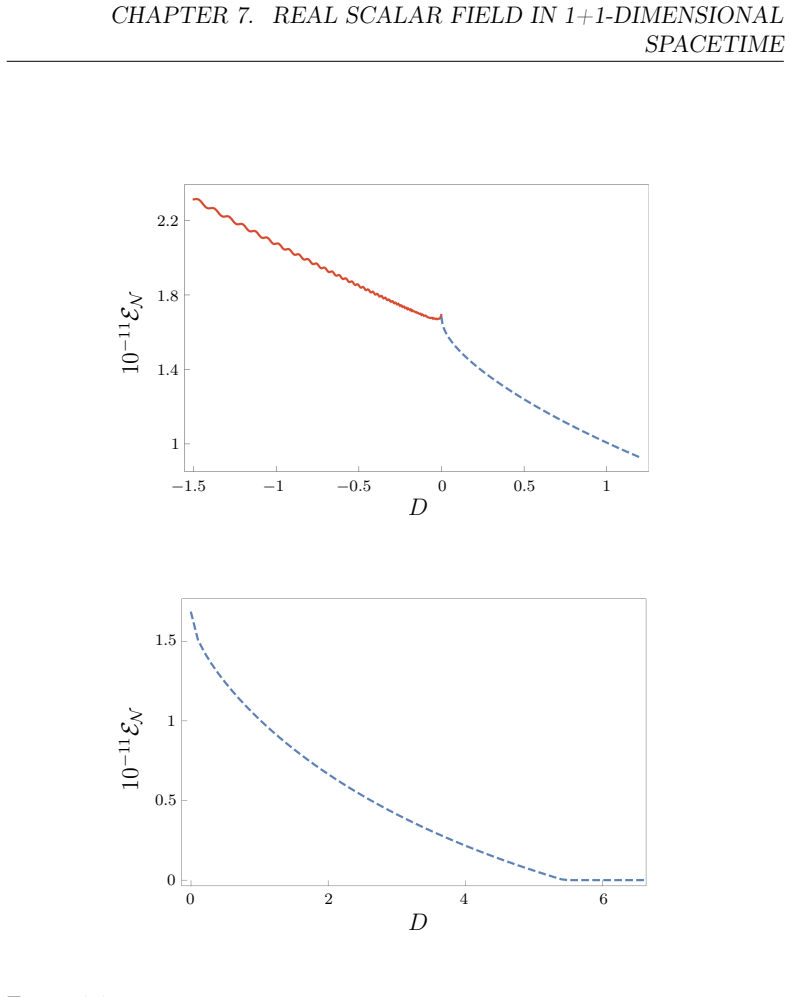
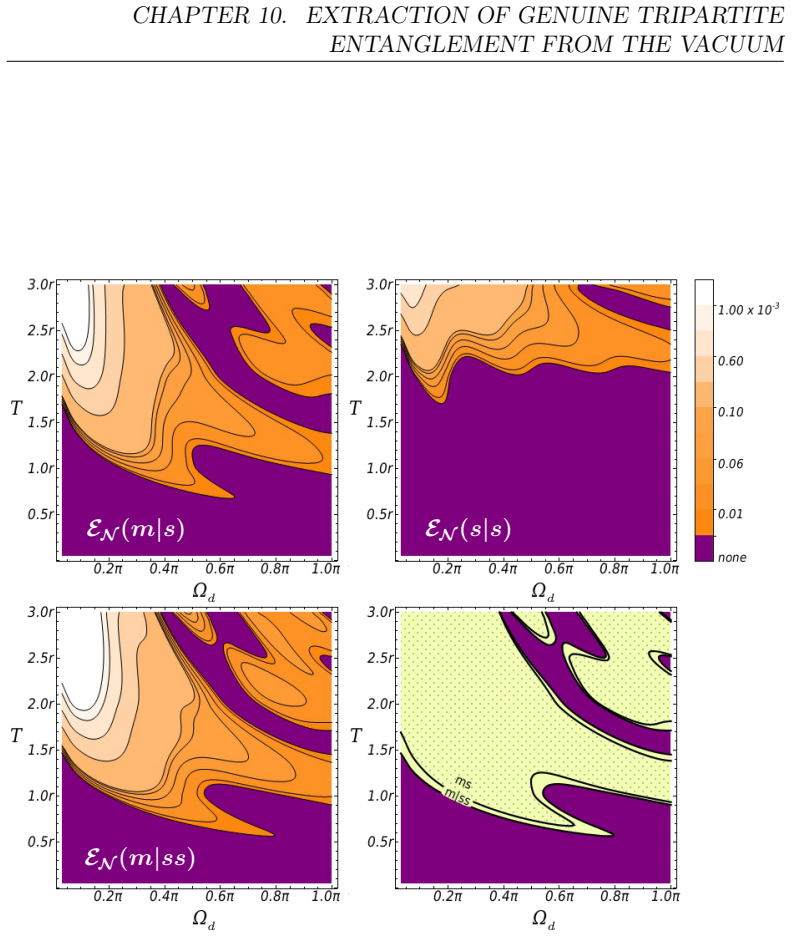
On the paper's own terms, the proper-time rule of special relativity is not the whole story for real clocks. A decay-based clock in uniform acceleration sees a thermal Unruh bath; the bath changes the decay probability and hence the ticking rate, so the discrepancy between stationary and accelerated clocks deviates from the special-relativistic prediction. For fields, the thesis constructs a Gaussian quantum channel that maps any two-mode Gaussian state of inertial localized modes to the state seen by two accelerated observers, and applies it to the vacuum. The observed logarithmic negativity grows with the observers' proper accelerations and falls with mode size and central frequency; for counter-accelerating observers separated by a distance it exhibits oscillations and sudden death, while for co-accelerating observers in the weak-noise regime entanglement is absent. Finally, three harmonic-oscillator detectors coupled briefly to a cavity field become entangled without causal contact; the tripartite entanglement appears earlier and in a wider parameter region than bipartite entanglement, and a periodic cavity outperforms a Dirichlet cavity. If these results hold, the ideal clock is a fiction rather than a physical limit, and the spatial structure of vacuum entanglement is richer and more extractable than previously mapped.
Load-bearing premise
The broad clock conclusion assumes that a single toy model — one uniformly accelerated trajectory, one coupling, first-order perturbation theory in 1+1 dimensions — tells us what any realistic clock would do; if that model is not representative, the ideal-clock-impossibility claim does not follow.
Editorial extensions
If this is right
- If the clock result is right, no physical device can serve as an ideal clock at high accelerations, and operational time along arbitrary accelerated trajectories is not identical to proper time.
- Gaussian states of two localized field modes, including squeezed and thermal states, become less faithful under acceleration because the mode mismatch $M$ and noise $N$ degrade them; fidelity falls with acceleration.
- Accelerated observers can extract more vacuum entanglement by using smaller, lower-frequency modes, and separated counter-accelerating observers lose entanglement abruptly at finite separations.
- Genuine tripartite entanglement can be harvested without causal contact, and it is easier to harvest than bipartite entanglement in the same setting.
- Periodic boundary conditions are more efficient for harvesting both bipartite and tripartite vacuum entanglement than Dirichlet boundary conditions.
Reading between the lines
- A concrete next step the thesis does not perform: computing the skew-angle interpolation between antiparallel and parallel observers in 3+1 dimensions would locate the transition where vacuum entanglement switches on.
- If the clock deviation were generic, precision clocks at very high accelerations would need trajectory-dependent corrections, making proper time a derived quantity rather than a directly measurable one.
- The periodic-boundary advantage suggests that the topology of the cavity, not merely its size, controls how much vacuum entanglement can be harvested; ring or effectively-periodic experiments would be the direct test.
- The fermionic negativity is computed only as a lower bound, so the roughly one-order-of-magnitude gap to bosons may be partly an artifact of the bound.
Signed reviews
Editorial analysis
A structured set of objections, weighed in public.
Referee Report
Summary. This doctoral thesis studies the influence of uniform acceleration on quantum states and quantum vacuum entanglement. Part II analyzes a quantum clock based on the decay of an unstable particle, comparing a stationary and a uniformly accelerating clock, and claims a deviation from the special-relativistic prediction for the difference of their ticking rates, attributed to the Unruh effect. Part III constructs a Gaussian quantum channel that maps two localized inertial modes of a quantum field to two uniformly accelerated localized modes, developed for real scalar fields in 1+1 and 3+1 dimensions and for a Dirac spinor field in 1+1 dimensions, and applies it to the Minkowski vacuum to investigate bipartite vacuum entanglement as a function of observer accelerations, mode size, central frequency, and separation. Part IV studies the extraction of bipartite and tripartite entanglement by three harmonic-oscillator detectors in a cavity, comparing periodic and Dirichlet boundary conditions. The main reported findings are: more perceived vacuum entanglement for stronger accelerations and for smaller mode sizes and central frequencies; sudden death of entanglement for antiparallel accelerated observers at finite separation; absence of vacuum entanglement for observers accelerating in the same direction; and easier extraction of tripartite than bipartite entanglement, with periodic boundary conditions more efficient than Dirichlet.
Significance. If the results hold, the thesis provides a systematic framework for analyzing how uniformly accelerated observers perceive Gaussian states, including a detailed derivation of the channel matrices, a proof of the a-independence of the channel, and new predictions about the structure of vacuum entanglement. The thesis also challenges the universality of the clock postulate at high accelerations. Strengths include thorough analytic derivations, explicit specification of the observer modes, numerical evaluation of the derived integrals without parameter fitting, and non-perturbative Gaussian calculations for entanglement harvesting. The results are largely based on published peer-reviewed papers, which adds credibility. However, the broad claim that ideal clocks are fundamentally impossible and the results for nonzero wedge displacement depend on unproven assumptions, as detailed in the major comments.
major comments (3)
- [Sec. 6.5, Eq. (6.17), Abstract] The universal conclusion that 'no clock would correctly measure the proper time along arbitrary high-acceleration trajectories' (Sec. 6.5) and the abstract's implication that the clock postulate fails generically are not supported by the presented calculation. The derivation is restricted to a 1+1-dimensional massless cavity mode linearly coupled to a massive external scalar field, computed in first-order perturbation theory along a uniformly accelerated trajectory, and the thesis itself concedes that 'We have not proven that the effect occurs for every accelerated trajectory and for every interaction Hamiltonian.' The concrete deviation in Eq. (6.17) is a legitimate model prediction, but the extrapolation to a general impossibility of ideal clocks is not. Please reframe the abstract and Sec. 6.5 as demonstrating a model-dependent breakdown of the clock postulate, and present the universal claim as a conjecture or as a conclusion supported by supplementary evidence (e.g., the muon calculation [40]), not as an established result.
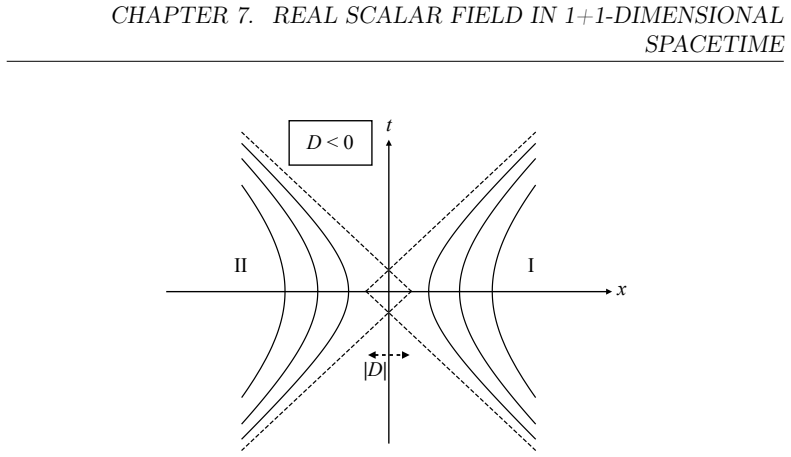
- [Sec. 7.2, Eq. (7.2); Sec. 7.4.2, Eq. (7.54)] The D≠0 channel is derived using the modified Rindler decomposition (7.2), which for D>0 contains an unspecified operator Φ_III(D) and for D<0 is explicitly overcomplete. The thesis asserts that the form of Φ_III(D) is irrelevant, but it never proves that the extra or overlapping degrees of freedom decouple from the observer modes, nor that the canonical commutation relations assumed for the shifted Rindler modes remain valid when the basis is overcomplete. Since the D≠0 results (sudden death and oscillations, Figs. 7.7–7.8) are central new findings, this is a load-bearing technical gap. Please provide a completeness/decoupling argument, for example by showing that the localized wavepackets ψΛ have vanishing overlap with the Φ_III modes and that the overcompleteness for D<0 does not affect the traced-out channel, or restrict the D≠0 claims to a case in which the basis is complete and well-defined.
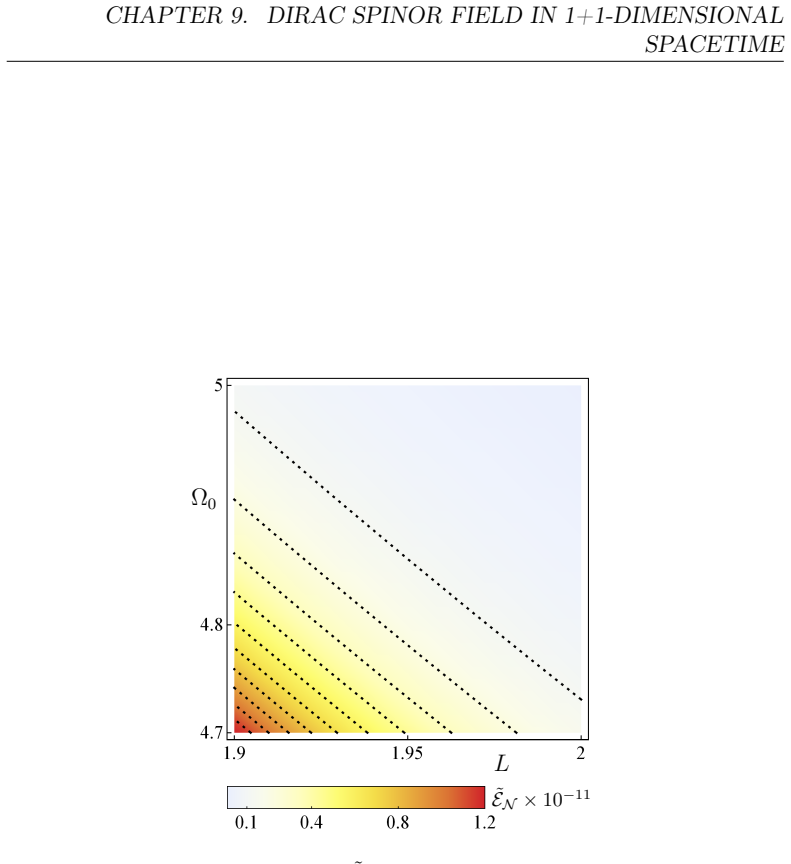
- [Sec. 9.4, Eq. (9.23), Figs. 9.2–9.3] The fermionic logarithmic negativity is only a lower bound Ẽ_N, as the text correctly notes, but it is subsequently relabelled as the logarithmic negativity and used for quantitative statements, including the claim that fermionic vacuum entanglement is 'lower than for bosons by approximately one order of magnitude.' The lower bound is not proven to be close to the true value, so these quantitative comparisons are unsupported. Please present the fermionic results explicitly as bounds on the negativity, remove or clearly qualify the quantitative comparison with bosons, and state which qualitative trends are robust under the lower-bound approximation.
minor comments (5)
- [Sec. 6.4, Eq. (6.18)] The recovery of the ideal-clock limit (6.18) relies on an averaging over the acceleration; please state explicitly that this averaging is an additional smoothing assumption beyond the model, since the unaveraged result in the small-acceleration limit contains superimposed rapid oscillations.
- [Sec. 4.2 (title)] Typo: 'Rindler cooridnates' should be 'Rindler coordinates.'
- [Sec. 7.6] The 'extra cut-off at zero frequency' used to enforce the no-negative-frequency condition (7.16) is not specified; please provide its precise definition or a reference, so that the procedure is reproducible.
- [Sec. 8.5] The 3+1 numerical results are presented only for D=0, although the framework for D≠0 is derived; please state explicitly in the abstract and conclusions that the sudden-death and oscillation phenomena are established only in the 1+1-dimensional scalar-field case.
- [Sec. 10.5.1] The statement that tripartite entanglement is 'easier to extract' than bipartite entanglement should be qualified: the comparison is between EN(s|s) and EN(s|ss), and EN(s|ss) ≥ EN(s|s) follows from partial tracing, so the nontrivial content is the existence of regions where the tripartite sector is entangled without pairwise entanglement; consider highlighting this distinction explicitly.
Circularity Check
No significant circularity: the derivations are reproduced in the thesis and the quantitative results are direct evaluations of derived integrals, not fits or self-referential definitions.
full rationale
The thesis is self-contained with respect to its central derivations. Part II computes the decay probabilities for stationary and uniformly accelerated clocks from a stated Hamiltonian and first-order perturbation theory (Eqs. (6.8), (6.9), (6.16), (6.17)); the comparison is a direct evaluation, and the low-acceleration limit explicitly recovers the stationary formula, so no fitted parameter is renamed as a prediction. Part III derives the Gaussian channel from Bogolyubov coefficients and mode overlaps (Secs. 7.3-7.5); the a-independence is a change of integration variables, not a fit, and the mode choices in Sec. 7.6 are openly stated modelling assumptions rather than parameters tuned to produce the entanglement maps. The tripartite estimator in Sec. 10.4 is admittedly not a proper entanglement measure, and the inequality E_N(s|s) <= E_N(s|ss) is a partial-trace monotonicity; however, the paper's claims about broader regions and earlier emergence rest on the numerical maps that exhibit strict inclusion, so the claim is not merely the inequality itself. The thesis cites the author's own publications ([1]-[5]), but the relevant chapters reproduce the derivations instead of importing them as black boxes, so the self-citations are not load-bearing. The only notable weakness is explicit: Sec. 6.5 admits the ideal-clock conclusion is not proven for every trajectory or interaction Hamiltonian; that is an extrapolation or scope concern, not a circular reduction. Similarly, the unproven completeness of the D != 0 modified-Rindler mode set is a technical assumption, not a circularity. Overall, no step in the claimed derivation chain reduces by construction to its own inputs.
Assumptions & free parameters
free parameters (5)
- Mode width L =
L = 2 (also 0.1; L perpendicular = 2 in 3+1)
- Central frequency Omega_0 =
Omega_0 approximately 5 (also 5.5)
- Field mass m =
m = 0.1
- Detector coupling lambda =
lambda = 0.01
- UV cutoff n_c =
n_c = 50
assumptions (7)
- ad hoc to paper The observer wavepackets have no overlap with negative-frequency modes of their rest frames, enforced by an extra zero-frequency cutoff (Sec. 7.6).
- ad hoc to paper For D not equal to zero, the modified Rindler expansion (7.2) with the unspecified Phi_III(D) term can be used; the extra or overlapping degrees of freedom do not affect the channel.
- domain assumption Accelerated observer modes are exactly localized within their Rindler wedge and orthogonal to the other wedge modes (Sec. 7.2).
- domain assumption A particle-decay clock can be modeled by a single boson in a rigid cavity coupled to a massive external scalar field through the interaction lambda integral Phi_cav Phi_ext, treated in first-order perturbation theory (Sec. 6.2).
- ad hoc to paper The fermionic logarithmic negativity is adequately approximated by the lower bound in Eq. (9.23).
- domain assumption Truncating the cavity field to n_c = 50 modes is sufficient for the detector entanglement maps (Sec. 10.5).
- domain assumption The geometric mean of bipartite negativities in Eq. (10.18) indicates the presence of genuine tripartite entanglement.
Cite this review
Pith. "Pith review of Effects of uniform acceleration on quantum states and vacuum entanglement in relativistic quantum information." pith.science (2026). https://pith.science/paper/V2HXSRQ7
@misc{pith2026190806002,
  author       = {Pith},
  title        = {Pith review of: Effects of uniform acceleration on quantum states and vacuum entanglement in relativistic quantum information},
  year         = {2026},
  howpublished = {\url{https://pith.science/paper/V2HXSRQ7}},
  note         = {Machine review of arXiv:1908.06002}
}
read the original abstract
In this thesis we focus on the influence of uniform acceleration on quantum states and their properties, as well as on quantum entanglement contained in the vacuum. First, we analyze a quantum clock measuring time in terms of the decay of an unstable particle. We compare the rate of ticking of a stationary clock to the one of a uniformly accelerating clock. We discover that there exists a deviation from what the discrepancy between those rates is predicted to be by special relativity. In a further part of this thesis we focus on the family of two-mode Gaussian states of two localized modes of a given quantum field. A general framework is developed for investigating the properties of such states, when observed by two uniformly accelerated observers, having access to another pair of localized modes. In particular, we focus on the vacuum state and examine the amount of quantum entanglement perceived by the observers. The framework is developed for three cases: the quantum scalar field in 1+1 and 3+1 dimensions and the Dirac spinor field in 1+1 dimensions. We find that in general more entanglement is seen when the accelerations of the observers increase and when the size of the modes of the observers and their central frequencies decrease. Furthermore, we extend our attention also to tripartite entanglement and investigate its extraction from the quantum vacuum by three particle detectors in a cavity, interacting with a quantum field for a finite time. Detailed maps of amounts of tripartite and bipartite entanglement extracted by the detectors, are produced and compared between two types of boundary conditions. It is found vacuum entanglement is most easily extracted in the case of periodic boundary conditions and it is easier to extract tripartite than bipartite entanglement.
Figures


Figures from the paper (18 more)








Reference graph
Works this paper leans on
-
[40]
Can a charged decaying particle serve as an ideal clock in the presence of the magnetic field?
author author R. Pierini , author K. Turzynski , \ and\ author A. Dragan ,\ https://arxiv.org/abs/1708.00327 journal journal arXiv:1708.00327 [quant-ph] \ ( year 2017 ) NoStop
work page Pith review arXiv 2017
-
[1]
author author K. Lorek , author D. Pecak , author E. G. \ Brown , \ and\ author A. Dragan ,\ 10.1103/PhysRevA.90.032316 journal journal Phys. Rev. A \ volume 90 ,\ pages 032316 ( year 2014 ) NoStop
-
[2]
Lorek , author J
author author K. Lorek , author J. Louko , \ and\ author A. Dragan ,\ http://stacks.iop.org/0264-9381/32/i=17/a=175003 journal journal Class. Quantum Grav. \ volume 32 ,\ pages 175003 ( year 2015 ) NoStop
2015
-
[3]
author author M. Ahmadi , author K. Lorek , author A. Ch e e ci n \' n ska , author A. R. H. \ Smith , author R. B. \ Mann , \ and\ author A. Dragan ,\ 10.1103/PhysRevD.93.124031 journal journal Phys. Rev. D \ volume 93 ,\ pages 124031 ( year 2016 ) NoStop
-
[4]
author author B. Richter , author K. Lorek , author A. Dragan , \ and\ author Y. Omar ,\ 10.1103/PhysRevD.95.076004 journal journal Phys. Rev. D \ volume 95 ,\ pages 076004 ( year 2017 ) NoStop
-
[5]
Lorek , author P
author author K. Lorek , author P. Grochowski , author M. Ahmadi , \ and\ author A. Dragan ,\ @noop \ ( year in preparation ) NoStop
-
[6]
Planck ,\ 10.1002/andp.19013090310 journal journal Annalen Phys
author author M. Planck ,\ 10.1002/andp.19013090310 journal journal Annalen Phys. \ volume 309 ,\ pages 553 ( year 1901 ) NoStop
-
[7]
Einstein ,\ 10.1002/andp.19053220607 journal journal Annalen Phys
author author A. Einstein ,\ 10.1002/andp.19053220607 journal journal Annalen Phys. \ volume 322 ,\ pages 132 ( year 1905 a ) NoStop
Show all 94 references
-
[8]
Dirac ,\ @noop title The Principles of Quantum Mechanics ,\ International series of monographs on physics\ ( publisher Clarendon Press ,\ year 1981 ) NoStop
author author P. Dirac ,\ @noop title The Principles of Quantum Mechanics ,\ International series of monographs on physics\ ( publisher Clarendon Press ,\ year 1981 ) NoStop
1981
-
[9]
Shankar ,\ @noop title Principles of quantum mechanics \ ( publisher Plenum ,\ address New York, NY ,\ year 1980 ) NoStop
author author R. Shankar ,\ @noop title Principles of quantum mechanics \ ( publisher Plenum ,\ address New York, NY ,\ year 1980 ) NoStop
1980
-
[10]
Einstein ,\ 10.1002/andp.19053221004 journal journal Annalen Phys
author author A. Einstein ,\ 10.1002/andp.19053221004 journal journal Annalen Phys. \ volume 322 ,\ pages 891 ( year 1905 b ) NoStop
1905 doi
-
[11]
Einstein ,\ 10.1002/andp.19163540702 journal journal Annalen Phys
author author A. Einstein ,\ 10.1002/andp.19163540702 journal journal Annalen Phys. \ volume 354 ,\ pages 769 ( year 1916 ) NoStop
1916 doi
-
[12]
Klein ,\ 10.1007/BF01397481 journal journal Z
author author O. Klein ,\ 10.1007/BF01397481 journal journal Z. Phys. \ volume 37 ,\ pages 895 ( year 1926 ) NoStop
1926 doi
-
[13]
Gordon ,\ 10.1007/BF01390840 journal journal Z
author author W. Gordon ,\ 10.1007/BF01390840 journal journal Z. Phys. \ volume 40 ,\ pages 117 ( year 1926 ) NoStop
1926 doi
-
[14]
author author P. A. M. \ Dirac ,\ 10.1098/rspa.1928.0023 journal journal Proc. Royal Soc. A \ volume 117 ,\ pages 610 ( year 1928 ) NoStop
1928
-
[15]
author author P. A. M. \ Dirac ,\ 10.1098/rspa.1930.0013 journal journal Proc. Royal Soc. A \ volume 126 ,\ pages 360 ( year 1930 ) NoStop
1930
-
[16]
author author M. E. \ Peskin \ and\ author D. V. \ Schroeder ,\ @noop title An Introduction to Quantum Field Theory \ ( publisher Addison-Wesley ,\ address Reading, USA ,\ year 1995 ) NoStop
1995
-
[17]
author author S. L. \ Glashow ,\ http://dx.doi.org/10.1016/0029-5582(61)90469-2 journal journal Nucl. Phys. \ volume 22 ,\ pages 579 ( year 1961 ) NoStop
1961 doi
-
[18]
Weinberg ,\ 10.1103/PhysRevLett.19.1264 journal journal Phys
author author S. Weinberg ,\ 10.1103/PhysRevLett.19.1264 journal journal Phys. Rev. Lett. \ volume 19 ,\ pages 1264 ( year 1967 ) NoStop
1967 doi
-
[19]
Salam ,\ booktitle booktitle 8th Nobel Symposium Lerum, Sweden, May 19-25, 1968 ,\ @noop journal journal Conf
author author A. Salam ,\ booktitle booktitle 8th Nobel Symposium Lerum, Sweden, May 19-25, 1968 ,\ @noop journal journal Conf. Proc. \ volume C680519 ,\ pages 367 ( year 1968 ) NoStop
1968
-
[20]
Englert \ and\ author R
author author F. Englert \ and\ author R. Brout ,\ 10.1103/PhysRevLett.13.321 journal journal Phys. Rev. Lett. \ volume 13 ,\ pages 321 ( year 1964 ) NoStop
1964 doi
-
[21]
author author P. W. \ Higgs ,\ 10.1103/PhysRevLett.13.508 journal journal Phys. Rev. Lett. \ volume 13 ,\ pages 508 ( year 1964 ) NoStop
1964 doi
-
[22]
author author G. S. \ Guralnik , author C. R. \ Hagen , \ and\ author T. W. B. \ Kibble ,\ 10.1103/PhysRevLett.13.585 journal journal Phys. Rev. Lett. \ volume 13 ,\ pages 585 ( year 1964 ) NoStop
1964 doi
-
[23]
author author N. D. \ Birrell \ and\ author P. C. W. \ Davies ,\ in\ @noop booktitle Quantum Fields in Curved Space ,\ series and number Cambridge Monographs on Mathematical Physics \ ( publisher Cambridge University Press ,\ year 1982 ) NoStop
1982
-
[24]
author author S. W. \ Hawking ,\ 10.1007/BF02345020 journal journal Commun. Math. Phys. \ volume 43 ,\ pages 199 ( year 1975 ) NoStop
1975 doi
-
[25]
author author W. G. \ Unruh ,\ 10.1103/PhysRevD.14.870 journal journal Phys. Rev. D \ volume 14 ,\ pages 870 ( year 1976 ) NoStop
1976 doi
-
[26]
author author S. A. \ Fulling \ and\ author P. C. W. \ Davies ,\ 10.1098/rspa.1976.0045 journal journal Proc. Royal Soc. A \ volume 348 ,\ pages 393 ( year 1976 ) NoStop
1976
-
[27]
Alber , author T
author author G. Alber , author T. Beth , author M. Horodecki , author P. Horodecki , author R. Horodecki , author M. R \"o tteler , author H. Weinfurter , author R. Werner , \ and\ author A. Zeilinger ,\ @noop title Quantum Information: An Introduction to Basic Theoretical Co...
2003
-
[28]
author author M. A. \ Nielsen \ and\ author I. L. \ Chuang ,\ @noop title Quantum Computation and Quantum Information: 10th Anniversary Edition \ ( publisher Cambridge University Press ,\ address New York, NY, USA ,\ year 2011 ) NoStop
2011
-
[29]
Martín-Martínez \ and\ author N
author author E. Martín-Martínez \ and\ author N. C. \ Menicucci ,\ http://stacks.iop.org/0264-9381/29/i=22/a=224003 journal journal Class. Quantum Grav. \ volume 29 ,\ pages 224003 ( year 2012 ) NoStop
2012
-
[30]
Reznik ,\ @noop journal journal Found
author author B. Reznik ,\ @noop journal journal Found. Phys. \ volume 33 ,\ pages 167 ( year 2003 ) NoStop
2003
-
[31]
Reznik , author A
author author B. Reznik , author A. Retzker , \ and\ author J. Silman ,\ 10.1103/PhysRevA.71.042104 journal journal Phys. Rev. A \ volume 71 ,\ pages 042104 ( year 2005 ) NoStop
2005 doi
-
[32]
Ch e e ci n \' n ska , author K
author author A. Ch e e ci n \' n ska , author K. Lorek , \ and\ author A. Dragan ,\ 10.1103/PhysRevA.95.013817 journal journal Phys. Rev. A \ volume 95 ,\ pages 013817 ( year 2017 ) NoStop
2017 doi
-
[33]
Ahmadi , author D
author author M. Ahmadi , author D. E. \ Bruschi , author C. Sabín , author G. Adesso , \ and\ author I. Fuentes ,\ 10.1038/srep04996 journal journal Sci. Rep. \ volume 4 ,\ pages 4996 ( year 2014 ) NoStop
2014 doi
-
[34]
author author D. E. \ Bruschi , author A. Dragan , author A. R. \ Lee , author I. Fuentes , \ and\ author J. Louko ,\ 10.1103/PhysRevLett.111.090504 journal journal Phys. Rev. Lett. \ volume 111 ,\ pages 090504 ( year 2013 ) NoStop
2013 doi
-
[35]
author author V. V. \ Nesvizhevsky , author H. G. \ Borner , author A. K. \ Petukhov , author H. Abele , author S. Baeszler , author F. J. \ Ruesz , author T. Stoferle , author A. Westphal , author A. M. \ Gagarski , author G. A. \ Petrov , \ and\ author A. V. \ Strelkov ,\ 10...
-
[36]
author author C. M. \ Wilson , author G. Johansson , author A. Pourkabirian , author M. Simoen , author J. R. \ Johansson , author T. Duty , author F. Nori , \ and\ author P. Delsing ,\ 10.1038/nature10561 journal journal Nature \ volume 479 ,\ pages 376 ( year 2011 ) NoStop
-
[37]
Steinhauer ,\ http://dx.doi.org/10.1038/nphys3104 journal journal Nature \ volume 10 ,\ pages 864 ( year 2014 ) NoStop
author author J. Steinhauer ,\ http://dx.doi.org/10.1038/nphys3104 journal journal Nature \ volume 10 ,\ pages 864 ( year 2014 ) NoStop
2014 doi
-
[38]
Steinhauer ,\ http://dx.doi.org/10.1038/nphys3863 journal journal Nature \ volume 12 ,\ pages 959 ( year 2016 ) NoStop
author author J. Steinhauer ,\ http://dx.doi.org/10.1038/nphys3863 journal journal Nature \ volume 12 ,\ pages 959 ( year 2016 ) NoStop
2016 doi
-
[39]
Lindkvist , author C
author author J. Lindkvist , author C. Sab\' n , author I. Fuentes , author A. Dragan , author I.-M. \ Svensson , author P. Delsing , \ and\ author G. Johansson ,\ 10.1103/PhysRevA.90.052113 journal journal Phys. Rev. A \ volume 90 ,\ pages 052113 ( year 2014 ) NoStop
-
[41]
Dragan , author J
author author A. Dragan , author J. Doukas , \ and\ author E. Mart\' n-Mart\' nez ,\ 10.1103/PhysRevA.87.052326 journal journal Phys. Rev. A \ volume 87 ,\ pages 052326 ( year 2013 ) NoStop
2013 doi
-
[42]
author author R. F. \ Werner ,\ 10.1103/PhysRevA.40.4277 journal journal Phys. Rev. A \ volume 40 ,\ pages 4277 ( year 1989 ) NoStop
1989 doi
-
[43]
Peres ,\ 10.1103/PhysRevLett.77.1413 journal journal Phys
author author A. Peres ,\ 10.1103/PhysRevLett.77.1413 journal journal Phys. Rev. Lett. \ volume 77 ,\ pages 1413 ( year 1996 ) NoStop
1996 doi
-
[44]
Horodecki , author P
author author M. Horodecki , author P. Horodecki , \ and\ author R. Horodecki ,\ http://dx.doi.org/10.1016/S0375-9601(96)00706-2 journal journal Phys. Lett. A \ volume 223 ,\ pages 1 ( year 1996 ) NoStop
1996 doi
-
[45]
Horodecki , author P
author author R. Horodecki , author P. Horodecki , author M. Horodecki , \ and\ author K. Horodecki ,\ 10.1103/RevModPhys.81.865 journal journal Rev. Mod. Phys. \ volume 81 ,\ pages 865 ( year 2009 ) NoStop
2009 doi
-
[46]
Horodecki , author P
author author M. Horodecki , author P. Horodecki , \ and\ author R. Horodecki ,\ 10.1103/PhysRevLett.80.5239 journal journal Phys. Rev. Lett. \ volume 80 ,\ pages 5239 ( year 1998 ) NoStop
1998 doi
-
[47]
author author D. M. \ Greenberger , author M. A. \ Horne , \ and\ author A. Zeilinger ,\ @noop title ``Going Beyond Bell's Theorem'' in ``Bell's Theorem, Quantum Theory, and Conceptions of the Universe'' ,\ edited by\ editor M. Kafatos NoStop
-
[48]
D\"ur , author G
author author W. D\"ur , author G. Vidal , \ and\ author J. I. \ Cirac ,\ 10.1103/PhysRevA.62.062314 journal journal Phys. Rev. A \ volume 62 ,\ pages 062314 ( year 2000 ) NoStop
-
[49]
Vidal \ and\ author R
author author G. Vidal \ and\ author R. F. \ Werner ,\ 10.1103/PhysRevA.65.032314 journal journal Phys. Rev. A \ volume 65 ,\ pages 032314 ( year 2002 ) NoStop
2002 doi
-
[50]
author author M. B. \ Plenio ,\ 10.1103/PhysRevLett.95.090503 journal journal Phys. Rev. Lett. \ volume 95 ,\ pages 090503 ( year 2005 ) NoStop
2005 doi
-
[51]
author author B. L. \ Schumaker ,\ 10.1016/0370-1573(86)90179-1 journal journal Phys. Rep. \ volume 135 ,\ pages 317 ( year 1986 ) NoStop
1986 doi
-
[52]
author author N. C. \ Menicucci , author S. T. \ Flammia , \ and\ author P. van Loock ,\ 10.1103/PhysRevA.83.042335 journal journal Phys. Rev. A \ volume 83 ,\ pages 042335 ( year 2011 ) NoStop
2011 doi
-
[53]
author author E. G. \ Brown , author E. Mart\' n-Mart\' nez , author N. C. \ Menicucci , \ and\ author R. B. \ Mann ,\ 10.1103/PhysRevD.87.084062 journal journal Phys. Rev. D \ volume 87 ,\ pages 084062 ( year 2013 ) NoStop
2013 doi
-
[54]
author author A. S. \ Holevo \ and\ author R. F. \ Werner ,\ 10.1103/PhysRevA.63.032312 journal journal Phys. Rev. A \ volume 63 ,\ pages 032312 ( year 2001 ) NoStop
2001 doi
-
[55]
Adesso , author A
author author G. Adesso , author A. Serafini , \ and\ author F. Illuminati ,\ 10.1103/PhysRevA.70.022318 journal journal Phys. Rev. A \ volume 70 ,\ pages 022318 ( year 2004 a ) NoStop
2004 doi
-
[56]
author author J. B. \ Hartle ,\ @noop title Gravity: An Introduction to Einstein’s General Relativity \ ( publisher Addison Wesley ,\ year 2003 ) NoStop
2003
-
[57]
Rindler ,\ 10.1119/1.1972547 journal journal Am
author author W. Rindler ,\ 10.1119/1.1972547 journal journal Am. J. Phys. \ volume 34 ,\ pages 1174 ( year 1966 ) NoStop
1966 doi
-
[58]
Rindler ,\ @noop title Relativity: Special, General, and Cosmological ,\ Relativity: Special, General, and Cosmological\ ( publisher Oxford University Press ,\ year 2001 ) NoStop
author author W. Rindler ,\ @noop title Relativity: Special, General, and Cosmological ,\ Relativity: Special, General, and Cosmological\ ( publisher Oxford University Press ,\ year 2001 ) NoStop
2001
-
[59]
Takagi ,\ 10.1143/PTP.88.1 journal journal Prog
author author S. Takagi ,\ 10.1143/PTP.88.1 journal journal Prog. Theor. Phys. Suppl. \ volume 88 ,\ pages 1 ( year 1986 ) NoStop
1986 doi
-
[60]
author author L. C. B. \ Crispino , author A. Higuchi , \ and\ author G. E. A. \ Matsas ,\ 10.1103/RevModPhys.80.787 journal journal Rev. Mod. Phys. \ volume 80 ,\ pages 787 ( year 2008 ) NoStop
2008 doi
-
[61]
DLMF ,\ http://dlmf.nist.gov/ title NIST Digital Library of Mathematical Functions , \ howpublished http://dlmf.nist.gov/, Release 1.0.9 of 2014-08-29 NoStop
2014
-
[62]
Passian , author H
author author A. Passian , author H. Simpson , author S. Kouchekian , \ and\ author S. Yakubovich ,\ http://dx.doi.org/10.1016/j.jmaa.2009.06.067 journal journal J. Math. Anal. Appl. \ volume 360 ,\ pages 380 ( year 2009 ) NoStop
2009 doi
-
[63]
Dragan , author I
author author A. Dragan , author I. Fuentes , \ and\ author J. Louko ,\ 10.1103/PhysRevD.83.085020 journal journal Phys. Rev. D \ volume 83 ,\ pages 085020 ( year 2011 ) NoStop
2011 doi
-
[64]
author author T. M. \ Dunster ,\ 10.1137/0521055 journal journal SIAM J. Math. Anal. \ volume 21 ,\ pages 995 ( year 1990 ) NoStop
1990 doi
-
[65]
author author R. C. \ Tolman ,\ 10.1103/PhysRev.35.904 journal journal Phys. Rev. \ volume 35 ,\ pages 904 ( year 1930 ) NoStop
1930 doi
-
[66]
Tolman \ and\ author P
author author R. Tolman \ and\ author P. Ehrenfest ,\ 10.1103/PhysRev.36.1791 journal journal Phys. Rev. \ volume 36 ,\ pages 1791 ( year 1930 ) NoStop
1930 doi
-
[67]
Retzker , author J
author author A. Retzker , author J. I. \ Cirac , author M. B. \ Plenio , \ and\ author B. Reznik ,\ 10.1103/PhysRevLett.101.110402 journal journal Phys. Rev. Lett. \ volume 101 ,\ pages 110402 ( year 2008 ) NoStop
2008 doi
-
[68]
Radd \ and\ author D
author author N. Radd \ and\ author D. Singleton ,\ https://doi.org/10.1140/epjd/e2012-30387-6 journal journal Eur. Phys. J. D \ volume 66 ,\ pages 258 ( year 2012 ) NoStop
2012 doi
-
[69]
Cozzella , author A
author author G. Cozzella , author A. G. S. \ Landulfo , author G. E. A. \ Matsas , \ and\ author D. A. T. \ Vanzella ,\ 10.1103/PhysRevLett.118.161102 journal journal Phys. Rev. Lett. \ volume 118 ,\ pages 161102 ( year 2017 ) NoStop
-
[70]
Gerry \ and\ author P
author author C. Gerry \ and\ author P. Knight ,\ @noop title Introductory Quantum Optics \ ( publisher Cambridge University Press ,\ year 2005 )\ pp.\ pages 176--178 NoStop
2005
-
[71]
M\"uller ,\ 10.1103/PhysRevD.56.953 journal journal Phys
author author R. M\"uller ,\ 10.1103/PhysRevD.56.953 journal journal Phys. Rev. D \ volume 56 ,\ pages 953 ( year 1997 ) NoStop
1997 doi
-
[72]
Bailey , author K
author author J. Bailey , author K. Borer , author F. Combley , author H. Drumm , author F. Krienen , author F. Lange , author E. Picasso , author W. von Ruden , author F. J. M. \ Farley , author J. H. \ Field , author W. Flegel , \ and\ author P. M. \ Hattersley ,\ 10.1038/26...
-
[73]
Bailey , author K
author author J. Bailey , author K. Borer , author F. Combley , author H. Drumm , author C. Eck , author F. Farley , author J. Field , author W. Flegel , author P. Hattersley , author F. Krienen , author F. Lange , author G. Lebée , author E. McMillan , author G. Petrucci , au...
-
[74]
author author S. R. \ Mainwaring \ and\ author G. E. \ Stedman ,\ 10.1103/PhysRevA.47.3611 journal journal Phys. Rev. A \ volume 47 ,\ pages 3611 ( year 1993 ) NoStop
1993 doi
-
[75]
ansch , author G. Huber , author S. Karpuk , author A. Krieger , author T. K\
author author B. Botermann , author D. Bing , author C. Geppert , author G. Gwinner , author T. W. \ H\"ansch , author G. Huber , author S. Karpuk , author A. Krieger , author T. K\"uhl , author W. N\"ortersh\"auser , author C. Novotny , author S. Reinhardt , author R. S\'anch...
-
[76]
author author B. L. \ Hu , author S.-Y. \ Lin , \ and\ author J. Louko ,\ http://stacks.iop.org/0264-9381/29/i=22/a=224005 journal journal Class. Quantum Grav. \ volume 29 ,\ pages 224005 ( year 2012 ) NoStop
2012
-
[77]
author author B. S. \ DeWitt ,\ http://adsabs.harvard.edu/abs/2010grae.book.....H title General Relativity: an Einstein Centenary Survey ,\ edited by\ editor S. Hawking \ and\ editor W. Israel \ ( publisher Cambridge University Press ,\ year 1979 ) NoStop
1979
-
[78]
Dragan , author J
author author A. Dragan , author J. Doukas , author E. Martín-Martínez , \ and\ author D. E. \ Bruschi ,\ http://stacks.iop.org/0264-9381/30/i=23/a=235006 journal journal Class. Quantum Grav. \ volume 30 ,\ pages 235006 ( year 2013 ) NoStop
2013
-
[79]
D e bski \ and\ author A
author author K. D e bski \ and\ author A. Dragan ,\ @noop \ ( year in preparation ) NoStop
-
[80]
Salton , author R
author author G. Salton , author R. B. \ Mann , \ and\ author N. C. \ Menicucci ,\ http://stacks.iop.org/1367-2630/17/i=3/a=035001 journal journal New J. Phys. \ volume 17 ,\ pages 035001 ( year 2015 ) NoStop
2015
-
[81]
Doukas , author E
author author J. Doukas , author E. G. \ Brown , author A. Dragan , \ and\ author R. B. \ Mann ,\ 10.1103/PhysRevA.87.012306 journal journal Phys. Rev. A \ volume 87 ,\ pages 012306 ( year 2013 ) NoStop
2013 doi
-
[82]
author author P. M. \ Alsing , author I. Fuentes-Schuller , author R. B. \ Mann , \ and\ author T. E. \ Tessier ,\ 10.1103/PhysRevA.74.032326 journal journal Phys. Rev. A \ volume 74 ,\ pages 032326 ( year 2006 ) NoStop
2006 doi
-
[83]
Friis , author A
author author N. Friis , author A. R. \ Lee , \ and\ author J. Louko ,\ 10.1103/PhysRevD.88.064028 journal journal Phys. Rev. D \ volume 88 ,\ pages 064028 ( year 2013 ) NoStop
2013 doi
-
[84]
Eisler \ and\ author Z
author author V. Eisler \ and\ author Z. Zimborás ,\ http://stacks.iop.org/1367-2630/17/i=5/a=053048 journal journal New J. Phys. \ volume 17 ,\ pages 053048 ( year 2015 ) NoStop
2015
-
[85]
Eisert , author V
author author J. Eisert , author V. Eisler , \ and\ author Z. Zimborás ,\ https://arxiv.org/abs/1611.08007 journal journal arXiv:1611.08007 [quant-ph] \ ( year 2016 ) NoStop
2016 arXiv
-
[86]
Rajchel \ and\ author A
author author G. Rajchel \ and\ author A. Dragan ,\ @noop \ ( year in preparation ) NoStop
-
[87]
author author P. T. \ Grochowski , author G. Rajchel , author F. Kia ka , \ and\ author A. Dragan ,\ 10.1103/PhysRevD.95.105005 journal journal Phys. Rev. D \ volume 95 ,\ pages 105005 ( year 2017 ) NoStop
2017 doi
-
[88]
Dragan \ and\ author I
author author A. Dragan \ and\ author I. Fuentes ,\ https://arxiv.org/abs/1105.1192 journal journal arXiv:1105.1192 [quant-ph] \ ( year 2011 ) NoStop
2011 arXiv
-
[89]
Mart\' n-Mart\' nez , author E
author author E. Mart\' n-Mart\' nez , author E. G. \ Brown , author W. Donnelly , \ and\ author A. Kempf ,\ 10.1103/PhysRevA.88.052310 journal journal Phys. Rev. A \ volume 88 ,\ pages 052310 ( year 2013 ) NoStop
2013 doi
-
[90]
Adesso , author A
author author G. Adesso , author A. Serafini , \ and\ author F. Illuminati ,\ 10.1103/PhysRevLett.93.220504 journal journal Phys. Rev. Lett. \ volume 93 ,\ pages 220504 ( year 2004 b ) NoStop
2004 doi
-
[91]
Serafini , author G
author author A. Serafini , author G. Adesso , \ and\ author F. Illuminati ,\ 10.1103/PhysRevA.71.032349 journal journal Phys. Rev. A \ volume 71 ,\ pages 032349 ( year 2005 ) NoStop
2005 doi
-
[92]
Adesso \ and\ author F
author author G. Adesso \ and\ author F. Illuminati ,\ http://stacks.iop.org/1751-8121/40/i=28/a=S01 journal journal J. Phys. A \ volume 40 ,\ pages 7821 ( year 2007 ) NoStop
2007
-
[93]
author author D. E. \ Bruschi , author T. C. \ Ralph , author I. Fuentes , author T. Jennewein , \ and\ author M. Razavi ,\ 10.1103/PhysRevD.90.045041 journal journal Phys. Rev. D \ volume 90 ,\ pages 045041 ( year 2014 ) NoStop
2014 doi
-
[94]
Castelvecchi ,\ https://doi.org/10.1038/nature.2017.22142 journal journal Nature, 10.1038/nature.2017.22142 \ ( year 2017 ) NoStop
author author D. Castelvecchi ,\ https://doi.org/10.1038/nature.2017.22142 journal journal Nature, 10.1038/nature.2017.22142 \ ( year 2017 ) NoStop
2017
Reviewed August 14, 2026 · model on record in the stance chip above.
Discussion (0). Continue with ORCID to comment.