REVIEW 4 major objections 4 minor 50 references
Texture++: Elevating 3D Asset Texture Resolution with a Region-Aware Diffusion Model
T0 review · 4 major / 4 minor · reviewed 2026-08-01 · deepseek-v4-flash
Pith's one-line read The paper argues that 3D texture super-resolution is best done across rendered views with a region-aware diffusion model, not on the UV map directly.
desk verdict Coherent, well-specified view-space texture SR with a genuinely useful view-selection scheme, but synthetic-only evaluation and missing key baselines keep it at a solid conditional accept. read the letter →
The pith
A machine-rendered reading of the paper's core claim, the machinery that carries it, and where it could break.
The reading
What carries the argument
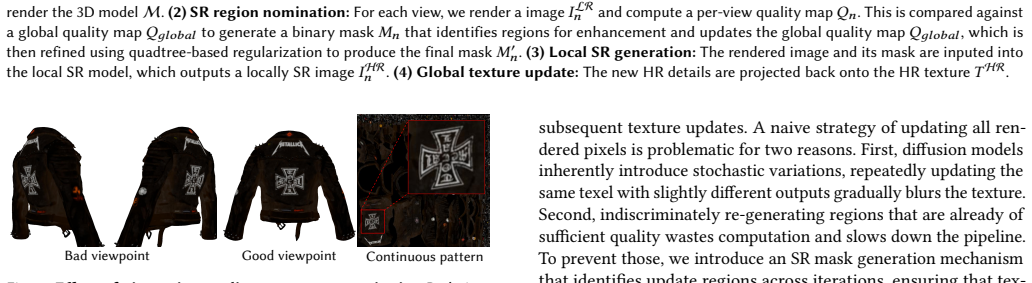
The load-bearing mechanism is the iterative refinement loop with four coupled pieces: (1) seam-aware view selection, which separates canonical viewpoints for single UV charts from observation viewpoints that bridge adjacent charts; (2) a global quality map per texel, so each view's update mask only covers pixels whose current rendered quality beats their historical best; (3) quadtree regularization of those masks, converting jagged pixel-level decisions into clean blocks the diffusion model can respect; and (4) a mask-conditioned latent diffusion model fine-tuned to predict a single residual in latent space, subtracted only inside the mask. The single-step residual prediction is what makes t
What would settle it
Run Texture++ on legacy low-resolution textures from real game assets that have known high-resolution originals, and compare against the originals; if PSNR/LPIPS are much worse than the paper's synthetic Gaussian-blur evaluation, or visible seams appear, the generalization claim fails.
Extended reading notes
Core claim
The paper claims that texture super-resolution for 3D assets should not be done directly on the UV texture map (where artificial chart boundaries break natural image statistics and cause seams), nor by treating it as a from-scratch generation task (which hallucinates and over-smooths). Instead, Texture++ renders the mesh from adaptively chosen viewpoints — canonical views that keep a single UV chart frontal and seam-aware views that frame adjacent charts together — and iteratively refines only those regions that a global quality map deems under-resolved. A mask-conditioned diffusion model, fine-tuned to predict a single latent-space residual inside masked regions, injects high-frequency deta
Load-bearing premise
The central bet is that a single-step diffusion model trained on natural images with synthetic random masks will generalize to rendered views of 3D assets (which contain shading and geometric context) and that Gaussian-blur plus bicubic downsampling is a faithful stand-in for real legacy low-resolution textures; if either fails, the reported gains may not transfer to actual asset pipelines.
Editorial extensions
If this is right
- Legacy 3D assets with low-resolution textures can be upscaled 4× without manually re-authoring details, preserving artistic intent.
- The method works across different UV unwrappings (atlas, smart projections), so it can slot into existing asset pipelines without re-mapping.
- Because refinement is mask-limited and single-step, runtime is competitive with or faster than many baselines (the paper reports roughly 94 seconds per asset on its hardware).
- The framework can serve as a refinement stage for texture-generation methods, since it is designed to enhance given LR textures rather than generate from scratch.
- View-space SR with global quality tracking avoids the error accumulation of gradient-based multi-view optimization.
Reading between the lines
- The same masked-single-step-residual loop could in principle upscale PBR material sets; the paper explicitly lists PBR support as future work, and testing it would be a direct next step.
- Because the local SR model is trained on natural images, a public benchmark on real legacy LR textures (compressed, artist-authored, or upscaled in-engine) would be a sharper test than the synthetic degradation used in the paper.
- The global-quality-map mask scheduler is a generic 'what to refine next' mechanism; it could be reused outside texture SR, e.g., for progressive geometry detail synthesis or multi-view inpainting, if the per-pixel quality criterion is replaced by a task-appropriate score.
- On self-occluded geometry, the paper itself shows a failure case (armor occludes a shoulder pattern); a view-selection strategy that explicitly optimizes for visibility coverage would be a concrete improvement and a testable hypothesis.
Editorial analysis
A structured set of objections, weighed in public.
Referee Report
Summary. The paper presents Texture++, an iterative framework for 4× super-resolution of 3D asset textures. Starting from a bilinearly upsampled HR texture, the method selects canonical and seam-aware viewpoints, renders the mesh, computes a per-pixel geometric quality map, and derives binary update masks via a global quality map and quadtree regularization. A Stable Diffusion 2.1-based model with two LoRA modules is fine-tuned to perform single-step masked residual prediction in latent space, and the locally super-resolved rendered views are back-projected into the texture. The paper reports state-of-the-art quantitative results in Table 1 and supports the design with ablations in Table 2 and qualitative comparisons.
Significance. If the reported results are reproducible, Texture++ is a practical, gradient-free alternative to optimization-based texture SR, with a coherent view-selection strategy and an effective masked single-step diffusion module. The view selection, quadtree mask regularization, and local SR conditioning are clearly motivated, and the ablations support each component. However, the evaluation is currently limited to synthetic degradations and omits the most relevant baselines; the practical significance for 'aging yet valuable assets' is therefore not yet established.
major comments (4)
- [§4.2, Table 1, Appendix B.1] All quantitative comparisons are performed on synthetic LR textures produced by Gaussian blur + 4× bicubic downsampling from HR assets. The local SR model is trained on LSDIR with RealESRGAN degradation (Appendix B.2), so the test degradation is within the training distribution. No experiment uses real legacy low-resolution textures with compression, noise, or non-uniform blur. This is directly relevant to the central claim of practical utility for 'aging yet valuable assets' and to the generalization claim in the abstract. Please add an evaluation on real-world LR textures, or at least a cross-degradation robustness test with unseen degradations, report the number of test assets and per-asset error bars, and state statistical significance for the Table 1 differences.
- [§4.2, Related Work (§2)] The two most relevant texture-SR baselines, PBR-SR (Chen et al. 2025c) and Richard et al. (2020), are discussed in Related Work but are not compared because their code is not open-source. As a result, Table 1 compares against image-SR models applied to the whole UV texture in one pass and texture-generation methods adapted to use their refinement stages, none of which is designed for the texture-SR task. The claim of substantial improvement 'over existing methods' is therefore not supported with respect to the actual texture-SR state of the art. If official code is unavailable, the authors should approximate these methods with a differentiable-rendering or multi-view-consistency baseline, or temper the claim accordingly.
- [§3.3, Eqs. (2)-(3)] The mask is defined by comparing geometric view quality to a global geometric quality map; it does not measure whether the SR output is actually closer to ground truth or less artifact-laden. The paper states that this 'ensures that texture updates improve monotonically' and that the method 'identifies regions for enhancement,' but a geometrically high-quality view can still produce a hallucinated or misaligned SR output, and because Q_global stores only geometric scores, such an output would be locked in as 'best.' Please either prove or empirically demonstrate monotonic improvement with respect to an actual fidelity measure (e.g., by verifying that the back-projected update reduces a reference/no-reference distortion metric), or revise the claim. This is load-bearing for the iterative refinement design.
- [§3.4, Appendix B.1/B.2] The local SR model is trained on natural image patches (LSDIR) with synthetic random masks and RealESRGAN degradation, but at inference it is applied to rendered views containing shading, occlusion boundaries, and UV-seam discontinuities, and to hybrid sharp/blurry images. The paper does not quantify this domain gap. Since the central contribution is a view-space SR model, please report an analysis or experiment isolating the effect of training data domain (e.g., fine-tuning on rendered views of 3D assets, or at least an evaluation of the SR model on rendered vs. natural inputs with identical degradation).
minor comments (4)
- [Table 1 vs. Table 2] The 'full' row in Table 2 reports PSNR 38.4241, SSIM 0.9686, LPIPS 0.0433, DISTS 0.0760, while Table 1 reports PSNR 37.5277, SSIM 0.9524, LPIPS 0.0637, DISTS 0.0736 for the same 'Our' method. Clarify whether the two tables use different test sets, different iterations, or different settings; otherwise the discrepancy is confusing.
- [Table 2 heading and text (§4.3)] The abbreviation 'w/o v.s.' is not defined; the surrounding text refers to 'observation view selection,' so please spell out 'w/o view selection' in the table or define the abbreviation in the caption.
- [Fig. 10 and Eq. (4)] Eq. (4) writes z_final = z - Δz ⊙ M, but Fig. 10 uses z_HR and z_LR with the same operation. Align the notation between the main text, the equation, and the supplementary figure to avoid ambiguity about whether the residual is subtracted or added.
- [Appendix B.1] The description of the synthetic mask generation for training is underspecified. Please provide the mask size distribution, the range of mask fractions, and the number of training patches. Also report the number and source of test assets and the per-asset metric variance, which is needed to interpret the aggregate numbers in Table 1.
Circularity Check
No circularity: the claimed SR improvements are evaluated on held-out synthetic-degraded assets, and no load-bearing step reduces to its own inputs or to authors' prior work.
full rationale
I walked the derivation chain from the LR texture to the Table 1 numbers and found no reduction of a prediction to its input. The central claim is that Texture++ outperforms baselines on 4x texture SR; that claim is supported by metrics computed on HR textures from TRELLIS/Sketchfab assets whose LR versions were synthesized by Gaussian blur plus 4x bicubic downsampling (App. B.1). The local SR model was trained on LSDIR natural images with synthetic random masks and RealESRGAN degradations (App. B.1-B.2), so the test degradation is similar to, but not fitted from, the reported ground-truth outputs. Loss weights (lambda_mse=1, lambda_lpips=2) are fixed training hyperparameters, not tuned on the evaluation set. The masks used at inference are generated from the geometric quality comparison in Eqs. (2)-(3), not from the SR model's own output, and the masked residual update in Eq. (4) is not a self-definitional loop. There are no self-citations in the reference list, and no uniqueness theorem or ansatz is imported from the authors' prior work. The acknowledged limitations (self-occlusion, no PBR support) and the broader synthetic-degradation/domain-gap concerns are legitimate generalization and correctness risks, but they are not circularity: the evaluation is not statistically forced by construction. Therefore the appropriate score is 0.
Assumptions & free parameters
free parameters (5)
- loss weights λ_mse, λ_lpips =
λ_mse = 1.0, λ_lpips = 2.0
- LoRA rank and scale (r, α) =
r=8, α=16
- Training schedule (lr, batch, steps) =
lr=5e-5, batch=12, steps=10,000
- Quadtree minimum block size
- Viewpoint consolidation thresholds τ_pos, τ_cos
assumptions (4)
- domain assumption The Nvidiffrast renderer π(M,T,v) produces view images whose pixel colors are an accurate projection of the texture map, with no significant lighting or shading effects that would corrupt back-projection.
- domain assumption The quality score Q_n(u,v) = cos(direction, normal)/distance^2 (Eq. 2) is a valid proxy for how much texture detail is resolvable from a viewpoint, so that masks generated by comparing Q against a global max correctly identify which texels need SR.
- domain assumption Iterative masked back-projection with a single-step diffusion residual update strictly improves the texture, or at least never decreases quality, in each iteration.
- domain assumption Gaussian blur followed by 4× bicubic downsampling produces LR textures representative of the legacy low-resolution textures the method targets.
Cite this review
Pith. "Pith review of Texture++: Elevating 3D Asset Texture Resolution with a Region-Aware Diffusion Model." pith.science (2026). https://pith.science/paper/V2IA5TL5
@misc{pith2026260721504,
  author       = {Pith},
  title        = {Pith review of: Texture++: Elevating 3D Asset Texture Resolution with a Region-Aware Diffusion Model},
  year         = {2026},
  howpublished = {\url{https://pith.science/paper/V2IA5TL5}},
  note         = {Machine review of arXiv:2607.21504}
}
read the original abstract
Numerous 3D assets are discarded due to low texture resolution, while current super-resolution models ignore texture maps and focus on natural images. An efficient and generalizable texture super-resolution model can revitalize a large corpus of aging yet valuable assets across industries such as film and video games. We present Texture++, a novel framework for texture super-resolution, which enhances the low-resolution textures of assets to produce high-resolution, high-quality results. Specifically, we reformulate the task of super-resolution in UV space into performing it across multiple rendered views and merging the outputs. Firstly, to achieve more complete and continuous textures in the view space, we propose an adaptive view selection strategy to integrate textures dispersed across UV texture patches. Furthermore, we introduce a quadtree-based texture region organization method for combining super-resolved textures from different viewpoints, providing masks to distinguish regions that require improvement. Finally, we design a diffusion-based super-resolution model that enhances the texture resolution for specified masked regions, seamlessly integrating with surrounding regions. Through comprehensive evaluations, we demonstrate that our approach yields textures with substantially improved detail and coherence over existing methods.
Figures


Figures from the paper (12 more)


Reference graph
Works this paper leans on
-
[1]
2020 , eprint=
Denoising Diffusion Probabilistic Models , author=. 2020 , eprint=
2020
-
[2]
2022 , eprint=
High-Resolution Image Synthesis with Latent Diffusion Models , author=. 2022 , eprint=
2022
-
[3]
FirstName LastName , title =
-
[4]
FirstName Alpher , title =
-
[5]
Journal of Foo , volume = 13, number = 1, pages =
FirstName Alpher and FirstName Fotheringham-Smythe , title =. Journal of Foo , volume = 13, number = 1, pages =
-
[6]
Journal of Foo , volume = 14, number = 1, pages =
FirstName Alpher and FirstName Fotheringham-Smythe and FirstName Gamow , title =. Journal of Foo , volume = 14, number = 1, pages =
-
[7]
FirstName Alpher and FirstName Gamow , title =
-
[8]
Proceedings of the Computer Vision and Pattern Recognition Conference (CVPR) , month =
Xiong, Bojun and Liu, Jialun and Hu, Jiakui and Wu, Chenming and Wu, Jinbo and Liu, Xing and Zhao, Chen and Ding, Errui and Lian, Zhouhui , title =. Proceedings of the Computer Vision and Pattern Recognition Conference (CVPR) , month =. 2025 , pages =
2025
Show all 50 references
-
[9]
Proceedings of the IEEE/CVF International Conference on Computer Vision , pages=
Text2tex: Text-driven texture synthesis via diffusion models , author=. Proceedings of the IEEE/CVF International Conference on Computer Vision , pages=
-
[10]
ACM SIGGRAPH 2023 conference proceedings , pages=
Texture: Text-guided texturing of 3d shapes , author=. ACM SIGGRAPH 2023 conference proceedings , pages=
2023
-
[11]
Proceedings of the IEEE/CVF Conference on Computer Vision and Pattern Recognition , pages=
Paint3d: Paint anything 3d with lighting-less texture diffusion models , author=. Proceedings of the IEEE/CVF Conference on Computer Vision and Pattern Recognition , pages=
-
[12]
Proceedings of the IEEE/CVF Conference on Computer Vision and Pattern Recognition , pages=
Paint-it: Text-to-texture synthesis via deep convolutional texture map optimization and physically-based rendering , author=. Proceedings of the IEEE/CVF Conference on Computer Vision and Pattern Recognition , pages=
-
[13]
ACM Transactions on Graphics (TOG) , volume=
DreamMat: High-quality PBR Material Generation with Geometry-and Light-aware Diffusion Models , author=. ACM Transactions on Graphics (TOG) , volume=. 2024 , publisher=
2024
-
[14]
Proceedings of the Computer Vision and Pattern Recognition Conference , pages=
Texgaussian: Generating high-quality pbr material via octree-based 3d gaussian splatting , author=. Proceedings of the Computer Vision and Pattern Recognition Conference , pages=
-
[15]
arXiv preprint arXiv:2501.06838 , year=
Generalized and Efficient 2D Gaussian Splatting for Arbitrary-scale Super-Resolution , author=. arXiv preprint arXiv:2501.06838 , year=
-
[16]
Proceedings of the IEEE/CVF Conference on Computer Vision and Pattern Recognition , pages=
Arbitrary-scale image generation and upsampling using latent diffusion model and implicit neural decoder , author=. Proceedings of the IEEE/CVF Conference on Computer Vision and Pattern Recognition , pages=
-
[17]
2025 , eprint=
OFTSR: One-Step Flow for Image Super-Resolution with Tunable Fidelity-Realism Trade-offs , author=. 2025 , eprint=
2025
-
[18]
2024 , eprint=
Improving the Stability and Efficiency of Diffusion Models for Content Consistent Super-Resolution , author=. 2024 , eprint=
2024
-
[19]
2025 , eprint=
Pixel-level and Semantic-level Adjustable Super-resolution: A Dual-LoRA Approach , author=. 2025 , eprint=
2025
-
[20]
2021 , eprint=
LoRA: Low-Rank Adaptation of Large Language Models , author=. 2021 , eprint=
2021
-
[21]
2024 , eprint=
SeeSR: Towards Semantics-Aware Real-World Image Super-Resolution , author=. 2024 , eprint=
2024
-
[22]
ACM Trans
Zhang, Yuqing and Xu, Hao and Wu, Yiqian and Chen, Sirui and Lin, Sirui and Li, Xiang and Gao, Xifeng and Jin, Xiaogang , title =. ACM Trans. Graph. , month = jul, articleno =. 2025 , issue_date =. doi:10.1145/3731158 , abstract =
2025 doi
-
[23]
2020 , eprint=
Learned Multi-View Texture Super-Resolution , author=. 2020 , eprint=
2020
-
[24]
2025 , eprint=
PBR-SR: Mesh PBR Texture Super Resolution from 2D Image Priors , author=. 2025 , eprint=
2025
-
[25]
2018 , eprint=
The Unreasonable Effectiveness of Deep Features as a Perceptual Metric , author=. 2018 , eprint=
2018
-
[26]
2025 , eprint=
One Diffusion Step to Real-World Super-Resolution via Flow Trajectory Distillation , author=. 2025 , eprint=
2025
-
[27]
Beyond a Gaussian Denoiser: Residual Learning of Deep CNN for Image Denoising , year=
Zhang, Kai and Zuo, Wangmeng and Chen, Yunjin and Meng, Deyu and Zhang, Lei , journal=. Beyond a Gaussian Denoiser: Residual Learning of Deep CNN for Image Denoising , year=
-
[28]
2018 , eprint=
Residual Dense Network for Image Super-Resolution , author=. 2018 , eprint=
2018
-
[29]
2023 , eprint=
Paint3D: Paint Anything 3D with Lighting-Less Texture Diffusion Models , author=. 2023 , eprint=
2023
-
[30]
2020 , eprint=
Modular Primitives for High-Performance Differentiable Rendering , author=. 2020 , eprint=
2020
-
[31]
2017 , eprint=
Adam: A Method for Stochastic Optimization , author=. 2017 , eprint=
2017
-
[32]
LSDIR: A Large Scale Dataset for Image Restoration , year=
Li, Yawei and Zhang, Kai and Liang, Jingyun and Cao, Jiezhang and Liu, Ce and Gong, Rui and Zhang, Yulun and Tang, Hao and Liu, Yun and Demandolx, Denis and Ranjan, Rakesh and Timofte, Radu and Van Gool, Luc , booktitle=. LSDIR: A Large Scale Dataset for Image Restoration , year=
-
[33]
Real-ESRGAN: Training Real-World Blind Super-Resolution with Pure Synthetic Data , year=
Wang, Xintao and Xie, Liangbin and Dong, Chao and Shan, Ying , booktitle=. Real-ESRGAN: Training Real-World Blind Super-Resolution with Pure Synthetic Data , year=
-
[34]
2019 , eprint=
A Style-Based Generator Architecture for Generative Adversarial Networks , author=. 2019 , eprint=
2019
-
[35]
and Sheikh, H.R
Zhou Wang and Bovik, A.C. and Sheikh, H.R. and Simoncelli, E.P. , journal=. Image quality assessment: from error visibility to structural similarity , year=
-
[36]
2024 , eprint=
Exploiting Diffusion Prior for Real-World Image Super-Resolution , author=. 2024 , eprint=
2024
-
[37]
2024 , eprint=
DiffBIR: Towards Blind Image Restoration with Generative Diffusion Prior , author=. 2024 , eprint=
2024
-
[38]
2025 , eprint=
Harnessing Diffusion-Yielded Score Priors for Image Restoration , author=. 2025 , eprint=
2025
-
[39]
2025 , eprint=
Arbitrary-steps Image Super-resolution via Diffusion Inversion , author=. 2025 , eprint=
2025
-
[40]
2024 , eprint=
One-Step Effective Diffusion Network for Real-World Image Super-Resolution , author=. 2024 , eprint=
2024
-
[41]
ICASSP 2022-2022 IEEE International Conference on Acoustics, Speech and Signal Processing (ICASSP) , pages=
3D Texture Super Resolution via the Rendering Loss , author=. ICASSP 2022-2022 IEEE International Conference on Acoustics, Speech and Signal Processing (ICASSP) , pages=. 2022 , organization=
2022
-
[42]
2024 , eprint=
DreamClear: High-Capacity Real-World Image Restoration with Privacy-Safe Dataset Curation , author=. 2024 , eprint=
2024
-
[43]
2025 , eprint=
Adversarial Diffusion Compression for Real-World Image Super-Resolution , author=. 2025 , eprint=
2025
-
[44]
2024 , eprint=
XPSR: Cross-modal Priors for Diffusion-based Image Super-Resolution , author=. 2024 , eprint=
2024
-
[45]
2023 , eprint=
SinSR: Diffusion-Based Image Super-Resolution in a Single Step , author=. 2023 , eprint=
2023
-
[46]
Proceedings of the IEEE/CVF conference on computer vision and pattern recognition , pages=
3D appearance super-resolution with deep learning , author=. Proceedings of the IEEE/CVF conference on computer vision and pattern recognition , pages=
-
[47]
2015 , eprint=
Very Deep Convolutional Networks for Large-Scale Image Recognition , author=. 2015 , eprint=
2015
-
[48]
Ding, Keyan and Ma, Kede and Wang, Shiqi and Simoncelli, Eero P. , year=. Image Quality Assessment: Unifying Structure and Texture Similarity , ISSN=. doi:10.1109/tpami.2020.3045810 , journal=
2020
-
[49]
Proceedings of the Computer Vision and Pattern Recognition Conference , pages=
Mvpaint: Synchronized multi-view diffusion for painting anything 3d , author=. Proceedings of the Computer Vision and Pattern Recognition Conference , pages=
-
[50]
arXiv preprint arXiv:2412.01506 , year =
Structured 3D Latents for Scalable and Versatile 3D Generation , author =. arXiv preprint arXiv:2412.01506 , year =
Reviewed August 1, 2026 · model on record in the stance chip above.
Discussion (0). Sign in to comment.