Comparing Architectures for Supervised Political Scaling
Pith reviewed 2026-07-03 21:00 UTC · model grok-4.3
The pith
Joint prediction of ideological scales outperforms individual predictions and creates a middle ground between classification and regression.
A machine-rendered reading of the paper's core claim, the machinery that carries it, and where it could break.
Core claim
Predicting scales jointly rather than individually improves performance on political scaling tasks, and hybrid models occupy a useful middle ground between pure classification and regression methods.
What carries the argument
Joint multi-scale prediction architectures and hybrid classification-regression models applied to ideological text scaling.
If this is right
- Joint models reduce error rates compared to separate scale predictions on the evaluated datasets.
- Hybrid architectures achieve performance between classification and regression baselines.
- The approach lowers the annotation burden for multi-dimensional ideological analysis.
- Architecture choice matters more when the number of scales increases.
Where Pith is reading between the lines
- The joint prediction benefit might extend to other multi-label or multi-dimensional NLP tasks beyond politics.
- Testing these models on streaming social media could reveal whether they support dynamic, real-time scaling.
- The hybrid middle ground invites exploration of loss functions that blend discrete and continuous targets in adjacent domains like sentiment or stance detection.
Load-bearing premise
Standard evaluation metrics and datasets for political scaling are adequate to detect meaningful differences between joint prediction, hybrid models, and baseline architectures.
What would settle it
A replication on multiple held-out political text datasets where joint models show no accuracy gain over separate predictions would falsify the main performance claim.
Figures
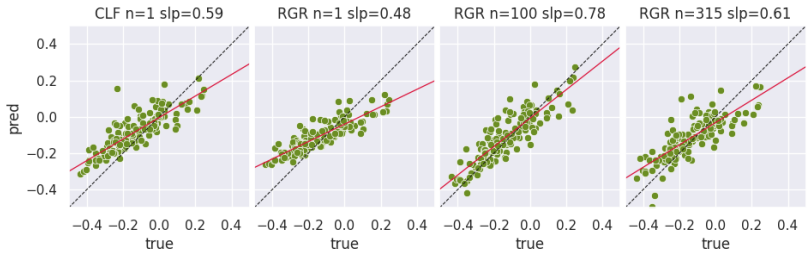
read the original abstract
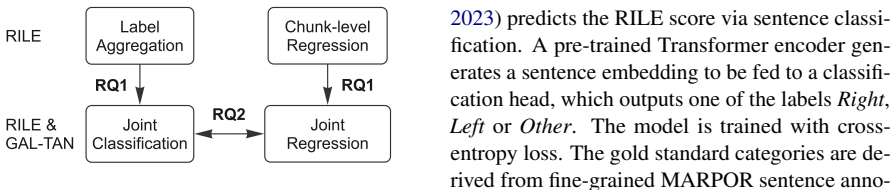
Text scaling, the task of positioning political actors on an ideological scale, is a fundamental task in political analysis. To ease the need for manual analysis, various NLP methods have been proposed for this task, including classification- and regression-based approaches, showing successes as well as limitations. The goal of our paper is to consolidate the state of the art in this area. We ask two questions: (a) Can the performance of scaling methods be improved by predicting scales not individually but jointly? (b) Is there a middle ground between classification and regression?
Editorial analysis
A structured set of objections, weighed in public.
Referee Report
Summary. The manuscript consolidates the state of the art in supervised text scaling for positioning political actors on ideological scales. It poses two empirical questions: (a) whether predicting scales jointly rather than individually improves performance, and (b) whether hybrid architectures can occupy a middle ground between classification-based and regression-based approaches.
Significance. If the experiments demonstrate clear gains from joint prediction and identify effective hybrids, the work would offer actionable architecture recommendations for computational political analysis, building on existing classification and regression baselines in NLP for ideology detection.
major comments (2)
- [Abstract] Abstract and introduction: the two research questions are posed but the manuscript provides no quantitative results, error analysis, or dataset details in the supplied abstract; without the methods/results sections it is impossible to evaluate whether joint prediction or hybrids outperform baselines on standard political scaling metrics.
- The weakest assumption noted in the reader report—that standard evaluation metrics and datasets suffice to detect meaningful differences—remains untestable here; if the full paper relies on the same metrics without ablation on metric sensitivity, this would be load-bearing for claims about improvement.
minor comments (1)
- Notation for 'scales' and 'joint prediction' should be defined early with reference to prior work on multi-task vs. single-task scaling.
Simulated Author's Rebuttal
We thank the referee for their review. We address the major comments point by point below, drawing on the full manuscript content.
read point-by-point responses
-
Referee: [Abstract] Abstract and introduction: the two research questions are posed but the manuscript provides no quantitative results, error analysis, or dataset details in the supplied abstract; without the methods/results sections it is impossible to evaluate whether joint prediction or hybrids outperform baselines on standard political scaling metrics.
Authors: The abstract is a concise overview of the research questions only. The full manuscript contains a methods section detailing the datasets, architectures, and standard political scaling metrics, along with a results section that reports quantitative performance comparisons, including error analysis for joint prediction versus individual scaling and for hybrid models versus pure classification or regression baselines. revision: partial
-
Referee: The weakest assumption noted in the reader report—that standard evaluation metrics and datasets suffice to detect meaningful differences—remains untestable here; if the full paper relies on the same metrics without ablation on metric sensitivity, this would be load-bearing for claims about improvement.
Authors: The manuscript applies the same standard metrics and datasets used in prior political scaling work to all models, enabling direct relative comparisons. No explicit ablation on metric sensitivity is present; we can add a limitations discussion on this point in revision. revision: partial
Circularity Check
No significant circularity
full rationale
The paper poses two open empirical questions about joint vs. individual scale prediction and the existence of a middle ground between classification and regression. No derivations, equations, fitted parameters renamed as predictions, or self-citation chains are present in the provided abstract or described structure. The work is a comparative evaluation on standard datasets and metrics, with no load-bearing step that reduces to its own inputs by construction.
Axiom & Free-Parameter Ledger
Reference graph
Works this paper leans on
-
[1]
Smith , year=
Anna Brigevich and William B. Smith , year=. Proceedings of the European Union Studies Association Biannual Conference , address=
-
[2]
West European Politics , volume =
Anna-Sophie Kurella and Milena Rapp , title =. West European Politics , volume =. 2026 , publisher =
2026
-
[3]
Liesenfeld, Andreas and Dingemanse, Mark , title =. Proceedings of the ACM Conference on Fairness, Accountability, and Transparency , year = 2024, pages =. doi:10.1145/3630106.3659005 , numpages = 14, address =
-
[4]
WIREs Data Mining and Knowledge Discovery , volume =
Alva Principe, Renzo and Chiarini, Nicola and Viviani, Marco , title =. WIREs Data Mining and Knowledge Discovery , volume =. doi:https://doi.org/10.1002/widm.70019 , url =. https://wires.onlinelibrary.wiley.com/doi/pdf/10.1002/widm.70019 , note =
-
[5]
Koedam, Jelle and Binding, Garret and Steenbergen, Marco R. , title =. British Journal of Political Science , volume =. 2025 , publisher =. doi:10.1017/S0007123424000474 , url =
-
[6]
Jan Rovny and Jonathan Polk and Ryan Bakker and Liesbet Hooghe and Seth Jolly and Gary Marks and Marco Steenbergen and Milada Anna Vachudova , keywords =. The 2024 Chapel Hill Expert Survey on political party positioning in Europe: Twenty-five years of party positional data , journal =. 2025 , issn =. doi:https://doi.org/10.1016/j.electstud.2025.102981 , url =
-
[7]
Party Policy in Modern Democracies , isbn =
Benoit, Kenneth and Laver, Michael , year =. Party Policy in Modern Democracies , isbn =. doi:10.4324/9780203028179 , address=
-
[8]
2013 , url =
Budge, Ian , title =. 2013 , url =
2013
-
[9]
and Best, Robin and Franzmann, Simon , isbn =
Volkens, Andrea and Bara, Judith and Budge, Ian and McDonald, Michael D. and Best, Robin and Franzmann, Simon , isbn =. Understanding and Validating the Left-Right Scale (RILE) , booktitle =. 2013 , month =. doi:10.1093/acprof:oso/9780199640041.003.0006 , url =
work page doi:10.1093/acprof:oso/9780199640041.003.0006 2013
-
[10]
2025 , note =
Yu, Jun and Liu, Xiaokang and Luo, Chongliang and Zhou, Rong and Liu, Yixin and Hu, Jie and Chen, Jianmin and Zhang, Ke and Zhang, Dazheng and Shen, Yishan and Adhikarla, Eashan and Dai, Yutong and Zhang, Kai and Kong, Zhaoming and Ye, Wenxuan and Yin, Yilong and Namboodiri, Vinod and Davison, Brian and Moore, Jason and Chen, Yong , journal =. 2025 , note =
2025
-
[11]
Proceedings of the IEEE conference on computer vision and pattern recognition , pages=
Facenet: A unified embedding for face recognition and clustering , author=. Proceedings of the IEEE conference on computer vision and pattern recognition , pages=
-
[12]
BERT : Pre-training of Deep Bidirectional Transformers for Language Understanding
Devlin, Jacob and Chang, Ming-Wei and Lee, Kenton and Toutanova, Kristina. BERT : Pre-training of Deep Bidirectional Transformers for Language Understanding. Proceedings of the 2019 Conference of the North A merican Chapter of the Association for Computational Linguistics: Human Language Technologies, Volume 1 (Long and Short Papers). 2019. doi:10.18653/v...
-
[13]
European Journal of Political Research , volume =
Dassonneville, Ruth and Hooghe, Liesbet and Marks, Gary , title =. European Journal of Political Research , volume =. doi:https://doi.org/10.1111/1475-6765.12590 , url =. https://ejpr.onlinelibrary.wiley.com/doi/pdf/10.1111/1475-6765.12590 , year =
-
[14]
Nikolaev, Dmitry and Ceron, Tanise and Pad \'o , Sebastian. Multilingual estimation of political-party positioning: From label aggregation to long-input Transformers. Proceedings of the 2023 Conference on Empirical Methods in Natural Language Processing. 2023. doi:10.18653/v1/2023.emnlp-main.591
-
[15]
American political science review , volume=
Extracting policy positions from political texts using words as data , author=. American political science review , volume=. 2003 , publisher=
2003
-
[16]
American Journal of Political Science , volume=
A scaling model for estimating time-series party positions from texts , author=. American Journal of Political Science , volume=. 2008 , publisher=
2008
-
[17]
Additive manifesto decomposition: A policy domain aware method for understanding party positioning
Ceron, Tanise and Nikolaev, Dmitry and Pad \'o , Sebastian. Additive manifesto decomposition: A policy domain aware method for understanding party positioning. Findings of the Association for Computational Linguistics: ACL 2023. 2023. doi:10.18653/v1/2023.findings-acl.499
-
[18]
Warner, Benjamin and Chaffin, Antoine and Clavi. Smarter, Better, Faster, Longer: A Modern Bidirectional Encoder for Fast, Memory Efficient, and Long Context Finetuning and Inference. Proceedings of the 63rd Annual Meeting of the Association for Computational Linguistics (Volume 1: Long Papers). 2025. doi:10.18653/v1/2025.acl-long.127
-
[19]
Advances in neural information processing systems , volume=
Big bird: Transformers for longer sequences , author=. Advances in neural information processing systems , volume=
-
[20]
Sentence- BERT : Sentence Embeddings using S iamese BERT -Networks
Reimers, Nils and Gurevych, Iryna. Sentence- BERT : Sentence Embeddings using S iamese BERT -Networks. Proceedings of the 2019 Conference on Empirical Methods in Natural Language Processing and the 9th International Joint Conference on Natural Language Processing (EMNLP-IJCNLP). 2019. doi:10.18653/v1/D19-1410
-
[21]
Large Language Models: A Survey
Shervin Minaee and Tomas Mikolov and Narjes Nikzad and Meysam Chenaghlu and Richard Socher and Xavier Amatriain and Jianfeng Gao , year=. 2402.06196 , archivePrefix=
work page internal anchor Pith review Pith/arXiv arXiv
-
[22]
Unsupervised Cross-Lingual Scaling of Political Texts
Glava s , Goran and Nanni, Federico and Ponzetto, Simone Paolo. Unsupervised Cross-Lingual Scaling of Political Texts. Proceedings of the 15th Conference of the E uropean Chapter of the Association for Computational Linguistics: Volume 2, Short Papers. 2017
2017
-
[23]
Word Embeddings for the Analysis of Ideological Placement in Parliamentary Corpora , volume=. Political Analysis , author=. 2020 , pages=. doi:10.1017/pan.2019.26 , number=
-
[24]
Political Text Scaling Meets Computational Semantics , year =
Nanni, Federico and Glava. Political Text Scaling Meets Computational Semantics , year =. ACM/IMS Trans. Data Sci. , month = may, articleno =. doi:10.1145/3485666 , abstract =
-
[25]
Optimizing text representations to capture (dis)similarity between political parties
Ceron, Tanise and Blokker, Nico and Pad \'o , Sebastian. Optimizing text representations to capture (dis)similarity between political parties. Proceedings of the 26th Conference on Computational Natural Language Learning (CoNLL). 2022. doi:10.18653/v1/2022.conll-1.22
-
[26]
Zhang, Haopeng and Yu, Philip S. and Zhang, Jiawei , title =. ACM Comput. Surv. , month = jun, articleno =. 2025 , issue_date =. doi:10.1145/3731445 , abstract =
-
[27]
Yu, Fei and Zhang, Hongbo and Tiwari, Prayag and Wang, Benyou , title =. ACM Comput. Surv. , month = oct, articleno =. 2024 , issue_date =. doi:10.1145/3664194 , abstract =
-
[28]
2021 , eprint=
Whitening Sentence Representations for Better Semantics and Faster Retrieval , author=. 2021 , eprint=
2021
-
[29]
International Conference on Learning Representations , year=
Decoupled Weight Decay Regularization , author=. International Conference on Learning Representations , year=
-
[30]
Ethayarajh, Kawin. How Contextual are Contextualized Word Representations? C omparing the Geometry of BERT , ELM o, and GPT -2 Embeddings. Proceedings of the 2019 Conference on Empirical Methods in Natural Language Processing and the 9th International Joint Conference on Natural Language Processing (EMNLP-IJCNLP). 2019. doi:10.18653/v1/D19-1006
-
[31]
MPNet: Masked and Permuted Pre-training for Language Understanding , url =
Song, Kaitao and Tan, Xu and Qin, Tao and Lu, Jianfeng and Liu, Tie-Yan , booktitle =. MPNet: Masked and Permuted Pre-training for Language Understanding , url =
-
[32]
Why comparing single performance scores does not allow to draw conclusions about machine learning approaches , author=. arXiv preprint arXiv:1803.09578 , year=
work page internal anchor Pith review Pith/arXiv arXiv
-
[33]
International conference on machine learning , pages=
Learning transferable visual models from natural language supervision , author=. International conference on machine learning , pages=. 2021 , organization=
2021
-
[34]
Advances in neural information processing systems , volume=
Attention is all you need , author=. Advances in neural information processing systems , volume=
-
[35]
Proceedings of the 56th Annual Meeting of the Association for Computational Linguistics (Volume 2: Short Papers) , pages=
Know what you don’t know: Unanswerable questions for SQuAD , author=. Proceedings of the 56th Annual Meeting of the Association for Computational Linguistics (Volume 2: Short Papers) , pages=
-
[36]
Proceedings of the 2018 EMNLP workshop BlackboxNLP: Analyzing and interpreting neural networks for NLP , pages=
GLUE: A multi-task benchmark and analysis platform for natural language understanding , author=. Proceedings of the 2018 EMNLP workshop BlackboxNLP: Analyzing and interpreting neural networks for NLP , pages=
2018
-
[37]
Learning Thematic Similarity Metric from Article Sections Using Triplet Networks
Dor, Liat Ein and Mass, Yosi and Halfon, Alon and Venezian, Elad and Shnayderman, Ilya and Aharonov, Ranit and Slonim, Noam. Learning Thematic Similarity Metric from Article Sections Using Triplet Networks. Proceedings of the 56th Annual Meeting of the Association for Computational Linguistics (Volume 2: Short Papers). 2018. doi:10.18653/v1/P18-2009
-
[38]
A Robustly Optimized BERT Pre-training Approach with Post-training
Zhuang, Liu and Wayne, Lin and Ya, Shi and Jun, Zhao. A Robustly Optimized BERT Pre-training Approach with Post-training. Proceedings of the 20th Chinese National Conference on Computational Linguistics. 2021
2021
-
[39]
Pengcheng He and Jianfeng Gao and Weizhu Chen , booktitle=. De. 2023 , url=
2023
-
[40]
Zhang, Xin and Zhang, Yanzhao and Long, Dingkun and Xie, Wen and Dai, Ziqi and Tang, Jialong and Lin, Huan and Yang, Baosong and Xie, Pengjun and Huang, Fei and Zhang, Meishan and Li, Wenjie and Zhang, Min. mGTE : Generalized Long-Context Text Representation and Reranking Models for Multilingual Text Retrieval. Proceedings of the 2024 Conference on Empiri...
-
[41]
Improving Neural Political Statement Classification with Class Hierarchical Information
Dayanik, Erenay and Blessing, Andre and Blokker, Nico and Haunss, Sebastian and Kuhn, Jonas and Lapesa, Gabriella and Pado, Sebastian. Improving Neural Political Statement Classification with Class Hierarchical Information. Findings of the Association for Computational Linguistics: ACL 2022. 2022. doi:10.18653/v1/2022.findings-acl.186
-
[42]
2025 , booktitle =
Wu, Xinyi and Wang, Yifei and Jegelka, Stefanie and Jadbabaie, Ali , title =. 2025 , booktitle =
2025
-
[43]
American Political Science Review , author=
A Pairwise Comparison Framework for Fast, Flexible, and Reliable Human Coding of Political Texts , volume=. American Political Science Review , author=. 2017 , pages=. doi:10.1017/S0003055417000302 , number=
-
[44]
Advances in neural information processing systems , volume=
Flashattention: Fast and memory-efficient exact attention with io-awareness , author=. Advances in neural information processing systems , volume=
-
[45]
Qbaibi, Samia , title =
-
[46]
Party Politics , volume=
Scaling hand-coded political texts to learn more about left-right policy content , author=. Party Politics , volume=. 2022 , publisher=
2022
-
[47]
Political Science Research and Methods , author=
What’s in a buzzword? A systematic review of the state of populism research in political science , volume=. Political Science Research and Methods , author=. 2022 , pages=. doi:10.1017/psrm.2021.44 , number=
-
[48]
Efficient Estimation of Word Representations in Vector Space
Efficient estimation of word representations in vector space , author=. arXiv preprint arXiv:1301.3781 , year=
work page internal anchor Pith review Pith/arXiv arXiv
-
[49]
International conference on machine learning , pages=
Distributed representations of sentences and documents , author=. International conference on machine learning , pages=. 2014 , organization=
2014
-
[50]
Unsupervised Cross-lingual Representation Learning at Scale
Conneau, Alexis and Khandelwal, Kartikay and Goyal, Naman and Chaudhary, Vishrav and Wenzek, Guillaume and Guzm \'a n, Francisco and Grave, Edouard and Ott, Myle and Zettlemoyer, Luke and Stoyanov, Veselin. Unsupervised Cross-lingual Representation Learning at Scale. Proceedings of the 58th Annual Meeting of the Association for Computational Linguistics. ...
-
[51]
2020 , eprint=
Longformer: The Long-Document Transformer , author=. 2020 , eprint=
2020
-
[52]
European security , volume=
The party politics of the EU’s relations with the USA: evidence from the European Parliament , author=. European security , volume=. 2021 , publisher=
2021
-
[53]
2021 , publisher=
Political Ideologies: An Introduction , author=. 2021 , publisher=
2021
-
[54]
2004 , publisher=
European integration and political conflict , author=. 2004 , publisher=
2004
-
[55]
American Journal of Political Science , pages=
Putting parties in their place: Inferring party left-right ideological positions from party manifestos data , author=. American Journal of Political Science , pages=. 2000 , publisher=
2000
-
[56]
Party politics , volume=
Locating political parties in policy space: A reanalysis of party manifesto data , author=. Party politics , volume=. 2006 , publisher=
2006
-
[57]
Party Politics , volume=
Conceptualizing Left and Right in comparative politics: Towards a deductive approach , author=. Party Politics , volume=. 2011 , publisher=
2011
-
[58]
Party Politics , volume=
The multidimensional nature of party competition , author=. Party Politics , volume=. 2010 , publisher=
2010
-
[59]
Comparative European Politics , volume=
The changing relevance and meaning of left and right in 34 party systems from 1945 to 2020 , author=. Comparative European Politics , volume=. 2023 , publisher=
1945
-
[60]
American Journal of Political Science , volume=
Treating words as data with error: Uncertainty in text statements of policy positions , author=. American Journal of Political Science , volume=. 2009 , publisher=
2009
-
[61]
Estimating the Policy Position of Political Actors , pages=
Estimating policy positions from the computer coding of political texts: results from Italy, the Netherlands and Ireland , author=. Estimating the Policy Position of Political Actors , pages=. 2003 , publisher=
2003
-
[62]
1994 , publisher=
An introduction to the bootstrap , author=. 1994 , publisher=
1994
-
[63]
American Journal of Political Science , year=
Using large language models to analyze political texts through natural language understanding , author=. American Journal of Political Science , year=
-
[64]
Political Science Research and Methods , volume=
How to train your stochastic parrot: Large language models for political texts , author=. Political Science Research and Methods , volume=. 2025 , publisher=
2025
-
[65]
Political Analysis , volume=
Positioning political texts with large language models by asking and averaging , author=. Political Analysis , volume=. 2025 , publisher=
2025
-
[66]
2026 , eprint=
Olmo 3 , author=. 2026 , eprint=
2026
-
[67]
1992 , publisher=
Party policy and government coalitions , author=. 1992 , publisher=
1992
-
[68]
Political analysis , volume=
Coder reliability and misclassification in the human coding of party manifestos , author=. Political analysis , volume=. 2012 , publisher=
2012
discussion (0)
Sign in with ORCID, Apple, or X to comment. Anyone can read and Pith papers without signing in.