REVIEW 4 major objections 6 minor 39 references
Beacon: A Naturalistic Driving Dataset During Blackouts for Benchmarking Traffic Reconstruction and Control
T0 review · 4 major / 6 minor · reviewed 2026-08-11 · deepseek-v4-flash
Pith's one-line read A four-hour, manually annotated dataset of vehicle movements at two Memphis intersections during a real blackout provides the first public benchmark of traffic behavior when signals are dead, and supports simulations in which robot…
desk verdict Beacon is a genuinely first-of-its-kind blackout intersection dataset and worth having, but the headline performance claims are overstated and internally inconsistent as presented. read the letter →
The pith
A machine-rendered reading of the paper's core claim, the machinery that carries it, and where it could break.
The reading
What carries the argument
The central object is the Beacon dataset itself: per-vehicle records of origin lane, destination lane, and the timestep at which each vehicle reaches the head of its starting lane, covering four one-hour peak periods at two four-way intersections during a blackout. These records are converted into routes and replayed in a microscopic traffic simulator whose default car-following model, the Intelligent Driver Model, governs human-driven vehicles; reconstruction fidelity is scored by route-level match rates (start lane, end lane, timestep) rather than continuous trajectories, which were not annotated. For control, robot vehicles are modeled as agents in a partially observable Markov decision process with a discrete stop/go action space within 30 meters of the intersection, trained with the Rainbow DQN deep reinforcement learning algorithm and evaluated at penetration rates from 20% to 100% against the simulator's default human driver model. This machinery connects the sparse naturalistic observations to the paper's claims about reconstruction accuracy, signal versus blackout performance, and robot-vehicle coordination.
What would settle it
Rerun the published reconstruction with the same Beacon records but replace the simulator's default car-following model with one calibrated to blackout video, then compare per-vehicle lane choices and crossing times to the recorded data; if match rates fall well below 91% or the 82.6% wait-time reduction disappears, the central claims are tied to the default simulator rather than to real blackout traffic.
Extended reading notes
Core claim
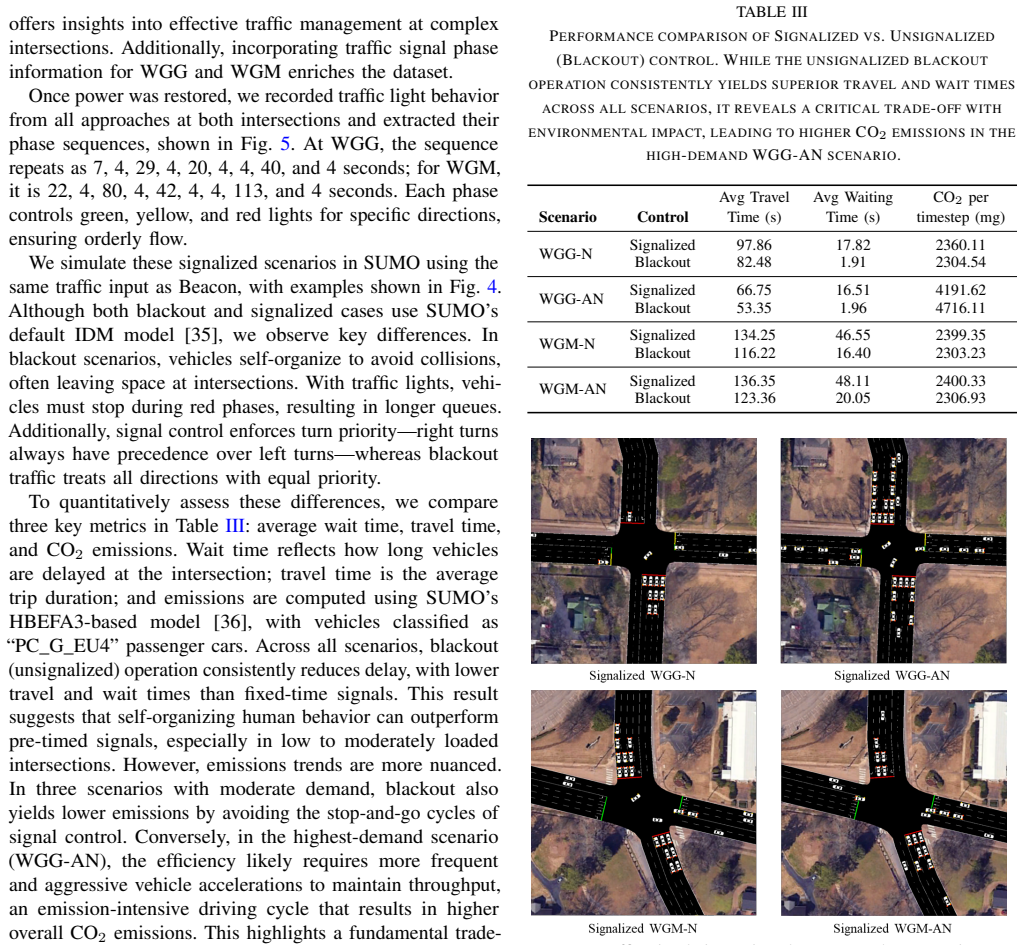
The authors' central claim is that Beacon provides the first empirical benchmark of intersection traffic during blackouts, and that this benchmark supports high-fidelity reconstruction and useful control analysis. The reconstruction pipeline takes each vehicle's origin lane, destination lane, and head-of-queue timestep from the dataset, builds routes, and replays them in a microscopic traffic simulator; the reported match rates are over 98% at the simpler intersection and above 91% at the more complex one, with zero start-lane mismatches and small end-lane and timestep mismatches. With the same traffic demand, unsignalized blackout operation shows lower average wait and travel times than fixed-time signal control in all four scenarios. In mixed-traffic experiments, robot vehicles trained with a stop/go deep reinforcement learning policy reduce wait times by up to 82.6% in high-demand cases, while CO2 emissions can rise even as delays fall, because maintaining throughput requires more frequent acceleration. The authors also document signal phase timing after power restoration, enabling the signalized versus blackout comparisons.
Load-bearing premise
The simulation results rest on the assumption that the traffic simulator's default driver model behaves like real drivers at a dark, signal-less intersection; if real blackout driving differs, the reported match rates and wait-time improvements are simulator artifacts.
Editorial extensions
If this is right
- Beacon gives reconstruction researchers a four-scenario benchmark with known route-level ground truth, so any future method can be scored against the same start-lane, end-lane, and timestep match rates.
- At moderately loaded intersections, self-organizing blackout traffic can achieve lower average wait and travel times than fixed-time signal control, which suggests signals are not automatically the best fallback during an outage.
- Robot-vehicle coordination can reduce wait times by up to 82.6% in high-demand blackout scenarios, and the benefit increases with demand and penetration, pointing toward adaptive, demand-aware deployment of robot vehicles rather than uniform use.
- Efficiency and emissions do not move together in the reconstructed scenarios: lower idling can coincide with higher CO2 emissions under heavy demand, so mixed-traffic control should be evaluated on emissions as well as delay.
Reading between the lines
- Because the dataset records only origin/destination lanes and head-of-queue timesteps rather than continuous per-frame trajectories, the reported 'high-fidelity' reconstruction is route-level fidelity; adding video-based per-frame tracking at the same intersections would let future work test whether the simulator's internal lane-changing and gap acceptance match real blackout driving.
- The finding that unsignalized self-organization beats pre-timed signals on delay suggests a testable extension the paper does not run: adaptive or demand-responsive signal timing, or a dynamic all-way-stop protocol, might capture part of that gain without robot vehicles.
- The robot-vehicle policy was trained against the simulator's default human-driver model, so the 82.6% wait-time improvement should be re-tested with a human-driver model calibrated to blackout-specific behavior before being read as a field-ready estimate.
- The CO2 trade-off implies that emission metrics sensitive to acceleration should be standard in mixed-traffic control benchmarks; delay-only evaluations may systematically understate the environmental cost of throughput-oriented policies.
Signed reviews
Editorial analysis
A structured set of objections, weighed in public.
Referee Report
Summary. The paper introduces Beacon, a manually annotated four-hour naturalistic driving dataset collected during a blackout at two signalized intersections in Memphis, TN, covering four one-hour scenarios (WGG-N, WGG-AN, WGM-N, WGM-AN) with per-vehicle start lane, end lane, and timestep data. The authors use the dataset to reconstruct the blackout traffic in SUMO, compare blackout operation against signalized operation, and evaluate mixed traffic control with robot vehicles trained via Rainbow DQN. The central claims are that the reconstruction achieves match rates above 91% (over 98% at WGG), that blackout operation reduces delays relative to fixed-time signals, and that RV coordination reduces wait times by up to 82.6%, with a trade-off of increased CO2 emissions in some high-demand scenarios. The manuscript also releases the dataset on GitHub.
Significance. If the dataset is released as described, Beacon is a plausible first-of-its-kind public resource for studying unsignalized intersection behavior during infrastructure failures. The manual annotation of four hours of lane-level origin/destination and timestep data at two real intersections is nontrivial, and the statistical-stability check in Figure 2 supports the representativeness of the one-hour windows. The paper's contribution is therefore real and useful for benchmarking traffic reconstruction and control under blackout conditions. The downstream simulation claims, however, are currently stronger than the evidence: reconstruction is validated only on route-level metadata, not on driving behavior, and the control results are produced and evaluated inside the same uncalibrated simulation environment. The dataset contribution should survive a revision that aligns the claims with the evidence.
major comments (4)
- [Section IV, Table II] The reported match rates validate only route-level metadata—start lane, end lane, and timestep at the head of the start lane—and the paper explicitly states that continuous per-frame positions are unavailable. Consequently, the claim of 'high-fidelity reconstruction' in the abstract and Section VII is stronger than what the evaluation supports: nothing in Table II checks car-following, gap acceptance, turning speeds, yielding, or lane-changing against the videos. This is load-bearing because Sections V and VI draw behavioral conclusions from the same SUMO environment; I recommend reframing the claim as route and timing consistency and adding an explicit limitation that driving behavior itself is not validated.
- [Section VI, Table VI, Figure 7, Abstract] The headline 82.6% wait-time reduction is internally inconsistent. Table VI yields 82.6% as (6.48−1.13)/6.48 for the WGG 25% demand-increase scenario at 80% RV penetration, whereas the Figure 7 caption attributes the same value to WGM-AN at 100% RVs; Table V gives a 93.5% reduction for that case (1.06 s vs 16.21 s). The abstract also presents 82.6% without saying that it comes from a synthetic 25% demand increase rather than the observed blackout demand. Please correct the attribution and state the scenario, penetration rate, and baseline in every occurrence.
- [Section VI] The RL evaluation reports a single training run with no random seeds, error bars, or sensitivity analysis. Because the reward function is designed to reduce wait times and delays, and the reported headline metric is wait time, the qualitative direction of the result is partly built into the objective; without variance across seeds and ablations (e.g., reward weights, the 30 m decision distance, network architecture), the quantitative claims such as 82.6% and the travel-time/emissions trade-offs are not established as robust.
- [Section V, Tables III and IV] The signalized-versus-blackout comparison in Table III is produced entirely with SUMO's default IDM and is validated only by end-lane match rates (Table IV), not by any behavioral measure. The conclusion that 'self-organizing human behavior can outperform pre-timed signals' is therefore a simulator property claim unless the IDM parameters are calibrated to the Beacon videos or the claim is softened to 'in this simulation environment.' The same concern applies to the RV results in Section VI, which use the same uncalibrated human-vehicle model.
minor comments (6)
- [Section III.B.2] The word 'trajectories' is misleading because the dataset does not contain continuous vehicle trajectories; consider using 'movements' or 'turning movements' to match the actual data format.
- [Tables I and II] Table II reports 1,962 vehicles for WGG-N, 2,452 for WGG-AN, and 2,032 for WGM-N, while Table I reports 1,983, 2,453, and 2,033; the differences are not explained and should be clarified.
- [Table IV] The signalized simulation for WGG-AN uses 2,135 vehicles, a drop of 317 from the blackout reconstruction count of 2,452; please explain why this scenario has fewer vehicles.
- [Tables III and V] The emission units are inconsistent: Table III reports 'CO2 per timestep (mg)' while Table V reports 'CO2 Emissions (mg/s)'; please align the units and define the reporting interval.
- [Section VI] There is a typo 'upto' in the sentence reporting the 82.6% reduction; the related-work section also uses inconsistent spacing in 'A V'/'AV'.
- [Section V] The claim that 'right turns always have precedence over left turns' under signal control is stated without qualification; please specify whether this is for the right-turn-on-red phasing or the general SUMO behavior model, since real-world signal timing can differ.
Circularity Check
Beacon is a real empirical dataset, but the headline reconstruction and RV-control numbers are partly circular: the reconstruction validation re-checks the same start/timestep fields used to build the routes, and the 82.6% wait-time gain is the RL reward objective being optimized in the same simulator.
-
fitted input called prediction
[Section IV (Traffic Reconstruction), Table II]
"From Beacon, we extract each vehicle’s start lane, end lane, and the timestep when it reaches the head of its starting lane to form its route. This information is then used in SUMO to simulate and reconstruct traffic flow. ... To evaluate the accuracy of our traffic reconstruction, we compare the reconstructed traffic in SUMO with the recorded data. ... First, no mismatches are found with respect to the start lane."
The route file is built from Beacon's start lanes, end lanes, and timesteps, and those same Beacon fields are used as the ground truth for the Table II match rates. The zero start-lane mismatch is guaranteed by construction, so the reported >91% match rates mainly measure whether SUMO preserved the route file's imported start-lane and timestep information. The paper concedes that per-frame positions, which would test whether the simulated driving actually matches the videos, are unavailable. The 'high-fidelity reconstruction' claim is therefore a self-consistency check against the dataset's own inputs rather than an independent validation of SUMO's ability to reproduce real blackout driving behavior.
-
self definitional
[Section VI (Mixed Traffic Control), Table VI and Figure 7]
"The reward function R(s, a) is designed to improve throughput and reduce delays. ... WITH 25% HIGHER DEMAND , 80% RV PENETRATION CUTS WAIT TIME FROM 6.48 S TO 1.13 S ..."
The headline 'wait time improvements of up to 82.6%' is computed on the same quantity that the reinforcement-learning reward is designed to minimize: the reward targets delay reduction, and the reported metric is wait time in the same SUMO environment. Reporting that the trained RV policy cuts wait time is therefore an in-sample optimization result, not an independent empirical prediction about real blackout traffic. The headline number is also internally inconsistent: Table VI locates the 82.6% reduction at WGG under a synthetic 25% demand increase, while Figure 7's caption attributes the same 82.6% value to WGM-AN at 100% RV penetration, which weakens the construction claim further.
full rationale
Beacon itself is an empirical, first-of-its-kind dataset with manually annotated start/end lanes and timesteps at two blackout-affected Memphis intersections; that contribution is not circular and survives the analysis. The circularity concerns are limited to two utility claims. First, the reconstruction validation in Section IV feeds Beacon routes into SUMO and then scores the simulation against the same Beacon fields: start-lane mismatch is zero by construction, and the timestep is also an imported input, so the Table II match rates are largely a simulator route-execution self-check. Second, the 82.6% wait-time improvement is the output of a reward function explicitly designed to reduce delay, evaluated on wait time in the same simulator, making the headline control result an in-sample optimization outcome rather than an independently verified traffic finding. The paper's own limitation statement that continuous per-frame positions are unavailable directly supports the first point. The signalized-versus-blackout comparison and the CO2 trade-off are not circular because those metrics (signal phases, HBEFA3 emissions) come from independent inputs, though they inherit the correctness risk of SUMO's unvalidated default IDM. Self-citations to Wang et al., Poudel et al., and Islam et al. are context for the mixed-control method and are not load-bearing evidence for the reconstruction or the 82.6% number. Overall score 6: the dataset is genuine, but two headline 'predictions' partially reduce to their own inputs or objective by construction.
Assumptions & free parameters
free parameters (5)
- RV penetration rate for case study =
60% (also scanned 0-100%)
- RL hyperparameters =
learning rate 5e-4, discount 0.99, 1000 iterations, 512 units/layer
- RV decision distance threshold =
30m
- Demand scaling factors =
25% and 50% increases over WGG-AN
- Vehicle emission class =
PC_G_EU4 (HBEFA3)
assumptions (6)
- domain assumption SUMO's Intelligent Driver Model (IDM) with default parameters realistically models human driving at unsignalized intersections.
- domain assumption Manual annotation of start lanes, end lanes, and timesteps from video is accurate and complete.
- domain assumption The one-hour observation windows are representative of typical peak-hour traffic at these intersections.
- domain assumption The recorded signal phase sequences accurately represent the signalized condition after power restoration.
- domain assumption HBEFA3 emissions model with vehicle class PC_G_EU4 correctly estimates CO2 for the simulated fleet.
- domain assumption The Rainbow DQN policy trained for 1,000 iterations has converged and generalizes to the scenarios reported.
Cite this review
Pith. "Pith review of Beacon: A Naturalistic Driving Dataset During Blackouts for Benchmarking Traffic Reconstruction and Control." pith.science (2026). https://pith.science/paper/V33DQAQD
@misc{pith2026241214208,
  author       = {Pith},
  title        = {Pith review of: Beacon: A Naturalistic Driving Dataset During Blackouts for Benchmarking Traffic Reconstruction and Control},
  year         = {2026},
  howpublished = {\url{https://pith.science/paper/V33DQAQD}},
  note         = {Machine review of arXiv:2412.14208}
}
read the original abstract
Extreme weather and infrastructure vulnerabilities pose significant challenges to urban mobility, particularly at intersections where signals become inoperative. To address this growing concern, we introduce Beacon, a naturalistic driving dataset capturing traffic dynamics during blackouts at two major intersections in Memphis, TN, USA. The dataset provides detailed traffic movements, including timesteps, origin, and destination lanes for each vehicle over four hours of peak periods. We analyze traffic demand, vehicle trajectories, and density across different scenarios, demonstrating high-fidelity reconstruction under unsignalized, signalized, and mixed traffic conditions. We find that integrating robot vehicles (RVs) into traffic flow can substantially reduce intersection delays, with wait time improvements of up to 82.6%. However, this enhanced traffic efficiency comes with varying environmental impacts, as decreased vehicle idling may lead to higher overall CO2 emissions. To the best of our knowledge, Beacon is the first publicly available traffic dataset for naturalistic driving behaviors during blackouts at intersections.
Figures


Figures from the paper (3 more)


Reference graph
Works this paper leans on
-
[1]
Power still out to 50k customers, days after memphis storm,
A. Press, “Power still out to 50k customers, days after memphis storm,” https://www.usnews. com/news/best-states/tennessee/articles/2022-02-07/ power-still-out-to-60k-customers-days-after-memphis-storm, Feb. 2022
work page 2022
-
[2]
Crash factors in intersection-related crashes: An on-scene perspective,
E.-H. Choi, “Crash factors in intersection-related crashes: An on-scene perspective,” National Highway Traffic Safety Administration, U.S. Department of Transportation , 2010
work page 2010
-
[3]
B. Winck, “Get ready for blackouts from london to la, as the global energy crisis overwhelms grids and sends energy prices skyrocketing,” https://www.businessinsider.com/global- europe-energy-crisis-power-electricity-outages-blackouts -energy-grid-2022-9, Sept. 2022
work page 2022
-
[4]
Power outages are on the rise, led by texas, michigan and california. here’s what’s to blame,
R. Ramirez, “Power outages are on the rise, led by texas, michigan and california. here’s what’s to blame,” https://www.cnn.com/2022/09/ 14/us/power-outages-rising-extreme-weather-climate/index.html, Sept. 2022
work page 2022
-
[5]
Trajectory data reconstruction and simulation-based validation against macroscopic traffic patterns,
M. Montanino and V . Punzo, “Trajectory data reconstruction and simulation-based validation against macroscopic traffic patterns,” Trans- portation Research Part B: Methodological , vol. 80, pp. 82–106, 2015
work page 2015
-
[6]
Data-Driven Traffic Reconstruction and Kernel Methods for Identifying Stop-and-Go Congestion
E. R. Sanchez, S. Raghavan, and C. Wu, “Data-driven traffic recon- struction and kernel methods for identifying stop-and-go congestion,” arXiv preprint arXiv:2312.03186 , 2023
work page Pith review arXiv 2023
-
[7]
City-scale traffic animation using statistical learning and metamodel-based optimization,
W. Li, D. Wolinski, and M. C. Lin, “City-scale traffic animation using statistical learning and metamodel-based optimization,” ACM Trans. Graph., vol. 36, no. 6, pp. 200:1–200:12, 2017
work page 2017
-
[8]
Sind: A drone dataset at signalized intersection in china,
Y . Xu, W. Shao, J. Li, K. Yang, W. Wang, H. Huang, C. Lv, and H. Wang, “Sind: A drone dataset at signalized intersection in china,” in 2022 IEEE 25th International Conference on Intelligent Transportation Systems (ITSC). IEEE, 2022, pp. 2471–2478
2022
Show all 39 references
-
[9]
Presenting the multi-view traffic intersection dataset (mtid): A detailed traffic- surveillance dataset,
M. B. Jensen, A. Møgelmose, and T. B. Moeslund, “Presenting the multi-view traffic intersection dataset (mtid): A detailed traffic- surveillance dataset,” in 2020 IEEE 23rd International Conference on Intelligent Transportation Systems (ITSC) . IEEE, 2020, pp. 1–6
2020
-
[10]
V2x-seq: A large-scale sequential dataset for vehicle-infrastructure cooperative perception and forecasting,
H. Yu, W. Yang, H. Ruan, Z. Yang, Y . Tang, X. Gao, X. Hao, Y . Shi, Y . Pan, N. Sun, et al. , “V2x-seq: A large-scale sequential dataset for vehicle-infrastructure cooperative perception and forecasting,” in Proceedings of the IEEE/CVF Conference on Computer Vision and Patter...
2023
-
[11]
Mapping the knowledge of traffic collision reconstruction: A scientometric analysis in citespace, vosviewer, and scimat,
Z. Shen, W. Ji, S. Yu, G. Cheng, Q. Yuan, Z. Han, H. Liu, and T. Yang, “Mapping the knowledge of traffic collision reconstruction: A scientometric analysis in citespace, vosviewer, and scimat,” Science & Justice, vol. 63, no. 1, pp. 19–37, 2023
2023
-
[12]
Scenarionet: Open-source platform for large-scale traffic scenario simulation and modeling,
Q. Li, Z. M. Peng, L. Feng, Z. Liu, C. Duan, W. Mo, and B. Zhou, “Scenarionet: Open-source platform for large-scale traffic scenario simulation and modeling,” Advances in neural information processing systems, vol. 36, 2024
2024
-
[13]
Scalability in perception for autonomous driving: Waymo open dataset,
P. Sun, H. Kretzschmar, X. Dotiwalla, A. Chouard, V . Patnaik, P. Tsui, J. Guo, Y . Zhou, Y . Chai, B. Caine, et al., “Scalability in perception for autonomous driving: Waymo open dataset,” in Proceedings of the IEEE/CVF conference on computer vision and pattern recognition , ...
2020
-
[14]
nuscenes: A multimodal dataset for autonomous driving,
H. Caesar, V . Bankiti, A. H. Lang, S. V ora, V . E. Liong, Q. Xu, A. Krishnan, Y . Pan, G. Baldan, and O. Beijbom, “nuscenes: A multimodal dataset for autonomous driving,” in Proceedings of the IEEE/CVF conference on computer vision and pattern recognition , 2020, pp. 11 621–11 631
2020
-
[15]
Argoverse: 3d tracking and forecasting with rich maps,
M.-F. Chang, J. Lambert, P. Sangkloy, J. Singh, S. Bak, A. Hartnett, D. Wang, P. Carr, S. Lucey, D. Ramanan, et al., “Argoverse: 3d tracking and forecasting with rich maps,” in Proceedings of the IEEE/CVF conference on computer vision and pattern recognition , 2019, pp. 8748–8757
2019
-
[16]
Metadrive: Composing diverse driving scenarios for generalizable reinforcement learning,
Q. Li, Z. Peng, L. Feng, Q. Zhang, Z. Xue, and B. Zhou, “Metadrive: Composing diverse driving scenarios for generalizable reinforcement learning,” IEEE Transactions on Pattern Analysis and Machine Intelligence, 2022
2022
-
[17]
Vista 2.0: An open, data-driven simulator for multimodal sensing and policy learning for autonomous vehicles,
A. Amini, T.-H. Wang, I. Gilitschenski, W. Schwarting, Z. Liu, S. Han, S. Karaman, and D. Rus, “Vista 2.0: An open, data-driven simulator for multimodal sensing and policy learning for autonomous vehicles,” in 2022 International Conference on Robotics and Automation (ICRA) . I...
2022
-
[18]
Autoware: Open-source software for urban autonomous driving,
“Autoware: Open-source software for urban autonomous driving,” https: //github.com/CPFL/Autoware, accessed: 2024-08-26
2024
-
[19]
Traffic flow reconstruction by solving indeterminacy on traffic distribution at junctions,
S. Bilotta and P. Nesi, “Traffic flow reconstruction by solving indeterminacy on traffic distribution at junctions,” Future Generation Computer Systems, vol. 114, pp. 649–660, 2021
2021
-
[20]
Vehicle trajectory reconstruction on urban traffic network using automatic license plate recognition data,
X. Qi, Y . Ji, W. Li, and S. Zhang, “Vehicle trajectory reconstruction on urban traffic network using automatic license plate recognition data,” IEEE Access, vol. 9, pp. 49 110–49 120, 2021
2021
-
[21]
Measurements of urban traffic parameters before and after road reconstruction,
A. Bakowski and L. Radziszewski, “Measurements of urban traffic parameters before and after road reconstruction,” Open Engineering, vol. 11, no. 1, pp. 365–376, 2021
2021
-
[22]
Numerical investigation of traffic state reconstruction and control using connected automated vehicles,
M. ˇCiˇci´c, M. Barreau, and K. H. Johansson, “Numerical investigation of traffic state reconstruction and control using connected automated vehicles,” in 2020 IEEE 23rd International Conference on Intelligent Transportation Systems (ITSC) . IEEE, 2020, pp. 1–6
2020
-
[23]
Flow: A modular learning framework for mixed autonomy traffic,
C. Wu, A. R. Kreidieh, K. Parvate, E. Vinitsky, and A. M. Bayen, “Flow: A modular learning framework for mixed autonomy traffic,” IEEE Transactions on Robotics , vol. 38, no. 2, pp. 1270–1286, 2022
2022
-
[24]
Connected autonomous vehicles for improving mixed traffic efficiency in unsignal- ized intersections with deep reinforcement learning,
B. Peng, M. F. Keskin, B. Kulcsár, and H. Wymeersch, “Connected autonomous vehicles for improving mixed traffic efficiency in unsignal- ized intersections with deep reinforcement learning,” Communications in Transportation Research, vol. 1, p. 100017, 2021
2021
-
[25]
Reinforcement learning for mixed autonomy intersections,
Z. Yan and C. Wu, “Reinforcement learning for mixed autonomy intersections,” in IEEE International Intelligent Transportation Systems Conference, 2021, pp. 2089–2094
2021
-
[26]
Learning to control and coordinate hybrid traffic through robot vehicles at complex and unsignalized intersections,
D. Wang, W. Li, L. Zhu, and J. Pan, “Learning to control and coordinate hybrid traffic through robot vehicles at complex and unsignalized intersections,” arXiv preprint arXiv:2301.05294 , 2023
2023 arXiv
-
[27]
Large-scale mixed traffic control using dynamic vehicle routing and privacy-preserving crowdsourcing,
D. Wang, W. Li, and J. Pan, “Large-scale mixed traffic control using dynamic vehicle routing and privacy-preserving crowdsourcing,” arXiv preprint arXiv:2311.11347, 2023
2023 arXiv
-
[28]
Mixed traffic control and coordination from pixels,
M. Villarreal, B. Poudel, J. Pan, and W. Li, “Mixed traffic control and coordination from pixels,” arXiv preprint arXiv:2302.09167 , 2023
2023 arXiv
-
[29]
Carl: Congestion-aware reinforcement learning for imitation-based perturbations in mixed traffic control,
B. Poudel, W. Li, and S. Li, “Carl: Congestion-aware reinforcement learning for imitation-based perturbations in mixed traffic control,” International Conference on CYBER Technology in Automation, Control, and Intelligent Systems (CYBER) , 2024
2024
-
[30]
Endurl: Enhancing safety, stability, and efficiency of mixed traffic under real-world perturbations via rein- forcement learning,
B. Poudel, W. Li, and K. Heaslip, “Endurl: Enhancing safety, stability, and efficiency of mixed traffic under real-world perturbations via rein- forcement learning,” IEEE/RSJ International Conference on Intelligent Robots and Systems (IROS) , 2024
2024
-
[31]
Heterogeneous mixed traffic control and coordination,
I. Islam, W. Li, S. Li, and K. Heaslip, “Heterogeneous mixed traffic control and coordination,” arXiv preprint arXiv:2409.12330 , 2024
2024 arXiv
-
[32]
Waterloo multi-agent traffic dataset: Intersection,
W. I. S. E. Lab, “Waterloo multi-agent traffic dataset: Intersection,” https://uwaterloo.ca/waterloo-intelligent-systems-engineering-lab/ datasets/waterloo-multi-agent-traffic-dataset-intersection, 2021, accessed: 2025-07-13
2021
-
[33]
Openstreetmap,
OpenStreetMap contributors, “Openstreetmap,” https://www. openstreetmap.org, 2013, accessed: 2023-03-25
2013
-
[34]
Microscopic traffic simulation using sumo,
P. A. Lopez, M. Behrisch, L. Bieker-Walz, J. Erdmann, Y .-P. Flötteröd, R. Hilbrich, L. Lücken, J. Rummel, P. Wagner, and E. Wießner, “Microscopic traffic simulation using sumo,” in The 21st IEEE International Conference on Intelligent Transportation Systems . IEEE,
-
[35]
Congested traffic states in empirical observations and microscopic simulations,
M. Treiber, A. Hennecke, and D. Helbing, “Congested traffic states in empirical observations and microscopic simulations,” Physical review E, vol. 62, no. 2, p. 1805, 2000
2000
-
[36]
Hbefa3-based,
SUMO, “Hbefa3-based,” 2024, accessed: 2025-02-12. [Online]. Available: https://sumo.dlr.de/docs/Models/Emissions/HBEFA3-based. html
2024
-
[37]
Examining the effects of geometric features, traffic control, and traffic volume on crash frequency at urban intersections,
M. Wisal Khattak, A. Pirdavani, P. De Winne, T. Brijs, and H. De Backer, “Examining the effects of geometric features, traffic control, and traffic volume on crash frequency at urban intersections,” in International Conference on Transportation and Development 2020 . American ...
2020
-
[38]
Rainbow: Combining improvements in deep reinforcement learning,
M. Hessel, J. Modayil, H. Van Hasselt, T. Schaul, G. Ostrovski, W. Dabney, D. Horgan, B. Piot, M. Azar, and D. Silver, “Rainbow: Combining improvements in deep reinforcement learning,” in AAAI Conference on Artificial Intelligence , 2018
2018
-
[2018]
Available: https://elib.dlr.de/124092/
[Online]. Available: https://elib.dlr.de/124092/
Reviewed August 11, 2026 · model on record in the stance chip above.
Discussion (0). Continue with ORCID to comment.