REVIEW 4 major objections 5 minor 42 references
Image Regeneration: Evaluating Text-to-Image Model via Generating Identical Image with Multimodal Large Language Models
T0 review · 4 major / 5 minor · reviewed 2026-08-12 · deepseek-v4-flash
Pith's one-line read The paper claims that a text-to-image model is best judged by asking it to reproduce a reference image and comparing image to image, rather than matching output text to prompt.
desk verdict The regeneration-task idea is genuinely new and worth discussing, but the selection-and-score loop uses the same metrics twice, so the reported rankings don't cleanly support the human-alignment claims. read the letter →
The pith
A machine-rendered reading of the paper's core claim, the machinery that carries it, and where it could break.
The reading
What carries the argument
ImageRepainter's load-bearing component is the image understanding tree (IUT): a hierarchical JSON-like description of the reference image extracted by GPT-4V, containing the overall caption, global features, objects, object relations, and per-object detailed attributes. The framework then runs an iterative loop of prompt expansion, image generation, candidate selection, feedback generation, and prompt revision, using CLIP and DINOv2 for coarse semantic and visual similarity and GPT-4V for fine-grained content and perceptual scoring. IUT supplies the richer, more accurate text that lets a T2I model approach the reference, while the selection and feedback cycle stabilizes generation and concentrates each revision on one aspect such as style, color, or detail per iteration.
What would settle it
Run the ImageRepainter pipeline on a fixed set of reference images but replace the image-selection step with random selection from the same candidates; if the resulting model rankings roughly match the reported ones, selection is not inflating scores, but if they diverge, the metric is measuring search effort. Additionally, a larger pairwise human study asking which of two regenerations better matches the reference would either confirm or weaken the claimed alignment with human perception.
Extended reading notes
Core claim
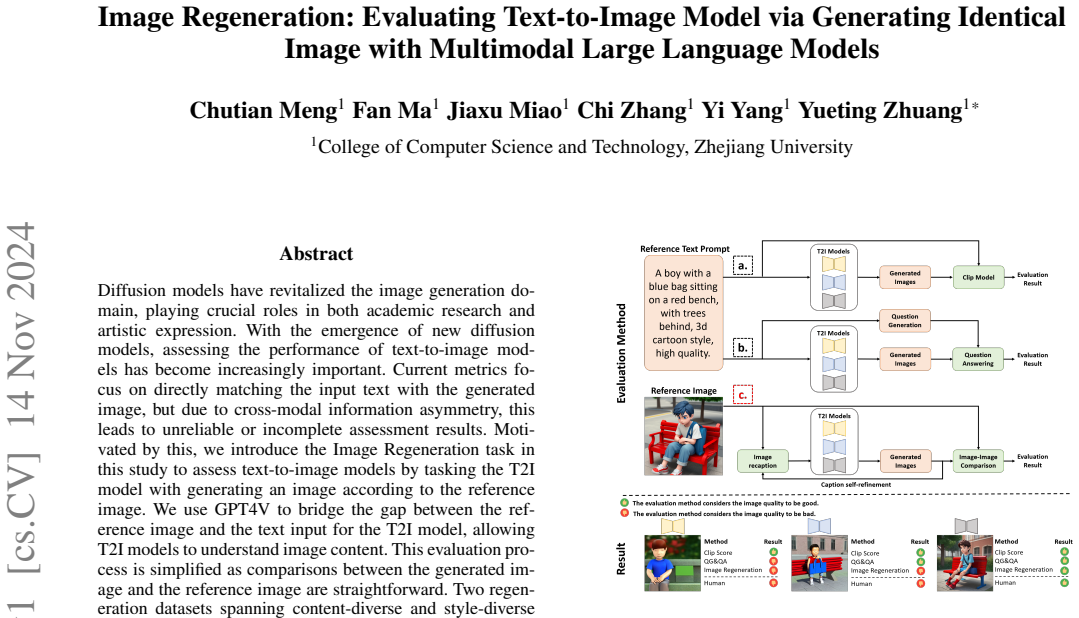
The central claim is that a reference image, not a text prompt, is the right probe for measuring what a text-to-image model can generate: a good model should be able to reproduce the content and style of a given image after that image is translated into text through a multimodal large language model. The paper supports this with the ImageRepainter framework, whose Image Understanding Tree (IUT) organizes reference-image details into a hierarchy of overall features, objects, relationships, and fine attributes; an iterative loop then generates multiple synonymous prompts, produces candidate images, selects the best by CLIP, DINOv2, and GPT-4V similarity, and revises the prompt based on observed differences. On two new benchmarks, content-diverse and style-diverse, the paper reports that this visual-to-visual regeneration ranks models such as SD1.4, SD1.5, SD2.0, SDXL1.0, and JuggernautXLv1/v9 in closer agreement with human perception than existing text-image alignment metrics.
Load-bearing premise
The evaluation assumes that selecting the best of several candidate images and then scoring it with the same metrics measures the generation model's capability, not the evaluator's search effort.
Editorial extensions
If this is right
- If the image-regeneration protocol is accepted, T2I models can be ranked by reference-image reproduction without relying on any text-image alignment metric.
- The iterative ImageRepainter pipeline yields higher CLIP, DINOv2, and GPT-4V regeneration scores than using CLIP-interrogator captions, for both content and style.
- The content-diverse benchmark ranks the evaluated diffusion models in closer agreement with user-study Likert ratings than T2I-CompBench or PickScore do.
- Iterative revision matters more for weaker models, while stronger models like JuggernautXLv9 can produce similar-quality images with fewer iterations, suggesting the protocol can also expose generation consistency.
Reading between the lines
- Beyond the paper: because the selection step uses the same CLIP, DINOv2, and GPT-4V metrics as the final score, a model with high output diversity may be advantaged even if a single random sample is mediocre; a paired experiment with fixed inference budget could separate generation ability from search efficiency.
- Beyond the paper: the IUT prompt-revision loop could double as a benchmark for prompt engineering itself, since a robust T2I model should recover a reference image under many synonymous phrasings of the same content.
- Beyond the paper: the claimed visual-to-visual advantage could be stress-tested by injecting small edits into the reference image and measuring whether the regeneration scores respond proportionally, which would reveal how sensitive the protocol really is to fine-grained detail.
Editorial analysis
A structured set of objections, weighed in public.
Referee Report
Summary. The paper proposes a new evaluation protocol for text-to-image (T2I) models, called image regeneration: given a reference image, an MLLM (GPT-4V) converts it into a text prompt (organized as an Image Understanding Tree, IUT), the T2I model generates an image, and the regenerated image is compared with the reference using CLIP, DINOv2, and GPT-4V scores. The authors introduce ImageRepainter, an iterative framework that revises prompts and selects the highest-scoring candidate across iterations, and two benchmarks (content-diverse and style-diverse) for evaluation. They report that their method ranks models more consistently with a user study than existing text-image alignment metrics such as T2I-CompBench, HPSv2, and PickScore, and claim that visual-to-visual assessment better aligns with human perception.
Significance. If validated, the image regeneration task would provide a genuinely new paradigm for T2I evaluation that removes the cross-modal asymmetry of text-image matching, and the IUT-based prompt construction plus iterative refinement is a reasonable way to operationalize the task. The paper also proposes two diverse benchmarks and compares a range of recent diffusion models, including community fine-tunes, which is useful for the community. The central weakness is that the same metrics used to select the best candidate are then used as the final evaluation score, so the reported rankings may partly reflect the search effort of the framework rather than the generative capability of the T2I model; furthermore, the claimed human alignment is not directly supported by the described user study. The paper does not release datasets or code, which limits reproducibility.
major comments (4)
- [Methodology, 'Image selection' and 'Evaluation Metrics'] The selection step and the evaluation step use exactly the same three metrics: CLIP, DINOv2, and GPT-4V. In the 'Image selection' paragraph, the framework selects the highest-scoring image among N_t candidates using these metrics; in 'Evaluation Metrics', the final score for a model is computed with the same metrics on the selected image. Consequently, the reported score is a best-of-N maximum over a model-dependent candidate set, not a typical sample from the model. For a model with higher output diversity, or with outputs that are more easily improved by the GPT-4V-based prompt revision loop, the selection gain will be larger regardless of average single-image regeneration quality. The paper's own iteration ablation (Figure 9) states that weaker or more seed-sensitive models benefit more from iterations, so the gain is not uniform across models. The authors should report the score at the first iteration, the average score over all candidates, or a held-out metric not used in selection, and explicitly quantify the selection gain. Without this separation, the rankings in Table 1 cannot be attributed to the T2I model's generative ability alone.
- [Experiments, 'Human evaluation' and Table 1] The user study is described as rating content consistency and perceptual quality of 'text-image pairs' following the ImagenHub template, i.e., standard text-to-image alignment judgments. This does not directly evaluate the regeneration outputs against the reference images, which is the actual claim of the paper. The assertion that 'image regeneration for evaluation aligns more closely with human annotations' (Section 'Evaluating T2I Models') is therefore not substantiated by the reported experiment. The authors should either conduct a human study in which annotators compare regenerated images with the reference image, or at least compute a correlation (e.g., Spearman rank correlation) between the regeneration scores and human preference scores on the same set of model outputs. A qualitative statement in the text and a visual inspection of a few cases are not sufficient to support the human-alignment claim.
- [Table 1, Table 2, Table 3] No variance or statistical significance is reported for any of the main evaluation tables. The datasets contain 100 or 200 samples, so the CLIP/DINO/GPT-4V scores presumably have non-negligible sampling error; moreover, the reported differences between some models are small (e.g., SD1.5 vs SD2.0 in Table 1). The authors should report standard deviations, confidence intervals, or significance tests (e.g., bootstrap or paired tests) to establish that the observed rankings are not noise. This is particularly important because the paper's central claim is that its method can distinguish T2I models more effectively than existing metrics.
- [Evaluation Datasets] The two benchmarks are described only briefly and are not released, and no code is provided for IUT construction or the iterative selection procedure. The paper states that the content-diverse benchmark is 'manually collected through an open-source creation platform' and normalized using ChatGPT, but gives no URLs, license information, or detailed statistics beyond Figure 5. Without the actual datasets or a detailed construction protocol, the quantitative results cannot be reproduced or compared against in future work. The authors should release the benchmarks and code, or at least provide full prompt templates, sample images, and the complete list of text prompts used.
minor comments (5)
- [Abstract and Contributions] There are several typos: 'multimodel' should be 'multimodal', 'T2M' should be 'T2I', and 'mutimodel' in the contributions list should be 'multimodal'.
- [Conclusion] The phrase 'more insensitive to fine-grained information' is awkward and presumably means 'less sensitive to fine-grained information' or 'more robust to fine-grained variations'; please rephrase.
- [Methodology, 'Feedback generation'] The text says 'perceputual information', which should be 'perceptual information'.
- [Implementation Details] The authors state they use 'ChatGPT' for pure text tasks and specifically 'text-davinci-003'; text-davinci-003 is an InstructGPT model, not ChatGPT, and the terminology should be corrected for accuracy.
- [Figure 7 and Table 3] The DINO score for JuggerXL v9 'Direct' in Table 3 is 94.83, but the text and Figure 7 plots would benefit from a consistent formatting of decimal points (the table uses 94.83 and the figure uses 94.83%, which is fine); more importantly, the caption of Figure 7 says 'a significant improvement', but no statistical test is provided to support 'significant'.
Circularity Check
Selection-oracle circularity: the same CLIP/DINOv2/GPT-4V metrics that select the best candidate also produce the final evaluation score, so reported regeneration scores are selected maxima and partly reflect search effort rather than pure generative capability.
-
fitted input called prediction
[Methodology, 'Iterative Generation' > 'Image selection'; Experiments, 'Evaluation Metrics']
"Image selection. CLIP, DINOv2, GPT4v is used to assess the similarity between Nt images and the reference image, selecting the highest scoring image and prompt. ... Evaluation Metrics: We use CLIP (Radford et al. 2021), DINOv2 (Oquab et al. 2024), and GPT4v."
The same three measures (CLIP, DINOv2, and GPT-4V) that choose the best candidate during Image selection are subsequently reported as the model's regeneration scores in Evaluation Metrics. Therefore the final score is, by construction, the maximum of the Nt candidate scores under those measures, not an average or a typical sample from the model. The paper's own iteration ablation (Figure 9) states that iteration helps weaker or more seed-sensitive models more, so this selection gain is model-dependent. Reported rankings thus conflate the T2I model's generative ability with the framework's search and diversity benefit, and the human study does not break the loop because it rates text-image pairs rather than the selected regeneration outputs against reference images.
full rationale
The paper's central 'Image Regeneration' proposal is an empirical evaluation protocol rather than a mathematical derivation, and most components (IUT construction, benchmark curation, comparison against CLIP-interrogator) are independent of the conclusion. However, there is one genuine self-referential loop: the 'Image selection' step uses CLIP, DINOv2, and GPT-4V similarity to choose the best of Nt generated images, and the 'Evaluation Metrics' step then reports those same CLIP, DINOv2, and GPT-4V similarity values as the model's regeneration score. The final score is therefore a best-of-N maximum under the same oracle that performed the selection, so it is forced upward by construction and conflates the T2I model's generative ability with the framework's search effort. The paper's own ablation confirms that iteration helps weaker or more seed-sensitive models more, so the selection gain is not uniform across models and can change rankings. The human user study provides some external grounding for the overall ranking claim, but it rates text-image pairs rather than the selected regeneration outputs against reference images, so it does not directly validate that these selected maxima align with human perception. No load-bearing self-citation chain or imported uniqueness theorem is present; the remaining claims are self-contained. Overall, this is a partial, not total, circularity.
Assumptions & free parameters
assumptions (5)
- domain assumption GPT-4V provides accurate and sufficiently detailed descriptions of reference images via the IUT template.
- domain assumption CLIP, DINOv2, and GPT-4V similarity scores are valid proxies for human perceptual and content similarity.
- domain assumption A best-of-N selection over generated images does not materially distort cross-model comparisons of generative ability.
- domain assumption The two manually constructed benchmarks (100 content, 200 style samples) are representative of complex real-world text-to-image conditions.
- domain assumption The user study's 50 random pairs per model and 1-5 Likert ratings provide reliable ground truth for human judgment.
invented entities (1)
-
Image Understanding Tree (IUT)
Cite this review
Pith. "Pith review of Image Regeneration: Evaluating Text-to-Image Model via Generating Identical Image with Multimodal Large Language Models." pith.science (2026). https://pith.science/paper/V37ULEK4
@misc{pith2026241109449,
  author       = {Pith},
  title        = {Pith review of: Image Regeneration: Evaluating Text-to-Image Model via Generating Identical Image with Multimodal Large Language Models},
  year         = {2026},
  howpublished = {\url{https://pith.science/paper/V37ULEK4}},
  note         = {Machine review of arXiv:2411.09449}
}
read the original abstract
Diffusion models have revitalized the image generation domain, playing crucial roles in both academic research and artistic expression. With the emergence of new diffusion models, assessing the performance of text-to-image models has become increasingly important. Current metrics focus on directly matching the input text with the generated image, but due to cross-modal information asymmetry, this leads to unreliable or incomplete assessment results. Motivated by this, we introduce the Image Regeneration task in this study to assess text-to-image models by tasking the T2I model with generating an image according to the reference image. We use GPT4V to bridge the gap between the reference image and the text input for the T2I model, allowing T2I models to understand image content. This evaluation process is simplified as comparisons between the generated image and the reference image are straightforward. Two regeneration datasets spanning content-diverse and style-diverse evaluation dataset are introduced to evaluate the leading diffusion models currently available. Additionally, we present ImageRepainter framework to enhance the quality of generated images by improving content comprehension via MLLM guided iterative generation and revision. Our comprehensive experiments have showcased the effectiveness of this framework in assessing the generative capabilities of models. By leveraging MLLM, we have demonstrated that a robust T2M can produce images more closely resembling the reference image.
Figures


Figures from the paper (6 more)


Reference graph
Works this paper leans on
-
[1]
, " * write output.state after.block = add.period write newline
ENTRY address archivePrefix author booktitle chapter edition editor eid eprint howpublished institution isbn journal key month note number organization pages publisher school series title type volume year label extra.label sort.label short.list INTEGERS output.state before.all mid.sentence after.sentence after.block FUNCTION init.state.consts #0 'before.a...
-
[2]
write newline
" write newline "" before.all 'output.state := FUNCTION n.dashify 't := "" t empty not t #1 #1 substring "-" = t #1 #2 substring "--" = not "--" * t #2 global.max substring 't := t #1 #1 substring "-" = "-" * t #2 global.max substring 't := while if t #1 #1 substring * t #2 global.max substring 't := if while FUNCTION word.in bbl.in capitalize " " * FUNCT...
-
[3]
Chowdhery, A.; Narang, S.; Devlin, J.; Bosma, M.; Mishra, G.; Roberts, A.; Barham, P.; Chung, H. W.; Sutton, C.; Gehrmann, S.; Schuh, P.; Shi, K.; Tsvyashchenko, S.; Maynez, J.; Rao, A.; Barnes, P.; Tay, Y.; Shazeer, N.; Prabhakaran, V.; Reif, E.; Du, N.; Hutchinson, B.; Pope, R.; Bradbury, J.; Austin, J.; Isard, M.; Gur-Ari, G.; Yin, P.; Duke, T.; Levska...
arXiv 2022
-
[4]
Fernando, C.; Banarse, D.; Michalewski, H.; Osindero, S.; and Rocktäschel, T. 2023. Promptbreeder: Self-Referential Self-Improvement Via Prompt Evolution. arXiv:2309.16797
arXiv 2023
-
[5]
H.; Chechik, G.; and Cohen-Or, D
Gal, R.; Alaluf, Y.; Atzmon, Y.; Patashnik, O.; Bermano, A. H.; Chechik, G.; and Cohen-Or, D. 2022. An Image is Worth One Word: Personalizing Text-to-Image Generation using Textual Inversion. arXiv:2208.01618
arXiv 2022
-
[6]
Heusel, M.; Ramsauer, H.; Unterthiner, T.; Nessler, B.; and Hochreiter, S. 2018. GANs Trained by a Two Time-Scale Update Rule Converge to a Local Nash Equilibrium. arXiv:1706.08500
arXiv 2018
-
[7]
Huang, K.; Sun, K.; Xie, E.; Li, Z.; and Liu, X. 2023. T2I-CompBench: A Comprehensive Benchmark for Open-world Compositional Text-to-image Generation. arXiv:2307.06350
arXiv 2023
-
[8]
KandooAI. 2024. Juggernaut XL
work page 2024
Show all 42 references
-
[9]
Khachatryan, L.; Movsisyan, A.; Tadevosyan, V.; Henschel, R.; Wang, Z.; Navasardyan, S.; and Shi, H. 2023. Text2Video-Zero: Text-to-Image Diffusion Models are Zero-Shot Video Generators. arXiv:2303.13439
2023 arXiv
-
[10]
S.; Reid, M.; Matsuo, Y.; and Iwasawa, Y
Kojima, T.; Gu, S. S.; Reid, M.; Matsuo, Y.; and Iwasawa, Y. 2023. Large Language Models are Zero-Shot Reasoners. arXiv:2205.11916
2023 arXiv
-
[11]
Ku, M.; Li, T.; Zhang, K.; Lu, Y.; Fu, X.; Zhuang, W.; and Chen, W. 2024. ImagenHub: Standardizing the evaluation of conditional image generation models. arXiv:2310.01596
2024 arXiv
-
[12]
Li, J.; Li, D.; Savarese, S.; and Hoi, S. 2023. BLIP-2: Bootstrapping Language-Image Pre-training with Frozen Image Encoders and Large Language Models. arXiv:2301.12597
2023 arXiv
-
[13]
Li, J.; Li, D.; Xiong, C.; and Hoi, S. 2022. BLIP: Bootstrapping Language-Image Pre-training for Unified Vision-Language Understanding and Generation. arXiv:2201.12086
2022 arXiv
-
[14]
Liu, Y.; Zhang, K.; Li, Y.; Yan, Z.; Gao, C.; Chen, R.; Yuan, Z.; Huang, Y.; Sun, H.; Gao, J.; He, L.; and Sun, L. 2024. Sora: A Review on Background, Technology, Limitations, and Opportunities of Large Vision Models. arXiv:2402.17177
2024 arXiv
-
[15]
P.; Nicholson, A
Nyberg, E. P.; Nicholson, A. E.; Korb, K. B.; Wybrow, M.; Zukerman, I.; Mascaro, S.; Thakur, S.; Oshni Alvandi, A.; Riley, J.; Pearson, R.; Morris, S.; Herrmann, M.; Azad, A.; Bolger, F.; Hahn, U.; and Lagnado, D. 2021. BARD: A Structured Technique for Group Elicitation of Bay...
2021
-
[16]
OpenAI; :; Achiam, J.; Adler, S.; Agarwal, S.; Ahmad, L.; Akkaya, I.; Aleman, F. L.; Almeida, D.; Altenschmidt, J.; Altman, S.; Anadkat, S.; Avila, R.; Babuschkin, I.; Balaji, S.; Balcom, V.; Baltescu, P.; Bao, H.; Bavarian, M.; Belgum, J.; Bello, I.; Berdine, J.; Bernadett-Sh...
2024 arXiv
-
[17]
Oquab, M.; Darcet, T.; Moutakanni, T.; Vo, H.; Szafraniec, M.; Khalidov, V.; Fernandez, P.; Haziza, D.; Massa, F.; El-Nouby, A.; Assran, M.; Ballas, N.; Galuba, W.; Howes, R.; Huang, P.-Y.; Li, S.-W.; Misra, I.; Rabbat, M.; Sharma, V.; Synnaeve, G.; Xu, H.; Jegou, H.; Mairal, ...
2024 arXiv
-
[18]
Ouyang, L.; Wu, J.; Jiang, X.; Almeida, D.; Wainwright, C. L.; Mishkin, P.; Zhang, C.; Agarwal, S.; Slama, K.; Ray, A.; Schulman, J.; Hilton, J.; Kelton, F.; Miller, L.; Simens, M.; Askell, A.; Welinder, P.; Christiano, P.; Leike, J.; and Lowe, R. 2022. Training language model...
2022 arXiv
-
[19]
Podell, D.; English, Z.; Lacey, K.; Blattmann, A.; Dockhorn, T.; Müller, J.; Penna, J.; and Rombach, R. 2023. SDXL: Improving Latent Diffusion Models for High-Resolution Image Synthesis. arXiv:2307.01952
2023 arXiv
-
[20]
W.; Hallacy, C.; Ramesh, A.; Goh, G.; Agarwal, S.; Sastry, G.; Askell, A.; Mishkin, P.; Clark, J.; Krueger, G.; and Sutskever, I
Radford, A.; Kim, J. W.; Hallacy, C.; Ramesh, A.; Goh, G.; Agarwal, S.; Sastry, G.; Askell, A.; Mishkin, P.; Clark, J.; Krueger, G.; and Sutskever, I. 2021. Learning Transferable Visual Models From Natural Language Supervision. arXiv:2103.00020
2021 arXiv
-
[21]
Ramesh, A.; Dhariwal, P.; Nichol, A.; Chu, C.; and Chen, M. 2022. Hierarchical Text-Conditional Image Generation with CLIP Latents. arXiv:2204.06125
2022 arXiv
-
[22]
Rombach, R.; Blattmann, A.; Lorenz, D.; Esser, P.; and Ommer, B. 2022 a . High-Resolution Image Synthesis with Latent Diffusion Models. arXiv:2112.10752
2022 arXiv
-
[23]
Rombach, R.; Blattmann, A.; Lorenz, D.; Esser, P.; and Ommer, B. 2022 b . High-Resolution Image Synthesis With Latent Diffusion Models. In Proceedings of the IEEE/CVF Conference on Computer Vision and Pattern Recognition (CVPR), 10684--10695
2022
-
[24]
Ruiz, N.; Li, Y.; Jampani, V.; Pritch, Y.; Rubinstein, M.; and Aberman, K. 2023 a . DreamBooth: Fine Tuning Text-to-Image Diffusion Models for Subject-Driven Generation. arXiv:2208.12242
2023 arXiv
-
[25]
Ruiz, N.; Li, Y.; Jampani, V.; Wei, W.; Hou, T.; Pritch, Y.; Wadhwa, N.; Rubinstein, M.; and Aberman, K. 2023 b . HyperDreamBooth: HyperNetworks for Fast Personalization of Text-to-Image Models. arXiv:2307.06949
2023 arXiv
-
[26]
Saharia, C.; Chan, W.; Saxena, S.; Li, L.; Whang, J.; Denton, E.; Ghasemipour, S. K. S.; Ayan, B. K.; Mahdavi, S. S.; Lopes, R. G.; Salimans, T.; Ho, J.; Fleet, D. J.; and Norouzi, M. 2022. Photorealistic Text-to-Image Diffusion Models with Deep Language Understanding. arXiv:2...
2022 arXiv
-
[27]
Salimans, T.; Goodfellow, I.; Zaremba, W.; Cheung, V.; Radford, A.; and Chen, X. 2016. Improved Techniques for Training GANs. arXiv:1606.03498
2016 arXiv
-
[28]
Schick, T.; Dwivedi-Yu, J.; Dessì, R.; Raileanu, R.; Lomeli, M.; Zettlemoyer, L.; Cancedda, N.; and Scialom, T. 2023. Toolformer: Language Models Can Teach Themselves to Use Tools. arXiv:2302.04761
2023 arXiv
-
[29]
Shen, Y.; Song, K.; Tan, X.; Li, D.; Lu, W.; and Zhuang, Y. 2023. HuggingGPT: Solving AI Tasks with ChatGPT and its Friends in Hugging Face. arXiv:2303.17580
2023 arXiv
-
[30]
Touvron, H.; Lavril, T.; Izacard, G.; Martinet, X.; Lachaux, M.-A.; Lacroix, T.; Rozière, B.; Goyal, N.; Hambro, E.; Azhar, F.; Rodriguez, A.; Joulin, A.; Grave, E.; and Lample, G. 2023. LLaMA: Open and Efficient Foundation Language Models. arXiv:2302.13971
2023 arXiv
-
[31]
R.; and Naik, N
Wallace, B.; Dang, M.; Rafailov, R.; Zhou, L.; Lou, A.; Purushwalkam, S.; Ermon, S.; Xiong, C.; Joty, S. R.; and Naik, N. 2023. Diffusion Model Alignment Using Direct Preference Optimization. ArXiv, abs/2311.12908
2023 arXiv
-
[32]
Wang, Z.; Zhao, L.; and Xing, W. 2023. StyleDiffusion: Controllable Disentangled Style Transfer via Diffusion Models. arXiv:2308.07863
2023 arXiv
-
[33]
J.; Montoya, E.; Munechika, D.; Yang, H.; Hoover, B.; and Chau, D
Wang, Z. J.; Montoya, E.; Munechika, D.; Yang, H.; Hoover, B.; and Chau, D. H. 2023. DiffusionDB: A Large-scale Prompt Gallery Dataset for Text-to-Image Generative Models. arXiv:2210.14896
2023 arXiv
-
[34]
Wei, J.; Wang, X.; Schuurmans, D.; Bosma, M.; Ichter, B.; Xia, F.; Chi, E.; Le, Q.; and Zhou, D. 2023. Chain-of-Thought Prompting Elicits Reasoning in Large Language Models. arXiv:2201.11903
2023 arXiv
-
[35]
Wu, C.; Yin, S.; Qi, W.; Wang, X.; Tang, Z.; and Duan, N. 2023. Visual ChatGPT: Talking, Drawing and Editing with Visual Foundation Models. arXiv:2303.04671
2023 arXiv
-
[36]
Yang, L.; Yu, Z.; Meng, C.; Xu, M.; Ermon, S.; and Cui, B. 2024 a . Mastering Text-to-Image Diffusion: Recaptioning, Planning, and Generating with Multimodal LLMs. arXiv:2401.11708
2024 arXiv
-
[37]
Yang, L.; Zhang, Z.; Song, Y.; Hong, S.; Xu, R.; Zhao, Y.; Zhang, W.; Cui, B.; and Yang, M.-H. 2024 b . Diffusion Models: A Comprehensive Survey of Methods and Applications. arXiv:2209.00796
2024
-
[38]
Yang, Z.; Li, L.; Lin, K.; Wang, J.; Lin, C.-C.; Liu, Z.; and Wang, L. 2023 a . The Dawn of LMMs: Preliminary Explorations with GPT-4V(ision). arXiv:2309.17421
2023 arXiv
-
[39]
Yang, Z.; Wang, J.; Li, L.; Lin, K.; Lin, C.-C.; Liu, Z.; and Wang, L. 2023 b . Idea2Img: Iterative Self-Refinement with GPT-4V(ision) for Automatic Image Design and Generation. arXiv:2310.08541
2023 arXiv
-
[40]
Y.; Luong, T.; Baid, G.; Wang, Z.; Vasudevan, V.; Ku, A.; Yang, Y.; Ayan, B
Yu, J.; Xu, Y.; Koh, J. Y.; Luong, T.; Baid, G.; Wang, Z.; Vasudevan, V.; Ku, A.; Yang, Y.; Ayan, B. K.; Hutchinson, B.; Han, W.; Parekh, Z.; Li, X.; Zhang, H.; Baldridge, J.; and Wu, Y. 2022. Scaling Autoregressive Models for Content-Rich Text-to-Image Generation. arXiv:2206.10789
2022 arXiv
-
[41]
Zhang, Y.; Huang, N.; Tang, F.; Huang, H.; Ma, C.; Dong, W.; and Xu, C. 2023. Inversion-Based Style Transfer with Diffusion Models. arXiv:2211.13203
2023 arXiv
-
[42]
Zhang, Z.; Zhang, A.; Li, M.; and Smola, A. 2022. Automatic Chain of Thought Prompting in Large Language Models. arXiv:2210.03493
2022 arXiv
Reviewed August 12, 2026 · model on record in the stance chip above.
Discussion (0). Continue with ORCID to comment.