A Unified Framework for Context-Aware and Relation-Aware Graph Retrieval-Augmented Generation
Pith reviewed 2026-06-27 01:14 UTC · model grok-4.3
The pith
HyGRAG constructs hierarchical hybrid chunk-entity graphs with iterative LLM summaries to fuse context and relations for RAG retrieval.
A machine-rendered reading of the paper's core claim, the machinery that carries it, and where it could break.
Core claim
HyGRAG shows that hierarchical index structures over hybrid graphs, formed by iterative clustering and LLM-based summarization, produce representations that integrate contextual and relational information; context and relation-aware retrieval across all levels then accesses emergent knowledge during generation, yielding a 9.7 percent average accuracy gain on multi-hop reasoning tasks while permitting efficient dynamic updates through attachment-based local re-summarization.
What carries the argument
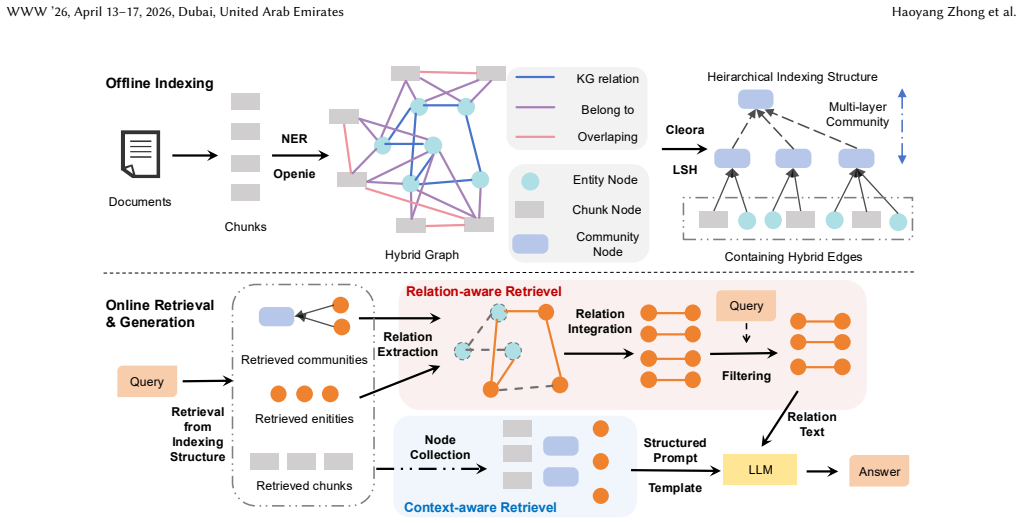
Hierarchical index over hybrid chunk-entity graphs, built via iterative clustering followed by LLM summarization at each level, which carries both context and relations into synthesized representations for retrieval.
If this is right
- Retrieval operates across every abstraction level while expanding via community membership.
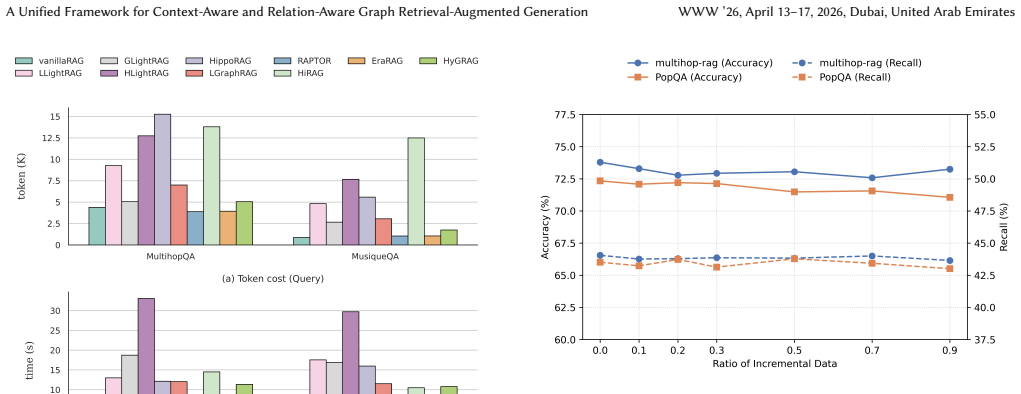
- Dynamic corpora are updated with attachment algorithms that require only local re-summarization.
- Average accuracy on multi-hop reasoning tasks rises by 9.7 percent.
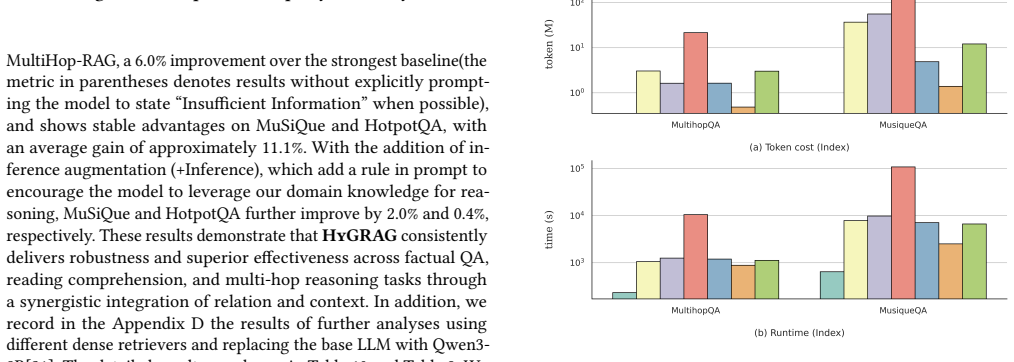
- Efficiency remains comparable to prior graph RAG baselines.
Where Pith is reading between the lines
- The same hierarchy could be applied to single-hop or open-ended generation tasks where synthesis matters more than isolated facts.
- If summaries truly create emergent knowledge, the method might reduce reliance on ever-larger context windows in base LLMs.
- Testing whether the fused representations contain information absent from any single source document would distinguish genuine emergence from improved organization.
Load-bearing premise
Iteratively clustering hybrid graphs and generating LLM summaries at successive levels actually produces representations that fuse contextual and relational information into usable emergent knowledge.
What would settle it
A controlled test in which removing the hierarchical summarization step or the hybrid node structure yields no measurable drop in multi-hop accuracy on the same benchmark set.
Figures
read the original abstract
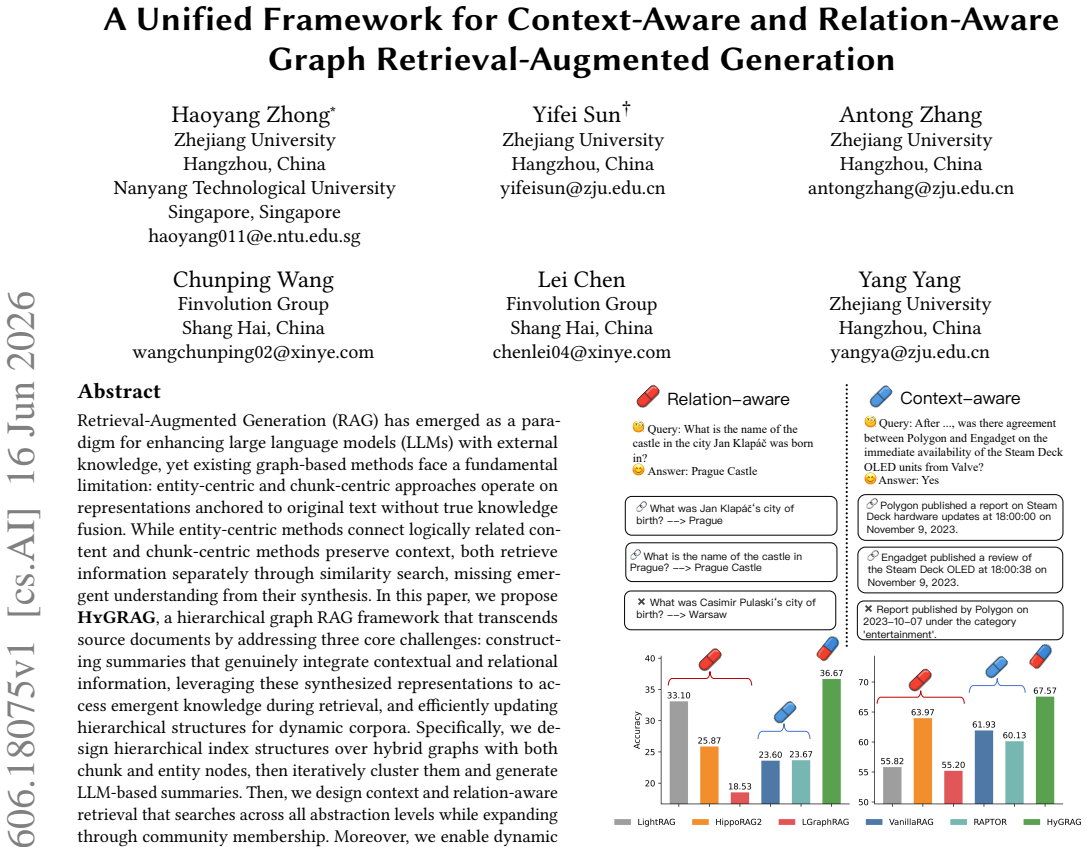
Retrieval-Augmented Generation (RAG) has emerged as a paradigm for enhancing large language models (LLMs) with external knowledge, yet existing graph-based methods face a fundamental limitation: entity-centric and chunk-centric approaches operate on representations anchored to original text without true knowledge fusion. While entity-centric methods connect logically related content and chunk-centric methods preserve context, both retrieve information separately through similarity search, missing emergent understanding from their synthesis. In this paper, we propose HyGRAG, a hierarchical graph RAG framework that transcends source documents by addressing three core challenges: constructing summaries that genuinely integrate contextual and relational information, leveraging these synthesized representations to access emergent knowledge during retrieval, and efficiently updating hierarchical structures for dynamic corpora. Specifically, we design hierarchical index structures over hybrid graphs with both chunk and entity nodes, then iteratively cluster them and generate LLM-based summaries. Then, we design context and relation-aware retrieval that searches across all abstraction levels while expanding through community membership. Moreover, we enable dynamic knowledge update through attachment-based algorithms with only local re-summarization. Experimental results show that HyGRAG improves the average accuracy of multi-hop reasoning tasks by 9.7%, while maintaining reasonable efficiency.
Editorial analysis
A structured set of objections, weighed in public.
Referee Report
Summary. The paper proposes HyGRAG, a hierarchical graph RAG framework that builds hybrid chunk-entity graphs, iteratively clusters them at multiple levels while generating LLM-based summaries, performs context- and relation-aware retrieval that expands through community membership across abstraction levels, and supports dynamic updates via attachment-based algorithms requiring only local re-summarization. It claims this addresses the lack of true knowledge fusion in prior entity-centric and chunk-centric graph RAG methods and reports a 9.7% average accuracy gain on multi-hop reasoning tasks while maintaining reasonable efficiency.
Significance. If the central empirical claim holds under proper controls, the framework offers a concrete mechanism for synthesizing contextual and relational information beyond direct similarity search on base graphs, which could meaningfully advance graph-augmented retrieval. The dynamic update procedure is a practical contribution that existing static hierarchical methods often lack.
major comments (2)
- [Experimental results] Experimental results (abstract and § on experiments): the 9.7% multi-hop accuracy improvement is stated without reference to specific baselines, datasets, number of runs, error bars, or ablation studies that isolate the contribution of the LLM-generated hierarchical summaries versus simply retrieving from a larger number of nodes or performing additional expansion steps. This directly bears on whether the performance delta arises from emergent knowledge fusion or from retrieval volume.
- [Hierarchical index construction] Hierarchical index construction (abstract and § describing index structures): the claim that iterative clustering of hybrid chunk-entity graphs plus LLM summarization at each level produces synthesized representations granting access to emergent knowledge is presented as a core motivation, yet no evidence (e.g., qualitative examples of novel inferences or quantitative comparison against non-summarized multi-level retrieval) is supplied to rule out the alternative that summaries largely restate or concatenate existing content.
minor comments (1)
- Notation for the hybrid graph (chunk and entity nodes) and the community-expansion retrieval operator should be defined explicitly with symbols before first use to improve readability.
Simulated Author's Rebuttal
We thank the referee for the constructive feedback. We address each major comment below and will incorporate clarifications and additional evidence in the revised manuscript.
read point-by-point responses
-
Referee: Experimental results (abstract and § on experiments): the 9.7% multi-hop accuracy improvement is stated without reference to specific baselines, datasets, number of runs, error bars, or ablation studies that isolate the contribution of the LLM-generated hierarchical summaries versus simply retrieving from a larger number of nodes or performing additional expansion steps. This directly bears on whether the performance delta arises from emergent knowledge fusion or from retrieval volume.
Authors: We agree that additional experimental details are warranted to strengthen the claims. The reported 9.7% average improvement is computed over multi-hop reasoning datasets (HotpotQA, 2WikiMultihopQA) against baselines including standard RAG, GraphRAG, and entity-centric graph methods. All results use three independent runs with reported means and standard deviations. To isolate the contribution of the LLM-generated hierarchical summaries from mere increases in retrieval volume or expansion steps, we will add controlled ablation experiments in the revised version that fix the number of retrieved nodes while varying the presence of summarized communities. revision: yes
-
Referee: Hierarchical index construction (abstract and § describing index structures): the claim that iterative clustering of hybrid chunk-entity graphs plus LLM summarization at each level produces synthesized representations granting access to emergent knowledge is presented as a core motivation, yet no evidence (e.g., qualitative examples of novel inferences or quantitative comparison against non-summarized multi-level retrieval) is supplied to rule out the alternative that summaries largely restate or concatenate existing content.
Authors: We acknowledge the value of direct evidence for the synthesis claim. While the multi-hop accuracy gains provide supporting quantitative indication, we will add qualitative examples of novel cross-document inferences enabled by the hierarchical summaries. We will also include a quantitative ablation comparing context- and relation-aware retrieval over summarized communities versus equivalent multi-level retrieval performed directly on the unsummarized hybrid graph, thereby addressing the possibility that gains stem only from restated content. revision: yes
Circularity Check
No circularity: empirical performance claim with no derivation chain or self-referential reductions
full rationale
The paper proposes a hierarchical graph RAG framework and reports an empirical accuracy gain of 9.7% on multi-hop tasks. No equations, fitted parameters, or first-principles derivations are present in the provided text. The central claim is an experimental result rather than a mathematical prediction that reduces to its inputs by construction. The assumption about emergent knowledge from LLM summaries is a methodological hypothesis, not a self-definitional or fitted-input circularity. No self-citation load-bearing steps or uniqueness theorems are invoked in a way that collapses the result. The derivation chain is therefore self-contained as an engineering contribution validated by experiments.
Axiom & Free-Parameter Ledger
axioms (1)
- domain assumption LLM-generated summaries of clustered hybrid graphs integrate contextual and relational information to produce emergent knowledge representations
invented entities (1)
-
hierarchical index structures over hybrid graphs with chunk and entity nodes
no independent evidence
Reference graph
Works this paper leans on
-
[1]
@articlesun2025mlnc, author = Yifei Sun and Zemin Liu and Bryan Hooi and Yang Yang and Rizal Fathony and Jia Chen and Bingsheng He, ... . 2025. Multi- Label Node Classification with Label Influence Propagation. InInternational Conference on Learning Representations
2025
-
[2]
Jianlv Chen, Shitao Xiao, Peitian Zhang, Kun Luo, Defu Lian, and Zheng Liu
-
[3]
arXiv:2402.03216 [cs.CL] https://arxiv.org/abs/2402.03216
BGE M3-Embedding: Multi-Lingual, Multi-Functionality, Multi-Granularity Text Embeddings Through Self-Knowledge Distillation. arXiv:2402.03216 [cs.CL] https://arxiv.org/abs/2402.03216
-
[4]
Darren Edge, Ha Trinh, Newman Cheng, Joshua Bradley, Alex Chao, Apurva Mody, Steven Truitt, Dasha Metropolitansky, Robert Osazuwa Ness, and Jonathan Larson. 2025. From Local to Global: A Graph RAG Approach to Query-Focused Summarization. arXiv:2404.16130 [cs.CL] https://arxiv.org/abs/2404.16130
Pith/arXiv arXiv 2025
-
[5]
Wenqi Fan, Yujuan Ding, Liangbo Ning, Shijie Wang, Hengyun Li, Dawei Yin, Tat-Seng Chua, and Qing Li. 2024. A Survey on RAG Meeting LLMs: Towards Retrieval-Augmented Large Language Models. arXiv:2405.06211 [cs.CL] https: //arxiv.org/abs/2405.06211
arXiv 2024
-
[6]
Yunfan Gao, Yun Xiong, Xinyu Gao, Kangxiang Jia, Jinliu Pan, Yuxi Bi, Yi Dai, Jiawei Sun, Meng Wang, and Haofen Wang. 2024. Retrieval-Augmented Generation for Large Language Models: A Survey. arXiv:2312.10997 [cs.CL] https://arxiv.org/abs/2312.10997
Pith/arXiv arXiv 2024
-
[7]
Aaron Grattafiori, Abhimanyu Dubey, Abhinav Jauhri, Abhinav Pandey, Abhishek Kadian, et al . 2024. The Llama 3 Herd of Models. arXiv:2407.21783 [cs.AI] https://arxiv.org/abs/2407.21783
Pith/arXiv arXiv 2024
-
[8]
Zirui Guo, Lianghao Xia, Yanhua Yu, Tu Ao, and Chao Huang. 2025. LightRAG: Simple and Fast Retrieval-Augmented Generation. arXiv:2410.05779 [cs.IR] https: //arxiv.org/abs/2410.05779
Pith/arXiv arXiv 2025
-
[9]
Bernal Jiménez Gutiérrez, Yiheng Shu, Yu Gu, Michihiro Yasunaga, and Yu Su
-
[10]
InProceedings of the 38th International Conference on Neural Infor- mation Processing Systems(Vancouver, BC, Canada)(NIPS ’24)
HippoRAG: neurobiologically inspired long-term memory for large lan- guage models. InProceedings of the 38th International Conference on Neural Infor- mation Processing Systems(Vancouver, BC, Canada)(NIPS ’24). Curran Associates Inc., Red Hook, NY, USA, Article 1902, 38 pages
1902
-
[11]
Bernal Jiménez Gutiérrez, Yiheng Shu, Weijian Qi, Sizhe Zhou, and Yu Su. 2025. From RAG to Memory: Non-Parametric Continual Learning for Large Language Models. arXiv:2502.14802 [cs.CL] https://arxiv.org/abs/2502.14802
Pith/arXiv arXiv 2025
-
[12]
Yuntong Hu, Zhihan Lei, Zheng Zhang, Bo Pan, Chen Ling, and Liang Zhao
-
[13]
arXiv:2405.16506 [cs.LG] https://arxiv.org/abs/2405.16506
GRAG: Graph Retrieval-Augmented Generation. arXiv:2405.16506 [cs.LG] https://arxiv.org/abs/2405.16506
-
[14]
Haoyu Huang, Yongfeng Huang, Junjie Yang, Zhenyu Pan, Yongqiang Chen, Kaili Ma, Hongzhi Chen, and James Cheng. 2025. Retrieval-Augmented Generation with Hierarchical Knowledge. arXiv:2503.10150 [cs.CL] https://arxiv.org/abs/ 2503.10150
arXiv 2025
-
[15]
Lei Huang, Weijiang Yu, Weitao Ma, Weihong Zhong, Zhangyin Feng, Haotian Wang, Qianglong Chen, Weihua Peng, Xiaocheng Feng, Bing Qin, and Ting Liu. 2025. A Survey on Hallucination in Large Language Models: Principles, Taxonomy, Challenges, and Open Questions.ACM Transactions on Information Systems43, 2 (Jan. 2025), 1–55. doi:10.1145/3703155
-
[16]
Thomas N. Kipf and Max Welling. 2016. Semi-Supervised Classification with Graph Convolutional Networks.CoRRabs/1609.02907 (2016). arXiv:1609.02907 http://arxiv.org/abs/1609.02907
Pith/arXiv arXiv 2016
-
[17]
Takeshi Kojima, Shixiang Shane Gu, Machel Reid, Yutaka Matsuo, and Yusuke Iwasawa. 2022. Large language models are zero-shot reasoners. InProceedings of the 36th International Conference on Neural Information Processing Systems(New Orleans, LA, USA)(NIPS ’22). Curran Associates Inc., Red Hook, NY, USA, Article 1613, 15 pages
2022
-
[18]
Gonzalez, Hao Zhang, and Ion Stoica
Woosuk Kwon, Zhuohan Li, Siyuan Zhuang, Ying Sheng, Lianmin Zheng, Cody Hao Yu, Joseph E. Gonzalez, Hao Zhang, and Ion Stoica. 2023. Efficient Mem- ory Management for Large Language Model Serving with PagedAttention. In Proceedings of the ACM SIGOPS 29th Symposium on Operating Systems Principles
2023
-
[19]
Patrick Lewis, Ethan Perez, Aleksandra Piktus, Fabio Petroni, Vladimir Karpukhin, Naman Goyal, Heinrich Küttler, Mike Lewis, Wen-tau Yih, Tim Rocktäschel, Sebastian Riedel, and Douwe Kiela. 2020. Retrieval-augmented generation for knowledge-intensive NLP tasks. InProceedings of the 34th International Conference on Neural Information Processing Systems(Van...
2020
-
[20]
Patrick Lewis, Ethan Perez, Aleksandra Piktus, Fabio Petroni, Vladimir Karpukhin, Naman Goyal, Heinrich Küttler, Mike Lewis, Wen tau Yih, Tim Rocktäschel, Sebastian Riedel, and Douwe Kiela. 2021. Retrieval-Augmented Generation for Knowledge-Intensive NLP Tasks. arXiv:2005.11401 [cs.CL] https://arxiv.org/abs/ 2005.11401
Pith/arXiv arXiv 2021
-
[21]
Shengjie Ma, Chengjin Xu, Xuhui Jiang, Muzhi Li, Huaren Qu, Cehao Yang, Jiaxin Mao, and Jian Guo. 2025. Think-on-Graph 2.0: Deep and Faithful Large Language Model Reasoning with Knowledge-guided Retrieval Augmented Generation. arXiv:2407.10805 [cs.CL] https://arxiv.org/abs/2407.10805
arXiv 2025
-
[22]
Alex Mallen, Akari Asai, Victor Zhong, Rajarshi Das, Daniel Khashabi, and Han- naneh Hajishirzi. 2023. When Not to Trust Language Models: Investigating Effec- tiveness of Parametric and Non-Parametric Memories. arXiv:2212.10511 [cs.CL] https://arxiv.org/abs/2212.10511
Pith/arXiv arXiv 2023
-
[23]
Richard Yuanzhe Pang, Alicia Parrish, Nitish Joshi, Nikita Nangia, Jason Phang, Angelica Chen, Vishakh Padmakumar, Johnny Ma, Jana Thompson, He He, and Samuel R. Bowman. 2022. QuALITY: Question Answering with Long Input Texts, Yes! arXiv:2112.08608 [cs.CL] https://arxiv.org/abs/2112.08608
arXiv 2022
-
[24]
Boci Peng, Yun Zhu, Yongchao Liu, Xiaohe Bo, Haizhou Shi, Chuntao Hong, Yan Zhang, and Siliang Tang. 2024. Graph Retrieval-Augmented Generation: A Survey. arXiv:2408.08921 [cs.AI] https://arxiv.org/abs/2408.08921
arXiv 2024
-
[25]
Parth Sarthi, Salman Abdullah, Aditi Tuli, Shubh Khanna, Anna Goldie, and Christopher D. Manning. 2024. RAPTOR: Recursive Abstractive Processing for Tree-Organized Retrieval. InInternational Conference on Learning Representations (ICLR)
2024
-
[26]
Yifei Sun, Haoran Deng, Yang Yang, Chunping Wang, Jiarong Xu, Renhong Huang, Linfeng Cao, Yang Wang, and Lei Chen. 2022. Beyond Homophily: Structure- aware Path Aggregation Graph Neural Network. InProceedings of the Thirty-First International Joint Conference on Artificial Intelligence, IJCAI-22, Lud De Raedt (Ed.). International Joint Conferences on Arti...
-
[27]
Yifei Sun, Yang Yang, Xiaojuan Feng, Zijun Wang, Haoyang Zhong, Chunping Wang, and Lei Chen. 2025. Handling Feature Heterogeneity with Learnable Graph Patches. InKnowledge Discovery and Data Mining. https://dl.acm.org/doi/ 10.1145/3690624.3709242
-
[28]
Yifei Sun, Qi Zhu, Yang Yang, Chunping Wang, Tianyu Fan, Jiajun Zhu, and Lei Chen. 2024. Fine-Tuning Graph Neural Networks by Preserving Graph Generative Patterns. InProceedings of the AAAI Conference on Artificial Intelligence, Vol. 38. 9053–9061
2024
-
[29]
Yixuan Tang and Yi Yang. 2024. MultiHop-RAG: Benchmarking Retrieval- Augmented Generation for Multi-Hop Queries. arXiv:2401.15391 [cs.CL] https: //arxiv.org/abs/2401.15391
Pith/arXiv arXiv 2024
-
[30]
Harsh Trivedi, Niranjan Balasubramanian, Tushar Khot, and Ashish Sabharwal
-
[31]
arXiv:2108.00573 [cs.CL] https://arxiv.org/abs/2108.00573
MuSiQue: Multihop Questions via Single-hop Question Composition. arXiv:2108.00573 [cs.CL] https://arxiv.org/abs/2108.00573
-
[32]
Liang Wang, Nan Yang, Xiaolong Huang, Linjun Yang, Rangan Majumder, and Furu Wei. 2024. Multilingual E5 Text Embeddings: A Technical Report. arXiv:2402.05672 [cs.CL] https://arxiv.org/abs/2402.05672
Pith/arXiv arXiv 2024
-
[33]
Shu Wang, Yixiang Fang, Yingli Zhou, Xilin Liu, and Yuchi Ma. 2025. ArchRAG: Attributed Community-based Hierarchical Retrieval-Augmented Generation. arXiv:2502.09891 [cs.IR] https://arxiv.org/abs/2502.09891
Pith/arXiv arXiv 2025
-
[34]
Zhishang Xiang, Chuanjie Wu, Qinggang Zhang, Shengyuan Chen, Zijin Hong, Xiao Huang, and Jinsong Su. 2025. When to use Graphs in RAG: A Comprehensive Analysis for Graph Retrieval-Augmented Generation. arXiv:2506.05690 [cs.CL] https://arxiv.org/abs/2506.05690
arXiv 2025
-
[35]
An Yang, Anfeng Li, Baosong Yang, Beichen Zhang, Binyuan Hui, et al . 2025. Qwen3 Technical Report. arXiv:2505.09388 [cs.CL] https://arxiv.org/abs/2505. 09388
Pith/arXiv arXiv 2025
-
[36]
Cohen, Ruslan Salakhutdinov, and Christopher D
Zhilin Yang, Peng Qi, Saizheng Zhang, Yoshua Bengio, William W. Cohen, Ruslan Salakhutdinov, and Christopher D. Manning. 2018. HotpotQA: A Dataset for Diverse, Explainable Multi-hop Question Answering. arXiv:1809.09600 [cs.CL] https://arxiv.org/abs/1809.09600
Pith/arXiv arXiv 2018
-
[37]
Fangyuan Zhang, Zhengjun Huang, Yingli Zhou, Qintian Guo, Zhixun Li, Wen- sheng Luo, Di Jiang, Yixiang Fang, and Xiaofang Zhou. 2025. EraRAG: Effi- cient and Incremental Retrieval Augmented Generation for Growing Corpora. arXiv:2506.20963 [cs.IR] https://arxiv.org/abs/2506.20963
arXiv 2025
-
[38]
Yanzhao Zhang, Mingxin Li, Dingkun Long, Xin Zhang, Huan Lin, Baosong Yang, Pengjun Xie, An Yang, Dayiheng Liu, Junyang Lin, Fei Huang, and Jingren Zhou
-
[39]
arXiv:2506.05176 [cs.CL] https://arxiv.org/abs/2506.05176
Qwen3 Embedding: Advancing Text Embedding and Reranking Through Foundation Models. arXiv:2506.05176 [cs.CL] https://arxiv.org/abs/2506.05176
-
[40]
Yingli Zhou, Yaodong Su, Youran Sun, Shu Wang, Taotao Wang, Runyuan He, Yongwei Zhang, Sicong Liang, Xilin Liu, Yuchi Ma, and Yixiang Fang
-
[41]
In what city was Paul Walker born?
In-depth Analysis of Graph-based RAG in a Unified Framework. arXiv:2503.04338 [cs.IR] https://arxiv.org/abs/2503.04338 A Case Study As shown in Table 4, the baselines fail to establish the correct reasoning chain required to answer the question. LLightRAG re- trieves partial contextual evidence (i.e., Jan Klapáč’s birthplace) but lacks the relational link...
Pith/arXiv arXiv 2026
-
[42]
relationships and connections between these entities, and 4) the overall context and significance of the information. By specifying both a word limit and the explicit need for rich semantic content, the prompt ensures the generation of a concise yet information-rich text that captures the core essence of the knowledge community. The detailed prompt are pr...
discussion (0)
Sign in with ORCID, Apple, or X to comment. Anyone can read and Pith papers without signing in.