REVIEW 2 major objections 5 minor 145 references
ArborEnum: Decision Tree Rashomon Sets over Continuous Features
T0 review · 2 major / 5 minor · reviewed 2026-08-11 · deepseek-v4-flash
Pith's one-line read The paper establishes that decision-tree Rashomon sets—all bounded-depth trees within a tolerance of the optimal regularized objective—can be enumerated exactly over continuous thresholds without a user-chosen binarization.
desk verdict First continuous-threshold Rashomon enumeration, worth reviewing, but exactness rests on a delegated Lipschitz proof and the speedup claims outrun Table 6. read the letter →
The pith
A machine-rendered reading of the paper's core claim, the machinery that carries it, and where it could break.
The reading
What carries the argument
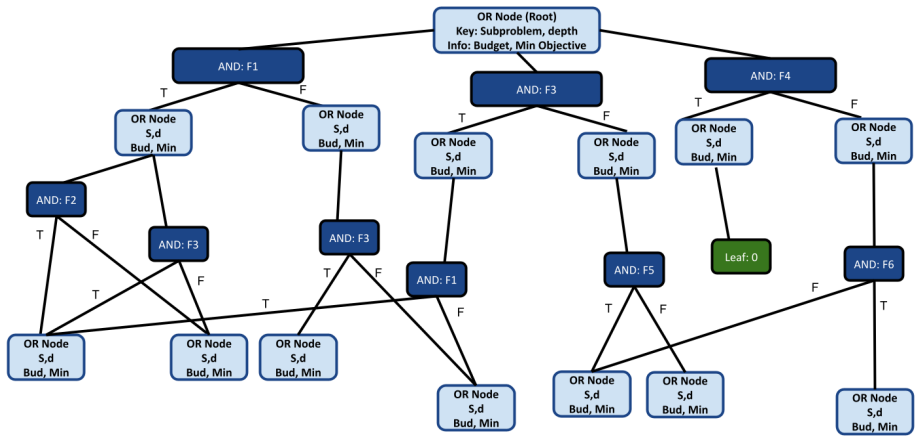
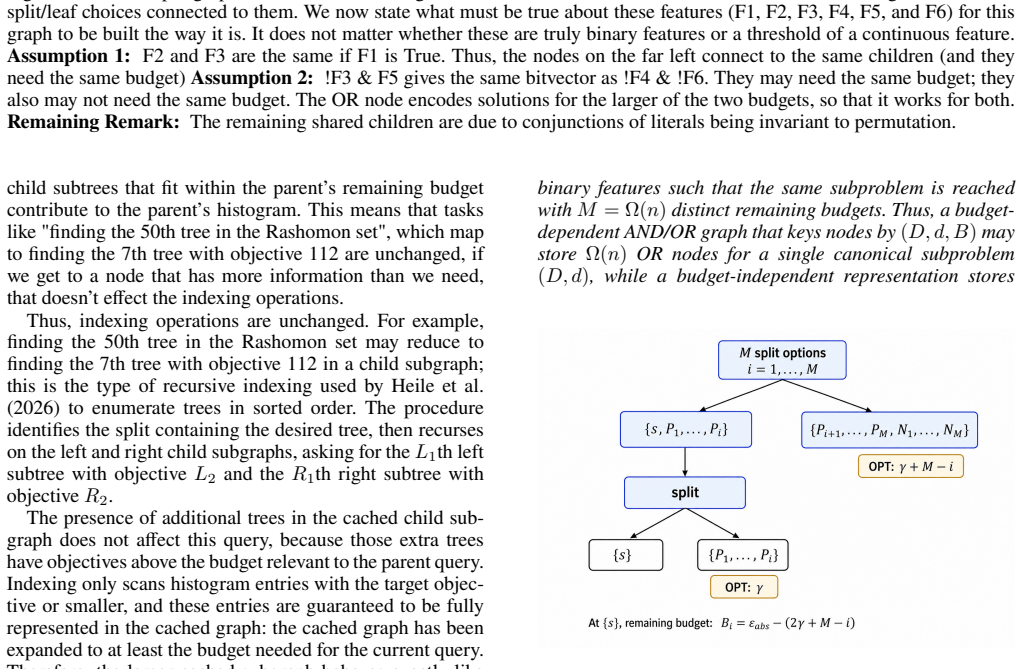
The load-bearing object is a Lipschitz-style interval-pruning rule for ordered thresholds. For thresholds s and t of one continuous feature, define dist_D(s,t) as the number of active samples whose branch assignment changes when the cut moves from s to t; if the proxy completion at s exceeds the budget by Δ, then any threshold within active-sample distance < Δ cannot enter the budget, provided the proxy robustness condition holds—moving k samples changes the proxy-completed objective by at most k. The algorithm stores a threshold-to-proxy-completion map keyed by exhaustive threshold indices, uses an excluded-range tracker to mark pruned or explored intervals, and encodes recovered subtrees in a budget-independent AND/OR graph with one canonical node per subproblem-depth pair that is extended in place as budgets grow.
What would settle it
Construct a small binary dataset in which shifting a single continuous threshold by one sample changes the optimal subtree cost by more than one, run ArborEnum with the LicketySNIP proxy, and check whether the returned Rashomon set omits a tree that an optimal-proxy run includes; if any such tree is pruned, the Lipschitz robustness condition is violated on that instance and the approximate recall guarantee fails.
Extended reading notes
Core claim
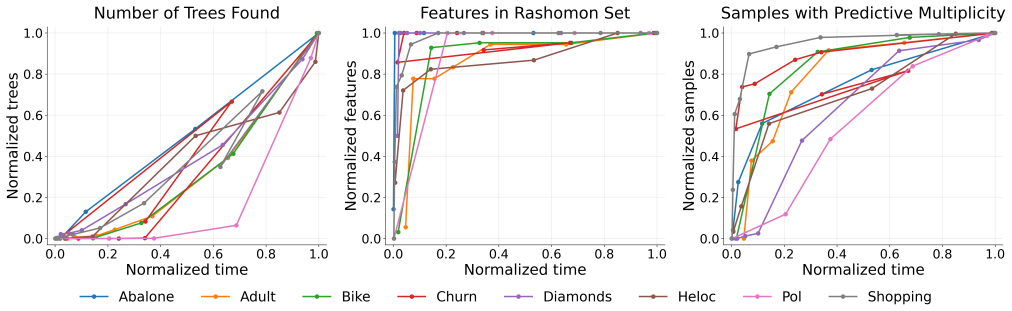
On the paper's own terms, the discovery is that exact Rashomon-set enumeration over continuous thresholds is not a separate, harder combinatorial problem: the nested structure of threshold columns turns candidate splits into an ordered sequence, and bounds on nearby thresholds can be reused. ArborEnum evaluates a threshold, records its left and right proxy completions, and then prunes the interval of thresholds whose active-sample distance from the failed threshold is smaller than the budget excess; when the proxy is optimal this pruning loses no in-budget tree. The same interval machinery powers approximate enumeration with the LicketySNIP greedy proxy and an anytime mode that refines the threshold set. The paper reports that on real datasets the exact variant finishes where prior methods time out, the approximate variants run orders of magnitude faster with near-perfect recall, and the anytime procedure incurs only about 2.7% median overhead.
Load-bearing premise
The pruning is exact only under a Lipschitz condition on the cost proxy—moving a few training samples across a split can change the proxy's estimated objective by at most the number of samples moved—and the fast approximate proxies used in most experiments do not guarantee this condition, so their near-perfect recall is an empirical result rather than a certificate.
Editorial extensions
If this is right
- Exact Rashomon sets over continuous thresholds make downstream analyses—feature importance, predictive multiplicity, tree counts—independent of the user's choice of binarization.
- Coarse binarization demonstrably under-represents the Rashomon set, missing high-quality trees, important features, and conflicting predictions; ArborEnum recovers the missing structure.
- The LicketySNIP approximate variants give near-perfect recall (worst case at least 94.5% over the reported experiment grid) while running orders of magnitude faster, widening the range of datasets on which Rashomon sets can be computed.
- The anytime variant lets a practitioner stop early with a partial Rashomon set and later refine it by activating additional thresholds, with a median runtime overhead of about 2.7% relative to running on the final threshold set.
- Theoretical bounds on the binarization optimality gap show that a threshold set with covering radius δ gives an objective gap of at most (2^d − 1)δ for depth-d trees, and midpoint refinement halves the covering radius each round.
Reading between the lines
- If the exactness claims hold, published tree Rashomon-set analyses could shift to a binarization-free standard, removing a hidden source of researcher discretion in what splits are even allowed.
- The anytime refinement view suggests an interactive workflow: inspect coarse summaries (which features appear, where predictions conflict) and spend additional computation only where the coarse view is inconclusive; the paper's observation that downstream properties converge faster than tree counts supports this.
- A natural extension is to apply the same active-sample-distance pruning to other ordered model families—e.g., piecewise-constant regression trees or rule lists—where cut points also form nested sample sets; the paper names these as future directions.
- A testable extension of the theory: validate Theorem 6 empirically by comparing exact ArborEnum against quantile binarizations at increasing K, to see whether the (2^d − 1)δ gap bound predicts the observed loss in recovered trees and to guide when the anytime algorithm has added enough thresholds.
Editorial analysis
A structured set of objections, weighed in public.
Referee Report
Summary. The paper introduces ArborEnum, a framework for enumerating decision-tree Rashomon sets directly over continuous features, without a user-chosen binarization. The method builds on an AND/OR graph representation of the Rashomon set and a proxy-based interval pruning scheme: when a threshold's proxy-completed objective exceeds the budget by Delta, neighboring thresholds whose active-sample Hamming distance is less than Delta are pruned. This pruning is exact when the proxy satisfies a 1-Lipschitz robustness condition, which the paper claims holds for optimal proxies, yielding an exact enumeration algorithm. The paper also proposes an approximate variant using a modified LicketySPLIT proxy (LicketySNIP), an anytime variant that progressively activates more thresholds and optionally strengthens the proxy, and a budget-independent subgraph caching scheme. Experiments on 20 datasets compare runtimes, memory, and recall against existing enumeration methods under exhaustive binarization.
Significance. If the central exactness claim holds, this is a substantial advance: it is the first algorithm that exactly enumerates decision-tree Rashomon sets while exploiting the ordered structure of continuous features, avoiding the information loss and combinatorial blowup of exhaustive binarization. The paper's empirical comparison is extensive, covering 20 datasets, multiple regularization levels, three bootstrap replicates, and existing methods, with clear reporting of timeouts and memory limits. The budget-independent AND/OR graph representation is a meaningful contribution in its own right, with theoretical lower bounds (Theorems 1--3) showing concrete duplication factors avoided. The paper also provides self-contained guarantees for binarization-induced optimality gaps (Theorems 4--9). However, the central exactness proof is delegated to a prior publication in a form that does not clearly cover the Rashomon-set enumeration setting, and the anytime convergence claim is asserted without proof.
major comments (2)
- [Section 3, Algorithms 2--3 and Appendix B, Theorem 10] The exactness of the interval pruning rules in Algorithms 2 and 3 (lines 16--24 and 43--51) rests on the claim that an optimal proxy's completed objective changes by at most the number of samples moved when a threshold shifts. The manuscript states in Section 3 that 'Optimal proxies satisfy this condition' and Theorem 10's proof says 'See Brita, van der Linden, and Demirovi (2025) for details of this fact,' but the cited work is about finding a single optimal tree, not about Rashomon-set enumeration with a slack budget and a per-leaf penalty. Because the headline contribution---exact enumeration over continuous thresholds---depends entirely on this Lipschitz property, the paper must either prove it self-contained or provide a precise statement and theorem number from the cited work that explicitly covers this setting. As written, the exactness claim is not verifiable from the manuscript.
- [Section 3, Anytime Algorithm and Algorithm 4] The claim that the anytime variant is 'truly anytime' and 'converges to the complete continuous-feature Rashomon set' is asserted without a theorem. Specifically, no proof is given that (a) the proxy-strengthening loop can reach an optimal proxy in this setting, and (b) after all thresholds are activated and the proxy is strengthened, RefineGraph produces the same graph as running ArborEnum from scratch with the full threshold set and optimal proxy. Since the anytime convergence is an advertised capability in the abstract, this needs a formal statement with conditions.
minor comments (5)
- [Throughout (citations)] The author name 'Brita' appears with a typographical artifact in multiple places (e.g., 'Brit,a'); this should be fixed to 'Brita'.
- [Section 3 and Appendix C.1] The robustness condition is stated only in prose; it would help to state it as a numbered assumption, and to state explicitly that LicketySNIP's greedy completions are not known to satisfy it, so the near-perfect recall results for the approximate variants are empirical rather than guaranteed.
- [Appendix E.2, Table 5 and Table 10] The recall metric is defined relative to the 'best method that finished' using a 'guessed Rashomon bound' from the minimum objective found; this definition should also appear in the main text near Table 2, since it is important for interpreting the reported recall values.
- [Algorithm 4] The predicate 'notIsProxyOptimal(Proxy)' is used without definition; the paper should specify when the lookahead parameter is considered to make the proxy optimal, e.g., when the lookahead reaches the remaining depth.
- [Appendix B, Theorem 8] Theorem 8 assumes a fixed tie-breaking order, but the main text describes using empirical quantile thresholds with deduplication; the relation between these two settings should be clarified.
Circularity Check
No significant circularity: continuous-threshold exactness is not constructed from fitted inputs; the only load-bearing external fact is an omitted proof from prior work, not a self-referential reduction.
full rationale
The paper's headline claim—exact enumeration of decision-tree Rashomon sets over continuous features—does not reduce to its inputs by construction. The exact budget is defined from the true optimum of the objective, and the exact variant uses an optimal proxy, so the budget is the actual optimal objective rather than a fitted quantity. The interval-pruning rules in Algorithms 2 and 3 prune a threshold only when the proxy-completed objective exceeds the budget by Delta and the active-sample distance to the failed threshold is below Delta; the paper states this is exact under the proxy robustness condition ('Our pruning rules assume a proxy robustness condition... Optimal proxies satisfy this condition, in which case our algorithm returns the exact Rashomon set'), and Theorem 10 delegates the proof of that condition to prior work ('See Brita, van der Linden, and Demirović (2025) for details of this fact'). This is an omitted/delegated proof, not a circular step: Brita et al. is not a self-citation, and the Lipschitz-type bound is a mathematical property of optimal completions, not an output-equivalent input. Self-citations to PRAXIS (Heile et al. 2026) supply the proxy-caching and approximate-enumeration framework, but the exactness of the continuous-threshold pruning does not depend on them; the approximation proxies are explicitly heuristic and are validated empirically against the best method that completed, with the appendix tracking the proxy-selected split to avoid false pruning. No fitted parameter is renamed as a prediction, and no known result is relabeled via new coordinates. The caveat that the delegated Lipschitz fact deserves independent verification is a correctness risk, not evidence of circularity; accordingly the circularity score is low.
Assumptions & free parameters
free parameters (5)
- per-leaf penalty gamma =
gamma = round(lambda |D|) with lambda in {0.02, 0.01, 0.005}
- Rashomon multiplier epsilon_mult =
0.03 (also 0.015, 0.0325, 0.0375 in ablations)
- max depth d =
5
- proxy threshold set Bproxy =
thresholds from 150 depth-2 gradient-boosted trees with backward elimination (ThresholdGuessing)
- proxy strength lookahead l =
l=1 default (LicketySNIP), increased to optimality in anytime
assumptions (4)
- domain assumption Proxy robustness: moving k samples across a threshold changes the proxy-completed objective by at most k
- domain assumption Exhaustive threshold columns represent all continuous splits; ties cannot be separated
- ad hoc to paper 64-bit subproblem fingerprints have negligible collision probability
- domain assumption Optimal proxy over a binarization satisfies the robustness conditions of Brito et al. (2025)
Cite this review
Pith. "Pith review of ArborEnum: Decision Tree Rashomon Sets over Continuous Features." pith.science (2026). https://pith.science/paper/V3Q4K3Z4
@misc{pith2026260804310,
  author       = {Pith},
  title        = {Pith review of: ArborEnum: Decision Tree Rashomon Sets over Continuous Features},
  year         = {2026},
  howpublished = {\url{https://pith.science/paper/V3Q4K3Z4}},
  note         = {Machine review of arXiv:2608.04310}
}
read the original abstract
The Rashomon effect describes the phenomenon that many models can achieve nearly equivalent performance on the same learning task, with significant ramifications for robustness, feature importance, and customizability. These use cases motivate the computation of Rashomon sets: the set of all models whose regularized loss is near-optimal. Decision trees are one of the few model classes for which Rashomon sets can be fully enumerated, but this computation has always been conditional on a binarization of the original data, either restricting which splits each tree is allowed to make or substantially increasing the complexity of an already difficult combinatorial problem. We introduce the first algorithm that exactly enumerates decision-tree Rashomon sets while exploiting the ordered structure of continuous features. We further develop a relaxation for approximate enumeration and an anytime algorithm that progressively refines the set of candidate thresholds, producing increasingly detailed approximations that converge to the continuous-feature Rashomon set. Experiments show that coarse binarization can miss many trees, important features, and predictive multiplicity; our algorithms achieve orders-of-magnitude speedups over existing enumeration methods, with approximations providing further speedups while maintaining near-perfect recall.
Figures

Figures from the paper (1 more)
Reference graph
Works this paper leans on
-
[1]
International Conference on Machine Learning , year=
Gaining no or low-cost transparency with interpretable partial substitute , author=. International Conference on Machine Learning , year=
-
[2]
Wang, Tong and Lin, Qihang , title =. J. Mach. Learn. Res. , month = jan, articleno =. 2021 , issue_date =
2021
-
[3]
International conference on artificial intelligence and statistics , pages=
Interpretable companions for black-box models , author=. International conference on artificial intelligence and statistics , pages=. 2020 , organization=
2020
-
[4]
arXiv preprint arXiv:2303.04437 , year=
Learning hybrid interpretable models: Theory, taxonomy, and methods , author=. arXiv preprint arXiv:2303.04437 , year=
-
[5]
International conference on machine learning , pages=
Born-again tree ensembles , author=. International conference on machine learning , pages=. 2020 , organization=
2020
-
[6]
Forty-second International Conference on Machine Learning , year=
Compressing tree ensembles through Level-wise Optimization and Pruning , author=. Forty-second International Conference on Machine Learning , year=
-
[7]
Journal of Computer Science and Technology , volume=
Lossless compression of random forests , author=. Journal of Computer Science and Technology , volume=. 2019 , publisher=
2019
-
[8]
Advances in Neural Information Processing Systems , volume=
Human expertise in algorithmic prediction , author=. Advances in Neural Information Processing Systems , volume=
Show all 145 references
-
[9]
Information Sciences , volume=
Approximating XGBoost with an interpretable decision tree , author=. Information Sciences , volume=. 2021 , publisher=
2021
-
[10]
Chen, Tianqi and Guestrin, Carlos , booktitle=
-
[11]
Advances in neural information processing systems , volume=
Predict responsibly: improving fairness and accuracy by learning to defer , author=. Advances in neural information processing systems , volume=
-
[12]
International conference on machine learning , pages=
Consistent estimators for learning to defer to an expert , author=. International conference on machine learning , pages=. 2020 , organization=
2020
-
[13]
Proceedings of the 2001 IEEE computer society conference on computer vision and pattern recognition
Rapid object detection using a boosted cascade of simple features , author=. Proceedings of the 2001 IEEE computer society conference on computer vision and pattern recognition. CVPR 2001 , volume=. 2001 , organization=
2001
-
[14]
Machine learning , volume=
Cascade generalization , author=. Machine learning , volume=. 2000 , publisher=
2000
-
[15]
Advances in neural information processing systems , volume=
Decision jungles: Compact and rich models for classification , author=. Advances in neural information processing systems , volume=
-
[16]
IEEE Transactions on information theory , volume=
On optimum recognition error and reject tradeoff , author=. IEEE Transactions on information theory , volume=. 2003 , publisher=
2003
-
[17]
Machine Learning , volume=
Random Forests , author=. Machine Learning , volume=. 2001 , publisher=
2001
-
[18]
2014 , publisher=
C4.5: Programs for Machine Learning , author=. 2014 , publisher=
2014
-
[19]
Journal of Machine Learning Research , volume=
Murtree: Optimal decision trees via dynamic programming and search , author=. Journal of Machine Learning Research , volume=
-
[20]
Machine Learning , volume=
Research note on decision lists , author=. Machine Learning , volume=. 1993 , publisher=
1993
-
[21]
Proceedings of the twenty-ninth annual ACM symposium on Theory of computing , pages=
Using and combining predictors that specialize , author=. Proceedings of the twenty-ninth annual ACM symposium on Theory of computing , pages=
-
[22]
, author=
On the Foundations of Noise-free Selective Classification. , author=. Journal of Machine Learning Research , volume=
-
[23]
Artificial Intelligence Review , volume=
Recent advances in decision trees: An updated survey , author=. Artificial Intelligence Review , volume=. 2023 , publisher=
2023
-
[24]
Machine Learning , volume=
Optimal classification trees , author=. Machine Learning , volume=. 2017 , publisher=
2017
-
[25]
Proceedings of the AAAI Conference on Artificial Intelligence , volume=
Learning optimal classification trees using a binary linear program formulation , author=. Proceedings of the AAAI Conference on Artificial Intelligence , volume=
-
[26]
Machine learning , volume=
Induction of decision trees , author=. Machine learning , volume=. 1986 , publisher=
1986
-
[27]
International Conference on Machine Learning , pages=
Blossom: an anytime algorithm for computing optimal decision trees , author=. International Conference on Machine Learning , pages=. 2023 , organization=
2023
-
[28]
Advances in Neural Information Processing Systems , volume=
Harnessing the power of choices in decision tree learning , author=. Advances in Neural Information Processing Systems , volume=
-
[29]
Optimal Sparse Decision Trees , volume =
Hu, Xiyang and Rudin, Cynthia and Seltzer, Margo , booktitle =. Optimal Sparse Decision Trees , volume =
-
[30]
Mazumder, Rahul and Meng, Xiang and Wang, Haoyue , booktitle =. Quant-. 2022 , volume =
2022
-
[31]
Proceedings of the AAAI Conference on Artificial Intelligence , volume=
Optimal classification trees for continuous feature data using dynamic programming with branch-and-bound , author=. Proceedings of the AAAI Conference on Artificial Intelligence , volume=
-
[32]
arXiv preprint arXiv:2601.14765 , year=
Anytime Optimal Decision Tree Learning with Continuous Features , author=. arXiv preprint arXiv:2601.14765 , year=
-
[33]
International Symposium on Intelligent Data Analysis , pages=
Efficient Lookahead Decision Trees , author=. International Symposium on Intelligent Data Analysis , pages=. 2024 , organization=
2024
-
[35]
2021 IEEE 33rd International Conference on Tools with Artificial Intelligence (ICTAI) , pages=
Assessing optimal forests of decision trees , author=. 2021 IEEE 33rd International Conference on Tools with Artificial Intelligence (ICTAI) , pages=. 2021 , organization=
2021
-
[36]
International Conference on Machine Learning , pages=
Generalized and scalable optimal sparse decision trees , author=. International Conference on Machine Learning , pages=. 2020 , organization=
2020
-
[37]
Machine Learning and Knowledge Extraction , volume=
A Meta Algorithm for Interpretable Ensemble Learning: The League of Experts , author=. Machine Learning and Knowledge Extraction , volume=. 2024 , publisher=
2024
-
[38]
International conference on algorithmic learning theory , pages=
Partially interpretable models with guarantees on coverage and accuracy , author=. International conference on algorithmic learning theory , pages=. 2024 , organization=
2024
-
[39]
Proceedings of the 37th International Conference on Machine Learning , pages =
Consistent Estimators for Learning to Defer to an Expert , author =. Proceedings of the 37th International Conference on Machine Learning , pages =. 2020 , editor =
2020
-
[40]
2024 , isbn =
Pisztora, Vincent and Li, Jia , title =. 2024 , isbn =. doi:10.1609/aaai.v38i13.29378 , booktitle =
2024 doi
-
[41]
Advances in Neural Information Processing Systems , volume=
A Path to Simpler Models Starts With Noise , author=. Advances in Neural Information Processing Systems , volume=
-
[42]
2022 ACM Conference on Fairness, Accountability, and Transparency , pages=
On the existence of simpler machine learning models , author=. 2022 ACM Conference on Fairness, Accountability, and Transparency , pages=
2022
-
[43]
Advances In Neural Information Processing Systems , year=
Using Noise to Infer Aspects of Simplicity Without Learning , author=. Advances In Neural Information Processing Systems , year=
-
[44]
Proceedings of the AAAI Conference on Artificial Intelligence , volume=
Free lunch in the forest: Functionally-identical pruning of boosted tree ensembles , author=. Proceedings of the AAAI Conference on Artificial Intelligence , volume=
-
[45]
Proceedings of the National Academy of Sciences , volume =
Yan Shuo Tan and Chandan Singh and Keyan Nasseri and Abhineet Agarwal and James Duncan and Omer Ronen and Matthew Epland and Aaron Kornblith and Bin Yu , title =. Proceedings of the National Academy of Sciences , volume =. 2025 , doi =
2025
-
[46]
2026 , journal =
Yifan Li and Shuhan Qi and Lei Cui and Chao Xing and Lei Zhang and Xuan Wang , title =. 2026 , journal =
2026
-
[47]
2023 , eprint=
Plugin estimators for selective classification with out-of-distribution detection , author=. 2023 , eprint=
2023
-
[48]
Santos-Pereira and Ana M
Carla M. Santos-Pereira and Ana M. Pires , keywords =. On optimal reject rules and ROC curves , journal =. 2005 , issn =. doi:https://doi.org/10.1016/j.patrec.2004.09.042 , url =
2005 doi
-
[49]
and Singer, Yoram , title =
Schapire, Robert E. and Singer, Yoram , title =. 1998 , isbn =. doi:10.1145/279943.279960 , booktitle =
1998
-
[50]
2017 , howpublished =
2017
-
[51]
and Kullgren, Jeffrey and Solway, Erica , title =
Malani, Preeti N. and Kullgren, Jeffrey and Solway, Erica , title =. 2019 , publisher =. doi:10.3886/ICPSR37305.v1 , url =
2019 doi
-
[52]
and Rita, P
Moro, S. and Rita, P. and Cortez, P. , title =. 2014 , howpublished =
2014
-
[53]
A data-driven approach to predict the success of bank telemarketing , author=. Decis. Support Syst. , year=
-
[54]
Progress in Artificial Intelligence , year=
Event labeling combining ensemble detectors and background knowledge , author=. Progress in Artificial Intelligence , year=
-
[55]
2013 , howpublished =
Fanaee-T, Hadi , title =. 2013 , howpublished =
2013
-
[56]
1994 , howpublished =
Bain, Michael and Hoff, Arthur , title =. 1994 , howpublished =
1994
-
[57]
AutoML , series =
Isabelle Guyon and Lisheng Sun-Hosoya and Marc Boull\'e and Hugo Jair Escalante and Sergio Escalera and Zhengying Liu and Damir Jajetic and Bisakha Ray and Mehreen Saeed and Mich\'ele Sebag and Alexander Statnikov and WeiWei Tu and Evelyne Viegas , title =. AutoML , series =. ...
2019
-
[58]
2018 , publisher =
OpenML , title =. 2018 , publisher =
2018
-
[59]
2025 , eprint=
TabArena: A Living Benchmark for Machine Learning on Tabular Data , author=. 2025 , eprint=
2025
-
[60]
Marcoulides , title =
George A. Marcoulides , title =. 2005 , publisher =
2005
-
[61]
Bao, Michelle and Zhou, Angela and Zottola, A. S. and Brubach, Brian and Desmarais, Sarah and Horowitz, Seth A. and Lum, Kristian and Venkatasubramanian, Suresh , title =. Proceedings of the Thirty-Fifth Conference on Neural Information Processing Systems (NeurIPS) , year =
-
[62]
1998 , howpublished =
Blackard, Jock , title =. 1998 , howpublished =
1998
-
[63]
2009 , howpublished =
Yeh, I-Cheng , title =. 2009 , howpublished =
2009
-
[64]
Expert Syst
The comparisons of data mining techniques for the predictive accuracy of probability of default of credit card clients , author=. Expert Syst. Appl. , year=
-
[65]
Burrows, N. R. and Hora, I. and Geiss, L. S. and Gregg, E. W. and Albright, A. , title =. MMWR. Morbidity and Mortality Weekly Report , year =. doi:10.15585/mmwr.mm6643a2 , url =
-
[66]
2021 , howpublished =
Mathur, Akshay , title =. 2021 , howpublished =
2021
-
[67]
2021 , url=
Poster: NATICUSdroid: A malware detection framework for Android using native and custom , author=. 2021 , url=
2021
-
[68]
Electricity Dataset , year =
-
[69]
1989 , howpublished =
Janosi, Andras and Steinbrunn, William and Pfisterer, Matthias and Detrano, Robert , title =. 1989 , howpublished =
1989
-
[70]
, author=
International application of a new probability algorithm for the diagnosis of coronary artery disease. , author=. The American journal of cardiology , year=
-
[71]
Helena Dataset , year =
-
[72]
Home Equity Line of Credit (HELOC) Dataset , year =
-
[73]
2014 , howpublished =
Whiteson, Daniel , title =. 2014 , howpublished =
2014
-
[74]
and Sadowski, P
Baldi, P. and Sadowski, P. and Whiteson, D. , year=. Searching for exotic particles in high-energy physics with deep learning , volume=. Nature Communications , publisher=. doi:10.1038/ncomms5308 , number=
-
[75]
and Nagapadma, Rohini , title =
S., B. and Nagapadma, Rohini , title =. 2023 , howpublished =
2023
-
[76]
Cybersecurity , year=
Quantized autoencoder (QAE) intrusion detection system for anomaly detection in resource-constrained IoT devices using RT-IoT2022 dataset , author=. Cybersecurity , year=
-
[77]
Jannis Dataset , year =
-
[78]
Jasmine Dataset , year =
-
[79]
Madeline Dataset , year =
-
[80]
2004 , howpublished =
Guyon, Isabelle , title =. 2004 , howpublished =
2004
-
[81]
, title =
Bock, R. , title =. 2004 , howpublished =
2004
-
[82]
1991 , url=
The MONK''s Problems-A Performance Comparison of Different Learning Algorithms, CMU-CS-91-197, Sch , author=. 1991 , url=
1991
-
[83]
, title =
Wnek, J. , title =. 1993 , howpublished =
1993
-
[84]
1981 , howpublished =
1981
-
[85]
2015 , howpublished =
Fernandes, Kelwin and Vinagre, Pedro and Cortez, Paulo and Sernadela, Pedro , title =. 2015 , howpublished =
2015
-
[86]
Portuguese Conference on Artificial Intelligence , year=
A Proactive Intelligent Decision Support System for Predicting the Popularity of Online News , author=. Portuguese Conference on Artificial Intelligence , year=
-
[87]
2012 , howpublished =
Mohammad, Rami and McCluskey, Lee , title =. 2012 , howpublished =
2012
-
[88]
2012 International Conference for Internet Technology and Secured Transactions , year=
An assessment of features related to phishing websites using an automated technique , author=. 2012 International Conference for Internet Technology and Secured Transactions , year=
2012
-
[89]
2002 , howpublished =
Cattral, Robert and Oppacher, Franz , title =. 2002 , howpublished =
2002
-
[90]
and Kastro, Yomi , title =
Sakar, C. and Kastro, Yomi , title =. 2018 , howpublished =
2018
-
[91]
Neural Computing and Applications , year=
Real-time prediction of online shoppers’ purchasing intention using multilayer perceptron and LSTM recurrent neural networks , author=. Neural Computing and Applications , year=
-
[92]
1999 , howpublished =
Hopkins, Mark and Reeber, Erik and Forman, George and Suermondt, Jaap , title =. 1999 , howpublished =
1999
-
[93]
2008 , howpublished =
Cortez, Paulo , title =. 2008 , howpublished =
2008
-
[94]
2008 , url=
Using data mining to predict secondary school student performance , author=. 2008 , url=
2008
-
[95]
NYC Taxi Green Trips, December 2016 , year =
2016
-
[96]
1991 , howpublished =
Aha, David , title =. 1991 , howpublished =
1991
-
[97]
Wine Dataset , year =
-
[98]
Pol Dataset , year =
-
[99]
Diamonds Dataset , year =
-
[100]
California Dataset , year =
-
[101]
Abalone Dataset , year =
-
[102]
Near-Optimal Decision Trees in a
Varun Babbar and Hayden McTavish and Cynthia Rudin and Margo Seltzer , booktitle=. Near-Optimal Decision Trees in a
-
[103]
1984 , publisher=
Classification and regression trees , author=. 1984 , publisher=
1984
-
[104]
Proceedings of the 18th International Conference on Machine Learning and Data Mining (MLDM 2022) , year =
Computing the Collection of Good Models for Rule Lists , author =. Proceedings of the 18th International Conference on Machine Learning and Data Mining (MLDM 2022) , year =
2022
-
[105]
, title =
Norton, Steven W. , title =. Proceedings of the International Joint Conference on Artificial Intelligence (IJCAI) , year =
-
[106]
, title =
Sarkar, Soumya and White, Martha E. , title =. Proceedings of the International Conference on Machine Learning , year =
-
[107]
Efficient Exploration of the
Ciaperoni, Martino and Xiao, Han and Gionis, Aristides , booktitle =. Efficient Exploration of the. 2024 , pages =
2024
-
[108]
Joint European Conference on Machine Learning and Knowledge Discovery in Databases , pages=
Time constrained dl8.5 using limited discrepancy search , author=. Joint European Conference on Machine Learning and Knowledge Discovery in Databases , pages=. 2022 , organization=
2022
-
[109]
Advances in Neural Information Processing Systems , year=
Exploring and Interacting with the Set of Good Sparse Generalized Additive Models , author=. Advances in Neural Information Processing Systems , year=
-
[110]
Proceedings of the
Fast sparse decision tree optimization via reference ensembles , author=. Proceedings of the
-
[111]
Proceedings of the AAAI Conference on Artificial Intelligence , volume=
Maptree: Beating “optimal” decision trees with bayesian decision trees , author=. Proceedings of the AAAI Conference on Artificial Intelligence , volume=
-
[112]
Forty-second International Conference on Machine Learning , year=
Branches: Efficiently Seeking Optimal Sparse Decision Trees via AO , author=. Forty-second International Conference on Machine Learning , year=
-
[113]
Journal of heuristics , volume=
Rollout algorithms for combinatorial optimization , author=. Journal of heuristics , volume=. 1997 , publisher=
1997
-
[114]
Annals of Operations Research , volume=
Looking ahead with the pilot method , author=. Annals of Operations Research , volume=. 2005 , publisher=
2005
-
[115]
Operations Research Proceedings 1993: DGOR/NSOR Papers of the 22nd Annual Meeting of DGOR in Cooperation with NSOR/Vortr
Steiner tree heuristics—a survey , author=. Operations Research Proceedings 1993: DGOR/NSOR Papers of the 22nd Annual Meeting of DGOR in Cooperation with NSOR/Vortr. 1994 , organization=
1993
-
[116]
Rashomon Sets of Falling Trees
Varun Babbar and Zachery Boner and Margo Seltzer and Cynthia Rudin. Rashomon Sets of Falling Trees
-
[117]
Doctor Rashomon and the
Donnelly, Jon and Srikar Katta and Emanuele Borgonovo and Rudin, Cynthia , booktitle =. Doctor Rashomon and the
-
[118]
Advances in Neural Information Processing Systems , volume=
Necessary and sufficient conditions for optimal decision trees using dynamic programming , author=. Advances in Neural Information Processing Systems , volume=
-
[119]
Proceedings of the
Learning optimal decision trees using caching branch-and-bound search , author=. Proceedings of the
-
[120]
Browne , year=
Jon Donnelly and Srikar Katta and Cynthia Rudin and Edward P. Browne , year=. The. Proceedings of Neural Information Processing Systems (
-
[121]
Exploring the whole
Rui Xin and Chudi Zhong and Zhi Chen and Takuya Takagi and Margo Seltzer and Cynthia Rudin , booktitle=. Exploring the whole
-
[122]
International Conference on Machine Learning , year=
Amazing things come from having many good models , author=. International Conference on Machine Learning , year=
-
[123]
Donnelly, Jon and Katta, Srikar and Rudin, Cynthia and Browne, Edward , booktitle=. The
-
[124]
arXiv preprint arXiv:2511.03344 , year=
Arslan, Elif and van der Linden, Jacobus GM and Hoogendoorn, Serge and Rinaldi, Marco and Demirovi. arXiv preprint arXiv:2511.03344 , year=
-
[125]
arXiv preprint arXiv:2508.06064 , year=
A Generic Complete Anytime Beam Search for Optimal Decision Tree , author=. arXiv preprint arXiv:2508.06064 , year=
-
[126]
Warren, Greta and Byrne, Ruth M. J. and Keane, Mark T. , title =. Proceedings of the 28th International Conference on Intelligent User Interfaces , pages =. 2023 , publisher =
2023
-
[127]
The Double-Edged Nature of the
Hsu, Ethan and Chen, Harry and Zhong, Chudi and Semenova, Lesia , journal=. The Double-Edged Nature of the
-
[128]
On the Existence of Simpler Machine Learning Models , DOI=
Semenova, Lesia and Rudin, Cynthia and Parr, Ronald , year=. On the Existence of Simpler Machine Learning Models , DOI=. 2022 ACM Conference on Fairness Accountability and Transparency , publisher=
2022
-
[129]
2013 , isbn =
Motwani, Rajeev and Raghavan, Prabhakar , title =. 2013 , isbn =
2013
-
[130]
2025 , author=
Leveraging Predictive Equivalence in Decision Trees , booktitle =. 2025 , author=
2025
-
[131]
1996 , howpublished =
Becker, Barry and Kohavi, Ronny , title =. 1996 , howpublished =
1996
-
[132]
Journal of Machine Learning Research , year =
Aaron Fisher and Cynthia Rudin and Francesca Dominici , title =. Journal of Machine Learning Research , year =
-
[133]
From Rashomon Theory to
Zakk Heile and Hayden McTavish and Varun Babbar and Margo Seltzer and Cynthia Rudin , booktitle=. From Rashomon Theory to. 2026 , url=
2026
-
[134]
Rashomon Sets for Prototypical-Part Networks: Editing Interpretable Models in Real-Time , year=
Donnelly, Jon and Guo, Zhicheng and Barnett, Alina Jade and McTavish, Hayden and Chen, Chaofan and Rudin, Cynthia , booktitle=. Rashomon Sets for Prototypical-Part Networks: Editing Interpretable Models in Real-Time , year=
-
[135]
2026 , eprint=
Multistage Defer Trees for Hybrid Interpretability: If at First You Can't Succeed, Tree Again , author=. 2026 , eprint=
2026
-
[136]
Communication, Simulation, and Intelligent Agents: Implications of Personal Intelligent Machines for Medical Education
Clancey, William J. Communication, Simulation, and Intelligent Agents: Implications of Personal Intelligent Machines for Medical Education. Proceedings of the Eighth International Joint Conference on Artificial Intelligence (IJCAI-83)
-
[137]
Classification Problem Solving
Clancey, William J. Classification Problem Solving. Proceedings of the Fourth National Conference on Artificial Intelligence
-
[138]
, title =
Robinson, Arthur L. , title =. 1980 , doi =. https://science.sciencemag.org/content/208/4447/1019.full.pdf , journal =
1980
-
[139]
New Ways to Make Microcircuits Smaller---Duplicate Entry
Robinson, Arthur L. New Ways to Make Microcircuits Smaller---Duplicate Entry. Science
-
[140]
Clancey and Glenn Rennels , abstract =
Diane Warner Hasling and William J. Clancey and Glenn Rennels , abstract =. Strategic explanations for a diagnostic consultation system , journal =. 1984 , issn =. doi:https://doi.org/10.1016/S0020-7373(84)80003-6 , url =
1984 doi
-
[141]
and Rennels, Glenn R
Hasling, Diane Warner and Clancey, William J. and Rennels, Glenn R. and Test, Thomas. Strategic Explanations in Consultation---Duplicate. The International Journal of Man-Machine Studies
-
[142]
Poligon: A System for Parallel Problem Solving
Rice, James. Poligon: A System for Parallel Problem Solving
-
[143]
Transfer of Rule-Based Expertise through a Tutorial Dialogue
Clancey, William J. Transfer of Rule-Based Expertise through a Tutorial Dialogue
-
[144]
The Engineering of Qualitative Models
Clancey, William J. The Engineering of Qualitative Models
-
[145]
2023 , eprint=
Attention Is All You Need , author=. 2023 , eprint=
2023
-
[146]
Pluto: The 'Other' Red Planet
NASA. Pluto: The 'Other' Red Planet
Reviewed August 11, 2026 · model on record in the stance chip above.
Discussion (0). Continue with ORCID to comment.