Constrained Symplectic Quantization: Disclosing the Deterministic Framework Behind Quantum Field Theory
Pith reviewed 2026-06-29 09:15 UTC · model grok-4.3
The pith
Constrained symplectic quantization recovers the Feynman generating functional with the correct real-time prescription in the continuum limit.
A machine-rendered reading of the paper's core claim, the machinery that carries it, and where it could break.
Core claim
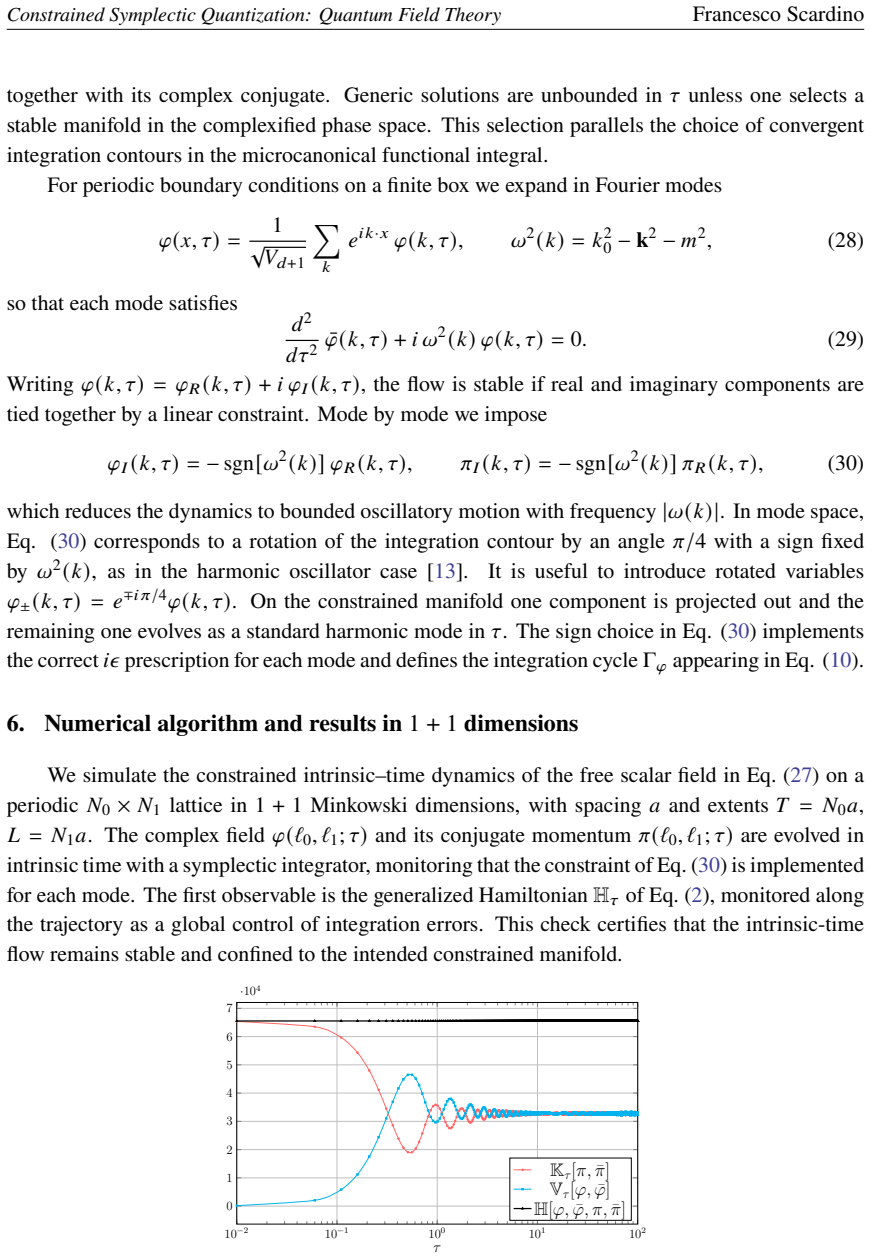
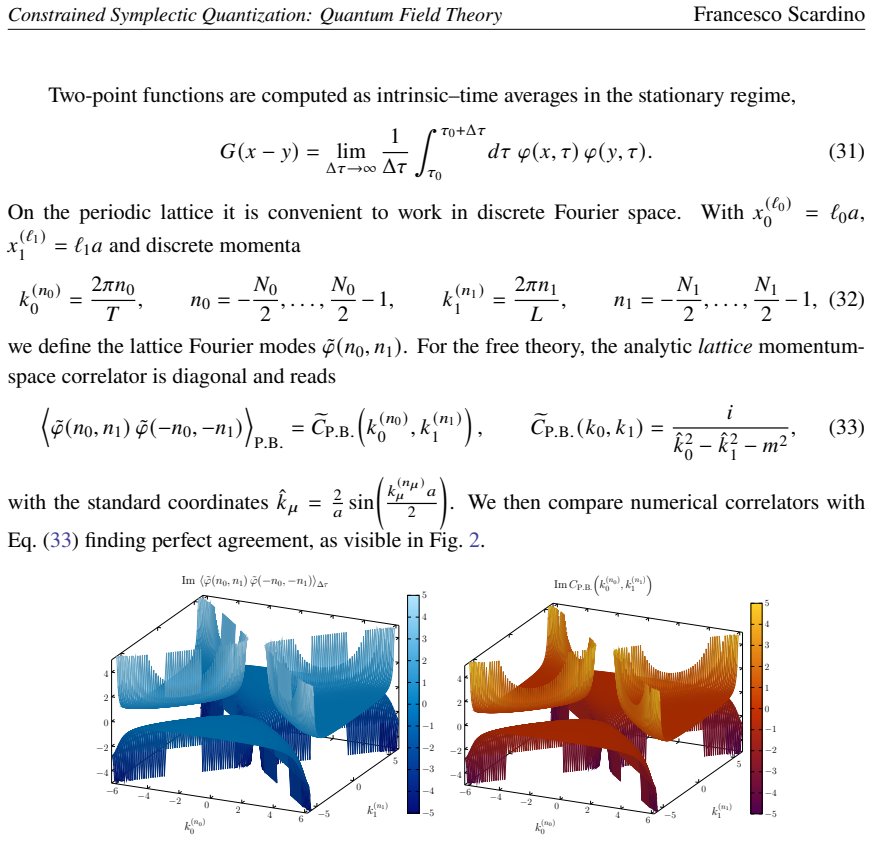
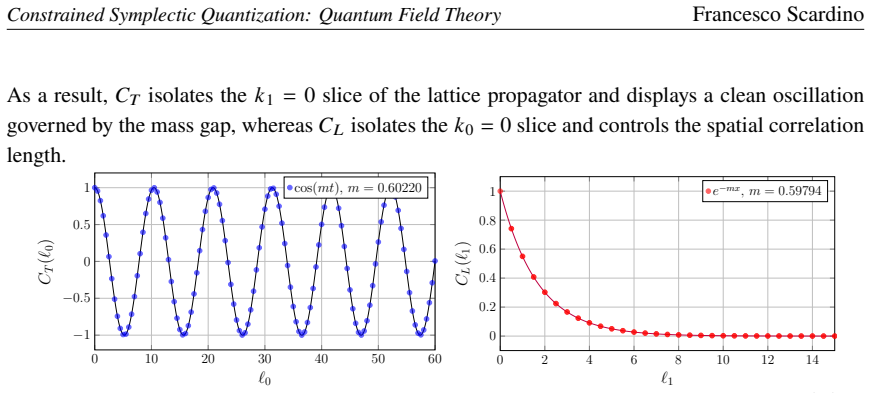
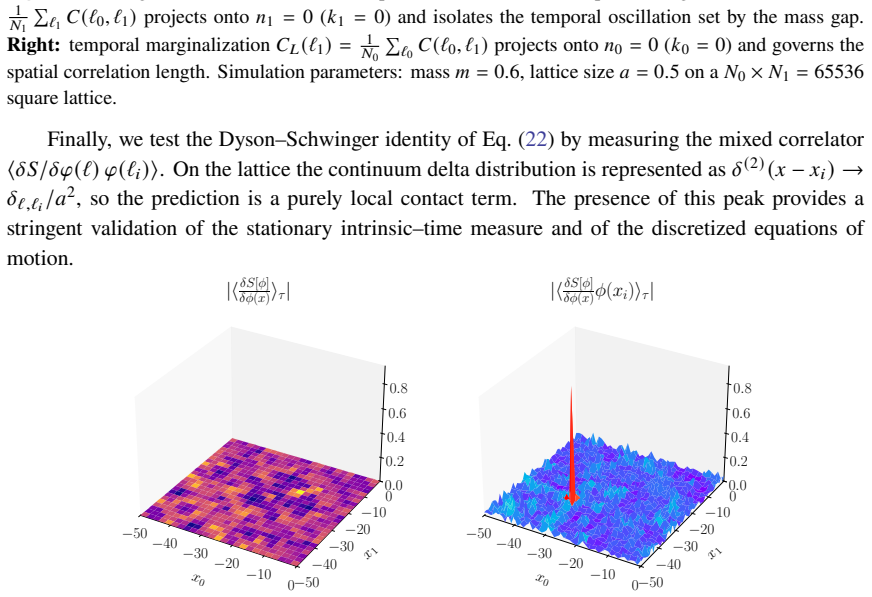
By analytically continuing fields and the action from real to complex values and then imposing constraints that simultaneously select stable intrinsic-time trajectories and convergent integration cycles for the microcanonical partition function, the method yields, in the continuum limit, the Feynman generating functional equipped with the correct real-time prescription; the result is verified by direct measurement of real-time two-point functions and by confirmation of Dyson-Schwinger identities (including the proper contact term) for a free scalar field in 1+1 dimensions on a periodic lattice.
What carries the argument
The constraints that select stable intrinsic time trajectories while simultaneously defining convergent integration cycles for the microcanonical partition function.
If this is right
- Real-time two-point functions can be measured directly without Wick rotation.
- Dyson-Schwinger identities hold with the proper contact term.
- The construction extends from quantum mechanics to relativistic quantum field theory on a periodic lattice.
- In the continuum limit the standard Feynman path integral is recovered.
Where Pith is reading between the lines
- The same constraint mechanism might be applied to interacting theories that suffer from sign problems in Euclidean formulations.
- Lattice computations could be performed entirely in Minkowski space for a wider class of models.
- The deterministic microcanonical dynamics may offer a classical underpinning for the quantum measure.
Load-bearing premise
The constraints that select stable intrinsic time trajectories and define convergent integration cycles are sufficient to produce the correct quantum theory.
What would settle it
Direct measurement on the lattice showing that the real-time two-point functions fail to match the expected continuum expressions, or that the Dyson-Schwinger identities are not satisfied with the correct contact term.
Figures
read the original abstract
Symplectic quantization is a functional approach to quantum field theory that allows sampling of quantum fluctuations directly in Minkowski space time by means of a Hamiltonian dynamics in an intrinsic time $\tau$ which samples a microcanonical ensemble, in close analogy with the standard microcanonical approach to lattice field theory. In this contribution we present constrained symplectic quantization for relativistic quantum field theory, generalizing from the quantum mechanical case. The method is based on the analytic continuation of fields and action from $\mathbb{R}$ to $\mathbb{C}$ and on constraints that select stable intrinsic time trajectories and that simultaneously define convergent integration cycles for the microcanonical partition function. In the continuum limit we recover the Feynman generating functional with the correct real time prescription. We test the construction for a free scalar field in $1+1$ dimensions on a periodic lattice by measuring real time two point functions and by verifying Dyson Schwinger identities with the correct contact term.
Editorial analysis
A structured set of objections, weighed in public.
Referee Report
Summary. The manuscript introduces constrained symplectic quantization as a generalization of a quantum-mechanical construction to relativistic QFT. Fields and the action are analytically continued from real to complex values; two classes of constraints are imposed that simultaneously select stable intrinsic-time trajectories and define convergent integration cycles for a microcanonical partition function. The central claim is that, in the continuum limit, this procedure recovers the Feynman generating functional equipped with the standard real-time prescription. The only numerical tests reported are for a free scalar field in 1+1 dimensions on a periodic lattice, where real-time two-point functions and Dyson-Schwinger identities (including the contact term) are examined.
Significance. If the construction can be shown to select the correct contour for interacting theories, the approach would supply a deterministic, real-time sampling method for QFT that derives the standard functional integral from constraints rather than from a fitted measure. The absence of free parameters and the explicit derivation from analytic continuation plus stability and convergence conditions are genuine strengths. At present, however, the supporting evidence remains confined to the free Gaussian case.
major comments (1)
- [Abstract] Abstract (and the section describing the numerical tests): the claim that the two classes of constraints together enforce the correct real-time integration cycle is verified only for the free scalar field. Because the free theory is quadratic, the microcanonical measure is Gaussian and the constraints may be satisfied identically once the lattice action is written; no demonstration is given that the same constraints continue to select the Feynman contour once non-linear interactions are present and multiple saddles or cycles become possible. This verification is load-bearing for the central claim.
minor comments (1)
- [Abstract] The abstract states that the tests are successful but supplies no lattice sizes, error bars, or quantitative measures of agreement for the two-point functions or Dyson-Schwinger identities; these details are required to judge the precision of the reported checks.
Simulated Author's Rebuttal
We thank the referee for the careful reading and constructive comments on the manuscript. We address the major comment below.
read point-by-point responses
-
Referee: [Abstract] Abstract (and the section describing the numerical tests): the claim that the two classes of constraints together enforce the correct real-time integration cycle is verified only for the free scalar field. Because the free theory is quadratic, the microcanonical measure is Gaussian and the constraints may be satisfied identically once the lattice action is written; no demonstration is given that the same constraints continue to select the Feynman contour once non-linear interactions are present and multiple saddles or cycles become possible. This verification is load-bearing for the central claim.
Authors: We agree that the numerical verification of the constraints selecting the correct real-time cycle is performed only for the free scalar field. The construction itself, however, is formulated for a general action: analytic continuation of fields and action to complex values is performed without assuming a quadratic form, and the two classes of constraints (stability of intrinsic-time trajectories and convergence of the integration cycle) are defined independently of the specific interaction terms. The continuum-limit recovery of the Feynman generating functional with the standard prescription is argued at the level of the functional integral by construction. The free-field tests confirm consistency with known results, including the contact term in Dyson-Schwinger identities. We acknowledge that explicit numerical demonstration for interacting theories, where multiple saddles may appear, would provide stronger support. We will revise the abstract and numerical section to clarify the scope of the tests while retaining the general analytic argument. revision: partial
Circularity Check
No circularity: derivation proceeds from analytic continuation plus explicit constraints to recover standard functional
full rationale
The paper defines constrained symplectic quantization via analytic continuation of fields/action to complex domain together with two classes of constraints (stable intrinsic-time trajectories and convergent microcanonical cycles). It then states that these yield the Feynman generating functional with standard real-time prescription in the continuum limit. No equation reduces a derived quantity to a fitted parameter or to a self-citation chain; the free-field lattice test verifies two-point functions and Dyson-Schwinger identities but does not constitute the derivation itself. The construction is therefore self-contained against external benchmarks and receives score 0.
Axiom & Free-Parameter Ledger
axioms (1)
- domain assumption Analytic continuation of fields and action from real to complex numbers yields a well-defined theory whose constraints produce the correct quantum measure.
Reference graph
Works this paper leans on
-
[1]
Constrained Symplectic Quantization II: The Free Scalar Field
F. Scardino, M. Giachello and G. Gradenigo,Constrained Symplectic Quantization II: The Free Scalar Field,2605.26892
work page internal anchor Pith review Pith/arXiv arXiv
-
[2]
G. Gradenigo and R. Livi,Symplectic quantization i: dynamics of quantum fluctuations in a relativistic field theory,Found. Phys.51(2021) 66, [2101.02125]
-
[3]
G. Gradenigo,Symplectic quantization ii: Dynamics of space-time quantum fluctuations and the cosmological constant,Found. Phys.51(2021) 64, [2101.01795]
-
[4]
G. Gradenigo, R. Livi and L. Salasnich,Symplectic quantization iii: Non-relativistic limit,Found. Phys.54(2024) 50, [2401.12355]
-
[5]
de Alfaro, S
V. de Alfaro, S. Fubini and G. Furlan,Microcanonical ensemble and quantum field theory,Nuovo Cim. A74(1983) 365
1983
-
[6]
A. E. Strominger,Microcanonical quantum field theory,Annals Phys.146(1983) 419
1983
-
[7]
Iwazaki,Microcanonical formulation of quantum field theories,Phys
A. Iwazaki,Microcanonical formulation of quantum field theories,Phys. Lett. B141(1984) 342–348
1984
-
[8]
D. J. E. Callaway and A. Rahman,Lattice gauge theory in the microcanonical ensemble,Phys. Rev. D 28(Sep, 1983) 1506–1514
1983
-
[9]
Duane, A
S. Duane, A. D. Kennedy, B. J. Pendleton and D. Roweth,Hybrid monte carlo,Phys. Lett. B195 (1987) 216–222
1987
-
[10]
M. Giachello, F. Scardino and G. Gradenigo,Symplectic quantization: numerical results for the Feynman propagator on a 1+1 lattice and the theoretical relation with quantum field theory,JHEP09 (2025) 129, [2403.17149]
-
[11]
M. Giachello, G. Gradenigo and F. Scardino,Symplectic quantization and minkowskian statistical mechanics: simulations on a 1+1 lattice,PoSLATTICE2024(2024) 359, [2412.09162]
-
[12]
Giachello and G
M. Giachello and G. Gradenigo,Symplectic quantization: A new deterministic approach to the dynamics of quantum fields inspired by statistical mechanics,EPJ Web Conf.314(2024) 00028
2024
-
[13]
Constrained Symplectic Quantization I: the Quantum Harmonic Oscillator
M. Giachello, F. Scardino and G. Gradenigo,Constrained Symplectic Quantization I: the Quantum Harmonic Oscillator,2601.16963
work page internal anchor Pith review Pith/arXiv arXiv
-
[14]
Approaches to the sign problem in lattice field theory
C. Gattringer and K. Langfeld,Approaches to the sign problem in lattice field theory,Int. J. Mod. Phys. A31(2016) 1643007, [1603.09517]
work page internal anchor Pith review Pith/arXiv arXiv 2016
-
[15]
A. Alexandru, G. Basar, P. F. Bedaque and N. C. Warrington,Complex paths around the sign problem, Rev. Mod. Phys.94(2022) 015006, [2007.05436]
-
[16]
Creutz and B
M. Creutz and B. Freedman,A STATISTICAL APPROACH TO QUANTUM MECHANICS,Annals Phys.132(1981) 427
1981
-
[17]
Parisi and Y.-s
G. Parisi and Y.-s. Wu,Perturbation Theory Without Gauge Fixing,Sci. Sin.24(1981) 483
1981
-
[18]
High density QCD on a Lefschetz thimble?
M. Cristoforetti, F. Di Renzo and L. Scorzato,New approach to the sign problem in quantum field theories: High density QCD on a Lefschetz thimble,Phys. Rev. D86(2012) 074506, [1205.3996]
work page internal anchor Pith review Pith/arXiv arXiv 2012
-
[19]
The Lefschetz thimble and the sign problem
L. Scorzato,The Lefschetz thimble and the sign problem,PoSLATTICE2015(2016) 016, [1512.08039]
work page internal anchor Pith review Pith/arXiv arXiv 2016
-
[20]
Toward Picard-Lefschetz Theory of Path Integrals, Complex Saddles and Resurgence
A. Behtash, G. V. Dunne, T. Schäfer, T. Sulejmanpasic and M. Ünsal,Toward Picard–Lefschetz theory of path integrals, complex saddles and resurgence,Ann. Math. Sci. Appl.02(2017) 95–212, [1510.03435]. 10 Constrained Symplectic Quantization: Quantum Field TheoryFrancesco Scardino
work page internal anchor Pith review Pith/arXiv arXiv 2017
-
[21]
Analytic Continuation Of Chern-Simons Theory
E. Witten,Analytic Continuation Of Chern-Simons Theory,AMS/IP Stud. Adv. Math.50(2011) 347–446, [1001.2933]. 11
work page internal anchor Pith review Pith/arXiv arXiv 2011
discussion (0)
Sign in with ORCID, Apple, or X to comment. Anyone can read and Pith papers without signing in.