REVIEW 4 major objections 5 minor 32 references
Displacement of three-phase flow for Heavy Oil: Riemann Solutions
T0 review · 4 major / 5 minor · reviewed 2026-08-07 · deepseek-v4-flash
Pith's one-line read For heavy-oil reservoirs, the paper classifies every Riemann solution connecting a water–gas injection state on the edge G–W to almost any displaced state in the saturation triangle, and shows the resulting wave pattern is stable to small…
desk verdict A substantial extension of the three-phase Riemann classification, honestly limited by the D=I admissibility assumption and by numerical rather than proof-based verification. read the letter →
The pith
A machine-rendered reading of the paper's core claim, the machinery that carries it, and where it could break.
The reading
What carries the argument
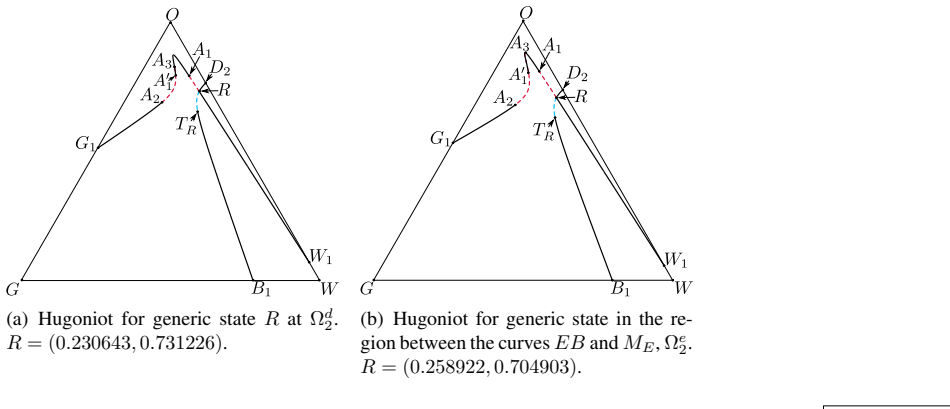
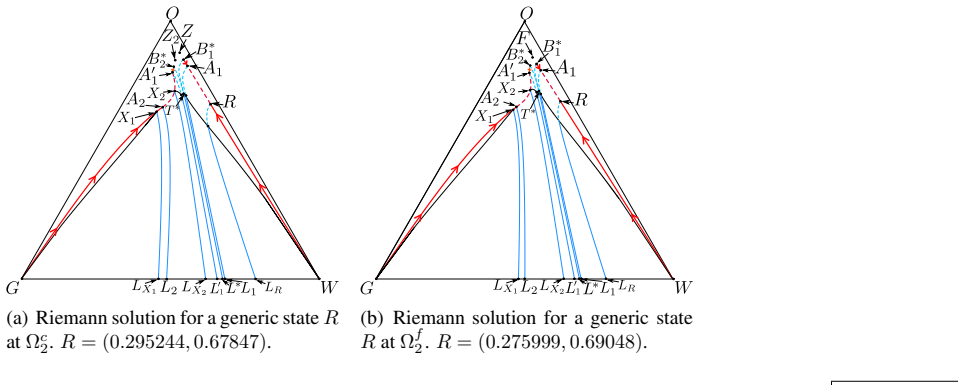
The wave curve method. For each right state R, one constructs the backward fast wave curve W_f(R) out of fast rarefaction segments, admissible fast shock segments of the Hugoniot locus, and composite segments defined by extensions of rarefaction and inflection loci; for each left state L on G–W, one constructs the forward slow wave curve and requires speed compatibility (end of slow group no faster than start of fast group) to assemble the solution. The organization of the classification is carried out by bifurcation loci in the saturation triangle—the secondary bifurcation loci E–W, G–D, O–B, the inflection loci, the hysteresis loci, the double-contact and mixed-contact loci, and the tangential extension locus T_I—whose intersections define regions of right states with a fixed solution structure.
What would settle it
Pick a viscosity ratio satisfying the inequalities in (5), replace D(S) = I by a positive-definite anisotropic matrix in the parabolic system (8), and recompute the viscous-profile condition for the shock segment [A_2, A_3] that is declared admissible for R in region Θ_1; if that segment loses its profile or a previously non-admissible segment gains one, the classification is specific to the identity-matrix model rather than to the physical three-phase flow.
Extended reading notes
Core claim
The central discovery is that in the heavy-oil viscosity regime, every Riemann solution with left state on the edge G–W and right state in almost all of the saturation triangle consists of at most two wave groups—a slow group followed by a fast group—with no undercompressive or overcompressive shocks. The paper partitions the saturation triangle into regions Λ, Θ, Ω, Γ, subdivided by bifurcation loci (inflection, hysteresis, double-contact, mixed-contact, and tangential extensions), and for each subregion it lists the admissible backward fast wave curve and the resulting composition path for every left state L on G–W. Shock admissibility is decided by the viscous profile criterion under the simplification that the viscosity matrix is the identity, and each admissible segment is verified numerically. The paper verifies L1_loc stability of the Riemann solution with respect to variations in the data and presents numerical simulations that match the analytical saturation profiles.
Load-bearing premise
The load-bearing premise is that shock admissibility can be decided by viscous profiles with the capillary-pressure matrix D(S) taken to be the identity matrix; if the true capillary matrix is not a scalar multiple of the identity, the set of admissible shocks—and hence the wave sequences in the classification—could change.
Editorial extensions
If this is right
- In the heavy-oil regime, water-alternating-gas injection into almost any oil-water-gas mixture produces only classical shock and rarefaction waves, so front-tracking simulators can use the explicit composition paths instead of costly Riemann solvers.
- The classification provides a complete map of which right states reach the oil vertex region versus stay near the gas-water edge, which bears on oil displacement efficiency for given injection compositions.
- The L1_loc stability result means that small perturbations in measured initial saturations lead to small perturbations of the predicted saturation profiles, supporting the use of these solutions for uncertainty quantification.
- The framework reduces the previously treated regions (near oil vertex and quadrilateral O–E–U–D) to a nearly global picture of the saturation triangle, leaving only two small boundary strips unclassified.
- Because the model uses quadratic Corey permeabilities, the same wave-curve construction can be repeated for other Corey exponents, so the paper supplies the base case for a wider family of heavy-oil relative-permeability laws.
Reading between the lines
- A natural next step is the two small unclassified strips near the G–O and W–O edges; the detached Hugoniot branches that are non-admissible under the identity viscosity matrix may become admissible under other capillary matrices, so those strips could harbor undercompressive or overcompressive waves even in this viscosity regime.
- The identity-matrix simplification is probably the most fragile link: a diagonal but non-scalar capillary matrix, let alone an anisotropic one, would change the traveling-wave ODEs and could eliminate or create admissible shock segments, so the classification should be rechecked numerically for at least one physically motivated non-identity D(S).
- The authors' restriction to one branch of the double-contact locus (Definition 3.5) suggests that for viscosity ratios satisfying (5) but closer to equality, additional contact branches enter the triangle and the subdivision of Θ, Ω, Γ would need to be refined; this gives a concrete parameter-space boundary where the present classification breaks.
- The stability proved is L1_loc with respect to data variations within the class; if a full uniqueness theorem were desired, one would need to compare against an entropy or front-tracking selection rule, and a numerical search for alternative paths exactly at subregion boundaries (e.g., L = L* cases) could test whether the triple-shock rule really collapses the two candidate paths to the same solut
Editorial analysis
A structured set of objections, weighed in public.
Referee Report
Summary. The paper studies the Riemann problem for a 2x2 system of conservation laws modeling three-phase immiscible flow in a porous medium with Corey-type quadratic relative permeabilities, in the heavy-oil regime where oil viscosity greatly exceeds water and gas viscosities. The left state L is taken on the G-W edge of the saturation triangle and the right state R covers nearly the whole saturation triangle except small regions near G-O and W-O. The authors use the wave curve method to construct solutions, dividing the right-state triangle into regions Θ, Ω, Γ (and subregions) and presenting the resulting wave-group structure in Claims 4.1-4.30. Shock admissibility is enforced through the viscous profile criterion, but with the viscosity matrix D(S) set to the identity and admissibility verified numerically. Three numerical simulations are compared with the analytical profiles. The authors state that L^1_loc-stability is verified but that uniqueness is not established.
Significance. If the classification is correct, it is a substantial advance over the authors' previous results, which were restricted to right states near the oil vertex or inside the quadrilateral O-E-U-D. The paper provides a detailed, systematic wave-curve construction for a large part of the saturation triangle in a physically motivated viscosity regime, with explicit claims for each subregion and supporting numerical simulations. Strengths include the use of an explicit Corey model that permits concrete computations, a transparent statement that uniqueness is not proved, and numerical validation in Section 5. However, the advertised scope is broader than what is actually established: the admissibility analysis is carried out for D(S)=I, the single-branch restriction on the double contact locus is not quantified, and the claimed L^1_loc-stability is not demonstrated in the text. These issues affect the central classification claim and need to be addressed before the paper can be accepted as a definitive classification.
major comments (4)
- [Section 3.1, Eq. (9), Remark 3.1] The viscous profile admissibility criterion is implemented only for D(S)=I, as stated in Section 3.1: 'we assume D(S) to be the identity matrix and numerically verify the admissibility of shocks.' All admissible shock segments used in Claims 4.1-4.30, such as [A1,R), [A2,A3], and (R,A1], are selected by numerical checks of the D=I traveling-wave ODE. For a physical positive-definite capillary pressure matrix that is not proportional to the identity, the ODE vector field in Eq. (9) changes, the invariance of the segments G-D, W-E, and O-B is lost, and the criterion based on 'relative positions of M and N with respect to the corresponding segments' no longer applies. The admissible Hugoniot set, and hence the backward fast wave curve W_f(R), can change. Since the abstract and conclusion present the classification for three-phase flow in porous media without this qualification, the central claim is currently only supported for the special artificial case D=I. The authors should either prove that the admissible set is invariant under all positive-definite D in the allowed class, or explicitly restrict all theorems and claims to D=I and adjust the abstract and conclusion accordingly.
- [Section 2, Eq. (5)-(6), Definition 3.5] The paper imposes an additional restriction on the viscosities, namely that the double contact locus has only one branch in the saturation triangle, but this restriction is never translated into explicit inequalities on r_w and r_g. The text says 'The viscosities are further restricted so that the double contact locus, see Definition 3.5, possesses only one branch' and that the boundaries AO and A'O are defined by this restriction, yet no formula or proof is given. The numerical computations use the single parameter set (µ_w=1, µ_o=9.5, µ_g=0.45). Consequently the statement in the abstract that the classification 'remains valid for all viscosity variations satisfying the inequalities (5)' is not established, because the single-branch condition is an additional, unquantified hypothesis that can fail even when (5) holds. The authors need to provide the explicit parameter region or reformulate the main theorem to cover only the cases for which the topological assumptions are verified.
- [Abstract, Conclusion, Section 5] The paper claims L^1_loc-stability of the Riemann solution with respect to variations in the data, but no definition, theorem, proof, or numerical stability study is provided. Section 5 contains three comparisons of analytical and numerical saturation profiles at t_D=1; these single-time comparisons do not constitute a verification of L^1_loc-stability, which concerns continuous dependence of the solution as a curve in L^1_loc on the initial data. Either a precise stability statement with supporting argument or numerical experiments measuring data-to-solution continuity should be added, or the claim of L^1_loc-stability should be removed from the abstract, introduction, and conclusion.
- [Section 4, Claims 4.1-4.30] The central classification is presented as a series of claims whose support is largely numerical or visual. For instance, Claim 4.1 and subsequent claims describe the complete backward fast wave curve W_f(R) by referring to figures and rely on statements such as 'We verify numerically that ... satisfy the viscous profile admissibility criterion.' The orderings of the intersection points L_1, L_R, L_*, L_3, L_2 along the edge G-W, which determine the left-state intervals in each claim, are asserted from the figures rather than proved. Combined with the explicit statement that uniqueness is not established, the phrase 'we classify all Riemann solution problems' overstates what is demonstrated: the paper provides a conjectured classification based on numerical evidence and geometric inspection. The authors should either supply proofs for the structural properties of the wave curves and the left-state orderings, or clearly rephrase the claims as a numerically supported classification and remove the word 'all' from the main claims.
minor comments (5)
- [Claim 4.5] The claim states that R lies in subregion Θ^b_1, but the surrounding text and Figure 13 indicate that the intended subregion is Θ^e_1; this should be corrected.
- [Figure 25 caption] The caption refers to 'the ODE system (4.3)', but the relevant system is Eq. (9); the reference should be updated.
- [Section 5, Cases 1 and 3] There are typos such as 'ans-rarefaction' instead of 'an s-rarefaction' and 'The numerical simulation match' instead of 'The numerical simulation matches'; these should be corrected.
- [Section 3.1, Eq. (9) and surrounding text] The definition of ξ contains an unbalanced parenthesis: 'ξ=x−σt)/ε' should be 'ξ=(x−σt)/ε'.
- [Claim 4.1] The sentence 'Refer to Fig. 6W f (R) comprises states M...' is missing a period after 'Fig. 6'; it should read 'Refer to Fig. 6. W_f(R) comprises states M...'.
Circularity Check
No significant circularity: the classification is conditional on an explicitly stated D=I viscous-profile criterion and is checked against independent numerical simulations; self-citations to prior work are not load-bearing.
full rationale
The paper's derivation chain is self-contained and non-circular. The Riemann solutions are constructed by the wave curve method (Section 3.2) from rarefaction curves, Hugoniot loci (Eq. (7)), and admissible shocks selected by the viscous profile criterion of Eq. (9). The only parametric simplification is D(S)=I, stated explicitly in Section 3.1 ('we assume D(S) to be the identity matrix and numerically verify the admissibility of shocks') and in Remark 3.1; this restricts the model but does not make any output equal to an input. The regions Theta, Omega, Gamma and their subregions are defined by geometric loci (inflection, hysteresis, double contact, mixed contact, tangential extension), not by the claimed Riemann solution structure, so the classification is not definitionally circular. No parameter is fitted to data and no 'prediction' is a renamed fit. The citations to the authors' prior work [1,2,3,4] supply published foundational facts (real characteristic speeds, explicit Hugoniot loci on invariant lines, earlier solution classes in region Lambda); these are parameter-free results with stated assumptions that do not include the present classification, so they constitute real evidence rather than a self-citation chain. The paper explicitly disclaims uniqueness ('we do not establish the uniqueness of the Riemann solution'), so no uniqueness theorem is imported to force the answer. Section 5 validates representative solutions against an independent finite-difference scheme, providing an external check. The D=I simplification is a physical limitation (the admissible shock set may change for non-identity capillary pressure), but that is a correctness or scope issue, not circularity.
Assumptions & free parameters
assumptions (5)
- domain assumption The quadratic relative permeability (Corey) model (2) accurately represents three-phase flow in the regimes of interest.
- domain assumption Shock admissibility is determined by the viscous profile criterion with identity viscosity matrix D(S) = I.
- domain assumption The characteristic speeds and integral curve properties established in [4] hold.
- ad hoc to paper The double contact locus has only one branch in the saturation triangle.
- domain assumption The umbilic point lies in regions ABO or A'B'O, corresponding to Case II of the Schaeffer-Shearer classification.
Cite this review
Pith. "Pith review of Displacement of three-phase flow for Heavy Oil: Riemann Solutions." pith.science (2026). https://pith.science/paper/V3RULBKH
@misc{pith2026250609077,
  author       = {Pith},
  title        = {Pith review of: Displacement of three-phase flow for Heavy Oil: Riemann Solutions},
  year         = {2026},
  howpublished = {\url{https://pith.science/paper/V3RULBKH}},
  note         = {Machine review of arXiv:2506.09077}
}
abstract
This work presents the Riemann solution for three-phase flow in porous media under the condition that oil viscosity exceeds that of water and gas. We classify all Riemann solution problems for scenarios where the left states $L$ lie along the edge $G$-$W$, and the right states $R$ span nearly the entire saturation triangle, excluding small regions near the boundaries $G$-$O$ and $W$-$O$. We use the wave curve method to determine the Riemann solution for initial and injection data within the above-mentioned class. This study extends previous analytical solutions, which were limited to right states near the corner $O$ or within the quadrilateral $O$-$E$-$\mathcal{U}$-$D$. Notably, this classification remains valid for all viscosity variations satisfying the inequalities \eqref{eq:classical}, corresponding to viscosity regimes where the umbilic point is close to the vertex $O$. We verify the $L^1_{loc}$-stability of the Riemann solution with respect to variations in the data. While we do not establish the uniqueness of the Riemann solution, extensive numerical experiments confirm its validity. Our findings provide a comprehensive framework for understanding three-phase flow dynamics in porous media under a wide range of conditions.
Figures


Figures from the paper (41 more)






Reference graph
Works this paper leans on
-
[1]
P. Andrade, A. de Souza, F. Furtado, and D. Marchesin. Oil displacement by water and gas in a porous medium: the Riemann problem . Bull. Braz. Math. Soc. (N.S.), 47 0 (1): 0 1--14, 2016
work page 2016
-
[2]
P. Andrade, A. de Souza, F. Furtado, and D. Marchesin. Three-phase fluid displacement in a porous medium . Journal of Hyperbolic Differential Equations, 15 0 (4): 0 731--753, 2018
work page 2018
-
[3]
A. Azevedo, A. de Souza, F. Furtado, D. Marchesin, and B. Plohr. The solution by the wave curve method of three-phase flow in virgin reservoirs . Transport in Porous Media, 83 0 (1): 0 99--125, 2010
work page 2010
-
[4]
A. Azevedo, A. de Souza, F. Furtado, and D. Marchesin. Uniqueness of the Riemann solution for three-phase flow in a porous medium . SIAM J. Appl. Math., 74 0 (6): 0 1967--1997, 2014
work page 1967
-
[5]
A. V. Azevedo, D. Marchesin, B. Plohr, and K. Zumbrun. Capillary instability in models for three-phase flow. Zeitschrift f \"u r angewandte Mathematik und Physik ZAMP , 53: 0 713--746, 2002
work page 2002
-
[6]
A critical review on parameters affecting the feasibility of underground hydrogen storage
Chiradip Bagchi, Samarth D Patwardhan, Stefan Iglauer, Hisham Ben Mahmud, and Muhammad Fazil Jaffar Ali. A critical review on parameters affecting the feasibility of underground hydrogen storage. ACS Omega, 2025
work page 2025
-
[7]
Wagner Q Barros, Adolfo P Pires, and Alvaro MM Peres. Analytical solution for one-dimensional three-phase incompressible flow in porous media for concave relative permeability curves. International Journal of Non-Linear Mechanics, 137: 0 103792, 2021
work page 2021
-
[8]
Safety of hydrogen storage technologies
Emma Davies, Andrea Ehrmann, and Eva Schwenzfeier-Hellkamp. Safety of hydrogen storage technologies. Processes, 12 0 (10): 0 2182, 2024
work page 2024
Show all 32 references
-
[9]
de Souza
A. de Souza. Stability of singular fundamental solutions under perturbations for flow in porous media . Mat. Apl. Comput., 11 0 (2): 0 43, 1992
1992
-
[10]
ELI , I nteractive G raphical R iemann P roblem S olver
ELI. ELI , I nteractive G raphical R iemann P roblem S olver. https://eli.fluid.impa.br/, pages A ccessed : 2025--06--08, 2025
2025
-
[11]
Lozano L. F. Diffusive effects in Riemann solutions for the three phase flow in porous media, D.Sc. thesis . PhD thesis, Instituto de Matem \' a tica Pura e Aplicada (IMPA), Rio de Janeiro, Brazil , 2018
2018
-
[12]
Isaacson, D
E. Isaacson, D. Marchesin, and B. Plohr. Transitional waves for conservation laws . SIAM J. Math. Anal., 21 0 (4): 0 837--866, 1990
1990
-
[13]
Isaacson, D
E. Isaacson, D. Marchesin, B. Plohr, and B. Temple. Multiphase flow models with singular Riemann problems . Comput. Appl. Math., 11 0 (2): 0 147--166, 1992
1992
-
[14]
Data-driven prediction of in situ co2 foam strength for enhanced oil recovery and carbon sequestration
Javad Iskandarov, George S Fanourgakis, Shehzad Ahmed, Waleed Alameri, George E Froudakis, and Georgios N Karanikolos. Data-driven prediction of in situ co2 foam strength for enhanced oil recovery and carbon sequestration. RSC advances, 12 0 (55): 0 35703--35711, 2022
2022
-
[15]
Analytical solution to the riemann problem of three-phase flow in porous media
Ruben Juanes and Tadeusz W Patzek. Analytical solution to the riemann problem of three-phase flow in porous media. Transport in Porous Media, 55: 0 47--70, 2004
2004
-
[16]
Mathematics and numerics for balance partial differential-algebraic equations (pdaes)
Wanderson Lambert, Amaury Alvarez, Ismael Ledoino, Duilio Tadeu, Dan Marchesin, and Johannes Bruining. Mathematics and numerics for balance partial differential-algebraic equations (pdaes). J. Sci. Comput., 84 0 (2): 0 29, 2020. doi:10.1007/s10915-020-01279-w
2020 doi
-
[17]
P. Lax. Hyperbolic systems of conservation laws II . Comm. Pure Appl. Math., X, 1952
1952
-
[18]
T. P. Liu. The Riemann problem for general 2x2 conservations laws . Trans. Amer. Math. Soc., 199: 0 89--112, 1974
1974
-
[19]
T. P. Liu. The Riemann problem for general systems of conservations laws . J. Differential Equations, 18: 0 218--234, 1975
1975
-
[20]
Analytical investigation of the three-phase foam flow in porous media
L Lozano, G Chapiro, and D Marchesin. Analytical investigation of the three-phase foam flow in porous media. In ECMOR 2024, volume 2024, pages 1--9. European Association of Geoscientists & Engineers, 2024 a
2024
-
[21]
Lozano, I
L. Lozano, I. Ledoino, B. J . Plohr, and D. Marchesin. Structure of undercompressive shock waves in three-phase flow in porous media, 2024 b . URL https://arxiv.org/abs/2412.04439
2024 arXiv
-
[22]
Matos, A
V. Matos, A. Azevedo, J. Mota, and D. Marchesin. Bifurcation under parameter change of Riemann solutions for nonstrictly hyperbolic systems . Z. Angew. Math. Phys., 66 0 (4): 0 1413--1452, 2015
2015
-
[23]
Matos, J
V. Matos, J. D. Silva, and D. Marchesin. Loss of hyperbolicity changes the number of wave groups in Riemann problems . Bulletin of the Brazilian Mathematical Society, 47 0 (2): 0 545--559, 2016
2016
-
[24]
Solution construction to a class of R iemann problems of multiphase flow in porous media
Mehran Mehrabi, Kamy Sepehrnoori, and Mojdeh Delshad. Solution construction to a class of R iemann problems of multiphase flow in porous media. Transport in porous media, 132: 0 241--266, 2020
2020
-
[25]
Core flooding experimental study on enhanced oil recovery of heavy oil reservoirs with high water cut by sub-and supercritical water
Yan Miao, Qiuyang Zhao, Zujie Huang, Keyu Zhao, Hao Zhao, Liejin Guo, and Yechun Wang. Core flooding experimental study on enhanced oil recovery of heavy oil reservoirs with high water cut by sub-and supercritical water. Geoenergy Science and Engineering, 242: 0 213208, 2024
2024
-
[26]
Approximate analytical solutions for 1-d immiscible water alternated gas
Adolfo P Pires, Wagner Q Barros, and Alvaro MM Peres. Approximate analytical solutions for 1-d immiscible water alternated gas. Transport in Porous Media, 151 0 (1): 0 171--191, 2024
2024
-
[27]
The influence of capillary pressure on the phase equilibrium of the co2--water system: Application to carbon sequestration combined with geothermal energy
Hamidreza Salimi, Karl-Heinz Wolf, and Johannes Bruining. The influence of capillary pressure on the phase equilibrium of the co2--water system: Application to carbon sequestration combined with geothermal energy. International Journal of Greenhouse Gas Control, 11: 0 S47--S66, 2012
2012
-
[28]
The classification of 2 2 systems of non-strictly hyperbolic conservation laws, with application to oil recovery
David G Schaeffer and Michael Shearer. The classification of 2 2 systems of non-strictly hyperbolic conservation laws, with application to oil recovery. Communications on pure and applied mathematics, 40 0 (2): 0 141--178, 1987
1987
-
[29]
Riemann solutions without an intermediate constant state for a system of two conservation laws
Julio Daniel Silva and Dan Marchesin. Riemann solutions without an intermediate constant state for a system of two conservation laws. Journal of Differential Equations, 256 0 (4): 0 1295--1316, 2014
2014
-
[30]
Foam-oil displacements in porous media: Insights from three-phase fractional-flow theory
Jinyu Tang, Pablo Castaneda, Dan Marchesin, and William R Rossen. Foam-oil displacements in porous media: Insights from three-phase fractional-flow theory. In Abu Dhabi International Petroleum Exhibition and Conference, page D042S195R003. SPE, 2022
2022
-
[31]
Wendroff
B. Wendroff. The Riemann problem for materials with Non Convex Equations of state: I Isentropic flow; II General flow . J. Math. Anal Appl., 38 0 (2--3): 0 454 -- 466; 640 -- 658, 1972
1972
-
[32]
Enhanced heavy oil recovery by immiscible WAG injection
YP Zhang, S Sayegh, and S Huang. Enhanced heavy oil recovery by immiscible WAG injection. In PETSOC Canadian International Petroleum Conference, pages PETSOC--2006. PETSOC, 2006
2006
Reviewed August 7, 2026 · model on record in the stance chip above.
Discussion (0). Sign in to comment.