REVIEW 3 major objections 3 minor 24 references
Least gradient problem on annuli
T0 review · 3 major / 3 minor · reviewed 2026-08-14 · deepseek-v4-flash
Pith's one-line read This paper proves that on an annulus the least-gradient problem is equivalent to a boundary optimal transport problem, and gives admissibility conditions for existence, uniqueness, and W1,p regularity.
desk verdict A genuinely new least-gradient/optimal-transport framework for annuli, held back by an unproved measure-valued lemma at the center of the equivalence. read the letter →
The pith
A machine-rendered reading of the paper's core claim, the machinery that carries it, and where it could break.
The reading
What carries the argument
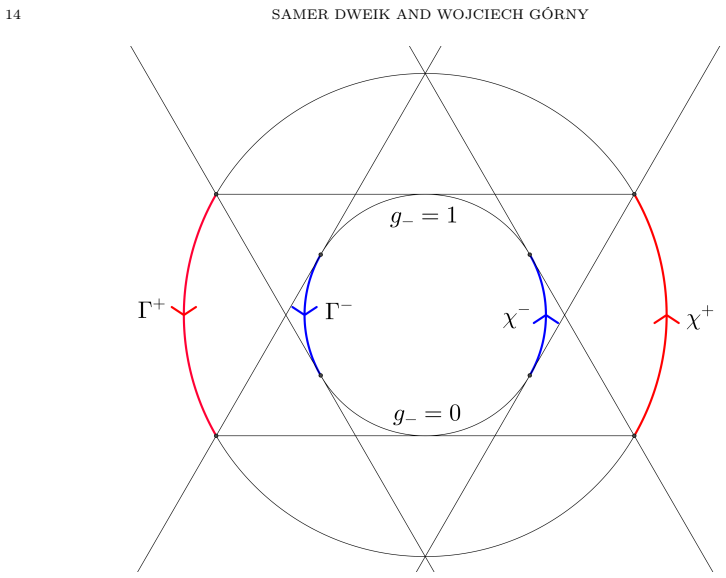
The load-bearing identity is the rotation formula $v=R_{\pi/2}Du$ in $\mathbb{R}^2$: rotation by $\pi/2$ interchanges gradients with divergence-free fields and normal traces with tangential derivatives, so the least-gradient functional becomes the Beckmann cost. The flow is then studied through an optimal transport problem between the positive and negative parts of the boundary measure $f=\partial_\tau g$, whose optimal plans move mass along transport rays, i.e. maximal segments on which a Kantorovich potential $\varphi$ satisfies $\varphi(x)-\varphi(y)=|x-y|$. The admissibility conditions (H1)-(H4) guarantee that every such ray is a segment contained in the annulus and connects the prescribed monotonicity arcs of the boundary datum; from the optimal plan $\gamma$ the paper builds the flow $v_\gamma=-\sigma\nabla\varphi$, shows that $\sigma(\partial\Omega)=0$, and uses that boundary-free property to pass back to a least-gradient solution.
What would settle it
Look at the vortex field $v=(-x_2/|x|^2, x_1/|x|^2)$ on the annulus $B(0,2)\setminus B(0,1)$: it is divergence-free, its normal component vanishes on both boundary circles, and $|v|(\partial\Omega)=0$, but its circulation around the inner circle is $2\pi$. If this field cannot be written as $R_{\pi/2}Du$ for any $u\in BV(\Omega)$, then Proposition 3.3 is false and the equivalence theorem lacks its key step.
Extended reading notes
Core claim
The central discovery is the equivalence, on an annulus $\Omega=\Omega_+\setminus\overline{\Omega_-}$, between the Beckmann problem $\inf\{\int_{\overline\Omega}|v|:\nabla\cdot v=f\}$ and the relaxed least-gradient problem $\inf\{\int_\Omega |Du|:\partial_\tau(Tu)=f\}$; the two infima coincide, and optimal objects transfer in both directions. In dimension two the transfer is carried by the rotation operator $v=R_{\pi/2}Du$, which turns a gradient into a divergence-free vector measure and the normal boundary component into the tangential derivative of the trace. Because the annulus is not simply connected, the proof needs an extension argument through the inner hole and a representation lemma for measure-valued flows. With the admissibility conditions (H1)-(H4) in force, every transport ray between $f^+$ and $f^-$ lies inside the annulus, the optimal transport plan is unique when $f^+$ is atomless, the induced flow has no boundary mass, and the associated $u$ solves the least-gradient problem for a boundary datum obtained by vertical shifts on the two boundary components. In addition, $L^p$ summability of the transport density $\sigma$ translates directly into $W^{1,p}$ regularity of the solution.
Load-bearing premise
The argument rests on an unproved representation lemma: every measure-valued flow on the annulus that has zero flux across each boundary component and puts no mass on the boundary must be the 90-degree rotation of the gradient of a function of bounded variation; if that fails, the construction of least-gradient solutions from optimal transport flows collapses.
Editorial extensions
If this is right
- On an annulus, the least-gradient problem and the Beckmann boundary-transport problem have the same infimum, and any optimal flow with no boundary mass produces a least-gradient solution.
- Under the admissibility conditions (H1)-(H4), a solution exists for some boundary datum obtained from the original datum by adding a constant on each boundary component; under an equal-total-variation condition the datum is identified explicitly and the solution is unique.
- When the positive part of the tangential derivative is atomless, the underlying optimal transport plan is unique, so the least-gradient solution is unique.
- Regularity transfers from boundary to interior: $g\in W^{1,p}(\partial\Omega)$ implies $u\in W^{1,p}(\Omega)$ for every $p\in[1,\infty]$ when the flat pieces are flat, and for $p\le 2$ when some flat piece is not flat and the outer domain is uniformly convex.
Reading between the lines
- If the unproved representation lemma is valid, the same Beckmann-to-least-gradient transfer should extend to domains with several inner holes, because the proof of the trace variation bound only needs positive distances between the inner components and the outer boundary.
- The rotation representation on a non-simply-connected domain implicitly requires the optimal flow to have zero circulation around each hole; checking whether the flows constructed from boundary-to-boundary transport plans automatically satisfy this would settle the status of the unproved lemma.
- The admissibility inequalities (H4) are purely geometric, so for a fixed annulus and fixed monotonicity arcs one can verify them by computing distances between arcs, as the paper does in its worked example; this makes the existence criterion directly testable.
Signed reviews
Editorial analysis
A structured set of objections, weighed in public.
Referee Report
Summary. The paper studies the BV least gradient problem on a planar annulus Ω = Ω+ \ Ω−, where Ω− is compactly contained in the strictly convex domain Ω+. The central claims are: (i) the least gradient problem with boundary datum g ∈ BV(∂Ω) is equivalent, in an appropriate sense, to a Beckmann optimal transport problem and to a Monge-Kantorovich problem with boundary-supported measures; (ii) under structural admissibility conditions (H1)–(H4), the Beckmann problem has a solution with zero boundary mass, unique when f+ is atomless, and this yields existence of a solution to the least gradient problem for some boundary datum g̃ with ∂τ g̃ = f; and (iii) under an additional condition (H5), transport densities are Lp and the corresponding least gradient solutions are W^{1,p} for all p ∈ [1, ∞] when the relevant boundary arcs are flat. The main results are Theorem 3.4, Theorem 4.4, Theorem 4.5, Theorem 5.1, and Corollary 5.2.
Significance. If the proof gaps identified below are filled, this would be a valuable contribution to the least gradient literature. The paper extends existence and regularity theory beyond strictly convex domains, makes a nontrivial connection between least gradient problems and optimal transport on domains with holes, and is careful to state structural hypotheses and discuss their optimality with concrete examples. The authors also provide explicit examples of existence and non-existence, and they are transparent about the limitations of their approach. The main unresolved issue is the missing proof of the measure-valued converse in Proposition 3.3, which is load-bearing for the equivalence theorem and hence for the existence results in Section 4; Section 5 also contains several unfinished estimates.
major comments (3)
- [Section 3, Proposition 3.3] Proposition 3.3 is stated without proof, but it is the measure-valued converse used in the proof of Theorem 3.4. The statement that every v ∈ M(Ω; R^2) with |v|(∂Ω)=0 and ∇·v=f can be written as v=R_{π/2}Du for some u∈BV(Ω) is not a routine limiting case of Proposition 3.2. On the annulus, the rotated one-form -v_2 dx + v_1 dy is not automatically exact, and one must prove that its period around ∂Ω− vanishes, that the BV potential can be constructed by path integration, and that the condition |v|(∂Ω)=0 controls the boundary contribution to Du. Without this proof, the direction of Theorem 3.4 constructing a solution of (3.2) from a solution of (3.1) has no justification, and Theorem 4.5 inherits the gap. Please supply the full proof.
- [Section 4, Theorem 4.4] The uniqueness claim in Theorem 4.4 depends on the assertion, made after Proposition 3.7, that 'every solution w for the Beckmann problem (3.1) is of the form w=w_γ for some optimal transport plan γ.' This representation is attributed to [20, Chapter 4] but is not proved in the present setting, where the measures f+ and f− are supported on the boundary and the domain is not convex. The representation is necessary to conclude that uniqueness of the optimal transport plan implies uniqueness of the Beckmann solution. Please provide a proof or a precise sufficient condition from the literature that covers this boundary-supported, non-simply-connected case.
- [Section 5, Theorem 5.1] The proof of the Lp estimate for the transport density is incomplete. The displayed computation of ||σ++_{i,j}||_{L^p} uses an atomic approximation of f+ and a change of variables, but the Jacobian computation, the integration bounds, and the passage to the limit n→∞ are only sketched. The estimate for σ− is dismissed with the sentence that it follows from 'an approximation of f+ by an atomic sequence,' but σ− is supported on different segments and requires a separate argument. In addition, the theorem states p∈[1,∞] while the proof only addresses p<∞. Since Corollary 5.2 is the paper's W^{1,p} regularity claim, these gaps must be repaired.
minor comments (3)
- [Lemma 2.4] In the proof of Lemma 2.4, the sentence 'As Ω is a convex subset of the plane, ∂Ω is homeomorphic to a circle' should refer to Ω±, since Ω is an annulus. Also, the inequality P(Ω,R^2) ≥ M dist(∂Ω−,∂Ω+) requires an explanation of how the number of transition points of {g≥t} on ∂Ω− forces at least that many disjoint segments of the level set ∂{u≥t}.
- [Problem (3.1) and Theorem 4.4] The domain of the measures in the Beckmann problem is inconsistent: problem (3.1) is written with v∈M(Ω;R^2) and integral over ̅Ω, while Theorem 4.4 writes v∈M(̅Ω;R^2). The authors should fix one convention and state whether |v|(∂Ω) is meaningful by extension or by allowing measures on the closure.
- [Section 5, notation] The notation F_i^+ in Theorem 5.1 conflicts with the decomposition F_i^{++} ∪ F_i^{+-} used in condition (H2); the first paragraph of Theorem 5.1 says 'assume that F_i^+ is a flat part for each i,' but later discusses the case where F_i^+ is not flat. Please clarify which arcs are assumed flat and how this relates to (H2).
Circularity Check
No circularity: the Beckmann/least-gradient equivalence is proved by explicit rotation identities, and the prior self-citations used are independent published theorems.
full rationale
The paper's central equivalence (Theorem 3.4) is not circular. Proposition 3.1 proves the forward direction directly by integration by parts: v=R_{pi/2}Du is divergence-free in Omega and has v·nu = d_tau(Tu). Proposition 3.2 proves the L^1 converse by subtracting the inner hole and applying the published convex-domain result [13, Prop. 2.1]; the annulus case is non-trivial because the domain is not simply connected. Although [13] and [6] are self-citations, they are published, parameter-free theorems whose assumptions do not include the annulus conclusion, so they are independent support. The admissibility conditions (H1)-(H4) are hypotheses, not fitted parameters. The L^p estimates in Theorem 5.1 are derived from the transport map structure with explicit constants, not assumed. One flagged issue is that Proposition 3.3, the measure-valued converse used in Theorems 3.4 and 4.5, is stated without proof; this is an omitted-proof and correctness risk, but it is not a circular reduction because the statement is not defined in terms of the target result and no fitted quantity is renamed as a prediction. Overall, the derivation is self-contained; circularity score is 0.
Assumptions & free parameters
assumptions (5)
- domain assumption The domain is an annulus Ω = Ω+ \ Ω− with Ω± open bounded strictly convex and Ω− compactly contained in Ω+.
- standard math Optimal transport duality, cyclical monotonicity, and the L^p estimates for convex domains from Dweik-Santambrogio [6] and Górny-Rybka-Sabra [13] are taken as known.
- ad hoc to paper Admissibility conditions (H1)-(H4): the boundary datum g ∈ BV(∂Ω), the boundary can be decomposed into matching increasing/decreasing arcs with equal total variation, visibility of corresponding arcs, and strict inequalities (H4) bounding distances between arcs.
- ad hoc to paper Condition (H5): there exists c>0 such that (y-x)·ν(x) ≥ c for x on target arcs and y on corresponding source arcs, where ν is the outward normal to ∂Ω−.
- standard math The trace operator and BV theory on one-dimensional boundaries (coarea formula, precise representatives, superlevel sets minimality, Theorem 2.3).
Cite this review
Pith. "Pith review of Least gradient problem on annuli." pith.science (2026). https://pith.science/paper/V3S6RI4S
@misc{pith2026190809113,
  author       = {Pith},
  title        = {Pith review of: Least gradient problem on annuli},
  year         = {2026},
  howpublished = {\url{https://pith.science/paper/V3S6RI4S}},
  note         = {Machine review of arXiv:1908.09113}
}
abstract
We consider the two dimensional BV least gradient problem on an annulus with given boundary data $g \in BV(\partial\Omega)$. Firstly, we prove that this problem is equivalent to the optimal transport problem with source and target measures located on the boundary of the domain. Then, under some admissibility conditions on the trace, we show that there exists a unique solution for the BV least gradient problem. Moreover, we prove some $L^p$ estimates on the corresponding minimal flow of the Beckmann problem, which implies directly $W^{1,p}$ regularity for the solution of the BV least gradient problem.
Figures
Reference graph
Works this paper leans on
-
[1]
Beckmann, A continuous model of transportation,Econometrica 20, 643–660, 1952
M. Beckmann, A continuous model of transportation,Econometrica 20, 643–660, 1952
work page 1952
-
[2]
E. Bombieri, E. de Giorgi and E. Giusti , Minimal cones and the Bernstein problem,Invent. Math. 7, 243–268, 1969.v
work page 1969
-
[3]
L. De Pascale, L. C. Ev ans and A. Pratelli, integral estimates for transport densities,Bull. of the London Math. Soc.. 36, n. 3,pp. 383-395, 2004
work page 2004
-
[4]
L. De Pascale and A. Pratelli, Regularity properties for Monge Transport Density and for Solutions of some Shape Optimization Problem,Calc. Var. Par. Diff. Eq. 14, n. 3, pp.249-274, 2002
work page 2002
-
[5]
L. De Pascale and A. Pratelli, Sharp summability for Monge Transport density via Interpolation,ESAIM Control Optim. Calc. Var.10, n. 4, pp. 549-552, 2004
work page 2004
-
[6]
S. Dweik and F. Santambrogio , Lp bounds for boundary-to-boundary transport densities, andW 1,p bounds for the BV least gradient problem in 2D,Calc. Var. Partial Differential Equations58, no. 1, 31, 2019
work page 2019
-
[7]
S. Dweik and F. Santambrogio, Summability estimates on transport densities with Dirichlet regions on the boundary via symmetrization techniques,preprint arXiv:1606.00705, 2016
work page Pith review arXiv 2016
-
[8]
L.C. Ev ans and R.F. Gariepy , Measure theory and fine properties of functions, CRC Press, Boca Raton, 1992
work page 1992
Show all 24 references
-
[9]
Giusti, Minimal surfaces and functions of bounded variation, Birkhäuser, Basel, 1984
E. Giusti, Minimal surfaces and functions of bounded variation, Birkhäuser, Basel, 1984
1984
-
[10]
Górny, Planar least gradient problem: existence, regularity and anisotropic case,Calc
W. Górny, Planar least gradient problem: existence, regularity and anisotropic case,Calc. Var. Partial Dif- ferential Equations 57, no. 4, 98, 2018
2018
-
[11]
Górny, Existence of minimisers in the least gradient problem for general boundary data,Indiana Univ
W. Górny, Existence of minimisers in the least gradient problem for general boundary data,Indiana Univ. Math J., to appear
-
[12]
Górny, Least gradient problem with respect to a non-strictly convex norm,arXiv:1806.01921, 2018
W. Górny, Least gradient problem with respect to a non-strictly convex norm,arXiv:1806.01921, 2018
2018 arXiv
-
[13]
Górny, P
W. Górny, P. Rybka and A. Sabra , Special cases of the planar least gradient problem,Nonlinear Anal. 151, 66-–95, 2017
2017
-
[14]
Kantorovich, On the transfer of masses,Dokl
L. Kantorovich, On the transfer of masses,Dokl. Acad. Nauk. USSR, (37), 7-8, 1942
1942
-
[15]
Mazón, J.D
J.M. Mazón, J.D. Rossi and S. Segura de Léon , Functions of least gradient and 1-harmonic functions, Indiana Univ. Math. J.63, no. 4, 1067–1084, 2014. LEAST GRADIENT PROBLEM ON ANNULI 19
2014
-
[16]
Monge, Mémoire sur la théorie des déblais et des remblais,Histoire de l’Académie Royale des Sciences de Paris (1781), 666–704
G. Monge, Mémoire sur la théorie des déblais et des remblais,Histoire de l’Académie Royale des Sciences de Paris (1781), 666–704
-
[17]
Moradif am, Existence and structure of minimizers of least gradient problems,Indiana Univ
A. Moradif am, Existence and structure of minimizers of least gradient problems,Indiana Univ. Math. J.67, no. 3, 1025–1037, 2018
2018
-
[18]
Rybka and A
P. Rybka and A. Sabra , The planar Least Gradient problem in convex domains, the case of continuous datum, preprint, 2019
2019
-
[19]
Santambrogio, Absolute continuity and summability of transport densities: simpler proofs and new estimates, Calc
F. Santambrogio, Absolute continuity and summability of transport densities: simpler proofs and new estimates, Calc. Var. Par. Diff. Eq.(2009) 36: 343-354
2009
-
[20]
Santambrogio,Optimal Transport for Applied Mathematicians, inProgress in Nonlinear Differential Equa- tions and Their Applications87, Birkhäuser, Basel, 2015
F. Santambrogio,Optimal Transport for Applied Mathematicians, inProgress in Nonlinear Differential Equa- tions and Their Applications87, Birkhäuser, Basel, 2015
2015
-
[21]
G. S. Spradlin and A. Tamasan , Not all traces on the circle come from functions of least gradient in the disk, Indiana Univ. Math. J.63, no. 6, 1819–1837, 2014
2014
-
[22]
Sternberg, G
P. Sternberg, G. Williams and W.P. Ziemer , Existence, uniqueness, and regularity for functions of least gradient, J. Reine Angew. Math., 430, 35–60, 1992
1992
-
[23]
Sternberg and W.P
P. Sternberg and W.P. Ziemer , The Dirichlet problem for functions of least gradient, inDegenerate diffu- sions. The IMA Volumes in Mathematics and its Applications, 197–214, 1993
1993
-
[24]
Villani, Topics in Optimal Transportation, Graduate Studies in Mathematics
C. Villani, Topics in Optimal Transportation, Graduate Studies in Mathematics. Vol. 58, 2003. S. Dweik: Department of Mathematics, University of British Columbia, V ancouver, BC Canada V6T 1Z2., W. Górny: F aculty of Mathematics, Informatics and Mechanics, University of W arsa...
2003
Reviewed August 14, 2026 · model on record in the stance chip above.
Discussion (0). Continue with ORCID to comment.