REVIEW 2 major objections 3 minor 51 references
A new textbook maps deep reinforcement learning from Bellman equations to reasoning-model RL.
Reviewed by Pith at T0; open to challenge. T0 means a machine referee read the full paper against a public rubric. the ladder, T0–T4 →
T0 review · deepseek-v4-flash
2026-08-04 01:11 UTC pith:V4M32V5V
load-bearing objection A well-structured RL textbook whose visible first 120 pages are correct and clear, but whose central teaching value sits in 22 chapters the preprint doesn't show. the 2 major comments →
Deep Reinforcement Learning: From First Principles to Reasoning Models
The pith
A machine-rendered reading of the paper's core claim, the machinery that carries it, and where it could break.
Core claim
The book's central claim is that deep RL forms a coherent progression driven by recurring ideas—Bellman consistency, bootstrapping, generalized policy iteration, approximation-induced instability, exploration, constraints, safety, and evaluation—rather than isolated algorithm names. On the book's own terms, its discovery is pedagogical: the same mathematical core that powers tabular Q-learning also powers DQN, PPO, SAC, MuZero, offline RL, multi-agent learning, safe RL, RLHF, and reasoning-model RL, with differences layered on as solutions to representational and stability problems. The book presents itself as both textbook and systems-oriented research guide, organized in seven parts that m
What carries the argument
The load-bearing object is the Markov decision process, together with the Bellman equations derived from it. The book treats Bellman consistency—value of the present equals immediate reward plus discounted value of the future—as the recurring engine, and generalized policy iteration as the pattern that turns value estimates into improved policies. Everything else, from experience replay and target networks to actor-critic losses, safety shields, and preference models, is presented as a modification layered onto that core to handle realism. The agent-environment loop and the UAV/SD-WAN running examples are the pedagogical machinery that keeps the abstractions anchored to concrete decision pro
Load-bearing premise
The load-bearing premise is that the roughly 22 chapters not shown in this excerpt (chapters 4–25, which carry the main teaching content) are accurate and current as of 2026; only the preface, foreword, table of contents, and chapters 1–3 are fully visible here.
What would settle it
A reader could falsify the book's central pedagogical claim by following one of its suggested reading paths and checking the later chapters against primary sources: if the DQN, PPO, RLHF, or GRPO exposition contains systematic technical errors, or if the 'from zero' code in chapter 3 cannot be extended to the chapter 5 implementation without missing steps, the promised coherent path would fail. Concretely, reproducing the chapter 5 DQN training loop in a minimal Atari environment and comparing the loss curve to published behavior would settle whether the implementation blocks are genuinely usa
If this is right
- If the book's pedagogical bet is right, a reader can move from the agent-environment loop to reasoning-model RL without switching conceptual frameworks; one narrative covers both.
- The explicit failure-mode chapters give practitioners checklists for reward hacking, instability, and evaluation bias that should reduce common deployment mistakes.
- The running UAV/SD-WAN examples give communications and control engineers a direct translation path from MDP formalism to applied deep RL.
- Used as a course text, the combination of exercises, code blocks, and suggested reading paths offers multiple entry routes for different reader backgrounds.
- The historical framing suggests that future directions—world models, offline-to-online learning, safety as architecture, reasoning agents—are extensions of the same core questions, which is the book's stated forward-looking thesis.
Where Pith is reading between the lines
- Because the manuscript makes no new algorithmic claim, its value will be determined by the accuracy and currency of the chapters not visible in this excerpt (roughly chapters 4–25); that cannot be verified from the submitted material.
- The 'recurring ideas' framing implies a testable pedagogical prediction: students who learn Bellman consistency and generalized policy iteration first should transfer faster to unfamiliar new algorithms—an experiment the book itself does not run.
- If the field continues to shift toward verifier-based reasoning RL, the book's decision to include RLHF and reasoning models as core parts, rather than as an appendix, makes it more durable than a benchmark-focused survey.
- The UAV/SD-WAN running example also functions as an implicit argument that network systems, not just games and robotics, are a natural home for modern deep RL.
Editorial analysis
A structured set of objections, weighed in public.
Referee Report
Summary. This is a book-length expository manuscript on deep reinforcement learning. The submitted artifact consists of front matter, a full table of contents, and the complete text of Chapters 1–3; the remaining 22 chapters appear only as TOC entries. The book claims to offer a structured, current introduction to DRL from classical foundations through 2025–2026 reasoning-model RL, combining textbook mathematics, implementation, and systems examples (UAV networks, SD-WAN, safe control). The visible chapters present standard RL material: the agent–environment loop, MDPs, Bellman equations, dynamic programming, Monte Carlo methods, TD learning, SARSA, Q-learning, and the motivation for function approximation. No novel scientific claims are made; the contribution is pedagogical synthesis.
Significance. If the remaining chapters match the quality and accuracy of the visible ones, this book could be a valuable teaching resource for graduate students and practitioners, spanning classical RL to modern topics such as RLHF and reasoning models. The visible chapters are mathematically standard and technically correct, with appropriate citations to primary sources (Bellman, Sutton, Watkins, Mnih, etc.), and the code listings are consistent with the equations. The significance is real but conditional: the book's central claim depends on roughly 22 unprovided chapters that cover the majority of the advertised content. The present artifact alone cannot establish the completeness or 2026 currency of that content.
major comments (2)
- [Preface / Table of Contents] The submission contains only Chapters 1–3 in full; the abstract and preface describe a 25-chapter book spanning DQN, PPO, SAC, MuZero, offline RL, MARL, safe RL, RLHF, and reasoning-model RL. The central pedagogical claim — that the book provides a structured, current introduction to deep RL from first principles to 2025–2026 reasoning models — cannot be evaluated without the full text of Chapters 4–25. This is not a minor omission; it is the load-bearing content of the title and abstract. The authors should either submit the complete manuscript for review or clearly re-scope the claim to the material actually provided.
- [Abstract / Preface] The abstract promises coverage of '2025–2026 research directions' and 'reasoning models,' while the preface concedes that 'No single book can settle a field as active as this one.' The TOC alone does not substantiate the currency or accuracy of the later chapters (e.g., the PPO, GRPO, and reasoning-model treatments). These factual claims must be checked against the literature, which is impossible from a partial submission. The manuscript should either provide the full text or temper the claim to the chapters present.
minor comments (3)
- [Chapter 3, Listings 3.1–3.10] The code listings contain spacing artifacts (e.g., 'fromc o l l e c t i o n s import' in Listing 3.1) that should be cleaned for final publication. These are likely OCR or formatting issues but reduce readability.
- [General formatting] The manuscript uses in-text author–date citations but no reference list is included in the artifact, making it impossible to verify the cited sources (e.g., Bellemare et al., 2013; Machado et al., 2018; Tsitsiklis and Van Roy, 1997). A bibliography should be appended.
- [Figure 4.3] The axis label 'Number of states md' is potentially confusing because 'm' and 'd' are not defined on the figure; adding a definition or a more explicit legend would improve clarity.
Circularity Check
No circularity: expository text with all technical content attributed to external prior work; no fitted parameters, predictions, or self-citation chains.
full rationale
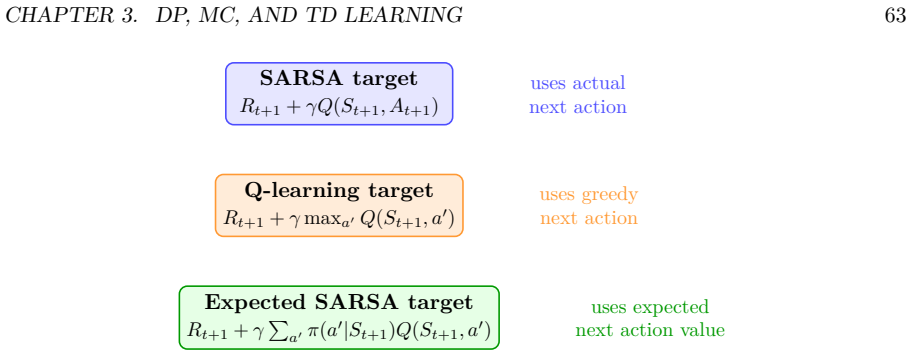
The submission is a textbook/preprint whose visible content (Preface, How to Use This Book, Chapters 1–3) is expository. It makes no novel scientific claim, performs no parameter fits, and issues no falsifiable predictions. The Bellman equations, TD(0), SARSA, Q-learning, and related results are presented as standard derivations from definitions of return and expectation, with explicit attribution to external sources (e.g., 'Sutton and Barto, 2018', 'Watkins and Dayan, 1992', 'Puterman, 1994'). There is no evidence that any equation is defined in terms of a target result, no fitted input is renamed as a prediction, and no load-bearing claim rests on a self-citation by the author. The only substantive limitation is that most chapters (4–25) are present only as a table of contents, so their accuracy cannot be verified from the artifact; this is a completeness/verification gap, not a circularity. Accordingly, the circularity burden is effectively zero.
Axiom & Free-Parameter Ledger
axioms (4)
- domain assumption Markov property: P(S_{t+1}, R_{t+1} | H_t, A_t) = P(S_{t+1}, R_{t+1} | S_t, A_t) (Eq. 2.2)
- standard math For finite discounted MDPs with gamma in [0,1), Bellman operators are contractions in the max norm, guaranteeing DP convergence (Sec. 3.4.6)
- standard math Tabular Q-learning converges to Q* under sufficient exploration and suitable step sizes (Sec. 3.7.2)
- domain assumption Stationarity of transition and reward functions (Sec. 2.11.2)
read the original abstract
Deep reinforcement learning has evolved from classical dynamic programming, temporal-difference learning, and tabular control into a broad framework for sequential decision-making under uncertainty. This book provides a structured introduction to that evolution, emphasizing not only how reinforcement learning algorithms work, but also why they were developed, which problems they address, where they fail, and how they connect to real-world systems. It combines textbook foundations, research-oriented discussion, and a systems perspective. Early chapters introduce reinforcement learning, Markov decision processes, dynamic programming, Monte Carlo methods, temporal-difference learning, and the transition from tabular to deep approaches. The middle chapters cover major algorithmic families, including DQN, advanced value-based methods, policy gradients, actor-critic methods, PPO, SAC, model-based reinforcement learning, MuZero, offline reinforcement learning, and sequence-modeling approaches. Later chapters extend the discussion to multi-agent and hierarchical learning, safe reinforcement learning, reinforcement learning from human feedback, reasoning-oriented AI systems, communication networks, UAV applications, implementation pipelines, experimental methodology, failure analysis, and future research directions. Throughout the book, examples from UAV-assisted networks, SD-WAN traffic engineering, safe control, and reasoning-based AI connect mathematical concepts to practical challenges such as partial observability, competing objectives, safety constraints, deployment drift, and uncertain evaluation. The book is intended for advanced students, researchers, and engineers with basic knowledge of probability, linear algebra, calculus, and programming.
Figures


























Reference graph
Works this paper leans on
-
[7]
Genie: Generative interactive environments
Jake Bruce, Michael Dennis, Adam Edwards, et al. Genie: Generative interactive environments. arXiv preprint arXiv:2402.15391,
-
[9]
Soft actor-critic for discrete action settings.arXiv preprint arXiv:1910.07207,
Petros Christodoulou. Soft actor-critic for discrete action settings.arXiv preprint arXiv:1910.07207,
Pith/arXiv arXiv 1910
-
[14]
D4RL: Datasets for deep data-driven reinforcement learning.arXiv preprint arXiv:2004.07219,
Justin Fu, Aviral Kumar, Ofir Nachum, George Tucker, and Sergey Levine. D4RL: Datasets for deep data-driven reinforcement learning.arXiv preprint arXiv:2004.07219,
Pith/arXiv arXiv 2004
-
[16]
Amelia Glaese, Nat McAleese, et al. Improving alignment of dialogue agents via targeted human judgements.arXiv preprint arXiv:2209.14375,
-
[17]
Maxime Guerrier, Hany Fouad, and Giovanni Beltrame. Learning control barrier functions and their application in safe reinforcement learning.arXiv preprint arXiv:2404.16879,
-
[18]
World models.arXiv preprint arXiv:1803.10122,
David Ha and Jürgen Schmidhuber. World models.arXiv preprint arXiv:1803.10122,
-
[19]
Soft actor-critic: Off-policy maximum entropy deep reinforcement learning with a stochastic actor
Tuomas Haarnoja, Aurick Zhou, Pieter Abbeel, and Sergey Levine. Soft actor-critic: Off-policy maximum entropy deep reinforcement learning with a stochastic actor. InInternational Conference on Machine Learning, 2018a. Tuomas Haarnoja, Aurick Zhou, Kristian Hartikainen, et al. Soft actor-critic algorithms and applications.arXiv preprint arXiv:1812.05905, 2...
-
[20]
Mastering diverse domains through world models.arXiv preprint arXiv:2301.04104,
Danijar Hafner, Jurgis Pasukonis, Jimmy Ba, and Timothy Lillicrap. Mastering diverse domains through world models.arXiv preprint arXiv:2301.04104,
-
[21]
Nicklas Hansen, Xiaolong Wang, and Hao Su
doi: 10.1038/s41586-025-08744-2. Nicklas Hansen, Xiaolong Wang, and Hao Su. Temporal difference learning for model predictive control. InInternational Conference on Machine Learning,
-
[22]
Dropout Q-functions for doubly efficient reinforcement learning.arXiv preprint arXiv:2110.02034,
Takuya Hiraoka, Takuya Imagawa, Takuma Hashimoto, Takashi Onishi, and Yoshimasa Tsu- ruoka. Dropout Q-functions for doubly efficient reinforcement learning.arXiv preprint arXiv:2110.02034,
-
[23]
Orpo: Monolithic preference optimization without reference model.arXiv preprint arXiv:2403.07691,
Jiwoo Hong, Noah Lee, and James Thorne. Orpo: Monolithic preference optimization without reference model.arXiv preprint arXiv:2403.07691,
-
[24]
A. U. Kaypak et al. A control barrier function-constrained model predictive control framework for safe reinforcement learning.arXiv preprint arXiv:2604.06463,
-
[25]
Kimi k1.5: Scaling reinforcement learning with LLMs.arXiv preprint arXiv:2501.12599,
Kimi Team. Kimi k1.5: Scaling reinforcement learning with LLMs.arXiv preprint arXiv:2501.12599,
-
[26]
BIBLIOGRAPHY511 Deepak S. Kushwaha and Zachary A. Biron. A review on safe reinforcement learning using lyapunov and barrier functions.arXiv preprint arXiv:2508.09128,
-
[28]
Sergey Levine, Aviral Kumar, George Tucker, and Justin Fu. Offline reinforcement learning: Tutorial, review, and perspectives on open problems.arXiv preprint arXiv:2005.01643,
Pith/arXiv arXiv 2005
-
[29]
Timothy P. Lillicrap, Jonathan J. Hunt, Alexander Pritzel, et al. Continuous control with deep reinforcement learning.arXiv preprint arXiv:1509.02971,
-
[30]
Junwei Luo and Yuke Zhu. Online finetuning decision transformers with pure reinforcement learning gradients.arXiv preprint arXiv:2601.00167,
-
[31]
Huan Ma et al. Efficient soft actor-critic with LLM-based action-level guidance for continuous control.arXiv preprint arXiv:2603.17468,
-
[32]
SimPO: Simple preference optimization with a reference-free reward.arXiv preprint arXiv:2405.14734,
Yu Meng, Mengzhou Xia, and Danqi Chen. SimPO: Simple preference optimization with a reference-free reward.arXiv preprint arXiv:2405.14734,
-
[34]
Accelerating online reinforce- ment learning with offline datasets.arXiv preprint arXiv:2006.09359,
Ashvin Nair, Murtaza Dalal, Abhishek Gupta, and Sergey Levine. Accelerating online reinforce- ment learning with offline datasets.arXiv preprint arXiv:2006.09359,
Pith/arXiv arXiv 2006
-
[35]
How to train your latent control barrier function.arXiv preprint arXiv:2511.18606,
Kenta Nakamura et al. How to train your latent control barrier function.arXiv preprint arXiv:2511.18606,
-
[36]
Xue Bin Peng, Aviral Kumar, Grace Zhang, and Sergey Levine. Advantage-weighted regression: Simple and scalable off-policy reinforcement learning.arXiv preprint arXiv:1910.00177,
Pith/arXiv arXiv 1910
-
[37]
John Schulman, Sergey Levine, Philipp Moritz, Michael I. Jordan, and Pieter Abbeel. Trust region policy optimization. InInternational Conference on Machine Learning, 2015a. BIBLIOGRAPHY514 John Schulman, Philipp Moritz, Sergey Levine, Michael Jordan, and Pieter Abbeel. High- dimensional continuous control using generalized advantage estimation.arXiv prepr...
-
[38]
Zhihong Shao, Peiyi Wang, Qihao Zhu, et al. Deepseekmath: Pushing the limits of mathematical reasoning in open language models.arXiv preprint arXiv:2402.03300,
-
[39]
Towards understanding sycophancy in language models.arXiv preprint arXiv:2310.13548,
Megha Sharma et al. Towards understanding sycophancy in language models.arXiv preprint arXiv:2310.13548,
-
[40]
Joar Skalse, N. H. R. Howe, Dmitrii Krasheninnikov, and David Krantz. Defining and character- izing reward hacking.arXiv preprint arXiv:2209.13085,
-
[41]
Targetreturnoptimizerformulti-gamedecisiontransformer
KentaTatematsuandAtsushiWachi. Targetreturnoptimizerformulti-gamedecisiontransformer. arXiv preprint arXiv:2503.02311,
-
[42]
Mark Towers, Ariel Kwiatkowski, Jordan Terry, et al. Gymnasium: A standard interface for reinforcement learning environments.arXiv preprint arXiv:2407.17032,
-
[43]
Deep reinforcement learning and the deadly triad.arXiv preprint arXiv:1812.02648,
Hado van Hasselt, Yotam Doron, Florian Strub, et al. Deep reinforcement learning and the deadly triad.arXiv preprint arXiv:1812.02648,
-
[45]
Behavior regularized offline reinforcement learning
BIBLIOGRAPHY517 Yifan Wu, George Tucker, and Ofir Nachum. Behavior regularized offline reinforcement learning. arXiv preprint arXiv:1911.11361,
Pith/arXiv arXiv 1911
-
[46]
An Yang et al. Qwen2.5-math technical report: Toward mathematical expert model via self- improvement.arXiv preprint arXiv:2409.12122,
-
[47]
Lin Yang, Brian Werner, Michael de Sa, and Aaron D. Ames. CBF-RL: Safety filtering reinforce- ment learning in training with control barrier functions.arXiv preprint arXiv:2510.14959,
-
[48]
Zheng Yuan, Hongyi Yuan, Cheng Li, et al. Scaling relationship on learning mathematical reasoning with large language models.arXiv preprint arXiv:2308.01825,
-
[49]
G. Zhang et al. The landscape of agentic reinforcement learning for LLMs: A survey.arXiv preprint arXiv:2509.02547, 2025a. M. Zhang et al. Enhance the safety in reinforcement learning by ADRC lagrangian methods. arXiv preprint arXiv:2601.18142,
-
[50]
Ning Zhang, Yifan Zhao, Meng Yang, and Shijie Dai. LLMs augmented hierarchical reinforcement learning with action primitives for long-horizon manipulation tasks.Scientific Reports, 15: 36779, 2025b. BIBLIOGRAPHY518 Shangtong Zhang and Richard S. Sutton. A deeper look at experience replay.arXiv preprint arXiv:1712.01275,
-
[51]
Revisiting discrete soft actor-critic.arXiv preprint arXiv:2209.10081,
Haibin Zhou et al. Revisiting discrete soft actor-critic.arXiv preprint arXiv:2209.10081,
-
[52]
Ziegler, Nisan Stiennon, Jeffrey Wu, et al
Daniel M. Ziegler, Nisan Stiennon, Jeffrey Wu, et al. Fine-tuning language models from human preferences.arXiv preprint arXiv:1909.08593,
Pith/arXiv arXiv 1909
-
[1993]
Deepseek-r1: Incentivizing reasoning capability in LLMs via reinforcement learning
DeepSeek-AI. Deepseek-r1: Incentivizing reasoning capability in LLMs via reinforcement learning. arXiv preprint arXiv:2501.12948,
-
[1998]
Harrison Lee et al. RLAIF vs. RLHF: Scaling reinforcement learning from human feedback with AI feedback.arXiv preprint arXiv:2309.00267,
-
[2012]
F. Delgrange et al. Foundation world models for agents that learn, verify, and abstract.arXiv preprint arXiv:2602.23997,
-
[2015]
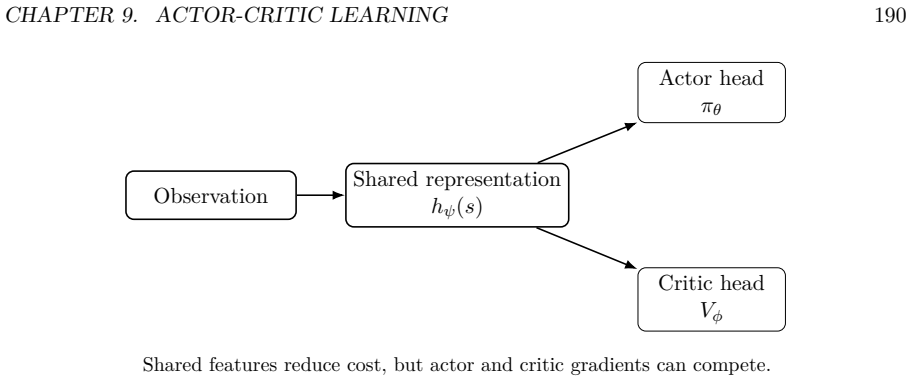
Sébastien Garcin et al. Studying the interplay between the actor and critic representations in deep reinforcement learning.arXiv preprint arXiv:2503.06343,
-
[2016]
URL https://arxiv.org/abs/1606.06565. 503 BIBLIOGRAPHY504 Marcin Andrychowicz, Anton Raichuk, Piotr Stańczyk, Manu Orsini, Sertan Girgin, Raphaël Marinier, Léo Hussenot, Matthieu Geist, Olivier Pietquin, Marcin Michalski, Sylvain Gelly, and Olivier Bachem. What matters for on-policy deep actor-critic methods? a large-scale study. InInternational Conferenc...
-
[2017]
Constitutional AI: Harmlessness from AI feedback.arXiv preprint arXiv:2212.08073,
Yuntao Bai, Saurav Kadavath, Sandipan Kundu, et al. Constitutional AI: Harmlessness from AI feedback.arXiv preprint arXiv:2212.08073,
-
[2018]
2024 ACM a.m
Association for Computing Machinery. 2024 ACM a.m. turing award: Andrew g. barto and richard s. sutton.https://awards.acm.org/about/2024-turing,
2024
-
[2020]
Training verifiers to solve math word problems.arXiv preprint arXiv:2110.14168,
Karl Cobbe, Vineet Kosaraju, Mohammad Bavarian, et al. Training verifiers to solve math word problems.arXiv preprint arXiv:2110.14168,
-
[2021]
Process reinforcement through implicit rewards.arXiv preprint arXiv:2502.01456,
Guangyuan Cui et al. Process reinforcement through implicit rewards.arXiv preprint arXiv:2502.01456,
-
[2022]
Openai gym.arXiv preprint arXiv:1606.01540,
Greg Brockman, Vicki Cheung, Ludwig Pettersson, Jonas Schneider, John Schulman, Jie Tang, and Wojciech Zaremba. Openai gym.arXiv preprint arXiv:1606.01540,
-
[2023]
Zhendong Wang, Jonathan J. Hunt, and Mingyuan Zhou. Diffusion policies as an expressive policy class for offline reinforcement learning.arXiv preprint arXiv:2208.06193,
-
[2024]
Stephen Casper, Xander Davies, Claudia Shi, et al. Open problems and fundamental limitations of reinforcement learning from human feedback.arXiv preprint arXiv:2307.15217,
-
[2025]
URLhttps://arxiv.org/abs/2512.03835. arXiv preprint. Ghoshana Bista, Kamal Singh, et al. Safety-aware multi-class QoS control in SD-WAN via ensemble-based neural control barrier functions. InIFIP Networking 2026 (TX4Nets), Lugano, May 2026a. Ghoshana Bista, Kamal Singh, et al. Safe reinforcement learning for SD-WAN traffic engineer- ing via uncertainty-aw...
arXiv 2026
-
[2026]
Playing atari with deep reinforcement learning.arXiv preprint arXiv:1312.5602,
Volodymyr Mnih, Koray Kavukcuoglu, David Silver, et al. Playing atari with deep reinforcement learning.arXiv preprint arXiv:1312.5602,
discussion (0)
Sign in with ORCID, Apple, or X to comment. Anyone can read and Pith papers without signing in.