REVIEW 4 major objections 6 minor 30 references
Graph Neural Networks for Automatic Addition of Optimizing Components in Printed Circuit Board Schematics
T0 review · 4 major / 6 minor · reviewed 2026-08-07 · deepseek-v4-flash
Pith's one-line read The paper claims that a graph neural network reading a PCB schematic as a bipartite graph of nets and symbols can predict, with over 85% AUPRC, where an expert would add a robustness component, and that this node-pair formulation…
desk verdict A credible, transparent GNN-for-EDA paper whose headline AUPRC numbers are joint pre-filter plus node-pair metrics; the practical claims outrun the evidence, but the benchmark itself deserves serious refereeing. read the letter →
The pith
A machine-rendered reading of the paper's core claim, the machinery that carries it, and where it could break.
The reading
What carries the argument
The load-bearing mechanism is the pairing of a bipartite graph representation with a two-stage prediction head: a pre-filter MLP scores each net node as a potential connection point, then a node-pair MLP classifies each surviving pair of net nodes. The bipartite graph makes the two-terminal nature of the new component explicit, and the edge attributes (summed pin-name embeddings plus a parallel-edge count) carry functional information that node names alone lack. This machinery turns placement into a classification problem whose target is a pair of existing net nodes, avoiding the quadratic blow-up and instability of classifying all pairs at once.
What would settle it
Take a held-out set of schematics and have a different team of expert engineers independently mark where they would place pull-ups, RC filters, and decoupling capacitors; if the inter-labeler agreement is low, or a model trained on the original labels scores far below 85% AUPRC against the new labels, the claim that the GNN learns correct component placement collapses into the weaker claim that it imitates one labeling habit.
Extended reading notes
Core claim
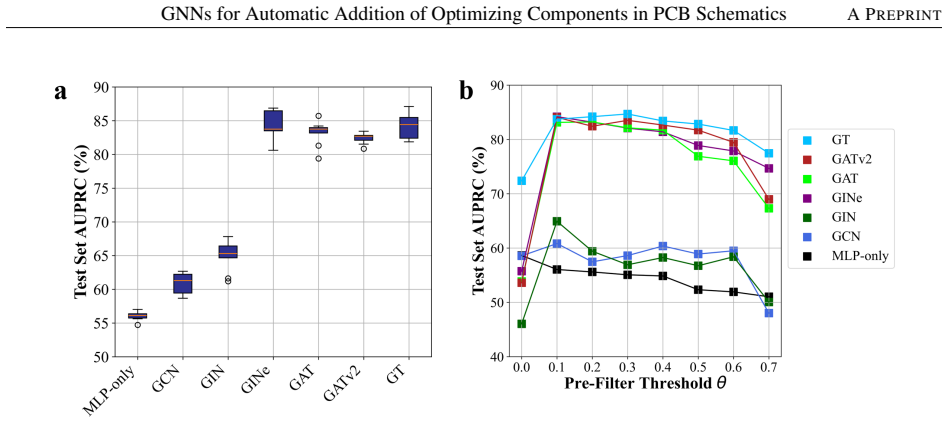
On the paper's own terms, the central discovery is that component placement for PCB optimization can be learned as a node-pair classification over a bipartite schematic graph: symbol nodes and net nodes form the two parts, pins become edges, and sentence-transformer embeddings of component names and pin names serve as input features. The best model reaches 85.8% AUPRC for pull-up/pull-down resistor placement and nearly 85% for RC filter placement, while models that ignore edge attributes lag far behind. The same framework also estimates how many parallel decoupling capacitors an expert would place, deviating by at most one capacitor in about 70% of predictions.
Load-bearing premise
The manual expert labels that define correct component placement are complete and consistent across the dataset; if they are not, the reported AUPRC measures imitation of a particular labeling style rather than circuit optimization.
Editorial extensions
If this is right
- EDA tools could automate the addition of pull-up/pull-down resistors, RC filters, and decoupling capacitors during schematic design, since the model predicts placement with AUPRC above 80%.
- Edge attributes (pin-name embeddings) are necessary for high accuracy on all three tasks; models without them perform markedly worse, indicating that pin function, not just component name, drives placement.
- The pre-filter step is not merely a speed optimization: removing it degrades performance, so candidate pruning also stabilizes training and improves final accuracy.
- Decoupling-capacitor count prediction is feasible: the regression deviates by at most one capacitor in about 70% of cases and achieves an area of 89.2% under the cumulative-error curve.
- The node-pair formulation avoids the shortcomings of link-prediction frameworks for components with a known number of terminals, making it a reusable template for similar two-terminal additions.
Reading between the lines
- If the approach transfers to other two-terminal additions (series termination resistors, ESD diodes, ferrite beads), the same bipartite node-pair framework could be reused with only a task-specific output head, as the paper itself leaves this extension implicit.
- Because the model leans heavily on name embeddings, its accuracy may drop on schematics with unusual or obfuscated naming conventions; a testable extension is fine-tuning the language model on PCB-specific nomenclature.
- The reported AUPRC is measured against one expert labeling process, so practical deployment would need inter-expert agreement studies: the model can only be as consistent as the labels it imitates.
- The regression head's rough count estimates could be combined with component-value and market-availability information, which the paper explicitly lists as future work, to produce more complete placement recommendations.
Editorial analysis
A structured set of objections, weighed in public.
Referee Report
Summary. The paper proposes a graph-based method for recommending where to insert additional components (pull-up/pull-down resistors, RC filters, decoupling capacitors) into PCB schematics. Schematics are represented as bipartite graphs of net and symbol nodes, with node/edge features derived from sentence-transformer embeddings of component and pin names. The model first uses a GNN to compute node representations, then an MLP pre-filter prunes unlikely net nodes, and a second MLP scores the remaining net pairs. Experiments on three expert-labeled real-world datasets compare several GNN backbones (GCN, GIN, GINe, GAT, GATv2, Transformer) against an MLP-only baseline, reporting test AUPRC values up to 85.8% for pull-ups/downs and near 85% for RC filters. The authors conclude that GNNs, especially with edge attributes, can predict component placement with high accuracy.
Significance. If the reported results hold, this is a novel and practically relevant application of GNNs to PCB design automation. The bipartite graph representation and the use of sentence-transformer embeddings to handle non-standardized component names are sensible contributions, and the paper provides a reproducible codebase. The work fills a gap between ML-based EDA for ICs and the less automated PCB design flow. However, the significance is currently limited by evaluation gaps: the headline AUPRC conflates pre-filter and node-pair performance, no statistical uncertainty is reported for the model comparisons, and the ground truth is a single expert labeling process without reliability analysis. These issues need to be addressed before the practical claims are fully supported.
major comments (4)
- [Section 5.2, Figure 4 and surrounding text] The reported AUPRC is computed over all net-node pairs, with pairs that are pruned by the pre-filter assigned negative labels. As the paper itself states, this makes AUPRC a joint measure of the pre-filter and the node-pair MLP. The paper does not report the pre-filter's precision/recall or the node-pair MLP's AUPRC restricted to the candidate pairs that pass the pre-filter. Consequently, the claim that "GNNs can solve these problems with high accuracy" is not localized to the node-pair prediction component, which is the paper's stated contribution. Please provide (i) pre-filter recall and precision at the selected threshold θ for each task and model, and (ii) an AUPRC computed only over the pairs that pass the pre-filter, or an ablation using a trivial/random pre-filter, to separate the contributions of the two modules.
- [Section 5.1, 'Experimental Setting' and Figures 4-6] The paper reports a single AUPRC per model per task from 9-fold cross-validation, but gives no standard deviations, confidence intervals, or significance tests. The narrative emphasizes differences such as "much lower performance" for GCN/GIN and "very similar performance" among edge-aware models, yet without variance estimates these differences may be within fold-to-fold noise. In addition, hyperparameters, including the threshold θ, are selected per model on the validation set; the reported test numbers inherit selection bias. Please provide per-fold results and paired significance tests (e.g., Wilcoxon signed-rank) for the headline comparisons, and indicate how selection across the hyperparameter grid is accounted for.
- [Section 5.1, 'Datasets'] The ground-truth labels are produced by manual optimization by human experts, but the paper provides no labeling protocol, no number of labelers, and no inter-labeler agreement. The abstract and conclusion make claims about automating "optimization" and improving circuit "robustness and reliability," yet the evaluation only measures agreement with this particular labeling process. If the labels are incomplete, inconsistent, or reflect a single design style, the high AUPRC may not transfer to other settings, and the practical claims are not supported. I recommend either adding label-reliability analysis (e.g., duplicate labeling on a subset, consistency metrics) or substantially tempering the practical wording in the abstract and conclusion.
- [Sections 5.2-5.4] The only non-GNN comparator is the MLP-only baseline, which still uses the sentence-transformer name embeddings and therefore already captures net-name semantics to some degree. No comparison is made to simple rule-based placement heuristics (e.g., placing decoupling capacitors between all supply/ground net pairs, or pull-ups on nets with name patterns indicating open-drain connections). Without such a baseline, it is unclear whether the high AUPRC reflects the GNN's graph reasoning or simply the predictability of net names. A rule-based baseline would also help contextualize the claimed practical value over existing engineering heuristics.
minor comments (6)
- [Section 6 / before Figure 7] The text immediately before Figure 7 contains an apparent rendering artifact: a long string of "/uni00000013/uni00000014/..." that is not readable prose. This should be removed.
- [Section 5.4, 'Regression Results'] The regression evaluation rounds predictions to integers and reports cumulative absolute error as an "area under the curve," but the rounding rule (nearest integer?) and the exact definition of the AUC are not stated. Please define the metric precisely and report mean absolute error with variance across folds.
- [Section 4 and Section 5.1] The training procedure for the node-pair MLP is underspecified: it is not stated how negative node pairs are sampled for the task-specific loss, whether all pairs (after pre-filtering) are used in each epoch, and whether the pre-filter threshold θ is applied during training or only at inference. Please clarify these details for reproducibility.
- [Section 3, 'Node Attributes'] The description of the sentence transformer says it was "trained on a diverse language dataset containing over 1 billion training pairs" and cites reference [26] (Minilm). Please verify that this claim is supported by the cited source, or rephrase.
- [Section 5.1, 'Experimental Setting'] Please clarify how batching is performed for graphs with up to 702 nodes when the batch size is 128. For example, is each graph treated as a separate batch or are multiple graphs padded and packed? This affects memory use and training dynamics.
- [Appendix B] The symmetry verification reports a correlation above 99.9% but gives no indication of variance across folds or models. Please report the mean and standard deviation of this correlation.
Circularity Check
No significant circularity: the node-pair predictions are evaluated on held-out test labels, and the pipeline-level AUPRC is explicitly disclosed rather than disguised as a pure pair-classifier metric.
full rationale
The paper's central quantitative claims are supervised-learning accuracies measured on held-out test splits (80/10/10 with 9-fold cross-validation), so the reported AUPRC values are genuine predictions rather than re-statements of fitted constants. The only candidate concern is the evaluation protocol in Section 5.2: pairs skipped by the pre-filter are assigned negative labels, so the AUPRC jointly measures pre-filter recall and node-pair-MLP discrimination; however, the paper explicitly states this ('the AUPRC metric reflects both errors resulting from node pair misclassifications as well as errors resulting from incorrect filtering by the pre-filter MLP'), and the test split prevents any statistical forcing. The expert-labeled ground truth ('The schematics were optimized and labeled manually by human experts in electrical engineering') is an external empirical target, not an equation that defines the model's output; whether those labels capture true circuit-reliability improvements is a validity question, not a circularity. There are no load-bearing self-citations: all cited neural architectures, the sentence-transformer embedding model, and the optimizer are external prior work. No derived quantity in the paper reduces by construction to a fitted parameter or to the labels it claims to predict.
Assumptions & free parameters
free parameters (3)
- Pre-filter threshold theta =
0.1 to 0.7 depending on model and task
- Regression loss weight alpha =
0.1
- Architecture hyperparameters (hidden dimension, layers, heads, learning rate) =
Hidden 64, layers 0-3, heads 1-4, learning rate mostly 0.001
assumptions (4)
- domain assumption New components to be added are two-terminal components connected to exactly two net nodes.
- domain assumption The bipartite graph plus SentenceTransformer name embeddings captures sufficient information to infer correct placement.
- domain assumption Human expert labels are correct and complete ground truth for component placement.
- domain assumption Aggregating parallel pin edges by summing embeddings preserves the information needed for placement prediction.
Cite this review
Pith. "Pith review of Graph Neural Networks for Automatic Addition of Optimizing Components in Printed Circuit Board Schematics." pith.science (2026). https://pith.science/paper/V4UU2LHL
@misc{pith2026250610577,
  author       = {Pith},
  title        = {Pith review of: Graph Neural Networks for Automatic Addition of Optimizing Components in Printed Circuit Board Schematics},
  year         = {2026},
  howpublished = {\url{https://pith.science/paper/V4UU2LHL}},
  note         = {Machine review of arXiv:2506.10577}
}
read the original abstract
The design and optimization of Printed Circuit Board (PCB) schematics is crucial for the development of high-quality electronic devices. Thereby, an important task is to optimize drafts by adding components that improve the robustness and reliability of the circuit, e.g., pull-up resistors or decoupling capacitors. Since there is a shortage of skilled engineers and manual optimizations are very time-consuming, these best practices are often neglected. However, this typically leads to higher costs for troubleshooting in later development stages as well as shortened product life cycles, resulting in an increased amount of electronic waste that is difficult to recycle. Here, we present an approach for automating the addition of new components into PCB schematics by representing them as bipartite graphs and utilizing a node pair prediction model based on Graph Neural Networks (GNNs). We apply our approach to three highly relevant PCB design optimization tasks and compare the performance of several popular GNN architectures on real-world datasets labeled by human experts. We show that GNNs can solve these problems with high accuracy and demonstrate that our approach offers the potential to automate PCB design optimizations in a time- and cost-efficient manner.
Figures


Figures from the paper (4 more)



Reference graph
Works this paper leans on
-
[1]
In: Proceedings of the 56th Annual Design Automation Conference 2019
Barboza, E.C., Shukla, N., Chen, Y ., Hu, J.: Machine learning-based pre-routing timing prediction with reduced pessimism. In: Proceedings of the 56th Annual Design Automation Conference 2019. pp. 1–6 (2019)
work page 2019
-
[2]
Brody, S., Alon, U., Yahav, E.: How attentive are graph attention networks? International Conference on Learning Representations (2022)
work page 2022
-
[3]
Budak, A.F., Gandara, M., Shi, W., Pan, D.Z., Sun, N., Liu, B.: An efficient analog circuit sizing method based on machine learning assisted global optimization. IEEE Transactions on Computer-Aided Design of Integrated Circuits and Systems 41(5), 1209–1221 (2021)
work page 2021
-
[4]
Advances in Neural Information Processing Systems 34, 16508–16519 (2021)
Cheng, R., Yan, J.: On joint learning for solving placement and routing in chip design. Advances in Neural Information Processing Systems 34, 16508–16519 (2021)
work page 2021
-
[5]
International Conference on Learning Representations (2023)
Dong, Z., Cao, W., Zhang, M., Tao, D., Chen, Y ., Zhang, X.: Cktgnn: Circuit graph neural network for electronic design automation. International Conference on Learning Representations (2023)
work page 2023
-
[6]
Hamilton, W., Ying, Z., Leskovec, J.: Inductive representation learning on large graphs. Advances in Neural Information Processing Systems 30 (2017) 10 GNNs for Automatic Addition of Optimizing Components in PCB Schematics A PREPRINT
work page 2017
-
[7]
In: 2020 25th Asia and South Pacific Design Automation Conference (ASP-DAC)
Hosny, A., Hashemi, S., Shalan, M., Reda, S.: Drills: Deep reinforcement learning for logic synthesis. In: 2020 25th Asia and South Pacific Design Automation Conference (ASP-DAC). pp. 581–586. IEEE (2020)
work page 2020
-
[8]
International Conference on Learning Representations (2020)
Hu, W., Liu, B., Gomes, J., Zitnik, M., Liang, P., Pande, V ., Leskovec, J.: Strategies for pre-training graph neural networks. International Conference on Learning Representations (2020)
work page 2020
Show all 30 references
-
[9]
ACM Transactions on Design Automation of Electronic Systems (TODAES) 26(5), 1–46 (2021)
Huang, G., Hu, J., He, Y ., Liu, J., Ma, M., Shen, Z., Wu, J., Xu, Y ., Zhang, H., Zhong, K., et al.: Machine learning for electronic design automation: A survey. ACM Transactions on Design Automation of Electronic Systems (TODAES) 26(5), 1–46 (2021)
2021
-
[10]
arXiv preprint arXiv:1611.07308 (2016)
Kipf, T.N., Welling, M.: Variational graph auto-encoders. arXiv preprint arXiv:1611.07308 (2016)
2016 arXiv
-
[11]
International Confer- ence on Learning Representations (2017)
Kipf, T.N., Welling, M.: Semi-supervised classification with graph convolutional networks. International Confer- ence on Learning Representations (2017)
2017
-
[12]
In: 2020 Design, Automation & Test in Europe Conference & Exhibition (DATE)
Kunal, K., Dhar, T., Madhusudan, M., Poojary, J., Sharma, A., Xu, W., Burns, S.M., Hu, J., Harjani, R., Sapatnekar, S.S.: Gana: Graph convolutional network based automated netlist annotation for analog circuits. In: 2020 Design, Automation & Test in Europe Conference & Exhibit...
2020
-
[13]
International Conference on Learning Represen- tations (2019)
Loshchilov, I., Hutter, F.: Decoupled weight decay regularization. International Conference on Learning Represen- tations (2019)
2019
-
[14]
Electronics 11(3), 435 (2022)
Mina, R., Jabbour, C., Sakr, G.E.: A review of machine learning techniques in analog integrated circuit design automation. Electronics 11(3), 435 (2022)
2022
-
[15]
arXiv preprint arXiv:2004.10746 (2020)
Mirhoseini, A., Goldie, A., Yazgan, M., Jiang, J., Songhori, E., Wang, S., Lee, Y .J., Johnson, E., Pathak, O., Bae, S., et al.: Chip placement with deep reinforcement learning. arXiv preprint arXiv:2004.10746 (2020)
2020 arXiv
-
[16]
Nature 594(7862), 207–212 (2021)
Mirhoseini, A., Goldie, A., Yazgan, M., Jiang, J.W., Songhori, E., Wang, S., Lee, Y .J., Johnson, E., Pathak, O., Nova, A., et al.: A graph placement methodology for fast chip design. Nature 594(7862), 207–212 (2021)
2021
-
[17]
arXiv preprint arXiv:1908.10084 (2019)
Reimers, N., Gurevych, I.: Sentence-bert: Sentence embeddings using siamese bert-networks. arXiv preprint arXiv:1908.10084 (2019)
2019 arXiv
-
[18]
In: 2020 57th ACM/IEEE Design Automation Conference (DAC)
Ren, H., Kokai, G.F., Turner, W.J., Ku, T.S.: Paragraph: Layout parasitics and device parameter prediction using graph neural networks. In: 2020 57th ACM/IEEE Design Automation Conference (DAC). pp. 1–6. IEEE (2020)
2020
-
[19]
Neural Computing and Applications 35(16), 12145–12157 (2023)
Said, A., Shabbir, M., Broll, B., Abbas, W., Völgyesi, P., Koutsoukos, X.: Circuit design completion using graph neural networks. Neural Computing and Applications 35(16), 12145–12157 (2023)
2023
-
[20]
ACM Transactions on Design Automation of Electronic Systems 28(2), 1–27 (2023)
Sánchez, D., Servadei, L., Kiprit, G.N., Wille, R., Ecker, W.: A comprehensive survey on electronic design automation and graph neural networks: Theory and applications. ACM Transactions on Design Automation of Electronic Systems 28(2), 1–27 (2023)
2023
-
[21]
In: 2020 Design, Automation & Test in Europe Conference & Exhibition (DATE)
Settaluri, K., Haj-Ali, A., Huang, Q., Hakhamaneshi, K., Nikolic, B.: Autockt: Deep reinforcement learning of analog circuit designs. In: 2020 Design, Automation & Test in Europe Conference & Exhibition (DATE). pp. 490–495. IEEE (2020)
2020
-
[22]
In: Proceedings of the Thirtieth International Joint Conference on Artificial Intelligence (2021)
Shi, Y ., Huang, Z., Feng, S., Zhong, H., Wang, W., Sun, Y .: Masked label prediction: Unified message passing model for semi-supervised classification. In: Proceedings of the Thirtieth International Joint Conference on Artificial Intelligence (2021)
2021
-
[23]
In: 2024 25th International Symposium on Quality Electronic Design (ISQED)
Shrestha, P., Savidis, I.: Eda-ml: Graph representation learning framework for digital ic design automation. In: 2024 25th International Symposium on Quality Electronic Design (ISQED). pp. 1–7. IEEE (2024)
2024
-
[24]
International Conference on Learning Representations (2018)
Veliˇckovi´c, P., Cucurull, G., Casanova, A., Romero, A., Lio, P., Bengio, Y .: Graph attention networks. International Conference on Learning Representations (2018)
2018
-
[25]
In: 2020 57th ACM/IEEE Design Automation Conference (DAC)
Wang, H., Wang, K., Yang, J., Shen, L., Sun, N., Lee, H.S., Han, S.: Gcn-rl circuit designer: Transferable transistor sizing with graph neural networks and reinforcement learning. In: 2020 57th ACM/IEEE Design Automation Conference (DAC). pp. 1–6. IEEE (2020)
2020
-
[26]
Advances in Neural Information Processing Systems 33, 5776–5788 (2020)
Wang, W., Wei, F., Dong, L., Bao, H., Yang, N., Zhou, M.: Minilm: Deep self-attention distillation for task- agnostic compression of pre-trained transformers. Advances in Neural Information Processing Systems 33, 5776–5788 (2020)
2020
-
[27]
In: 2018 IEEE/ACM International Conference on Computer-Aided Design (ICCAD)
Xie, Z., Huang, Y .H., Fang, G.Q., Ren, H., Fang, S.Y ., Chen, Y ., Hu, J.: Routenet: Routability prediction for mixed-size designs using convolutional neural network. In: 2018 IEEE/ACM International Conference on Computer-Aided Design (ICCAD). pp. 1–8. IEEE (2018)
2018
-
[28]
Xu, K., Hu, W., Leskovec, J., Jegelka, S.: How powerful are graph neural networks? International Conference on Learning Representations (2019) 11 GNNs for Automatic Addition of Optimizing Components in PCB Schematics A PREPRINT
2019
-
[29]
In: Proceedings of the 55th Annual Design Automation Conference
Yu, C., Xiao, H., De Micheli, G.: Developing synthesis flows without human knowledge. In: Proceedings of the 55th Annual Design Automation Conference. pp. 1–6 (2018)
2018
-
[30]
Zhang, M., Chen, Y .: Link prediction based on graph neural networks. Advances in Neural Information Processing Systems 31 (2018) 12 GNNs for Automatic Addition of Optimizing Components in PCB Schematics A PREPRINT A Results of the Hyperparameter Optimizations Here, we report ...
2018
Reviewed August 7, 2026 · model on record in the stance chip above.
Discussion (0). Continue with ORCID to comment.