REVIEW 2 major objections 4 minor 88 references
Polaron-mediated metal-insulator transition and proton conduction in hydrogenated nickelate perovskites
T0 review · 2 major / 4 minor · reviewed 2026-08-04 · deepseek-v4-flash
Pith's one-line read The hydrogen-driven metal-insulator transition in nickelate perovskites is caused by electron and proton polarons that localize nickel's eg electrons into a Mott-insulating d8 state, not by simple electron filling of the nickel orbitals.
desk verdict A coherent polaron-mediated MIT mechanism in hydrogenated nickelates, with genuinely new proton-transport trends, but the central charge-transfer assignment rests on a single Hubbard U and needs a sensitivity check. read the letter →
The pith
A machine-rendered reading of the paper's core claim, the machinery that carries it, and where it could break.
The reading
What carries the argument
The central object is the Ni–O hybridized d8L electronic configuration—a nickel d8 state carrying a hole on an oxygen ligand. The paper's mechanism is that hydrogen doping fills that ligand hole, and the resulting lattice distortion forms an electron polaron; the proton adds a second polaronic distortion. Polaron formation weakens Ni–O hybridization, which is the step that localizes the eg electrons into a d8 Mott state. For proton transport, the key distinction is between intraoctahedral transfer (proton hopping between oxygen sites within the same NiO6 octahedron) and interoctahedral transfer (proton moving through the A-site plane), whose computed energy barriers and percolation pathways
What would settle it
Resonant inelastic X-ray scattering or X-ray absorption at the Ni L-edge and O K-edge on hydrogenated NdNiO3 could directly show whether the added electrons sit in oxygen ligand holes or in Ni eg states. Alternatively, repeating the first-principles calculation with the on-site Coulomb parameter varied from 1 to 4 eV would reveal whether the d8-ligand-hole occupation and polaron localization survive; if they disappear at moderate interaction strengths, the mechanism is an artifact of the parameter choice.
Extended reading notes
Core claim
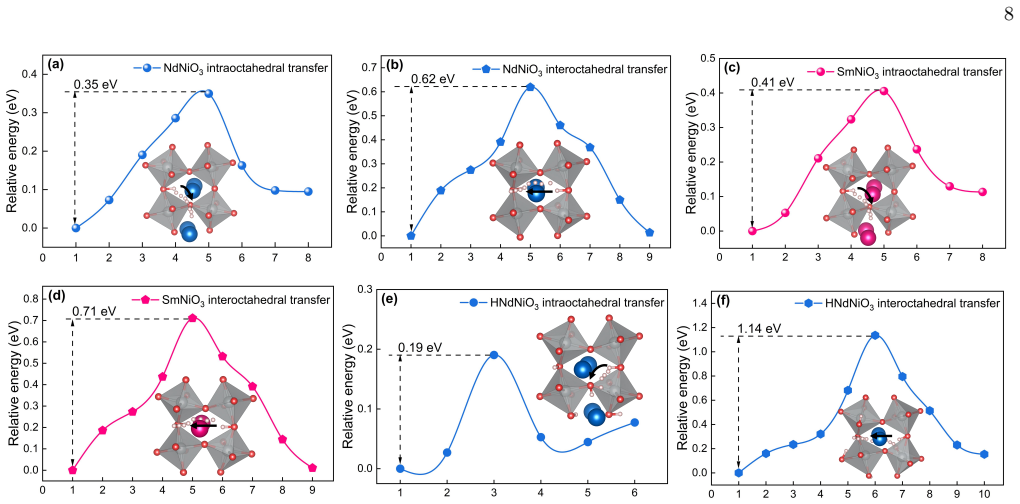
In hydrogenated NdNiO3, the electrons introduced by hydrogen fill the O 2p ligand hole of the Ni–O antibonding d8L states rather than directly converting Ni3+ to Ni2+. Filling these antibonding states elongates the Ni–O bonds, forming electron polarons, and the protons themselves act as polarizing centers. Together these polarons weaken the Ni–O σ hybridization, converting the itinerant Ni eg electron into a localized t2g^6 eg^2 configuration. The half-filled eg shell then experiences strong on-site Coulomb repulsion, opening a Mott gap of about 0.81 eV. The same calculations map proton transport: in pristine NdNiO3 the intraoctahedral proton-transfer barrier is 0.35 eV and the interoctahedr
Load-bearing premise
The entire polaron mechanism rests on the choice of the on-site Coulomb correction parameter (Ueff = 2.0 eV) and on freezing the rare-earth f electrons in the core; if the real nickel–oxygen energy balance differs, the added electrons might occupy nickel states instead of oxygen ligand holes, and the polaron-driven localization would not hold.
Editorial extensions
If this is right
- The hydrogen-induced insulating phase of NdNiO3 should be classified as a polaron-driven Mott insulator, not a simple band-filling or charge-transfer insulator.
- Proton conductivity in rare-earth nickelates is set by two competing effects: smaller A-site cations increase hydrogen uptake but raise migration barriers, implying an optimal cation size for electrolyte performance.
- Hydrogenation creates fast one-dimensional proton channels along the c-axis while blocking three-dimensional percolation, so the material may still work well at electrolyte–electrode interfaces that exploit that direction.
- The calculated 0.81 eV gap in hydrogenated NdNiO3 provides a concrete target for optical and transport measurements to confirm the insulating state.
- The finding that purely electron-doped NdNiO3 has a smaller gap (0.55 eV) than hydrogenated material supports a measurable role for the proton polaron beyond electron filling.
Reading between the lines
- A similar polaron-mediated mechanism may operate in other strongly correlated oxides that spontaneously absorb hydrogen, such as cobaltites and vanadates, offering a screening criterion: materials with O 2p ligand-hole states in their metallic phase are prime candidates.
- Because electron-polaron formation is driven by filling antibonding states, strain or electrostatic doping could be used instead of hydrogen to tune the transition, with hydrogen adding proton-polaron effects on top.
- The suppression of three-dimensional proton diffusion under full hydrogenation suggests an intermediate hydrogen concentration may best balance polaron formation against proton mobility; measuring conductivity across H concentrations could reveal a peak.
- The computed role of A-site radius implies that mixing Nd and Sm on the A-site could tune both hydrogen uptake and proton mobility, an experimentally accessible chemical substitution.
Editorial analysis
A structured set of objections, weighed in public.
Referee Report
Summary. The paper presents first-principles DFT+U calculations on hydrogenated NdNiO3 and SmNiO3, aiming to explain the hydrogen-induced metal-insulator transition (MIT) and proton conduction. The central claim is that electrons introduced by hydrogen doping occupy O 2p ligand-hole states of the Ni-O d8L hybrid, forming electron polarons that, together with proton polarons, weaken Ni-O hybridization and drive the itinerant Ni eg electrons toward a localized d8 configuration, opening a Mott gap. The authors support this with PDOS, COHP, MLWF, Bader charge, and structural distortion analyses, and also report hydrogen insertion energies and proton migration barriers/diffusion coefficients for NdNiO3 and SmNiO3.
Significance. If the proposed mechanism is correct, it provides a coherent atomistic picture of the hydrogen-induced MIT in rare-earth nickelates, distinguishing it from the simpler electron-filling Mott picture and connecting it to polaron formation. The paper is strengthened by the use of multiple complementary electronic-structure diagnostics, the agreement of the calculated ground-state structural parameters with experiment, the absence of parameter fitting beyond a literature-inherited Ueff, and the open data statement. The proton-transport results, while more qualitative, offer comparative insight for electrolyte design. However, the central mechanistic conclusion rests on a single DFT+U parameter setting and on an under-specified electron-doped reference calculation, so the current evidence is not yet conclusive.
major comments (2)
- [Computational Method, Ueff] The entire anti-doping/polaron mechanism depends on the relative energy of Ni eg vs O 2p ligand-hole states, which in this calculation is controlled by Ueff = 2.0 eV applied only to Ni 3d (with Nd 4f frozen in the core). The authors justify this value by consistency with prior PBEsol+U work and by the statement that larger U yields an incorrect magnetic ground state for pristine nickelates, but no sensitivity check is reported for the hydrogenated phase or for the electron-doped reference. The pristine magnetic ground state does not directly constrain the charge-transfer energy relevant to adding an electron to the d8L hybrid. A larger U could move the added electron from O 2p into Ni eg, collapsing the proposed mechanism. I request calculations at additional Ueff values (e.g., 1.0, 3.0, 4.0 eV) or a hybrid-functional test on HNdNiO3, reporting the PDOS/COHP/MLWF occupations, band gap, a
- [Results and Discussion B] The electron-doped NdNiO3 calculation is central to isolating the electron-polaron effect from the proton-polaron effect, but the computational protocol is not specified. Adding 'eight extra electrons' to a periodic 40-atom supercell requires charge neutralization; no compensating background or other procedure is mentioned. If a uniform background was used, its effect on total energies, structural relaxations, and the resulting band gap should be discussed. It is also unclear whether the electron-doped structures were fully relaxed with the same criteria as the hydrogenated ones, and what magnetic ordering was assumed. Without this information, the 0.55 eV gap and the bond-length elongations reported for this reference cannot be properly evaluated.
minor comments (4)
- [Results and Discussion B] The MLWF evidence for weakened hybridization and eg localization is presented only qualitatively ('the weight ... is reduced', 'shapes become closer to ideal'). Providing numeric MLWF occupation matrices or oxygen weights would make the central electron-localization claim more quantitative and easier to assess.
- [Proton conduction C] The migration barriers and diffusion coefficients are obtained with the CHGNet machine-learning potential, not with the DFT+U approach used for the electronic-structure analysis. The manuscript does state that CHGNet is used for qualitative trends, but for a journal publication it would be helpful to benchmark at least one barrier (e.g., the intraoctahedral barrier in NdNiO3) against direct DFT+U NEB, or to state the expected MLIP error for these correlated oxides.
- [General / Fig. 3] There are several presentation issues: 'electron-doped symstem' should be 'system'; the isosurface unit in Fig. 3(e) reads '0.01 e−3' and should presumably be 'e Å⁻³' or similar; the d8L notation should be defined at first use; and in the Wannier-function description it should be stated explicitly why only the spin-up channel is considered, given that spin-down states also contribute to the insulating gap.
- [Table I] The column layout of Table I is hard to parse: for pristine NdNiO3, the experimental values are given alongside PBEsol+U and LDA+U+J, but for HNdNiO3 no experimental structural parameters are listed even though the text refers to agreement with experiment for the volume expansion. Please clarify which entries are experimental and cite the corresponding sources in the table caption.
Circularity Check
No significant circularity: the central MIT mechanism is a DFT-computed interpretation with an inherited Hubbard U and an electron-doped control; self-citations are peripheral.
full rationale
The central derivation is self-contained. The MIT mechanism is read out of PBEsol+U calculations with Ueff=2.0 eV taken from prior PBEsol+U nickelate literature (refs [35,50]) and justified by the pristine ground state, not fitted to the hydrogenated phase or to the ligand-hole occupation. The claim that doped electrons occupy O 2p ligand holes of the d8L configuration is supported by PDOS, COHP, charge-density difference, Wannier functions, and a separately computed electron-doped control (Fig. 4) that is not a re-use of the hydrogenated result. The localization of Ni eg electrons is diagnosed from MLWF weight reduction, magnetic-moment changes, and Bader charges, all direct calculated observables. No equation in the paper is equivalent by construction to an input; there is no fitted parameter renamed as a prediction, and no uniqueness theorem from the authors is invoked to force the mechanism. The self-citations [22] and [67] support proton pairing/trapping and antiferrodistortive rotations, but the same distortions and trapping are independently computed here (ISOTROPY modes, BVEL, MSD), so these citations are not load-bearing for the central claim. The absence of a Hubbard-U sensitivity sweep is a robustness/correctness limitation rather than circularity: Ueff is inherited from prior work, and changing it would change the numerical results without making the derivation tautological.
Assumptions & free parameters
free parameters (1)
- Ueff (Hubbard U on Ni 3d) =
2.0 eV
assumptions (4)
- domain assumption PBEsol+U with Ueff=2.0 eV and frozen 4f cores provides a reliable electronic structure for rare-earth nickelates.
- domain assumption The ferromagnetic orthorhombic phase is the correct reference state for hydrogenated NdNiO3 at the operating temperatures of interest.
- domain assumption The fully hydrogenated HNdNiO3 configuration (protons at eight apical oxygen sites) is representative of the saturated hydrogenated state.
- domain assumption The CHGNet machine-learned potential is transferable to proton migration in these specific nickelates.
Cite this review
Pith. "Pith review of Polaron-mediated metal-insulator transition and proton conduction in hydrogenated nickelate perovskites." pith.science (2026). https://pith.science/paper/V54NHYAY
@misc{pith2026260802243,
  author       = {Pith},
  title        = {Pith review of: Polaron-mediated metal-insulator transition and proton conduction in hydrogenated nickelate perovskites},
  year         = {2026},
  howpublished = {\url{https://pith.science/paper/V54NHYAY}},
  note         = {Machine review of arXiv:2608.02243}
}
abstract
Nickel-based perovskites, owing to their spontaneous hydrogen uptake and the dramatic increase in resistivity upon hydrogenation, have emerged as promising candidates for proton-conducting fuel cell electrolytes. However, the mechanism of the hydrogen-induced metal-insulator transition (MIT) in rare-earth nickelates remains under debate, particularly regarding whether the doped electrons occupy Ni e$_g$ states or O 2p ligand hole states. Here, we reveal a comprehensive MIT mechanism using first-principles calculations on NdNiO$_3$: the electrons introduced by hydrogen doping occupy the O 2p ligand hole states of the Ni-O hybridized d$_8$L configuration, promoting electron-polaron formation. The resulting electron polarons, together with proton polarons, weaken the Ni-O hybridization and thereby drive the originally itinerant Ni e$_g$ electrons toward localization. This generates a local d8 (t$_{2g}$$^6$e$_g$$^2$) electronic configuration, leading to a Mott transition. In addition, we also find that compared with NdNiO$_3$, SmNiO$_3$ with a smaller A-site ionic radius more readily absorbs hydrogen but exhibits weaker proton diffusion capability. Hydrogenation promotes proton permeation along the [001] direction via the intraoctahedral transfer, whereas the overall proton diffusivity is reduced. These results provide guidance for experimental screening of strongly correlated oxides as electrolyte materials and offer theoretical insights for enhancing proton conductivity in rare-earth nickelates.
Figures


Figures from the paper (4 more)



Reference graph
Works this paper leans on
-
[1]
Wannier-interpolated band structures As shown in Fig. A1, the band structure obtained from the Wannier-interpolated tight-binding model for the spin-up channel agrees well with the DFT results, demonstrating the accuracy of the constructed Wannier functions
-
[2]
electronic configuration, leading to a Mott transition. In addition, we also find that compared with NdNiO3, SmNiO3 with a smaller A-site ionic radius more readily absorbs hydrogen but exhibits weaker proton diffusion capability. Hydrogenation promotes proton permeation along the [001] direction via the intraoctahedral transfer, whereas the overall proton...
arXiv 2026
-
[3]
Our calculations show that orthorhombic NdNiO3 favors a FM ground state, while all AFM configurations are at least 100 meV higher in en- ergy per 40-atom supercell (Fig
only at low temper- atures (T <200K)[63, 64], we consider several conven- tional magnetic configurations for the high-temperature phase, including ferromagnetic (FM) and three types of antiferromagnetic orderings: A-type (A-AFM), C-type (C-AFM), and G-type (G-AFM), corresponding to inter- layer, intrachain, and fully staggered antiferromagnetic arrangemen...
-
[4]
A2, based on a 40-atom orthorhombic NdNiO3 supercell, our PBEsol+U calculations yield the relative energy ordering of different magnetic configura- tions as FM<A-AFM<C-AFM<G-AFM
Magnetic ground state of NdNiO3 As shown in Fig. A2, based on a 40-atom orthorhombic NdNiO3 supercell, our PBEsol+U calculations yield the relative energy ordering of different magnetic configura- tions as FM<A-AFM<C-AFM<G-AFM. Therefore, the FM state is identified as the magnetic ground state of orthorhombic NdNiO3
-
[5]
Compared to NdNiO3, the smaller A-site ionic radius in SmNiO3 leads to a larger lattice mismatch between the A- and B-site, resulting in enhanced octahedral tilting and rotation
The structural parameters of SmNiO3 TableIIpresentsthestructuralparametersofSmNiO 3. Compared to NdNiO3, the smaller A-site ionic radius in SmNiO3 leads to a larger lattice mismatch between the A- and B-site, resulting in enhanced octahedral tilting and rotation. Consequently, the Ni-O-Ni bond angles are reduced, and the amplitudes of the a−a−c0/a0a0c+ 10...
-
[6]
A3, protons bound to apical O4c and equatorial O8d sites exhibit four mutually perpendicu- lar interstitial orientations
Proton configurations at oxygen sites As shown in Fig. A3, protons bound to apical O4c and equatorial O8d sites exhibit four mutually perpendicu- lar interstitial orientations. For each oxygen site, the configurational energies of these orientations depend on the distances between the proton and the two nearest A- site cations. The interstitial orientatio...
-
[7]
Proton diffusion in NdNiO3 and SmNiO3 The transfer barriers for intraoctahedral and interocta- hedral transfer in NdNiO3 are 0.35 and 0.62 eV, respec- tively. The higher barrier for interoctahedral transfer arises because the proton passes through the A-O plane at the transition state, resulting in a shorter distance to the A-site cations compared to the ...
-
[8]
This trend is consistent with the change in the distance be- tween the proton and the Nd cations at the transition state (Fig
Comparison of proton diffusion in NdNiO3 and HNdNiO3 Hydrogenation significantly reduces the intraoctahe- dral transfer barrier, while markedly increasing the inte- roctahedral barrier compared to pristine NdNiO3. This trend is consistent with the change in the distance be- tween the proton and the Nd cations at the transition state (Fig. A4(a)). For the ...
Show all 88 references
-
[9]
J. O. Abe, A. Popoola, E. Ajenifuja, and O. M. Popoola, Hydrogen energy, economy and storage: Review and rec- ommendation, International journal of hydrogen energy 44, 15072 (2019)
2019
-
[10]
Q. Xu, Z. Guo, L. Xia, Q. He, Z. Li, I. Temitope Bello, K. Zheng, and M. Ni, A comprehensive review of solid oxide fuel cells operating on various promising alternative fuels, Energy Conversion and Management253, 115175 12 Nd Ni NdNiO3 HNdNiO3 O H local minima voxels intraocta...
2022
-
[11]
Bicer and F
Y. Bicer and F. Khalid, Life cycle environmental impact comparison of solid oxide fuel cells fueled by natural gas, hydrogen, ammonia and methanol for combined heat and power generation, International Journal of Hydrogen En- ergy45, 3670 (2020), hydrogen Energy Technologies fo...
2020
-
[12]
Timurkutluk, C
B. Timurkutluk, C. Timurkutluk, M. D. Mat, and Y. Ka- plan, A review on cell/stack designs for high performance solid oxide fuel cells, Renewable and Sustainable Energy Reviews56, 1101 (2016)
2016
-
[13]
S. Ryu, I. W. Choi, Y. J. Kim, S. Lee, W. Jeong, W. Yu, G. Y. Cho, and S. W. Cha, Nanocrystal engineering of thin-film yttria-stabilized zirconia electrolytes for low- temperature solid-oxide fuel cells, ACS Appl. Mater. In- terfaces15, 42659 (2023)
2023
-
[14]
H. Ding, W. Wu, C. Jiang, Y. Ding, W. Bian, B. Hu, P. Singh, C. J. Orme, L. Wang, Y. Zhang,et al., Self- sustainable protonic ceramic electrochemical cells using a triple conducting electrode for hydrogen and power pro- duction, Nat. Commun.11, 1907 (2020)
1907
-
[15]
Somekawa, Y
T. Somekawa, Y. Matsuzaki, Y. Tachikawa, H. Mat- sumoto, S. Taniguchi, and K. Sasaki, Physicochemical properties of proton-conductive ba (zr0. 1ce0. 7y0. 1yb0
-
[16]
o3-δsolid electrolyte in terms of electrochemical per- formance of solid oxide fuel cells, International journal of hydrogen energy41, 17539 (2016)
2016
-
[17]
Kannan, K
R. Kannan, K. Singh, S. Gill, T. Fürstenhaupt, and V. Thangadurai, Chemically stable proton conducting doped baceo3-no more fear to sofc wastes, Scientific Re- ports3, 2138 (2013)
2013
-
[18]
Fabbri, D
E. Fabbri, D. Pergolesi, and E. Traversa, Materials chal- lenges toward proton-conducting oxide fuel cells: a criti- cal review, Chem. Soc. Rev.39, 4355 (2010)
2010
-
[19]
Fabbri, D
E. Fabbri, D. Pergolesi, S. Licoccia, and E. Traversa, Does the increase in y-dopant concentration improve the proton conductivity of bazr1−xyxo3−δ fuel cell elec- trolytes?, Solid State Ionics181, 1043 (2010)
2010
-
[20]
Münch, K
W. Münch, K. D. Kreuer, Adams, G. Seifert, and J. Maier, The relation between crystal structure and the formation and mobility of protonic charge carriers in perovskite-type oxides: A case study of y-doped baceo3 and srceo3, Phase Transitions68, 567 (1999)
1999
-
[21]
Zhang, J
L. Zhang, J. Meng, F. Yao, W. Zhang, X. Liu, J. Meng, and H. Zhang, Insight into the mechanism of the ionic conductivity for ln-doped ceria (ln= la, pr, nd, pm, sm, gd, tb, dy, ho, er, and tm) through first-principles calcu- lation, Inorganic Chemistry57, 12690 (2018)
2018
-
[22]
Q. Liu, L. Xu, J. Meng, J. Meng, X. Liu, and H. Zhang, Microscopic mechanism study of 4f electrons’ positive ef- fect on the enhanced proton conduction in a pr-doped baceo3 electrolyte, The Journal of Physical Chemistry C 124, 21232 (2020)
2020
-
[23]
Domingo, E
N. Domingo, E. Pach, K. Cordero-Edwards, V. Pérez- Dieste, C. Escudero, and A. Verdaguer, Water adsorp- tion, dissociation and oxidation on srtio 3 and ferroelec- tric surfaces revealed by ambient pressure x-ray pho- toelectron spectroscopy, Physical Chemistry Chemical Physics...
2019
-
[24]
Agmon, The grotthuss mechanism, Chemical Physics Letters244, 456 (1995)
N. Agmon, The grotthuss mechanism, Chemical Physics Letters244, 456 (1995)
1995
-
[25]
Kreuer, On the complexity of proton conduction phe- 13 nomena, Solid state ionics136, 149 (2000)
K. Kreuer, On the complexity of proton conduction phe- 13 nomena, Solid state ionics136, 149 (2000)
2000
-
[26]
Braun and Q
A. Braun and Q. Chen, Experimental neutron scatter- ing evidence for proton polaron in hydrated metal oxide proton conductors, Nat. Commun.8, 15830 (2017)
2017
-
[27]
Merinov and W
B. Merinov and W. Goddard, Proton diffusion pathways and rates in y-doped bazro3 solid oxide electrolyte from quantum mechanics, The Journal of chemical physics 130, https://doi.org/10.1063/1.3122984 (2009)
2009 doi
-
[28]
Kreuer, A
K.-D. Kreuer, A. Fuchs, and J. Maier, Hd isotope effect ofprotonconductivityandprotonconductionmechanism in oxides, Solid State Ionics77, 157 (1995)
1995
-
[29]
Münch, K.-D
W. Münch, K.-D. Kreuer, G. Seifert, and J. Maier, Pro- ton diffusion in perovskites: comparison between baceo3, bazro3, srtio3, and catio3 using quantum molecular dy- namics, Solid State Ionics136-137, 183 (2000)
2000
-
[30]
Jing and N
Y. Jing and N. Aluru, The role of a-site ion on proton diffusion in perovskite oxides (abo3), Journal of Power Sources445, 227327 (2020)
2020
-
[31]
H. Ma, J. Linghu, N. Han, P. Feng, Y. Zhuo, Y. Liang, K. Yang, T. Ma, and Z.-P. Li, Hydrogen bond strength dictates the rate-limiting steps of diffusion in proton- conducting perovskites: A critical length perspective, Chemistry of Materials38, 6069 (2026)
2026
-
[32]
Samgin, Lattice-assisted proton motion in perovskite oxides, Solid State Ionics136, 291 (2000)
A. Samgin, Lattice-assisted proton motion in perovskite oxides, Solid State Ionics136, 291 (2000)
2000
-
[33]
P. Du, Q. Chen, Z. Fan, H. Pan, F. G. Haibach, M. A. Gomez, and A. Braun, Cooperative origin of proton pair diffusivity in yttrium substituted barium zirconate, Com- munications Physics3, 200 (2020)
2020
-
[34]
Y. Zhou, X. Guan, H. Zhou, K. Ramadoss, S. Adam, H. Liu, S. Lee, J. Shi, M. Tsuchiya, D. D. Fong,et al., Strongly correlated perovskite fuel cells, Nature534, 231 (2016)
2016
-
[35]
S. Chen, Z. Wang, H. Ren, Y. Chen, W. Yan, C. Wang, B. Li, J. Jiang, and C. Zou, Gate-controlled vo2 phase transition for high-performance smart windows, Science advances5, eaav6815 (2019)
2019
-
[36]
X. Zhou, Y. Jiao, W. Lu, J. Guo, X. Yao, J. Ji, G. Zhou, H. Ji, Z. Yuan, and X. Xu, Hydrogen-associated filling-controlled mottronics within thermodynamically metastable vanadium dioxide, Advanced Science12, 2414991 (2025)
2025
-
[37]
X. Zhou, H. Li, F. Meng, W. Mao, J. Wang, Y. Jiang, K. Fukutani, M. Wilde, B. Fugetsu, I. Sakata,et al., Re- vealing the role of hydrogen in electron-doping mottron- ics for strongly correlated vanadium dioxide, The Journal of Physical Chemistry Letters13, 8078 (2022)
2022
-
[38]
N. Lu, P. Zhang, Q. Zhang, R. Qiao, Q. He, H.-B. Li, Y. Wang, J. Guo, D. Zhang, Z. Duan,et al., Electric-field control of tri-state phase transformation with a selective dual-ion switch, Nature546, 124 (2017)
2017
-
[39]
L. Wei, P. Jiang, P. Chen, Y. Hong, Z. Deng, T. Wang, W. Xiao, L. Wang, Y. Gan, X. Tian,et al., Hydrogen- driven ferromagnetic insulator in cobalt perovskite above room temperature, Nano Letters25, 10478 (2025)
2025
-
[40]
M. S. Islam, A. M. Nolan, S. Wang, Q. Bai, and Y. Mo, A computational study of fast proton diffusion in brownmil- lerite sr2co2o5, Chemistry of Materials32, 5028 (2020)
2020
-
[41]
Tsang, J
S.-C. Tsang, J. Zhang, K. Tse, and J. Zhu, Towards un- derstanding the special stability ofsrcoo2.5 andhsrcoo 2.5, Phys. Rev. Mater.3, 024603 (2019)
2019
-
[42]
J. Shi, Y. Zhou, and S. Ramanathan, Colossal resistance switching and band gap modulation in a perovskite nick- elate by electron doping, Nature communications5, 4860 (2014)
2014
-
[43]
J. Chen, W. Mao, L. Gao, F. Yan, T. Yajima, N. Chen, Z. Chen, H. Dong, B. Ge, P. Zhang,et al., Electron- doping mottronics in strongly correlated perovskite, Ad- vanced Materials32, 1905060 (2020)
2020
-
[44]
P.YooandP.Liao,Metal-to-insulatortransitioninsmnio 3 induced by chemical doping: A first principles study, Molecular Systems Design & Engineering3, 264 (2018)
2018
-
[45]
C. Lan, H. Li, and S. Zhao, A first-principles study of the proton and oxygen migration behavior in the rare-earth perovskite smnio3, Journal of Computational Electronics 19, 905 (2020)
2020
-
[46]
L. Gao, H. Wang, F. Meng, H. Peng, X. Lyu, M. Zhu, Y. Wang, C. Lu, J. Liu, T. Lin,et al., Unveiling strong ion–electron–lattice coupling and electronic antidoping in hydrogenated perovskite nickelate, Advanced Materials 35, 2300617 (2023)
2023
-
[47]
I. V. Leonov, Electronic structure and magnetic corre- lations in the trilayer nickelate superconductorla4ni3o10 under pressure, Phys. Rev. B109, 235123 (2024)
2024
-
[48]
H. Park, A. J. Millis, and C. A. Marianetti, Site-selective mott transition in rare-earth-element nickelates, Phys. Rev. Lett.109, 156402 (2012)
2012
-
[49]
M.L.Medarde,Structural, magneticandelectronicprop- erties of perovskites (r= rare earth), Journal of Physics: Condensed Matter9, 1679 (1997)
1997
-
[50]
N. Bork, N. Bonanos, J. Rossmeisl, and T. Vegge, Simple descriptors for proton-conducting perovskites from den- sity functional theory, Phys. Rev. B82, 014103 (2010)
2010
-
[51]
Catalano, M
S. Catalano, M. Gibert, J. Fowlie, J. Íñiguez, J. Triscone, and J. Kreisel, Rare-earth nickelates r nio3: thin films and heterostructures, Reports on Progress in Physics81, 046501 (2018)
2018
-
[52]
Middey, J
S. Middey, J. Chakhalian, P. Mahadevan, J. Freeland, A. J. Millis, and D. Sarma, Physics of ultrathin films and heterostructures of rare-earth nickelates, Annual Review of Materials Research46, 305 (2016)
2016
-
[53]
Kresse and J
G. Kresse and J. Furthmüller, Efficiency of ab-initio total energy calculations for metals and semiconductors using a plane-wave basis set, Computational materials science 6, 15 (1996)
1996
-
[54]
Kresse and J
G. Kresse and J. Furthmüller, Efficient iterative schemes for ab initio total-energy calculations using a plane-wave basis set, Physical review B54, 11169 (1996)
1996
-
[55]
Kresse and D
G. Kresse and D. Joubert, From ultrasoft pseudopoten- tials to the projector augmented-wave method, Phys. Rev. B59, 1758 (1999)
1999
-
[56]
Kiejna, G
A. Kiejna, G. Kresse, J. Rogal, A. De Sarkar, K. Reuter, and M. Scheffler, Comparison of the full-potential and frozen-core approximation approaches to density- functional calculations of surfaces, Physical Review B—Condensed Matter and Materials Physics73, 035404 (2006)
2006
-
[57]
J. P. Perdew, A. Ruzsinszky, G. I. Csonka, O. A. Vydrov, G. E. Scuseria, L. A. Constantin, X. Zhou, and K. Burke, Restoring the density-gradient expansion for exchange in solids and surfaces, Phys. Rev. Lett.100, 136406 (2008)
2008
-
[58]
S. L. Dudarev, G. A. Botton, S. Y. Savrasov, C. J. Humphreys, and A. P. Sutton, Electron-energy-loss spec- traandthestructuralstabilityofnickeloxide: Anlsda+u study, Phys. Rev. B57, 1505 (1998)
1998
-
[59]
Varignon, M
J. Varignon, M. N. Grisolia, J. Íñiguez, A. Barthélémy, and M. Bibes, Complete phase diagram of rare-earth nickelates from first-principles, npj Quantum Materials 14 2, 21 (2017)
2017
-
[60]
Girardot, J
C. Girardot, J. Kreisel, S. Pignard, N. Caillault, and F. Weiss, Raman scattering investigation across the mag- netic and metal-insulator transition in rare earth nick- elate r nio 3 (r= sm, nd) thin films, Physical Review B—Condensed Matter and Materials Physics78, 104101 (2008)
2008
-
[61]
P. E. Blöchl, O. Jepsen, and O. K. Andersen, Improved tetrahedron method for brillouin-zone integrations, Phys. Rev. B49, 16223 (1994)
1994
-
[62]
H. T. Stokes and D. M. Hatch, Findsym: program for identifying the space-group symmetry of a crystal, Ap- plied Crystallography38, 237 (2005)
2005
-
[63]
B. J. Campbell, H. T. Stokes, D. E. Tanner, and D. M. Hatch, Isodisplace: a web-based tool for explor- ing structural distortions, Applied Crystallography39, 607 (2006)
2006
-
[64]
Maintz, V
S. Maintz, V. L. Deringer, A. L. Tchougréeff, and R. Dronskowski, Lobster: a tool to extract chemical bonding from plane-wave based dft (2016)
2016
-
[65]
Henkelman, A
G. Henkelman, A. Arnaldsson, and H. Jónsson, A fast and robust algorithm for bader decomposition of charge density, Computational Materials Science36, 354 (2006)
2006
-
[66]
A. A. Mostofi, J. R. Yates, Y.-S. Lee, I. Souza, D. Van- derbilt, and N. Marzari, wannier90: A tool for ob- tainingmaximally-localisedwannierfunctions,Computer physics communications178, 685 (2008)
2008
-
[67]
I.Souza, N.Marzari,andD.Vanderbilt,Maximallylocal- ized wannier functions for entangled energy bands, Phys. Rev. B65, 035109 (2001)
2001
-
[68]
B. Deng, P. Zhong, K. Jun, J. Riebesell, K. Han, C. J. Bartel, and G. Ceder, Chgnet as a pretrained universal neural network potential for charge-informed atomistic modelling, Nature Machine Intelligence5, 1031 (2023)
2023
-
[69]
Henkelman, B
G. Henkelman, B. P. Uberuaga, and H. Jónsson, A climb- ing image nudged elastic band method for finding saddle points and minimum energy paths, The Journal of chem- ical physics113, 9901 (2000)
2000
-
[70]
Hjorth Larsen, J
A. Hjorth Larsen, J. Jørgen Mortensen, J. Blomqvist, I. E. Castelli, R. Christensen, M. Dułak, J. Friis, M. N. Groves, B. Hammer, C. Hargus,et al., The atomic sim- ulation environment—a python library for working with atoms, Journal of Physics: Condensed Matter29, 273002 (2017)
2017
-
[71]
Giovannetti, S
G. Giovannetti, S. Kumar, D. Khomskii, S. Picozzi, and J. van den Brink, Multiferroicity in rare-earth nickelates rnio3, Phys. Rev. Lett.103, 156401 (2009)
2009
-
[72]
Rodríguez-Carvajal, S
J. Rodríguez-Carvajal, S. Rosenkranz, M. Medarde, P. Lacorre, M. T. Fernandez-Díaz, F. Fauth, and V. Trounov, Neutron-diffraction study of the magnetic and orbital ordering in 154smnio3 and 153eunio3, Phys. Rev. B57, 456 (1998)
1998
-
[73]
M. T. Fernández-Díaz, J. A. Alonso, M. J. Martínez- Lope, M. T. Casais, and J. L. García-Muñoz, Magnetic structure of thehonio 3 perovskite, Phys. Rev. B64, 144417 (2001)
2001
-
[74]
S. S. Bhat, V. Singh, U. Herath, B. Varughese, S. K. R. S. Sankaranarayanan, H. Park, and A. H. Romero, Dynamical correlations leading to site and orbital selec- tive mott insulator transition in hydrogen dopedsmnio3, Phys. Rev. B109, 205124 (2024)
2024
-
[75]
A. M. Glazer, The classification of tilted octahedra in perovskites, Structural Science28, 3384 (1972)
1972
-
[76]
H. Ma, J. Linghu, N. Han, Y. Liang, Y. Sun, T. Ma, and Z.-P. Li, Lattice distortion mediated proton pairing and trapping in solid state oxides, Phys. Rev. B112, 224315 (2025)
2025
-
[77]
J. B. Goodenough, Bond-length mismatch in intergrowth structures, Journal of the Less Common Metals116, 83 (1986)
1986
-
[78]
García, J
J. García, J. Blasco, M. G. Proietti, and M. Benfatto, Analysis of the x-ray-absorption near-edge-structure spectra ofla 1−xndxNio3 andLani 1−xfexo3 perovskites at the nickelkedge, Phys. Rev. B52, 15823 (1995)
1995
-
[79]
Allançon, A
C. Allançon, A. Gonthier-Vassal, J. Bascat, J. Loup, and P. Odier, Influence of oxygen on structural transitions in pr2nio4+δ, Solid State Ionics74, 239 (1994)
1994
-
[80]
Kim and H.-I
H.-S. Kim and H.-I. Yoo, Defect-chemical analysis of the nonstoichiometry, conductivity and thermopower of la 2 nio 4+δ, Physical Chemistry Chemical Physics12, 4704 (2010)
2010
-
[81]
Jeon, M.-B
S.-Y. Jeon, M.-B. Choi, J.-H. Hwang, E. Wachsman, and S.-J. Song, Oxygen excess nonstoichiometry and thermo- dynamic quantities of la2nio4+δ, Journal of Solid State Electrochemistry16, 785 (2012)
2012
-
[82]
Johnston, A
S. Johnston, A. Mukherjee, I. Elfimov, M. Berciu, and G. A. Sawatzky, Charge disproportionation with- out charge transfer in the rare-earth-element nickelates as a possible mechanism for the metal-insulator transi- tion, Phys. Rev. Lett.112, 106404 (2014)
2014
-
[83]
J. Chen, W. Mao, B. Ge, J. Wang, X. Ke, V. Wang, Y. Wang, M. Döbeli, W. Geng, H. Matsuzaki,et al., Re- vealing the role of lattice distortions in the hydrogen- induced metal-insulator transition of smnio3, Nature communications10, 694 (2019)
2019
-
[84]
S. S. Bhat, V. Singh, U. Herath, B. Varughese, S. K. Sankaranarayanan, H. Park, and A. H. Romero, Dynam- ical correlations leading to site and orbital selective mott insulator transition in hydrogen doped smnio 3, Physical Review B109, 205124 (2024)
2024
-
[85]
Linghu, M
J. Linghu, M. K. Butt, P. Feng, K. Yang, F. Ye, T. Yang, J. Che, M. Yang, and Z. Li, Multivalent metal perovskite ybcoo3 as a novel proton-conducting electrolyte for solid oxide fuel cells, Ceramics International51, 2922 (2025)
2025
-
[86]
J. Chen, Y. Zhou, S. Middey, J. Jiang, N. Chen, L. Chen, X. Shi, M. Döbeli, J. Shi, J. Chakhalian, et al., Self-limited kinetics of electron doping in correlated oxides, Applied Physics Letters107, https://doi.org/10.1063/1.4927322 (2015)
2015 doi
-
[87]
H. Chen, L. L. Wong, and S. Adams, Softbv–a software tool for screening the materials genome of inorganic fast ion conductors, Structural Science75, 18 (2019)
2019
-
[88]
H. Ma, T. Ma, and Y. Liang, Data associated with polaron-mediated metal-insulator transition and pro- ton conduction in hydrogenated nickelate perovskites, 10.5281/zenodo.21278339 (2026)
2026 doi
Reviewed August 4, 2026 · model on record in the stance chip above.
Discussion (0). Continue with ORCID to comment.