REVIEW 4 major objections 4 minor 44 references
ScaleNet: Scale Invariance Learning in Directed Graphs
T0 review · 4 major / 4 minor · reviewed 2026-08-12 · deepseek-v4-flash
Pith's one-line read Node classification in directed graphs is scale-invariant across adjacency-matrix products, the paper claims, and a model built on this invariance, ScaleNet, tops five of seven benchmarks.
desk verdict Solid empirical architecture with an unsupported central invariance claim; worth reviewing but needs major reframing. read the letter →
The pith
A machine-rendered reading of the paper's core claim, the machinery that carries it, and where it could break.
The reading
What carries the argument
The central object is the scaled adjacency matrix set $\mathcal{A}^k = \{a_1 a_2 \cdots a_k \mid a_i \in \{A, A^T\}\}$, whose matrices encode $k$th-scale edges (ordered sequences of directed in- and out-hops); a scaled ego-graph is the ego-graph reachable through one such scaled-edge type. Definition 7, $f(G_v) = f(G_k(v))$, is the load-bearing identity: it is what licenses fusing multiple scaled graphs without destroying label information. The architecture that exploits it is the bidirectional aggregation block $AGG\text{-}B_\alpha(M,N,X) = (1+\alpha)\alpha\, AGG(M,X) + (1+\alpha)(1-\alpha)\, AGG(N,X)$, whose parameter $\alpha$ selects, balances, unions, or intersects opposite-direction scaled matrices, combined layer-wise by a COMB function (Jumping Knowledge or addition) and optionally with self-loops, batch norm, and nonlinearities.
What would settle it
Train a single GNN on the original adjacency matrix $A$ for Chameleon or Squirrel, then apply it without any retraining to the scaled matrices $AAT$, $AA$, $A^T A$, and $A^T A^T$; if accuracy on any scale drops toward the no-input baseline (roughly 22%–38%), the invariance $f(G_v)=f(G_k(v))$ is false for that dataset, regardless of the comparable separately trained numbers in Table 1.
Extended reading notes
Core claim
The paper's central claim is Definition 7: for any $k \ge 1$, $f(G_v) = f(G_k(v))$, meaning the classification of a node does not change when its ego-graph is replaced by a $k$th-scale ego-graph formed from ordered sequences of in- and out-edge hops. Table 1 shows, on seven benchmark datasets, that higher-scale graphs reach accuracies comparable to their lower-scale counterparts, even after removing edges shared with the lower scale; the paper reads this as confirming scale invariance. It further finds that on homophilic graphs both directions $A$ and $A^T$ carry signal, while on heterophilic graphs $A$-based scales preserve performance but $A^T$-based scales degrade because many nodes have no in-neighbors. From this it concludes that the success of digraph inception models rests on scale-invariant multi-scale fusion, that their expensive edge-weight computation is unnecessary (constant weight 1 or even random weights match or beat it), and that a direction-aware fusion of scaled graphs, ScaleNet, unifies homophilic and heterophilic node classification.
Load-bearing premise
The paper's evidence for Definition 7 is that separately trained GNNs reach similar accuracy on different scaled graphs; it assumes this implies one and the same classifier would label original and scaled ego-graphs identically, but Table 1 never shows that.
Editorial extensions
If this is right
- Scale invariance makes multi-scale adjacency products safe to combine, explaining the empirical success of DiGCN and SymDiGCN on homophilic graphs.
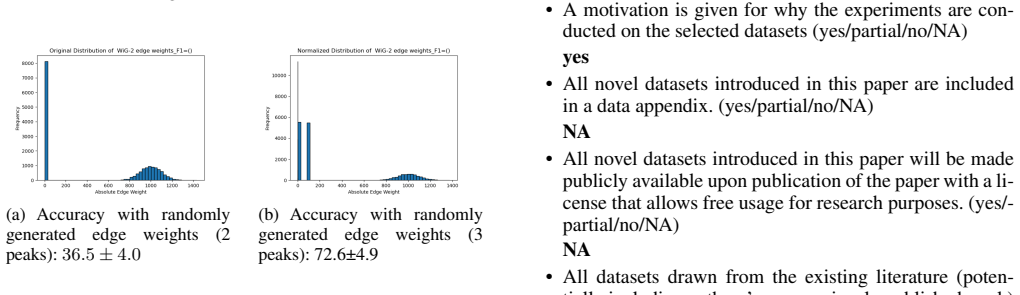
- The expensive eigenvalue- and normalization-based edge weights in those methods are unnecessary; constant unit weights give equal or better accuracy, and random weights can also outperform the learned ones.
- On heterophilic graphs scale invariance is directional: $A$, $AA$, and $AAT$ preserve information, while $A^T$, $A^T A$, and $A^T A^T$ inject noise and zeros; excluding the bad direction recovers performance.
- A single tunable architecture, ScaleNet, can thereby match or beat specialized models on both graph types, reaching state-of-the-art accuracy on five of seven datasets and matching on the remaining two.
- Constant-weight scaled edges avoid the out-of-memory failures of SymDiGCN and DiGCN on larger datasets, improving scalability.
Reading between the lines
- The paper's Table 1 trains a separate classifier per scale, so it does not directly test whether one fixed classifier labels original and scaled ego-graphs identically; verifying Definition 7 would require training once on $A$ and evaluating on the scaled matrices without retraining.
- The consistent $A$-versus-$A^T$ asymmetry on heterophilic graphs suggests the grid-searched direction parameters $\alpha, \beta, \gamma$ could be replaced by a simple data statistic, such as the share of nodes with zero in-neighbors.
- If constant-weight scaled edges keep beating random-walk-weighted ones, the label signal in higher-order scales may be purely topological; other proximity-based GNNs could similarly drop their spectral-weight machinery.
- If scale invariance is confirmed for a fixed classifier, scaled ego-graphs become a principled, non-random data-augmentation scheme for node classification, with potential benefits for robustness to distribution shift.
Signed reviews
Editorial analysis
A structured set of objections, weighed in public.
Referee Report
Summary. The paper introduces the concept of "scaled ego-graphs" for directed graphs, obtained by ordered products of the adjacency matrix A and its transpose A^T. It claims that node classification is scale-invariant (Definition 7, Eq. 5), argues that this invariance explains the success of digraph inception models such as DiGCN and SymDiGCN, and proposes ScaleNet, a multi-scale architecture that combines features from these scaled graphs. The paper reports experiments on seven datasets (four homophilic, two heterophilic, plus an imbalanced setting), claiming state-of-the-art or tied-best accuracy on all datasets, and also proposes simplified inception variants with unit edge weights that outperform the original weighted versions. The code and detailed hyperparameter settings are provided.
Significance. If the scale-invariance claim were rigorously established, it would provide a principled explanation for the empirical success of multi-scale digraph models and motivate a unified treatment of homophilic and heterophilic graphs. The practical findings—that replacing DiGCN's expensive edge weights with constant weights improves or matches performance, and that ScaleNet achieves strong results across both graph types—are valuable and potentially publishable. The paper includes a reproducibility-conscious appendix with code, hyperparameter grids, and Wilcoxon signed-rank tests for the main comparisons. However, the central conceptual claim of scale invariance is not adequately supported by the evidence, which limits the significance of the theoretical framing.
major comments (4)
- [Definition 7, Eq. (5) and Section 3.2] The invariance equality f(G_v) = f(G^k(v)) is not tested. Table 1 reports accuracies of separately trained GNNs on different scaled adjacency matrices, each on a single split; this does not show that the same classifier f labels the original and scaled ego-graphs identically. As written, Eq. (5) is not a well-defined property of the graph unless f is specified (e.g., a fixed trained model, an optimal classifier, or an explicit architecture family). The statement in Section 3.2 that "higher-scale graphs consistently achieve performance comparable to their lower-scale counterparts, confirming scale invariance" is not a valid inference from those comparisons. Please either specify f and test same-classifier invariance (for example, train on one scale and evaluate on another, or compare the predictions of a single model on original versus scaled ego-graphs), or reformulate the claim as "classification performance is roughly preserved across scales" and adjust the motivation accordingly.
- [Table 1, heterophilic rows] The heterophilic results in Table 1 show strong scale dependence that contradicts the invariance claim. For Chameleon, A achieves 78 while AT achieves 30 (near the no-input baseline of 22), and AAT/AA achieve 68/70 while AT A/AT AT achieve 29/30. This is the opposite of f(G_v) = f(G^k(v)) for all k and all scaled variants; at best it shows that some scaled graphs preserve the discriminative information of A while others discard it. Please address this directly, either by testing Eq. (5) at the node level or by explicitly restricting the claimed invariance to the scales that preserve information, with a rationale for why those scales are the relevant ones.
- [Section 4.2, Eq. (6)] The formula AGG-Bα(M,N,X) = (1+α)α AGG(M,X) + (1+α)(1−α) AGG(N,X) does not match the following sentence. For α=0, the formula gives weight 0 on M and weight 1 on N (i.e., it uses only N), whereas the text states "α=0 uses only M"; for α=1, the formula gives weight 2 on M and 0 on N (i.e., only M), whereas the text states "α=1 uses only N." Please correct either the formula or the text, and clarify how the reported α values in Table 4 (including the special modes α=2 and α=3 defined in Eqs. (7)-(8)) map to the formula, since the current inconsistency makes the method ambiguous.
- [Appendix D, Reproducibility Checklist] The checklist states that "Proofs of all novel claims are included" and that "All theoretical claims are demonstrated empirically to hold," but no proof or direct verification of Definition 7 appears anywhere in the manuscript. The only evidence is the Table 1 accuracy comparison, which, as noted above, does not establish Eq. (5). Please either supply a proof for a clearly specified f, or correct the checklist to reflect that the scale-invariance claim is a hypothesis supported only indirectly by accuracy comparisons rather than a proven theoretical claim.
minor comments (4)
- [Figures 2 and 4] Figure 2 and Figure 4 appear to be the same figure with slightly different captions; please unify them or differentiate their content to avoid redundancy.
- [Appendix D] The word "satisficing" in the dataset checklist should be "satisfying" (or "satisfactory").
- [Table 3 footnote] The footnote "When accuracy is below 45%, only one split is used" means that some entries (e.g., Dir-GNN on CiteSeer) are single-split results; please state this in the main text and clearly mark single-split entries so that the table does not mix single-split and multi-split statistics without indication.
- [Table 1] The final column labeled "None" is described as "all zero input"; consider renaming it to "Zero input" for clarity, and consider reporting multiple splits or confidence intervals for the single-split accuracy columns, since the invariance claim rests entirely on these numbers.
Circularity Check
Scale invariance is asserted from the same per-scale GNN accuracy comparisons that the architecture is built to exploit, so the explanation of inception models is partly a renaming of that observed pattern; ScaleNet's empirical performance itself remains an independent contribution.
-
renaming known result
[Section 4.1 (Digraph Inception Networks), building on Section 3.2/Table 1]
"The essence of their success is the equivalent edge augmentation, as shown in Figure 2. ... Given the observed scale invariance across all tested datasets, combining these scaled graphs might further enhance the performance of GNNs."
The 'scale invariance' invoked to explain DiGCN/SymDiGCN is the paper's own Table 1 observation: each scaled adjacency matrix (A, AT, AA, AAT, ATA, ATAT) is fed to a separately trained GNN, and comparable accuracies are read as 'confirming scale invariance.' DiGCN's success is then attributed to the same edge augmentation built from those scaled matrices. The explanation thus reduces to the known per-scale accuracy pattern of DiGCN-like products relabeled as 'scale invariance'; no independent fixed classifier f from Eq. 5 or first-principles argument is supplied.
full rationale
The paper has no load-bearing self-citation chain: the references are external, and ScaleNet is evaluated against external baselines with released code. The main circularity concern is explanatory, not experimental. Definition 7 states scale invariance as f(G_v)=f(G^k(v)) for an unspecified f, and Section 3.2 claims Table 1 'confirms' it by training separate GNNs on each scaled adjacency matrix and observing similar accuracies. Section 4.1 then explains the success of DiGCN and SymDiGCN by 'the equivalent edge augmentation' and by the 'observed scale invariance.' Because DiGCN's k-th order proximity matrices are the same products used in Table 1, the explanation restates the per-scale accuracy pattern under the new label 'scale invariance' rather than deriving it from an independent fixed classifier or from Eq. 5. This is a moderate circularity in the conceptual narrative: the phenomenon and its explanation are the same empirical observation. However, ScaleNet's actual performance numbers and the comparisons to Dir-GNN and MagNet are independent empirical contributions and do not reduce to this loop, so the score is 4 rather than higher.
Assumptions & free parameters
free parameters (3)
- directional aggregation parameters (α, β, γ) =
dataset-specific values: e.g., (0.5,-1,-1), (2,-1,-1), (1,1,1)
- self-loop handling mode =
add, remove, or none depending on dataset
- architecture option flags (batch norm, ReLU, jumping knowledge) =
enabled or disabled per dataset
assumptions (3)
- domain assumption Node classification of a node v is classification of its ego-graph G_v.
- domain assumption Products of A and A^T represent scaled edges and preserve enough label information for classification.
- ad hoc to paper Scale invariance holds for the evaluated graph datasets.
invented entities (1)
-
scaled-edge and scaled ego-graph
Cite this review
Pith. "Pith review of ScaleNet: Scale Invariance Learning in Directed Graphs." pith.science (2026). https://pith.science/paper/V5IIXQHQ
@misc{pith2026241108758,
  author       = {Pith},
  title        = {Pith review of: ScaleNet: Scale Invariance Learning in Directed Graphs},
  year         = {2026},
  howpublished = {\url{https://pith.science/paper/V5IIXQHQ}},
  note         = {Machine review of arXiv:2411.08758}
}
read the original abstract
Graph Neural Networks (GNNs) have advanced relational data analysis but lack invariance learning techniques common in image classification. In node classification with GNNs, it is actually the ego-graph of the center node that is classified. This research extends the scale invariance concept to node classification by drawing an analogy to image processing: just as scale invariance being used in image classification to capture multi-scale features, we propose the concept of ``scaled ego-graphs''. Scaled ego-graphs generalize traditional ego-graphs by replacing undirected single-edges with ``scaled-edges'', which are ordered sequences of multiple directed edges. We empirically assess the performance of the proposed scale invariance in graphs on seven benchmark datasets, across both homophilic and heterophilic structures. Our scale-invariance-based graph learning outperforms inception models derived from random walks by being simpler, faster, and more accurate. The scale invariance explains inception models' success on homophilic graphs and limitations on heterophilic graphs. To ensure applicability of inception model to heterophilic graphs as well, we further present ScaleNet, an architecture that leverages multi-scaled features. ScaleNet achieves state-of-the-art results on five out of seven datasets (four homophilic and one heterophilic) and matches top performance on the remaining two, demonstrating its excellent applicability. This represents a significant advance in graph learning, offering a unified framework that enhances node classification across various graph types. Our code is available at https://github.com/Qin87/ScaleNet/tree/July25.
Figures


Figures from the paper (3 more)


Reference graph
Works this paper leans on
-
[1]
Abu-El-Haija, S.; Perozzi, B.; Kapoor, A.; Alipourfard, N.; Lerman, K.; Harutyunyan, H.; Steeg, G. V.; and Galstyan, A. 2019. MixHop : Higher - Order Graph Convolutional Architectures via Sparsified Neighborhood Mixing . In Proceedings of the 36th International Conference on Machine Learning , 21--29. PMLR. ISSN: 2640-3498
work page 2019
-
[2]
Alvarez-Gonzalez, N.; Kaltenbrunner, A.; and Gómez, V. 2023. Beyond Weisfeiler – Lehman with Local Ego - Network Encodings . Machine Learning and Knowledge Extraction, 5(4): 1234--1265
work page 2023
-
[3]
Berberidis, D.; Nikolakopoulos, A. N.; and Giannakis, G. B. 2019. Adaptive Diffusions for Scalable Learning Over Graphs . IEEE Transactions on Signal Processing, 67(5): 1307--1321
work page 2019
-
[4]
Chen, Y.; Bian, Y.; Zhou, K.; Xie, B.; Han, B.; and Cheng, J. 2023. Does Invariant Graph Learning via Environment Augmentation Learn Invariance ? Advances in Neural Information Processing Systems, 36: 71486--71519
work page 2023
-
[5]
Chien, E.; Peng, J.; Li, P.; and Milenkovic, O. 2020. Adaptive universal generalized pagerank graph neural network. arXiv preprint arXiv:2006.07988
arXiv 2020
-
[6]
Cohen, T. S.; and Welling, M. 2016. Group Equivariant Convolutional Networks. In Proceedings of the 33rd International Conference on Machine Learning (ICML), volume 48, 2990--2999. PMLR
work page 2016
-
[7]
Defferrard, M.; Bresson, X.; and Vandergheynst, P. 2016. Convolutional Neural Networks on Graphs with Fast Localized Spectral Filtering . In Advances in Neural Information Processing Systems , volume 29. Curran Associates, Inc
work page 2016
-
[8]
Fiorini, S.; Coniglio, S.; Ciavotta, M.; and Messina, E. 2023. Sigmanet: One laplacian to rule them all. In Proceedings of the AAAI Conference on Artificial Intelligence, volume 37, 7568--7576
work page 2023
Show all 44 references
-
[9]
Fiorini, S.; Coniglio, S.; Ciavotta, M.; and Messina, E. 2024. Graph Learning in 4D: A Quaternion-Valued Laplacian to Enhance Spectral GCNs. In Proceedings of the AAAI Conference on Artificial Intelligence, volume 38, 12006--12015
2024
-
[10]
Gao, J.; and Wu, J. 2023. Multiple sparse graphs condensation. Knowledge-Based Systems, 278: 110904
2023
-
[11]
Gao, X.; Dai, W.; Li, C.; Xiong, H.; and Frossard, P. 2020. Graph Pooling with Node Proximity for Hierarchical Representation Learning. arXiv preprint arXiv:2006.11118
2020 arXiv
-
[12]
Garg, V.; Jegelka, S.; and Jaakkola, T. 2020. Generalization and Representational Limits of Graph Neural Networks . In Proceedings of the 37th International Conference on Machine Learning , 3419--3430. PMLR. ISSN: 2640-3498
2020
-
[13]
Hamilton, W.; Ying, Z.; and Leskovec, J. 2017. Inductive representation learning on large graphs. Advances in neural information processing systems, 30
2017
-
[14]
A.; and Jin, W
Hashemi, M.; Gong, S.; Ni, J.; Fan, W.; Prakash, B. A.; and Jin, W. 2024. A comprehensive survey on graph reduction: Sparsification, coarsening, and condensation. arXiv preprint arXiv:2402.03358
2024 arXiv
-
[15]
He, Y.; Perlmutter, M.; Reinert, G.; and Cucuringu, M. 2022. MSGNN : A Spectral Graph Neural Network Based on a Novel Magnetic Signed Laplacian . In Proceedings of the First Learning on Graphs Conference , 40:1--40:39. PMLR
2022
-
[16]
N.; and Welling, M
Kipf, T. N.; and Welling, M. 2016. Semi-supervised classification with graph convolutional networks. arXiv preprint arXiv:1609.02907
2016 arXiv
-
[17]
Kollias, G.; Kalantzis, V.; Ide, T.; Lozano, A.; and Abe, N. 2022. Directed Graph Auto - Encoders . Proceedings of the AAAI Conference on Artificial Intelligence, 36(7): 7211--7219
2022
-
[18]
Lenc, K.; and Vedaldi, A. 2015. Understanding image representations by measuring their equivariance and equivalence. In Proceedings of the IEEE conference on computer vision and pattern recognition, 991--999
2015
-
[19]
Liang, J.; Gurukar, S.; and Parthasarathy, S. 2021. MILE : A Multi - Level Framework for Scalable Graph Embedding . Proceedings of the International AAAI Conference on Web and Social Media, 15: 361--372
2021
-
[20]
Ma, Y.; Hao, J.; Yang, Y.; Li, H.; Jin, J.; and Chen, G. 2019. Spectral-based graph convolutional network for directed graphs. arXiv preprint arXiv:1907.08990
2019 arXiv
-
[21]
Maron, H.; Ben-Hamu, H.; Shamir, N.; and Lipman, Y. 2018. Invariant and equivariant graph networks. arXiv preprint arXiv:1812.09902
2018 arXiv
-
[22]
Mernyei, P.; and Cangea, C. 2020. Wiki-cs: A wikipedia-based benchmark for graph neural networks. arXiv preprint arXiv:2007.02901
2020 arXiv
-
[23]
Monti, F.; Otness, K.; and Bronstein, M. M. 2018. MOTIFNET : A Motif-Based Graph Convolutional Network For Directed Graphs. In 2018 IEEE Data Science Workshop ( DSW ) , 225--228. Lausanne, Switzerland: IEEE. ISBN 978-1-5386-4410-2
2018
-
[24]
C.-C.; Lei, Y.; and Yang, B
Pei, H.; Wei, B.; Chang, K. C.-C.; Lei, Y.; and Yang, B. 2020. Geom-gcn: Geometric graph convolutional networks. arXiv preprint arXiv:2002.05287
2020 arXiv
-
[25]
Rossi, E.; Charpentier, B.; Di Giovanni, F.; Frasca, F.; G \"u nnemann, S.; and Bronstein, M. M. 2024. Edge directionality improves learning on heterophilic graphs. In Learning on Graphs Conference, 25--1. PMLR
2024
-
[26]
Rozemberczki, B.; Allen, C.; and Sarkar, R. 2021. Multi-scale attributed node embedding. Journal of Complex Networks, 9(2): cnab014
2021
-
[27]
Sokolic, J.; Giryes, R.; Sapiro, G.; and Rodrigues, M. 2017. Generalization Error of Invariant Classifiers . In Proceedings of the 20th International Conference on Artificial Intelligence and Statistics , 1094--1103. PMLR. ISSN: 2640-3498
2017
-
[28]
Sui, Y.; Wu, Q.; Wu, J.; Cui, Q.; Li, L.; Zhou, J.; Wang, X.; and He, X. 2023. Unleashing the Power of Graph Data Augmentation on Covariate Distribution Shift . Advances in Neural Information Processing Systems, 36: 18109--18131
2023
-
[29]
Sun, H.; Li, X.; Wu, Z.; Su, D.; Li, R.-H.; and Wang, G. 2024. Breaking the Entanglement of Homophily and Heterophily in Semi-supervised Node Classification. In 2024 IEEE 40th International Conference on Data Engineering (ICDE), 2379--2392. IEEE
2024
-
[30]
Suresh, S.; Li, P.; Hao, C.; and Neville, J. 2021. Adversarial Graph Augmentation to Improve Graph Contrastive Learning . In Advances in Neural Information Processing Systems , volume 34, 15920--15933. Curran Associates, Inc
2021
-
[31]
Tong, Z.; Liang, Y.; Sun, C.; Li, X.; Rosenblum, D.; and Lim, A. 2020 a . Digraph inception convolutional networks. Advances in neural information processing systems, 33: 17907--17918
2020
-
[32]
S.; and Lim, A
Tong, Z.; Liang, Y.; Sun, C.; Rosenblum, D. S.; and Lim, A. 2020 b . Directed graph convolutional network. arXiv preprint arXiv:2004.13970
2020 arXiv
-
[33]
Veli c kovi \'c , P.; Cucurull, G.; Casanova, A.; Romero, A.; Li \`o , P.; and Bengio, Y. 2018. Graph Attention Networks. In International Conference on Learning Representations
2018
-
[34]
Verma, S.; and Zhang, Z.-L. 2019. Stability and generalization of graph convolutional neural networks. In Proceedings of the 25th ACM SIGKDD International Conference on Knowledge Discovery & Data Mining, 1539--1548
2019
-
[35]
Wu, Q.; Zhang, H.; Yan, J.; and Wipf, D. 2022. Handling distribution shifts on graphs: An invariance perspective. arXiv preprint arXiv:2202.02466
2022 arXiv
-
[36]
Xie, X.; Sun, Y.; Liu, Y.; Zhang, M.; and Tan, K. C. 2023. Architecture augmentation for performance predictor via graph isomorphism. IEEE Transactions on Cybernetics, 54(3): 1828--1840
2023
-
[37]
Xu, K.; Li, C.; Tian, Y.; Sonobe, T.; Kawarabayashi, K.-i.; and Jegelka, S. 2018. Representation learning on graphs with jumping knowledge networks. In International conference on machine learning, 5453--5462. PMLR
2018
-
[38]
You, Y.; Chen, T.; Sui, Y.; Chen, T.; Wang, Z.; and Shen, Y. 2020. Graph contrastive learning with augmentations. Advances in neural information processing systems, 33: 5812--5823
2020
-
[39]
Zhang, R.; Chen, Z.; Xiao, T.; Wang, Y.; and Kuang, K. 2024. Discovering Invariant Neighborhood Patterns for Heterophilic Graphs. arXiv preprint arXiv:2403.10572
2024 arXiv
-
[40]
Zhang, X.; He, Y.; Brugnone, N.; Perlmutter, M.; and Hirn, M. 2021. Magnet: A neural network for directed graphs. Advances in neural information processing systems, 34: 27003--27015
2021
-
[41]
Zhu, J.; Yan, Y.; Zhao, L.; Heimann, M.; Akoglu, L.; and Koutra, D. 2020. Beyond homophily in graph neural networks: Current limitations and effective designs. Advances in neural information processing systems, 33: 7793--7804
2020
-
[42]
Zhuo, W.; and Tan, G. 2024. Commute Graph Neural Networks. arXiv preprint arXiv:2407.01635
2024 arXiv
-
[43]
, " * write output.state after.block = add.period write newline
ENTRY address archivePrefix author booktitle chapter edition editor eid eprint howpublished institution isbn journal key month note number organization pages publisher school series title type volume year label extra.label sort.label short.list INTEGERS output.state before.all...
-
[44]
write newline
" write newline "" before.all 'output.state := FUNCTION n.dashify 't := "" t empty not t #1 #1 substring "-" = t #1 #2 substring "--" = not "--" * t #2 global.max substring 't := t #1 #1 substring "-" = "-" * t #2 global.max substring 't := while if t #1 #1 substring * t #2 gl...
Reviewed August 12, 2026 · model on record in the stance chip above.
Discussion (0). Continue with ORCID to comment.