REVIEW 3 major objections 4 minor 45 references
Grounding Functional Similarity by Invariance-Aware Model Stitching
T0 review · 3 major / 4 minor · reviewed 2026-08-07 · deepseek-v4-flash
Pith's one-line read Task-based model stitching can fabricate functional similarity; a new alignment objective, FuLA, avoids it.
desk verdict A plausible but not-yet-fully-supported new stitching objective that deserves a serious referee, provided the authors add a label-shuffled control and release code. read the letter →
The pith
A machine-rendered reading of the paper's core claim, the machinery that carries it, and where it could break.
The reading
What carries the argument
The load-bearing object is the FuLA objective (Eq. 5): a weighted average of normalized Frobenius-distance "Hint" terms between the stitched model's activations and the end model's own activations, evaluated at the stitch layer and at each frozen layer after it. The first term coincides with direct matching (DM); the additional functional Hints force the alignment to be interpretable by the end model's later layers in the same way its native representations are. The stitching transformation is restricted to a $1\times1$ convolutional layer with bias, initialized by a Moore-Penrose solution of the DM objective, so any score reflects what a low-capacity map can preserve, not what a high-capacity adapter can force.
What would settle it
Run FuLA and task-based stitching on a pair of models that are behaviorally identical on the test distribution but whose internal representations past the stitch layer are related by a nonlinear but invertible transform; FuLA should score them dissimilar, and if independent behavioral probes judge them functionally interchangeable, FuLA's criterion is too strict.
Extended reading notes
Core claim
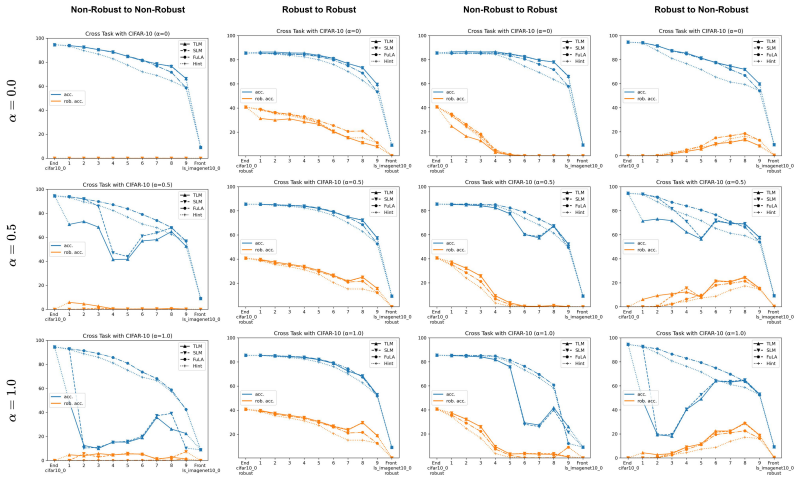
The central claim is that functional similarity between two networks should be judged by forward-backward compatibility: a low-capacity affine map must be able to send the front model's representation into the end model's layers such that those layers, frozen, produce the same internal activations they produce on their own native input. Under this criterion, the paper defines a stitched model $h = g_{>j} \circ T_\theta \circ f_{\le i}$ and optimizes $T_\theta$ to minimize normalized Frobenius distances between stitched and native activations at the stitch layer and at every subsequent layer of the end model (Eq. 5). The authors show that the previously dominant task-loss matching (TLM) and soft-label matching (SLM) objectives can fabricate functional alignment, for example by reporting non-robust accuracy when stitching between non-robust models, while FuLA interpolates functional properties smoothly and reveals discrepancies, such as a sharp drop in functional similarity at the penultimate layer when morphing non-robust to robust models, that direct matching misses.
Load-bearing premise
The paper's conclusions rest on defining functional similarity as the ability of a low-capacity affine map to reproduce the end model's internal activations through its frozen layers, and if that definition is not what functional similarity should mean, the experimental results do not establish it.
Editorial extensions
If this is right
- Conclusions about functional similarity drawn from task-based stitching, for instance that robust and non-robust models are functionally similar with respect to clean accuracy, need to be re-examined under alignment-based objectives.
- FuLA and Hint-based stitching should be preferred over TLM and SLM when the goal is to know whether two models share internal functional properties rather than whether they can both solve the task.
- Directionality in cross-layer stitching is an intrinsic property of functional similarity, not an artifact of the task loss: earlier layers can be guided by deeper layers, but deeper guidance does not help shallow input layers.
- Functional discrepancies between models can be localized in depth, because FuLA's per-layer Hints can pinpoint where similarity breaks down, such as the penultimate layer, earlier than direct matching.
Reading between the lines
- If FuLA's notion is adopted, previously published stitching-based similarity scores between robust and non-robust models are best interpreted as upper bounds contaminated by task cues until re-run under FuLA.
- The same forward-backward compatibility criterion could serve as a training signal or selection criterion for model merging and reassembly, where a stitch must transfer representations across independently trained components.
- A natural stress test would be to construct two models with identical input-output behavior but a known nonlinear reparametrization of internal layers; FuLA should report low similarity, revealing that it measures representational compatibility rather than purely behavioral equivalence.
- The shortcut experiments suggest that FuLA's advantage grows under distribution shift between training and test, so evaluating it on out-of-distribution benchmarks for language or multimodal models is a direct next step.
Editorial analysis
A structured set of objections, weighed in public.
Referee Report
Summary. The paper proposes Functional Latent Alignment (FuLA), a new optimality condition for model stitching that aligns the front model's representations not only at the stitching layer but also through the frozen layers of the end model (Eq. 5). The authors argue that standard task-based stitching (TLM and SLM) can fabricate functional alignment by overfitting to task-specific cues, while FuLA is a more reliable, task-agnostic alternative. The method is evaluated on adversarial training, shortcut learning, cross-layer stitching, and class-subset stitching experiments using CIFAR-10 and a low-resolution ImageNet-10 benchmark with ResNet variants. The central claims are that task-based stitching can hallucinate non-existent functional alignment and that FuLA recovers non-trivial alignments missed by direct matching.
Significance. If the central claims hold, the paper would substantially challenge previous conclusions about functional similarity between robust and non-robust models and would provide a practical alternative to task-based stitching. The method is clearly specified, the experimental suite is extensive across architectures and settings, and the paper honestly acknowledges the lack of ground truth for functional similarity. However, the evidence for FuLA's superior reliability is currently qualitative and lacks the controls and statistical support needed to make the claims load-bearing. The paper is a useful contribution to the ongoing debate on model stitching, but its main assertions require stronger empirical grounding before they can be accepted as established.
major comments (3)
- [Section 3.1, Fig. 4] The load-bearing claim that TLM/SLM 'fabricate' or 'hallucinate' functional alignment under adversarial training is not supported by a control experiment. The paper attributes the non-zero robust accuracy achieved when stitching two non-robust models with α=1 to overfitting on task cues, but it does not test whether the effect survives label shuffling or random-label stitching. Without such a control, the observed behavior could be a genuine effect of the stitching layer learning robustness from the adversarial examples used during stitching, rather than evidence of task-cue exploitation. This distinction is central to the paper's main conclusion, so the authors should either add the control or substantially soften the 'fabrication' claim.
- [Eq. (5) and Section 5 (Limitations)] FuLA's objective is, by construction, the criterion used to define functional similarity, and the validation then checks whether FuLA matches intuitive expectations in designed scenarios. The paper's own Limitations section concedes that 'definitive conclusions remain out of reach due to the lack of ground truth.' To make the 'more reliable metric' claim convincing, the authors need to specify falsifiable predictions or quantitative criteria for reliability, such as consistency across seeds, area-under-stitching-curve comparisons, or agreement with a clearly stated operational definition of functional similarity that is not identical to the FuLA objective.
- [Section 3.1 and Figures 4–6] The experimental evidence for FuLA's superior stability and 'non-existent functional similarity' at the penultimate layer is presented only through visual inspection of stitching plots without error bars, confidence intervals, or statistical tests. In particular, the statement that FuLA reports 'random chance performance' at the penultimate layer is not quantified against a defined chance level. The authors should provide repeated runs or confidence intervals and, where possible, a quantitative measure of the differences between stitching settings so that the reader can assess whether the claimed differences are meaningful.
minor comments (4)
- [Eq. (5)] The indexing in Eq. (5) is ambiguous: the sum over l runs to k, but the text states that FuLA aligns representations only up to the penultimate layer. Please clarify whether the output layer is included and align the notation with the definition of k-layer networks.
- [Section 5] There is a typo in the Limitations paragraph: 'lack to ground truth' should be 'lack of ground truth.'
- [Abstract and Introduction] The statement that 'recent studies' highlight the limitation of compatible representations misleadingly similar cites Smith et al. 2025, but the reference list gives 'Smith and Marcu'; please ensure the citation format is consistent.
- [Experimental Setting] The paper does not state the number of random seeds or whether the reported stitching plots are from a single run. Reporting variability would greatly improve the interpretability of the qualitative comparisons.
Circularity Check
Minor definitional aspect: FuLA's conclusions about functional alignment partly restate its own objective, but the central comparison against external baselines is independent.
-
self definitional
[Section 2.3, Eq. (5) and Section 3.3, Fig. 11 discussion]
"we have observed a smooth transition as we included deeper functional terms (i.e., through weighting the FuLA objective the Eq. (5)) as shown in Fig. 11. Based on that, we conclude that earlier layers can retain functionally relevant information when guided by deeper layers."
The 'functionally relevant information' is defined by the functional-Hint terms (Ll_Hint, l ≥ j+1) of Eq. (5), the very terms whose weights are changed. Observing a smooth transition as deeper terms are added, and then concluding that earlier layers are 'guided by deeper layers,' restates the construction of the FuLA objective rather than an independent empirical finding. This is not load-bearing for the paper's main claim that task-based stitching can fabricate alignment, because that claim is evaluated against external baselines on the AT and shortcut testbeds; it is a mild interpretive circularity in the cross-layer analysis.
full rationale
This is primarily a method-proposal paper. FuLA's objective (Eq. 5) is normative: it defines functional similarity as the degree to which low-capacity affine stitching can reproduce the end model's internal activations through frozen layers. The paper openly acknowledges that 'definitive conclusions remain out of reach due to the lack to ground truth' (Section 5). The central comparisons are external: TLM, SLM, DM/Hint are evaluated on the same AT, shortcut, and cross-layer testbeds, and the claims about task-based stitching 'fabricating alignment' are empirical interpretations rather than fitted parameters renamed as predictions. There are no load-bearing self-citations; the references to knowledge distillation and FitNets are used as inspiration, not as authority that forces the result. The only noticeable circularity is the definitional one: when the paper concludes that FuLA 'captures functional alignment' or that deeper layers 'guide' earlier layers, it is partly restating that FuLA optimizes exactly those deeper-layer alignment terms. This is a minor, acknowledged limitation, not a hidden reduction of the central result, so the overall circularity score is low.
Assumptions & free parameters
free parameters (2)
- Hint weights C =
uniform default
- Number of functional hints =
all layers between stitching and penultimate
assumptions (3)
- domain assumption Functional similarity is appropriately defined by alignment of internal latent activations through frozen layer compositions of the end model
- domain assumption Affine 1x1 convolutions are a sufficiently constrained family that the stitching layer cannot fabricate alignment
- domain assumption Ground truth for functional similarity is unavailable, so constructed testbeds are assumed to reflect true similarity
invented entities (1)
-
Forward-backward compatibility requirement
Cite this review
Pith. "Pith review of Grounding Functional Similarity by Invariance-Aware Model Stitching." pith.science (2026). https://pith.science/paper/V5LBFQXV
@misc{pith2026250520142,
  author       = {Pith},
  title        = {Pith review of: Grounding Functional Similarity by Invariance-Aware Model Stitching},
  year         = {2026},
  howpublished = {\url{https://pith.science/paper/V5LBFQXV}},
  note         = {Machine review of arXiv:2505.20142}
}
read the original abstract
In deep learning, functional similarity evaluation quantifies the extent to which independently trained models learn similar input--output relationships. In model stitching, functional similarity is framed as representation forward compatibility, i.e., whether the representations of two models can be aligned to solve a given task. Recent studies, however, highlight a critical limitation: models relying on different information cues can still produce compatible representations, making them appear misleadingly similar (Smith et al., 2025). We attribute this failure to standard model stitching being inherently blind to the invariance properties of the stitched models. To address this limitation, we introduce the forward--backward compatibility requirement under which we formulate the invariance-aware model stitching. Through analyzing key stitching configurations, we study the interplay between forward and backward compatibility, showing that invariance-aware model stitching provides a more principled approach to functional similarity evaluation while revealing functional discrepancies previously obscured.
Figures


Figures from the paper (27 more)




Reference graph
Works this paper leans on
-
[1]
On the functional similarity of robust and non-robust neural representations
András Balogh and Márk Jelasity. On the functional similarity of robust and non-robust neural representations. In International Conference on Machine Learning, pages 1614–1635. PMLR, 2023
work page 2023
-
[2]
How not to stitch representations to measure similarity: Task loss matching versus direct matching
András Balogh and Márk Jelasity. How not to stitch representations to measure similarity: Task loss matching versus direct matching. In Proceedings of the AAAI Conference on Artificial Intelligence, volume 39, pages 15472–15480, 2025
work page 2025
-
[3]
Revisiting model stitching to compare neural representations
Yamini Bansal, Preetum Nakkiran, and Boaz Barak. Revisiting model stitching to compare neural representations. Advances in neural information processing systems, 34:225–236, 2021
work page 2021
-
[4]
Representation learning: A review and new perspectives
Yoshua Bengio, Aaron Courville, and Pascal Vincent. Representation learning: A review and new perspectives. arxiv 2012. arXiv preprint arXiv:1206.5538, 2012
arXiv 2012
-
[5]
From bricks to bridges: Product of invariances to enhance latent space communication
Irene Cannistraci, Luca Moschella, Marco Fumero, Valentino Maiorca, and Emanuele Rodolà. From bricks to bridges: Product of invariances to enhance latent space communication. arXiv preprint arXiv:2310.01211, 2023
arXiv 2023
-
[6]
Cross-layer distillation with semantic calibration
Defang Chen, Jian-Ping Mei, Yuan Zhang, Can Wang, Zhe Wang, Yan Feng, and Chun Chen. Cross-layer distillation with semantic calibration. In Proceedings of the AAAI conference on artificial intelligence, volume 35, pages 7028–7036, 2021
work page 2021
-
[7]
What do cnns learn in the first layer and why? a linear systems perspective
Rhea Chowers and Yair Weiss. What do cnns learn in the first layer and why? a linear systems perspective. In International Conference on Machine Learning , pages 6115–6139. PMLR, 2023
work page 2023
-
[8]
Reliable evaluation of adversarial robustness with an ensemble of diverse parameter-free attacks
Francesco Croce and Matthias Hein. Reliable evaluation of adversarial robustness with an ensemble of diverse parameter-free attacks. In International conference on machine learning, pages 2206–2216. PMLR, 2020
2020
Show all 45 references
-
[9]
Similarity and matching of neural network representations
Adrián Csiszárik, Péter K ˝orösi-Szabó, Akos Matszangosz, Gergely Papp, and Dániel Varga. Similarity and matching of neural network representations. Advances in Neural Information Processing Systems, 34:5656–5668, 2021
2021
-
[10]
Reliability of cka as a similarity measure in deep learning
MohammadReza Davari, Stefan Horoi, Amine Natik, Guillaume Lajoie, Guy Wolf, and Eu- gene Belilovsky. Reliability of cka as a similarity measure in deep learning. arXiv preprint arXiv:2210.16156, 2022
2022 arXiv
-
[11]
Imagenet: A large- scale hierarchical image database
Jia Deng, Wei Dong, Richard Socher, Li-Jia Li, Kai Li, and Li Fei-Fei. Imagenet: A large- scale hierarchical image database. In 2009 IEEE conference on computer vision and pattern recognition, pages 248–255. Ieee, 2009
2009
-
[12]
Grounding representation similarity through statistical testing
Frances Ding, Jean-Stanislas Denain, and Jacob Steinhardt. Grounding representation similarity through statistical testing. Advances in Neural Information Processing Systems, 34:1556–1568, 2021
2021
-
[13]
Hierarchical nucleation in deep neural networks
Diego Doimo, Aldo Glielmo, Alessio Ansuini, and Alessandro Laio. Hierarchical nucleation in deep neural networks. Advances in Neural Information Processing Systems, 33:7526–7536, 2020
2020
-
[14]
Dermatologist-level classification of skin cancer with deep neural networks
Andre Esteva, Brett Kuprel, Roberto A Novoa, Justin Ko, Susan M Swetter, Helen M Blau, and Sebastian Thrun. Dermatologist-level classification of skin cancer with deep neural networks. nature, 542(7639):115–118, 2017
2017
-
[15]
Automatic generation and detection of highly reliable fiducial markers under occlusion
Sergio Garrido-Jurado, Rafael Muñoz-Salinas, Francisco José Madrid-Cuevas, and Manuel Jesús Marín-Jiménez. Automatic generation and detection of highly reliable fiducial markers under occlusion. Pattern Recognition, 47(6):2280–2292, 2014
2014
-
[16]
Shortcut learning in deep neural networks
Robert Geirhos, Jörn-Henrik Jacobsen, Claudio Michaelis, Richard Zemel, Wieland Brendel, Matthias Bethge, and Felix A Wichmann. Shortcut learning in deep neural networks. Nature Machine Intelligence, 2(11):665–673, 2020. 10
2020
-
[17]
Explaining and harnessing adversar- ial examples
Ian J Goodfellow, Jonathon Shlens, and Christian Szegedy. Explaining and harnessing adversar- ial examples. arXiv preprint arXiv:1412.6572, 2014
2014 arXiv
-
[18]
Deep residual learning for image recognition
Kaiming He, Xiangyu Zhang, Shaoqing Ren, and Jian Sun. Deep residual learning for image recognition. In Proceedings of the IEEE conference on computer vision and pattern recognition, pages 770–778, 2016
2016
-
[19]
Lu, and Marin Soljacic
Adriano Hernandez, Rumen Dangovski, Peter Y . Lu, and Marin Soljacic. Model stitching: Looking for functional similarity between representations. In SVRHM 2022 Workshop @ NeurIPS, 2022. URL https://openreview.net/forum?id=7bHLCO5FQdB
2022
-
[20]
Show, attend and distill: Knowledge distillation via attention-based feature matching
Mingi Ji, Byeongho Heo, and Sungrae Park. Show, attend and distill: Knowledge distillation via attention-based feature matching. In Proceedings of the AAAI conference on artificial intelligence, volume 35, pages 7945–7952, 2021
2021
-
[21]
If you’ve trained one you’ve trained them all: inter-architecture similarity increases with robustness
Haydn T Jones, Jacob M Springer, Garrett T Kenyon, and Juston S Moore. If you’ve trained one you’ve trained them all: inter-architecture similarity increases with robustness. In Uncertainty in Artificial Intelligence, pages 928–937. PMLR, 2022
2022
-
[22]
Adam: A method for stochastic optimization
Diederik P Kingma. Adam: A method for stochastic optimization. arXiv preprint arXiv:1412.6980, 2014
2014 arXiv
-
[23]
Similarity of neural network representations revisited
Simon Kornblith, Mohammad Norouzi, Honglak Lee, and Geoffrey Hinton. Similarity of neural network representations revisited. In International conference on machine learning , pages 3519–3529. PMLR, 2019
2019
-
[24]
Imagenet classification with deep convolutional neural networks
Alex Krizhevsky, Ilya Sutskever, and Geoffrey E Hinton. Imagenet classification with deep convolutional neural networks. Communications of the ACM, 60(6):84–90, 2017
2017
-
[25]
Understanding image representations by measuring their equivariance and equivalence
Karel Lenc and Andrea Vedaldi. Understanding image representations by measuring their equivariance and equivalence. In Proceedings of the IEEE conference on computer vision and pattern recognition, pages 991–999, 2015
2015
-
[26]
Subspace adversarial training
Tao Li, Yingwen Wu, Sizhe Chen, Kun Fang, and Xiaolin Huang. Subspace adversarial training. In Proceedings of the IEEE/CVF Conference on Computer Vision and Pattern Recognition , pages 13409–13418, 2022
2022
-
[27]
Function-consistent feature distillation
Dongyang Liu, Meina Kan, Shiguang Shan, and Xilin Chen. Function-consistent feature distillation. arXiv preprint arXiv:2304.11832, 2023
2023 arXiv
-
[28]
Exploring inter-channel correlation for diversity-preserved knowledge distillation
Li Liu, Qingle Huang, Sihao Lin, Hongwei Xie, Bing Wang, Xiaojun Chang, and Xiaodan Liang. Exploring inter-channel correlation for diversity-preserved knowledge distillation. In Proceedings of the IEEE/CVF international conference on computer vision, pages 8271–8280, 2021
2021
-
[29]
Towards deep learning models resistant to adversarial attacks
Aleksander Madry, Aleksandar Makelov, Ludwig Schmidt, Dimitris Tsipras, and Adrian Vladu. Towards deep learning models resistant to adversarial attacks. arXiv preprint arXiv:1706.06083, 2017
2017 arXiv
-
[30]
The tunnel effect: Building data representations in deep neural networks
Wojciech Masarczyk, Mateusz Ostaszewski, Ehsan Imani, Razvan Pascanu, Piotr Miło´s, and Tomasz Trzcinski. The tunnel effect: Building data representations in deep neural networks. Advances in Neural Information Processing Systems, 36:76772–76805, 2023
2023
-
[31]
Efficient estimation of word representations in vector space
Tomas Mikolov, Kai Chen, Greg Corrado, and Jeffrey Dean. Efficient estimation of word representations in vector space. arXiv preprint arXiv:1301.3781, 2013
2013 arXiv
-
[32]
Linear mode connectivity in multitask and continual learning
Seyed Iman Mirzadeh, Mehrdad Farajtabar, Dilan Gorur, Razvan Pascanu, and Hassan Ghasemzadeh. Linear mode connectivity in multitask and continual learning. arXiv preprint arXiv:2010.04495, 2020
2010 arXiv
-
[33]
Insights on representational similarity in neural networks with canonical correlation
Ari Morcos, Maithra Raghu, and Samy Bengio. Insights on representational similarity in neural networks with canonical correlation. Advances in neural information processing systems, 31, 2018. 11
2018
-
[34]
Relative representations enable zero-shot latent space communication
Luca Moschella, Valentino Maiorca, Marco Fumero, Antonio Norelli, Francesco Locatello, and Emanuele Rodolà. Relative representations enable zero-shot latent space communication. arXiv preprint arXiv:2209.15430, 2022
2022 arXiv
-
[35]
Measuring representational robustness of neural networks through shared invariances
Vedant Nanda, Till Speicher, Camila Kolling, John P Dickerson, Krishna Gummadi, and Adrian Weller. Measuring representational robustness of neural networks through shared invariances. In International Conference on Machine Learning, pages 16368–16382. PMLR, 2022
2022
-
[36]
Do wide and deep networks learn the same things? uncovering how neural network representations vary with width and depth
Thao Nguyen, Maithra Raghu, and Simon Kornblith. Do wide and deep networks learn the same things? uncovering how neural network representations vary with width and depth. arXiv preprint arXiv:2010.15327, 2020
2010 arXiv
-
[37]
Stitchable neural networks
Zizheng Pan, Jianfei Cai, and Bohan Zhuang. Stitchable neural networks. In Proceedings of the IEEE/CVF Conference on Computer Vision and Pattern Recognition, pages 16102–16112, 2023
2023
-
[38]
Stitched vits are flexible vision backbones
Zizheng Pan, Jing Liu, Haoyu He, Jianfei Cai, and Bohan Zhuang. Stitched vits are flexible vision backbones. In European Conference on Computer Vision, pages 258–274. Springer, 2024
2024
-
[39]
Fitnets: Hints for thin deep nets
Adriana Romero, Nicolas Ballas, Samira Ebrahimi Kahou, Antoine Chassang, Carlo Gatta, and Yoshua Bengio. Fitnets: Hints for thin deep nets. arXiv preprint arXiv:1412.6550, 2014
2014 arXiv
-
[40]
Comparing apples and oranges: is stitching similarity a load of spheres? In NeurIPS 2024 Workshop on Scientific Methods for Understanding Deep Learning, 2024
Damian Smith and Antonia Marcu. Comparing apples and oranges: is stitching similarity a load of spheres? In NeurIPS 2024 Workshop on Scientific Methods for Understanding Deep Learning, 2024
2024
-
[41]
Robustness may be at odds with accuracy
Dimitris Tsipras, Shibani Santurkar, Logan Engstrom, Alexander Turner, and Aleksander Madry. Robustness may be at odds with accuracy. arXiv preprint arXiv:1805.12152, 2018
2018 arXiv
-
[42]
Knowledge distillation via softmax regression representation learning
Jing Yang, Brais Martinez, Adrian Bulat, and Georgios Tzimiropoulos. Knowledge distillation via softmax regression representation learning. In International Conference on Learning Representations, 2021
2021
-
[43]
Deep model reassembly
Xingyi Yang, Daquan Zhou, Songhua Liu, Jingwen Ye, and Xinchao Wang. Deep model reassembly. Advances in neural information processing systems, 35:25739–25753, 2022
2022
-
[44]
Paying more attention to attention: Improving the performance of convolutional neural networks via attention transfer
Sergey Zagoruyko and Nikos Komodakis. Paying more attention to attention: Improving the performance of convolutional neural networks via attention transfer. arXiv preprint arXiv:1612.03928, 2016
2016 arXiv
-
[45]
Formation of representations in neural networks
Liu Ziyin, Isaac Chuang, Tomer Galanti, and Tomaso Poggio. Formation of representations in neural networks. arXiv preprint arXiv:2410.03006, 2024. 12 A Experimental Setup In this section, we cover the implementation details needed for reproducing our results. A.1 Baseline Trai...
2024 arXiv
Reviewed August 7, 2026 · model on record in the stance chip above.
Discussion (0). Sign in to comment.