REVIEW 3 major objections 8 minor 1 cited by
Nested Diffusion Models Using Hierarchical Latent Priors
T0 review · 3 major / 8 minor · reviewed 2026-08-11 · deepseek-v4-flash
Pith's one-line read Nested diffusion models use a frozen encoder's semantic hierarchy to cut ImageNet FID from 45.19 to 11.05 unconditionally.
desk verdict A simple, effective recipe for stacking diffusion models on frozen encoder features, with big FID gains; the main caveat is heavy tuning on the reported metric and an unaddressed exposure-bias gap. read the letter →
The pith
A machine-rendered reading of the paper's core claim, the machinery that carries it, and where it could break.
The reading
What carries the argument
The nested diffusion architecture: a sequence of L diffusion models Dθl, where level l generates latent zl conditioned on higher-level latents z>l and z1 is the image itself. The latent hierarchy is extracted from a frozen encoder (MoCo-v3 for ImageNet, CLIP for COCO) via patchification, SVD channel reduction, and Gaussian noise injection (σl), which together control the information each level transmits. The training loss (Eqn. 3) sums per-level denoising objectives, each conditioned on noisy higher-level latents, with a separate noising process for the conditional signal.
What would settle it
Train the same five-level architecture but replace the encoder features with random noise of identical shape (or features from an untrained encoder): if the FID improvement persists, the semantic content is not the cause. Alternatively, during sampling, feed oracle encoder features as the top-level latent rather than the model's own generated latent and measure whether FID degrades sharply, which would reveal a teacher-forcing distribution shift.
Extended reading notes
Core claim
The paper claims that a chain of diffusion models, each generating a latent variable at a different semantic level and conditioned on the outputs of higher levels, produces substantially better images than a single-level model at similar computational cost. The hierarchy is built from a frozen pretrained visual encoder applied to image patches of decreasing size, with singular value decomposition to trim feature channels and Gaussian noise injection to limit information capacity. With five levels, the unconditional generator surpasses the class-conditional baseline, suggesting that hierarchical semantic priors—not just model size or class labels—are what drive the quality gain.
Load-bearing premise
The load-bearing premise is that a frozen pretrained encoder's features, after SVD truncation and Gaussian noise, form a generable semantic ladder, and that training on ground-truth encoder latents transfers to sampling with model-generated latents.
Editorial extensions
If this is right
- Adding more hierarchical levels consistently improves FID on ImageNet-1K, both with and without classifier-free guidance, so depth itself is a scaling axis for generation quality.
- Unconditional generation can outperform class-conditional generation when anchored to a rich semantic hierarchy, implying that semantic structure can substitute for explicit labels.
- Gaussian noise injection is essential for deep hierarchies: without it, the generator reverts to an autoencoder that bypasses higher levels, so information-capacity control is what makes the approach scale.
- The extra compute from deeper hierarchies is modest because higher levels operate on low-dimensional representations, making the quality gain nearly compute-free.
- On COCO text-to-image generation, a 2-level model trained only on COCO beats much larger models trained on extra data, suggesting the hierarchy transfers to complex scene synthesis.
Reading between the lines
- The semantic ladder could be extended beyond static images to video or 3D scenes, where the same frozen-encoder hierarchy might guide temporal or geometric structure.
- Because the paper shows generation quality tracks the KNN accuracy of the chosen encoder, swapping in a better representation learner should yield further FID gains without architectural changes.
- The paper trains each level on ground-truth encoder latents (teacher forcing); the authors implicitly assume generated latents stay close to those, and a testable extension is to measure FID when the top-level latent is drawn from the model's own prior versus an oracle encoder feature.
- The hierarchy offers a natural control handle: resampling only low levels edits fine detail while preserving global semantics, which could enable semantic editing and style transfer with no extra training.
Signed reviews
Editorial analysis
A structured set of objections, weighed in public.
Referee Report
Summary. The paper proposes a hierarchical generative framework called nested diffusion models. It trains a chain of L diffusion models: the top-level model generates a low-dimensional semantic latent z_L from noise; each lower-level model generates z_l conditioned on previously generated higher-level latents z_{>l}; the bottom level generates the image. The latent targets z_l are extracted from a frozen pretrained visual encoder (MoCo-v3 for ImageNet, CLIP for COCO) via patchification, SVD-based channel reduction, and Gaussian noise injection, with the noise level sigma_l controlling information capacity. The training loss (Eq. 3) is a denoising objective in which lower-level models are conditioned on noisy ground-truth encoder latents. On ImageNet-1K 256x256, a five-level model reduces FID from 45.19 to 11.05 for unconditional generation and from 31.13 to 9.87 for class-conditional generation relative to a single-level baseline, at an inference cost of roughly 34 GFlops versus 26.8 GFlops. On COCO-2014 text-to-image generation, the hierarchical model outperforms the U-ViT baseline. The paper also claims that the unconditional five-level model surpasses the class-conditional single-level baseline. The paper includes ablations over depth, noise level, encoder choice, and the gamma schedule for generation-time noise.
Significance. If the results are robust, the contribution is significant: it offers a conceptually simple and computationally lightweight way to inject semantic structure into diffusion generation using frozen visual encoders, with large FID improvements over single-level baselines. The controlled comparison to a GFlops-matched baseline (Table 6), the consistent improvements with depth for nonzero noise levels in Table 1, the encoder ablation in Table 5, and the cross-dataset COCO experiments are strengths. The paper is also transparent about the role of noise injection and reports the key hyperparameter choices. However, three issues currently prevent full confidence: (i) the teacher-forcing mismatch between training on noisy encoder latents and sampling from model-generated latents is never measured; (ii) the headline FIDs are selected over sigma_l and gamma without seed variance or a held-out validation split; and (iii) the ImageNet encoder is pretrained on the same distribution as the evaluation set, which may inflate the unconditional-generation gains. These concerns are addressable with additional experiments and analysis, so the work merits a major revision rather than rejection.
major comments (3)
- [Sec. 3.3, Eq. (3), Sec. 4.2] The training objective in Eq. (3) conditions every lower-level denoiser on noisy ground-truth encoder latents, hat z_{>l} ~ N(z_{>l}(x), sigma_l^2 I), but at generation time the conditioning latents are ancestral samples from the upper-level diffusion models. The paper never trains on model-generated latents, so the lower-level models only see encoder-derived conditioning inputs during training. This distribution shift is never quantified. Moreover, for the no-CFG case the best FID is obtained with gamma = infinity (Table 3), i.e., no noise is added to the conditioning latents at generation, while all training runs use nonzero sigma_l. The reported gains therefore depend on the untested assumption that model-generated latents fall in a region where the lower-level denoisers, trained on noisier encoder latents, remain well-behaved. I request a direct experiment comparing FID when conditioning on encoder latents (oracle) versus model-generated latents, together with statistics of the marginal distributions of the latents under q and p_theta, or an experiment with scheduled sampling / self-conditioning during training. Without this, the headline FIDs (11.05 and 9.87) cannot be confidently attributed to a usable hierarchical latent prior.
- [Table 1, Sec. 4.1, Sec. 4.2] For each depth L, the reported FID in Table 1 is the minimum over sigma_l in {0, 0.5, 1.0}, and the gamma value in Table 3 is likewise chosen on the reported FID. No seed variance or error bars are given. Under a fixed noise level sigma^2 = 0 in Table 1(a), the FIDs for L = 2, 3, 4, 5 are 19.32, 20.34, 17.67, and 19.04, which are not monotonic in L; the claim that generation quality consistently improves with L therefore rests on selecting a different noise level for each depth. The same selection issue applies to the CFG weights in Sec. 4.3. I request at least three seeds for the reported configurations, with mean and standard deviation, and a validation split for all hyperparameter choices (sigma_l, gamma, CFG weights) so that the reported test FIDs are not the result of selection on the evaluation set.
- [Sec. 4.1, Table 5] For the ImageNet experiments, the hierarchy is built with MoCo-v3 features from a model pretrained on the same ImageNet-1K distribution. The unconditional system is therefore conditioned, at every level, on dataset-specific statistics learned from the very distribution used to compute FID. This is not circular in the derivation, but it weakens the benchmark claim: the FID gains may partly reflect that the conditioning latents provide a compressed encoding of the training distribution, rather than a generable semantic hierarchy. The COCO encoder ablation in Table 5 shows that feature quality matters, but it does not control for pretraining-domain overlap. A concrete test would be to swap MoCo-v3 for a ViT-B/16 encoder pretrained on data that excludes ImageNet (e.g., ImageNet-21K or another large corpus) and report ImageNet FID. If the FID degrades sharply, the claims that the method learns a general semantic prior, and that the unconditional system surpasses the conditional baseline, would need to be qualified.
minor comments (8)
- [Eq. (2)] In the top-level term of Eq. (2), the notation p_theta_l should be p_theta_L, since the KL divergence is for the top-level latent z_L.
- [Sec. 3.2] The text says 'the latent variable z_l in R' and should read 'z_l in R^{d_l}' to be consistent with the dimensions used later.
- [Eq. (4)] Eq. (4) uses a discrete sum over z_l even though z_l is a continuous latent; the expression should be written as an integral, or the discrete notation should be justified.
- [Sec. 3.3] The sentence 'p_theta_L(z_0 | z_L) is approximately 1' appears to be a typo: the reconstruction path at the bottom level is through D_theta_1, not D_theta_L. Please correct the subscript or clarify the intended level.
- [Table 1] The column header 'sigma^2 = 0.0 0.5 1.0' is ambiguous: the text alternates between sigma and sigma^2 for the noise level. Please state clearly whether the table reports sigma or sigma^2.
- [Sec. 4.3 and Table 6] The abstract says the computational overhead is about 25%, but Sec. 4.3 says 27.00% and Table 6 implies roughly 26.7% ((33.98-26.82)/26.82). Please harmonize these numbers.
- [Appendix A.2, Eqs. (12)-(15)] The derivation drops the outer expectation over z_{>l} that appears in Eq. (12) when passing to Eq. (15); the loss in Eq. (3) conditions on z_{>l}, so this expectation should be retained or the notational shortcut should be explained.
- [Table 4] The explanation that L=3 underperforms L=2 with CFG 'likely due to a suboptimal CFG weight' is speculative; please either provide the CFG-tuned result or remove the conjecture.
Circularity Check
No significant circularity: ELBO derivation and external FID benchmarks keep the central claims independent of their inputs.
full rationale
The derivation chain is self-contained: Eqn. 3 is the standard hierarchical ELBO (Eqn. 2) with frozen encoder latents; Appendix A.2 derives it via Jensen's inequality and the usual diffusion bound, without inserting the target FID or the final samples as assumptions. The headline numbers are measured against external precomputed ImageNet/COCO validation statistics (Dhariwal and Nichol), so no fitted parameter is renamed as a prediction. The noise levels sigma_l and gamma are validation-set hyperparameters selected by greedy search; this is model selection, not a definitional reduction. The pretrained encoders (MoCo-v3, CLIP, DINO) are external models; Table 5's correlation between KNN accuracy and FID is an empirical dependence, not a definitional equivalence. The paper explicitly acknowledges the only real weakness, the train/test distribution shift from teacher-forced noisy latents to ancestrally sampled latents (Sec. 4.2), and proposes a gamma decay schedule; this is a correctness/robustness risk, not circularity. The two self-citations ([78], [79]) are related-work mentions and carry none of the argument. No uniqueness theorem or ansatz is imported from the authors' prior work.
Assumptions & free parameters
free parameters (5)
- sigma_l (per-level Gaussian noise variance) =
sigma_2 in {0.0, 0.5, 1.0}; deeper sigma_l retained from previous levels
- CFG weights {w_i} =
[0.5, 0.4, 0.3, 0.2, 0.1] for conditional; constant 0.8 for unconditional
- gamma (noise decay exponent) =
0.3 with CFG; infinity without CFG
- SVD dimension budgets =
z_L in R^256; z_{L-1} in R^{4x128}; z_{L-2} in R^{16x64}
- sigma_l for COCO =
0.5 fixed
assumptions (4)
- domain assumption Pre-trained visual encoder features, after patchification and compression, form a semantic hierarchy that improves generation.
- domain assumption Training each level conditioned on ground-truth noisy latents (teacher forcing) transfers to sampling the full hierarchy from noise.
- domain assumption Gaussian noise injection and SVD truncation prevent the lower-level model from degenerating into an autoencoder.
- standard math The optimal denoiser is a weighted average over data points (mean-shift interpretation, Eqn. 4).
Cite this review
Pith. "Pith review of Nested Diffusion Models Using Hierarchical Latent Priors." pith.science (2026). https://pith.science/paper/V5QC2PIY
@misc{pith2026241205984,
  author       = {Pith},
  title        = {Pith review of: Nested Diffusion Models Using Hierarchical Latent Priors},
  year         = {2026},
  howpublished = {\url{https://pith.science/paper/V5QC2PIY}},
  note         = {Machine review of arXiv:2412.05984}
}
read the original abstract
We introduce nested diffusion models, an efficient and powerful hierarchical generative framework that substantially enhances the generation quality of diffusion models, particularly for images of complex scenes. Our approach employs a series of diffusion models to progressively generate latent variables at different semantic levels. Each model in this series is conditioned on the output of the preceding higher-level models, culminating in image generation. Hierarchical latent variables guide the generation process along predefined semantic pathways, allowing our approach to capture intricate structural details while significantly improving image quality. To construct these latent variables, we leverage a pre-trained visual encoder, which learns strong semantic visual representations, and modulate its capacity via dimensionality reduction and noise injection. Across multiple datasets, our system demonstrates significant enhancements in image quality for both unconditional and class/text conditional generation. Moreover, our unconditional generation system substantially outperforms the baseline conditional system. These advancements incur minimal computational overhead as the more abstract levels of our hierarchy work with lower-dimensional representations.
Figures
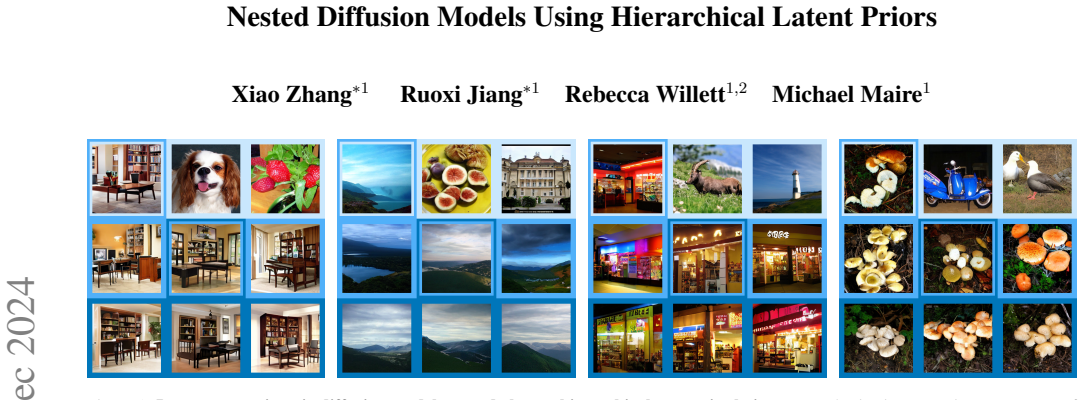


Figures from the paper (6 more)


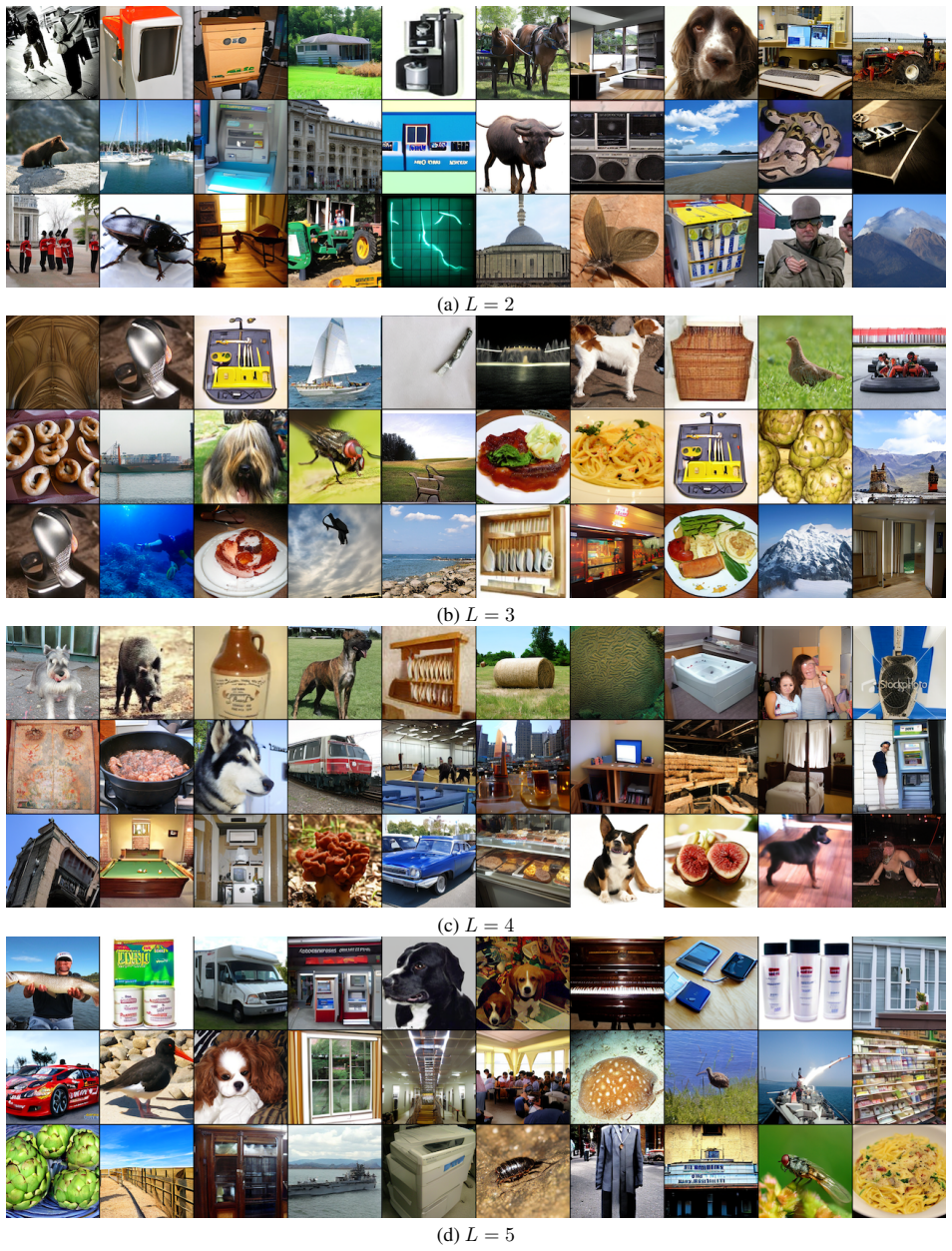
Forward citations
Cited by 1 Pith paper
-
Hierarchical Implicit Neural Emulators
Feeding a hierarchy of predicted coarse-grained future states into an autoregressive neural emulator greatly improves long-term stability for 2D turbulent flow forecasting.
Reference graph
Works this paper leans on
-
[1]
Styleflow: Attribute-conditioned exploration of stylegan- generated images using conditional continuous normalizing flows
Rameen Abdal, Peihao Zhu, Niloy J Mitra, and Peter Wonka. Styleflow: Attribute-conditioned exploration of stylegan- generated images using conditional continuous normalizing flows. TOG, 2021. 2
2021
-
[2]
Diffusion-based representa- tion learning
Korbinian Abstreiter, Sarthak Mittal, Stefan Bauer, Bernhard Schölkopf, and Arash Mehrjou. Diffusion-based representa- tion learning. arXiv:2105.14257, 2021. 3
arXiv 2021
-
[3]
All are worth words: A vit backbone for diffusion models
Fan Bao, Shen Nie, Kaiwen Xue, Yue Cao, Chongxuan Li, Hang Su, and Jun Zhu. All are worth words: A vit backbone for diffusion models. In CVPR, 2023. 2, 5, 6, 8
work page 2023
-
[4]
Label-efficient semantic seg- mentation with diffusion models
Dmitry Baranchuk, Ivan Rubachev, Andrey V oynov, Valentin Khrulkov, and Artem Babenko. Label-efficient semantic seg- mentation with diffusion models. arXiv:2112.03126, 2021. 2, 3
arXiv 2021
-
[5]
End- to-end object detection with transformers
Nicolas Carion, Francisco Massa, Gabriel Synnaeve, Nicolas Usunier, Alexander Kirillov, and Sergey Zagoruyko. End- to-end object detection with transformers. In ECCV, 2020. 1
work page 2020
-
[6]
Emerg- ing properties in self-supervised vision transformers
Mathilde Caron, Hugo Touvron, Ishan Misra, Hervé Jégou, Julien Mairal, Piotr Bojanowski, and Armand Joulin. Emerg- ing properties in self-supervised vision transformers. InICCV,
-
[7]
A simple framework for contrastive learning of visual representations
Ting Chen, Simon Kornblith, Mohammad Norouzi, and Geof- frey Hinton. A simple framework for contrastive learning of visual representations. In ICML, 2020. 2
2020
-
[8]
Re-imagen: Retrieval-augmented text-to-image gen- erator
Wenhu Chen, Hexiang Hu, Chitwan Saharia, and William W Cohen. Re-imagen: Retrieval-augmented text-to-image gen- erator. arXiv:2209.14491, 2022. 8
arXiv 2022
Show all 81 references
-
[9]
An empirical study of training self-supervised vision transformers
Xinlei Chen, Saining Xie, and Kaiming He. An empirical study of training self-supervised vision transformers. InICCV,
-
[10]
Mean shift, mode seeking, and clustering
Yizong Cheng. Mean shift, mode seeking, and clustering. PAMI, 1995. 5
1995
-
[11]
Very deep vaes generalize autoregressive mod- els and can outperform them on images
Rewon Child. Very deep vaes generalize autoregressive mod- els and can outperform them on images. arXiv:2011.10650,
2011 arXiv
-
[12]
Mean shift analysis and applications
Dorin Comaniciu and Peter Meer. Mean shift analysis and applications. In ICCV, 1999. 5
1999
-
[13]
Diffusion models beat gans on image synthesis
Prafulla Dhariwal and Alexander Nichol. Diffusion models beat gans on image synthesis. In NeurIPS, 2021. 6
2021
-
[14]
Generative models: What do they know? do they know things? let’s find out! arXiv:2311.17137, 2023
Xiaodan Du, Nicholas Kolkin, Greg Shakhnarovich, and Anand Bhattad. Generative models: What do they know? do they know things? let’s find out! arXiv:2311.17137, 2023. 2
2023 arXiv
-
[15]
Frido: Feature pyramid diffusion for complex scene image synthesis
Wan-Cyuan Fan, Yen-Chun Chen, DongDong Chen, Yu Cheng, Lu Yuan, and Yu-Chiang Frank Wang. Frido: Feature pyramid diffusion for complex scene image synthesis. In AAAI, 2023. 8
2023
-
[16]
Girshick, Jeff Donahue, Trevor Darrell, and Jitendra Malik
Ross B. Girshick, Jeff Donahue, Trevor Darrell, and Jitendra Malik. Region-based convolutional networks for accurate object detection and segmentation. PAMI, 2016. 1
2016
-
[17]
Generative adversarial nets
Ian Goodfellow, Jean Pouget-Abadie, Mehdi Mirza, Bing Xu, David Warde-Farley, Sherjil Ozair, Aaron Courville, and Yoshua Bengio. Generative adversarial nets. In NeurIPS,
-
[18]
Matryoshka diffusion models
Jiatao Gu, Shuangfei Zhai, Yizhe Zhang, Joshua M Susskind, and Navdeep Jaitly. Matryoshka diffusion models. In ICLR,
-
[19]
Vector quan- tized diffusion model for text-to-image synthesis
Shuyang Gu, Dong Chen, Jianmin Bao, Fang Wen, Bo Zhang, Dongdong Chen, Lu Yuan, and Baining Guo. Vector quan- tized diffusion model for text-to-image synthesis. In CVPR,
-
[20]
Girshick, and Jitendra Malik
Bharath Hariharan, Pablo Andrés Arbeláez, Ross B. Girshick, and Jitendra Malik. Hypercolumns for object segmentation and fine-grained localization. In CVPR, 2015. 1
2015
-
[21]
Efficientvdvae: Less is more
Louay Hazami, Rayhane Mama, and Ragavan Thurairatnam. Efficientvdvae: Less is more. arXiv:2203.13751, 2022. 3
2022 arXiv
-
[22]
Deep residual learning for image recognition
Kaiming He, Xiangyu Zhang, Shaoqing Ren, and Jian Sun. Deep residual learning for image recognition. In CVPR, 2016. 1
2016
-
[23]
Girshick
Kaiming He, Georgia Gkioxari, Piotr Dollár, and Ross B. Girshick. Mask R-CNN. In ICCV, 2017. 1
2017
-
[24]
Momentum contrast for unsupervised visual repre- sentation learning
Kaiming He, Haoqi Fan, Yuxin Wu, Saining Xie, and Ross Girshick. Momentum contrast for unsupervised visual repre- sentation learning. In CVPR, 2020. 2
2020
-
[25]
Masked autoencoders are scalable vision learners
Kaiming He, Xinlei Chen, Saining Xie, Yanghao Li, Piotr Dollár, and Ross Girshick. Masked autoencoders are scalable vision learners. In CVPR, 2022. 2, 8
2022
-
[26]
Classifier-free diffusion guidance
Jonathan Ho and Tim Salimans. Classifier-free diffusion guidance. arXiv:2207.12598, 2022. 5
2022 arXiv
-
[27]
Denoising diffu- sion probabilistic models
Jonathan Ho, Ajay Jain, and Pieter Abbeel. Denoising diffu- sion probabilistic models. In NeurIPS, 2020. 3
2020
-
[28]
Denoising diffu- sion probabilistic models
Jonathan Ho, Ajay Jain, and Pieter Abbeel. Denoising diffu- sion probabilistic models. In NeurIPS, 2020. 4
2020
-
[29]
Cascaded diffusion models for high fidelity image generation
Jonathan Ho, Chitwan Saharia, William Chan, David J Fleet, Mohammad Norouzi, and Tim Salimans. Cascaded diffusion models for high fidelity image generation. JMLR, 2022. 3
2022
-
[30]
Self-guided diffusion mod- els
Vincent Tao Hu, David W Zhang, Yuki M Asano, Gertjan J Burghouts, and Cees GM Snoek. Self-guided diffusion mod- els. In CVPR, 2023. 2, 3
2023
-
[31]
Soda: Bottle- neck diffusion models for representation learning
Drew A Hudson, Daniel Zoran, Mateusz Malinowski, An- drew K Lampinen, Andrew Jaegle, James L McClelland, Loic Matthey, Felix Hill, and Alexander Lerchner. Soda: Bottle- neck diffusion models for representation learning. In CVPR,
-
[32]
Training neural operators to preserve invariant measures of chaotic attractors
Ruoxi Jiang, Peter Y Lu, Elena Orlova, and Rebecca Willett. Training neural operators to preserve invariant measures of chaotic attractors. In NeurIPS, 2024. 3
2024
-
[33]
How far is video generation from world model: A physical law perspective
Bingyi Kang, Yang Yue, Rui Lu, Zhijie Lin, Yang Zhao, Kaixin Wang, Gao Huang, and Jiashi Feng. How far is video generation from world model: A physical law perspective. arXiv:2411.02385, 2024. 2
2024 arXiv
-
[34]
Scaling up gans for text-to-image synthesis
Minguk Kang, Jun-Yan Zhu, Richard Zhang, Jaesik Park, Eli Shechtman, Sylvain Paris, and Taesung Park. Scaling up gans for text-to-image synthesis. In CVPR, 2023. 3
2023
-
[35]
Diffusion models for zero-shot open-vocabulary segmentation
Laurynas Karazija, Iro Laina, Andrea Vedaldi, and Christian Rupprecht. Diffusion models for zero-shot open-vocabulary segmentation. arXiv:2306.09316, 2023. 3
2023 arXiv
-
[36]
Elucidating the design space of diffusion-based generative models
Tero Karras, Miika Aittala, Timo Aila, and Samuli Laine. Elucidating the design space of diffusion-based generative models. In NeurIPS, 2022. 5
2022
-
[37]
Variational diffusion models
Diederik Kingma, Tim Salimans, Ben Poole, and Jonathan Ho. Variational diffusion models. In NeurIPS, 2021. 4
2021
-
[38]
Auto-encoding variational bayes
Diederik P Kingma. Auto-encoding variational bayes. arXiv:1312.6114, 2013. 2, 3
2013 arXiv
-
[39]
Alex Krizhevsky, Ilya Sutskever, and Geoffrey E. Hinton. Im- agenet classification with deep convolutional neural networks. In NeurIPS, 2012. 1
2012
-
[40]
Your diffusion model is secretly a zero-shot classifier
Alexander C Li, Mihir Prabhudesai, Shivam Duggal, Ellis Brown, and Deepak Pathak. Your diffusion model is secretly a zero-shot classifier. In CVPR, 2023. 2
2023
-
[41]
Mage: Masked generative en- coder to unify representation learning and image synthesis
Tianhong Li, Huiwen Chang, Shlok Mishra, Han Zhang, Dina Katabi, and Dilip Krishnan. Mage: Masked generative en- coder to unify representation learning and image synthesis. In CVPR, 2023. 2, 3
2023
-
[42]
Self- conditioned image generation via generating representations
Tianhong Li, Dina Katabi, and Kaiming He. Self- conditioned image generation via generating representations. arXiv:2312.03701, 2023. 2, 3
2023 arXiv
-
[43]
Microsoft coco: Common objects in context
Tsung-Yi Lin, Michael Maire, Serge Belongie, James Hays, Pietro Perona, Deva Ramanan, Piotr Dollár, and C Lawrence Zitnick. Microsoft coco: Common objects in context. In ECCV, 2014. 5
2014
-
[44]
Alleviating distortion in image genera- tion via multi-resolution diffusion models
Qihao Liu, Zhanpeng Zeng, Ju He, Qihang Yu, Xiaohui Shen, and Liang-Chieh Chen. Alleviating distortion in image genera- tion via multi-resolution diffusion models. arXiv:2406.09416,
-
[45]
Fully convolutional networks for semantic segmentation
Jonathan Long, Evan Shelhamer, and Trevor Darrell. Fully convolutional networks for semantic segmentation. In CVPR,
-
[46]
Optimizing hierarchical image vaes for sample quality
Eric Luhman and Troy Luhman. Optimizing hierarchical image vaes for sample quality. arXiv:2210.10205, 2022. 2, 3
2022 arXiv
-
[47]
Glide: Towards photorealistic image generation and editing with text-guided diffusion models
Alex Nichol, Prafulla Dhariwal, Aditya Ramesh, Pranav Shyam, Pamela Mishkin, Bob McGrew, Ilya Sutskever, and Mark Chen. Glide: Towards photorealistic image generation and editing with text-guided diffusion models. arXiv:2112.10741, 2021. 2, 8
2021 arXiv
-
[48]
Normalizing flows for probabilistic modeling and inference
George Papamakarios, Eric Nalisnick, Danilo Jimenez Rezende, Shakir Mohamed, and Balaji Lakshminarayanan. Normalizing flows for probabilistic modeling and inference. JMLR, 2021. 2
2021
-
[49]
Scalable diffusion models with transformers
William Peebles and Saining Xie. Scalable diffusion models with transformers. In ICCV, 2023. 6, 8
2023
-
[50]
Variance reduction in hierarchical variational autoencoders
Adeel Pervez and Efstratios Gavves. Variance reduction in hierarchical variational autoencoders. 2020. 2, 4, 12
2020
-
[51]
Diffusion autoencoders: Toward a meaningful and decodable representation
Konpat Preechakul, Nattanat Chatthee, Suttisak Wizad- wongsa, and Supasorn Suwajanakorn. Diffusion autoencoders: Toward a meaningful and decodable representation. In CVPR,
-
[52]
Learning transferable visual models from natural language supervision
Alec Radford, Jong Wook Kim, Chris Hallacy, Aditya Ramesh, Gabriel Goh, Sandhini Agarwal, Girish Sastry, Amanda Askell, Pamela Mishkin, Jack Clark, et al. Learning transferable visual models from natural language supervision. In ICML, 2021. 6, 8
2021
-
[53]
Hierarchical text-conditional image genera- tion with clip latents
Aditya Ramesh, Prafulla Dhariwal, Alex Nichol, Casey Chu, and Mark Chen. Hierarchical text-conditional image genera- tion with clip latents. arXiv:2204.06125, 2022. 8
2022 arXiv
-
[54]
Generative adver- sarial text to image synthesis
Scott Reed, Zeynep Akata, Xinchen Yan, Lajanugen Lo- geswaran, Bernt Schiele, and Honglak Lee. Generative adver- sarial text to image synthesis. In ICML, 2016. 3
2016
-
[55]
High-resolution image synthesis with latent diffusion models
Robin Rombach, Andreas Blattmann, Dominik Lorenz, Patrick Esser, and Björn Ommer. High-resolution image synthesis with latent diffusion models. In CVPR, 2022. 2, 3
2022
-
[56]
Imagenet large scale visual recognition challenge
Olga Russakovsky, Jia Deng, Hao Su, Jonathan Krause, San- jeev Satheesh, Sean Ma, Zhiheng Huang, Andrej Karpathy, Aditya Khosla, Michael Bernstein, et al. Imagenet large scale visual recognition challenge. IJCV, 2015. 5
2015
-
[57]
Cads: Unleashing the diver- sity of diffusion models through condition-annealed sampling
Seyedmorteza Sadat, Jakob Buhmann, Derek Bradley, Otmar Hilliges, and Romann M Weber. Cads: Unleashing the diver- sity of diffusion models through condition-annealed sampling. arXiv:2310.17347, 2023. 7
2023 arXiv
-
[58]
Pho- torealistic text-to-image diffusion models with deep language understanding
Chitwan Saharia, William Chan, Saurabh Saxena, Lala Li, Jay Whang, Emily L Denton, Kamyar Ghasemipour, Raphael Gontijo Lopes, Burcu Karagol Ayan, Tim Salimans, et al. Pho- torealistic text-to-image diffusion models with deep language understanding. In NeurIPS, 2022. 8
2022
-
[59]
Shadows don’t lie and lines can’t bend! generative models don’t know projective geometry
Ayush Sarkar, Hanlin Mai, Amitabh Mahapatra, Svetlana Lazebnik, David A Forsyth, and Anand Bhattad. Shadows don’t lie and lines can’t bend! generative models don’t know projective geometry... for now. In CVPR, 2024. 2
2024
-
[60]
Very deep convolu- tional networks for large-scale image recognition
Karen Simonyan and Andrew Zisserman. Very deep convolu- tional networks for large-scale image recognition. In ICLR,
-
[61]
Ladder variational autoencoders
Casper Kaae Sønderby, Tapani Raiko, Lars Maaløe, Søren Kaae Sønderby, and Ole Winther. Ladder variational autoencoders. In NeurIPS, 2016. 2
2016
-
[62]
Denoising diffusion implicit models
Jiaming Song, Chenlin Meng, and Stefano Ermon. Denoising diffusion implicit models. arXiv:2010.02502, 2020. 2, 3
2010 arXiv
-
[63]
Improved techniques for training score-based generative models
Yang Song and Stefano Ermon. Improved techniques for training score-based generative models. In NeurIPS, 2020. 5
2020
-
[64]
Score-based generative modeling through stochastic differential equations
Yang Song, Jascha Sohl-Dickstein, Diederik P Kingma, Ab- hishek Kumar, Stefano Ermon, and Ben Poole. Score-based generative modeling through stochastic differential equations. arXiv:2011.13456, 2020. 3
2011 arXiv
-
[65]
Hq-vae: Hierarchical discrete representation learning with variational bayes
Yuhta Takida, Yukara Ikemiya, Takashi Shibuya, Kazuki Shimada, Woosung Choi, Chieh-Hsin Lai, Naoki Murata, Toshimitsu Uesaka, Kengo Uchida, Wei-Hsiang Liao, et al. Hq-vae: Hierarchical discrete representation learning with variational bayes. arXiv:2401.00365, 2023. 3, 12
2023 arXiv
-
[66]
Emergent correspondence from image diffusion
Luming Tang, Menglin Jia, Qianqian Wang, Cheng Perng Phoo, and Bharath Hariharan. Emergent correspondence from image diffusion. NeurIPS, 2023. 3
2023
-
[67]
Visual autoregressive modeling: Scalable image gen- eration via next-scale prediction
Keyu Tian, Yi Jiang, Zehuan Yuan, Bingyue Peng, and Liwei Wang. Visual autoregressive modeling: Scalable image gen- eration via next-scale prediction. arXiv:2404.02905, 2024. 3
2024 arXiv
-
[68]
Nvae: A deep hierarchical variational autoencoder
Arash Vahdat and Jan Kautz. Nvae: A deep hierarchical variational autoencoder. In NeurIPS, 2020. 2, 3, 4, 12
2020
-
[69]
Score jacobian chaining: Lifting pretrained 2d diffusion models for 3d generation
Haochen Wang, Xiaodan Du, Jiahao Li, Raymond A Yeh, and Greg Shakhnarovich. Score jacobian chaining: Lifting pretrained 2d diffusion models for 3d generation. In CVPR,
-
[70]
Instancediffusion: Instance-level control for image generation
Xudong Wang, Trevor Darrell, Sai Saketh Rambhatla, Rohit Girdhar, and Ishan Misra. Instancediffusion: Instance-level control for image generation. In CVPR, 2024. 3
2024
-
[71]
Low-light image enhancement with normalizing flow
Yufei Wang, Renjie Wan, Wenhan Yang, Haoliang Li, Lap- Pui Chau, and Alex Kot. Low-light image enhancement with normalizing flow. In AAAI, 2022. 2
2022
-
[72]
Open-vocabulary panoptic segmentation with text-to-image diffusion models
Jiarui Xu, Sifei Liu, Arash Vahdat, Wonmin Byeon, Xiaolong Wang, and Shalini De Mello. Open-vocabulary panoptic segmentation with text-to-image diffusion models. In CVPR,
-
[73]
Diffusion model as repre- sentation learner
Xingyi Yang and Xinchao Wang. Diffusion model as repre- sentation learner. In ICCV, 2023. 2, 3
2023
-
[74]
Scaling autore- gressive models for content-rich text-to-image generation
Jiahui Yu, Yuanzhong Xu, Jing Yu Koh, Thang Luong, Gunjan Baid, Zirui Wang, Vijay Vasudevan, Alexander Ku, Yinfei Yang, Burcu Karagol Ayan, et al. Scaling autore- gressive models for content-rich text-to-image generation. arXiv:2206.10789, 2022. 8
2022 arXiv
-
[75]
Scaling autoregres- sive multi-modal models: Pretraining and instruction tuning
Lili Yu, Bowen Shi, Ramakanth Pasunuru, Benjamin Muller, Olga Golovneva, Tianlu Wang, Arun Babu, Binh Tang, Brian Karrer, Shelly Sheynin, et al. Scaling autoregres- sive multi-modal models: Pretraining and instruction tuning. arXiv:2309.02591, 2023. 8
2023 arXiv
-
[76]
Representa- tion alignment for generation: Training diffusion transformers is easier than you think
Sihyun Yu, Sangkyung Kwak, Huiwon Jang, Jongheon Jeong, Jonathan Huang, Jinwoo Shin, and Saining Xie. Representa- tion alignment for generation: Training diffusion transformers is easier than you think. arXiv:2410.06940, 2024. 2, 6, 8
-
[77]
Adding conditional control to text-to-image diffusion models
Lvmin Zhang, Anyi Rao, and Maneesh Agrawala. Adding conditional control to text-to-image diffusion models. In ICCV, 2023. 2, 3
2023
-
[78]
Structural adversar- ial objectives for self-supervised representation learning
Xiao Zhang and Michael Maire. Structural adversar- ial objectives for self-supervised representation learning. arXiv:2310.00357, 2023. 3
2023 arXiv
-
[79]
Decipher- ing’what’and’where’visual pathways from spectral clustering of layer-distributed neural representations
Xiao Zhang, David Yunis, and Michael Maire. Decipher- ing’what’and’where’visual pathways from spectral clustering of layer-distributed neural representations. In CVPR, 2024. 3
2024
-
[80]
Learning hierarchical features from generative models
Shengjia Zhao, Jiaming Song, and Stefano Ermon. Learning hierarchical features from generative models. arXiv:1702.08396, 2017. 3
2017 arXiv
-
[81]
dz(1:T ) l pθ(z(0:T ) l |z>l) q(z(1:T ) l |z(0), x) q(z(1:T ) l |z(0), x) # ≥ Z dz(0:T ) l q(z(0:T ) l |x) (18) log
Jinghao Zhou, Chen Wei, Huiyu Wang, Wei Shen, Cihang Xie, Alan Yuille, and Tao Kong. ibot: Image bert pre-training with online tokenizer. arXiv:2111.07832, 2021. 2 A. Appendix A.1. Further comparison L 1 2 3 4 5 1∗ GFlops 26.82 27.13 28.17 29.61 33.98 35.11 Param(M) 104 208 31...
2021 arXiv
Reviewed August 11, 2026 · model on record in the stance chip above.
Discussion (0). Continue with ORCID to comment.