REVIEW 3 major objections 5 minor 42 references
Automated Multi-Label Annotation for Mental Health Illnesses Using Large Language Models
T0 review · 3 major / 5 minor · reviewed 2026-08-11 · deepseek-v4-flash
Pith's one-line read This paper claims that zero-shot LLM prompting can turn single-label mental-health datasets into multi-label datasets, producing a six-disorder Reddit corpus.
desk verdict The two-label prompt comparison is a legitimate, useful result, but the six-label SPAADE-DR dataset is built on self-generated labels and circular evaluation, so the central claim does not hold as written. read the letter →
The pith
A machine-rendered reading of the paper's core claim, the machinery that carries it, and where it could break.
The reading
What carries the argument
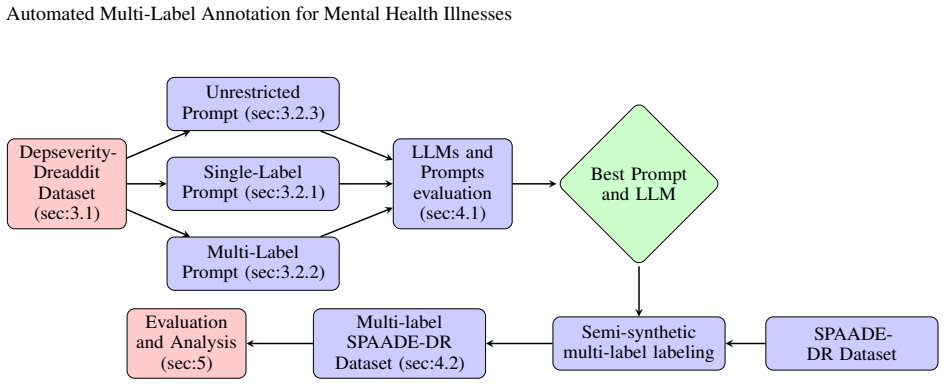
The load-bearing object is the single-label binary prompt template: a short instruction that asks the LLM to answer only Yes or No on whether the post's writer exhibits clear symptoms of one target disorder, with no explanation, and to pick the most probable label when ambiguous. Applied once per disorder, it produces one bit of a six-bit annotation vector per post, converting a subreddit-derived single label into a multi-label profile. The DepSeverity-Dreaddit merged dataset, in which the same posts carry independent human annotations for depression and stress, supplies the two-label testbed used to select prompt and model before scaling to six labels.
What would settle it
Take a random sample of about 200 SPAADE-DR posts, have two independent clinicians annotate all six disorders from the post text, and compare their labels with the LLM-generated labels on the five synthetically labeled disorders; if clinician-LLM agreement is near chance (for example, Cohen's kappa below 0.4), the dataset's ground truth, the six-label evaluation, and the comorbidity odds ratios are unsupported.
Extended reading notes
Core claim
On its own terms, the paper's central claim is that a zero-shot single-label prompting procedure is enough to turn any single-label mental-health dataset into a reliable multi-label dataset. For each post, the original subreddit assignment is kept as the true label for one disorder, and an LLM is asked a separate yes/no question for each of the other five disorders using the single-label prompt template; concatenating the answers produces a six-bit label vector. The authors construct SPAADE-DR this way and then evaluate multi-label and unrestricted prompts on it. They report that GPT-4o-mini outperforms the other models on the six-label multi-label and unrestricted tasks, that Llama-3 70b achieves near-perfect scores on the single-label prompts, and that odds ratios between labels reproduce established clinical associations, including strong depression-suicide and PTSD-anxiety links.
Load-bearing premise
The load-bearing premise is that the LLM's yes/no answers for the five conditions that the original subreddit did not label are accurate enough to count as ground truth; the paper applies the single-label prompt to those five conditions in Section 4.2.2 without human validation and later evaluates all models against those same answers in Section 5.2. If the answers are systematically wrong, the reported six-label performance and the comorbidity findings collapse.
Editorial extensions
If this is right
- The method turns any collection of single-label mental-health datasets into a multi-label dataset, removing the need for expensive multi-label human annotation.
- Single-label prompts remain the most robust as the number of disorders grows from two to six, at the price of running the LLM once per disorder.
- SPAADE-DR provides a six-disorder dataset on which multi-label classifiers and comorbidity studies can be trained and benchmarked.
- Comorbidity odds ratios computed from LLM labels align with clinical epidemiology, supporting use of such synthetic labels for association discovery.
Reading between the lines
- My inference: if this zero-shot pipeline generalizes, it also applies to other domains with overlapping categories, since nothing in the method is specific to Reddit or to these six disorders.
- My inference: the reverse ranking of models across prompt types (Llama-3 70b strong on single-label, GPT-4o-mini strong on multi-label) suggests that conclusions about LLMs for mental-health annotation should be conditioned on the prompt format used.
- My inference: a direct test of the method's value would be to train a classifier on SPAADE-DR and measure its agreement with clinician diagnoses on held-out posts; positive transfer would support the labels, while poor transfer would implicate platform or labeling noise.
Editorial analysis
A structured set of objections, weighed in public.
Referee Report
Summary. This paper proposes an LLM-based zero-shot pipeline for converting single-label mental-health social-media datasets into multi-label datasets. On the two-label DepSeverity-Dreaddit corpus, the authors compare five LLMs under single-label, multi-label, and unrestricted prompts, reporting that Llama-3 70b with the single-label prompt performs best (Table 3). They then apply the single-label prompt with Llama-3 70b, GPT-4o-mini, and Phi-3.5-MoE to posts sampled from six RMHD subreddits, retaining the source subreddit as the 'true' label for one disorder and using the models to label the other five, producing SPAADE-DR. The paper reports label distributions (Table 4), comorbidity and odds-ratio analyses (Figures 6 and 7), and a six-label evaluation of the same models (Table 5).
Significance. The two-label DepSeverity-Dreaddit experiment is a genuine, human-labeled benchmark and provides a useful comparison of prompt designs and LLMs for multi-label mental-health classification. If SPAADE-DR's labels were independently verified, the dataset could be a valuable resource for studying comorbidity from social media. However, the manuscript currently offers no such verification: the five non-source labels are generated by the same models later scored on them, so the six-label results and comorbidity findings cannot support the paper's central claims. The paper also does not report code or dataset release details, which limits reproducibility and adoptability.
major comments (3)
- [Section 4.2.2 and Table 5] The evaluation is circular. The five non-source labels of SPAADE-DR are produced by applying the single-label prompt with Llama-3 70b, GPT-4o-mini, and Phi-3.5-MoE, and Table 5 then scores these same models against those self-generated labels. The near-perfect single-label row for Llama-3 70b (GBA = 0.99, HL = 0.01) is the expected signature of this circularity, not evidence of diagnostic ability. No human or clinical validation of the generated labels is reported anywhere in the manuscript, so the six-label results in Table 5, the label distributions in Table 4, and the comorbidity findings in Section 5.1 are unsupported as statements about actual mental-health co-occurrence.
- [Section 4.2.1 and Table 4] The dataset size is internally inconsistent. The text states that after cleaning, 500 posts are selected for each of the six disorders, which would give 3,000 posts total, but every column of Table 4 sums to 3,500 for each LLM, implying 3,500 posts per disorder. The authors should clarify the exact sample size, whether control posts are included, and correct the discrepancy, because the reported positive/negative counts are central to the claimed dataset resource.
- [Section 5.1] The comorbidity percentages and odds ratios are computed on LLM-generated labels, so statements such as '93% of individuals diagnosed with depression also exhibit symptoms of anxiety' describe the annotating models' labeling behavior rather than clinically established co-occurrence. To support these claims, the authors would need a human-annotated validation sample, and preferably a comparison with clinically established comorbidity rates.
minor comments (5)
- [Section 2.3 / Table 3] The column header 'OR' is used for overall recall in Table 3, but 'OR' is also introduced as the symbol for odds ratio in Section 2.3 and used in Figure 7; renaming the Table 3 metric to 'Overall Recall' (or 'ORec') would avoid ambiguity.
- [Section 2.1.3] There is a typo: 'r/legalagvice' should read 'r/legaladvice'.
- [Section 4.2.1] The cleaning step says that posts predicted as negative are 'manually reviewed' and true negatives removed, but no review criteria, number of annotators, or inter-annotator agreement are reported; this step should be described in detail.
- [Section 3.4 / Section 4.2.2] The text says the 'optimal combinations' from the DepSeverity-Dreaddit evaluation are used for labeling, but Section 5.2 then evaluates multi-label and unrestricted prompts on SPAADE-DR; please clarify which prompt-LLM combinations were used to generate the labels versus which are being evaluated.
- [Table 5 caption] The caption contains a typo: 'ana 6 disorders' should read 'on 6 disorders'.
Circularity Check
SPAADE-DR's six-label evaluation is scored against labels written by the same LLMs and prompt strategy (Section 4.2.2 vs Table 5), so the near-perfect Llama-3 single-label result and the comorbidity statistics are partly self-confirming.
-
self definitional
[Sections 4.2.2 and 5.2, Table 5]
"Since each sample originates from a specific mental disorder subreddit, the original label is retained as the true label for that condition. The remaining five disorders are then annotated using the single-label prompt ... The multi-label and unrestricted prompts are re-evaluated on the labeled SPAADE-DR dataset ... when using the single-label prompt, Llama-3 70b achieves the highest scores. This is likely due to the alignment of the Llama-3 70b model with the prompt structure used during the data labeling process."
The five non-original disorder labels in SPAADE-DR are produced by applying the single-label prompt with Llama-3 70b, GPT-4o-mini, and Phi-3.5-MoE (Section 4.2.2). Section 5.2 then treats these synthetic outputs as ground truth when scoring the same prompt-family and models, including Llama-3 70b in the Single_Label row. For Llama-3, the reported BA/F1 of 0.97-1.00 and Hamming loss 0.01 are forced because the evaluation calls the model on the same prompt that generated the labels; the paper's own explanation explicitly attributes the high score to alignment with the labeling prompt. No human or clinical validation of the synthetic labels is reported, so the six-label scores are not independent evidence of diagnostic accuracy.
-
other
[Section 5.1, comorbidity analysis]
"Depression and anxiety show a strong association, with 93% of individuals diagnosed with depression also exhibiting symptoms of anxiety. This high comorbidity rate highlights the close relationship between these disorders, which often occur together in clinical settings."
This comorbidity result is computed from the same SPAADE-DR labels that Section 4.2.2 generated with the LLMs being evaluated, because the remaining five disorders are 'annotated using the single-label prompt' and no independent validation is provided. The 93% figure therefore measures correlations in the annotating models' outputs, not clinically verified co-occurrence. Unlike the DepSeverity-Dreaddit experiment, where the two labels come from human/psychiatrist annotations of the same posts, this analysis has no external anchor, so the claimed real-world comorbidity is not independently supported by the presented numbers.
full rationale
The DepSeverity-Dreaddit experiment (Sections 3.1 and 4.1) is genuinely independent: the merged two-label dataset comes from human/psychiatrist annotations of the same Reddit posts, and the prompt/model comparison there is a valid external benchmark. The circularity is confined to the SPAADE-DR component, but that component is the paper's central dataset contribution. Section 4.2.2 constructs five of the six labels by running the single-label prompt with the same models that Section 5.2 evaluates on the labeled dataset. Table 5's near-perfect Llama-3 single-label row is the fingerprint of this self-evaluation, and the authors explicitly connect the high score to prompt/model alignment during labeling. The comorbidity findings in Section 5.1 are likewise computed from these unvalidated synthetic labels and therefore describe annotator behavior rather than established clinical co-occurrence. No human validation or external gold standard for the six-label SPAADE-DR is reported anywhere in the manuscript. Reference [35] is a self-citation used only to inspire a prompt template and is not load-bearing. Overall, the paper has independent value in the two-label experiment, but the central six-label evaluation and comorbidity claims partially reduce to the models' own outputs, warranting a high circularity score.
Assumptions & free parameters
free parameters (2)
- Sample budget per disorder =
600 initial, 500 final
- LLM decoding settings =
not reported
assumptions (3)
- domain assumption LLM zero-shot outputs can serve as true multi-label mental health annotations without human verification.
- domain assumption Subreddit membership is a valid label for the corresponding disorder in RMHD.
- domain assumption Dreaddit and DepSeverity annotations on the same posts can be merged directly into a gold multi-label set.
invented entities (1)
-
SPAADE-DR dataset
Cite this review
Pith. "Pith review of Automated Multi-Label Annotation for Mental Health Illnesses Using Large Language Models." pith.science (2026). https://pith.science/paper/V5SKZMYA
@misc{pith2026241203796,
  author       = {Pith},
  title        = {Pith review of: Automated Multi-Label Annotation for Mental Health Illnesses Using Large Language Models},
  year         = {2026},
  howpublished = {\url{https://pith.science/paper/V5SKZMYA}},
  note         = {Machine review of arXiv:2412.03796}
}
read the original abstract
The growing prevalence and complexity of mental health disorders present significant challenges for accurate diagnosis and treatment, particularly in understanding the interplay between co-occurring conditions. Mental health disorders, such as depression and Anxiety, often co-occur, yet current datasets derived from social media posts typically focus on single-disorder labels, limiting their utility in comprehensive diagnostic analyses. This paper addresses this critical gap by proposing a novel methodology for cleaning, sampling, labeling, and combining data to create versatile multi-label datasets. Our approach introduces a synthetic labeling technique to transform single-label datasets into multi-label annotations, capturing the complexity of overlapping mental health conditions. To achieve this, two single-label datasets are first merged into a foundational multi-label dataset, enabling realistic analyses of co-occurring diagnoses. We then design and evaluate various prompting strategies for large language models (LLMs), ranging from single-label predictions to unrestricted prompts capable of detecting any present disorders. After rigorously assessing multiple LLMs and prompt configurations, the optimal combinations are identified and applied to label six additional single-disorder datasets from RMHD. The result is SPAADE-DR, a robust, multi-label dataset encompassing diverse mental health conditions. This research demonstrates the transformative potential of LLM-driven synthetic labeling in advancing mental health diagnostics from social media data, paving the way for more nuanced, data-driven insights into mental health care.
Figures


Figures from the paper (4 more)


Reference graph
Works this paper leans on
-
[1]
Diagnostic and Statistical Manual of Mental Disorders: DSM-5-TR
American Psychiatric Association. Diagnostic and Statistical Manual of Mental Disorders: DSM-5-TR . American Psychiatric Association Publishing, Washington, DC, 5th, text revision edition, 2022
work page 2022
-
[2]
Depression, 2023
World Health Organization. Depression, 2023. Accessed: September 14, 2024
2023
-
[3]
Anxiety disorders, 2022
World Health Organization. Anxiety disorders, 2022. Accessed: 2024-09-26
2022
-
[4]
World Mental Health Report: Transforming Mental Health for All
World Health Organization. World Mental Health Report: Transforming Mental Health for All . World Health Organization, Geneva, 2022. Accessed: 2024-09-26
work page 2022
-
[5]
Mental health discourse on reddit: Self-disclosure, social support, and anonymity
Munmun De Choudhury and Sushovan De. Mental health discourse on reddit: Self-disclosure, social support, and anonymity. Proceedings of the International AAAI Conference on Web and Social Media , 8(1):71–80, May 2014
work page 2014
-
[6]
Quantifying mental health signals in Twitter
Glen Coppersmith, Mark Dredze, and Craig Harman. Quantifying mental health signals in Twitter. In Philip Resnik, Rebecca Resnik, and Margaret Mitchell, editors, Proceedings of the Workshop on Computational Linguistics and Clinical Psychology: From Linguistic Signal to Clinical Reality , pages 51–60, Baltimore, Maryland, USA, June
-
[7]
Detecting depression and mental illness on social media: an integrative review
Sharath Chandra Guntuku, David B Yaden, Margaret L Kern, Lyle H Ungar, and Johannes C Eichstaedt. Detecting depression and mental illness on social media: an integrative review. Current Opinion in Behavioral Sciences , 18:43–49, 2017. Big data in the behavioural sciences
work page 2017
-
[8]
Beyond LDA: Exploring supervised topic modeling for depression-related language in Twitter
Philip Resnik, William Armstrong, Leonardo Claudino, Thang Nguyen, Viet-An Nguyen, and Jordan Boyd-Graber. Beyond LDA: Exploring supervised topic modeling for depression-related language in Twitter. In Proceedings of the 2nd Workshop on Computational Linguistics and Clinical Psychology: From Linguistic Signal to Clinical Reality, pages 99–107, Denver, Col...
work page 2015
Show all 42 references
-
[9]
From ADHD to SAD: Analyzing the language of mental health on Twitter through self-reported diagnoses
Glen Coppersmith, Mark Dredze, Craig Harman, and Kristy Hollingshead. From ADHD to SAD: Analyzing the language of mental health on Twitter through self-reported diagnoses. In Proceedings of the 2nd Workshop on Computational Linguistics and Clinical Psychology: From Linguistic ...
2015
-
[10]
Birnbaum, Eric D
Stevie Chancellor, Michael L. Birnbaum, Eric D. Caine, Vincent M. B. Silenzio, and Munmun De Choudhury. A taxonomy of ethical tensions in inferring mental health states from social media. In Proceedings of the Conference on Fairness, Accountability, and Transparency, FAT* ’19,...
2019
-
[11]
Andrew Schwartz
Matthew Matero, Akash Idnani, Youngseo Son, Salvatore Giorgi, Huy Vu, Mohammad Zamani, Parth Limbachiya, Sharath Chandra Guntuku, and H. Andrew Schwartz. Suicide risk assessment with multi-level dual-context language and BERT. In Kate Niederhoffer, Kristy Hollingshead, Philip ...
2019
-
[12]
Tom B. Brown, Benjamin Mann, Nick Ryder, Melanie Subbiah, Jared Kaplan, Prafulla Dhariwal, Arvind Nee- lakantan, Pranav Shyam, Girish Sastry, Amanda Askell, Sandhini Agarwal, Ariel Herbert-V oss, Gretchen Krueger, Tom Henighan, Rewon Child, Aditya Ramesh, Daniel M. Ziegler, Je...
2005 arXiv
-
[13]
Language models for online depression detection: A review and benchmark analysis on remote interviews
Ruiyang Qin, Ryan Cook, Kai Yang, Ahmed Abbasi, David Dobolyi, Salman Seyedi, Emily Griner, Hyeokhyen Kwon, Robert Cotes, Zifan Jiang, and Gari Clifford. Language models for online depression detection: A review and benchmark analysis on remote interviews. ACM Trans. Manage. I...
2024
-
[14]
Explainability for large language models: A survey, 2023
Haiyan Zhao, Hanjie Chen, Fan Yang, Ninghao Liu, Huiqi Deng, Hengyi Cai, Shuaiqiang Wang, Dawei Yin, and Mengnan Du. Explainability for large language models: A survey, 2023
2023
-
[15]
From understanding to utilization: A survey on explainability for large language models, 2024
Haoyan Luo and Lucia Specia. From understanding to utilization: A survey on explainability for large language models, 2024
2024
-
[16]
Trustworthy llms: a survey and guideline for evaluating large language models’ alignment, 2024
Yang Liu, Yuanshun Yao, Jean-Francois Ton, Xiaoying Zhang, Ruocheng Guo, Hao Cheng, Yegor Klochkov, Muhammad Faaiz Taufiq, and Hang Li. Trustworthy llms: a survey and guideline for evaluating large language models’ alignment, 2024
2024
-
[17]
Deep learning-based depression detection from social media: Comparative evaluation of ml and transformer techniques
Biodoumoye George Bokolo and Qingzhong Liu. Deep learning-based depression detection from social media: Comparative evaluation of ml and transformer techniques. Electronics, 12(21), 2023. 16 Automated Multi-Label Annotation for Mental Health Illnesses
2023
-
[18]
Bryson, and Arvind Narayanan
Aylin Caliskan, Joanna J. Bryson, and Arvind Narayanan. Semantics derived automatically from language corpora contain human-like biases. Science, 356(6334):183–186, 2017
2017
-
[19]
Large language models for data annotation: A survey, 2024
Zhen Tan, Dawei Li, Song Wang, Alimohammad Beigi, Bohan Jiang, Amrita Bhattacharjee, Mansooreh Karami, Jundong Li, Lu Cheng, and Huan Liu. Large language models for data annotation: A survey, 2024
2024
-
[20]
Data-free multi-label image recognition via llm-powered prompt tuning, 2024
Shuo Yang, Zirui Shang, Yongqi Wang, Derong Deng, Hongwei Chen, Qiyuan Cheng, and Xinxiao Wu. Data-free multi-label image recognition via llm-powered prompt tuning, 2024
2024
-
[21]
Definitions matter: Guiding GPT for multi-label classification
Youri Peskine, Damir Korenˇci´c, Ivan Grubisic, Paolo Papotti, Raphael Troncy, and Paolo Rosso. Definitions matter: Guiding GPT for multi-label classification. In Houda Bouamor, Juan Pino, and Kalika Bali, editors, Findings of the Association for Computational Linguistics: EMN...
2023
-
[22]
Comprehensive comparative study of multi-label classification methods
Jasmin Bogatinovski, Ljupco Todorovski, Saso Dzeroski, and Dragi Kocev. Comprehensive comparative study of multi-label classification methods. CoRR, abs/2102.07113, 2021
2021 arXiv
-
[23]
Dreaddit: A reddit dataset for stress analysis in social media
Elsbeth Turcan and Kathleen McKeown. Dreaddit: A reddit dataset for stress analysis in social media. arXiv preprint arXiv:1911.00133, 2019
1911 arXiv
-
[24]
Early identification of depression severity levels on reddit using ordinal classification
Usman Naseem, Adam G Dunn, Jinman Kim, and Matloob Khushi. Early identification of depression severity levels on reddit using ordinal classification. In Proceedings of the ACM Web Conference 2022, pages 2563–2572, 2022
2022
-
[25]
Towards developing an annotation scheme for depressive disorder symptoms: A preliminary study using Twitter data
Danielle Mowery, Craig Bryan, and Mike Conway. Towards developing an annotation scheme for depressive disorder symptoms: A preliminary study using Twitter data. InProceedings of the 2nd Workshop on Computational Linguistics and Clinical Psychology: From Linguistic Signal to Cl...
2015
-
[26]
The phq-9: A new depression diagnostic and severity measure
Kurt Kroenke and Robert L Spitzer. The phq-9: A new depression diagnostic and severity measure. Psychiatric Annals, 32(9):509–515, 2002
2002
-
[27]
The phq-9: Validity of a brief depression severity measure
Kurt Kroenke, Robert L Spitzer, and Janet B Williams. The phq-9: Validity of a brief depression severity measure. Journal of General Internal Medicine , 16(9):606–613, 2001
2001
-
[28]
Knowledge-aware assessment of severity of suicide risk for early intervention
Manas Gaur, Amanuel Alambo, Joy Prakash Sain, Ugur Kursuncu, Krishnaprasad Thirunarayan, Ramakanth Kavuluru, Amit Sheth, Randy Welton, and Jyotishman Pathak. Knowledge-aware assessment of severity of suicide risk for early intervention. In The World Wide Web Conference, WWW ’1...
-
[29]
Natural language processing reveals vulnerable mental health support groups and heightened health anxiety on reddit during covid-19: An observational study
Daniel Low, Laurie Rumker, Tanya Talker, John Torous, Guillermo Cecchi, and Satrajit Ghosh. Natural language processing reveals vulnerable mental health support groups and heightened health anxiety on reddit during covid-19: An observational study. Journal of medical Internet ...
2020
-
[30]
Gemma 2: Improving open language models at a practical size
Gemma Team, Morgane Riviere, Shreya Pathak, Pier Giuseppe Sessa, Cassidy Hardin, Surya Bhupatiraju, Léonard Hussenot, Thomas Mesnard, Bobak Shahriari, Alexandre Ramé, et al. Gemma 2: Improving open language models at a practical size. arXiv preprint arXiv:2408.00118, 2024
2024 arXiv
-
[31]
Gpt-4o mini
OpenAI. Gpt-4o mini. https://openai.com/index/gpt-4o-mini-advancing-cost-efficient-intelligence/ , 2024
2024
-
[32]
The llama 3 herd of models
Abhimanyu Dubey, Abhinav Jauhri, Abhinav Pandey, Abhishek Kadian, Ahmad Al-Dahle, Aiesha Letman, Akhil Mathur, Alan Schelten, Amy Yang, Angela Fan, et al. The llama 3 herd of models. arXiv preprint arXiv:2407.21783, 2024
2024 arXiv
-
[33]
Mistral-nemo
Mistral AI team. Mistral-nemo. https://mistral.ai/news/mistral-nemo//, 2024
2024
-
[34]
Phi-3 technical report: A highly capable language model locally on your phone
Marah Abdin, Sam Ade Jacobs, Ammar Ahmad Awan, Jyoti Aneja, Ahmed Awadallah, Hany Awadalla, Nguyen Bach, Amit Bahree, Arash Bakhtiari, Harkirat Behl, et al. Phi-3 technical report: A highly capable language model locally on your phone. arXiv preprint arXiv:2404.14219, 2024
2024 arXiv
-
[35]
Hanafy, and Mohammed E
Abdelrahman Hanafi, Mohammed Saad, Noureldin Zahran, Radwa J. Hanafy, and Mohammed E. Fouda. A comprehensive evaluation of large language models on mental illnesses, 2024
2024
-
[36]
Query2label: A simple transformer way to multi-label classification
Shilong Liu, Lei Zhang, Xiao Yang, Hang Su, and Jun Zhu. Query2label: A simple transformer way to multi-label classification. CoRR, abs/2107.10834, 2021
2021 arXiv
-
[37]
Gkgnet: Group k-nearest neighbor based graph convolutional network for multi-label image recognition, 2024
Ruijie Yao, Sheng Jin, Lumin Xu, Wang Zeng, Wentao Liu, Chen Qian, Ping Luo, and Ji Wu. Gkgnet: Group k-nearest neighbor based graph convolutional network for multi-label image recognition, 2024
2024
-
[38]
Multi-label classification: do hamming loss and subset accuracy really conflict with each other? CoRR, abs/2011.07805, 2020
Guoqiang Wu and Jun Zhu. Multi-label classification: do hamming loss and subset accuracy really conflict with each other? CoRR, abs/2011.07805, 2020. 17 Automated Multi-Label Annotation for Mental Health Illnesses
2011 arXiv
-
[39]
Ali M AL-Asadi, Britt Klein, and Denny Meyer. Multiple comorbidities of 21 psychological disorders and relationships with psychosocial variables: A study of the online assessment and diagnostic system within a web-based population. J Med Internet Res , 17(3):e55, Feb 2015
2015
-
[40]
J. J. McGrath, C. C. W. Lim, O. Plana-Ripoll, Y . Holtz, E. Agerbo, N. C. Momen, P. B. Mortensen, C. B. Pedersen, J. Abdulmalik, S. Aguilar-Gaxiola, and et al. Comorbidity within mental disorders: a comprehensive analysis based on 145 990 survey respondents from 27 countries. ...
2020
-
[2019]
Association for Computing Machinery
-
[2023]
Association for Computational Linguistics
Reviewed August 11, 2026 · model on record in the stance chip above.
Discussion (0). Continue with ORCID to comment.