REVIEW 3 major objections 4 minor 23 references
$\alpha$ Belief Propagation as Fully Factorized Approximation
T0 review · 3 major / 4 minor · reviewed 2026-08-14 · deepseek-v4-flash
Pith's one-line read Belief propagation is recast as localized $\alpha$-divergence minimization, giving an $\alpha$-BP rule that generalizes BP and can beat loopy BP on dense graphs.
desk verdict A clean re-derivation of power EP for pairwise MRFs with a useful empirical demo, but the central interpretability claim rests on an unvalidated cavity approximation. read the letter →
The pith
A machine-rendered reading of the paper's core claim, the machinery that carries it, and where it could break.
The reading
What carries the argument
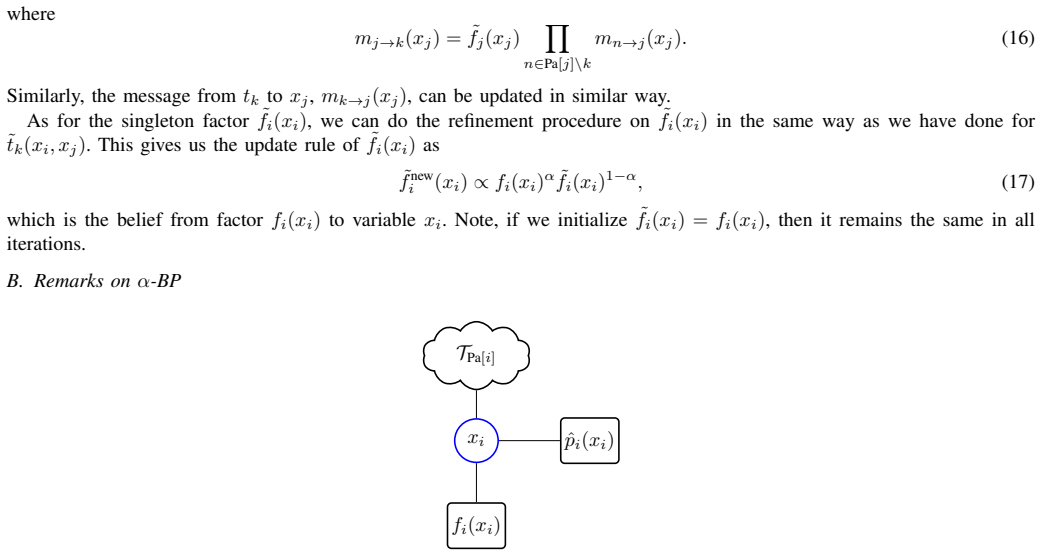
The load-bearing object is the fully factorized surrogate $q(x)\propto\prod_i\tilde f_i(x_i)\prod_{k\in K}m_{k\to i}(x_i)m_{k\to j}(x_j)$, whose factors are the messages, combined with the fixed-point heuristic $q^{\text{new}}=\operatorname{proj}[p^\alpha q^{1-\alpha}]$, where $\operatorname{proj}$ is KL projection onto the factorized family. Because KL projection onto a fully factorized family reduces to matching marginals, updating one message at a time turns into the explicit rule in Eq. 15. The parameter $\alpha$ does the tuning: at $\alpha=1$ the rule is exactly standard BP, while $\alpha<1$ gives the previous message a vote in its own replacement, the behavior that drives the reported gains on loopy graphs.
What would settle it
On a small binary MRF (say $N=5$), evaluate Eq. 14 exactly and check whether the message produced by Eq. 15 satisfies the marginal-matching condition after every update; a single mismatch beyond numerical precision would show the rule is not actually the localized $\alpha$-divergence minimizer claimed.
Extended reading notes
Core claim
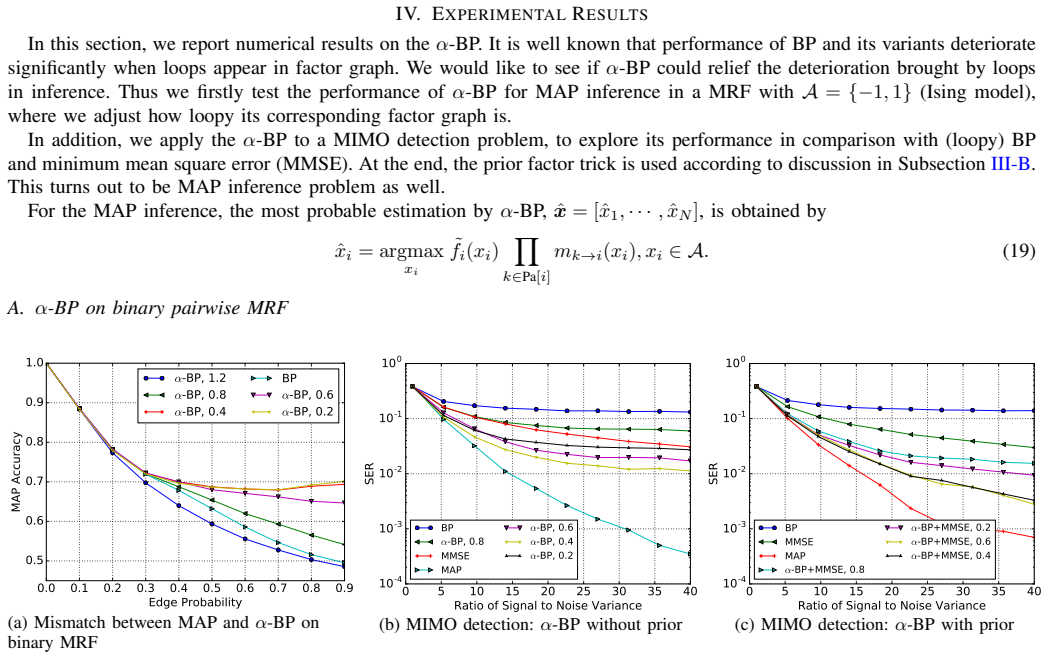
The paper's central claim is that the message-update rule in Eq. 15 follows from factor-wise minimization of $D_\alpha(p\|q)$, where $q$ is fully factorized and its factors are the messages, and that this rule strictly generalizes standard belief propagation. Setting $\alpha=1$ makes the update collapse to the classical BP message $m_{k\to i}(x_i)\propto\sum_{x_j}t_k(x_i,x_j)m_{j\to k}(x_j)$; setting $\alpha<1$ reweights the old message into the update. In the reported experiments on binary MRFs, $\alpha$-BP with $\alpha<1$ gives higher MAP accuracy than loopy BP as the graph becomes denser, and in MIMO detection it outperforms MMSE while keeping the linear-in-$N$ cost of message passing. Adding a weak prior factor from MMSE narrows the gap between $\alpha$-BP and exact MAP.
Load-bearing premise
The derivation assumes that when one factor is removed, the fully factorized surrogate is already a good approximation of the true distribution with that factor removed; if that assumption fails, the update no longer minimizes the $\alpha$-divergence it is claimed to minimize.
Editorial extensions
If this is right
- At $\alpha=1$, Eq. 15 reduces exactly to the standard BP message rule, so $\alpha$-BP contains BP as a special case rather than replacing it.
- On binary MRFs with edge probability above roughly 0.35, $\alpha$-BP at $\alpha=0.2$--$0.6$ stops losing MAP accuracy as the graph grows denser, whereas loopy BP keeps degrading.
- In the $8\times8$ MIMO experiment, $\alpha$-BP at small $\alpha$ beats MMSE in symbol-error rate while using only linear-in-$N$ message updates instead of MMSE's matrix inverse.
- Injecting a prior belief from a weak estimator, as done with MMSE, further improves $\alpha$-BP and narrows the gap to exact MAP.
- The fully factorized surrogate makes the update rule extend to continuous state spaces by replacing sums with integrals and to factors involving more than two variables.
Reading between the lines
- A reading the paper leaves implicit: $\alpha<1$ weights the old message into the new one, so $\alpha$-BP behaves like a divergence-derived damping of BP; testing against standard damped BP would show whether this is the mechanism behind its stability on loopy graphs.
- Because $\alpha=1$ is BP and smaller $\alpha$ moves toward a reverse-KL-style fit, $\alpha$-BP traces a continuous family between two known inference regimes; annealing $\alpha$ during iterations is a natural extension the paper does not test.
- The localized-minimization claim suggests a convergence diagnostic not used in the paper: track $D_\alpha(p\|q)$ per factor update and treat any increase as evidence that the cavity approximation has broken.
Signed reviews
Editorial analysis
A structured set of objections, weighed in public.
Referee Report
Summary. The paper proposes α-BP, a message-passing algorithm for pairwise Markov random fields. A fully factorized surrogate q(x) is introduced, and the authors derive a factor-wise update rule by minimizing a localized α-divergence between q and the target distribution p. The resulting message update (Eq. 15) reduces to standard loopy BP when α=1. The paper reports experiments on binary Ising models with varying loopiness and on MIMO detection, showing that α-BP can outperform BP and MMSE, and that adding a prior from MMSE further improves performance. The central claims are that α-BP has a clear variational interpretation and that it can outperform BP significantly even in fully connected graphs.
Significance. If fully justified, the result would be a clean and useful unification: a one-parameter family of message-passing updates with loopy BP as a special case and an explicit variational motivation. The α=1 recovery of BP is elegant, and the update has the same per-iteration complexity as BP. The empirical results are suggestive and the MIMO application is of practical interest. However, the variational interpretation rests on an unvalidated cavity approximation, and the experimental evaluation is weakened by post hoc selection of α, missing error bars, and the absence of comparisons with closely related methods such as fractional BP and power EP. The contribution is therefore plausible but currently incomplete.
major comments (3)
- [Section III.A.2, Eq. (11)] The derivation replaces the true cavity distribution p\k(x) with the fully factorized surrogate q\k(x) on the claim that q\k(x) ≃ p\k(x), but no justification, error bound, or empirical validation of this approximation is provided. In the experiments the graphs are dense (edge probability up to 0.9 in the Ising model, and a fully connected MIMO model with N=8), where p\k still contains many pairwise couplings and a fully factorized q\k cannot be expected to approximate it well. Because Eq. (15) is derived from this substitution, the central claim that α-BP 'is actually minimization of a localized α-divergence' is unsupported in exactly the regimes where the performance gains are reported. The authors should either validate the cavity approximation in the tested regimes or explicitly characterize Eq. (15) as an approximate/heuristic local update rather than an exact divergence minimizer.
- [Section IV, Figures 3a–3c] The empirical support for the headline claim is weakened by post hoc selection of α: different α values are highlighted for different tasks, the conclusion explicitly defers the choice of α to future work, and no error bars, confidence intervals, or statistical tests are reported despite 5000 realizations in the Ising experiment. Without a principled selection rule or at least a sensitivity analysis, the statement that α-BP 'can outperform BP by a significant margin' is a conditional observation about tuned runs rather than a predictive claim about the algorithm.
- [Section IV] The paper does not compare α-BP with the most relevant existing methods, namely fractional belief propagation [13] and power expectation propagation [18], which also have a divergence parameter and are known to improve on loopy BP. Such a comparison is necessary to establish that α-BP is a practical contribution beyond standard BP rather than a re-derivation of known behavior. In addition, Figure 3c reports α-BP with an MMSE prior but does not include a BP run with the same MMSE prior, so the improvement attributed to the prior trick cannot be separated from the effect of α.
minor comments (4)
- [Figure 3a] The caption says 'Mismatch between MAP and α-BP' but the vertical axis is labeled 'MAP Accuracy'; clarify whether higher values mean better accuracy or lower mismatch, and ensure the label and caption agree.
- [Algorithm 1] The algorithm does not specify whether messages are updated in parallel or sequentially, or whether damping is used; these choices are known to affect convergence of loopy BP and should be reported for reproducibility.
- [Conclusion] There is a typo in the conclusion: 'accoinding' should be 'according'; also 'Without lose of generality' in Section III.A.2 should be 'Without loss of generality'.
- [Section IV.B] The MIMO experiment reports results for N=8 but does not state the number of Monte Carlo trials or the SNR grid; adding this information would improve reproducibility.
Circularity Check
No significant circularity: the α-BP update is derived from a stated divergence objective, and the α=1 reduction to BP follows algebraically.
full rationale
The derivation is self-contained and not circular. The paper defines a fully factorized surrogate q (Eqs. 7–8) and a divergence objective Dα(p‖q), then invokes an external fixed-point equivalence theorem from Minka [18] to justify the update q_new = proj[p^α q^{1−α}] (Eq. 4). The local update is obtained by an explicit factor-wise refinement: with the stated approximation q\k ≃ p\k (Eq. 11), the minimization reduces to a KL projection, which for a fully factorized family is moment matching (Eq. 14), and solving that yields the message rule (Eq. 15). The approximation q\k ≃ p\k is a heuristic validity assumption, not a circular input: if it fails, the update may not minimize the stated divergence, but that is a robustness/correctness concern rather than a self-referential reduction. The claim that α-BP generalizes BP follows directly from substituting α=1 into Eq. 15, which gives Eq. 18, the standard BP message; this is not an input but an algebraic consequence. No fitted parameter is renamed as a prediction: α is a free algorithm parameter varied in experiments, and the paper explicitly defers a principled choice of α to future work. No load-bearing self-citation appears; the cited mathematical basis, Minka's stationary-point theorem, is external to the authors and not used to forbid alternatives. The experimental superiority claims rest on empirical sweeps and may be weakened by post-hoc α selection or lack of error bars, but those concerns belong to correctness risk, not circularity.
Assumptions & free parameters
free parameters (2)
- α (divergence parameter) =
0.2, 0.4, 0.6, 0.8, 1.2 scanned; best reported
- Message update scheduling and damping =
unspecified
assumptions (4)
- domain assumption Stationary point equivalence theorem from Minka (2005): proj[p^α q^{1-α}] and D_α(p||q) have the same stationary points.
- domain assumption The fixed-point iteration q_new = proj[p^α q^{1-α}] converges to a stationary point of D_α.
- ad hoc to paper Cavity approximation q\k(x) ≈ p\k(x) (Equation 11).
- standard math KL projection onto a fully factorized distribution reduces to matching the marginals.
Cite this review
Pith. "Pith review of $\alpha$ Belief Propagation as Fully Factorized Approximation." pith.science (2026). https://pith.science/paper/V64XGAAV
@misc{pith2026190808906,
  author       = {Pith},
  title        = {Pith review of: $\alpha$ Belief Propagation as Fully Factorized Approximation},
  year         = {2026},
  howpublished = {\url{https://pith.science/paper/V64XGAAV}},
  note         = {Machine review of arXiv:1908.08906}
}
abstract
Belief propagation (BP) can do exact inference in loop-free graphs, but its performance could be poor in graphs with loops, and the understanding of its solution is limited. This work gives an interpretable belief propagation rule that is actually minimization of a localized $\alpha$-divergence. We term this algorithm as $\alpha$ belief propagation ($\alpha$-BP). The performance of $\alpha$-BP is tested in MAP (maximum a posterior) inference problems, where $\alpha$-BP can outperform (loopy) BP by a significant margin even in fully-connected graphs.
Figures

Reference graph
Works this paper leans on
-
[13]
Fractional belief propagation,
W. Wiegerinck and T. Heskes, “Fractional belief propagation,” in Proceedings of the 15th International Conference on Neural Information Processing Systems, ser. NIPS’02. Cambridge, MA, USA: MIT Press, 2002, pp. 438–445. [Online]. Available: http://dl.acm.org/citation.cfm?id=2968618.2968673
-
[18]
Divergence measures and message passing,
T. Minka, “Divergence measures and message passing,” Tech. Rep. MSR-TR-2005-173, January 2005. [Online]. Available: https://www.microsoft.com/ en-us/research/publication/divergence-measures-and-message-passing/
work page 2005
-
[1]
Gaussian mixture markov random field for image denoising and reconstruction,
R. Zhang, C. A. Bouman, J. Thibault, and K. D. Sauer, “Gaussian mixture markov random field for image denoising and reconstruction,” in 2013 IEEE Global Conference on Signal and Information Processing , Dec 2013, pp. 1089–1092
work page 2013
-
[2]
Expectation propagation detection for high-order high-dimensional mimo systems,
J. Cspedes, P. M. Olmos, M. Snchez-Fernndez, and F. Perez-Cruz, “Expectation propagation detection for high-order high-dimensional mimo systems,” IEEE Transactions on Communications , vol. 62, no. 8, pp. 2840–2849, Aug 2014
work page 2014
-
[3]
Optimality of large mimo detection via approximate message passing,
C. Jeon, R. Ghods, A. Maleki, and C. Studer, “Optimality of large mimo detection via approximate message passing,” in 2015 IEEE International Symposium on Information Theory (ISIT) , June 2015, pp. 1227–1231
work page 2015
-
[4]
Bayesian inference in hidden markov random fields for binary data defined on large lattices,
N. Friel, A. N. Pettitt, R. Reeves, and E. Wit, “Bayesian inference in hidden markov random fields for binary data defined on large lattices,” Journal of Computational and Graphical Statistics , vol. 18, no. 2, pp. 243–261, 2009. [Online]. Available: http://www.jstor.org/stable/25651244
-
[5]
Restricted Boltzmann Machines: Introduction and Review,
G. Montufar, “Restricted Boltzmann Machines: Introduction and Review,” ArXiv e-prints, Jun. 2018
work page 2018
-
[6]
Deeply learning the messages in message passing inference,
G. Lin, C. Shen, I. Reid, and A. v. d. Hengel, “Deeply learning the messages in message passing inference,” in Proceedings of the 28th International Conference on Neural Information Processing Systems - Volume 1 , ser. NIPS’15. Cambridge, MA, USA: MIT Press, 2015, pp. 361–369. [Online]. Available: http://dl.acm.org/citation.cfm?id=2969239.2969280
Show all 23 references
-
[7]
Inference in probabilistic graphical models by graph neural networks,
K. Yoon, R. Liao, Y . Xiong, L. Zhang, E. Fetaya, R. Urtasun, R. S. Zemel, and X. Pitkow, “Inference in probabilistic graphical models by graph neural networks,” CoRR, vol. abs/1803.07710, 2018. [Online]. Available: http://arxiv.org/abs/1803.07710
2018 arXiv
-
[8]
C. M. Bishop, Pattern Recognition and Machine Learning (Information Science and Statistics) . Berlin, Heidelberg: Springer-Verlag, 2006
2006
-
[9]
Factor graphs and the sum-product algorithm,
F. R. Kschischang, B. J. Frey, and H. . Loeliger, “Factor graphs and the sum-product algorithm,” IEEE Transactions on Information Theory , vol. 47, no. 2, pp. 498–519, Feb 2001
2001
-
[10]
Loopy belief propagation: Convergence and effects of message errors,
A. T. Ihler, J. W. Fischer III, and A. S. Willsky, “Loopy belief propagation: Convergence and effects of message errors,” J. Mach. Learn. Res. , vol. 6, pp. 905–936, Dec. 2005. [Online]. Available: http://dl.acm.org/citation.cfm?id=1046920.1088703
2005
-
[11]
Convergence analysis of distributed inference with vector-valued gaussian belief propagation,
J. Du, S. Ma, Y .-C. Wu, S. Kar, and J. M. F. Moura, “Convergence analysis of distributed inference with vector-valued gaussian belief propagation,” J. Mach. Learn. Res. , vol. 18, no. 1, pp. 6302–6339, Jan. 2017. [Online]. Available: http://dl.acm.org/citation.cfm?id=3122009.3242029
2017
-
[12]
Generalized belief propagation,
J. S. Yedidia, W. T. Freeman, and Y . Weiss, “Generalized belief propagation,” in Proceedings of the 13th International Conference on Neural Information Processing Systems , ser. NIPS’00. Cambridge, MA, USA: MIT Press, 2000, pp. 668–674. [Online]. Available: http://dl.acm.org/...
2000
-
[14]
A message-passing algorithm with damping,
M. Pretti, “A message-passing algorithm with damping,” Journal of Statistical Mechanics: Theory and Experiment , vol. 2005, no. 11, pp. P11 008–P11 008, nov 2005. [Online]. Available: https://doi.org/10.1088%2F1742-5468%2F2005%2F11%2Fp11008
2005
-
[15]
Gaussian processes for classification: Mean-field algorithms,
M. Opper and O. Winther, “Gaussian processes for classification: Mean-field algorithms,” Neural Comput., vol. 12, no. 11, pp. 2655–2684, Nov. 2000. [Online]. Available: http://dx.doi.org/10.1162/089976600300014881
-
[16]
Expectation propagation for approximate bayesian inference,
T. P. Minka, “Expectation propagation for approximate bayesian inference,” in Proceedings of the 17th Conference in Uncertainty in Artificial Intelligence , ser. UAI ’01. San Francisco, CA, USA: Morgan Kaufmann Publishers Inc., 2001, pp. 362–369. [Online]. Available: http://dl....
2001
-
[17]
A family of algorithms for approximate bayesian inference,
——, “A family of algorithms for approximate bayesian inference,” Ph.D. dissertation, Cambridge, MA, USA, 2001, aAI0803033
2001
-
[19]
Stochastic expectation propagation,
Y . Li, J. M. Hern ´andez-Lobato, and R. E. Turner, “Stochastic expectation propagation,” in Advances in Neural Information Processing Systems 28 , C. Cortes, N. D. Lawrence, D. D. Lee, M. Sugiyama, and R. Garnett, Eds. Curran Associates, Inc., 2015, pp. 2323–2331. [Online]. A...
2015
-
[20]
Information geometric measurements of generalisation,
H. Zhu and R. Rohwer, “Information geometric measurements of generalisation,” Tech. Rep., 1995
1995
-
[21]
Pseudo prior belief propagation for densely connected discrete graphs,
J. Goldberger and A. Leshem, “Pseudo prior belief propagation for densely connected discrete graphs,” in 2010 IEEE Information Theory Workshop on Information Theory (ITW 2010, Cairo) , Jan 2010, pp. 1–5
2010
-
[22]
James, D
G. James, D. Witten, T. Hastie, and R. Tibshirani, An Introduction to Statistical Learning: With Applications in R . Springer Publishing Company, Incorporated, 2014
2014
-
[23]
On the evolution of random graphs,
P. Erdos and A. R ´enyi, “On the evolution of random graphs,” Publ. Math. Inst. Hung. Acad. Sci , vol. 5, no. 1, pp. 17–60, 1960
1960
Reviewed August 14, 2026 · model on record in the stance chip above.
Discussion (0). Continue with ORCID to comment.