An Exploratory Study of Live-Streamed Programming
Pith reviewed 2026-05-24 22:07 UTC · model grok-4.3
The pith
Live-streamed programming shares some pair-programming benefits but features a distinct public streamer-watcher relationship with unique motivations and challenges.
A machine-rendered reading of the paper's core claim, the machinery that carries it, and where it could break.
Core claim
Live-streamed programming shares some of the characteristics and benefits of pair programming, but differs in the nature of the relationship between the streamer and watchers. Streamers are motivated by knowledge sharing, socializing, and building an online identity, but face challenges with tool limitations and maintaining engagement with watchers.
What carries the argument
Exploratory analysis of 20 hours of live-streamed programming videos and surveys of 7 streamers that compares the practice to pair programming while cataloging motivations and challenges.
If this is right
- Live-streamed programming can function as a public form of knowledge sharing for open-source projects.
- Existing streaming platforms impose tool limitations that reduce effectiveness.
- Design recommendations for new tools can address watcher engagement and interaction needs.
- Streamers gain opportunities to build online identities through their development sessions.
Where Pith is reading between the lines
- The public format might encourage higher code quality through visible accountability.
- Educational use could arise if watchers treat sessions as live tutorials.
- Integration with code repositories might allow direct contributions from watchers during streams.
Load-bearing premise
The 20 hours of analyzed videos and the responses from 7 surveyed streamers provide a sufficient and unbiased basis for identifying general characteristics, motivations, and challenges of live-streamed programming.
What would settle it
A follow-up study that examines a much larger set of streams or surveys many more streamers and finds no meaningful similarity to pair programming or entirely different primary motivations would undermine the reported patterns.
Figures


read the original abstract
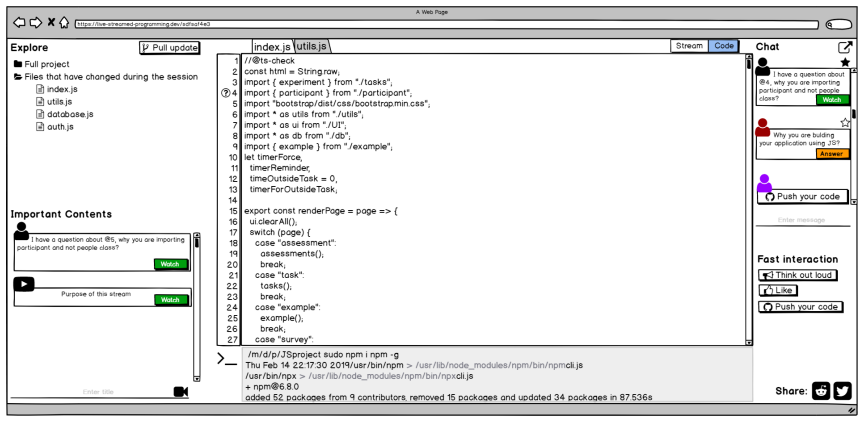
In live-streamed programming, developers broadcast their development work on open source projects using streaming media such as YouTube or Twitch. Sessions are first announced by a developer acting as the streamer, inviting other developers to join and interact as watchers using chat. To better understand the characteristics, motivations, and challenges in live-streamed programming, we analyzed 20 hours of live-streamed programming videos and surveyed 7 streamers about their experiences. The results reveal that live-streamed programming shares some of the characteristics and benefits of pair programming, but differs in the nature of the relationship between the streamer and watchers. We also found that streamers are motivated by knowledge sharing, socializing, and building an online identity, but face challenges with tool limitations and maintaining engagement with watchers. We discuss the implications of these findings, identify limitations with current tools, and propose design recommendations for new forms of tools to better supporting live-streamed programming.
Editorial analysis
A structured set of objections, weighed in public.
Referee Report
Summary. The paper reports an exploratory qualitative study of live-streamed programming on platforms such as Twitch and YouTube. It analyzes 20 hours of video sessions plus survey responses from 7 streamers to characterize the practice, compare it to pair programming, identify streamer motivations (knowledge sharing, socializing, identity building), and document challenges (tool limitations, maintaining watcher engagement). The central claims are descriptive and rest on thematic extraction from this dataset.
Significance. If the reported themes prove robust, the work supplies an early empirical baseline for an emerging form of open-source collaboration and could usefully inform requirements for streaming-aware development tools.
major comments (2)
- [Methods] Methods (or equivalent section describing data collection and analysis): the study draws conclusions about general motivations and challenges from only 7 survey respondents and 20 hours of video, yet provides no sampling frame, response rate, selection criteria for the video corpus, saturation assessment, or details of the qualitative coding procedure (e.g., codebook development, inter-rater reliability). These omissions make the load-bearing claims about prevalence of themes difficult to evaluate.
- [Results] Results/Discussion: the assertion that streamers are motivated by knowledge sharing, socializing, and identity building (and face the listed challenges) is presented as a finding of the study, but the small self-selected sample of public streamers who opted into research introduces plausible selection bias; no evidence or triangulation is offered to show that the themes generalize beyond this subset.
minor comments (1)
- [Abstract] The abstract states the sample sizes but the main text should explicitly report how many distinct streamers and sessions were observed in the 20 hours.
Simulated Author's Rebuttal
We thank the referee for the constructive feedback on our exploratory study. We address each major comment below and will make revisions to improve methodological transparency and to better frame the scope of the findings.
read point-by-point responses
-
Referee: [Methods] Methods (or equivalent section describing data collection and analysis): the study draws conclusions about general motivations and challenges from only 7 survey respondents and 20 hours of video, yet provides no sampling frame, response rate, selection criteria for the video corpus, saturation assessment, or details of the qualitative coding procedure (e.g., codebook development, inter-rater reliability). These omissions make the load-bearing claims about prevalence of themes difficult to evaluate.
Authors: We agree that more detail on data collection and analysis is needed. The study used convenience sampling of publicly announced streams on Twitch and YouTube involving open-source programming; we will add explicit selection criteria for the 20-hour video corpus, describe survey recruitment (via Twitter, Discord, and streaming communities), and expand the analysis description to cover the inductive thematic process (codes developed iteratively by the first author with team review). No formal saturation assessment or inter-rater reliability statistic was performed, as is typical for small-scale exploratory work with a single primary coder. We will revise the Methods section accordingly (revision_made = yes). revision: yes
-
Referee: [Results] Results/Discussion: the assertion that streamers are motivated by knowledge sharing, socializing, and identity building (and face the listed challenges) is presented as a finding of the study, but the small self-selected sample of public streamers who opted into research introduces plausible selection bias; no evidence or triangulation is offered to show that the themes generalize beyond this subset.
Authors: We accept that the self-selected survey respondents introduce selection bias and that the themes cannot be claimed to generalize. The study is exploratory and descriptive; the 20 hours of video analysis from additional streamers offers limited triangulation. We will revise the Results/Discussion to explicitly state the exploratory scope, add a limitations paragraph addressing sample characteristics and non-generalizability, and remove any phrasing that could imply prevalence beyond the observed data (revision_made = yes). revision: yes
Circularity Check
No circularity: purely descriptive empirical study
full rationale
The paper is an exploratory qualitative study that analyzes 20 hours of video and surveys 7 streamers to identify characteristics, motivations, and challenges. It contains no equations, fitted parameters, predictions, derivations, or mathematical claims. All findings are presented as direct observations from the collected data without any reduction to prior inputs or self-citations that bear the central load. This matches the default expectation of no circularity for non-derivational empirical work.
Axiom & Free-Parameter Ledger
axioms (1)
- domain assumption The selected 20 hours of videos and 7 streamers are representative of live-streamed programming practices overall.
Reference graph
Works this paper leans on
-
[1]
How open source soft- ware works:“free
K. R. Lakhani and E. V on Hippel, “How open source soft- ware works:“free” user-to-user assistance,” in Produktentwicklung mit virtuellen Communities. Springer, 2004, pp. 303–339
work page 2004
-
[2]
Design lessons from the fastest q&a site in the west,
L. Mamykina, B. Manoim, M. Mittal, G. Hripcsak, and B. Hartmann, “Design lessons from the fastest q&a site in the west,” in Conference on Human Factors in Computing Systems , 2011, pp. 2857–2866
work page 2011
-
[3]
Software engineering at the speed of light: how developers stay current using twitter,
L. Singer, F. Figueira Filho, and M.-A. Storey, “Software engineering at the speed of light: how developers stay current using twitter,” in International Conference on Software Engineering , 2014, pp. 211–221
work page 2014
-
[4]
Social coding in github: Transparency and collaboration in an open software repository,
L. Dabbish, C. Stuart, J. Tsay, and J. Herbsleb, “Social coding in github: Transparency and collaboration in an open software repository,” in Conference on Computer Supported Cooperative Work , 2012, pp. 1277–1286
work page 2012
-
[5]
Stackoverflow and github: Associations between software development and crowdsourced knowl- edge,
B. Vasilescu, V . Filkov, and A. Serebrenik, “Stackoverflow and github: Associations between software development and crowdsourced knowl- edge,” in International Conference on Social Computing, 2013, pp. 188– 195
work page 2013
-
[6]
Building reputation in stackoverflow: An empirical investiga- tion,
A. Bosu, C. S. Corley, D. Heaton, D. Chatterji, J. C. Carver, and N. A. Kraft, “Building reputation in stackoverflow: An empirical investiga- tion,” in International Conference on Mining Software Repositories , 2013, pp. 89–92
work page 2013
-
[7]
Let’s talk about it: Evaluating contributions through discussion in github,
J. Tsay, L. Dabbish, and J. Herbsleb, “Let’s talk about it: Evaluating contributions through discussion in github,” in International Symposium on Foundations of Software Engineering , 2014, pp. 144–154
work page 2014
-
[8]
Code reviewing in the trenches: Challenges and best practices,
L. MacLeod, M. Greiler, M. Storey, C. Bird, and J. Czerwonka, “Code reviewing in the trenches: Challenges and best practices,” IEEE Software, vol. 35, pp. 34–42, jul 2018
work page 2018
-
[9]
Thousands of people are watching this guy code a search engine,
J. Koebler, “Thousands of people are watching this guy code a search engine,” 2015, accessed: 2019-01-16. [Online]. Available: https://motherboard.vice.com/en_us/article/pgax4n/ thousands-of-people-are-watching-this-guy-code-a-search-engine
work page 2015
-
[10]
Live programming on twitch is growing fast,
C. Bernasconi, “Live programming on twitch is growing fast,” 2019, ac- cessed: 2019-06-25. [Online]. Available: https://www.claudiobernasconi. ch/2019/05/29/live-programming-on-twitch-is-growing-fast/
work page 2019
-
[11]
Lessons from my first year of live coding on twitch,
S. Hinton, “Lessons from my first year of live coding on twitch,” 2017, accessed: 2019- 01-16. [Online]. Available: https://medium.freecodecamp.org/ lessons-from-my-first-year-of-live-coding-on-twitch-41a32e2f41c1
work page 2017
-
[12]
Rethinking databases and noria with jon gjengset,
A. G. Bell, “Rethinking databases and noria with jon gjengset,” 2019, accessed: 2019-06-25. [Online]. Available: https://corecursive. com/030-rethinking-databases-with-jon-gjengset/
work page 2019
-
[13]
Live coding open source on twitch,
S. H. Adam Stacoviak, Jerod Santo, “Live coding open source on twitch,” 2018, accessed: 2019-06-25. [Online]. Available: https: //changelog.com/podcast/288
work page 2018
-
[14]
Social media for software engineering,
A. Begel, R. DeLine, and T. Zimmermann, “Social media for software engineering,” in Workshop on Future of software engineering research , 2010, pp. 33–38
work page 2010
-
[15]
Survey: Open source programs are a best practice among large companies,
L. Hecht and L. Clark, “Survey: Open source programs are a best practice among large companies,” 2018, accessed: 2019-03-02. [Online]. Available: https://thenewstack.io/ survey-open-source-programs-are-a-best-practice-among-large-companies/
work page 2018
-
[16]
Who really contributes to open source,
M. Asay, “Who really contributes to open source,” 2018, accessed: 2019-03-02. [Online]. Available: https://www.infoworld.com/article/ 3253948/who-really-contributes-to-open-source.html
work page 2018
-
[17]
Code, camera, action: how software developers document and share program knowledge using youtube,
L. MacLeod, M.-A. Storey, and A. Bergen, “Code, camera, action: how software developers document and share program knowledge using youtube,” in International Conference on Program Comprehension , 2015, pp. 104–114
work page 2015
-
[18]
L. Williams and R. Kessler, Pair programming illuminated. Addison- Wesley Longman Publishing Co., Inc., 2002
work page 2002
-
[19]
A multiple case study on the impact of pair programming on product quality,
H. Hulkko and P. Abrahamsson, “A multiple case study on the impact of pair programming on product quality,” in International Conference on Software Engineering , May 2005, pp. 495–504
work page 2005
-
[20]
The effects of pair-programming on performance in an introductory programming course,
C. McDowell, L. Werner, H. Bullock, and J. Fernald, “The effects of pair-programming on performance in an introductory programming course,” in Technical Symposium on Computer Science Education, 2002, pp. 38–42
work page 2002
-
[21]
Improving the cs1 experience with pair pro- gramming,
N. Nagappan, L. Williams, L. Williams, M. Ferzli, E. Wiebe, K. Yang, C. Miller, and S. Balik, “Improving the cs1 experience with pair pro- gramming,” in Technical Symposium on Computer Science Education , 2003, pp. 359–362
work page 2003
-
[22]
Strength- ening the case for pair programming,
W. Cunningham, L. Williams, R. R. Kessler, and R. Jeffries, “Strength- ening the case for pair programming,” IEEE Software, vol. 17, pp. 19–25, 07 2000
work page 2000
-
[23]
The costs and benefits of pair program- ming,
A. Cockburn and L. Williams, “The costs and benefits of pair program- ming,” in EXtreme Programming and Flexible Processes in Software Engineering. Addison-Wesley, 2000, pp. 223–247
work page 2000
- [24]
-
[25]
Mob programming: A whole team ap- proach,
W. Zuill and K. Meadows, “Mob programming: A whole team ap- proach,” in Agile 2014 Conference, Orlando, Florida , 2016
work page 2014
-
[26]
Exploring the efficacy of distributed pair programming,
P. Baheti, E. Gehringer, and D. Stotts, “Exploring the efficacy of distributed pair programming,” in Conference on Extreme Programming and Agile Methods , 2002, pp. 208–220
work page 2002
-
[27]
Globally distributed software development and pair pro- gramming,
N. V . Flor, “Globally distributed software development and pair pro- gramming,” Commun. ACM, vol. 49, pp. 57–58, Oct. 2006
work page 2006
-
[28]
How distribution affects the success of pair programming
G. Canfora, A. Cimitile, G. Di Lucca, and C. A. Visaggio, “How distribution affects the success of pair programming.” International Journal of Software Engineering and Knowledge Engineering , vol. 16, pp. 293–313, 04 2006
work page 2006
-
[29]
Distributed pair pro- gramming: A systematic literature review,
B. J. da Silva Estácio and R. Prikladnicki, “Distributed pair pro- gramming: A systematic literature review,” Information and Software Technology, vol. 63, pp. 1–10, 2015
work page 2015
-
[30]
Saros: An eclipse plug-in for distributed party programming,
S. Salinger, C. Oezbek, K. Beecher, and J. Schenk, “Saros: An eclipse plug-in for distributed party programming,” in Workshop on Cooperative and Human Aspects of Software Engineering , 2010, pp. 48–55
work page 2010
-
[31]
Exploring the effects of collaboration scripts embedded in a distributed pair program- ming system,
D. Tsompanoudi, M. Satratzemi, and S. Xinogalos, “Exploring the effects of collaboration scripts embedded in a distributed pair program- ming system,” in conference on Innovation and technology in computer science education, 2013, pp. 225–230
work page 2013
-
[32]
Collaboration and learning through live coding (Dagstuhl Seminar 13382),
A. Blackwell, A. McLean, J. Noble, and J. Rohrhuber, “Collaboration and learning through live coding (Dagstuhl Seminar 13382),” Dagstuhl Reports, vol. 3, pp. 130–168, 2014
work page 2014
-
[33]
C. Nilson, “Live coding practice,” in Conference on New interfaces for musical expression, 2007, pp. 112–117
work page 2007
-
[34]
Live coding in laptop performance,
N. Collins, A. McLean, J. Rohrhuber, and A. Ward, “Live coding in laptop performance,” Organised sound, pp. 321–330, 2003
work page 2003
-
[35]
Algorithms as scores: Coding live music,
T. Magnusson, “Algorithms as scores: Coding live music,” Leonardo Music Journal, pp. 19–23, 2011
work page 2011
-
[36]
What can computer science learn from a fine arts approach to teaching?
L. J. Barker, K. Garvin-Doxas, and E. Roberts, “What can computer science learn from a fine arts approach to teaching?” in Technical Symposium on Computer Science Education , 2005, pp. 421–425
work page 2005
-
[37]
Improv: Teaching programming at scale via live coding,
C. Chen and P. J. Guo, “Improv: Teaching programming at scale via live coding,” in Conference on Learning at Scale , 2019
work page 2019
-
[38]
Programming as a performance: Live-streaming and its implications for computer science education,
L. Haaranen, “Programming as a performance: Live-streaming and its implications for computer science education,” in Conference on Innovation and Technology in Computer Science Education , 2017, pp. 353–358
work page 2017
-
[39]
Watch me code: Programming mentorship communities on twitch.tv,
T. Faas, L. Dombrowski, A. Young, and A. D. Miller, “Watch me code: Programming mentorship communities on twitch.tv,” Human-Computer Interaction, vol. 2, pp. 50:1–50:18, Nov. 2018
work page 2018
-
[40]
Looking for group: Live streaming programming for small audiences,
T. Faas, L. Dombrowski, E. Brady, and A. Miller, “Looking for group: Live streaming programming for small audiences,” in Information in Contemporary Society, 2019, pp. 117–123
work page 2019
-
[41]
What it feels like to be an open-source maintainer,
N. Lawson, “What it feels like to be an open-source maintainer,” 2017, accessed: 2019-02-08. [Online]. Available: https://nolanlawson. com/2017/03/05/what-it-feels-like-to-be-an-open-source-maintainer/
work page 2017
-
[42]
How effective develop- ers investigate source code: An exploratory study,
M. P. Robillard, W. Coelho, and G. C. Murphy, “How effective develop- ers investigate source code: An exploratory study,” IEEE Transactions on Software Engineering. , vol. 30, pp. 889–903, Dec. 2004
work page 2004
-
[43]
Questions about object structure during coding activities,
M. Abi-Antoun, N. Ammar, and T. LaToza, “Questions about object structure during coding activities,” in Workshop on Cooperative and Human Aspects of Software Engineering , 2010, pp. 64–71
work page 2010
-
[44]
Asking and answering questions during a programming change task,
J. Sillito, G. C. Murphy, and K. De V older, “Asking and answering questions during a programming change task,” IEEE Transactions on Software Engineering., vol. 34, pp. 434–451, Jul. 2008
work page 2008
-
[45]
Searching and skimming: An ex- ploratory study,
J. Starke, C. Luce, and J. Sillito, “Searching and skimming: An ex- ploratory study,” in International Conference on Software Maintenance , 2009, pp. 157–166
work page 2009
-
[46]
Introducing visual studio live share,
A. Silver, “Introducing visual studio live share,” 2017, accessed: 2019-06-25. [Online]. Available: https://code.visualstudio.com/blogs/ 2017/11/15/live-share
work page 2017
-
[47]
Creating guided code explanations with chat.codes,
S. Oney, C. Brooks, and P. Resnick, “Creating guided code explanations with chat.codes,” Human-Computer Interaction. , vol. 2, pp. 131:1– 131:20, Nov. 2018
work page 2018
discussion (0)
Sign in with ORCID, Apple, or X to comment. Anyone can read and Pith papers without signing in.