REVIEW 4 major objections 6 minor 52 references
Resilience and adaptability in self-evidencing systems
T0 review · 4 major / 6 minor · reviewed 2026-08-07 · deepseek-v4-flash
Pith's one-line read The paper argues that self-organisation under the free energy principle is fundamentally about resilience: identity is a continuously reconfigured self-model, inertial resilience is high precision in self-beliefs, plasticity is a…
desk verdict A useful conceptual framework for resilience in active inference, but the load-bearing precision–resilience derivation rests on a mis-stated Freidlin–Wentzell rate function. read the letter →
The pith
A machine-rendered reading of the paper's core claim, the machinery that carries it, and where it could break.
The reading
What carries the argument
The central object is the self-model as a variational posterior over external (environmental) states parametrised by internal states through a mapping $\sigma: \hat{\mu}_{a,s} \mapsto \hat{\eta}_{a,s}$; minimising variational free energy is equivalent to minimising the surprisal (rate function) $-\log p^{|\Gamma|}(\mu_t) = \frac{1}{|\Gamma|} \int_0^t |\dot{\mu}_s - V(\mu_s,s)|^2 ds + o(1/|\Gamma|)$. This rate function carries the argument: its prefactor $|\Gamma|^{-1}$ is the precision of self-belief, so high precision makes characteristic trajectories attractors; its landscape curvature is the Fisher information, so flattening it enables exploration. The redundancy argument runs on a Chernoff-style bound, $P(\hat{C} - E[C] \ge h\varepsilon) \le e^{-h\varepsilon^2}$, which says the mode of a large cluster is exponentially insensitive to losing individual states.
What would settle it
Build or simulate a hierarchical stochastic system with $h$ redundant lower-level states feeding one higher-level mode, and lesion states one at a time. The paper's argument predicts the higher-level mode shifts with probability bounded by $e^{-h\varepsilon^2}$; a calculation that instead shows the mode shifting by an amount independent of $h$ whenever damage is correlated across the cluster, or whenever a single non-modular connection carries the feature, would show the redundancy claim fails outside its stated assumption.
Extended reading notes
Core claim
The central claim is that 'self-organisation under the free energy principle is about resilience': identity is a process, not a fixed essence, and an agent's self-model is maintained by the same variational inference that keeps it on an attractor. Formally, the paper argues that resilience-as-inertia is high self-precision: as the noise amplitude $|\Gamma|$ decreases, the Freidlin–Wentzell path measure concentrates on paths that track the expected trajectory, making that trajectory a path-wise attractor. Resilience-as-plasticity corresponds to flattening the free energy landscape: small Fisher information (low curvature) means the system has little preference among variational posteriors and can move between metastable modes, while the heat dissipated is proportional to negative precision, so flat landscapes are also energetically favourable. Finally, hierarchical redundancy protects higher identity: for a cluster of $h$ states with mode $\hat{C}$, the probability that the sample mean deviates from the optimum by $\varepsilon$ is bounded by $e^{-h\varepsilon^2}$, so larger clusters buffer damage. The paper presents this as a first formal framework connecting resilience, identity, and Bayesian mechanics.
Load-bearing premise
The cluster-protection argument assumes that hierarchy implies modularity — that damage to some lower-level states does not propagate into the higher-level cluster mode — an assumption the authors explicitly flag; if a hierarchy is not modular, the exponential protection estimate does not follow.
Editorial extensions
If this is right
- Inertial resilience is precision: raising the precision of self-beliefs makes an agent's characteristic trajectory a path-wise attractor, so the agent resists perturbation but may become inflexible.
- Plastic resilience is low free-energy curvature: flattening the landscape lets a system explore alternative modes, and because dissipated heat is proportional to negative precision, this adaptability is thermodynamically cheaper.
- Hierarchical redundancy protects identity: a higher-level feature encoded by many redundant lower-level states survives damage with an error that decays exponentially in the number of states.
- Self-evidencing and world-modelling are mutually demanding: high-precision self-beliefs require an accurate model of the environment, and failure to minimise variational free energy makes the system drift from its characteristic trajectory.
- Identity change can be described as a phase transition: under large perturbations the system can be kicked between metastable modes, and different environmental regimes select different 'phenotypes' or identities.
Reading between the lines
- One testable extension: lesion hidden units in a trained hierarchical neural network one at a time; the cluster-mode bound predicts that performance on a higher-level task degrades exponentially slowly with the number of redundant units, and this should fail in non-modular architectures where a single unit carries the feature.
- The heat-dissipation relation suggests a measurable trade-off: adaptable agents dissipate more heat than rigid ones; comparing metabolic or informational cost under perturbation could operationalise 'plasticity' in biological or artificial agents.
- The paper's drift condition gives a dynamical definition of identity loss: an agent that cannot minimise variational free energy will depart from its characteristic trajectory; one could measure this deviation directly in an active-inference agent after changing environmental statistics.
- The framework implies a continuum of resilience rather than a binary: the same system can tune precision and curvature, so resilience is a policy over the free energy landscape, not a fixed trait of the organism.
Editorial analysis
A structured set of objections, weighed in public.
Referee Report
Summary. This paper argues that self-organisation under the free energy principle (FEP) should be understood as a resilience process: identity is not a static essence but a self-model that is continually reconfigured, and the maintenance of that self-model is what resilience means. The authors propose a formal dictionary: inertial resilience is identified with high self-precision through a Freidlin–Wentzell path-measure argument (Eq. (2) in Section 2.1); plasticity is treated via mode-switching under changing blanket states and via flattening of the free energy landscape, justified by a curvature/heat-dissipation argument (Section 2.2); and hierarchical redundancy is claimed to buffer higher-level identity through a cluster concentration bound (Section 3). The paper situates these ideas in the psychology literature (identity control theory, narrative identity, Breakwell's identity resilience) and presents itself as a first sketch of a formalism connecting resilience studies with Bayesian mechanics.
Significance. If the central derivation were correct, this would supply a valuable unifying dictionary between the resilience literature and Bayesian mechanics, with the three classical facets of resilience (inertia, elasticity, plasticity) mapped onto precision, basin dynamics, and landscape geometry. The paper earns credit for being explicit that the FEP is conceptually tautological, for flagging the modularity assumption in Section 3, for grounding the taxonomy in empirical psychology, and for making claims that are in principle falsifiable (the escape behaviour of a stochastic dynamical system would test the precision–resilience correspondence). That said, the reader's main technical objection is confirmed on reading: Eq. (2) uses 1/det Γ where the Freidlin–Wentzell rate function requires the inverse noise covariance, and the subsequent 'e^{−∞·0} = 1' computation is not a valid limit argument.
major comments (4)
- [§2.1, Eq. (2)] The Freidlin–Wentzell rate function is mis-stated. For dX_t = V(X_t, t) dt + Γ dW_t with matrix noise, the small-noise action is I[x] = (1/2) ∫ (Ẋ − V)^T (ΓΓ^T)^{-1} (Ẋ − V) ds, so exponential concentration is controlled by the inverse noise covariance; det Γ enters only as a sub-exponential normalisation and cannot serve as the action coefficient. The issue is load-bearing, not cosmetic: for Γ = diag(ε, 1/ε), det Γ = 1, so Eq. (2) predicts symmetric penalisation of fluctuations in the two coordinates, whereas the true rate function penalises Ẋ₁ fluctuations at scale ε^{-2} and Ẋ₂ fluctuations at scale ε². In one dimension the paper's coefficient is also off by a power (1/σ rather than 1/σ²), i.e. inverse amplitude rather than inverse variance. Consequently the identification of |Γ|^{-1} with belief precision, and with it the central conclusion 'resilience in the inertial sense is high self-precision', is not established as written; the corrected rate function yields a directional, coordinate-dependent notion of inertial resilience. Please replace Eq. (2), redefine the precision measure accordingly, and test the correspondence on an anisotropic example (e.g., escape rates for a 2D gradient system).
- [§2.1, infinite-precision limit] The 'formal computation' of the infinite-precision limit is not valid. The text writes p∞(X_t) = e^{−∞ ∫ |Ẋ−V|² ds}, non-zero only when the integral vanishes, 'in which case it is e^{−∞·0} = 1'. The product −∞·0 is indeterminate, and the sentence silently adopts a convention about how the coefficient and the action compete as |Γ|^{-1} → ∞; moreover 'the limiting path measure equals 1 on these paths' requires a specified path space, topology, and reference measure to be a meaningful statement. The qualitative zero-noise conclusion can be justified rigorously (e.g., by the Stroock–Varadhan support theorem: the support of the law of X converges to solutions of the ODE ẋ = V), but that justification is absent. Since this passage is the second half of the inertial-resilience derivation, it should be rewritten as a proper limit statement rather than an indeterminate expression.
- [§2.2, heat dissipation] The inference about heat dissipation does not follow from the displayed formula. The paper writes q = −k_B T ΔF(μ, b), where ΔF is the trace of the Hessian and is identified with the Fisher information (precision), and concludes that the heat dissipated is proportional to the negative precision and that 'low precision dissipates a larger amount of heat than high precision'. If q ∝ −trace(P), then decreasing precision moves q toward zero, so the magnitude of dissipation decreases with lower precision; the printed inequality is reversed relative to the formula. Note that the authors' own desired conclusion (flatter landscapes allow more energetically efficient self-organisation) requires the opposite reading, so the sentence is internally inconsistent regardless of sign convention. This step is the quantitative justification for the plasticity claim in Section 2.2 and must be re-derived with an explicit sign convention and a clear definition of which quantity is the dissipated heat.
- [§3, cluster concentration bound] The concentration bound used for the redundancy model is mis-scaled. For h iid Gaussian states with mean E[C] and variance σ_C², the correct tail bound for the empirical mean is P(|Ĉ − E[C]| ≥ ε) ≤ 2 exp(−hε²/(2σ_C²)); the printed bound P(Ĉ − E[C] ≥ hε) ≤ e^{−hε²} has a threshold of order h on the left and an exponent of order h on the right, so it does not express concentration of the mean in any fixed neighbourhood, and the conclusion 'Ĉ is exponentially likely to get closer and closer to E[C]' does not follow from it in the form stated. The qualitative idea is correct, and the authors do flag the decisive premise ('Note that this tacitly assumes hierarchy implies modularity'), which I credit; however, the argument also conflates the cluster mode with the empirical mean and silently assumes that losses are independent across the h states. Please state the conditions (independence, modularity of damage) and give the bound in its correct form.
minor comments (6)
- [§2.1, before Eq. (2)] The phrase 'By a theorem of Friedlin–Wentzell' carries no citation; please cite the standard monograph (Freidlin and Wentzell, Random Perturbations of Dynamical Systems) and state the theorem's hypotheses and the regime of validity of the rate function.
- [Throughout] There are several typos and unpolished sentences: 'Friedlin–Wentzell' should be 'Freidlin–Wentzell'; 'Resilience is not simple a fixed quantity' should read 'simply'; 'how can it can be modelled' contains a duplicated word; and the sentence 'the concepts have porosity in the literature and a degree of metaphorical artistic license' is left incomplete.
- [§2 (Introduction to formalism)] The paper promises three aspects of resilience (inertia, elasticity, plasticity) but only inertia (§2.1) and plasticity (§2.2) are formalised; elasticity, defined as the ability to rebound to a prior attractor after perturbation, is discussed qualitatively in the basin picture but deserves a formal statement or an explicit pointer as to where it is treated.
- [§3, map sigma] The existence of the mapping σ from conditionally expected internal states to external states is asserted 'under generic conditions' with no statement of those conditions, no derivation, and no reference; since the redundancy argument in Section 3 uses σ to attach meaning to the cluster modes, the status of this assertion (assumption vs. theorem) should be made explicit.
- [End of §2.1] The sentence 'Minimising variational free energy also minimises this quantity by (3). Consequently it increases precision' is not a consequence of the preceding equations as written: minimising a rate function does not change its coefficient, which is where the precision lives. This should be rephrased as an interpretive claim or derived explicitly.
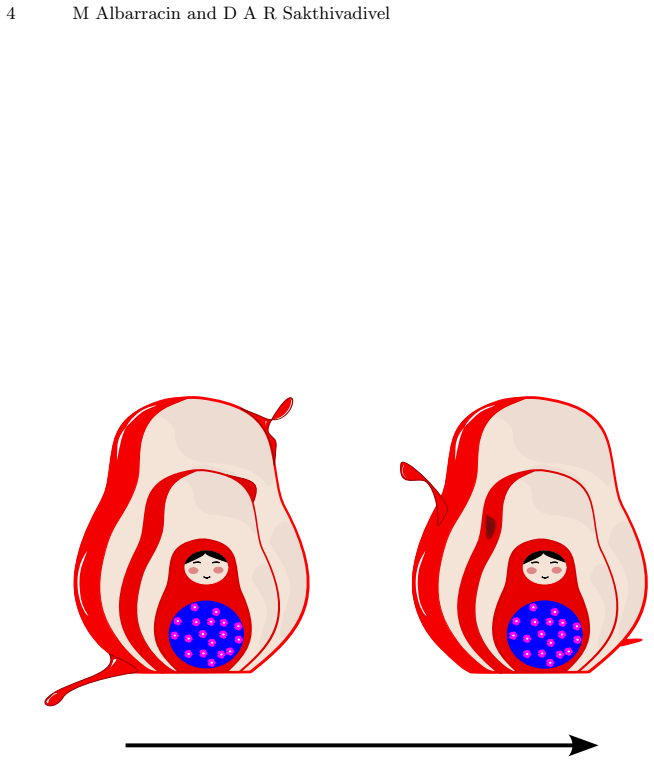
- [Figure 1] Figure 1 (the Matryoshka doll) is not referenced in the text and is purely illustrative; please reference it where the nested-identity discussion occurs or remove it.
Circularity Check
Inertial resilience is identified with self-precision by definition, and the heat-efficiency consequence is a substitution of definitions; the redundancy model is independent
-
self definitional
[Section 2.1, Eq. (2) and following paragraph]
"Suppose p(X_t) is the Bayesian belief of an agent about its own states. Then |Γ|^{-1} is the precision of that belief. When |Γ|^{-1} increases, the probability of large fluctuations away from ^x_t decays exponentially. ... As such, resilience in the inertial sense is high self-precision."
Inertial resilience was already stipulated in the Introduction as 'holding very high-precision beliefs that prevent change'. In the formal section, the large-deviation prefactor |Γ|^{-1} is simply renamed 'precision', and the conclusion that inertial resilience is high self-precision restates the label. No independent operational measure of resilience is introduced; the same equation would 'predict' any property one chose to attach to the prefactor. The claimed result is therefore equivalent to the definitions rather than derived from the stochastic dynamics. The paper's later admission that the FEP is 'conceptually a tautology' does not repair the definitional character of this step.
-
self definitional
[Section 2.2, 'Free energy curvatures']
"We claim that an adaptive system will find more effective ways to self-organise when the free energy landscape is flatter. To justify this, note that the heat dissipated is (see [38,47] for extended derivations) q = -k_B T ΔF(μ,b) ... If every change in μ is a new possible parameter, then the ΔF(μ,b) term is the Fisher information. Since the trace of a square matrix is the sum of its eigenvalues, the heat dissipated is proportional to the negative precision."
The 'prediction' that low precision dissipates more heat is obtained by substituting one definition into another: ΔF is defined as the trace of the Hessian, then conditionally equated to Fisher information, and Fisher information is identified with precision. The equation q ∝ -precision is therefore true by construction, not by stochastic thermodynamics. The added clause 'If every change in μ is a new possible parameter' makes the identification conditional and unconstrained, so the energy-efficiency conclusion carries no independent empirical content beyond the definitions adopted.
full rationale
The inertial-resilience identification is the first pillar of the paper's framework and it reduces to a definition: |Γ|^{-1} is called 'precision', and inertial resilience was already described as high-precision beliefs; the conclusion is the same statement with different words. The energy-efficiency claim in Section 2.2 is likewise a substitution of definitions (q ∝ -ΔF, ΔF := Fisher := precision). These are genuine circular steps by the paper's own equations. The Section 3 cluster-redundancy model, by contrast, is a self-contained concentration-of-measure argument for sample means and does not reduce to its conclusion; it is independent support for the plastic-redundancy discussion. Self-citations such as [13,46,43,33] are present, but the formal reductions identified above do not depend on them; the tautological status of the FEP is acknowledged in the text. Scoring 7 rather than 8-10 because the cluster argument and the qualitative psychological discussion retain independent content, so the paper is not wholly forced by definitions. Separately, Eq. (2) is not the standard Freidlin-Wentzell rate function for matrix noise, but that is a mathematical-correctness concern rather than a circularity and is not scored here.
Assumptions & free parameters
free parameters (1)
- Gamma (noise amplitude / precision matrix) =
unspecified positive-definite matrix, chosen by hand
assumptions (5)
- standard math Freidlin-Wentzell large-deviations action for SDE (1) gives the path measure (2).
- domain assumption The system can be partitioned into internal, blanket, and external states with a Markov blanket.
- domain assumption Laplace assumption: every posterior over environmental states is Gaussian with a unique (mode, variance) pair.
- ad hoc to paper Existence of a mapping sigma from conditionally expected internal states to external states 'under generic conditions'.
- ad hoc to paper Hierarchy implies modularity: damage can be localized to lower levels so higher-level modes persist.
Cite this review
Pith. "Pith review of Resilience and adaptability in self-evidencing systems." pith.science (2026). https://pith.science/paper/V6RDOHSL
@misc{pith2026250606897,
  author       = {Pith},
  title        = {Pith review of: Resilience and adaptability in self-evidencing systems},
  year         = {2026},
  howpublished = {\url{https://pith.science/paper/V6RDOHSL}},
  note         = {Machine review of arXiv:2506.06897}
}
read the original abstract
In this paper we will articulate a view of resilience under the free energy principle and vice versa. The free energy principle is about existence and identity, and resilience is the condition under which things exist at all. In previous work this has been investigated as modelling resilience using the free energy principle. We will extend that work by making the case that self-organisation under the free energy principle is about resilience, in the sense that identity is a constant process of self-reconfiguration, implying the existence of a self-model and the energy to reconfigure that self-model -- and hence, the resilience of a maintained identity under changes. A general framework for thinking about resilience in this context will be sketched out and some models will be provided using that framework.
Figures
Reference graph
Works this paper leans on
-
[1]
Neuroscience of Consciousness2024(1), niae007 (2024)
Albarracin, M., Bouchard-Joly, G., Sheikhbahaee, Z., Miller, M., Pitliya, R.J., Poir- ier, P.: Feeling our place in the world: an active inference account of self-esteem. Neuroscience of Consciousness2024(1), niae007 (2024)
work page 2024
-
[2]
Albarracin, M., Ramstead, M., Pitliya, R.J., Hipolito, I., Da Costa, L., Raffa, M., Constant, A., Manski, S.G.: Sustainability under active inference. Systems12(5), 163 (2024)
work page 2024
-
[3]
Contemporary Social Science16(5), 573–588 (2021)
Breakwell, G.M.: Identity resilience: Its origins in identity processes and its role in coping with threat. Contemporary Social Science16(5), 573–588 (2021)
work page 2021
-
[4]
Journal of Youth Studies15(6), 761–779 (2012)
Chen, J., Lau, C., Tapanya, S., Cameron, C.A.: Identities as protective processes: Socio-ecological perspectives on youth resilience. Journal of Youth Studies15(6), 761–779 (2012)
work page 2012
-
[5]
In: The Production of Reality: Essays and Readings on Social Interaction, pp
Cooley, C.H.: The looking-glass self. In: The Production of Reality: Essays and Readings on Social Interaction, pp. 126–128. 6 edn. (1902)
work page 1902
-
[6]
Cˆ ot´ e, J.E.: The enduring usefulness of Erikson’s concept of the identity crisis in the 21st century: An analysis of student mental health concerns. Identity18(4), 251–263 (2018)
work page 2018
-
[7]
Deane, G.: Shape of subjectivity: an active inference approach to consciousness and altered self-experience. Ph.D. thesis, The University of Edinburgh (2021)
work page 2021
-
[8]
Physica D: Nonlinear Phenomena 133(1-4), 106–136 (1999)
Ellis, R.S.: The theory of large deviations: from Boltzmann’s 1877 calculation to equilibrium macrostates in 2D turbulence. Physica D: Nonlinear Phenomena 133(1-4), 106–136 (1999)
work page 1999
Show all 52 references
-
[9]
Nature Nanotechno- logy10(11), 919–923 (2015)
England, J.L.: Dissipative adaptation in driven self-assembly. Nature Nanotechno- logy10(11), 919–923 (2015)
2015
-
[10]
American Psycho- logist28(5), 404 (1973)
Epstein, S.: The self-concept revisited: Or a theory of a theory. American Psycho- logist28(5), 404 (1973)
1973
-
[11]
Psikiyatride Guncel Yaklasimlar—Current Approaches in Psychiatry 12(4), 455–475 (2020)
Erg¨ un, N.: Identity development: Narrative identity and intergenerational narrat- ive identity. Psikiyatride Guncel Yaklasimlar—Current Approaches in Psychiatry 12(4), 455–475 (2020)
2020
-
[12]
International Journal of Psycho- physiology83(2), 248–252 (2012) Resilience and adaptability in self-evidencing systems 13
Friston, K.: Prediction, perception and agency. International Journal of Psycho- physiology83(2), 248–252 (2012) Resilience and adaptability in self-evidencing systems 13
2012
-
[13]
Physics of Life Reviews47, 35–62 (2023)
Friston, K., Da Costa, L., Sakthivadivel, D.A.R., Heins, C., Pavliotis, G.A., Ram- stead, M., Parr, T.: Path integrals, particular kinds, and strange things. Physics of Life Reviews47, 35–62 (2023)
2023
-
[14]
Neural Computation29(1), 1–49 (2017)
Friston, K., FitzGerald, T., Rigoli, F., Schwartenbeck, P., Pezzulo, G.: Active in- ference: a process theory. Neural Computation29(1), 1–49 (2017)
2017
-
[15]
Journal of the Royal Society Interface 12(105), 20141383 (2015)
Friston, K., Levin, M., Sengupta, B., Pezzulo, G.: Knowing one’s place: a free- energy approach to pattern regulation. Journal of the Royal Society Interface 12(105), 20141383 (2015)
2015
-
[16]
Neuroimage34(1), 220–234 (2007)
Friston, K., Mattout, J., Trujillo-Barreto, N., Ashburner, J., Penny, W.: Variational free energy and the Laplace approximation. Neuroimage34(1), 220–234 (2007)
2007
-
[17]
Hall, S.B., Baird, R.G., Czarnecki, J.: Engendering flexible social identities as the basis of organizational resiliency (2016)
2016
-
[18]
Health Policy and Planning33(3), 355–367 (2018)
Hanefeld, J., Mayhew, S., Legido-Quigley, H., Martineau, F., Karanikolos, M., Blanchet, K., Liverani, M., Yei Mokuwa, E., McKay, G., Balabanova, D.: Towards an understanding of resilience: responding to health systems shocks. Health Policy and Planning33(3), 355–367 (2018)
2018
-
[19]
Frontiers in Behavioral Neuroscience19, 1524722 (2025)
Harrison, L.A., Gracias, A.J., Friston, K.J., Buckwalter, J.G.: Resilience pheno- types derived from an active inference account of allostasis. Frontiers in Behavioral Neuroscience19, 1524722 (2025)
2025
-
[20]
Hohwy, J., Michael, J.: Why should any body have a self? In: The Subject’s Matter: Self-Consciousness and the Body, chap. 16. Representation and Mind Series, The MIT Press Cambridge, MA (2017)
2017
-
[21]
Proceedings of the National Academy of Sci- ences114(29), 7565–7570 (2017)
Horowitz, J.M., England, J.L.: Spontaneous fine-tuning to environment in many- species chemical reaction networks. Proceedings of the National Academy of Sci- ences114(29), 7565–7570 (2017)
2017
-
[22]
Studies in Psychological Science2(1), 28–39 (2024)
Howse, W.: Coping with identity crisis: Group dynamics in response to self-identity challenges. Studies in Psychological Science2(1), 28–39 (2024)
2024
-
[23]
BioSystems 91(2), 388–400 (2008)
Ikegami, T., Suzuki, K.: From a homeostatic to a homeodynamic self. BioSystems 91(2), 388–400 (2008)
2008
-
[24]
Physical Review Letters119(3), 038001 (2017)
Kachman, T., Owen, J.A., England, J.L.: Self-organized resonance during search of a diverse chemical space. Physical Review Letters119(3), 038001 (2017)
2017
-
[25]
Qualitative Health Research30(4), 634–649 (2020)
Kerr, D.J.R., Deane, F.P., Crowe, T.P.: A complexity perspective on narrative iden- tity reconstruction in mental health recovery. Qualitative Health Research30(4), 634–649 (2020)
2020
-
[26]
Journal of the Royal Society Interface17(169), 20200370 (2020)
Kiefer, A.B.: Psychophysical identity and free energy. Journal of the Royal Society Interface17(169), 20200370 (2020)
2020
-
[27]
Communications in Mathematics and Statistics pp
Li, M., Liu, W.: Large deviation principle for multi-scale stochastic systems with monotone coefficients. Communications in Mathematics and Statistics pp. 1–37 (2024)
2024
-
[28]
Maturana, H.R., Varela, F.J.: Autopoiesis and cognition: The realization of the living, Boston Studies in the Philosophy and History of Science, vol. 42. Springer Science & Business Media (2012)
2012
-
[29]
Entropy24(2), 301 (2022)
Mazzaglia, P., Verbelen, T., C ¸ atal, O., Dhoedt, B.: The free energy principle for perception and action: A deep learning perspective. Entropy24(2), 301 (2022)
2022
-
[30]
In: Handbook of Identity Theory and Research, pp
McAdams, D.P.: Narrative identity. In: Handbook of Identity Theory and Research, pp. 99–115. Springer (2011)
2011
-
[31]
The Journal of Philosophy, Psychology and Scientific Methods10(14), 374–380 (1913)
Mead, G.H.: The social self. The Journal of Philosophy, Psychology and Scientific Methods10(14), 374–380 (1913)
1913
-
[32]
In: The Evolution of Cognitive Behavior Therapy, pp
Meichenbaum, D.: Resilience and posttraumatic growth: A constructive narrat- ive perspective. In: The Evolution of Cognitive Behavior Therapy, pp. 157–171. Routledge (2017) 14 M Albarracin and D A R Sakthivadivel
2017
-
[33]
Frontiers in Psychology13, 1059117 (2022)
Miller, M., Albarracin, M., Pitliya, R.J., Kiefer, A., Mago, J., Gorman, C., Friston, K.J., Ramstead, M.J.: Resilience and active inference. Frontiers in Psychology13, 1059117 (2022)
2022
-
[34]
Frontiers in Human Neuroscience16, 824085 (2022)
Mokady, A., Reggev, N.: The role of predictions, their confirmation, and reward in maintaining the self-concept. Frontiers in Human Neuroscience16, 824085 (2022)
2022
-
[35]
Journal of Aesthetics and Creative Education13(1), 1–14 (2019)
Morris, J., Coleman, K.: Fluid identities in multiple cultural practices: How prac- tice changes becoming teachers’ perceptions of themselves. Journal of Aesthetics and Creative Education13(1), 1–14 (2019)
2019
-
[36]
Olivieri, E., Vares, M.E.: Large deviations and metastability. No. 100 in Encyclo- paedia of Mathematics and its Applications, Cambridge University Press (2005)
2005
-
[37]
Nature Reviews Physics6(6), 382–393 (2024)
Pachter, J.A., Yang, Y.J., Dill, K.A.: Entropy, irreversibility and inference at the foundations of statistical physics. Nature Reviews Physics6(6), 382–393 (2024)
2024
-
[38]
Philosophical Transactions of the Royal Society A 378(2164), 20190159 (2020)
Parr, T., Da Costa, L., Friston, K.: Markov blankets, information geometry and stochastic thermodynamics. Philosophical Transactions of the Royal Society A 378(2164), 20190159 (2020)
2020
-
[39]
Physical Review X6(2), 021036 (2016)
Perunov, N., Marsland, R.A., England, J.L.: Statistical physics of adaptation. Physical Review X6(2), 021036 (2016)
2016
-
[40]
Science201(4358), 777–785 (1978)
Prigogine, I.: Time, structure, and fluctuations. Science201(4358), 777–785 (1978)
1978
-
[41]
Consciousness and Cognition12(4), 495–509 (2003)
Proust, J.: Thinking of oneself as the same. Consciousness and Cognition12(4), 495–509 (2003)
2003
-
[42]
Personality and Individual Dif- ferences185, 111235 (2022)
Ramasubramanian, M., Patel, D., Turner, M.R., Ybarra, V.: The influence of life narrative themes on resilience and life outcomes. Personality and Individual Dif- ferences185, 111235 (2022)
2022
-
[43]
Interface Focus13(3), 20220029 (2023)
Ramstead, M., Sakthivadivel, D.A.R., Heins, C., Koudahl, M., Millidge, B., Da Costa, L., Klein, B., Friston, K.J.: On Bayesian mechanics: a physics of and by beliefs. Interface Focus13(3), 20220029 (2023)
2023
-
[44]
Cerebral Cortex30(11), 5750–5766 (2020)
Sajid, N., Parr, T., Hope, T.M., Price, C.J., Friston, K.J.: Degeneracy and redund- ancy in active inference. Cerebral Cortex30(11), 5750–5766 (2020)
2020
-
[45]
Sakthivadivel, D.A.R.: Towards a geometry and analysis for Bayesian mechanics (2022), preprint arXiv:2204.11900
2022 arXiv
-
[46]
In: Active Inference: Third International Workshop
Sakthivadivel, D.A.R.: A worked example of the Bayesian mechanics of classical objects. In: Active Inference: Third International Workshop. pp. 298–318. Springer (2022)
2022
-
[47]
Reports on Progress in Physics75(12), 126001 (2012)
Seifert, U.: Stochastic thermodynamics, fluctuation theorems and molecular ma- chines. Reports on Progress in Physics75(12), 126001 (2012)
2012
-
[48]
In: Andy Clark and His Critics, chap
Seth, A.: Being a beast machine: The origins of selfhood in control-oriented intero- ceptive inference. In: Andy Clark and His Critics, chap. 17, pp. 238–253. Oxford University Press (2019)
2019
-
[49]
Social and Personality Psychology Compass13(6), e12469 (2019)
Shih, M., Wilton, L.S., Does, S., Goodale, B.M., Sanchez, D.T.: Multiple racial identities as sources of psychological resilience. Social and Personality Psychology Compass13(6), e12469 (2019)
2019
-
[50]
Handbook of Self and Identity128152(1), 221–9 (2003)
Stets, J.E., Burke, P.J.: A sociological approach to self and identity. Handbook of Self and Identity128152(1), 221–9 (2003)
2003
-
[51]
Entropy 23(9), 1115 (2021)
Ueltzh¨ offer, K., Da Costa, L., Cialfi, D., Friston, K.: A drive towards thermody- namic efficiency for dissipative structures in chemical reaction networks. Entropy 23(9), 1115 (2021)
2021
-
[52]
In: A Museum Studies Ap- proach to Heritage, pp
Woodward, K.: Concepts of identity and difference. In: A Museum Studies Ap- proach to Heritage, pp. 429–440. Routledge (2018)
2018
Reviewed August 7, 2026 · model on record in the stance chip above.
Discussion (0). Sign in to comment.