REVIEW 3 major objections 4 minor 36 references
Machine-Learned Sampling of Conditioned Path Measures
T0 review · 3 major / 4 minor · reviewed 2026-08-07 · deepseek-v4-flash
Pith's one-line read A learned drift transports prior path ensembles to the exact posterior in one annealed pass.
desk verdict The Section 3 controlled-transport idea is worth a look, but Algorithm 3's Fisher-information estimator is provably constant, so the paper's other headline method does not work as claimed. read the letter →
The pith
A machine-rendered reading of the paper's core claim, the machinery that carries it, and where it could break.
The reading
What carries the argument
The machinery is the annealed family $\pi^s(x) = Z_s^{-1}\rho_0(x_{t_0})\exp(-I(x)-sJ(x;y))$ together with the controlled equilibrium condition $\rho^s = \pi^s$ for all $s$. Here $I$ is the Onsager--Machlup action of the prior path and $J$ is the quadratic observation likelihood. The consistency equation (10) equates the $s$-derivative of $\log \pi^s$, which is $-J+\mathbb{E}_{\pi_s}[J]$, with the $s$-derivative of $\log \rho^s$, expressed through the integral $h_s$ that is linear in $\partial_s b^s_t$; solving it at each $s$ produces the drift update. The second route replaces the path-space problem by a dynamic optimal-transport formulation of the marginal flow, with an extra relative Fisher information term $\frac{1}{4}\int \|\nabla\log(q_t/P^{\mathrm{ref}}_t)\|^2 q_t$, whose variational representation makes the Fisher information estimable directly from samples.
What would settle it
On a Brownian-bridge posterior with known exact transition density, run Algorithm 1 with a deliberately under-trained network (few optimizer steps per $s$) and measure the distance—say the squared Wasserstein or MMD metric—between the $s=1$ ensemble and exact bridge samples; if that distance does not shrink toward zero as training steps and ensemble size grow, exact tracking is failing. A second check: compare the thermodynamic-integration estimate $Z_1/Z_0 = \exp(-\int_0^1 \mathbb{E}_{\pi_s}[J]\,\mathrm{d}s)$ against the analytic partition ratio for an exactly solvable OU bridge; any bias beyond Monte Carlo error falsifies the claim that $\rho^s = \pi^s$ is maintained.
Extended reading notes
Core claim
The paper's central claim is that if, at each annealing step $s$, the drift derivative $\partial_s b^s_t$ is chosen as the solution of the consistency equation $h_s(x)-\mathbb{E}_{\rho_s}[h_s] = -J(x;y)+\mathbb{E}_{\pi_s}[J(\,\cdot\,;y)]$, then the path measure $\rho^s$ induced by $\mathrm{d}X^s_t = b^s_t(X^s_t)\,\mathrm{d}t+\sqrt{2}\,\mathrm{d}W_t$ with $b^0 = u^{\mathrm{ref}}$ coincides with the annealed posterior $\pi^s \propto \rho_0 \exp(-I(x)-sJ(x;y))$ for every $s\in[0,1]$. At $s=1$, therefore, the simulated ensemble is exactly distributed according to the target posterior $Q(x)$—the paper states this as a guarantee of Algorithm 1: it hits the target at finite time without additional reweighting or solving high-dimensional PDEs. Along the same interpolation, the normalizing constant $Z_1/Z_0$ is obtained by thermodynamic integration as $\exp(-\int_0^1 \mathbb{E}_{\pi_s}[J]\,\mathrm{d}s)$. The paper also proves a convex reformulation in which the same problem becomes joint optimization over marginals $q_t$ and momenta $m_t$ with a relative Fisher information term, leading to the Eulerian, push-forward, and particle implementations.
Load-bearing premise
The load-bearing premise is that the fitted regression at each annealing step actually solves equation (10) accurately enough, so that the simulated path measure never drifts away from the annealed posterior; the paper does not quantify that residual or how it accumulates over the $s$-schedule.
Editorial extensions
If this is right
- A posterior path sampler that solves equation (10) exactly reaches the target in one pass over $s\in[0,1]$, eliminating the need to run a Markov chain to equilibrium or to reweight the final ensemble.
- The same annealed interpolation yields the free-energy-like ratio $Z_1/Z_0 = \exp(-\int_0^1 \mathbb{E}_{\pi_s}[J]\,\mathrm{d}s)$, computable along the learned transport.
- The kernel-ridge variant of the drift update reduces to solving an $N\times N$ linear system at each physical time $t$, making the method closed-form when trajectories live in an RKHS.
- In the variational route, the posterior sampling problem is jointly convex in $(q_t,m_t)$; the low-dimensional Eulerian solver inherits convergence guarantees from composite convex optimization, and the high-dimensional Lagrangian versions avoid the grid-based curse of dimensionality.
- For an equilibrium reference with known stationary measure, the entropic-regularized formulation reduces to solving a sequence of two-point entropic optimal transport problems between observation times, a much smaller object than the full multi-marginal problem.
Reading between the lines
- The 'exact hit at $s=1$' guarantee is conditional on the regression residual in equation (10) being zero at every $s$; the paper does not bound how finite-sample estimation error or neural-network optimization error accumulates along the annealing schedule, so a quantitative convergence theorem would be a natural next step.
- If the tracking is only approximate, the method degrades into an annealed importance sampler with weights that are not analyzed; one testable extension is to measure the effective sample size of the final ensemble as a function of training budget.
- The variational formulation suggests that the same Wasserstein-gradient-flow objective with a relative Fisher information term applies to other linear-in-$q$ conditioning terms, such as soft hitting-set constraints or non-Gaussian likelihoods, not just the quadratic observation model in equation (4).
- The particle implementation interprets the optimal dynamics as Newtonian acceleration with force field $-\nabla F(q_t)$; this connection to second-order dynamics may transfer to other Wasserstein gradient-flow problems where the Fisher information is the driving functional.
Editorial analysis
A structured set of objections, weighed in public.
Referee Report
Summary. The manuscript proposes two families of samplers for posterior path measures on C([0,T],R^d). Section 3 introduces an annealed controlled-transport scheme: it interpolates path measures pi_s between prior and posterior, postulates SDE drifts b^s, and updates the drift by solving a consistency equation (10) so that rho_s tracks pi_s; a kernel-ridge variant (Lemma 1) and a path-space Jarzynski weighting method (Lemma 2) are also given. Section 4 reformulates the problem as a Wasserstein/JKO variational problem, derives convex reformulations (Propositions 1 and 2), and proposes an Eulerian solver, a push-forward neural-network method (Algorithm 3), and an interacting-particle method, all relying on a claimed Fisher-information estimator (Lemma 3). Numerical experiments are reported in Appendix F.
Significance. The Section 3 framework is conceptually attractive: the thermodynamic-integration identity for the normalizing constant, the closed-form kernel solution, and the path-space Jarzynski extension are useful contributions, and the paper ships an anonymous code repository. If the controlled-transport claim were fully established, the method would give a principled finite-time alternative to Langevin SPDE samplers. However, the manuscript as written does not establish its headline guarantees. The Section 4 implementation rests on Lemma 3, which is false: the proposed estimator is asymptotically constant and carries no information about the target density. In addition, the Section 3 'exact hitting' guarantee is only a property of an idealized infinite-dimensional solve, not of Algorithm 1 as implemented. These are load-bearing issues for both main contributions, so the paper needs substantial revision before the claims can be accepted.
major comments (3)
- [§4.3, Lemma 3 and Appendix C] Lemma 3 is false. Conditional on x_i, E_{y_j^i~N(x_i,sigma^2 I)} ||y_j^i - x_i||^2 = d sigma^2, so the proposed estimator R_hat(q_t) converges, for every q_t, to d/(2 sigma^2). It is therefore asymptotically constant and carries no information about q_t. For example, if q_t = N(0, tau^2 I), the Fisher information of q_t is d/(2 tau^2) and the Fisher information of the smoothed density q_t * N(0, sigma^2 I) is d/(2(tau^2+sigma^2)); the estimator tends to neither. The proof in Appendix C replaces the score of the kernel mixture q_hat_t(y) by the score of the mixture component that generated y, namely (x_i-y)/sigma^2, and drops all cross-component terms. Equivalently, the per-sample supremum over independent (alpha_i,beta_i) in Eq. (40) is not the variational form (19), whose supremum is over a single function pair evaluated at all points. Consequently the R_theta term in Algorithm 3's loss (47) is constant in expectation, the pushforward map is not regularized by the relative Fisher information, and Algorithm 3 does not solve (16)/(17) as claimed. The same per-component-score error propagates into the kernelized force field in Eqs. (42)-(43) of §4.3.2. This invalidates the Section 5 statement that the Lagrangian methods have 'good approximation properties'.
- [§3.1, Eq. (10), and Algorithm 1] The 'exact hitting' guarantee is stated only for the solution of the infinite-dimensional consistency equation (10), whereas Algorithm 1 minimizes an empirical least-squares objective over a finite neural-network family with finite ensemble size K, time step delta_t, and annealing step delta_s. The manuscript gives no bound on the residual r_s = h_s - E[h_s] + J - E[J], nor on how this residual accumulates over the annealing schedule. The optional MCMC step in Algorithm 1 does not repair the drift unless it is run to mixing, and the proof of Lemma 2 does not apply to that optional step. Therefore the Section 5 assertion that Algorithm 1 is 'guaranteed to hit target Q at finite time without additional reweighting' is, as written, an overstatement: it is a property of an idealized continuation, not of the implemented algorithm. This is a gap in the paper's central claim, and it should be stated explicitly with the required assumptions.
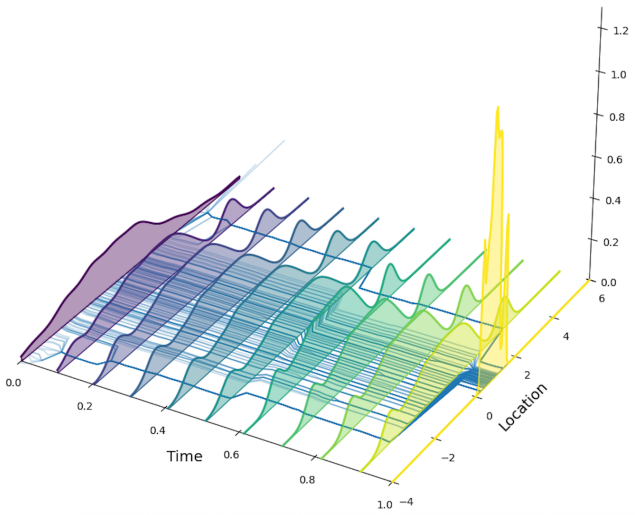
- [Appendix F] The reported experiments are qualitative visual comparisons only; no quantitative metric is given, such as MMD, KL divergence, effective sample size, acceptance rate, or a two-sample test. Figure 6, which is offered as evidence for Algorithm 3, is invalid because it uses the estimator from Lemma 3, which is constant in expectation. The Algorithm 1 experiments show plausible path ensembles, but they do not quantify the accumulated regression residual or compare against any baseline. The experimental section therefore does not compensate for the theoretical gaps identified above.
minor comments (4)
- [Abstract and §1] The phrase 'without access to data' is potentially misleading: the method does use the observations y_k. What is meant is that no complete observed trajectory samples are required. This should be stated precisely.
- [Lemma 1 and Appendix A] The symbol T is used both for the terminal time and for the index set of time grid points in the phrase 'for each t in [T]'. This should be disambiguated to avoid confusion.
- [Eq. (4)] The Dirac comb sum in J(x;y) has units of inverse time, and the associated J_t(x_t) terms in later equations do not explicitly carry the same normalization. A brief statement about units would improve readability.
- [Appendix F.2] The report of the perturbation variance as sigma^2 = 0.4^2 with m = 30 is given without any sensitivity analysis; given that Lemma 3 is the basis of the method, a sensitivity study of sigma and m would be needed even after the estimator is corrected.
Circularity Check
No significant circularity: the derivation chain is self-contained and the main guarantees are conditional consistency equations, not relabeled fits.
full rationale
The paper's central construction (Section 3) defines an annealing family π_s and a family of SDEs ρ_s, then imposes the consistency condition ∂log ρ_s/∂s = ∂log π_s/∂s (Eq. 10). This is a fixed-point equation for the drift update ∂b_s/∂s; if solved exactly, ρ_s=π_s follows from the common initial condition. The claim that the algorithm 'exactly hits the target at s=1' is explicitly conditional on solving Eq. (10), so no fitted quantity is relabeled as a prediction. The target posterior Q is fixed by the user-chosen prior and Gaussian likelihood (Eqs. (3)-(4)), and the algorithms minimize or regress toward that target; the loss functions are not derived from the output statistics they are claimed to predict. Section 4's variational reformulation (12)-(16) is a standard KL/Wasserstein reduction, and the later JKO, push-forward, and particle schemes are presented as approximations with stated error terms (e.g., o(h^2)), not as exact consequences of a self-citing uniqueness theorem. The paper contains no self-citations by the present authors; [24] and [28] are external algorithmic templates, not load-bearing uniqueness arguments. The skeptical note about Lemma 3's estimator (its expectation being d/(2σ²) independent of q_t) is a mathematical-correctness or estimator-bias concern, not a circularity: the estimator is asserted to approximate R(q_t), but if it fails to do so that is an approximation error, not an equivalence-by-definition between input and output. Overall, no circular step was found.
Assumptions & free parameters
free parameters (5)
- Bandwidth sigma in Fisher-information estimator =
0.4 in experiments
- JKO stepsize h =
0.2 in experiments
- Annealing stepsize delta_s =
0.1 in experiments
- Perturbation count m for FI estimator =
30 in experiments
- NN architecture and training steps =
MLP with two hidden layers of 20 and 30; 200-1000 ADAM steps
assumptions (5)
- domain assumption The posterior path measure has density Q ∝ ρ_0 exp(-I - J) w.r.t. the reference (Eq. 3)
- domain assumption The path measures π_s and ρ_s are mutually absolutely continuous and differentiable in s so that Eq. (9)-(10) hold
- ad hoc to paper The estimator in Lemma 3 and the kernelized gradient (42) approximate the Fisher information and its variation accurately at finite sigma and m
- ad hoc to paper The input-convex neural network can represent the optimal transport map ∇φ in Algorithm 3
- domain assumption The reference process P_ref in Section 4 is in equilibrium and its score ∇log P_ref is known or learnable
Cite this review
Pith. "Pith review of Machine-Learned Sampling of Conditioned Path Measures." pith.science (2026). https://pith.science/paper/V73NZBPP
@misc{pith2026250601904,
  author       = {Pith},
  title        = {Pith review of: Machine-Learned Sampling of Conditioned Path Measures},
  year         = {2026},
  howpublished = {\url{https://pith.science/paper/V73NZBPP}},
  note         = {Machine review of arXiv:2506.01904}
}
abstract
We propose algorithms for sampling from posterior path measures $P(C([0, T], \mathbb{R}^d))$ under a general prior process. This leverages ideas from (1) controlled equilibrium dynamics, which gradually transport between two path measures, and (2) optimization in $\infty$-dimensional probability space endowed with a Wasserstein metric, which can be used to evolve a density curve under the specified likelihood. The resulting algorithms are theoretically grounded and can be integrated seamlessly with neural networks for learning the target trajectory ensembles, without access to data.
Figures


Figures from the paper (3 more)


Reference graph
Works this paper leans on
-
[1]
NETS: A Non-Equilibrium Transport Sampler.arXiv preprint arXiv:2410.02711, 2024
Michael S Albergo and Eric Vanden-Eijnden. NETS: A Non-Equilibrium Transport Sampler.arXiv preprint arXiv:2410.02711, 2024
arXiv 2024
-
[2]
Input convex neural networks
Brandon Amos, Lei Xu, and J Zico Kolter. Input convex neural networks. InInternational conference on machine learning, pages 146–155. PMLR, 2017
2017
-
[3]
Amit Apte, Martin Hairer, AM Stuart, and Jochen Voss. Sampling the posterior: An approach to non-Gaussian data assimilation.Physica D: Nonlinear Phenomena, 230(1-2):50–64, 2007
work page 2007
-
[4]
Jean-David Benamou and Yann Brenier. A computational fluid mechanics solution to the Monge- Kantorovich mass transfer problem.Numerische Mathematik, 84(3):375–393, 2000
work page 2000
-
[5]
Jean-David Benamou, Guillaume Carlier, Simone Di Marino, and Luca Nenna. An entropy minimization approach to second-order variational mean-field games.Mathematical Models and Methods in Applied Sciences, 29(08):1553–1583, 2019
work page 2019
-
[6]
Jean-David Benamou, Guillaume Carlier, and Maxime Laborde. An augmented Lagrangian approach to Wasserstein gradient flows and applications.ESAIM: Proceedings and surveys, 54:1–17, 2016
work page 2016
-
[7]
MCMC methods for diffusion bridges.Stochastics and Dynamics, 8(03):319–350, 2008
Alexandros Beskos, Gareth Roberts, Andrew Stuart, and Jochen Voss. MCMC methods for diffusion bridges.Stochastics and Dynamics, 8(03):319–350, 2008
work page 2008
-
[8]
Peter G Bolhuis and David WH Swenson. Transition path sampling as Markov chain Monte Carlo of trajectories: Recent algorithms, software, applications, and future outlook.Advanced Theory and Simulations, 4(4):2000237, 2021
work page 2021
Show all 36 references
-
[9]
Proximal optimal trans- port modeling of population dynamics
Charlotte Bunne, Laetitia Papaxanthos, Andreas Krause, and Marco Cuturi. Proximal optimal trans- port modeling of population dynamics. InInternational Conference on Artificial Intelligence and Statis- tics, pages 6511–6528. PMLR, 2022
2022
-
[10]
Wasserstein gradient flow of the Fisher information from a non-smooth convex minimization viewpoint.Journal of Convex Analysis, 2024
Guillaume Carlier, Jean-David Benamou, and Daniel Matthes. Wasserstein gradient flow of the Fisher information from a non-smooth convex minimization viewpoint.Journal of Convex Analysis, 2024
2024
-
[11]
Numer- ical study of a particle method for gradient flows.arXiv preprint arXiv:1512.03029, 2015
José Antonio Carrillo, Yanghong Huang, Francesco Saverio Patacchini, and Gershon Wolansky. Numer- ical study of a particle method for gradient flows.arXiv preprint arXiv:1512.03029, 2015
2015 arXiv
-
[12]
Stochastic control liaisons: Richard sinkhorn meets gaspard monge on a schrodinger bridge.Siam Review, 63(2):249–313, 2021
Yongxin Chen, Tryphon T Georgiou, and Michele Pavon. Stochastic control liaisons: Richard sinkhorn meets gaspard monge on a schrodinger bridge.Siam Review, 63(2):249–313, 2021
2021
-
[13]
Trajectory inference via mean-field langevin in path space.Advances in Neural Information Processing Systems, 35:16731–16742, 2022
Lénaïc Chizat, Stephen Zhang, Matthieu Heitz, and Geoffrey Schiebinger. Trajectory inference via mean-field langevin in path space.Advances in Neural Information Processing Systems, 35:16731–16742, 2022
2022
-
[14]
A formula for the time derivative of the entropic cost and applications.Journal of Functional Analysis, 280(11):108964, 2021
Giovanni Conforti and Luca Tamanini. A formula for the time derivative of the entropic cost and applications.Journal of Functional Analysis, 280(11):108964, 2021
2021
-
[15]
Doob’sLagrangian: ASample-EfficientVariationalApproachtoTransition Path Sampling.arXiv preprint arXiv:2410.07974, 2024
Yuanqi Du, Michael Plainer, Rob Brekelmans, Chenru Duan, Frank Noe, Carla P Gomes, Alan Apsuru- Guzik, andKirillNeklyudov. Doob’sLagrangian: ASample-EfficientVariationalApproachtoTransition Path Sampling.arXiv preprint arXiv:2410.07974, 2024
-
[16]
About the analogy between optimal transport and minimal entropy.Annales de la Faculté des sciences de Toulouse: Mathématiques, 26(3):569–600, 2017
Ivan Gentil, Christian Léonard, and Luigia Ripani. About the analogy between optimal transport and minimal entropy.Annales de la Faculté des sciences de Toulouse: Mathématiques, 26(3):569–600, 2017
2017
-
[17]
The Wasserstein gradient flow of the Fisher information and the quantum drift-diffusion equation.Archive for rational mechanics and analysis, 194(1):133–220, 2009
Ugo Gianazza, Giuseppe Savaré, and Giuseppe Toscani. The Wasserstein gradient flow of the Fisher information and the quantum drift-diffusion equation.Archive for rational mechanics and analysis, 194(1):133–220, 2009
2009
-
[18]
Simulating diffusion bridges with score matching.arXiv preprint arXiv:2111.07243, 2021
Jeremy Heng, Valentin De Bortoli, Arnaud Doucet, and James Thornton. Simulating diffusion bridges with score matching.arXiv preprint arXiv:2111.07243, 2021. 11
2021 arXiv
-
[19]
Stochastic optimal control for collective variable free sampling of molecular transition paths.Advances in Neural Information Processing Systems, 36, 2024
Lars Holdijk, Yuanqi Du, Ferry Hooft, Priyank Jaini, Berend Ensing, and Max Welling. Stochastic optimal control for collective variable free sampling of molecular transition paths.Advances in Neural Information Processing Systems, 36, 2024
2024
-
[20]
Scalable gradients for stochastic differential equations
Xuechen Li, Ting-Kam Leonard Wong, Ricky TQ Chen, and David Duvenaud. Scalable gradients for stochastic differential equations. InInternational Conference on Artificial Intelligence and Statistics, pages 3870–3882. PMLR, 2020
2020
-
[21]
Stein variational gradient descent as gradient flow.Advances in neural information processing systems, 30, 2017
Qiang Liu. Stein variational gradient descent as gradient flow.Advances in neural information processing systems, 30, 2017
2017
-
[22]
Action matching: Learning stochastic dynamics from samples
Kirill Neklyudov, Rob Brekelmans, Daniel Severo, and Alireza Makhzani. Action matching: Learning stochastic dynamics from samples. InInternational conference on machine learning, pages 25858–25889. PMLR, 2023
2023
-
[23]
A computational framework for solving Wasserstein Lagrangian flows.arXiv preprint arXiv:2310.10649, 2023
Kirill Neklyudov, Rob Brekelmans, Alexander Tong, Lazar Atanackovic, Qiang Liu, and Alireza Makhzani. A computational framework for solving Wasserstein Lagrangian flows.arXiv preprint arXiv:2310.10649, 2023
2023 arXiv
-
[24]
Stein transport for Bayesian inference.arXiv preprint arXiv:2409.01464, 2024
Nikolas Nüsken. Stein transport for Bayesian inference.arXiv preprint arXiv:2409.01464, 2024
2024 arXiv
-
[25]
Variational inference for stochastic differential equations.Annalen der Physik, 531(3):1800233, 2019
Manfred Opper. Variational inference for stochastic differential equations.Annalen der Physik, 531(3):1800233, 2019
2019
-
[26]
Diffusion bridge mixture transports, Schrödinger bridge problems and generative modeling.Journal of Machine Learning Research, 24(374):1–51, 2023
Stefano Peluchetti. Diffusion bridge mixture transports, Schrödinger bridge problems and generative modeling.Journal of Machine Learning Research, 24(374):1–51, 2023
2023
-
[27]
Entropic approximation of Wasserstein gradient flows.SIAM Journal on Imaging Sci- ences, 8(4):2323–2351, 2015
Gabriel Peyré. Entropic approximation of Wasserstein gradient flows.SIAM Journal on Imaging Sci- ences, 8(4):2323–2351, 2015
2015
-
[28]
Conditioning Diffusions Using Malliavin Calculus.arXiv preprint arXiv:2504.03461, 2025
Jakiw Pidstrigach, Elizabeth Baker, Carles Domingo-Enrich, George Deligiannidis, and Nikolas Nüsken. Conditioning Diffusions Using Malliavin Calculus.arXiv preprint arXiv:2504.03461, 2025
2025 arXiv
-
[29]
A variational approach to sampling in diffusion processes.arXiv preprint arXiv:2405.00126, 2024
Maxim Raginsky. A variational approach to sampling in diffusion processes.arXiv preprint arXiv:2405.00126, 2024
2024 arXiv
-
[30]
Path sampling with stochastic dynamics: Some new algorithms.Journal of Computa- tional Physics, 225(1):491–508, 2007
Gabriel Stoltz. Path sampling with stochastic dynamics: Some new algorithms.Journal of Computa- tional Physics, 225(1):491–508, 2007
2007
-
[31]
World Scientific, 2010
Gabriel Stoltz, Mathias Rousset, et al.Free energy computations: A mathematical perspective. World Scientific, 2010
2010
-
[32]
Conditional path sampling of SDEs and the Langevin MCMC method.Communications in Mathematical Sciences, 2004
Andrew M Stuart, Jochen Voss, and Petter Wilberg. Conditional path sampling of SDEs and the Langevin MCMC method.Communications in Mathematical Sciences, 2004
2004
-
[33]
A variational approach to path estimation and parameter inference of hidden diffusion processes.Journal of Machine Learning Research, 17(190):1–37, 2016
Tobias Sutter, Arnab Ganguly, and Heinz Koeppl. A variational approach to path estimation and parameter inference of hidden diffusion processes.Journal of Machine Learning Research, 17(190):1–37, 2016
2016
-
[34]
Improving and generalizing flow-based generative models with minibatch optimal transport.arXiv preprint arXiv:2302.00482, 2023
Alexander Tong, Kilian Fatras, Nikolay Malkin, Guillaume Huguet, Yanlei Zhang, Jarrid Rector-Brooks, Guy Wolf, and Yoshua Bengio. Improving and generalizing flow-based generative models with minibatch optimal transport.arXiv preprint arXiv:2302.00482, 2023
2023 arXiv
-
[35]
∇ ·(πs(x)vs(x)) ! =π s(x) J(x)−E πs(x)[J(x)] =∂ sπs
Luke Triplett and Jianfeng Lu. Diffusion methods for generating transition paths.Journal of Compu- tational Physics, 522:113590, 2025. 12 A Additional Details for Section 3 We begin with a remark on the choice of the annealing path. Remark 3.In the special case of TPS withX0 =...
2025
-
[36]
with pathx(t, s)for(s, t)∈(0,∞)×[0, T]) 1:Input:Initial Brownian bridge pathx(t,0)∈R d×T /δt ∼π 0 withx(0,0) =A, x(T,0) =B, poten- tial/reference drift−∇V, ensemble sizeK, anneal stepsizeδ s, physical time stepsizeδt 2:SetA 0 = 0 3:fors= 0tos= 1do 4:Set the current potential t...
Reviewed August 7, 2026 · model on record in the stance chip above.
Discussion (0). Sign in to comment.