REVIEW 1 major objections 1 minor 1 cited by
Shedding Stray Light on Decaying Light Dark Matter: Constraints from NuSTAR X-ray Observations
T0 review · 1 major / 1 minor · reviewed 2026-06-28 · grok-4.3
Pith's one-line read NuSTAR stray-light data yields the strongest indirect bounds on light dark matter decaying into photons for masses between 6 and 70 keV.
desk verdict NuSTAR stray-light data yields new lifetime upper limits on light decaying DM for a handful of models, but the background handling needs explicit checks to back the 'strongest bound' claims. read the letter →
The pith
A machine-rendered reading of the paper's core claim, the machinery that carries it, and where it could break.
The reading
What carries the argument
Comparison of the observed NuSTAR stray-light spectrum against the expected photon flux from dark-matter decay in the galactic halo.
What would settle it
A re-reduction of the NuSTAR stray-light dataset that isolates and subtracts a background component whose energy spectrum matches the shape predicted for the dark-matter signal would remove or substantially weaken the reported bounds.
Extended reading notes
Core claim
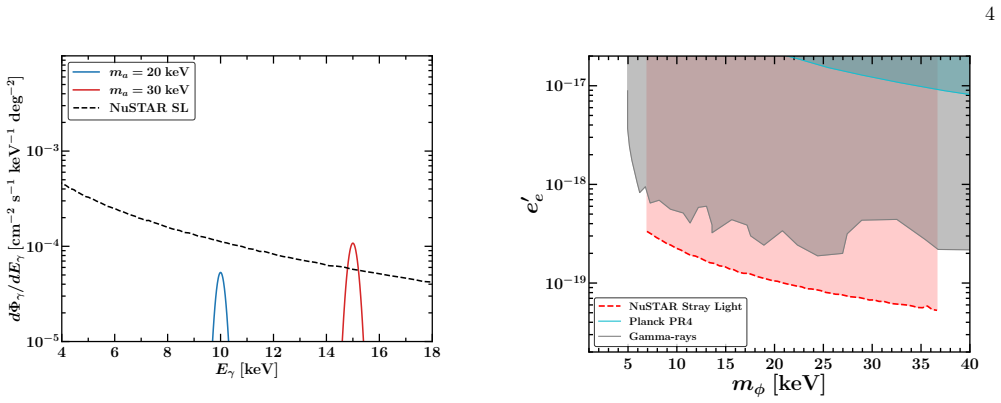
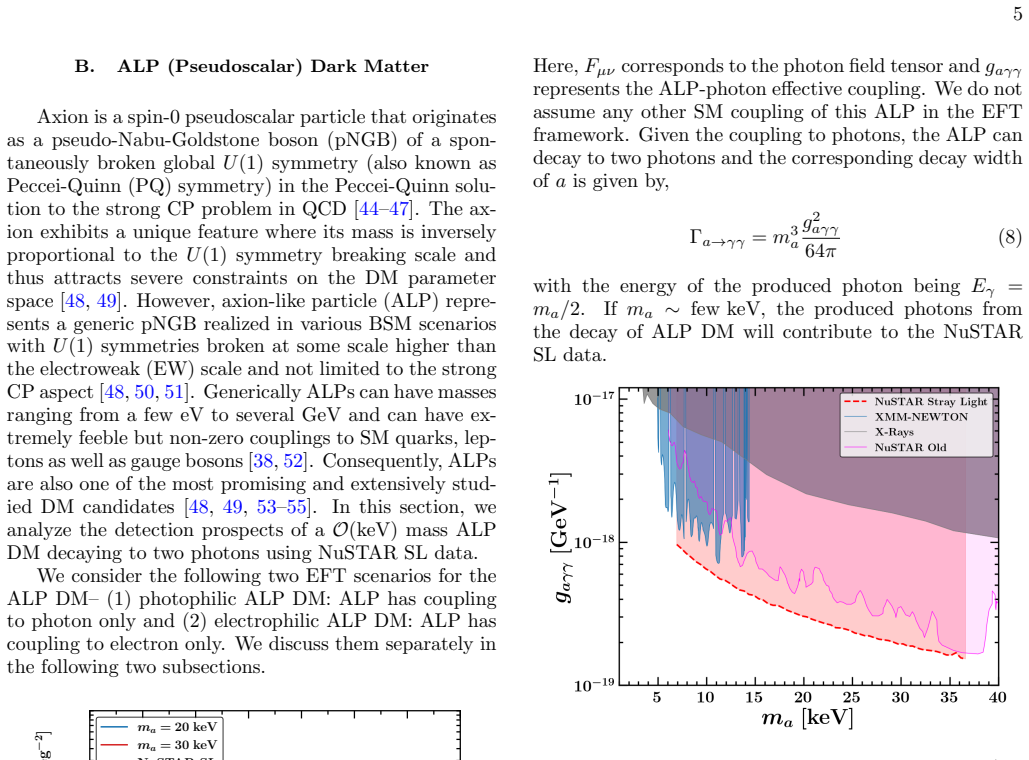
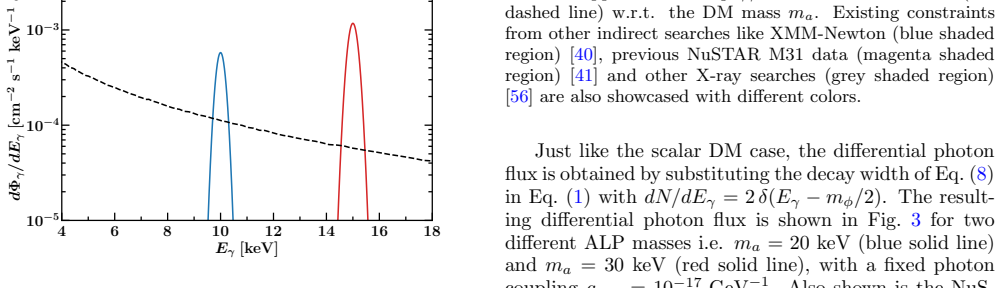
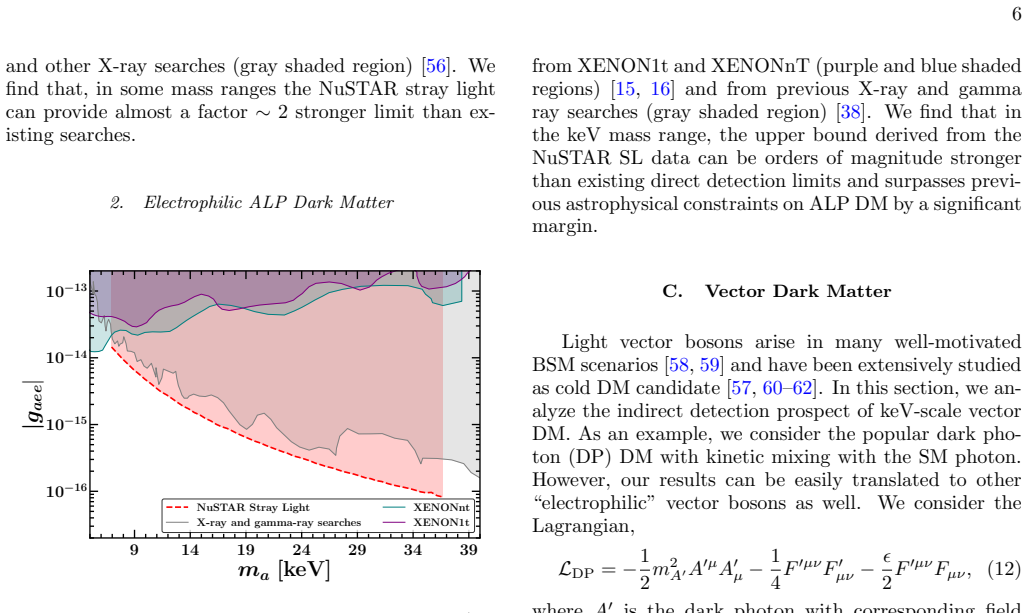
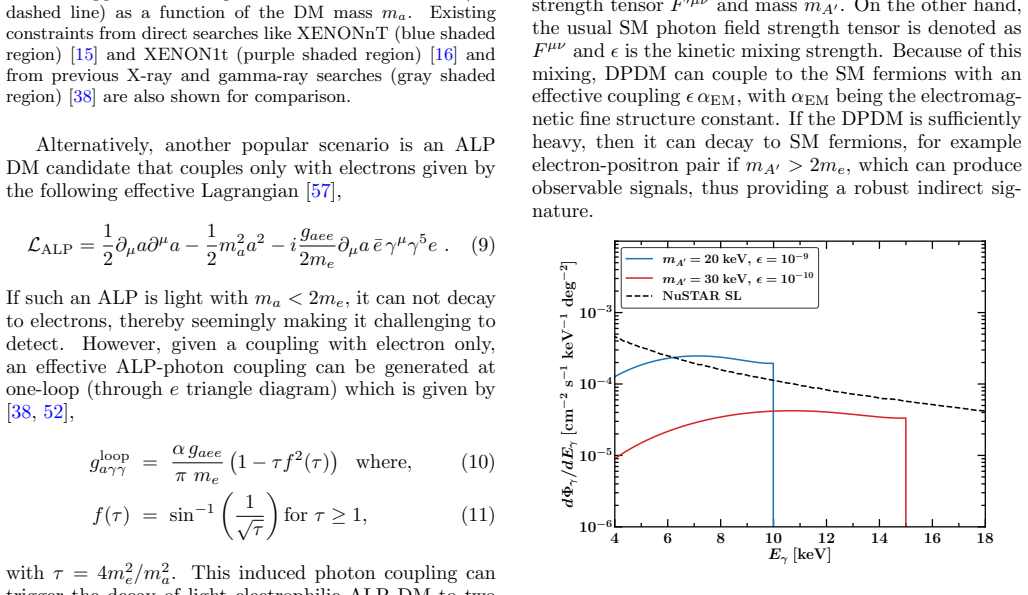
NuSTAR stray-light measurements of diffuse X-ray photons can be compared directly with the predicted photon spectra from galactic-halo decays of electrophilic scalar dark matter, photophilic and electrophilic axion-like particles, and dark-photon dark matter; the resulting comparison produces the strongest existing indirect-detection upper limits on the lifetime in the quoted mass intervals, and likewise the strongest lifetime bounds for inelastic dark matter with the stated mass splittings.
Load-bearing premise
The stray-light spectrum is assumed to contain no unmodeled astrophysical or instrumental backgrounds whose shape could mimic or hide a dark-matter decay signal.
Editorial extensions
If this is right
- Two-photon decay models are excluded for lifetimes shorter than the NuSTAR-derived values across 6-36 keV.
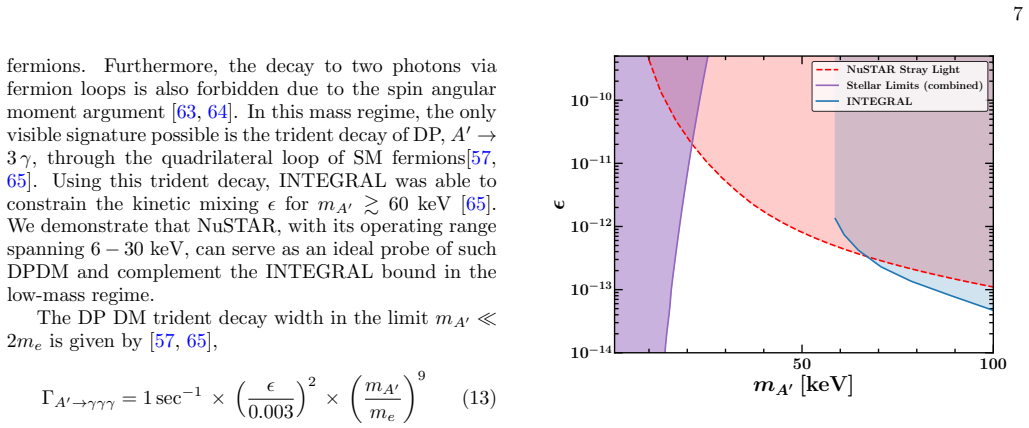
- Dark-photon models face their strongest lifetime constraint from these data in the 20-70 keV window.
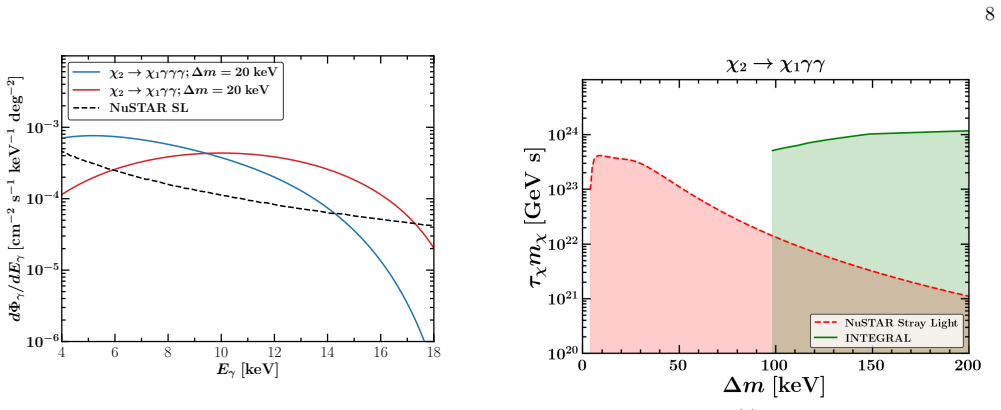
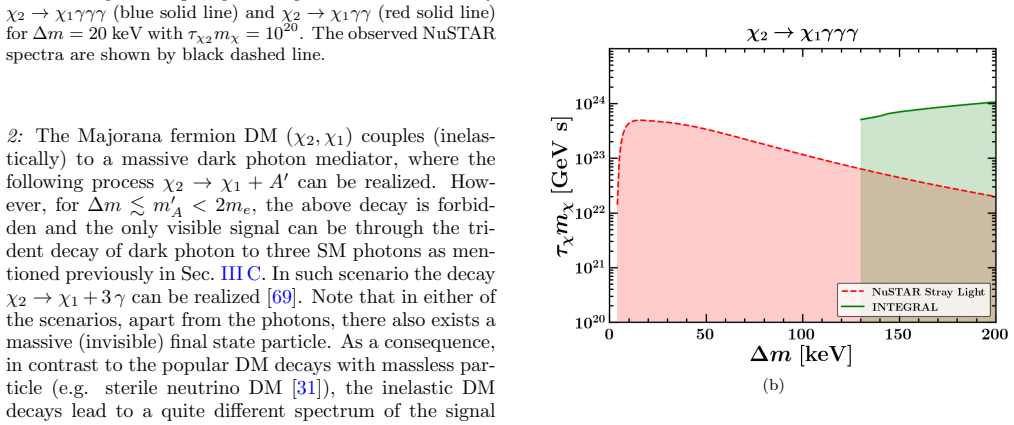
- Inelastic dark-matter models with mass splittings 3-100 keV receive the most stringent lifetime upper limits yet reported.
- X-ray stray-light observations become a competitive channel for light dark-matter searches where other indirect methods are threshold-limited.
Reading between the lines
- Future X-ray telescopes with lower backgrounds could extend the same method to still lighter masses or detect a signal.
- The approach could be applied to archival data from other X-ray instruments to cross-check the NuSTAR limits.
- If the bounds are confirmed, they would narrow the viable parameter space for light dark matter explanations of other anomalies.
- The technique highlights the value of using off-axis or stray-light data for diffuse searches that targeted observations miss.
Signed reviews
Editorial analysis
A structured set of objections, weighed in public.
Referee Report
Summary. The manuscript claims that NuSTAR stray-light (SL) X-ray data can be used to derive competitive indirect-detection constraints on light decaying DM, specifically electrophilic scalar DM, electrophilic/photophilic ALP DM, and dark-photon (vector) DM. For two-photon monochromatic signals the SL data are said to yield the strongest bounds in the ~6-36 keV mass window; for the continuous three-photon spectrum of dark-photon DM the strongest bounds are reported in ~20-70 keV. Additional limits are presented for inelastic DM decays (two- or three-photon final states plus a lighter dark-sector particle) for mass splittings 3-100 keV, obtained by direct comparison of the predicted photon spectra to the published NuSTAR SL counts.
Significance. If the background modeling and spectral comparison are robust, the work would supply new leading constraints on light DM decays in a mass range that is otherwise difficult to probe, thereby strengthening the indirect-detection landscape and demonstrating the scientific value of repurposing NuSTAR SL observations.
major comments (1)
- [§3, §4] §3 and the likelihood construction in §4: the lifetime limits are obtained by comparing predicted DM photon spectra directly to the published SL counts without explicit nuisance-parameter marginalization over possible residual astrophysical or instrumental continuum/line components (e.g., cosmic-ray-induced fluorescence or off-axis CXB leakage). Because this assumption is load-bearing for the “strongest bound” ranking versus existing X-ray/gamma-ray limits, an O(1) shift in the derived limits would alter the headline claims.
minor comments (1)
- [Abstract] Abstract: the statement that bounds are obtained “by comparing continuous photon spectra to data” would be clearer if it briefly indicated the treatment of statistical and systematic uncertainties or the precise exclusion criterion employed.
Simulated Author's Rebuttal
We thank the referee for their thorough review and valuable feedback on our manuscript. We address the major comment point by point below.
read point-by-point responses
-
Referee: [§3, §4] §3 and the likelihood construction in §4: the lifetime limits are obtained by comparing predicted DM photon spectra directly to the published SL counts without explicit nuisance-parameter marginalization over possible residual astrophysical or instrumental continuum/line components (e.g., cosmic-ray-induced fluorescence or off-axis CXB leakage). Because this assumption is load-bearing for the “strongest bound” ranking versus existing X-ray/gamma-ray limits, an O(1) shift in the derived limits would alter the headline claims.
Authors: We agree that a more detailed treatment of background uncertainties would strengthen the analysis. Our current approach uses the published SL counts directly, which is a conservative method as it attributes all counts to potential DM signal without subtracting backgrounds. This makes our derived limits weaker than they would be with background subtraction, yet they still rank as the strongest in the specified ranges. The original NuSTAR SL publications describe the data reduction and background handling. To address the referee's concern, we will revise the manuscript to include an explicit discussion in Section 4 on potential residual components and their impact, along with a sensitivity analysis showing that O(1) variations do not change the headline conclusions. We will also clarify the likelihood construction to note the conservative nature of the direct comparison. revision: partial
Circularity Check
No circularity; bounds derived from external NuSTAR data comparison
full rationale
The paper's central results consist of upper limits on DM lifetimes obtained by comparing predicted decay spectra (monochromatic two-photon or continuous three-photon) directly to published NuSTAR stray-light count data. No step fits a parameter to a subset of the target data and then renames the fit as a prediction, no quantity is defined in terms of itself, and no load-bearing premise reduces to a self-citation chain. The derivation therefore remains self-contained against the external dataset and does not exhibit any of the enumerated circularity patterns.
Assumptions & free parameters
Cite this review
Pith. "Pith review of Shedding Stray Light on Decaying Light Dark Matter: Constraints from NuSTAR X-ray Observations." pith.science (2026). https://pith.science/paper/V74YIICH
@misc{pith2026260603396,
  author       = {Pith},
  title        = {Pith review of: Shedding Stray Light on Decaying Light Dark Matter: Constraints from NuSTAR X-ray Observations},
  year         = {2026},
  howpublished = {\url{https://pith.science/paper/V74YIICH}},
  note         = {Machine review of arXiv:2606.03396}
}
abstract
Light dark matter (DM) (mass $\lesssim \mathcal{O}(100)$ keV) remains challenging to detect in several ongoing indirect detection experiments due to threshold limitations. Recent observations of diffuse X-ray photons from the NuSTAR stray-light (SL) data provide a powerful avenue to probe such light DM through its decay signatures in the galactic halo. This work explores the indirect detection prospects of decaying electrophilic scalar DM, electrophilic and photophilic ALP DM, and dark photon DM using the recent NuSTAR SL data. We find that for DM scenarios producing monochromatic two-photon signals, NuSTAR SL data can yield the strongest indirect detection bound in the $7-36$ keV mass range. In contrast, for dark photon (vector) DM featuring a continuous three-photon spectrum, the strongest indirect detection upper bound arises in the $ 22-65$ keV mass range. Additionally, we discuss the detection prospects of inelastic DM where the heavier DM decays to a two or three-photon final state along with a massive lighter dark sector particle. By comparing the resulting continuous photon spectra with the NuSTAR SL data, we obtain the most stringent lower bound on the lifetime of such DM for the mass splitting $\Delta m$ in the range $3 ~{\rm keV}- 100$ keV.
Figures
Figures from the paper (5 more)
Forward citations
Cited by 1 Pith paper
-
Dark Photons from Perturbative Decay of a Misaligned Higgs Field
Stochastically misaligned dark Higgs decay into dark photons can make all the dark matter for m_A′ ≈ 100 eV–1 GeV and g ≈ 10^-15–10^-10, shrinking to 10 keV–1 MeV with one-loop kinetic mixing.
Reviewed June 28, 2026 · model on record in the stance chip above.
Discussion (0). Continue with ORCID to comment.