Probing Hernquist dark matter through the optical appearance of black holes: A comprehensive study of various accretions
Pith reviewed 2026-05-21 22:32 UTC · model grok-4.3
The pith
Hernquist dark matter enlarges the photon sphere around black holes, producing a critical curve 2 to 30 percent larger than in empty space.
A machine-rendered reading of the paper's core claim, the machinery that carries it, and where it could break.
Core claim
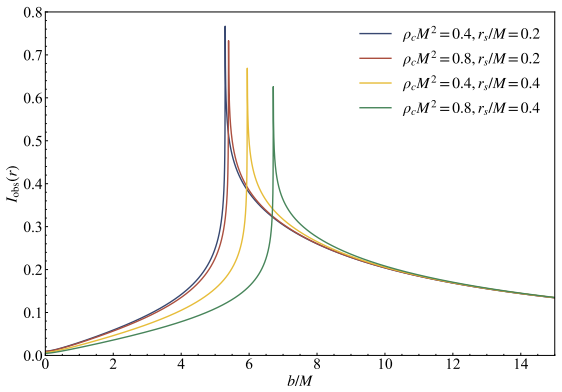
The Hernquist dark matter halo significantly enlarges the photon sphere of a Schwarzschild black hole. This enlargement leads to an observable critical curve radius approximately 2% to 30% larger than in the vacuum case. The intensity profiles exhibit general brightness suppression, especially pronounced under Doppler de-boosting in the infalling spherical flow. The size of the central brightness depression and the brightness profile thereby furnish a theoretical framework for constraining dark matter distributions in galactic centers.
What carries the argument
The spacetime metric modified by the Hernquist dark matter density profile, together with ray-tracing calculations performed for three accretion models: geometrically thin disk, static spherical flow, and infalling spherical flow.
If this is right
- The critical curve radius and photon ring size become direct observables sensitive to the dark matter halo parameters.
- Brightness profiles show model-dependent suppression, strongest in the infalling spherical case due to Doppler effects.
- The central brightness depression size varies systematically with the dark matter distribution and can be compared to vacuum predictions.
- These image features supply a framework for placing constraints on dark matter near supermassive black holes using existing and future telescope data.
Where Pith is reading between the lines
- If the predicted enlargement is detected, the same ray-tracing approach could be applied to other density profiles to differentiate them observationally.
- Linking to stellar dynamics or weak lensing around the same galaxies would allow cross-checks on the assumed dark matter distribution at small radii.
- Numerical images generated for specific galaxies such as M87 or the Milky Way center could yield quantitative predictions testable against current Event Horizon Telescope results.
Load-bearing premise
The Hernquist density profile accurately describes the dark matter very close to the black hole without significant back-reaction on the metric or accretion flow, and the three chosen accretion models capture the dominant radiative effects.
What would settle it
A high-precision measurement of the critical curve radius or shadow size for a galactic-center black hole that matches the pure vacuum Schwarzschild prediction within 1% would directly contradict the predicted 2-30% enlargement.
Figures




read the original abstract
The observational appearance of a black hole is critically dependent on the surrounding accreting matter, in particular on the central brightness depression and photon ring structure. We perform a systematic comparative analysis of the observational signatures of a Schwarzschild black hole embedded in a Hernquist dark matter (DM) halo under three distinct accretion scenarios: a geometrically thin disk, a static spherical flow, and an infalling spherical flow. For the thin disk model, we find that direct emission dominates the total observed intensity, while the size and brightness of the lensing and photon rings serve as sensitive probes of the Hernquist DM parameters. From a geometric perspective, the Hernquist DM halo significantly enlarges the photon sphere, resulting in an observable critical curve radius approximately $2\%$ to $30\%$ larger than in the vacuum case. Regarding the radiative signatures, the measured intensity profiles, which rely on the particular accretion models, show a general brightness suppression, which is especially affected by the Doppler de-boosting in the infalling scenario. Our results suggest that the size of the central brightness depression and the brightness profile of the black hole image provide a valuable theoretical framework for constraining the distribution of dark matter in galactic centers.
Editorial analysis
A structured set of objections, weighed in public.
Referee Report
Summary. The manuscript performs a comparative study of the observational appearance of a Schwarzschild black hole embedded in a Hernquist dark matter halo under three accretion scenarios (geometrically thin disk, static spherical flow, and infalling spherical flow). It claims that the Hernquist halo enlarges the photon sphere, producing an observable critical curve radius 2%–30% larger than the vacuum case, and that the resulting intensity profiles exhibit general brightness suppression (most pronounced via Doppler de-boosting in the infalling model), thereby providing a theoretical framework for constraining dark matter distributions near galactic centers.
Significance. If the numerical results hold, the work supplies a concrete theoretical framework linking black-hole image observables (critical curve size and central brightness depression) to Hernquist halo parameters, which could be relevant for interpreting EHT-style observations of galactic-center black holes. The geometric enlargement of the photon sphere follows directly from inserting the enclosed-mass function into the metric and solving the null circular orbit condition; this part is internally consistent under the stated assumptions. The radiative signatures are explicitly conditioned on the three chosen accretion flows, so model dependence is flagged rather than concealed.
major comments (2)
- [Methods (ray-tracing and accretion models)] Methods section on ray-tracing and intensity calculation: the emissivity profiles, specific intensity integration along geodesics, and numerical implementation for the three accretion models are only summarized. Full specification (including any analytic expressions for the emissivity and convergence/error estimates) is required to substantiate the reported brightness suppression and the statement that direct emission dominates in the thin-disk case.
- [Results (critical curve / photon sphere)] Results on critical curve enlargement: the quoted 2%–30% range for the critical impact parameter is presented without an accompanying table or plot that maps the interval to specific values of the Hernquist scale radius a and central density; because the enlargement is a direct function of these parameters, the range should be derived explicitly from the modified metric function f(r) = 1 – 2M(r)/r.
minor comments (2)
- [Abstract] Abstract: the phrase 'the size of the central brightness depression and brightness profile provide a valuable theoretical framework' could be sharpened by identifying which single observable (e.g., depression radius or ring brightness contrast) is most sensitive to the Hernquist parameters.
- [Throughout] Notation: ensure that the Hernquist parameters (scale radius and central density) are denoted consistently between the metric definition, the enclosed-mass function, and all figures.
Simulated Author's Rebuttal
We thank the referee for their constructive and detailed report. We address each major comment point by point below and will revise the manuscript accordingly to improve clarity and reproducibility.
read point-by-point responses
-
Referee: Methods section on ray-tracing and intensity calculation: the emissivity profiles, specific intensity integration along geodesics, and numerical implementation for the three accretion models are only summarized. Full specification (including any analytic expressions for the emissivity and convergence/error estimates) is required to substantiate the reported brightness suppression and the statement that direct emission dominates in the thin-disk case.
Authors: We agree that the current Methods section summarizes rather than fully specifies the numerical procedures. In the revised manuscript we will expand this section to provide the explicit analytic forms of the emissivity profiles for the thin-disk, static spherical, and infalling spherical models, the precise line-integral expression for specific intensity along geodesics, and a description of the ray-tracing code including step-size control, convergence tests, and estimated numerical errors. These additions will directly support the reported brightness suppression and the dominance of direct emission in the thin-disk case. revision: yes
-
Referee: Results on critical curve enlargement: the quoted 2%–30% range for the critical impact parameter is presented without an accompanying table or plot that maps the interval to specific values of the Hernquist scale radius a and central density; because the enlargement is a direct function of these parameters, the range should be derived explicitly from the modified metric function f(r) = 1 – 2M(r)/r.
Authors: The referee correctly notes that the 2%–30% range is stated without an explicit parameter mapping. This range is obtained by inserting the Hernquist enclosed-mass function into the metric coefficient f(r) = 1 – 2M(r)/r and solving the null circular-orbit condition for representative galactic-center values of the scale radius a and central density. In the revision we will add both a table listing selected (a, density) pairs with the corresponding critical impact parameters and a figure showing the continuous dependence on these parameters, thereby making the derivation fully explicit. revision: yes
Circularity Check
No significant circularity; derivation is direct metric calculation
full rationale
The paper's central geometric result follows from substituting the Hernquist enclosed-mass function directly into the Schwarzschild-like metric function and solving the standard null circular orbit condition; the quoted 2-30% enlargement of the critical curve is a parameter-dependent output of that substitution with M_DM and a as external inputs. Radiative signatures are explicitly conditioned on the three chosen accretion models rather than derived as predictions from fitted quantities. No self-citations, ansatzes, or uniqueness theorems are invoked as load-bearing steps in the provided derivation chain, and the analysis remains self-contained against the stated assumptions without reducing any claim to its own inputs by construction.
Axiom & Free-Parameter Ledger
free parameters (1)
- Hernquist scale radius and central density
axioms (2)
- domain assumption The spacetime is described by a Schwarzschild metric with an added Hernquist dark matter halo contribution to the gravitational potential.
- domain assumption Accretion flows can be modeled as geometrically thin disk, static spherical, or infalling spherical without magnetic fields or outflows.
Lean theorems connected to this paper
-
IndisputableMonolith/Foundation/RealityFromDistinction.leanreality_from_one_distinction unclear?
unclearRelation between the paper passage and the cited Recognition theorem.
f(r) = 1 - 2M/r - 4πρ_c r_s³/(r + r_s); photon-sphere conditions V_ph = 1/b² and dV_ph/dr = 0; numerical results in Table I showing 2–30 % enlargement of b_p
-
IndisputableMonolith/Foundation/AlphaCoordinateFixation.leanJ_uniquely_calibrated_via_higher_derivative unclear?
unclearRelation between the paper passage and the cited Recognition theorem.
Effective potential V_ph and ray-tracing for thin-disk and spherical accretion models
What do these tags mean?
- matches
- The paper's claim is directly supported by a theorem in the formal canon.
- supports
- The theorem supports part of the paper's argument, but the paper may add assumptions or extra steps.
- extends
- The paper goes beyond the formal theorem; the theorem is a base layer rather than the whole result.
- uses
- The paper appears to rely on the theorem as machinery.
- contradicts
- The paper's claim conflicts with a theorem or certificate in the canon.
- unclear
- Pith found a possible connection, but the passage is too broad, indirect, or ambiguous to say the theorem truly supports the claim.
Reference graph
Works this paper leans on
-
[1]
T. E. H. T. Collaboration, The Astrophysical Journal Letters875, L1 (2019)
work page 2019
-
[2]
T. E. H. T. Collaboration, The Astrophysical Journal Letters875, L2 (2019)
work page 2019
-
[3]
T. E. H. T. Collaboration, The Astrophysical Journal Letters875, L3 (2019)
work page 2019
-
[4]
T. E. H. T. Collaboration, The Astrophysical Journal Letters875, L4 (2019)
work page 2019
-
[5]
T. E. H. T. Collaboration, The Astrophysical Journal Letters875, L5 (2019)
work page 2019
-
[6]
T. E. H. T. Collaboration, The Astrophysical Journal Letters875, L6 (2019)
work page 2019
-
[7]
T. E. H. T. Collaboration, The Astrophysical Journal Letters910, L12 (2021)
work page 2021
-
[8]
T. E. H. T. Collaboration, The Astrophysical Journal Letters910, L13 (2021)
work page 2021
-
[9]
T. E. H. T. Collaboration, The Astrophysical Journal Letters957, L20 (2023)
work page 2023
-
[10]
A. Ghez, S. Salim, S. D. Hornstein, A. Tanner, J. Lu, M. Morris, E. Becklin, and G. Duchˆ ene, The Astrophysical Journal620, 744 (2005)
work page 2005
- [11]
-
[12]
K. Akiyama, A. Alberdi, W. Alef, J. C. Algaba, R. Anantua, K. Asada, R. Azulay, U. Bach, A.-K. Baczko, D. Ball, et al., The Astrophysical Journal Letters930, L12 (2022)
work page 2022
-
[13]
K. Akiyama, A. Alberdi, W. Alef, J. C. Algaba, R. Anantua, K. Asada, R. Azulay, U. Bach, A.-K. Baczko, D. Ball, et al., The Astrophysical Journal Letters930, L13 (2022)
work page 2022
-
[14]
K. Akiyama, A. Alberdi, W. Alef, J. C. Algaba, R. Anantua, K. Asada, R. Azulay, U. Bach, A.-K. Baczko, D. Ball, et al., The Astrophysical Journal Letters930, L14 (2022)
work page 2022
-
[15]
K. Akiyama, A. Alberdi, W. Alef, J. C. Algaba, R. Anantua, K. Asada, R. Azulay, U. Bach, A.-K. Baczko, D. Ball, et al., The Astrophysical Journal Letters930, L15 (2022)
work page 2022
-
[16]
K. Akiyama, A. Alberdi, W. Alef, J. C. Algaba, R. Anantua, K. Asada, R. Azulay, U. Bach, A.-K. Baczko, D. Ball, et al., The Astrophysical Journal Letters930, L16 (2022)
work page 2022
-
[17]
K. Akiyama, A. Alberdi, W. Alef, J. C. Algaba, R. Anantua, K. Asada, R. Azulay, U. Bach, A.-K. Baczko, D. Ball, et al., The Astrophysical Journal Letters930, L17 (2022)
work page 2022
-
[18]
K. Akiyama, A. Alberdi, W. Alef, J. C. Algaba, R. Anantua, K. Asada, R. Azulay, U. Bach, A.-K. Baczko, D. Ball, et al., The Astrophysical Journal Letters964, L25 (2024)
work page 2024
-
[19]
K. Akiyama, A. Alberdi, W. Alef, J. C. Algaba, R. Anantua, K. Asada, R. Azulay, U. Bach, A.-K. Baczko, D. Ball, et al., The Astrophysical Journal Letters964, L26 (2024). 26
work page 2024
-
[20]
S. W. Hawking, Communications in Mathematical Physics25, 152 (1972)
work page 1972
-
[21]
J. M. Bardeen, B. Carter, and S. W. Hawking, Communications in mathematical physics31, 161 (1973)
work page 1973
-
[22]
R. M. Wald,Quantum field theory in curved spacetime and black hole thermodynamics(Uni- versity of Chicago press, 1994)
work page 1994
-
[23]
R. M. Wald,General relativity(University of Chicago press, 2010)
work page 2010
- [24]
-
[25]
Synge, Monthly Notices of the Royal Astronomical Society131, 463 (1966)
J. Synge, Monthly Notices of the Royal Astronomical Society131, 463 (1966)
work page 1966
-
[26]
Luminet, Astronomy and Astrophysics, vol
J.-P. Luminet, Astronomy and Astrophysics, vol. 75, no. 1-2, May 1979, p. 228-235.75, 228 (1979)
work page 1979
-
[27]
J. M. Bardeen et al., Black holes (Les astres occlus) pp. 215–239 (1973)
work page 1973
-
[28]
Chandrasekhar,The mathematical theory of black holes, vol
S. Chandrasekhar,The mathematical theory of black holes, vol. 69 (Oxford university press, 1998)
work page 1998
-
[29]
L. Amarilla, E. F. Eiroa, and G. Giribet, Physical Review D—Particles, Fields, Gravitation, and Cosmology81, 124045 (2010)
work page 2010
-
[30]
L. Amarilla and E. F. Eiroa, Physical Review D—Particles, Fields, Gravitation, and Cosmol- ogy85, 064019 (2012)
work page 2012
-
[31]
M. Amir, B. P. Singh, and S. G. Ghosh, The European Physical Journal C78, 399 (2018)
work page 2018
- [32]
-
[33]
E. F. Eiroa and C. M. Sendra, The European Physical Journal C78, 91 (2018)
work page 2018
-
[34]
I. Banerjee, S. Chakraborty, and S. SenGupta, Physical Review D101, 041301 (2020)
work page 2020
- [35]
-
[36]
S. Vagnozzi, R. Roy, Y.-D. Tsai, L. Visinelli, M. Afrin, A. Allahyari, P. Bambhaniya, D. Dey, S. G. Ghosh, P. S. Joshi, et al., Classical and Quantum Gravity40, 165007 (2023)
work page 2023
-
[37]
M. Khodadi, S. Vagnozzi, and J. T. Firouzjaee, Scientific Reports14, 26932 (2024)
work page 2024
- [38]
-
[39]
M. Guerrero, G. J. Olmo, and D. Rubiera-Garcia, Journal of Cosmology and Astroparticle Physics2021, 066 (2021)
work page 2021
-
[40]
S. E. Gralla, D. E. Holz, and R. M. Wald, Physical Review D100, 024018 (2019)
work page 2019
-
[41]
N. Tsukamoto, Z. Li, and C. Bambi, Journal of Cosmology and Astroparticle Physics2014, 27 043 (2014)
work page 2014
-
[42]
Tsukamoto, Physical Review D97, 064021 (2018)
N. Tsukamoto, Physical Review D97, 064021 (2018)
work page 2018
-
[43]
X.-X. Zeng and H.-Q. Zhang, The European Physical Journal C80, 1058 (2020)
work page 2020
-
[44]
X.-X. Zeng, H.-Q. Zhang, and H. Zhang, The European Physical Journal C80, 872 (2020)
work page 2020
-
[45]
G.-P. Li and K.-J. He, Journal of Cosmology and Astroparticle Physics2021, 037 (2021)
work page 2021
-
[46]
K.-J. He, S. Guo, S.-C. Tan, and G.-P. Li, Chinese Physics C46, 085106 (2022)
work page 2022
-
[47]
J. Peng, M. Guo, and X.-H. Feng, Chinese Physics C45, 085103 (2021)
work page 2021
- [48]
-
[49]
X.-X. Zeng, L.-F. Li, P. Li, B. Liang, and P. Xu, Science China Physics, Mechanics & Astron- omy68, 220412 (2025)
work page 2025
- [50]
-
[51]
H. Davoudiasl and P. B. Denton, Physical review letters123, 021102 (2019)
work page 2019
- [52]
-
[53]
V. C. Rubin, W. K. Ford Jr, and N. Thonnard, Astrophysical Journal, Part 1, vol. 238, June 1, 1980, p. 471-487.238, 471 (1980)
work page 1980
- [54]
-
[55]
Sofue, inPlanets, Stars and Stellar Systems(Springer, 2013), pp
Y. Sofue, inPlanets, Stars and Stellar Systems(Springer, 2013), pp. 985–1037
work page 2013
-
[56]
K. Boshkayev and D. Malafarina, Monthly Notices of the Royal Astronomical Society484, 3325 (2019)
work page 2019
- [57]
- [58]
- [59]
-
[60]
X. Hou, Z. Xu, M. Zhou, and J. Wang, Journal of Cosmology and Astroparticle Physics2018, 015 (2018)
work page 2018
-
[61]
X. Liang, Y.-P. Hu, C.-H. Wu, and Y.-S. An, The European Physical Journal C83, 1009 (2023)
work page 2023
-
[62]
M. M. Gohain, P. Phukon, and K. Bhuyan, Physics of the Dark Universe46, 101683 (2024)
work page 2024
- [63]
-
[64]
S. K. Jha, Journal of Cosmology and Astroparticle Physics2025, 033 (2025). 28
work page 2025
-
[65]
Dehnen, Monthly Notices of the Royal Astronomical Society265, 250 (1993)
W. Dehnen, Monthly Notices of the Royal Astronomical Society265, 250 (1993)
work page 1993
-
[66]
H. Mo, F. Van den Bosch, and S. White,Galaxy formation and evolution(Cambridge Uni- versity Press, 2010)
work page 2010
- [67]
-
[68]
X.-H. Feng and G.-Y. Zhang, arXiv preprint arXiv:2509.04001 (2025)
- [69]
-
[70]
Y. Meng, X.-M. Kuang, X.-J. Wang, B. Wang, and J.-P. Wu, Physical Review D108, 064013 (2023)
work page 2023
- [71]
-
[72]
Y. Yang, D. Liu, A. ¨Ovg¨ un, G. Lambiase, and Z.-W. Long, The European Physical Journal C84, 63 (2024)
work page 2024
-
[73]
Z. Xu, X. Hou, X. Gong, and J. Wang, Journal of Cosmology and Astroparticle Physics2018, 038 (2018)
work page 2018
-
[74]
J. M. Bardeen, W. H. Press, and S. A. Teukolsky, Astrophysical Journal, Vol. 178, pp. 347-370 (1972)178, 347 (1972)
work page 1972
-
[75]
S. E. Gralla and A. Lupsasca, Physical Review D101, 044031 (2020)
work page 2020
- [76]
-
[77]
M. D. Johnson, A. Lupsasca, A. Strominger, G. N. Wong, S. Hadar, D. Kapec, R. Narayan, A. Chael, C. F. Gammie, P. Galison, et al., Science advances6, eaaz1310 (2020)
work page 2020
- [78]
-
[79]
J. Yang, C. Zhang, and Y. Ma, The European Physical Journal C83, 619 (2023)
work page 2023
-
[80]
Q. Gan, P. Wang, H. Wu, and H. Yang, Physical Review D104, 044049 (2021)
work page 2021
discussion (0)
Sign in with ORCID, Apple, or X to comment. Anyone can read and Pith papers without signing in.