Constraining inhomogeneities and asymmetries in SNe, FBOTs, and other high-energy transients from unresolved radio observations
Pith reviewed 2026-06-27 06:17 UTC · model grok-4.3
The pith
Radio spectra of unresolved transients reveal the homogeneity and symmetry of their emitting regions.
A machine-rendered reading of the paper's core claim, the machinery that carries it, and where it could break.
Core claim
We show how information on the homogeneity and symmetry of the emitting region can be directly inferred from SSA spectra, even when the source is unresolved. We discuss the circumstances under which inhomogeneities in the emitting region can change the spectrum below the self-absorption frequency, causing it to follow a different slope. We examine which parameters can be constrained from observations and which remain degenerate. We apply this method to the stripped-envelope supernova SN 2016coi and to the fast blue optical transient AT2018cow, showing that SSA spectra constrain the degree of inhomogeneity in these systems, providing strong evidence for inhomogeneities in the emitting region
What carries the argument
The mapping from the optically thick spectral index in synchrotron self-absorption to the degree of inhomogeneity or asymmetry in the emitting region.
If this is right
- The degree of inhomogeneity can be directly constrained from the observed spectral slope below the self-absorption frequency.
- Well-sampled spectra of SN 2016coi provide strong evidence for inhomogeneities in its emitting region.
- Spectra of AT2018cow indicate asymmetry in the emitting region.
- The characteristics of the emitting region can be inferred when spectra are well sampled.
- The same method can be applied to other unresolved transients including tidal disruption events and gamma-ray bursts.
Where Pith is reading between the lines
- The method could be combined with multi-wavelength modeling to reduce parameter degeneracies that remain in the radio data alone.
- Routine application to new events with good spectral coverage would allow statistical studies of how common asymmetric or inhomogeneous structures are across transient classes.
- Future high-resolution imaging of the same sources could provide direct calibration tests of the inferred degrees of inhomogeneity.
- The approach might help distinguish progenitor scenarios that predict different levels of asymmetry in the circumstellar material.
Load-bearing premise
Deviations from the standard optically thick synchrotron slope are caused by inhomogeneities or asymmetries in the emitting region.
What would settle it
A spatially resolved transient whose imaging shows a homogeneous and symmetric emitting region yet whose radio spectrum still deviates from the expected nu to the 5/2 slope below the turnover frequency.
Figures
read the original abstract
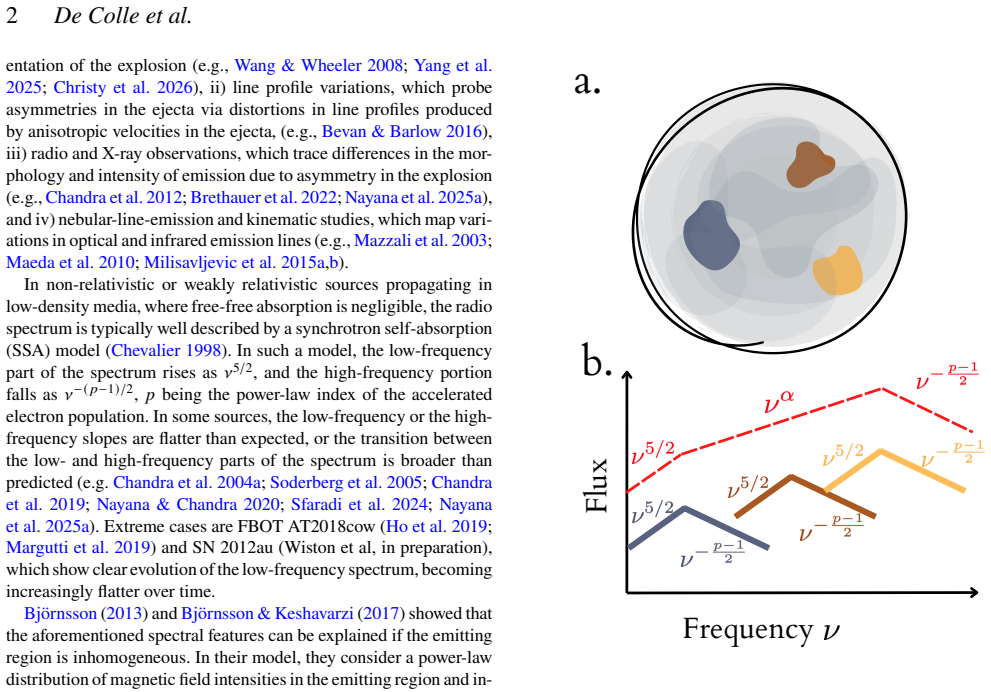
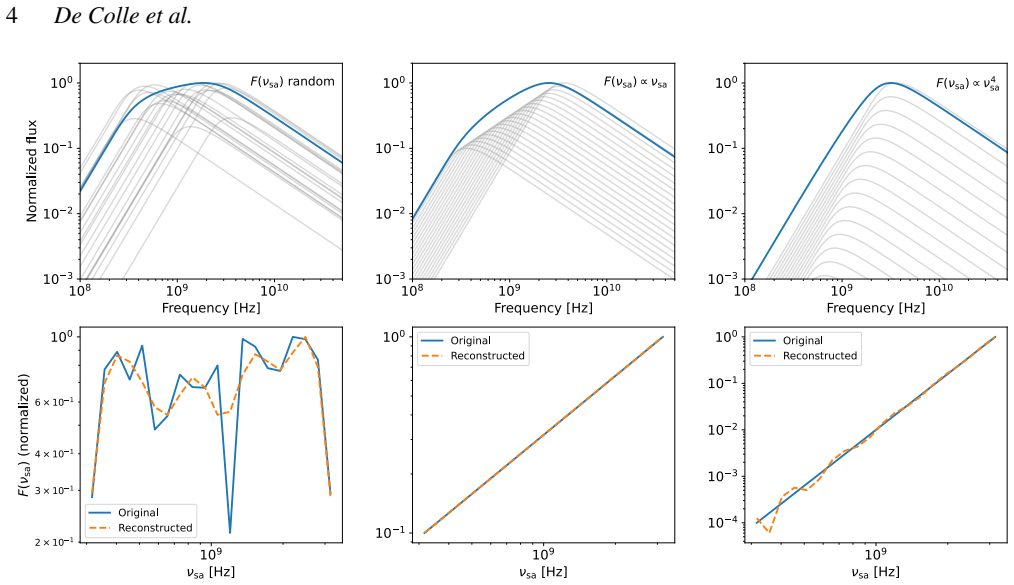
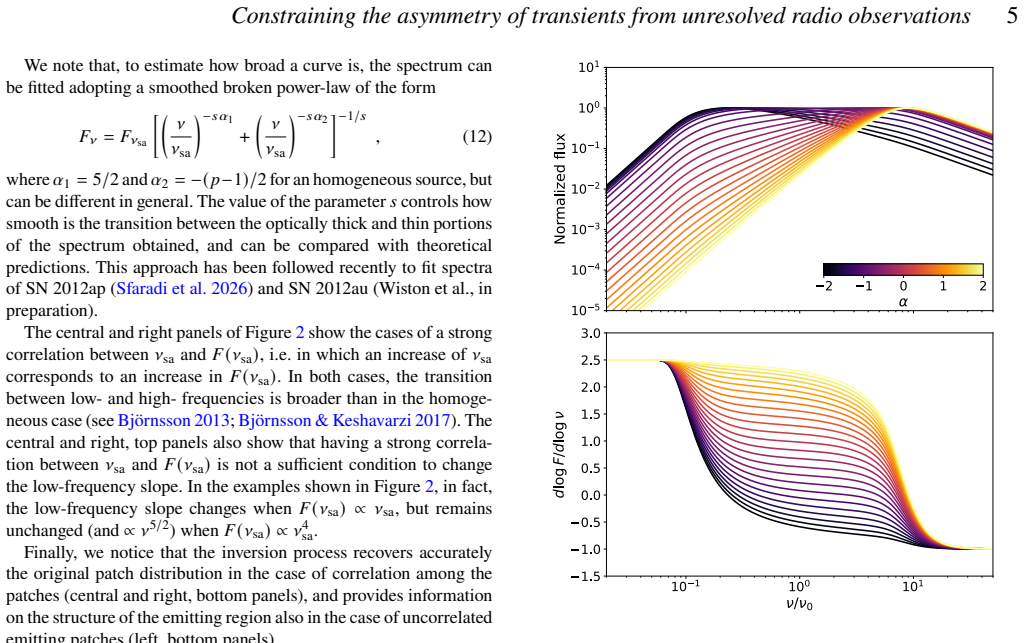
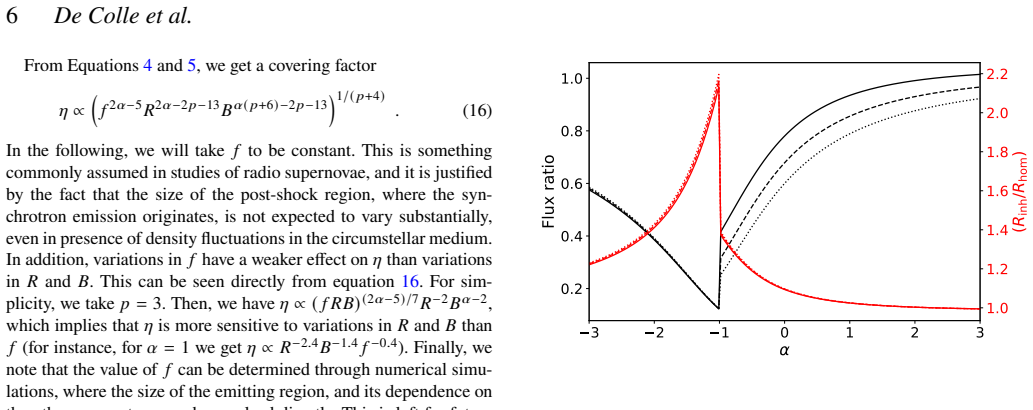
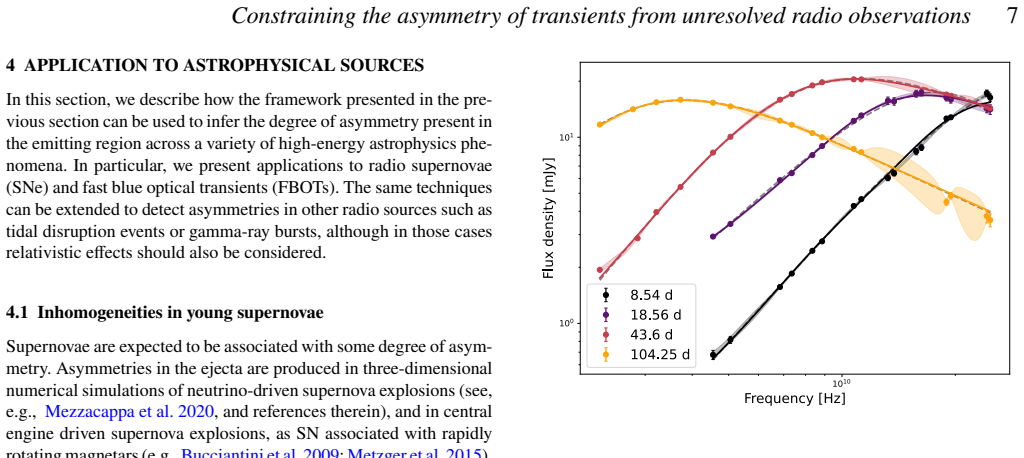
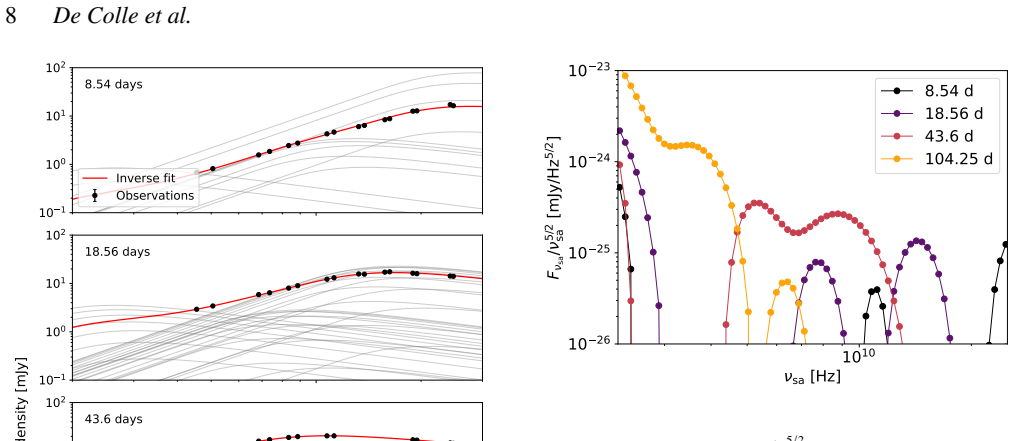
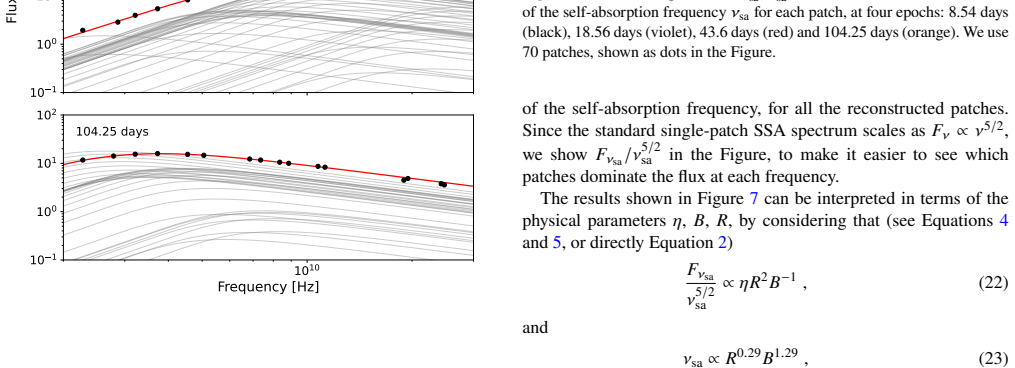
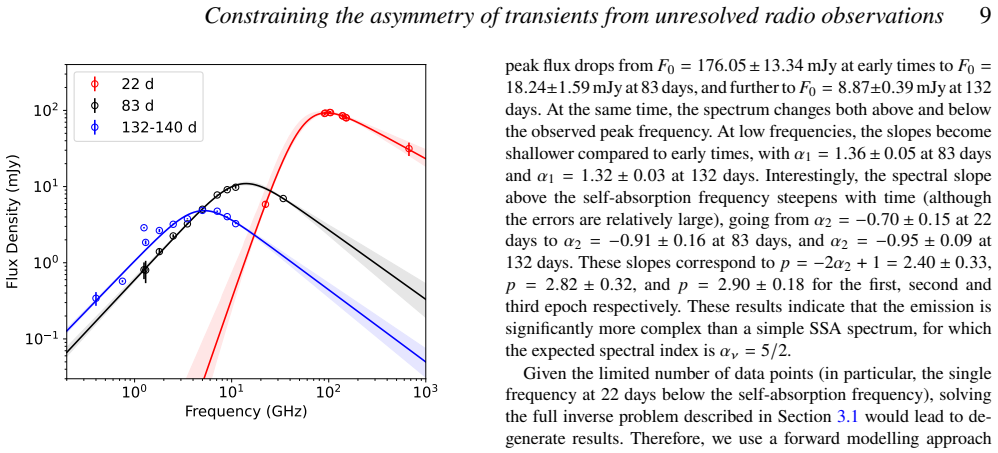
Synchrotron emission in high-energy transients is produced by relativistic electrons accelerated by shocks. As high-energy transients are often unresolved even on angular scales probed by very long baseline interferometry, it is difficult to obtain a full picture of the ejecta and circumstellar medium (CSM) properties that are probed by the radio synchrotron emission. Radio spectra of high-energy transients frequently show optically thick slopes shallower than the standard $F_\nu \propto \nu^{5/2}$ expected from synchrotron self-absorption (SSA) models, or broader spectra near the self-absorption frequency. Such deviations are often interpreted phenomenologically, without providing clear insights into the structure of the emitting region. We show how information on the homogeneity and symmetry of the emitting region can be directly inferred from SSA spectra, even when the source is unresolved. We discuss the circumstances under which inhomogeneities in the emitting region can change the spectrum below the self-absorption frequency, causing it to follow a different slope. We examine which parameters can be constrained from observations and which remain degenerate. We apply this method to the stripped-envelope supernova (SN) 2016coi and to the fast blue optical transient (FBOT) AT2018cow, showing that SSA spectra constrain the degree of inhomogeneity in these systems, providing strong evidence for inhomogeneities in the emitting region in the SN 2016coi, and asymmetry in the case of AT2018cow, and we infer the characteristics of the emitting region. When well sampled spectra are available, our method can be applied as a general, model-independent, inference method. This approach can be used to constrain inhomogeneities in a variety of unresolved high-energy astrophysical transients, including SNe, FBOTs, tidal disruption events and gamma-ray bursts.
Editorial analysis
A structured set of objections, weighed in public.
Referee Report
Summary. The manuscript claims that deviations from the canonical F_ν ∝ ν^{5/2} optically thick synchrotron self-absorption (SSA) slope, or broader turnover spectra, can be directly interpreted as signatures of inhomogeneities or asymmetries in the emitting region of unresolved high-energy transients. The authors derive how spatial variations alter the effective optical depth and emissivity below the turnover, identify which parameters are constrained versus degenerate, and apply the framework to the radio spectra of SN 2016coi (inferring inhomogeneity) and FBOT AT2018cow (inferring asymmetry), concluding that well-sampled spectra permit model-independent inference of these structural properties.
Significance. If the attribution of spectral deviations specifically to spatial structure is robust, the method supplies a practical, observationally accessible route to constrain ejecta and CSM geometry in transients that remain unresolved even by VLBI. The explicit application to two events and the emphasis on well-sampled spectra as enabling model-independent use constitute concrete strengths that could be adopted by observers of SNe, FBOTs, TDEs, and GRBs.
major comments (3)
- [Abstract and §3] The central claim that shallower optically thick slopes encode inhomogeneity or asymmetry (abstract; §3) rests on the assumption that such deviations arise exclusively from spatial structure rather than from non-uniform magnetic-field strength or electron energy distributions. No quantitative comparison is presented showing that the latter microphysical variations produce distinguishable spectral shapes from the modeled inhomogeneity cases.
- [§5] In the application to SN 2016coi and AT2018cow (§5), the inferred degree of inhomogeneity and asymmetry is obtained by fitting the observed slope or turnover width to the inhomogeneity model; without an explicit demonstration that alternative microphysical explanations are ruled out by the same data, the uniqueness of the structural inference is not established.
- [Abstract and §4] The statement that the method is 'model-independent' when spectra are well sampled (abstract; §4) is not reconciled with the fact that the mapping from observed slope to inhomogeneity parameter still requires an assumed functional form for the spatial variation; the manuscript does not show that the result is independent of that functional choice.
minor comments (2)
- [§2] Notation for the effective optical-depth index and the inhomogeneity parameter should be defined once in §2 and used consistently thereafter.
- [Figures 2–4] Figure captions for the model spectra should explicitly state the range of inhomogeneity parameters explored and the fixed values of other quantities.
Simulated Author's Rebuttal
We thank the referee for the constructive comments. We address each major point below and have revised the manuscript to improve clarity on the scope of the inferences.
read point-by-point responses
-
Referee: [Abstract and §3] The central claim that shallower optically thick slopes encode inhomogeneity or asymmetry (abstract; §3) rests on the assumption that such deviations arise exclusively from spatial structure rather than from non-uniform magnetic-field strength or electron energy distributions. No quantitative comparison is presented showing that the latter microphysical variations produce distinguishable spectral shapes from the modeled inhomogeneity cases.
Authors: The derivation in §3 shows how spatial variations in optical depth and emissivity produce shallower slopes or broader turnovers under the synchrotron self-absorption framework. We agree that non-uniform B-fields or electron distributions could produce similar deviations and that no direct comparison of spectral shapes is provided. The revised manuscript adds a paragraph in §3 noting these alternatives and stating that the method interprets deviations under the assumption of spatial structure; distinguishing causes requires additional data. revision: yes
-
Referee: [§5] In the application to SN 2016coi and AT2018cow (§5), the inferred degree of inhomogeneity and asymmetry is obtained by fitting the observed slope or turnover width to the inhomogeneity model; without an explicit demonstration that alternative microphysical explanations are ruled out by the same data, the uniqueness of the structural inference is not established.
Authors: Section 5 applies the spatial-inhomogeneity model to the observed spectra to infer the degree of structure. We have revised §5 to explicitly state that the inferences assume spatial inhomogeneity or asymmetry as the origin and that the radio spectra alone do not rule out microphysical alternatives. A brief note on the need for multi-wavelength or temporal data to break degeneracies has been added. revision: yes
-
Referee: [Abstract and §4] The statement that the method is 'model-independent' when spectra are well sampled (abstract; §4) is not reconciled with the fact that the mapping from observed slope to inhomogeneity parameter still requires an assumed functional form for the spatial variation; the manuscript does not show that the result is independent of that functional choice.
Authors: The phrase 'model-independent' is used to indicate that the inference does not depend on a specific hydrodynamic or microphysical model of the transient. We acknowledge that the quantitative mapping depends on the assumed functional form of the spatial variation. The revised abstract and §4 now clarify this distinction and note that different functional forms may alter the inferred parameter value while still indicating the presence of inhomogeneity. revision: yes
Circularity Check
No circularity: derivation grounded in standard SSA physics without self-referential reductions
full rationale
The abstract presents a method to infer homogeneity/asymmetry from deviations in optically thick synchrotron spectra, based on standard synchrotron self-absorption (SSA) models where the canonical F_ν ∝ ν^{5/2} slope is altered by spatial structure. No equations, parameters, or claims in the provided text reduce by construction to fitted inputs, self-citations, or ansatzes imported from the authors' prior work. The method is explicitly described as 'model-independent' for well-sampled spectra and applied to specific events without evidence that the inferred inhomogeneity degree is statistically forced by the fitting procedure itself. This is the expected honest non-finding for a paper whose central claim rests on external synchrotron theory rather than internal redefinition.
Axiom & Free-Parameter Ledger
Reference graph
Works this paper leans on
-
[1]
Inverse reconstruction of jet structure from off-axis gamma-ray burst afterglows. , keywords =. doi:10.1093/mnras/staa1984 , archivePrefix =. 1912.01871 , primaryClass =
-
[2]
Diverse jet structures consistent with the off-axis afterglow of GRB 170817A. , keywords =. doi:10.1093/mnras/stab032 , archivePrefix =. 2007.13116 , primaryClass =
-
[3]
The Structure of Gamma Ray Burst Jets. Galaxies , keywords =. doi:10.3390/galaxies10050093 , archivePrefix =. 2206.11088 , primaryClass =
-
[4]
A flash of polarized optical light points to an aspherical 'cow'. , keywords =. doi:10.1093/mnras/stad539 , archivePrefix =. 2303.00787 , primaryClass =
-
[5]
The Broad-lined Type Ic SN 2012ap and the Nature of Relativistic Supernovae Lacking a Gamma-Ray Burst Detection. , keywords =. doi:10.1088/0004-637X/799/1/51 , archivePrefix =. 1408.1606 , primaryClass =
work page internal anchor Pith review Pith/arXiv arXiv doi:10.1088/0004-637x/799/1/51
-
[6]
The late time radio emission from SN 1993J at meter wavelengths
The Late-Time Radio Emission from SN 1993J at Meter Wavelengths. , keywords =. doi:10.1086/422675 , archivePrefix =. astro-ph/0405448 , primaryClass =
work page internal anchor Pith review Pith/arXiv arXiv doi:10.1086/422675
-
[7]
Synchrotron aging and the radio spectrum of SN 1993J
Synchrotron Aging and the Radio Spectrum of SN 1993J. , keywords =. doi:10.1086/383615 , archivePrefix =. astro-ph/0402391 , primaryClass =
work page internal anchor Pith review Pith/arXiv arXiv doi:10.1086/383615
-
[8]
Metamorphosis of SN 2014C: Delayed Interaction between a Hydrogen Poor Core-collapse Supernova and a Nearby Circumstellar Shell. , keywords =. doi:10.1088/0004-637X/815/2/120 , archivePrefix =. 1511.01907 , primaryClass =
work page internal anchor Pith review Pith/arXiv arXiv doi:10.1088/0004-637x/815/2/120
-
[9]
Dinosaur in a Haystack: X-Ray View of the Entrails of SN 2023ixf and the Radio Afterglow of Its Interaction with the Medium Spawned by the Progenitor Star (Paper I). , keywords =. doi:10.3847/1538-4357/adc2fb , archivePrefix =. 2411.02647 , primaryClass =
-
[10]
An axisymmetric shock breakout indicated by prompt polarized emission from the type II supernova 2024ggi. Science Advances , keywords =. doi:10.1126/sciadv.adx2925 , archivePrefix =. 2511.08824 , primaryClass =
-
[11]
The Most Luminous Known Fast Blue Optical Transient AT 2024wpp: Unprecedented Evolution and Properties in the X-Rays and Radio. , keywords =. doi:10.3847/2041-8213/ae0b4d , archivePrefix =. 2509.00952 , primaryClass =
-
[12]
A Missing-Link in the Supernova-GRB Connection: The Case of SN 2012ap
A Missing-link in the Supernova-GRB Connection: The Case of SN 2012ap. , keywords =. doi:10.1088/0004-637X/805/2/187 , archivePrefix =. 1402.6336 , primaryClass =
work page internal anchor Pith review Pith/arXiv arXiv doi:10.1088/0004-637x/805/2/187
-
[13]
Radio view of a broad-line Type Ic supernova ASASSN-16fp. , keywords =. doi:10.1093/mnras/staa700 , archivePrefix =. 2003.02709 , primaryClass =
-
[14]
Magnetohydrodynamical simulations of a tidal disruption in general relativity
Magnetohydrodynamical simulations of a deep tidal disruption in general relativity. , keywords =. doi:10.1093/mnras/stw589 , archivePrefix =. 1512.04865 , primaryClass =
work page internal anchor Pith review Pith/arXiv arXiv doi:10.1093/mnras/stw589
-
[15]
The Supernova Gamma-Ray Burst Connection. , keywords =. doi:10.1146/annurev.astro.43.072103.150558 , archivePrefix =. astro-ph/0609142 , primaryClass =
-
[16]
Research in Astronomy and Astrophysics , keywords =
The Role of Jets in Exploding Supernovae and in Shaping their Remnants. Research in Astronomy and Astrophysics , keywords =. doi:10.1088/1674-4527/ac9782 , archivePrefix =. 2208.04875 , primaryClass =
-
[17]
Magnetized relativistic jets and long-duration GRBs from magnetar spin-down during core-collapse supernovae. , keywords =. doi:10.1111/j.1365-2966.2009.14940.x , archivePrefix =. 0901.3801 , primaryClass =
-
[18]
The Diversity of Transients from Magnetar Birth
The diversity of transients from magnetar birth in core collapse supernovae. , keywords =. doi:10.1093/mnras/stv2224 , archivePrefix =. 1508.02712 , primaryClass =
work page internal anchor Pith review Pith/arXiv arXiv doi:10.1093/mnras/stv2224
-
[19]
Exploding core collapse supernovae with jittering jets. , keywords =. doi:10.1111/j.1365-2966.2011.18671.x , archivePrefix =. 1103.1554 , primaryClass =
-
[20]
Living Reviews in Computational Astrophysics , keywords =
Physical, numerical, and computational challenges of modeling neutrino transport in core-collapse supernovae. Living Reviews in Computational Astrophysics , keywords =. doi:10.1007/s41115-020-00010-8 , archivePrefix =. 2010.09013 , primaryClass =
-
[21]
Radio Emission from the Cocoon of a GRB Jet: Implications for Relativistic Supernovae and Off-axis GRB Emission. , keywords =. doi:10.3847/1538-4357/aad04d , archivePrefix =. 1803.00602 , primaryClass =
work page internal anchor Pith review Pith/arXiv arXiv doi:10.3847/1538-4357/aad04d
-
[22]
Relativistic Supernovae have Shorter-lived Central Engines or More Extended Progenitors: The Case of SN 2012ap. , keywords =. doi:10.1088/0004-637X/797/2/107 , archivePrefix =. 1402.6344 , primaryClass =
work page internal anchor Pith review Pith/arXiv arXiv doi:10.1088/0004-637x/797/2/107
-
[23]
A Relativistic Type Ibc Supernova Without a Detected Gamma-ray Burst
A relativistic type Ibc supernova without a detected -ray burst. , keywords =. doi:10.1038/nature08714 , archivePrefix =. 0908.2817 , primaryClass =
work page internal anchor Pith review Pith/arXiv arXiv doi:10.1038/nature08714
-
[24]
Luminous Fast Blue Optical Transients and Type Ibn/Icn SNe from Wolf-Rayet/Black Hole Mergers. , keywords =. doi:10.3847/1538-4357/ac6d59 , archivePrefix =. 2203.04331 , primaryClass =
-
[25]
Tomographic Reconstruction of the Three-dimensional Structure of the HH30 Jet. , keywords =. doi:10.1088/0004-637X/721/2/929 , archivePrefix =. 1008.0015 , primaryClass =
-
[26]
ASASSN-16fp (SN 2016coi): A transitional supernova between Type Ic and broad-lined Ic
ASASSN-16fp (SN 2016coi): a transitional supernova between Type Ic and broad-lined Ic. , keywords =. doi:10.1093/mnras/stx2498 , archivePrefix =. 1709.08832 , primaryClass =
work page internal anchor Pith review Pith/arXiv arXiv doi:10.1093/mnras/stx2498
-
[27]
Relativistic jets as compact radio sources. , keywords =. doi:10.1086/157262 , adsurl =
-
[28]
Modeling of Radio Supernovae: Including the Effects of Inhomogeneities and Radiative Cooling. , keywords =. doi:10.3847/1538-4357/ad1109 , archivePrefix =. 2311.18516 , primaryClass =
-
[29]
Inhomogeneities in type Ib/c supernovae: An inverse Compton scattering origin of the X-ray emission
Inhomogeneities in Type Ib/c Supernovae: An Inverse Compton Scattering Origin of the X-Ray Emission. , keywords =. doi:10.1088/0004-637X/769/1/65 , archivePrefix =. 1303.4254 , primaryClass =
work page internal anchor Pith review Pith/arXiv arXiv doi:10.1088/0004-637x/769/1/65
-
[30]
Inhomogeneities and the modeling of radio supernovae
Inhomogeneities and the Modeling of Radio Supernovae. , keywords =. doi:10.3847/1538-4357/aa6cad , archivePrefix =. 1704.05283 , primaryClass =
work page internal anchor Pith review Pith/arXiv arXiv doi:10.3847/1538-4357/aa6cad
-
[31]
The Radio and X-ray Luminous Type Ibc Supernova 2003L
The Radio and X-Ray-Luminous Type Ibc Supernova 2003L. , keywords =. doi:10.1086/427649 , archivePrefix =. astro-ph/0410163 , primaryClass =
work page internal anchor Pith review Pith/arXiv arXiv doi:10.1086/427649
-
[32]
The dense and non-homogeneous circumstellar medium revealed in radio wavelengths around the Type Ib SN 2019oys. , keywords =. doi:10.1051/0004-6361/202348761 , archivePrefix =. 2312.00131 , primaryClass =
-
[33]
Type Ib Supernova Master OT J120451.50+265946.6: Radio-emitting Shock with Inhomogeneities Crossing through a Dense Shell. , keywords =. doi:10.3847/1538-4357/ab1900 , archivePrefix =. 1904.06392 , primaryClass =
work page internal anchor Pith review Pith/arXiv arXiv doi:10.3847/1538-4357/ab1900 1904
-
[34]
Experimental Astronomy , keywords =
A deep study of the high-energy transient sky. Experimental Astronomy , keywords =. doi:10.1007/s10686-021-09725-9 , adsurl =
-
[35]
Philosophical Transactions of the Royal Society of London Series A , keywords =
High-energy transients. Philosophical Transactions of the Royal Society of London Series A , keywords =. doi:10.1098/rsta.2012.0270 , archivePrefix =. 1207.6346 , primaryClass =
-
[36]
Diagnostics of inhomogeneous stellar jets: Convolution effects and data reconstruction
Diagnostics of inhomogeneous stellar jets. Convolution effects and data reconstruction. , keywords =. doi:10.1051/0004-6361:200809621 , archivePrefix =. 0805.0559 , primaryClass =
work page internal anchor Pith review Pith/arXiv arXiv doi:10.1051/0004-6361:200809621
-
[37]
Shock-powered light curves of luminous red novae as signatures of pre-dynamical mass-loss in stellar mergers. , keywords =. doi:10.1093/mnras/stx1768 , archivePrefix =. 1705.03895 , primaryClass =
work page internal anchor Pith review Pith/arXiv arXiv doi:10.1093/mnras/stx1768
-
[38]
Strong late-time circumstellar interaction in the peculiar supernova iPTF14hls
Strong late-time circumstellar interaction in the peculiar supernova iPTF14hls. , keywords =. doi:10.1093/mnras/sty584 , archivePrefix =. 1712.00514 , primaryClass =
work page internal anchor Pith review Pith/arXiv arXiv doi:10.1093/mnras/sty584
-
[39]
Black hole accretion discs and luminous transients in failed supernovae from non-rotating supergiants. , keywords =. doi:10.1093/mnrasl/slz031 , archivePrefix =. 1811.12427 , primaryClass =
work page internal anchor Pith review Pith/arXiv arXiv doi:10.1093/mnrasl/slz031
-
[40]
Mass Ejection in Failed Supernovae: Variation with Stellar Progenitor
Mass ejection in failed supernovae: variation with stellar progenitor. , keywords =. doi:10.1093/mnras/sty306 , archivePrefix =. 1710.01735 , primaryClass =
work page internal anchor Pith review Pith/arXiv arXiv doi:10.1093/mnras/sty306
-
[41]
Electron-capture supernovae exploding within their progenitor wind
Electron-capture supernovae exploding within their progenitor wind. , keywords =. doi:10.1051/0004-6361/201424264 , archivePrefix =. 1407.4563 , primaryClass =
work page internal anchor Pith review Pith/arXiv arXiv doi:10.1051/0004-6361/201424264
-
[42]
The Crab Nebula's progenitor. , keywords =. doi:10.1038/299803a0 , adsurl =
-
[43]
, year = 1980, month = jan, volume =
Supernova triggered by electron captures. , year = 1980, month = jan, volume =
1980
-
[44]
Ultra-stripped supernovae: progenitors and fate
Ultra-stripped supernovae: progenitors and fate. , keywords =. doi:10.1093/mnras/stv990 , archivePrefix =. 1505.00270 , primaryClass =
work page internal anchor Pith review Pith/arXiv arXiv doi:10.1093/mnras/stv990
-
[45]
Time-dependent models of accretion discs with nuclear burning following the tidal disruption of a white dwarf by a neutron star. , keywords =. doi:10.1093/mnras/stw1410 , archivePrefix =. 1603.07334 , primaryClass =
work page internal anchor Pith review Pith/arXiv arXiv doi:10.1093/mnras/stw1410
-
[46]
Optical and X-ray emission from stable millisecond magnetars formed from the merger of binary neutron stars. , keywords =. doi:10.1093/mnras/stu247 , archivePrefix =. 1311.1519 , primaryClass =
work page internal anchor Pith review Pith/arXiv arXiv doi:10.1093/mnras/stu247
-
[47]
Radio Evolution of a Type IIb Supernova SN 2016gkg. , keywords =. doi:10.3847/1538-4357/ac7c1e , archivePrefix =. 2206.12103 , primaryClass =
-
[48]
The Astronomer's Telegram , keywords =
SALT spectroscopic classification of SN 2016gkg as a young type-II supernova. The Astronomer's Telegram , keywords =
-
[49]
The Astronomer's Telegram , keywords =
ASAS-SN Confirmation of a Bright, Fast-Rising Supernova in NGC 613. The Astronomer's Telegram , keywords =
-
[50]
Transient Name Server Discovery Report , keywords =
Transient Discovery Report for 2016-09-21. Transient Name Server Discovery Report , keywords =
2016
-
[51]
The Astronomer's Telegram , keywords =
ATLAS detection of the bright, fast rising supernova candidate AT2016gkg in NGC 613. The Astronomer's Telegram , keywords =
-
[52]
The Radio Luminosity-risetime Function of Core-collapse Supernovae. , keywords =. doi:10.3847/1538-4357/abccd9 , archivePrefix =. 2011.11737 , primaryClass =
-
[53]
Seven Years of Coordinated Chandra-NuSTAR Observations of SN 2014C Unfold the Extreme Mass-loss History of Its Stellar Progenitor. , keywords =. doi:10.3847/1538-4357/ac8b14 , archivePrefix =. 2206.00842 , primaryClass =
-
[54]
Survival of the Fittest: Numerical Modeling of SN 2014C. , keywords =. doi:10.3847/1538-4357/ac649d , archivePrefix =. 2102.12581 , primaryClass =
-
[55]
Central Bureau Electronic Telegrams , year = 2012, month = feb, volume =
Supernova 2012ap in NGC 1729 = Psn J05001372-0320512. Central Bureau Electronic Telegrams , year = 2012, month = feb, volume =
2012
-
[56]
Jets launched at magnetar birth cannot be ignored
Jets launched at magnetar birth cannot be ignored. , keywords =. doi:10.1016/j.newast.2016.02.009 , archivePrefix =. 1602.07343 , primaryClass =
work page internal anchor Pith review Pith/arXiv arXiv doi:10.1016/j.newast.2016.02.009 2016
-
[57]
Discovery of an outflow from radio observations of the tidal disruption event ASASSN-14li
Discovery of an Outflow from Radio Observations of the Tidal Disruption Event ASASSN-14li. , keywords =. doi:10.3847/2041-8205/819/2/L25 , archivePrefix =. 1510.01226 , primaryClass =
work page internal anchor Pith review Pith/arXiv arXiv doi:10.3847/2041-8205/819/2/l25 2041
-
[58]
A Population Study of the Radio Emission of Fast Blue Optical Transients. , keywords =. doi:10.3847/1538-4357/acbb04 , archivePrefix =. 2301.06403 , primaryClass =
-
[59]
Radiative processes in astrophysics
-
[60]
Bright ``Merger-nova'' from the Remnant of a Neutron Star Binary Merger: A Signature of a Newly Born, Massive, Millisecond Magnetar. , keywords =. doi:10.1088/2041-8205/776/2/L40 , archivePrefix =. 1308.0876 , primaryClass =
work page internal anchor Pith review Pith/arXiv arXiv doi:10.1088/2041-8205/776/2/l40 2041
-
[61]
The Peculiar Transient AT2018cow: A Possible Origin of a Type Ibn/IIn Supernova. , keywords =. doi:10.3847/1538-4357/abdeba , archivePrefix =. 2101.08009 , primaryClass =
-
[62]
A hot and luminous source at the site of the fast transient AT2018cow at 2-3 yr after its explosion. , keywords =. doi:10.1093/mnrasl/slac023 , archivePrefix =. 2203.01960 , primaryClass =
-
[63]
Research in Astronomy and Astrophysics , keywords =
A Common Envelope Jets Supernova (CEJSN) Impostor Scenario for Fast Blue Optical Transients. Research in Astronomy and Astrophysics , keywords =. doi:10.1088/1674-4527/ac5b40 , archivePrefix =. 2201.07728 , primaryClass =
-
[64]
Diversity of common envelope jets supernovae and the fast transient AT2018cow
Diversity of common envelope jets supernovae and the fast transient AT2018cow. , keywords =. doi:10.1093/mnras/stz364 , archivePrefix =. 1811.11106 , primaryClass =
work page internal anchor Pith review Pith/arXiv arXiv doi:10.1093/mnras/stz364
-
[65]
X-ray Swift observations of SN 2018cow
X-ray Swift observations of SN 2018cow. , keywords =. doi:10.1093/mnrasl/sly145 , archivePrefix =. 1807.06369 , primaryClass =
work page internal anchor Pith review Pith/arXiv arXiv doi:10.1093/mnrasl/sly145
-
[66]
Evidence for a compact object in the aftermath of the extragalactic transient AT2018cow. Nature Astronomy , keywords =. doi:10.1038/s41550-021-01524-8 , archivePrefix =. 2112.04531 , primaryClass =
-
[67]
The Nearby Luminous Transient AT2018cow: A Magnetar Formed in a Subrelativistically Expanding Nonjetted Explosion. , keywords =. doi:10.3847/2041-8213/ab64d1 , archivePrefix =. 1911.11912 , primaryClass =
-
[68]
Fast-rising blue optical transients and AT2018cow following electron-capture collapse of merged white dwarfs. , keywords =. doi:10.1093/mnras/stz1640 , archivePrefix =. 1812.07569 , primaryClass =
-
[69]
A Model for the Fast Blue Optical Transient AT2018cow: Circumstellar Interaction of a Pulsational Pair-instability Supernova. , keywords =. doi:10.3847/1538-4357/abba33 , archivePrefix =. 2008.11404 , primaryClass =
-
[70]
Fast Optical Transients from Stellar-mass Black Hole Tidal Disruption Events in Young Star Clusters. , keywords =. doi:10.3847/1538-4357/abeb14 , archivePrefix =. 2012.02796 , primaryClass =
-
[71]
Swift spectra of AT2018cow: A White Dwarf Tidal Disruption Event?
Swift spectra of AT2018cow: a white dwarf tidal disruption event?. , keywords =. doi:10.1093/mnras/stz053 , archivePrefix =. 1808.08492 , primaryClass =
work page internal anchor Pith review Pith/arXiv arXiv doi:10.1093/mnras/stz053
-
[72]
Shocked jets in CCSNe can power the zoo of fast blue optical transients. , keywords =. doi:10.1093/mnras/stac910 , archivePrefix =. 2201.04636 , primaryClass =
-
[73]
Multimessenger Implications of AT2018cow: High-energy Cosmic-Ray and Neutrino Emissions from Magnetar-powered Superluminous Transients. , keywords =. doi:10.3847/1538-4357/ab1b72 , archivePrefix =. 1812.11673 , primaryClass =
work page internal anchor Pith review Pith/arXiv arXiv doi:10.3847/1538-4357/ab1b72
-
[74]
Synchrotron Self-Absorption in Radio Supernovae. , keywords =. doi:10.1086/305676 , adsurl =
-
[75]
Tidal Disruption of a Main-Sequence Star by an Intermediate-Mass Black Hole: A Bright Decade
Tidal Disruption of a Main-sequence Star by an Intermediate-mass Black Hole: A Bright Decade. , keywords =. doi:10.3847/1538-4357/aadfda , archivePrefix =. 1806.08093 , primaryClass =
work page internal anchor Pith review Pith/arXiv arXiv doi:10.3847/1538-4357/aadfda
-
[76]
MUSE Reveals a Recent Merger in the Post-starburst Host Galaxy of the TDE ASASSN-14li
MUSE Reveals a Recent Merger in the Post-starburst Host Galaxy of the TDE ASASSN-14li. , keywords =. doi:10.3847/2041-8205/830/2/L32 , archivePrefix =. 1609.00013 , primaryClass =
work page internal anchor Pith review Pith/arXiv arXiv doi:10.3847/2041-8205/830/2/l32 2041
-
[77]
Six months of multiwavelength follow-up of the tidal disruption candidate ASASSN-14li and implied TDE rates from ASAS-SN. , keywords =. doi:10.1093/mnras/stv2486 , archivePrefix =. 1507.01598 , primaryClass =
work page internal anchor Pith review Pith/arXiv arXiv doi:10.1093/mnras/stv2486
-
[78]
ASASSN-14li: A Model Tidal Disruption Event
ASASSN-14li: A Model Tidal Disruption Event. , keywords =. doi:10.3847/0004-637X/827/2/127 , archivePrefix =. 1602.02824 , primaryClass =
work page internal anchor Pith review Pith/arXiv arXiv doi:10.3847/0004-637x/827/2/127
-
[79]
Radio and X-Ray Observations of the Luminous Fast Blue Optical Transient AT 2020xnd. , keywords =. doi:10.3847/1538-4357/ac4506 , archivePrefix =. 2110.05514 , primaryClass =
-
[80]
Real-time discovery of AT2020xnd: a fast, luminous ultraviolet transient with minimal radioactive ejecta. , keywords =. doi:10.1093/mnras/stab2785 , archivePrefix =. 2103.01968 , primaryClass =
discussion (0)
Sign in with ORCID, Apple, or X to comment. Anyone can read and Pith papers without signing in.