REVIEW 5 major objections 5 minor 83 references
Cross section of the process $e^+ + e^- \to \Xi^0 + \bar{\Xi}^0$ in the vicinity of charmonium $\psi(3770)$ and in the charmonium (-like) state including the $D$-meson loop and three-gluon contributions
T0 review · 5 major / 5 minor · reviewed 2026-08-06 · deepseek-v4-flash
Pith's one-line read The paper argues that the measured $e^+e^- \to \Xi^0 \bar{\Xi}^0$ cross section near the $\psi(3770)$ resonance is explained by adding a D-meson loop and a three-gluon charmonium contribution to the Born amplitude, with a relative phase…
desk verdict Applies an established D-meson-loop plus three-gluon model to a new baryon channel, but the headline agreement at ψ(3770) is not a prediction—it rests on a fit to the same data and a transferable constant. read the letter →
The pith
A machine-rendered reading of the paper's core claim, the machinery that carries it, and where it could break.
The reading
What carries the argument
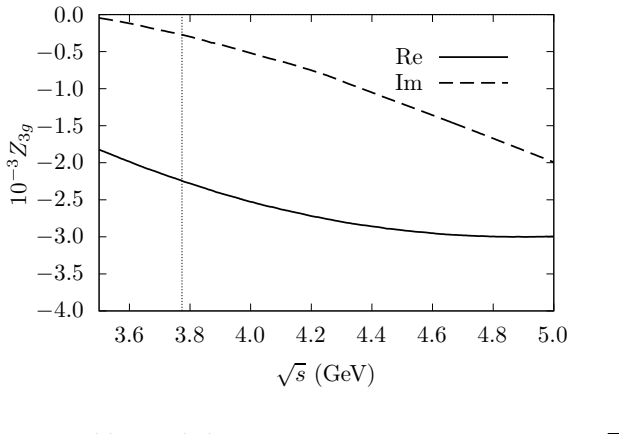
The load-bearing object is the combination $S_D(s) + S_{3g}(s) = |S(s)|e^{i\phi_\psi}$, the charmonium transition function whose phase controls the interference term $\sigma_{\rm int} = \mathrm{Re}\, S(s)/(s - M_\psi^2 + i M_\psi \Gamma_\psi)$. The $D$-meson loop contribution $S_D$ is evaluated by applying the Cutkosky cutting rules, the standard on-shell procedure for extracting the imaginary part of a loop, to the two $D$-meson propagators, and then restoring the real part through a once-subtracted dispersion relation. The three-gluon contribution $S_{3g}$ is evaluated from the $c\bar{c}$ annihilation into three gluons with a charmonium form factor $|G_\psi(s)| = C_\psi/(s^2 \log^2(s/\Lambda_{\rm QCD}^2))$ carrying $C_\psi = (45 \pm 9)$ GeV$^4$. Together these two pieces convert the Born amplitude, shaped by the effective form factor $G(s) = C/(s^2 \log^2(s/\Lambda_{\rm QCD}^2))$ with $C = (64.68 \pm 1.3)$ GeV$^4$, into the observed resonance structure near $\psi(3770)$.
What would settle it
Measure $e^+e^- \to \Xi^0 \bar{\Xi}^0$ in fine energy steps across $\psi(3770)$ (for example 3.76 to 3.80 GeV) with the full available luminosity; if the peak height deviates from the predicted $\sigma_\psi = 1005.75$ fb at the quoted phase, the three-gluon normalization does not transfer to this channel. Equivalently, refit $C_\psi$ using only $\Xi^0$ data, since a best-fit value outside $(45 \pm 9)$ GeV$^4$ would falsify the channel-independence assumption.
Extended reading notes
Core claim
The paper's central claim is that the total cross section of $e^+e^- \to \Xi^0 \bar{\Xi}^0$ in the charmonium region is the coherent sum $\sigma = \sigma_B + 2\cos\phi_\psi |M_B| |M_\psi| + \sigma_\psi$, where $M_\psi$ contains the $D$-meson loop and three-gluon mechanisms. At the $\psi(3770)$ mass shell the calculation yields $\sigma_\psi = 1005.75$ fb and $\phi_\psi = 178.45^\circ$ (Eq. 55), and the predicted total cross section agrees with the measured values at the resonance peak and on both shoulders. The paper further claims that the same mechanism, with parameters fixed in $p\bar{p}$ and $\Lambda\bar{\Lambda}$ production, also accounts for the data near $\psi(4040)$, $\psi(4160)$, $Y(4230)$, $Y(4360)$, $\psi(4415)$, and $Y(4660)$, and that as a byproduct it yields a pQCD-inspired fit to the $\Xi^0$ electromagnetic form factor in the large-momentum region. In the author's framing, a large relative phase of the charmonium vertex ($\phi_\psi \sim 200^\circ$) is a common feature of charmonium decays into baryon pairs.
Load-bearing premise
The prediction stands on the assumption that the three-gluon strength fitted to proton-antiproton and Lambda-antilambda production, $C_\psi = (45 \pm 9)$ GeV$^4$, applies unchanged to $\Xi^0 \bar{\Xi}^0$ production; if it does not, the predicted $\psi(3770)$ peak and the claimed agreement disappear.
Editorial extensions
If this is right
- The predicted peak height at $\psi(3770)$, $\sigma_\psi \approx 1005.75$ fb, follows from parameters fixed in other baryon channels rather than from a fit to $\Xi^0$ data, so the agreement is a quantitative test of the three-gluon annihilation mechanism.
- Because $\phi_\psi = 178.45^\circ$, the charmonium and Born amplitudes interfere almost destructively, leaving the visible $\psi(3770)$ feature dominated by the $|M_\psi|^2$ term rather than by the interference term.
- The same normalization, applied separately to $\psi(4040)$, $\psi(4160)$, $Y(4230)$, $Y(4360)$, $\psi(4415)$, and $Y(4660)$, reproduces the measured point at each resonance mass.
- The effective form-factor parametrization $G(s) = C/(s^2 \log^2(s/\Lambda_{\rm QCD}^2))$ with $C = (64.68 \pm 1.3)$ GeV$^4$ gives a concrete prediction for the timelike $\Xi^0$ electromagnetic form factor at large momentum transfer.
Reading between the lines
- Beyond the paper: if the inherited three-gluon constant $C_\psi$ is genuinely channel-independent, the same calculation predicts the cross sections for other octet-baryon channels not analyzed here, for example $e^+e^- \to \Omega^- \bar{\Omega}^+$, with no new free parameters.
- Beyond the paper: a fine energy scan across $\psi(3770)$ with more than the ten current points would separate the $D$-meson-loop and three-gluon contributions, because their energy dependences on the resonance shoulders differ.
- Beyond the paper: the calculation sets aside near-threshold Coulomb effects, so the lowest-energy point at 3.51 GeV is the natural place to test whether adding a threshold enhancement improves or worsens the overall agreement.
Editorial analysis
A structured set of objections, weighed in public.
Referee Report
Summary. The paper computes the cross section of e+e− → Ξ0 anti-Ξ0 in the BESIII energy range 3.51–4.95 GeV as a sum of a one-photon Born term, a ψ(3770) intermediate-state amplitude mediated by a D-meson loop and a three-gluon annihilation diagram, and separate contributions from the charmonium-like states ψ(4040), ψ(4160), Y(4230), Y(4360), ψ(4415), and Y(4660). The Born form factor is parametrized as G(s)=C/[s^2 log^2(s/Λ_QCD^2)], with C fitted to the BESIII data in Eq. (15). The central results are the relative phase φψ=178.45° and the charmonium contribution σψ=1005.75 fb at √s=Mψ in Eq. (55), together with the claim of good overall agreement with the BESIII measurements.
Significance. If its assumptions were justified, the work would offer a unified description of charmonium decays into baryon pairs and a concrete, falsifiable prediction for the ψ(3770) → Ξ0 anti-Ξ0 phase. The paper is transparent that the Born normalization is fitted to the same data it later reproduces, and it reuses parameters from the author's earlier ppbar and Λ anti-Λ analyses. The main limitation is that the resonance-region amplitude is controlled by a three-gluon constant Cψ taken from other channels and by ad hoc approximations in the D-meson loop, so the quoted agreement is conditional on untested channel-universality assumptions. No code or data files are provided, and the data availability statement contradicts the paper's use of BESIII data.
major comments (5)
- [II, Eq. (15), Fig. 3] The Born cross section that anchors the entire calculation has its only free parameter C fitted to the same BESIII data set [58] that the paper claims to reproduce (Eq. 15 and Fig. 3). The agreement of the Born curve, and part of the full-model agreement in Fig. 10, is therefore an interpolation rather than an independent check. This should be stated explicitly at every point where 'agreement' is claimed, and the fit should be repeated with the ψ(3770) region excluded to assess predictive power.
- [V, Eq. (52), Table I] The three-gluon form-factor normalization Cψ=(45±9) GeV^4 is taken unchanged from fits to e+e−→ppbar and Λ anti-Λ (Eq. 52), although this contribution is comparable to the D-meson loop at the ψ(3770) point (Table I: σ3g=1318.98 fb versus σD=848.51 fb at √s=3.765 GeV). No Ξ0-channel observable constrains Cψ, so a 20% change in Cψ shifts the three-gluon amplitude by about 20% and its cross-section contribution by roughly 40%, which moves the predicted peak well outside the quoted 'complete coincidence'. The paper should either fit Cψ to the Ξ0 data in a leave-one-out manner or propagate the 20% uncertainty through Fig. 10 and Eq. (55).
- [IV, Eqs. (44)–(45)] The D-meson loop, which is a large component of the resonance-region amplitude, relies on replacing the five intermediate hyperon masses by their average and on taking gΣDΞ from gKΣΞ=−7.02 (Eq. 45), with no uncertainty estimate or sensitivity test. Since the quoted φψ and σψ in Eq. (55) are determined by the complex sum S_D+S_3g, the central result is conditional on these uncontrolled approximations. A sensitivity scan over the average hyperon mass and over gΣDΞ is needed.
- [VI, Fig. 12] The charmonium-like states are not treated in a combined coherent model: each panel of Fig. 12 shows only the Born term plus one resonance. Because the resonances overlap in energy, separate Born+ψ(4040), Born+Y(4230), etc. curves cannot be compared with the data at the same √s without including the tails of neighboring states. The claim that the experimental result agrees 'at the point for each resonance' is therefore not a global test, and the total cross section including all listed states simultaneously is not presented.
- [IX, Data Availability] The statement 'No data were created or analyzed in this study' is inconsistent with the paper's explicit use and fitting of BESIII data from [58] in Figures 3, 8–10, and 12 and in Eq. (15). This contradiction must be corrected, otherwise the analysis cannot be reconstructed from the manuscript.
minor comments (5)
- [Abstract and Section I] There are typos in the abstract ('ofthe', 'ofther') and in several places ('BE SIII', '√s = 3770 GeV' should be '√s = 3.770 GeV').
- [Fig. 3 caption] The caption should state explicitly that the displayed Born curve uses C fitted to the BESIII data shown in the same figure; otherwise the curve may be misread as a prediction.
- [Eqs. (30) and (33)] The displayed formulas contain unmatched parentheses, for example in the definition of ZD(s) in Eq. (33); these should be cleaned up.
- [Abstract and Section VI] The name of the highest state is given as ψ(4660) in the abstract but as Y(4660) in the body and in Fig. 12; the notation should be harmonized.
- [Section III, Fig. 3] The text says that curve errors occur due to the uncertainty in the fitted constant (15), but no error band is shown in Fig. 3; the authors should either show the band or state why it is omitted.
Circularity Check
The agreement claim is partly forced: the Born baseline is fitted to the same BESIII Xi data used for comparison, and the dominant three-gluon peak inherits its normalization from the authors' own ppbar/Lambda-Lambda fits.
-
fitted input called prediction
[Sec. II, Eqs. (13)-(15); Sec. VI discussion of Fig. ́3]
"In this case, for the pair production of Ξ0 ¯Ξ0, the constant C is fixed using the whole BESIII measurement range [58]... C = (64.68 ± 1.3) GeV4. ... It is seen that the result obtained by me agrees well with the experimental points."
The baseline σB entering the final cross section (Eq. 13) is normalized by G(s) = C/[s² log²(s/Λ²)] with C fixed to the entire BESIII Ξ0 data set used for comparison in Fig. 3 and Fig. 10. Plotting a fit back onto its own input points and reading the agreement as validation is circular: the shoulders of the total curve in Fig. 10 are an interpolation of the target data, so the global 'on the whole ... good agreement' statement is not an independent test of the model. The genuinely new D-loop and three-gluon mechanisms add structure around ψ(3770), but the fitted Born component already guarantees the overall level of the curve.
-
self citation load bearing
[Sec. V, Eqs. (51)-(52); Sec. VI numerical results]
"In this process, for the parameter Cψ I use the same value that was used in the case of the production of the p¯p and the Λ ¯Λ [74, 75] pairs: Cψ = (45 ± 9) GeV4. ... Recall that in the process I am looking at, e+e− → Ξ0 ¯Ξ0, I do not make any additional parameter fitting; instead, I keep all the necessary parameters of my model the same as in the process e+e− → p¯p [74]."
The three-gluon mechanism is announced as the dominant contribution near ψ(3770) and controls the quoted peak values σψ = 1005.75 fb and φψ = 178.45° through Eqs. (46)-(47), (21), and (54)-(55). Its absolute scale is set by α3g ∝ Gψ(s), with Gψ normalized by Cψ = (45 ± 9) GeV4 taken from fits to ppbar and ΛΛ in the same research program (refs. 74-75), not constrained by any Ξ0-channel observable. The peak-level 'completely coincides' claim is therefore inherited from an assumed channel-independent fit constant, not derived from independent Ξ0 data. This is load-bearing self-citation: if Cψ is channel-dependent, the headline resonance contribution and phase are not predictions for this channel.
full rationale
The paper contains one genuine fitted-input circularity and one load-bearing self-citation. First, the Born amplitude is not a prediction for e+e−→Ξ0 ¯Ξ0: Eq. (15) states that C is fixed using the whole BESIII measurement range [58], and the same data are used in Figs. 3, 8, 9, 10, and 12 to claim agreement. Since σB is the baseline of every plotted total cross section, the broad agreement claim is partly interpolation of the target data. Second, the dominant three-gluon contribution near ψ(3770) is normalized by Cψ = (45 ± 9) GeV4 carried unchanged from the authors' own ppbar/ΛΛ fits (refs. 74-75); both the interferometric extraction of σψ (Eq. 21) and the large phase φψ (Eqs. 54-55) depend on this carried constant, so the headline peak-level agreement is conditional on channel universality of a parameter fitted elsewhere. This is not a formal reduction of the target Xi cross section to its own input, because Cψ was not fitted to Xi data and the D-loop contribution is computed independently; hence a score of 6 (partial circularity) rather than 8-10. Also flagged for completeness: Sec. IX states 'No data were created or analyzed in this study,' which contradicts the explicit fitting to BESIII data [58] used throughout, an inconsistency worth noting even though it does not by itself change the circularity score.
Assumptions & free parameters
free parameters (4)
- C (Born form factor normalization) =
(64.68 +/- 1.3) GeV^4
- C_psi (three-gluon form factor normalization) =
(45 +/- 9) GeV^4
- Average mass of intermediate hyperons in D-meson loop =
not stated
- g_Sigma D Xi (Sigma-D-Xi coupling) =
-7.02
assumptions (7)
- domain assumption The effective form factor has the pQCD-inspired form G(s) = C/(s^2 log^2(s/Lambda_QCD^2)) with Lambda_QCD = 300 MeV.
- domain assumption In the timelike region |GE| = |GM|, i.e., the Pauli form factor F2 = 0.
- domain assumption The vector current for e+e- to psi(3770) has the same structure as the electromagnetic current, and its imaginary part is negligible.
- domain assumption The real part of the loop functions Z_D and Z_3g is restored from the imaginary part by a once-subtracted dispersion relation with zero subtraction constant.
- ad hoc to paper The three-gluon form factor G_psi(s) for Xi0 anti-Xi0 is the same as that fitted for p anti-p and Lambda anti-Lambda, with C_psi = (45 +/- 9) GeV^4.
- ad hoc to paper The intermediate baryon propagator in the D-meson loop can be represented by the average mass of five hyperons.
- standard math Standard QED/QCD loop techniques: Cutkosky cutting rules, dispersion relations, and SU(3) couplings from QCD sum rules are valid here.
Cite this review
Pith. "Pith review of Cross section of the process $e^+ + e^- \to \Xi^0 + \bar{\Xi}^0$ in the vicinity of charmonium $\psi(3770)$ and in the charmonium (-like) state including the $D$-meson loop and three-gluon contributions." pith.science (2026). https://pith.science/paper/V7WBJ3ND
@misc{pith2026250704835,
  author       = {Pith},
  title        = {Pith review of: Cross section of the process $e^+ + e^- \to \Xi^0 + \bar\Xi^0$ in the vicinity of charmonium $\psi(3770)$ and in the charmonium (-like) state including the $D$-meson loop and three-gluon contributions},
  year         = {2026},
  howpublished = {\url{https://pith.science/paper/V7WBJ3ND}},
  note         = {Machine review of arXiv:2507.04835}
}
abstract
In this paper, we investigate the production of a $\Xi^0 \bar{\Xi}^0$ using $e^+e^-$ collision data at ten center-of-mass energies between 3.51 and 4.95 GeV collected with the BESIII detector at the BEPCII collider and corresponding to an integrated luminosity of 30 $\rm{fb}^{-1}$ to study the structure of baryons. The data collected by the BESIII detector are useful for the study of XYZ states, and this collaboration continues the exploration of these exotic charmonium-like states. We explore a hyperon pair produced in the electron-positron annihilation reactions. In the present paper we present the phenomenological results of our studies on the production of $\Xi^0 \bar{\Xi}^0$ in $e^+e^-$ annihilation at the BESIII detector at the BEPCII Collider. In the reaction $e^+e^- \to \Xi^0 \bar{\Xi}^0$, we consider two different contributions: one from the $D$ meson loop and the ofther from the three-gluon charmonium annihilation. We compute the total cross section of the process $e^+e^- \to \Xi^0 \bar{\Xi}^0$ including the contributions of the $D$-meson loop and three-gluon loops as well as the interference of all diagrams. As for the purely electromagnetic mechanism, large relative phases are generated for these contributions. For a large momentum transferred region we get as a byproduct a fit of the electromagnetic form factor of the $\Xi^0$ - hyperon. In this paper, in addition to the $\psi(3770)$ charmonium, we also take into account the contributions of other charmonium (-like) states, such as $\psi(4040)$, $\psi(4160)$, $Y(4230)$, $Y(4360)$, $\psi(4415)$, and $Y(4660)$. On the whole our results are in good agreement with the available experimental data.
Figures


Figures from the paper (9 more)




Reference graph
Works this paper leans on
-
[58]
M. Ablikim et al. (BESIII Collaboration), J. High Energ y Phys. 11 (2024) 062
work page 2024
-
[1]
Liu, Chin
X. Liu, Chin. Sci. Bull. 59, 3815 (2014); arXiv:1312.740 8 [hep-ph]
2014
-
[2]
H.-X. Chen, W. Chen, X. Liu, and S.-L. Zhu, Phys. Rep. 639, 1 (2016); arXiv:1601.02092 [hep-ph]
arXiv 2016
-
[3]
H.-X. Chen, W. Chen, X. Liu, Y.-R. Liu, and S.-L. Zhu, Rep. Prog. Phys. 80, 076201 (2017); arXiv:1609.08928 [hep-ph]
arXiv 2017
-
[4]
F.-K. Guo, C. Hanhart, U.-G. Meißner, Q. Wang, Q. Zhao, an d B.-S. Zou, Rev. Mod. Phys. 90, 015004 (2018); 94, 029901(E) (2022); arXiv:1705.00141 [hep-ph]
arXiv 2018
- [5]
-
[6]
N. Brambilla, S. Eidelman, C. Hanhart, A. Nefediev, C.-P . Shen, C. E. Thomas, A. Vairo, and C.-Z. Yuan, Phys. Rep. 873, 1 (2020); arXiv:1907.07583 [ hep-ex]
arXiv 2020
-
[7]
H.-X. Chen, W. Chen, X. Liu, Y.-R. Liu, and S.-L. Zhu, Rep. Prog. Phys. 86, 026201 (2023); arXiv:2204.02649 [hep-ph]
arXiv 2023
Show all 83 references
-
[8]
Aubert et al
B. Aubert et al. (BaBar Collaboration), Phys. Rev. Lett. 95, 142001 (2005)
2005
-
[9]
C. Z. Yuan et al., (Belle Collaboration), Phys. Rev. Lett . 99, 182004 (2007)
2007
-
[10]
He et al ., (CLEO Collaboration), Phys
Q. He et al ., (CLEO Collaboration), Phys. Rev. D 74, 091104(R) (2006)
2006
-
[11]
Aubert et al., (BaBar Collaboration), Phys
B. Aubert et al., (BaBar Collaboration), Phys. Rev. Let t. 98, 212001 (2007)
2007
-
[12]
X. L. Wang et al., (Belle Collaboration), Phys. Rev. Let t. 99, 142002 (2007)
2007
-
[13]
Lees et al ., (BABAR Collaboration), Phys.Rev
J.P. Lees et al ., (BABAR Collaboration), Phys.Rev. D 89, 111103 (2014)
2014
-
[14]
Wang et al ., (Belle Collaboration), Phys
X.L. Wang et al ., (Belle Collaboration), Phys. Rev. D 91, 112007 (2015)
2015
-
[15]
Ablikim et al., (BESIII Collaboration), Phys
M. Ablikim et al., (BESIII Collaboration), Phys. Rev. D 99, 032006 (2019). 31
2019
-
[16]
Brambilla et al
N. Brambilla et al. (Quarkonium Working Group), CERN Ye llow Report, CERN-2005-005, CERN, Geneva, 2005, p. 487; arXiv:hep-ph/0412158
2005 arXiv
-
[17]
Eichmann, H
G. Eichmann, H. Sanchis-Alepuz, R. Williams, R. Alkofe r, C.S. Fischer, Prog. Part. Nucl. Phys. 91, 1 (2016)
2016
-
[18]
Ramalho, K
G. Ramalho, K. Tsushima, A.W. Thomas, J. Phys. G 40, 0151 02 (2013)
2013
-
[19]
Gross, G
F. Gross, G. Ramalho, K. Tsushima, Phys. Lett. B 690, 183 (2010)
2010
-
[20]
Ramalho, M.T
G. Ramalho, M.T. Pe˜ na, K. Tsushima, Myung-Ki Cheoun, P hys. Lett. B 858, 139060 (2024)
2024
-
[21]
Ramalho, M.T
G. Ramalho, M.T. Pe˜ na, K. Tsushima, Phys. Rev. D 101, 01 4014 (2020)
2020
-
[22]
L.S. Geng, J. Martin Camalich, L. Alvarez-Ruso, M.J. Vi cente Vacas, Phys. Rev. Lett. 101, 222002 (2008)
2008
-
[23]
Brodsky, G.R
S.J. Brodsky, G.R. Farrar, Phys. Rev. D 11, 1309 (1975)
1975
-
[24]
Green, J.W
J.R. Green, J.W. Negele, A.V. Pochinsky, S.N. Syritsyn , M. Engelhardt, S. Krieg, Phys. Rev. D 90, 074507 (2014)
2014
-
[25]
Ablikim, M.N
M. Ablikim, M.N. Achasov, P. Adlarson, S. Ahmed, M. Albr echt, R. Aliberti, A. Amoroso, M.R. An, Q. An, X.H. Bai et al. , Phys. Rev. D 105, L011101 (2022)
2022
-
[26]
Delcourt et al ., Study of the reaction e+e− →pp in the total energy range 1925-2180 MeV, Phys
B. Delcourt et al ., Study of the reaction e+e− →pp in the total energy range 1925-2180 MeV, Phys. Lett. B 86, 395 (1979)
1979
-
[27]
Antonelli et al ., Nucl
A. Antonelli et al ., Nucl. Phys. B 517, 3 (1998)
1998
-
[28]
T. A. Armstrong et al ., Phys. Rev. Lett. 70, 1212 (1993)
1993
-
[29]
T. K. Pedlar et al ., Phys. Rev. Lett. 95, 261803 (2005)
2005
-
[30]
Ablikim et al ., Phys
M. Ablikim et al ., Phys. Rev. Lett. 120, 132001 (2018)
2018
-
[31]
Hofstadter, R.W
R. Hofstadter, R.W. McAllister, Phys. Rev. 98, 217 (195 5)
-
[32]
Hofstadter, R.W
R. Hofstadter, R.W. McAllister, Phys. Rev. 102, 851 (19 56)
-
[33]
Buchmann, AIP Conf
A.J. Buchmann, AIP Conf. Proc. 904, 110 (2007)
2007
-
[34]
Buchmann, Phys
A.J. Buchmann, Phys. Rev. Lett. 93, 212301 (2004)
2004
-
[35]
Buchmann and E.M
A.J. Buchmann and E.M. Henley, Eur. Phys. J. A 35, 267 (20 08)
-
[36]
Buchmann and E
A.J. Buchmann and E. M. Henley, Phys. Rev. D 65, 073017 (2 002)
-
[37]
X. L. Wang et al . (Belle Collaboration), Phys. Rev. D 87, 051101(R) (2013)
2013
-
[38]
Bacino et al
W. Bacino et al . (DELCO Collaboration), Phys. Rev. Lett. 40, 671 (1978)
1978
-
[39]
Godfrey and Isgure, Phys
S. Godfrey and Isgure, Phys. Rev. D 32, 189 (1985)
1985
-
[40]
Haidenbauer, X.W
J. Haidenbauer, X.W. Kang, and U.G. Meißner, Nucl. Phys . A 929, 102 (2014). 32
2014
-
[41]
Meißner, Sci
Qin-He Yang, Di Guo, Ling-Yun Dai, Johann Haidenbauer, Xian-Wei Kang, Ulf-G. Meißner, Sci. Bull. 68, 2729 (2023); arXiv:2206.01494 [nucl-th]
2023 arXiv
-
[42]
Cabibbo and R
N. Cabibbo and R. Gatto, Phys. Rev. Lett. 4, 313 (1960)
1960
-
[43]
Cabibbo and R
N. Cabibbo and R. Gatto, Phys. Rev. 124, 1577 (1961)
1961
-
[44]
Ablikim et al
M. Ablikim et al. , (BESIII Collaboration), Phys. Rev. D 104, L091104 (2021)
2021
-
[45]
Ablikim et al
M. Ablikim et al. , (BESIII Collaboration), Phys. Rev. D 97, 032013 (2018)
2018
-
[46]
Ablikim et al
M. Ablikim et al. , (BESIII Collaboration), Phys. Lett. B 735, 101 (2014)
2014
-
[47]
Aubert et al
B. Aubert et al. , (BABAR Collaboration), Phys. Rev. D 76, 092006 (2007)
2007
-
[48]
Lees et al
J.P. Lees et al. , (BABAR Collaboration), Phys. Rev. D 87, 092005 (2013)
2013
-
[49]
Lees et al
J.P. Lees et al. , Phys. Rev. D 88, 072009 (2013)
2013
-
[50]
Ablikim et al
M. Ablikim et al. , (BESIII Collaboration), Phys. Rev. D 91, 112004 (2015)
2015
-
[51]
Lepage and S.J
G.P. Lepage and S.J. Brodsky, Phys. Rev. Lett. 43, 545 (1 979); 43, 1625(E) (1979)
1979
-
[52]
Belitsky, X.d
A.V. Belitsky, X.d. Ji, and F. Yuan, Phys. Rev. Lett. 91, 092003 (2003)
2003
-
[53]
Ablikim et al
M. Ablikim et al. (BESIII Collaboration), Chin. Phys. C 39, 093001 (2015)
2015
-
[54]
Ablikim et al
M. Ablikim et al. (BESIII Collaboration), Phys. Rev. D 1 03, 012005 (2021)
2021
-
[55]
Ablikim et al
M. Ablikim et al. (BESIII Collaboration), Phys. Lett. B 831, 137187 (2022)
2022
-
[56]
Ablikim et al
M. Ablikim et al. (BESIII Collaboration), J. High Energ y Phys. 11 (2023) 228
2023
-
[57]
Ablikim et al
M. Ablikim et al. (BESIII Collaboration), J. High Energ y Phys. 05 (2024) 022
2024
-
[59]
Rapidis, et al
P.A. Rapidis, et al. , Phys. Rev. Lett. 39, 526 (1977)
1977
-
[60]
Pallin et al
D. Pallin et al. , (DM2 Collaboration), Nucl. Phys. B 292, 653 (1987)
1987
-
[61]
Navas et al
S. Navas et al. , (Particle Data Group Collaboration), Review of particle p hysics, Phys. Rev. D 110, 030001 (2024)
2024
-
[62]
Ablikim et al
M. Ablikim et al. , (BESIII Collaboration), Phys. Lett. B 814, 136110 (2021)
2021
-
[63]
Ablikim et al
M. Ablikim et al. , (BESIII Collaboration), Phys. Lett. B 820, 136557 (2021)
2021
-
[64]
Ablikim et al
M. Ablikim et al. , (BESIII Collaboration), Phys. Lett. B 770, 217 (2017)
2017
-
[65]
Ablikim et al
M. Ablikim et al. , (BESIII Collaboration), J. High Energy Phys. 06 (2022) 074
2022
-
[66]
Dobbs, A
S. Dobbs, A. Tomaradze, T. Xiao, K.K. Seth, G. Bonvicini , Phys. Lett. B 739, 90 (2014)
2014
-
[67]
Dobbs, K.K
S. Dobbs, K.K. Seth, A. Tomaradze, T. Xiao, and G. Bonvic ini, Phys. Rev. D 96, 092004 (2017)
2017
-
[68]
Xiongfei Wang, (on behalf of BESIII Collaboration), Pr oc. Sci. CHARM 026 (2020). 33
2020
-
[69]
Tomasi-Gustafsson, A
E. Tomasi-Gustafsson, A. Bianconi, and S. Pacetti, Phy s. Rev. C 103, 035203 (2021)
2021
-
[70]
Ferroli, S
R.B. Ferroli, S. Pacetti, and A. Zallo, Eur. Phys. J. A 48 , 33 (2012)
2012
-
[71]
Lepage and S
G. Lepage and S. J. Brodsky, Phys. Rev. D 22, 2157 (1980)
1980
-
[72]
Amoroso et al
A. Amoroso et al. , Universe 7, 436 (2021)
2021
-
[73]
Ahmadov, Yu.M
A.I. Ahmadov, Yu.M. Bystritskiy, E.A. Kuraev, and P. Wa ng, Nucl.Phys. B 888, 271 (2014)
2014
-
[74]
Bystritskiy, Phys
Yu.M. Bystritskiy, Phys. Rev. D 103, 116029 (2021)
2021
-
[75]
Bystritskiy, A.I
Yu.M. Bystritskiy, A.I. Ahmadov, Phys.Rev. D 105, 1160 12 (2022)
2022
-
[76]
Ahmadov, Phys
A.I. Ahmadov, Phys. Rev. D 109, 096037 (2024)
2024
-
[77]
Ahmadov, Phys
A.I. Ahmadov, Phys. Rev. D 111, 056008 (2025)
2025
-
[78]
Kuraev, Y
E. Kuraev, Y. Bystritskiy, and E. Tomasi-Gustafsson, N ucl. Phys. A 920, 45 (2013)
2013
-
[79]
Gong et al
G. Gong et al. , (BELLE Collaboration), Phys. Rev. D 107, 072008 (2023)
2023
-
[80]
R. E. Cutkosky, Rev. Mod. Phys. 33, 448 (1961)
1961
-
[81]
Navarra and M
F. Navarra and M. Nielsen, Phys. Lett. B 443, 285 (1998)
1998
-
[82]
Reinders, H
L. Reinders, H. Rubinstein, and S. Yazaki, Phys. Rep. 12 7, 1 (1985)
1985
-
[83]
Seungho Choe, Phys. Rev. C 57, 2061 (1998). 34
1998
Reviewed August 6, 2026 · model on record in the stance chip above.
Discussion (0). Sign in to comment.