Auto-correlation Function Keying
Pith reviewed 2026-06-26 22:37 UTC · model grok-4.3
The pith
Embedding data symbols on ACF sidelobes enables exact control of nominal periodic auto-correlation peaks in ISAC.
A machine-rendered reading of the paper's core claim, the machinery that carries it, and where it could break.
Core claim
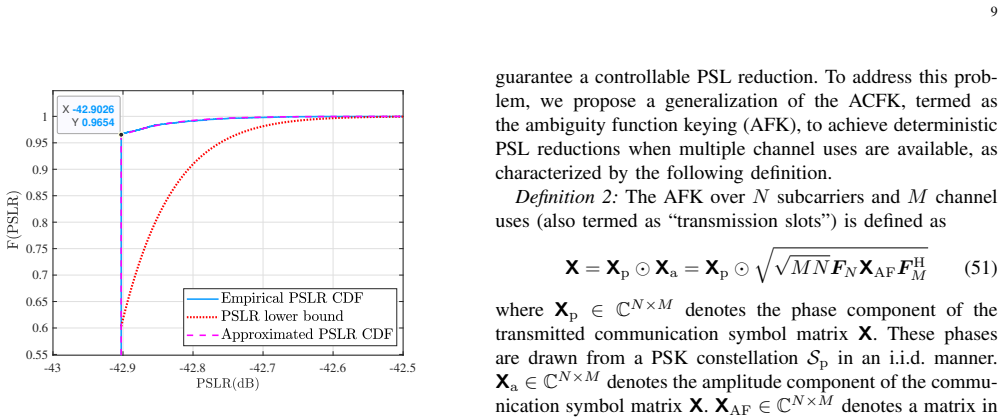
ACFK embeds data symbols directly onto the ACF-domain sidelobes to achieve exact control of the nominal P-ACF, which coincides with the actual P-ACF when the spectral non-negativity constraint is satisfied; otherwise the non-negativity violation probability is quantified and PSLR degradation bounded.
What carries the argument
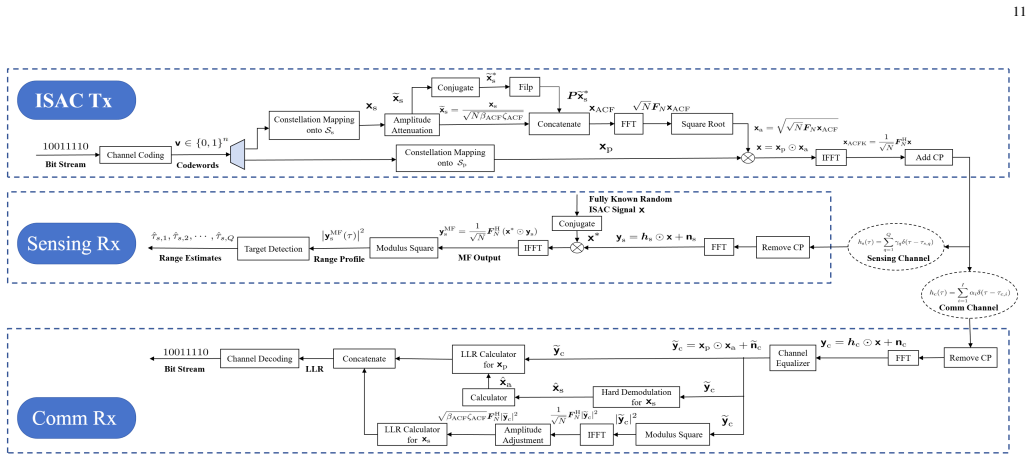
Auto-correlation function keying (ACFK), a modulation architecture that embeds data symbols directly onto the ACF-domain sidelobes to control the periodic auto-correlation function.
If this is right
- Stronger PSLR control than generalized PAS baseline
- Improved weak-target detection performance under comparable settings
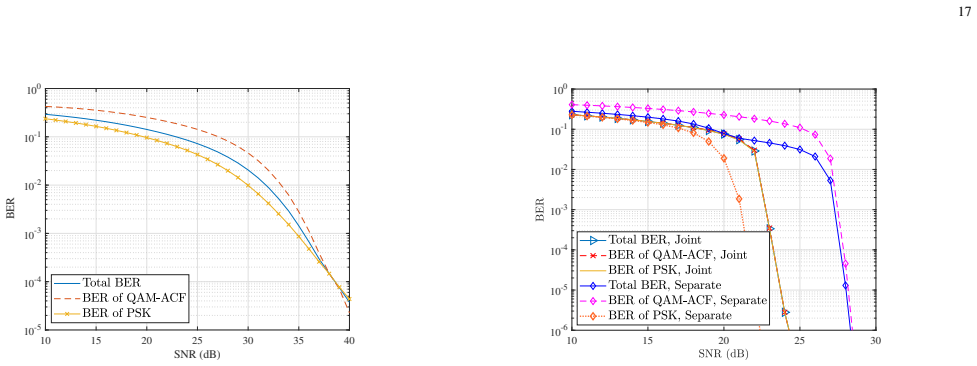
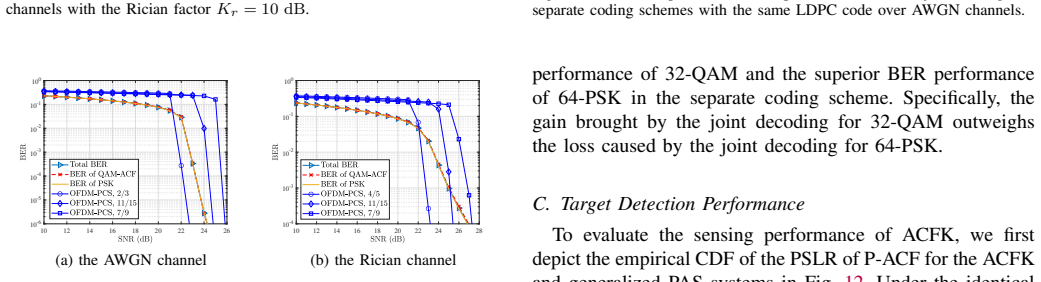
- High-SNR approximate BER analysis for the ISAC transceiver over multipath channels
- Exact nominal P-ACF control when spectral non-negativity holds
Where Pith is reading between the lines
- The ACFK approach could be tested in frequency-selective channels to see if the control extends beyond flat fading assumptions.
- Connecting ACFK to other correlation-based modulations might reveal broader applications in radar and communications.
- The bounds on PSLR degradation could be tightened with more detailed spectral analysis.
Load-bearing premise
The spectral non-negativity constraint holds so that nominal P-ACF control matches the actual one, or the optimality applies only to quasi-static frequency-flat channels at high SNR.
What would settle it
Generate many ACFK signal realizations, compute their actual P-ACF peak sidelobe levels, and check if the degradation exceeds the derived bound when the spectrum goes negative in some realizations.
Figures




read the original abstract
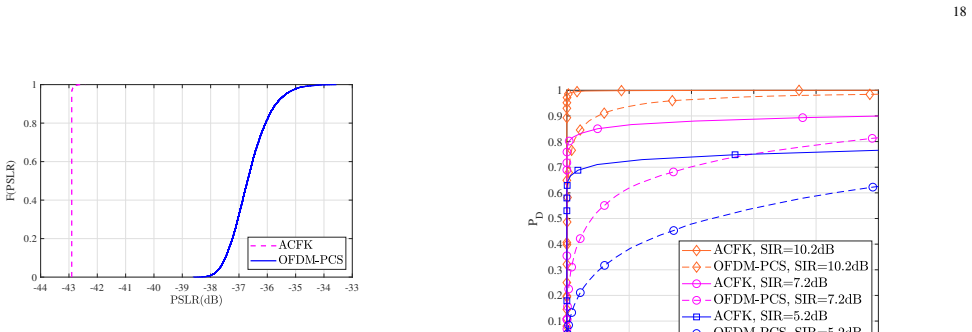
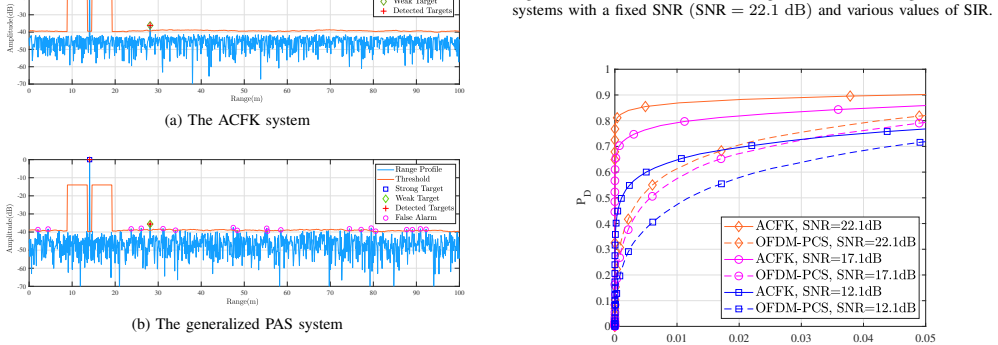
Communication-centric ISAC is a promising paradigm for future 6G networks, in which data payload signals are expected to be reused for sensing to enhance time-frequency resource efficiency. For random payload signals, existing studies have mainly characterized the expected sidelobe level (ESL) of the periodic auto-correlation function (P-ACF). However, ESL only captures the average sidelobe behavior and does not control large spurious sidelobe peaks in individual payload realizations, which may deteriorate weak-target detection performance. This motivates the design of information-bearing signals whose random P-ACF satisfies stringent peak sidelobe level (PSL) constraints. In this paper, we formulate a mutual information maximization problem under PSL constraints and a power budget. For quasi-static frequency-flat channels, we show that a continuous auto-correlation function (ACF)-domain uniform construction provides an asymptotically optimal high-SNR design principle. Motivated by this principle, we propose auto-correlation function keying (ACFK), a finite-constellation modulation architecture that embeds data symbols directly onto the ACF-domain sidelobes. ACFK enables exact control of the nominal P-ACF, which coincides with the actual P-ACF when a spectral non-negativity constraint is met. When this is not the case, we quantify the non-negativity violation probability and bound the resulting peak sidelobe level ratio (PSLR) degradation. We further provide a reference ISAC transceiver design for ACFK over quasi-static multipath channels, together with high-SNR approximate BER analysis. Numerical results validate the theoretical analysis and show that, compared with a generalized probabilistic amplitude shaping (PAS) baseline, ACFK provides substantially stronger PSLR control and improved weak-target detection performance under comparable sensing and communication settings.
Editorial analysis
A structured set of objections, weighed in public.
Referee Report
Summary. The paper proposes auto-correlation function keying (ACFK) for communication-centric ISAC. It formulates mutual-information maximization under peak sidelobe level (PSL) constraints and power budget. For quasi-static frequency-flat channels, a continuous ACF-domain uniform construction is shown to be asymptotically optimal at high SNR. ACFK embeds data symbols directly onto ACF-domain sidelobes to achieve exact control of the nominal periodic auto-correlation function (P-ACF), which coincides with the actual P-ACF when a spectral non-negativity constraint holds; otherwise the violation probability is quantified and the resulting PSLR degradation is bounded. A reference transceiver design is given for quasi-static multipath channels together with high-SNR approximate BER analysis. Numerical comparisons against a generalized probabilistic amplitude shaping (PAS) baseline show stronger PSLR control and improved weak-target detection.
Significance. If the central claims hold, the work supplies a concrete mechanism for controlling per-realization peak sidelobes in random payload signals rather than only expected sidelobe levels, directly addressing a limitation in existing ISAC sensing analyses and offering measurable gains in weak-target detection under comparable rate and power constraints.
major comments (2)
- [Abstract] Abstract: the headline claim of 'exact control of the nominal P-ACF, which coincides with the actual P-ACF' is load-bearing for the reported performance advantage over generalized PAS, yet the manuscript only quantifies the non-negativity violation probability without demonstrating that this probability is vanishing (or sufficiently close to zero) for the ACF-domain uniform construction; if the violation rate remains non-vanishing, the exact-control guarantee reduces to the weaker probabilistic PSLR bound and the claimed 'substantially stronger PSLR control' is no longer supported.
- [Abstract] Abstract: the asymptotic optimality result is derived under the explicit assumption of quasi-static frequency-flat channels at high SNR; the finite-constellation ACFK inherits the same spectral non-negativity requirement, but no explicit verification is provided that the optimality principle continues to hold once the continuous construction is discretized and the non-negativity constraint is enforced only probabilistically.
minor comments (1)
- [Abstract] The abstract states that 'high-SNR approximate BER analysis' is provided but does not indicate the order of the approximation or the error term that is neglected.
Simulated Author's Rebuttal
We thank the referee for the constructive feedback on the abstract claims regarding exact P-ACF control and asymptotic optimality. We address both major comments point-by-point below with clarifications and proposed revisions to strengthen the manuscript.
read point-by-point responses
-
Referee: [Abstract] Abstract: the headline claim of 'exact control of the nominal P-ACF, which coincides with the actual P-ACF' is load-bearing for the reported performance advantage over generalized PAS, yet the manuscript only quantifies the non-negativity violation probability without demonstrating that this probability is vanishing (or sufficiently close to zero) for the ACF-domain uniform construction; if the violation rate remains non-vanishing, the exact-control guarantee reduces to the weaker probabilistic PSLR bound and the claimed 'substantially stronger PSLR control' is no longer supported.
Authors: We acknowledge the concern that stronger evidence of low violation probability would better support the 'substantially stronger PSLR control' claim. The manuscript already quantifies the non-negativity violation probability for the ACF-domain uniform construction and derives a bound on the resulting PSLR degradation. To directly address this point, we will add numerical evaluations in the revised results section demonstrating that the violation probability is small (e.g., below 0.01 for practical parameters at high SNR). This evidence will confirm that the nominal and actual P-ACF coincide with high probability, thereby preserving the exact-control advantage. We will also refine the abstract wording to more explicitly note the high-probability nature of the coincidence. revision: yes
-
Referee: [Abstract] Abstract: the asymptotic optimality result is derived under the explicit assumption of quasi-static frequency-flat channels at high SNR; the finite-constellation ACFK inherits the same spectral non-negativity requirement, but no explicit verification is provided that the optimality principle continues to hold once the continuous construction is discretized and the non-negativity constraint is enforced only probabilistically.
Authors: The asymptotic optimality result is presented strictly as the motivating design principle for the continuous ACF-domain uniform construction under the stated channel and SNR assumptions. ACFK discretizes this construction while handling the non-negativity constraint probabilistically, as analyzed in the paper. The high-SNR approximate BER analysis and numerical comparisons already show that the performance benefits extend to the finite case. We agree an explicit link would strengthen the presentation; we will add a short remark in the discussion of the design principle (Section III) explaining that discretization error vanishes asymptotically at high SNR and the probabilistic enforcement has bounded impact per the existing PSLR degradation bound. This clarifies the extension without changing the core claims. revision: partial
Circularity Check
No significant circularity; derivation is self-contained from stated optimization.
full rationale
The central claim derives the continuous ACF-domain uniform construction as asymptotically optimal directly from the mutual information maximization problem under PSL constraints for quasi-static frequency-flat channels at high SNR. ACFK is motivated by this principle and provides nominal P-ACF control, with explicit quantification of non-negativity violation probability and PSLR degradation bounds when the constraint fails. All performance claims are benchmarked against an external generalized PAS baseline rather than internal fitted quantities. No self-definitional reductions, fitted inputs renamed as predictions, or load-bearing self-citations appear in the derivation chain.
Axiom & Free-Parameter Ledger
axioms (2)
- domain assumption Quasi-static frequency-flat channels allow the continuous ACF-domain uniform construction to be asymptotically optimal at high SNR
- domain assumption Spectral non-negativity constraint ensures nominal P-ACF coincides with actual P-ACF
invented entities (1)
-
ACFK modulation architecture
no independent evidence
Reference graph
Works this paper leans on
-
[1]
Draft New Recommendation ITU-R M. [IMT. Frame- work for 2030 and Beyond],
ITU-R WP5D, “Draft New Recommendation ITU-R M. [IMT. Frame- work for 2030 and Beyond],” 2023
2030
-
[2]
Twelve scientific challenges for 6G: Rethinking the foundations of communications theory,
M. Chafii, L. Bariah, S. Muhaidat, and M. Debbah, “Twelve scientific challenges for 6G: Rethinking the foundations of communications theory,”IEEE Commun. Surv. Tutor., vol. 25, no. 2, pp. 868–904, 2023
2023
-
[3]
A vision of 6G wireless systems: Applications, trends, technologies, and open research problems,
W. Saad, M. Bennis, and M. Chen, “A vision of 6G wireless systems: Applications, trends, technologies, and open research problems,”IEEE Netw., vol. 34, no. 3, pp. 134–142, 2019
2019
-
[4]
Integrating sensing and communi- cations for ubiquitous IoT: Applications, trends, and challenges,
Y . Cui, F. Liu, X. Jing, and J. Mu, “Integrating sensing and communi- cations for ubiquitous IoT: Applications, trends, and challenges,”IEEE Netw., vol. 35, no. 5, pp. 158–167, 2021
2021
-
[5]
Integrated sensing and communications: Toward dual-functional wire- less networks for 6G and beyond,
F. Liu, Y . Cui, C. Masouros, J. Xu, T. X. Han, Y . C. Eldar, and S. Buzzi, “Integrated sensing and communications: Toward dual-functional wire- less networks for 6G and beyond,”IEEE J. Sel. Areas Commun., vol. 40, no. 6, pp. 1728–1767, 2022
2022
-
[6]
An overview of signal processing techniques for joint communication and radar sensing,
J. A. Zhang, F. Liu, C. Masouros, R. W. Heath, Z. Feng, L. Zheng, and A. Petropulu, “An overview of signal processing techniques for joint communication and radar sensing,”IEEE J. Sel. Top. Signal Process., vol. 15, no. 6, pp. 1295–1315, 2021
2021
-
[7]
Multicarrier ISAC: Advances in waveform de- sign, signal processing, and learning under nonidealities,
V . Koivunen, M. F. Keskin, H. Wymeersch, M. Valkama, and N. Gonz ´alez-Prelcic, “Multicarrier ISAC: Advances in waveform de- sign, signal processing, and learning under nonidealities,”IEEE Signal Process. Mag., vol. 41, no. 5, pp. 17–30, 2024
2024
-
[8]
Integrated sensing and communication signals toward 5G-A and 6G: A survey,
Z. Wei, H. Qu, Y . Wang, X. Yuan, H. Wu, Y . Du, K. Han, N. Zhang, and Z. Feng, “Integrated sensing and communication signals toward 5G-A and 6G: A survey,”IEEE Internet Things J., vol. 10, no. 13, pp. 11 068– 11 092, 2023
2023
-
[9]
5G PRS-based sensing: A sensing reference signal approach for joint sensing and communication system,
Z. Wei, Y . Wang, L. Ma, S. Yang, Z. Feng, C. Pan, Q. Zhang, Y . Wang, H. Wu, and P. Zhang, “5G PRS-based sensing: A sensing reference signal approach for joint sensing and communication system,”IEEE Trans. Veh. Technol., vol. 72, no. 3, pp. 3250–3263, 2023
2023
-
[10]
Multiple reference signals collaborative sensing for integrated sensing and communication system towards 5G-A and 6G,
Z. Wei, F. Li, H. Liu, X. Chen, H. Wu, K. Han, and Z. Feng, “Multiple reference signals collaborative sensing for integrated sensing and communication system towards 5G-A and 6G,”IEEE Trans. Veh. Technol., vol. 73, no. 10, pp. 15 185–15 199, 2024
2024
-
[11]
Integrated sensing and communications via 5G NR waveform: Performance analysis,
Y . Cui, X. Jing, and J. Mu, “Integrated sensing and communications via 5G NR waveform: Performance analysis,” inProc. Int. Conf. Acoust., Speech Signal Process. (ICASSP), Singapore, 2022, pp. 8747–8751
2022
-
[12]
NR; physical channels and modulation,
3GPP, “NR; physical channels and modulation,” 3rd Generation Partner- ship Project (3GPP), Technical Specification (TS) 38.211, 2023, version 17.4.0
2023
-
[13]
On the fundamental tradeoff of integrated sensing and communications under Gaussian channels,
Y . Xiong, F. Liu, Y . Cui, W. Yuan, T. X. Han, and G. Caire, “On the fundamental tradeoff of integrated sensing and communications under Gaussian channels,”IEEE Trans. Inf. Theory, vol. 69, no. 9, pp. 5723– 5751, 2023
2023
-
[14]
From torch to projector: Fundamental tradeoff of integrated sensing and communications,
Y . Xiong, F. Liu, K. Wan, W. Yuan, Y . Cui, and G. Caire, “From torch to projector: Fundamental tradeoff of integrated sensing and communications,”IEEE BITS Inf. Theory Mag., pp. 1–13, 2024
2024
-
[15]
Deterministic- random tradeoff of integrated sensing and communications in Gaussian channels: A rate-distortion perspective,
F. Liu, Y . Xiong, K. Wan, T. X. Han, and G. Caire, “Deterministic- random tradeoff of integrated sensing and communications in Gaussian channels: A rate-distortion perspective,” inProc. IEEE Int. Symp. Inf. Theory (ISIT), Taipei, Taiwan, 2023, pp. 2326–2331
2023
-
[16]
Sensing with communication signals: From information theory to signal processing,
F. Liu, Y .-F. Liu, Y . Cui, C. Masouros, J. Xu, T. Xiao Han, S. Buzzi, Y . C. Eldar, and S. Jin, “Sensing with communication signals: From information theory to signal processing,”IEEE J. Sel. Areas Commun., vol. 44, pp. 1–30, 2026
2026
-
[17]
CP-OFDM achieves the lowest average ranging sidelobe under QAM/PSK constellations,
F. Liu, Y . Zhang, Y . Xiong, S. Li, W. Yuan, F. Gao, S. Jin, and G. Caire, “CP-OFDM achieves the lowest average ranging sidelobe under QAM/PSK constellations,”IEEE Trans. Inf. Theory, vol. 71, no. 9, pp. 6950–6967, 2025
2025
-
[18]
Uncovering the iceberg in the sea: Fundamentals of pulse shaping and modulation design for random ISAC signals,
F. Liu, Y . Xiong, S. Lu, S. Li, W. Yuan, C. Masouros, S. Jin, and G. Caire, “Uncovering the iceberg in the sea: Fundamentals of pulse shaping and modulation design for random ISAC signals,”IEEE Trans. Signal Process., vol. 73, pp. 2511–2526, 2025
2025
-
[19]
Reshaping the ISAC tradeoff under OFDM signaling: A probabilistic constellation shaping approach,
Z. Du, F. Liu, Y . Xionget al., “Reshaping the ISAC tradeoff under OFDM signaling: A probabilistic constellation shaping approach,”IEEE Trans. Signal Process., vol. 72, pp. 4782–4797, 2024
2024
-
[20]
Input distribution design for ranging-oriented OFDM-ISAC systems under frequency-selective fading,
W. Zhao and Y . Xiong, “Input distribution design for ranging-oriented OFDM-ISAC systems under frequency-selective fading,”arXiv preprint,
-
[21]
Input Distribution Design for Ranging-Oriented OFDM-ISAC Systems Under Frequency-Selective Fading
[Online]. Available: https://arxiv.org/abs/2604.26778
work page internal anchor Pith review Pith/arXiv arXiv
-
[22]
Constellation shaping for OFDM-ISAC Systems: From theoretical bounds to practical implementation,
B. Geiger, F. Liu, S. Lu, A. Rode, D. G. Gaviria, C. Muth, and L. Schmalen, “Constellation shaping for OFDM-ISAC Systems: From theoretical bounds to practical implementation,”IEEE Trans. Commun., vol. 74, pp. 6025–6042, 2026
2026
-
[23]
Exploiting both pilots and data payloads for integrated sensing and communications,
C. Xu, X. Yu, F. Liu, and S. Jin, “Exploiting both pilots and data payloads for integrated sensing and communications,”IEEE Trans. Wireless. Commun., vol. 25, pp. 5573–5586, 2026
2026
-
[24]
Rethinking signaling design for ISAC: From pilot-based to payload-based sensing,
Y . Li, Y . Zhang, C. Masouros, S. Pollin, and F. Liu, “Rethinking signaling design for ISAC: From pilot-based to payload-based sensing,” IEEE Commun. Stand. Mag., pp. 1–9, 2025
2025
-
[25]
On discrete ambiguity functions of random communication waveforms,
Y . Zhang, F. Liu, Y . Xiong, W. Yuan, S. Li, L. Zheng, T. X. Han, C. Masouros, and S. Jin, “On discrete ambiguity functions of random communication waveforms,”arXiv preprint, 2025. [Online]. Available: https://arxiv.org/pdf/2512.08352
-
[26]
M. A. Richards,Fundamentals of radar signal processing. Mcgraw-hill New York, 2005
2005
-
[27]
Lower bounds on the maximum cross correlation of signals (corresp.),
L. Welch, “Lower bounds on the maximum cross correlation of signals (corresp.),”IEEE Trans. Inf. Theory, vol. 20, no. 3, pp. 397–399, 1974
1974
-
[28]
Bounds on crosscorrelation and autocorrelation of se- quences (corresp.),
D. Sarwate, “Bounds on crosscorrelation and autocorrelation of se- quences (corresp.),”IEEE Trans. Inf. Theory, vol. 25, no. 6, pp. 720–724, 1979
1979
-
[29]
Class of binary sequences with zero correlation zone,
P. Z. Fan, N. Suehiro, N. Kuroyanagi, and X. M. Deng, “Class of binary sequences with zero correlation zone,”Electron. Lett., vol. 35, no. 10, pp. 777–779, 1999
1999
-
[30]
Lower bounds on correlation of spreading sequence set with low or zero correlation zone,
X. H. Tang, P. Z. Fan, and S. Matsufuji, “Lower bounds on correlation of spreading sequence set with low or zero correlation zone,”Electron. Lett., vol. 36, no. 6, pp. 551–552, 2000
2000
-
[31]
A new class of sequences with zero or low correlation zone based on interleaving technique,
Z. Zhou, X. Tang, and G. Gong, “A new class of sequences with zero or low correlation zone based on interleaving technique,”IEEE Trans. Inf. Theory, vol. 54, no. 9, pp. 4267–4273, 2008
2008
-
[32]
New constructions of zero- correlation zone sequences,
Y .-C. Liu, C.-W. Chen, and Y . T. Su, “New constructions of zero- correlation zone sequences,”IEEE Trans. Inf. Theory, vol. 59, no. 8, pp. 4994–5007, 2013
2013
-
[33]
Sequence design to minimize the weighted integrated and peak sidelobe levels,
J. Song, P. Babu, and D. P. Palomar, “Sequence design to minimize the weighted integrated and peak sidelobe levels,”IEEE Trans. Signal Process., vol. 64, no. 8, pp. 2051–2064, 2016. 26
2051
-
[34]
A coordinate-descent framework to design low PSL/ISL sequences,
M. A. Kerahroodi, A. Aubry, A. De Maio, M. M. Naghsh, and M. Modarres-Hashemi, “A coordinate-descent framework to design low PSL/ISL sequences,”IEEE Trans. Signal Process., vol. 65, no. 22, pp. 5942–5956, 2017
2017
-
[35]
Zak- transform-induced optimal sequences and their applications in OTFS,
X. Peng, C. Wu, Z. Liu, C. Li, J. Zhang, X. Li, and P. Fan, “Zak- transform-induced optimal sequences and their applications in OTFS,” IEEE Trans. Commun., vol. 74, pp. 6008–6024, 2026
2026
-
[36]
New design of sparse zero-correlation-zone sequence sets for optimal channel estimation in (generalized) spatial modulation systems,
B. Shen, T. Yu, Z. Zhou, Y . Yang, and Z. Liu, “New design of sparse zero-correlation-zone sequence sets for optimal channel estimation in (generalized) spatial modulation systems,”IEEE Trans. Commun., vol. 74, pp. 3423–3436, 2026
2026
-
[37]
Interference-avoidance pilot design using ZCZ sequences for multi-cell MIMO-OFDM systems,
R. Zhang, X. Cheng, M. Ma, and B. Jiao, “Interference-avoidance pilot design using ZCZ sequences for multi-cell MIMO-OFDM systems,” in Proc. IEEE Global Commun. Conf. (GLOBECOM), Anaheim, Califor- nia, 2012, pp. 5056–5061
2012
-
[38]
Zero correlation zone sequence pair sets for MIMO radar,
L. Xu and Q. Liang, “Zero correlation zone sequence pair sets for MIMO radar,”IEEE Trans. Aerosp. Electron. Syst., vol. 48, no. 3, pp. 2100– 2113, 2012
2012
-
[39]
Levanon and E
N. Levanon and E. Mozeson,Radar signals. John Wiley & Sons, 2004
2004
-
[40]
T. M. Cover,Elements of information theory. John Wiley & Sons, 1999
1999
-
[41]
Constant composition distribution match- ing,
P. Schulte and G. B ¨ocherer, “Constant composition distribution match- ing,”IEEE Trans. Inf. Theory, vol. 62, no. 1, pp. 430–434, 2016
2016
-
[42]
Turbo equalization: Principles and new results,
M. Tuchler, R. Koetter, and A. Singer, “Turbo equalization: Principles and new results,”IEEE Trans. Commun., vol. 50, no. 5, pp. 754–767, 2002
2002
-
[43]
A zero-forcing approximate log-likelihood receiver for MIMO bit-interleaved coded modulation,
M. Butler and I. Collings, “A zero-forcing approximate log-likelihood receiver for MIMO bit-interleaved coded modulation,”IEEE Commun. Lett., vol. 8, no. 2, pp. 105–107, 2004
2004
-
[44]
ASIC implementation of soft- input soft-output MIMO detection using MMSE parallel interference cancellation,
C. Studer, S. Fateh, and D. Seethaler, “ASIC implementation of soft- input soft-output MIMO detection using MMSE parallel interference cancellation,”IEEE J. Solid-State Circuits, vol. 46, no. 7, pp. 1754– 1765, 2011
2011
-
[45]
J. G. Proakis and M. Salehi,Digital communications. McGraw-hill New York, 2001, vol. 4
2001
-
[46]
Bandwidth efficient and rate-matched low-density parity-check coded modulation,
G. B ¨ocherer, F. Steiner, and P. Schulte, “Bandwidth efficient and rate-matched low-density parity-check coded modulation,”IEEE Trans. Commun., vol. 63, no. 12, pp. 4651–4665, 2015
2015
-
[47]
CVX: Matlab software for disciplined convex programming, version 2.1,
M. Grant and S. Boyd, “CVX: Matlab software for disciplined convex programming, version 2.1,” 2014
2014
-
[48]
On the distribution of the roots of certain symmetric matrices,
E. P. Wigner, “On the distribution of the roots of certain symmetric matrices,”Annals of Mathematics, vol. 67, no. 2, pp. 325–327, 1958
1958
-
[49]
On the sub-Gaussianity of the Beta and Dirichlet distributions,
O. Marchal and J. Arbel, “On the sub-Gaussianity of the Beta and Dirichlet distributions,”Electronic Communications in Probability, vol. 22, no. none, pp. 1 – 14, 2017
2017
-
[50]
Strictly subgaussian probabil- ity distributions,
S. Bobkov, G. Chistyakov, and F. G ¨otze, “Strictly subgaussian probabil- ity distributions,”Electron. J. Prob., vol. 29, pp. 1–28, 2024
2024
-
[51]
F. W. J. Olver, D. W. Lozier, R. F. Boisvert, and C. W. Clark, Eds., NIST Handbook of Mathematical Functions. Cambridge University Press, 2010
2010
-
[52]
Optimal sub-Gaussian variance proxy for 3-mass distributions,
S. Atouani, O. Marchal, and J. Arbel, “Optimal sub-Gaussian variance proxy for 3-mass distributions,”arXiv preprint, 2025. [Online]. Available: https://arxiv.org/abs/2510.06132
-
[53]
K. H. Rosen,Discrete Mathematics and Its Applications, 8th ed. New York, NY , USA: McGraw-Hill, 2019
2019
discussion (0)
Sign in with ORCID, Apple, or X to comment. Anyone can read and Pith papers without signing in.