Multi-Orientation Edge-Minimum Repair for Non-Redundant Fault-Tolerant Broadcasting in Dense Eisenstein--Jacobi Networks
Pith reviewed 2026-06-26 16:08 UTC · model grok-4.3
The pith
In dense Eisenstein-Jacobi networks, exactly c-1 external repair edges are necessary and sufficient to restore a spanning tree of the healthy subgraph after faults.
A machine-rendered reading of the paper's core claim, the machinery that carries it, and where it could break.
Core claim
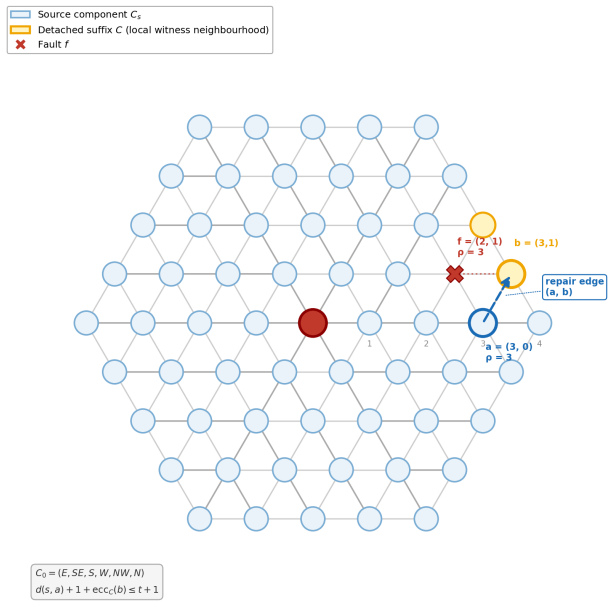
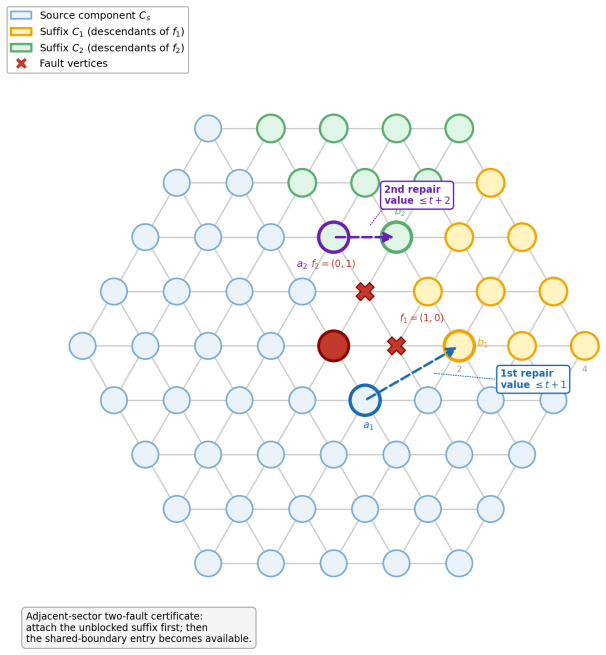
For a chosen orientation whose fault-pruned component graph is connected, exactly c-1 external repair edges are necessary and sufficient, where c is the number of healthy components. Every one-fault placement admits a repair of depth at most t+1, and every two-fault placement admits a repair of depth at most t+2. The proofs use the three-strip representation of EJ hexagons, a sector-suffix attachment lemma, a non-adjacent-sector separation lemma, and a six-direction shielding classification for paired cuts.
What carries the argument
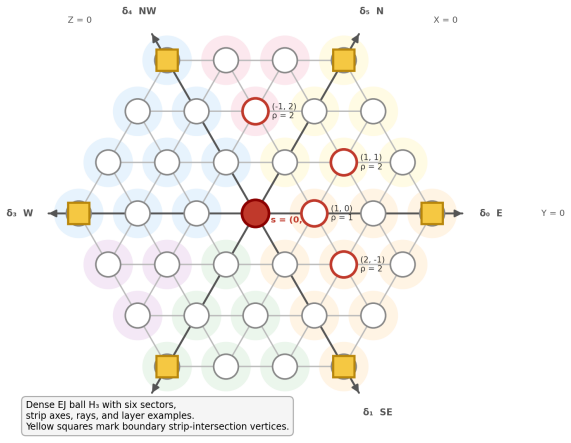
EJ-MOEM, the multi-orientation edge-minimum repair that evaluates hexagonal broadcast-tree orientations, contracts the fault-pruned tree into healthy components, and reconnects them with external edges; together with the depth-certificate theorem for EJ coordinate-reduction trees.
If this is right
- The resulting structure is a rooted spanning tree of the healthy subgraph.
- Every healthy node receives the message exactly once and no faulty node is used.
- The original healthy tree components are preserved.
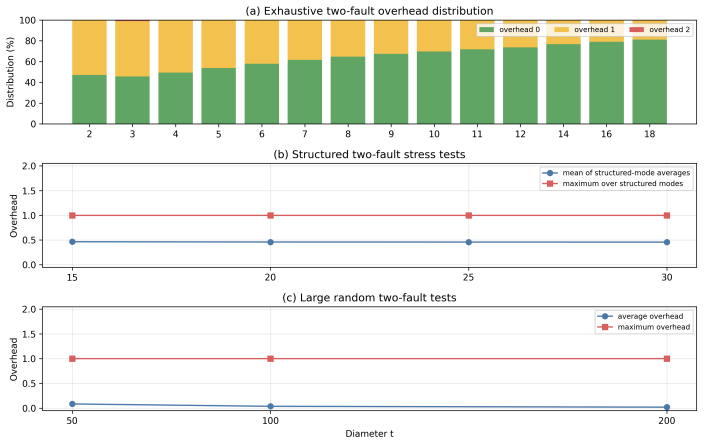
- Repairs succeed with 100 percent coverage in exhaustive enumeration up to t=18 and random tests through t=200.
Where Pith is reading between the lines
- The bounded depth increase implies that the repair can be scheduled with only a small number of additional time steps even in large-diameter networks.
- Orientation selection from a fixed small family may be adaptable to fault repair in other degree-six algebraic networks that admit similar axial coordinate systems.
- If an efficient way to locate a suitable orientation is added, the edge-minimum guarantee could support fully distributed repair protocols.
Load-bearing premise
There exists a broadcast-tree orientation for which the fault-pruned component graph remains connected.
What would settle it
A one-fault or two-fault placement in an EJ network of diameter t for which every orientation yields a disconnected component graph or requires more than c-1 repair edges, or for which no repair of depth at most t+1 (one fault) or t+2 (two faults) exists.
Figures
read the original abstract
Dense Eisenstein--Jacobi (EJ) networks are degree-six algebraic interconnection networks whose finite quotient geometry is naturally represented by a hexagonal axial-coordinate ball. This paper studies non-redundant one-to-all broadcast repair in the dense EJ network generated by $\alpha=(t+1)+t\omega$, where $t$ is the network diameter. We propose EJ-MOEM, a multi-orientation edge-minimum repair method that evaluates a constant-size family of hexagonal broadcast-tree orientations, selects a fault-aware candidate, contracts the fault-pruned tree into healthy components, and reconnects these components using external component-crossing repair edges. The resulting structure is a rooted spanning tree of the healthy subgraph: every healthy node receives the message exactly once, no faulty node is used, and the original healthy tree components are preserved. We prove that, for a chosen orientation whose fault-pruned component graph is connected, exactly $c-1$ external repair edges are necessary and sufficient, where $c$ is the number of healthy components. We also prove a depth-certificate theorem for EJ coordinate-reduction trees: every one-fault placement admits a repair of depth at most $t+1$, and every two-fault placement admits a repair of depth at most $t+2$. The proof uses the three-strip representation of EJ hexagons, a sector-suffix attachment lemma, a non-adjacent-sector separation lemma, and a six-direction shielding classification for paired cuts. Extended validation includes exhaustive one- and two-fault enumeration for $t=2,\ldots,12,14,16,18$ (up to $N=1027$ and 525,825 two-fault placements at $t=18$), structured theorem-critical tests through $t=30$, and large random tests through $t=200$, all with 100\% success and no violation of the theorem.
Editorial analysis
A structured set of objections, weighed in public.
Referee Report
Summary. The manuscript proposes EJ-MOEM, a multi-orientation edge-minimum repair algorithm for non-redundant one-to-all broadcast in dense Eisenstein-Jacobi networks of diameter t. It selects a fault-aware orientation from a constant-size family of hexagonal broadcast trees, contracts the fault-pruned tree into c healthy components, and reconnects them with exactly c-1 external repair edges. The paper proves that c-1 edges are necessary and sufficient whenever the chosen orientation yields a connected component graph, and separately proves a depth-certificate theorem guaranteeing repair depth at most t+1 (one fault) or t+2 (two faults) via three-strip representations, sector-suffix attachment, non-adjacent-sector separation, and six-direction shielding lemmas. Exhaustive enumeration for t=2..12,14,16,18 and random tests to t=200 report 100% success.
Significance. If the selection guarantee holds, the work supplies a parameter-free, non-redundant repair construction with minimal edge count and explicit depth bounds for fault-tolerant broadcasting on these algebraic networks. The geometric lemmas and the scale of the exhaustive validation (up to 525825 two-fault placements at t=18) are concrete strengths that would make the result useful for interconnection-network design.
major comments (2)
- [Abstract] Abstract and EJ-MOEM description: the c-1 edge bound is stated only for a chosen orientation whose fault-pruned component graph remains connected. The method EJ-MOEM selects from a fixed family of orientations, yet no proof is exhibited that this family always contains at least one orientation preserving connectivity after an arbitrary one- or two-fault placement. This existence claim is load-bearing for the non-redundant spanning-tree guarantee.
- [Abstract] Abstract: the depth-certificate theorem (t+1 / t+2) is proved separately using the listed geometric lemmas, but the interaction between the orientation-selection step and the depth bound is not made explicit; it is therefore unclear whether the depth guarantee applies unconditionally to the output of EJ-MOEM or only when a connected component graph is found.
Simulated Author's Rebuttal
We thank the referee for the careful reading and for highlighting two points of clarification needed in the abstract and EJ-MOEM description. We address each major comment below and will revise the manuscript to improve precision on the scope of the claims.
read point-by-point responses
-
Referee: [Abstract] Abstract and EJ-MOEM description: the c-1 edge bound is stated only for a chosen orientation whose fault-pruned component graph remains connected. The method EJ-MOEM selects from a fixed family of orientations, yet no proof is exhibited that this family always contains at least one orientation preserving connectivity after an arbitrary one- or two-fault placement. This existence claim is load-bearing for the non-redundant spanning-tree guarantee.
Authors: We agree that the manuscript presents the c-1 bound conditionally on the component graph being connected and does not supply a formal existence proof that the constant-size family always contains a suitable orientation for every one- or two-fault pattern. EJ-MOEM is defined to select from the family when such an orientation exists, and the 100% success rate in exhaustive enumeration (t=2..12,14,16,18) together with random sampling to t=200 provides empirical support but not a proof. We will revise the abstract, introduction, and algorithm description to state explicitly that the connectivity guarantee is empirically validated rather than formally proved, and we will flag the general existence question as open. revision: yes
-
Referee: [Abstract] Abstract: the depth-certificate theorem (t+1 / t+2) is proved separately using the listed geometric lemmas, but the interaction between the orientation-selection step and the depth bound is not made explicit; it is therefore unclear whether the depth guarantee applies unconditionally to the output of EJ-MOEM or only when a connected component graph is found.
Authors: The depth-certificate theorem is proved for any coordinate-reduction tree in the family and is independent of whether the component graph is connected; connectivity affects only the number of repair edges, not the depth bound. Because EJ-MOEM always outputs a tree from this family, the t+1 / t+2 guarantee applies to every repaired tree produced by the algorithm. We will revise the abstract and the statement of the depth theorem to make this separation and unconditional applicability explicit. revision: yes
- A formal proof that the fixed family of orientations always contains at least one connectivity-preserving orientation for arbitrary one- or two-fault placements (the claim rests solely on empirical validation).
Circularity Check
No circularity: proofs rest on independent lemmas and exhaustive validation
full rationale
The derivation claims two theorems: (1) c-1 repair edges suffice/necessary when the fault-pruned component graph is connected, and (2) depth bounds t+1 / t+2 via coordinate-reduction trees. Both are stated to follow from explicitly listed lemmas (three-strip representation, sector-suffix attachment, non-adjacent-sector separation, six-direction shielding) plus exhaustive enumeration up to t=18 and structured tests to t=30. No equation reduces a claimed quantity to a fitted parameter by construction, no result is renamed from prior self-work, and the connectivity premise is an explicit selection condition rather than a hidden tautology. The family-of-orientations selection is presented as an algorithmic step whose correctness is supported by the validation regime, not by self-definition.
Axiom & Free-Parameter Ledger
axioms (2)
- domain assumption The dense EJ network is generated by α = (t+1) + tω with t equal to the diameter.
- domain assumption Broadcast trees are coordinate-reduction trees whose geometry admits the three-strip representation and sector-suffix attachment properties.
Reference graph
Works this paper leans on
-
[1]
A group-theoretic model for symmetric intercon- nection networks,
S. B. Akers and B. Krishnamurthy, “A group-theoretic model for symmetric intercon- nection networks,”IEEE Transactions on Computers, vol. 38, no. 4, pp. 555–566, Apr. 1989
1989
-
[2]
F. T. Leighton,Introduction to Parallel Algorithms and Architectures: Arrays, Trees, Hypercubes. San Mateo, CA, USA: Morgan Kaufmann, 1992
1992
-
[3]
W. J. Dally and B. Towles,Principles and Practices of Interconnection Networks. San Francisco, CA, USA: Morgan Kaufmann, 2004
2004
-
[4]
Fault-tolerant communication algorithms in toroidal networks,
B. F. A. AlMohammad and B. Bose, “Fault-tolerant communication algorithms in toroidal networks,”IEEE Transactions on Parallel and Distributed Systems, vol. 10, no. 10, pp. 976–983, Oct. 1999
1999
-
[5]
Routing and broadcasting in faulty hypercube computers,
T. C. Lee and J. P. Hayes, “Routing and broadcasting in faulty hypercube computers,” inProc. Third Conference on Hypercube Concurrent Computers and Applications, vol. 1, 1988, pp. 346–354
1988
-
[6]
Broadcast in the locallyk-subcube-connected hypercube net- works with faulty tolerance,
F. Liu and Y. Song, “Broadcast in the locallyk-subcube-connected hypercube net- works with faulty tolerance,” inNetworking and Mobile Computing, Lecture Notes in Computer Science, vol. 3619. Berlin, Germany: Springer, 2005, pp. 305–313
2005
-
[7]
Fault-tolerant adaptive routing in dragonfly networks,
D. Xiang, B. Li, and Y. Fu, “Fault-tolerant adaptive routing in dragonfly networks,” IEEE Transactions on Dependable and Secure Computing, vol. 16, no. 2, pp. 259–271, Mar./Apr. 2019
2019
-
[8]
Independent spanning trees in Eisenstein–Jacobi networks,
Z. Hussain, H. AboElFotoh, and B. AlBdaiwi, “Independent spanning trees in Eisenstein–Jacobi networks,” arXiv:2101.09797 [cs.DC], Jan. 2021
arXiv 2021
-
[9]
Modeling toroidal networks with the Gaussian integers,
C. Martinez, R. Beivide, E. Stafford, M. Moreto, and E. M. Gabidulin, “Modeling toroidal networks with the Gaussian integers,”IEEE Transactions on Computers, vol. 57, no. 8, pp. 1046–1056, Aug. 2008
2008
-
[10]
Dense Gaussian networks: Suitable topologies for on-chip multiprocessors,
C. Martinez, E. Vallejo, R. Beivide, C. Izu, and M. Moreto, “Dense Gaussian networks: Suitable topologies for on-chip multiprocessors,”International Journal of Parallel Pro- gramming, vol. 34, no. 3, pp. 193–211, 2006
2006
-
[11]
Modeling hexagonal con- stellations with Eisenstein–Jacobi graphs,
C. Martinez, E. Stafford, R. Beivide, and E. M. Gabidulin, “Modeling hexagonal con- stellations with Eisenstein–Jacobi graphs,”Problems of Information Transmission, vol. 44, no. 1, pp. 1–11, 2008
2008
-
[12]
The topology of Gaussian and Eisenstein–Jacobi interconnec- tion networks,
M. Flahive and B. Bose, “The topology of Gaussian and Eisenstein–Jacobi interconnec- tion networks,”IEEE Transactions on Parallel and Distributed Systems, vol. 21, no. 8, pp. 1132–1142, Aug. 2010. 18
2010
-
[13]
Efficient communication algorithms in hexag- onal mesh interconnection networks,
B. A. Albader, B. Bose, and M. Flahive, “Efficient communication algorithms in hexag- onal mesh interconnection networks,”IEEE Transactions on Parallel and Distributed Systems, vol. 23, no. 1, pp. 69–77, Jan. 2012
2012
-
[14]
On resource placements in Gaussian and EJ networks,
M. Flahive and B. Bose, “On resource placements in Gaussian and EJ networks,”IEEE Transactions on Computers, vol. 62, no. 3, pp. 623–626, Mar. 2013
2013
-
[15]
Edge-disjoint Hamiltonian cycles in Gaussian networks,
B. A. Albader and B. Bose, “Edge-disjoint Hamiltonian cycles in Gaussian networks,” IEEE Transactions on Computers, vol. 65, no. 1, pp. 315–321, Jan. 2016
2016
-
[16]
Symmetric interconnection networks from cubic crystal lattices,
C. Camarero, C. Martinez, and R. Beivide, “Symmetric interconnection networks from cubic crystal lattices,” arXiv:1311.2019, 2013
Pith/arXiv arXiv 2019
-
[17]
Projective networks: Topologies for large parallel computer systems,
C. Camarero, C. Martinez, E. Vallejo, and R. Beivide, “Projective networks: Topologies for large parallel computer systems,” arXiv:1512.07574, 2015
Pith/arXiv arXiv 2015
-
[18]
A survey of fault-tolerant network-on- chip architectures,
D. Kliazovich, F. Granelli, and D. Miorandi, “A survey of fault-tolerant network-on- chip architectures,”IEEE Communications Surveys and Tutorials, vol. 15, no. 4, pp. 1676–1690, 2013
2013
-
[19]
Pasricha and N
S. Pasricha and N. Dutt,On-Chip Communication Architectures: System on Chip In- terconnect. San Francisco, CA, USA: Morgan Kaufmann, 2008. 19
2008
discussion (0)
Sign in with ORCID, Apple, or X to comment. Anyone can read and Pith papers without signing in.