REVIEW 3 major objections 4 minor 5 cited by
3D Scene Generation: A Survey
T0 review · 3 major / 4 minor · reviewed 2026-08-15 · deepseek-v4-flash
Pith's one-line read This survey claims that the entire field of 3D scene generation can be organized into four generation paradigms — procedural, neural 3D-based, image-based, and video-based — and that this taxonomy is complete enough to serve as a map of…
desk verdict A useful, broad survey of 3D scene generation whose four-way taxonomy is basically sound but needs a cleaner procedural/LLM boundary, a real comparison table, and search statistics before it should be cited as authoritative. read the letter →
The pith
A machine-rendered reading of the paper's core claim, the machinery that carries it, and where it could break.
The reading
What carries the argument
The load-bearing device is the hierarchical taxonomy built on the 'generation paradigm' — the kind of generator that turns input into a 3D scene. The four root categories are procedural, neural 3D-based, image-based, and video-based generation, each with named subcategories (e.g., rule/optimization/LLM-based; scene parameters/scene graph/semantic layout/implicit layout; holistic/iterative; two-stage/one-stage). The taxonomy carries the argument because every comparative claim in the survey, including the trade-off table and the discussion of challenges, is organized around these four buckets.
What would settle it
Take a recent 3D scene generation paper, such as an LLM-driven procedural city builder or an iterative image-outpainting pipeline, and ask whether it can be assigned to exactly one of the four categories without arbitrary choice; if a substantial share of the literature resists unique assignment, the taxonomy's completeness claim and the comparative conclusions drawn from it give way.
Extended reading notes
Core claim
The central claim is that state-of-the-art 3D scene generation methods fall into four paradigms defined by how the scene is produced: procedural generation (rules, optimization, or LLM-guided code), neural 3D-based generation (scene parameters, scene graphs, semantic layouts, or implicit layouts fed into 3D-aware generators), image-based generation (holistic panorama synthesis or iterative extrapolation), and video-based generation (two-stage or one-stage video diffusion that animates or constructs scenes over time). Each paradigm is analyzed for its technical foundation, its characteristic 3D representation, and its comparative strengths and weaknesses. The survey further claims that this taxonomy is complete for the current literature and that the field's progress can be traced as a shift from procedural control toward learned image and video priors.
Load-bearing premise
The taxonomy assumes every published method can be cleanly sorted into exactly one of the four paradigm buckets, even though hybrid methods — LLM-controlled procedural generation, or image outpainting followed by 3D reconstruction — span the boundaries.
Editorial extensions
If this is right
- If the taxonomy is correct, a researcher can locate any existing method in one of four paradigm buckets and immediately read off its expected trade-offs in realism, view consistency, controllability, and physical plausibility.
- The survey's framing implies that image- and video-based paradigms currently lead in photorealism and diversity, while procedural and neural 3D-based paradigms lead in geometric and semantic consistency, so combining paradigms is a natural route to scene generation that is both realistic and 3D-coherent.
- The four-way split gives the field a shared vocabulary, making it possible to compare methods across paradigms on common datasets and evaluation metrics rather than in isolated subcommunities.
- The taxonomy identifies missing combinations — such as physics-aware generation and interactive generation — as open directions, which the survey lists as future work.
Reading between the lines
- The taxonomy's boundaries are already softening: LLM-based procedural generation and image-outpainting-with-3D-reconstruction are hybrids that the survey must place in one bucket by fiat, so the four paradigms may be better seen as poles of a continuum than as disjoint classes.
- A testable consequence of the survey's completeness claim is that any new 3D scene generation paper should be assignable to exactly one root category; a meta-analysis of recent papers could check whether assignment is unambiguous in practice.
- The survey's framing suggests the next frontier is not a fifth paradigm but the convergence of video-based realism with neural 3D representations — the paper's own future-directions section points at unified perception-generation models, which would erase the current paradigm boundaries.
Signed reviews
Editorial analysis
A structured set of objections, weighed in public.
Referee Report
Summary. This manuscript surveys 3D scene generation for computer vision and graphics, proposing a hierarchical taxonomy of four generation paradigms: procedural generation, neural 3D-based generation, image-based generation, and video-based generation. It reviews core 3D scene representations (voxel grids, point clouds, meshes, neural fields, 3D Gaussians, image sequences) and generative models, then organizes representative methods under the four paradigms with subcategories. It also surveys datasets, evaluation metrics and benchmarks, downstream applications (scene editing, human-scene interaction, embodied AI, robotics, autonomous driving), and challenges and future directions. The central claim is that the four-way taxonomy is a valid and complete organizing framework for the current literature.
Significance. If the taxonomy is made internally consistent, this survey will be a useful and current reference: it covers a large body of work through 2025, provides two large summary tables (methods in Table 2 and datasets in Table 3), and gives a helpful overview of evaluation protocols and applications. Its strengths include breadth, the dataset-to-paradigm usage mapping, and the explicit discussion of challenges. The main weaknesses are the definitional inconsistency of the central taxonomy and the lack of comparative support in Table 1, both described below.
major comments (3)
- [§2.3 and §3.1.3] The definition of procedural generation in §2.3 is internally inconsistent with the classification of LLM-based methods in §3.1.3. Section 2.3 characterizes procedural generators as constructing scenes 'without learned priors' and contrasts them with models that 'learn statistical patterns,' yet §3.1.3 places LLM-based generation, which relies on large language models trained on data, under Procedural Generation, and Section 3's opening redefines procedural generation to include 'prior knowledge from LLMs.' Because an LLM is a learned statistical model on any reasonable reading, the procedural/neural boundary is not sharp: both categories now permit learned components. Since the paper's central claim is that the four paradigms organize the field 'based on their generation paradigms,' this contradiction needs to be resolved by either changing the §2.3 definition (e.g., distinguishing the control mechanism from the model class) or reassigning LLM-based methods to another paradigm.
- [Table 1] Table 1 assigns exactly three stars (⋆⋆⋆) to every category on every characteristic, so it does not support the comparative claims it is invoked for. The text repeatedly references this table (e.g., §3.1 states procedural methods 'offer high efficiency and spatial consistency'; §3.2 states neural methods 'achieve high view and semantic consistency, but their controllability and efficiency remain limited'), but an all-equal rating matrix conveys no information about trade-offs. I recommend either replacing the star ratings with differentiated, justified values (with citations or a documented rubric) or removing the table and stating the trade-offs in prose.
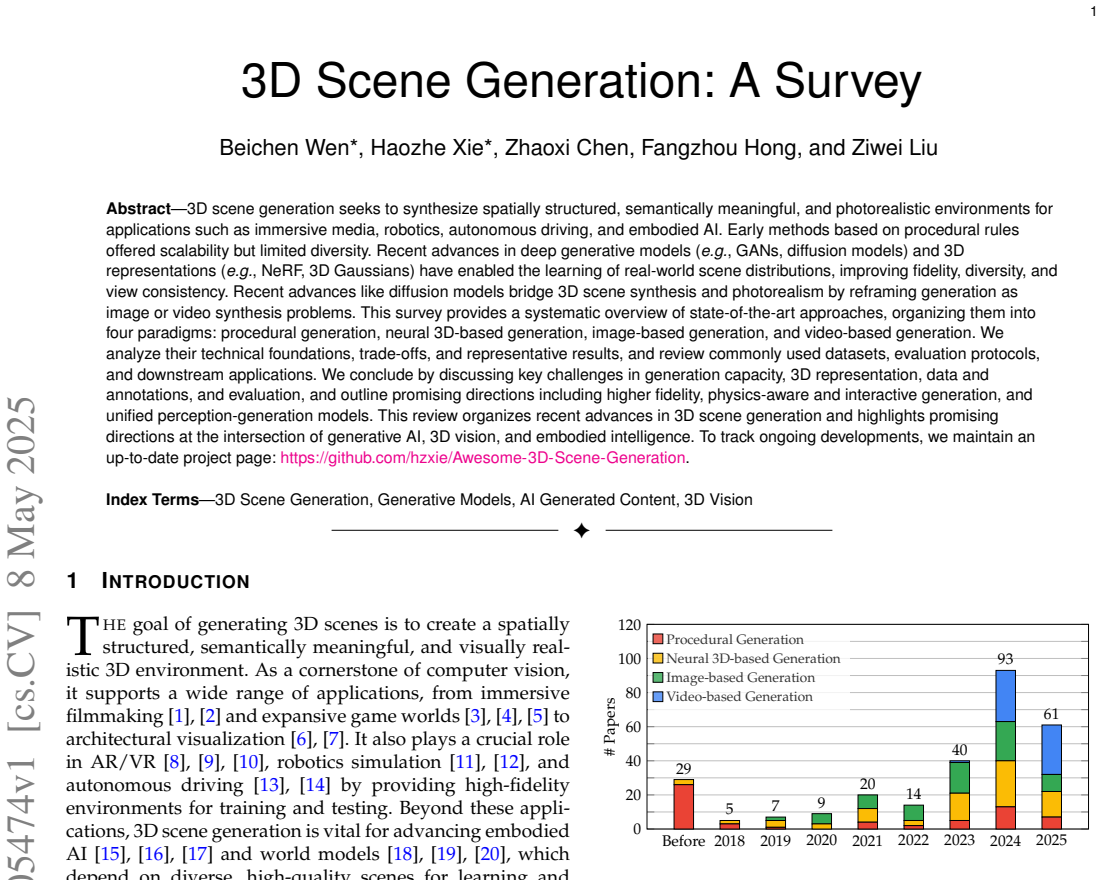
- [Figure 1 and Section 1] The survey's literature statistics and its claim to be comprehensive are not backed by a documented search or selection protocol. Figure 1 reports annual paper counts by paradigm, but the text does not state which databases were queried, which query terms were used, how duplicates or multi-paradigm papers were assigned, or what inclusion/exclusion criteria were applied. As a result, the counts cannot be reproduced and the apparent trend is not verifiable. I recommend adding a methodology subsection or appendix table describing the search protocol, the screening process, and the coding of papers into the four paradigms.
minor comments (4)
- [Table 2 caption] The condition-code list in Table 2 uses 'C' for both 'constraint' and 'camera pose'; for example, Wu et al. [27] uses C as a constraint while MagicDrive [39] uses C as a camera pose, making the table ambiguous. Please use distinct codes (e.g., CO for constraint and CP for camera pose).
- [Table 3] The 'Used by' codes P, N, I, V overlap with the scene-type codes I, N, U in the same table; for instance, 'I' in the 'Used by' column denotes image-based generation while 'I' in the 'Type' column denotes indoor. Consider using different letter sets or adding a clear legend to prevent confusion.
- [Section 2.3] The procedural-generator update equation S_{t+1}=R(S_t,Θ) is not numbered, unlike Eq. (1) and Eq. (2); numbering it would make cross-referencing easier.
- [References] The reference list has inconsistent formatting, e.g., [335] is cited only with a URL and [314] does not use the 'in' convention used by other entries; please align all references to the journal style.
Circularity Check
No significant circularity: the survey's taxonomy is an external literature organization, not a derivation from its own claims.
full rationale
This is a survey; its central claim is that the 3D scene generation literature can be organized into four generation paradigms. That taxonomy is applied to external, cited methods and is not derived from any equation or fitted parameter within the paper. The paper's Section 3 classification is an interpretive organization rather than a prediction, so there is no target quantity that could reduce to an input by construction. The authors' self-citations (SceneDreamer, CityDreamer, GaussianCity, etc.) appear as representative works in tables and taxonomies, but none of the survey's load-bearing organizational claims depends on the truth of those papers' unpublished results; citing one's own published, externally reviewed methods in a survey is normal scholarly practice. The procedural-vs-neural boundary issue raised by some readers (LLM-based methods classified as procedural despite Section 2.3 defining procedural generators as 'without learned priors') is a potential internal consistency or categorization-quality concern, not circularity: the taxonomy is not rendered circular by a debatable category boundary. Because the survey is self-contained against the external literature it catalogues, the circularity score is 0.
Assumptions & free parameters
assumptions (3)
- domain assumption All relevant 3D scene generation methods can be partitioned into four non-overlapping paradigm categories.
- domain assumption The publication statistics in Figure 1 reflect the field's growth.
- domain assumption The described evaluation metrics and benchmarks are representative of current practice.
Cite this review
Pith. "Pith review of 3D Scene Generation: A Survey." pith.science (2026). https://pith.science/paper/VAGICQK5
@misc{pith2026250505474,
  author       = {Pith},
  title        = {Pith review of: 3D Scene Generation: A Survey},
  year         = {2026},
  howpublished = {\url{https://pith.science/paper/VAGICQK5}},
  note         = {Machine review of arXiv:2505.05474}
}
read the original abstract
3D scene generation seeks to synthesize spatially structured, semantically meaningful, and photorealistic environments for applications such as immersive media, robotics, autonomous driving, and embodied AI. Early methods based on procedural rules offered scalability but limited diversity. Recent advances in deep generative models (e.g., GANs, diffusion models) and 3D representations (e.g., NeRF, 3D Gaussians) have enabled the learning of real-world scene distributions, improving fidelity, diversity, and view consistency. Recent advances like diffusion models bridge 3D scene synthesis and photorealism by reframing generation as image or video synthesis problems. This survey provides a systematic overview of state-of-the-art approaches, organizing them into four paradigms: procedural generation, neural 3D-based generation, image-based generation, and video-based generation. We analyze their technical foundations, trade-offs, and representative results, and review commonly used datasets, evaluation protocols, and downstream applications. We conclude by discussing key challenges in generation capacity, 3D representation, data and annotations, and evaluation, and outline promising directions including higher fidelity, physics-aware and interactive generation, and unified perception-generation models. This review organizes recent advances in 3D scene generation and highlights promising directions at the intersection of generative AI, 3D vision, and embodied intelligence. To track ongoing developments, we maintain an up-to-date project page: https://github.com/hzxie/Awesome-3D-Scene-Generation.
Figures


Figures from the paper (3 more)


Forward citations
Cited by 5 Pith papers
-
IDEAL-Bench: Indoor Dataset and Evaluation suite for Analyzing 3D Layout reasoning
Current VLMs top out at 62.1/100 on holistic single-image 3D indoor layout prediction, with strong recognition but weak geometric regression, and mid-tier rankings that shift relative to QA and primitive-reconstructio...
-
TabletopGen: Tabletop Scene Generation and Interactive Simulation for Robotic Manipulation
A training-free pipeline generates instance-level, physically interactive 3D tabletop scenes from text or one image, with a differentiable rotation optimizer and top-view spatial alignment for collision-free layouts.
-
WonderFree: Enhancing Novel View Quality and Cross-View Consistency for 3D Scene Exploration
A pipeline that restores corrupted novel-view videos with a video diffusion model and jointly denoises multiple viewpoints to improve 3D scene exploration from a single image.
-
Compositional Generative Model of Unbounded 4D Cities
CityDreamer4D is a compositional generative model that creates unbounded, temporally coherent 4D cities by separately generating static scenes, buildings, and vehicles with neural fields.
-
WorldClaw: Agentic 3D Open-World Generation at Scale
WorldClaw generates globally coherent, locally detailed, editable 3D worlds from open-ended text using a coarse-to-fine agentic pipeline.
Reference graph
Works this paper leans on
-
[1]
Mendiburu,3D movie making: stereoscopic digital cinema from script to screen
B. Mendiburu,3D movie making: stereoscopic digital cinema from script to screen. Routledge, 2012
2012
-
[2]
Artificial intelligence in the creative industries: a review,
N. Anantrasirichai and D. Bull, “Artificial intelligence in the creative industries: a review,”Artificial Intelligence Review, vol. 55, no. 1, pp. 589–656, 2022
2022
-
[3]
Procedural modeling of cities,
Y. I. H. Parish and P . M ¨uller, “Procedural modeling of cities,” in SIGGRAPH, 2001
2001
-
[4]
G. N. Yannakakis and J. Togelius,Artificial intelligence and games. Springer, 2018, vol. 2
2018
-
[5]
Short and T
T. Short and T. Adams,Procedural generation in game design. CRC Press, 2017
2017
-
[6]
Procedural modeling of buildings,
P . M ¨uller, P . Wonka, S. Haegler, A. Ulmer, and L. V . Gool, “Procedural modeling of buildings,”ACM TOG, vol. 25, no. 3, pp. 614–623, 2006
2006
-
[7]
Building-GAN: Graph-conditioned architectural volu- metric design generation,
K. Chang, C. Cheng, J. Luo, S. Murata, M. Nourbakhsh, and Y. Tsuji, “Building-GAN: Graph-conditioned architectural volu- metric design generation,” inICCV, 2021
2021
-
[8]
S. M. LaValle,Virtual reality. Cambridge university press, 2023
2023
Show all 300 references
-
[9]
All one needs to know about metaverse: A complete survey on technological singularity, virtual ecosys- tem, and research agenda,
L. Lee, T. Braud, P . Y. Zhou, L. Wang, D. Xu, Z. Lin, A. Kumar, C. Bermejo, and P . Hui, “All one needs to know about metaverse: A complete survey on technological singularity, virtual ecosys- tem, and research agenda,”Foundations and Trends in Human- Computer Interaction, vo...
2024
-
[10]
Artificial intelligence powered metaverse: analysis, challenges and future perspectives,
M. M. Soliman, E. Ahmed, A. Darwish, and A. E. Hassanien, “Artificial intelligence powered metaverse: analysis, challenges and future perspectives,”Artificial Intelligence Review, vol. 57, no. 2, p. 36, 2024
2024
-
[11]
BEHAVIOR-1K: A human-centered, embodied AI bench- mark with 1, 000 everyday activities and realistic simulation,
C. Li, R. Zhang, J. Wong, C. Gokmen, S. Srivastava, R. Mart ´ın- Mart´ın, C. Wang, G. Levine, W. Ai, B. J. Martinez, H. Yin, M. Lingelbach, M. Hwang, A. Hiranaka, S. Garlanka, A. Aydin, S. Lee, J. Sun, M. Anvari, M. Sharma, D. Bansal, S. Hunter, K. Kim, A. Lou, C. R. Matthews,...
2024 arXiv
-
[12]
π0: A vision-language-action flow model for general robot control,
K. Black, N. Brown, D. Driess, A. Esmail, M. Equi, C. Finn, N. Fu- sai, L. Groom, K. Hausman, B. Ichter, S. Jakubczak, T. Jones, L. Ke, S. Levine, A. Li-Bell, M. Mothukuri, S. Nair, K. Pertsch, L. X. Shi, J. Tanner, Q. Vuong, A. Walling, H. Wang, and U. Zhilinsky, “π0: A visio...
-
[13]
CARLA: an open urban driving simulator,
A. Dosovitskiy, G. Ros, F. Codevilla, A. M. L ´opez, and V . Koltun, “CARLA: an open urban driving simulator,” inCoRL, vol. 78, 2017, pp. 1–16
2017
-
[14]
End- to-end autonomous driving: Challenges and frontiers,
L. Chen, P . Wu, K. Chitta, B. Jaeger, A. Geiger, and H. Li, “End- to-end autonomous driving: Challenges and frontiers,”IEEE TP AMI, vol. 46, no. 12, pp. 10 164–10 183, 2024
2024
-
[15]
Proc- THOR: Large-scale embodied AI using procedural generation,
M. Deitke, E. VanderBilt, A. Herrasti, L. Weihs, K. Ehsani, J. Sal- vador, W. Han, E. Kolve, A. Kembhavi, and R. Mottaghi, “Proc- THOR: Large-scale embodied AI using procedural generation,” inNeurIPS, 2022
2022
-
[16]
GRUtopia: Dream general robots in a city at scale,
H. Wang, J. Chen, W. Huang, Q. Ben, T. Wang, B. Mi, T. Huang, S. Zhao, Y. Chen, S. Yang, P . Cao, W. Yu, Z. Ye, J. Li, J. Long, Z. Wang, H. Wang, Y. Zhao, Z. Tu, Y. Qiao, D. Lin, and J. Pang, “GRUtopia: Dream general robots in a city at scale,”arXiv 2407.10943, 2024
2024 arXiv
-
[17]
MetaUrban: A simulation platform for embodied AI in urban spaces,
W. Wu, H. He, Y. Wang, C. Duan, J. He, Z. Liu, Q. Li, and B. Zhou, “MetaUrban: A simulation platform for embodied AI in urban spaces,” inICLR, 2025
2025
-
[18]
Is sora a world simulator? A comprehensive survey on general world models and beyond,
Z. Zhu, X. Wang, W. Zhao, C. Min, N. Deng, M. Dou, Y. Wang, B. Shi, K. Wang, C. Zhang, Y. You, Z. Zhang, D. Zhao, L. Xiao, J. Zhao, J. Lu, and G. Huang, “Is sora a world simulator? A comprehensive survey on general world models and beyond,” arXiv 2405.03520, 2024
2024
-
[19]
Cosmos world foun- dation model platform for physical AI,
N. Agarwal, A. Ali, M. Bala, Y. Balaji, E. Barker, T. Cai, P . Chat- topadhyay, Y. Chen, Y. Cui, Y. Dinget al., “Cosmos world foun- dation model platform for physical AI,”arXiv 2501.03575, 2025
2025 arXiv
-
[20]
Generative physical AI in vision: A survey,
D. Liu, J. Zhang, A.-D. Dinh, E. Park, S. Zhang, and C. Xu, “Generative physical AI in vision: A survey,”arXiv 2501.10928, 2025
2025 arXiv
-
[21]
Selection expressions for procedural modeling,
H. Jiang, D. Yan, X. Zhang, and P . Wonka, “Selection expressions for procedural modeling,”IEEE TVCG, vol. 26, no. 4, pp. 1775– 1788, 2020
2020
-
[22]
DI-PCG: diffusion- based efficient inverse procedural content generation for high- quality 3D asset creation,
W. Zhao, Y. Cao, J. Xu, Y. Dong, and Y. Shan, “DI-PCG: diffusion- based efficient inverse procedural content generation for high- quality 3D asset creation,”arXiv 2412.15200, 2024
2024 arXiv
-
[23]
Proce- dural content generation for games: A survey,
M. Hendrikx, S. A. Meijer, J. V . D. Velden, and A. Iosup, “Proce- dural content generation for games: A survey,”ACM Transactions on Multimedia Computing, Communications, and Applications, vol. 9, no. 1, pp. 1:1–1:22, 2013
2013
-
[24]
CityX: Controllable procedural content generation for unbounded 3D cities,
S. Zhang, M. Zhou, Y. Wang, C. Luo, R. Wang, Y. Li, X. Yin, Z. Zhang, and J. Peng, “CityX: Controllable procedural content generation for unbounded 3D cities,”arXiv 2407.17572, 2024
2024 arXiv
-
[25]
Urban pattern: layout design by hierarchical domain splitting,
Y. Yang, J. Wang, E. Vouga, and P . Wonka, “Urban pattern: layout design by hierarchical domain splitting,”ACM TOG, vol. 32, no. 6, pp. 181:1–181:12, 2013
2013
-
[26]
Metropolis procedural modeling,
J. O. Talton, Y. Lou, S. Lesser, J. Duke, R. Mech, and V . Koltun, “Metropolis procedural modeling,”ACM TOG, vol. 30, no. 2, pp. 11:1–11:14, 2011
2011
-
[27]
Miqp-based layout design for building interiors,
W. Wu, L. Fan, L. Liu, and P . Wonka, “Miqp-based layout design for building interiors,”Computer Graphics Forum, 2018
2018
-
[28]
Make it home: automatic optimization of furniture arrangement,
L. Yu, S. K. Yeung, C. Tang, D. Terzopoulos, T. F. Chan, and S. J. Osher, “Make it home: automatic optimization of furniture arrangement,”ACM TOG, vol. 30, no. 4, p. 86, 2011
2011
-
[29]
Generative adversarial networks,
I. J. Goodfellow, J. Pouget-Abadie, M. Mirza, B. Xu, D. Warde- Farley, S. Ozair, A. C. Courville, and Y. Bengio, “Generative adversarial networks,” inNIPS, 2014
2014
-
[30]
Denoising diffusion probabilistic models,
J. Ho, A. Jain, and P . Abbeel, “Denoising diffusion probabilistic models,” inNeurIPS, 2020
2020
-
[31]
NeRF: Representing scenes as neural radiance fields for view synthesis,
B. Mildenhall, P . P . Srinivasan, M. Tancik, J. T. Barron, R. Ra- mamoorthi, and R. Ng, “NeRF: Representing scenes as neural radiance fields for view synthesis,” inECCV, 2020
2020
-
[32]
3D Gaussian splatting for real-time radiance field rendering,
B. Kerbl, G. Kopanas, T. Leimk ¨uhler, and G. Drettakis, “3D Gaussian splatting for real-time radiance field rendering,”ACM TOG, vol. 42, no. 4, pp. 139:1–139:14, 2023
2023
-
[33]
Infinite Nature: Perpetual view generation of natural scenes from a single image,
A. Liu, A. Makadia, R. Tucker, N. Snavely, V . Jampani, and A. Kanazawa, “Infinite Nature: Perpetual view generation of natural scenes from a single image,” inICCV, 2021
2021
-
[34]
InfiniteNature- Zero: Learning perpetual view generation of natural scenes from single images,
Z. Li, Q. Wang, N. Snavely, and A. Kanazawa, “InfiniteNature- Zero: Learning perpetual view generation of natural scenes from single images,” inECCV, 2022
2022
-
[35]
Text2Light: Zero-shot text-driven HDR panorama generation,
Z. Chen, G. Wang, and Z. Liu, “Text2Light: Zero-shot text-driven HDR panorama generation,”ACM TOG, vol. 41, no. 6, pp. 195:1– 195:16, 2022
2022
-
[36]
MVD- iffusion: Enabling holistic multi-view image generation with correspondence-aware diffusion,
S. Tang, F. Zhang, J. Chen, P . Wang, and Y. Furukawa, “MVD- iffusion: Enabling holistic multi-view image generation with correspondence-aware diffusion,” inNeurIPS, 2023
2023
-
[37]
Stable video diffusion: Scaling latent video diffusion models to large datasets,
A. Blattmann, T. Dockhorn, S. Kulal, D. Mendelevitch, M. Kilian, D. Lorenz, Y. Levi, Z. English, V . Voleti, A. Letts, V . Jampani, and R. Rombach, “Stable video diffusion: Scaling latent video diffusion models to large datasets,”arXiv 2311.15127, 2023
2023 arXiv
-
[38]
Sora: A review on background, technology, limitations, and opportunities of large vision models,
Y. Liu, K. Zhang, Y. Li, Z. Yan, C. Gao, R. Chen, Z. Yuan, Y. Huang, H. Sun, J. Gao, L. He, and L. Sun, “Sora: A review on background, technology, limitations, and opportunities of large vision models,”arXiv 2402.17177, 2024
2024 arXiv
-
[39]
MagicDrive: Street view generation with diverse 3D geometry control,
R. Gao, K. Chen, E. Xie, L. Hong, Z. Li, D. Yeung, and Q. Xu, “MagicDrive: Street view generation with diverse 3D geometry control,” inICLR, 2024
2024
-
[40]
4D Gaussian splatting for real-time dynamic scene rendering,
G. Wu, T. Yi, J. Fang, L. Xie, X. Zhang, W. Wei, W. Liu, Q. Tian, and X. Wang, “4D Gaussian splatting for real-time dynamic scene rendering,” inCVPR, 2024
2024
-
[41]
De- formable 3D Gaussians for high-fidelity monocular dynamic scene reconstruction,
Z. Yang, X. Gao, W. Zhou, S. Jiao, Y. Zhang, and X. Jin, “De- formable 3D Gaussians for high-fidelity monocular dynamic scene reconstruction,” inCVPR, 2024. 18
2024
-
[42]
DimensionX: Create any 3D and 4D scenes from a single image with controllable video diffusion,
W. Sun, S. Chen, F. Liu, Z. Chen, Y. Duan, J. Zhang, and Y. Wang, “DimensionX: Create any 3D and 4D scenes from a single image with controllable video diffusion,”arXiv 2411.04928, 2024
2024 arXiv
-
[43]
4K4DGen: Panoramic 4D generation at 4K resolution,
R. Li, P . Pan, B. Yang, D. Xu, S. Zhou, X. Zhang, Z. Li, A. Kadambi, Z. Wang, and Z. Fan, “4K4DGen: Panoramic 4D generation at 4K resolution,” inICLR, 2025
2025
-
[44]
A survey on procedural modelling for virtual worlds,
R. M. Smelik, T. Tutenel, R. Bidarra, and B. Benes, “A survey on procedural modelling for virtual worlds,”Computer Graphics Forum, vol. 33, no. 6, pp. 31–50, 2014
2014
-
[45]
A survey of procedural modelling methods for layout generation of virtual scenes,
E. Cogo, E. Krupalija, I. Prazina, S. Becirovic, V . Okanovic, S. Rizvic, and R. T. Mulahasanovic, “A survey of procedural modelling methods for layout generation of virtual scenes,” Computer Graphics Forum, vol. 43, no. 1, 2024
2024
-
[46]
A survey of 3D in- door scene synthesis,
S. Zhang, S. Zhang, Y. Liang, and P . Hall, “A survey of 3D in- door scene synthesis,”Journal of Computer Science and Technology, vol. 34, no. 3, pp. 594–608, 2019
2019
-
[47]
Advances in data-driven analysis and synthesis of 3D indoor scenes,
A. G. Patil, S. G. Patil, M. Li, M. Fisher, M. Savva, and H. Zhang, “Advances in data-driven analysis and synthesis of 3D indoor scenes,”Computer Graphics Forum, vol. 43, no. 1, 2024
2024
-
[48]
A survey of learning techniques for virtual scene generation,
D. V . Ayyildiz, A. J. Alnaser, S. Taj, M. Zakaria, and L. G. Jaimes, “A survey of learning techniques for virtual scene generation,” SAE International Journal of Connected and Automated Vehicles, 2024
2024
-
[49]
A survey on text-driven 360-degree panorama generation,
H. Wang, X. Xiang, W. Xia, and J. Xue, “A survey on text-driven 360-degree panorama generation,”arXiv 2502.14799, 2025
2025
-
[50]
Text to 3D, 2D scene generation systems, frameworks and approaches: a survey,
M. A. Ghorab and A. Lakhfif, “Text to 3D, 2D scene generation systems, frameworks and approaches: a survey,” inPattern Anal- ysis and Intelligent Systems, 2022
2022
-
[51]
Deep generative models on 3D representations: A survey,
Z. Shi, S. Peng, Y. Xu, Y. Liao, and Y. Shen, “Deep generative models on 3D representations: A survey,”arXiv 2210.15663, 2022
2022 arXiv
-
[52]
Generative AI meets 3D: A survey on text-to-3D in AIGC era,
C. Li, C. Zhang, A. Waghwase, L. Lee, F. Rameau, Y. Yang, S. Bae, and C. S. Hong, “Generative AI meets 3D: A survey on text-to-3D in AIGC era,”arXiv 2305.06131, 2023
2023 arXiv
-
[53]
Advances in 3D generation: A survey,
X. Li, Q. Zhang, D. Kang, W. Cheng, Y. Gao, J. Zhang, Z. Liang, J. Liao, Y. Cao, and Y. Shan, “Advances in 3D generation: A survey,”arXiv 2401.17807, 2024
2024 arXiv
-
[54]
A comprehensive survey on 3D content generation,
J. Liu, X. Huang, T. Huang, L. Chen, Y. Hou, S. Tang, Z. Liu, W. Ouyang, W. Zuo, J. Jiang, and X. Liu, “A comprehensive survey on 3D content generation,”arXiv 2402.01166, 2024
2024 arXiv
-
[55]
Diffusion models in 3D vision: A survey,
Z. Wang, D. Li, and R. Jiang, “Diffusion models in 3D vision: A survey,”arXiv 2410.04738, 2024
2024 arXiv
-
[56]
Advances in 4D generation: A survey,
Q. Miao, K. Li, J. Quan, Z. Min, S. Ma, Y. Xu, Y. Yang, and Y. Luo, “Advances in 4D generation: A survey,”arXiv 2503.14501, 2025
2025 arXiv
-
[57]
Understanding world or predicting future? A comprehensive survey of world models,
J. Ding, Y. Zhang, Y. Shang, Y. Zhang, Z. Zong, J. Feng, Y. Yuan, H. Su, N. Li, N. Sukiennik, F. Xu, and Y. Li, “Understanding world or predicting future? A comprehensive survey of world models,”arXiv 2411.14499, 2024
2024
-
[58]
A survey of world models for autonomous driving,
T. Feng, W. Wang, and Y. Yang, “A survey of world models for autonomous driving,”arXiv 2501.11260, 2025
2025 arXiv
-
[59]
Image-based 3D object reconstruction: State-of-the-art and trends in the deep learning era,
X. Han, H. Laga, and M. Bennamoun, “Image-based 3D object reconstruction: State-of-the-art and trends in the deep learning era,”IEEE TP AMI, vol. 43, no. 5, pp. 1578–1604, 2021
2021
-
[60]
Surface recon- struction from point clouds: A survey and a benchmark,
Z. Huang, Y. Wen, Z. Wang, J. Ren, and K. Jia, “Surface recon- struction from point clouds: A survey and a benchmark,”IEEE TP AMI, vol. 46, no. 12, pp. 9727–9748, 2024
2024
-
[61]
A survey on video diffusion models,
Z. Xing, Q. Feng, H. Chen, Q. Dai, H. Hu, H. Xu, Z. Wu, and Y. Jiang, “A survey on video diffusion models,”ACM Computing Surveys, vol. 57, no. 2, pp. 41:1–41:42, 2025
2025
-
[62]
Text-to-4D dynamic scene generation,
U. Singer, S. Sheynin, A. Polyak, O. Ashual, I. Makarov, F. Kokki- nos, N. Goyal, A. Vedaldi, D. Parikh, J. Johnson, and Y. Taigman, “Text-to-4D dynamic scene generation,” inICML, 2023
2023
-
[63]
Comp4D: Llm-guided compositional 4D scene generation,
D. Xu, H. Liang, N. P . Bhatt, H. Hu, H. Liang, K. N. Plataniotis, and Z. Wang, “Comp4D: Llm-guided compositional 4D scene generation,”arXiv 2403.16993, 2024
2024 arXiv
-
[64]
A unified approach for text-and image-guided 4D scene gener- ation,
Y. Zheng, X. Li, K. Nagano, S. Liu, O. Hilliges, and S. D. Mello, “A unified approach for text-and image-guided 4D scene gener- ation,” inCVPR, 2024
2024
-
[65]
A volumetric method for building complex models from range images,
B. Curless and M. Levoy, “A volumetric method for building complex models from range images,” inSIGGRAPH, 1996
1996
-
[66]
Structure-from-motion revis- ited,
J. L. Sch ¨onberger and J. Frahm, “Structure-from-motion revis- ited,” inCVPR, 2016
2016
-
[67]
DeepSDF: Learning continuous signed distance functions for shape representation,
J. J. Park, P . R. Florence, J. Straub, R. A. Newcombe, and S. Love- grove, “DeepSDF: Learning continuous signed distance functions for shape representation,” inCVPR, 2019
2019
-
[68]
Sphere tracing: a geometric method for the antialiased ray tracing of implicit surfaces,
J. C. Hart, “Sphere tracing: a geometric method for the antialiased ray tracing of implicit surfaces,”The Visual Computer, vol. 12, no. 10, pp. 527–545, 1996
1996
-
[69]
Ray tracing volume densities,
J. T. Kajiya and B. V . Herzen, “Ray tracing volume densities,” in SIGGRAPH, 1984
1984
-
[70]
Optical models for direct volume rendering,
N. L. Max, “Optical models for direct volume rendering,”IEEE TVCG, vol. 1, no. 2, pp. 99–108, 1995
1995
-
[71]
Auto-encoding variational bayes,
D. P . Kingma and M. Welling, “Auto-encoding variational bayes,” inICLR, 2014
2014
-
[72]
Attention is all you need,
A. Vaswani, N. Shazeer, N. Parmar, J. Uszkoreit, L. Jones, A. N. Gomez, L. Kaiser, and I. Polosukhin, “Attention is all you need,” inNeurIPS, 2017
2017
-
[73]
Learning deep generative models of graphs,
Y. Li, O. Vinyals, C. Dyer, R. Pascanu, and P . W. Battaglia, “Learning deep generative models of graphs,”arXiv 1803.03324, 2018
2018 arXiv
- [74]
-
[75]
Don’t Blame the ELBO! A linear VAE perspective on posterior collapse,
J. Lucas, G. Tucker, R. B. Grosse, and M. Norouzi, “Don’t Blame the ELBO! A linear VAE perspective on posterior collapse,” in NeurIPS, 2019
2019
-
[76]
Improved training of wasserstein gans,
I. Gulrajani, F. Ahmed, M. Arjovsky, V . Dumoulin, and A. C. Courville, “Improved training of wasserstein gans,” inNIPS, 2017
2017
-
[77]
Diffusion models beat gans on image synthesis,
P . Dhariwal and A. Q. Nichol, “Diffusion models beat gans on image synthesis,” inNeurIPS, 2021
2021
-
[78]
The synthesis and rendering of eroded fractal terrains,
F. K. Musgrave, C. E. Kolb, and R. S. Mace, “The synthesis and rendering of eroded fractal terrains,” inSIGGRAPH, 1989
1989
-
[79]
Authoring landscapes by combining ecosystem and terrain erosion simulation,
G. Cordonnier, E. Galin, J. Gain, B. Benes, E. Gu ´erin, A. Peytavie, and M. Cani, “Authoring landscapes by combining ecosystem and terrain erosion simulation,”ACM TOG, vol. 36, no. 4, pp. 134:1–134:12, 2017
2017
-
[80]
Infinite photorealistic worlds using procedural generation,
A. Raistrick, L. Lipson, Z. Ma, L. Mei, M. Wang, Y. Zuo, K. Kayan, H. Wen, B. Han, Y. Wang, A. Newell, H. Law, A. Goyal, K. Yang, and J. Deng, “Infinite photorealistic worlds using procedural generation,” inCVPR, 2023
2023
-
[81]
Infinigen Indoors: Photorealistic indoor scenes using procedural generation,
A. Raistrick, L. Mei, K. Kayan, D. Yan, Y. Zuo, B. Han, H. Wen, M. Parakh, S. Alexandropoulos, L. Lipson, Z. Ma, and J. Deng, “Infinigen Indoors: Photorealistic indoor scenes using procedural generation,” inCVPR, 2024
2024
-
[82]
LayoutGPT: Compositional vi- sual planning and generation with large language models,
W. Feng, W. Zhu, T. Fu, V . Jampani, A. R. Akula, X. He, S. Basu, X. E. Wang, and W. Y. Wang, “LayoutGPT: Compositional vi- sual planning and generation with large language models,” in NeurIPS, 2023
2023
-
[83]
3D- GPT: Procedural 3D modeling with large language models,
C. Sun, J. Han, W. Deng, X. Wang, Z. Qin, and S. Gould, “3D- GPT: Procedural 3D modeling with large language models,” in 3DV, 2025
2025
-
[84]
SceneX: procedural controllable large-scale scene generation via large- language models,
M. Zhou, J. Hou, C. Luo, Y. Wang, Z. Zhang, and J. Peng, “SceneX: procedural controllable large-scale scene generation via large- language models,” inAAAI, 2025
2025
-
[85]
Deep convo- lutional priors for indoor scene synthesis,
K. Wang, M. Savva, A. X. Chang, and D. Ritchie, “Deep convo- lutional priors for indoor scene synthesis,”ACM TOG, vol. 37, no. 4, p. 70, 2018
2018
-
[86]
ATISS: autoregressive transformers for indoor scene synthesis,
D. Paschalidou, A. Kar, M. Shugrina, K. Kreis, A. Geiger, and S. Fidler, “ATISS: autoregressive transformers for indoor scene synthesis,” inNeurIPS, 2021
2021
-
[87]
MIME: human-aware 3D scene generation,
H. Yi, C. P . Huang, S. Tripathi, L. Hering, J. Thies, and M. J. Black, “MIME: human-aware 3D scene generation,” inCVPR, 2023
2023
-
[88]
DiffuScene: Denoising diffusion models for generative indoor scene synthesis,
J. Tang, Y. Nie, L. Markhasin, A. Dai, J. Thies, and M. Nießner, “DiffuScene: Denoising diffusion models for generative indoor scene synthesis,” inCVPR, 2024
2024
-
[89]
PlanIT: planning and instantiating indoor scenes with relation graph and spatial prior networks,
K. Wang, Y. Lin, B. Weissmann, M. Savva, A. X. Chang, and D. Ritchie, “PlanIT: planning and instantiating indoor scenes with relation graph and spatial prior networks,”ACM TOG, vol. 38, no. 4, pp. 132:1–132:15, 2019
2019
-
[90]
GRAINS: generative recursive autoencoders for indoor scenes,
M. Li, A. G. Patil, K. Xu, S. Chaudhuri, O. Khan, A. Shamir, C. Tu, B. Chen, D. Cohen-Or, and H. R. Zhang, “GRAINS: generative recursive autoencoders for indoor scenes,”ACM TOG, vol. 38, no. 2, pp. 12:1–12:16, 2019
2019
-
[91]
Graph-to- 3D: End-to-end generation and manipulation of 3D scenes using scene graphs,
H. Dhamo, F. Manhardt, N. Navab, and F. Tombari, “Graph-to- 3D: End-to-end generation and manipulation of 3D scenes using scene graphs,” inICCV, 2021
2021
-
[92]
CommonScenes: Generating commonsense 3D indoor scenes with scene graph diffusion,
G. Zhai, E. P . ¨Ornek, S. Wu, Y. Di, F. Tombari, N. Navab, and B. Busam, “CommonScenes: Generating commonsense 3D indoor scenes with scene graph diffusion,” inNeurIPS, 2023
2023
-
[93]
InstructScene: Instruction-driven 3D indoor scene synthesis with semantic graph prior,
C. Lin and Y. Mu, “InstructScene: Instruction-driven 3D indoor scene synthesis with semantic graph prior,” inICLR, 2024
2024
-
[94]
GANcraft: Un- supervised 3D neural rendering of minecraft worlds,
Z. Hao, A. Mallya, S. J. Belongie, and M. Liu, “GANcraft: Un- supervised 3D neural rendering of minecraft worlds,” inICCV, 2021. 19
2021
-
[95]
CC3D: layout-conditioned generation of compositional 3D scenes,
S. Bahmani, J. J. Park, D. Paschalidou, X. Yan, G. Wetzstein, L. J. Guibas, and A. Tagliasacchi, “CC3D: layout-conditioned generation of compositional 3D scenes,” inICCV, 2023
2023
-
[96]
InfiniCity: Infinite-scale city synthesis,
C. H. Lin, H. Lee, W. Menapace, M. Chai, A. Siarohin, M. Yang, and S. Tulyakov, “InfiniCity: Infinite-scale city synthesis,” in ICCV, 2023
2023
-
[97]
SceneDreamer: Unbounded 3D scene generation from 2D image collections,
Z. Chen, G. Wang, and Z. Liu, “SceneDreamer: Unbounded 3D scene generation from 2D image collections,”IEEE TP AMI, vol. 45, no. 12, pp. 15 562–15 576, 2023
2023
-
[98]
CityDreamer: Composi- tional generative model of unbounded 3D cities,
H. Xie, Z. Chen, F. Hong, and Z. Liu, “CityDreamer: Composi- tional generative model of unbounded 3D cities,” inCVPR, 2024
2024
-
[99]
Compositional 3D scene generation using locally conditioned diffusion,
R. Po and G. Wetzstein, “Compositional 3D scene generation using locally conditioned diffusion,” in3DV, 2024
2024
-
[100]
BlockFusion: Expandable 3D scene gen- eration using latent tri-plane extrapolation,
Z. Wu, Y. Li, H. Yan, T. Shang, W. Sun, S. Wang, R. Cui, W. Liu, H. Sato, H. Li, and P . Ji, “BlockFusion: Expandable 3D scene gen- eration using latent tri-plane extrapolation,”ACM TOG, vol. 43, no. 4, pp. 43:1–43:17, 2024
2024
-
[101]
Unconstrained scene generation with locally conditioned radiance fields,
T. DeVries, M. ´A. Bautista, N. Srivastava, G. W. Taylor, and J. M. Susskind, “Unconstrained scene generation with locally conditioned radiance fields,” inICCV, 2021
2021
-
[102]
GAUDI: A neural architect for immersive 3D scene generation,
M. ´A. Bautista, P . Guo, S. Abnar, W. Talbott, A. Toshev, Z. Chen, L. Dinh, S. Zhai, H. Goh, D. Ulbricht, A. Dehghan, and J. M. Susskind, “GAUDI: A neural architect for immersive 3D scene generation,” inNeurIPS, 2022
2022
-
[103]
NeuralField-LDM: Scene generation with hierarchical latent diffusion models,
S. W. Kim, B. Brown, K. Yin, K. Kreis, K. Schwarz, D. Li, R. Rombach, A. Torralba, and S. Fidler, “NeuralField-LDM: Scene generation with hierarchical latent diffusion models,” inCVPR, 2023
2023
-
[104]
XCube: Large-scale 3D generative modeling using sparse voxel hierarchies,
X. Ren, J. Huang, X. Zeng, K. Museth, S. Fidler, and F. Williams, “XCube: Large-scale 3D generative modeling using sparse voxel hierarchies,” inCVPR, 2024
2024
-
[105]
Director3D: Real-world camera trajectory and 3D scene generation from text,
X. Li, Z. Lai, L. Xu, Y. Qu, L. Cao, S. Zhang, B. Dai, and R. Ji, “Director3D: Real-world camera trajectory and 3D scene generation from text,” inNeurIPS, 2024
2024
-
[106]
Guided co-modulated GAN for 360° field of view extrapolation,
M. R. K. Dastjerdi, Y. Hold-Geoffroy, J. Eisenmann, S. Kho- dadadeh, and J. Lalonde, “Guided co-modulated GAN for 360° field of view extrapolation,” in3DV, 2022
2022
-
[107]
Taming stable diffusion for text to 360° panorama image generation,
C. Zhang, Q. Wu, C. C. Gambardella, X. Huang, D. Phung, W. Ouyang, and J. Cai, “Taming stable diffusion for text to 360° panorama image generation,” inCVPR, 2024
2024
-
[108]
PERF: panoramic neural radiance field from a single panorama,
G. Wang, P . Wang, Z. Chen, W. Wang, C. C. Loy, and Z. Liu, “PERF: panoramic neural radiance field from a single panorama,”IEEE TP AMI, vol. 46, no. 10, pp. 6905–6918, 2024
2024
-
[109]
LayerPano3D: Layered 3D panorama for hyper- immersive scene generation,
S. Yang, J. Tan, M. Zhang, T. Wu, Y. Li, G. Wetzstein, Z. Liu, and D. Lin, “LayerPano3D: Layered 3D panorama for hyper- immersive scene generation,” inSIGGRAPH, 2025
2025
-
[110]
PixelSynth: Gener- ating a 3D-consistent experience from a single image,
C. Rockwell, D. F. Fouhey, and J. Johnson, “PixelSynth: Gener- ating a 3D-consistent experience from a single image,” inICCV, 2021
2021
-
[111]
Geometry-free view syn- thesis: Transformers and no 3D priors,
R. Rombach, P . Esser, and B. Ommer, “Geometry-free view syn- thesis: Transformers and no 3D priors,” inICCV, 2021
2021
-
[112]
3D cinemagraphy from a single image,
X. Li, Z. Cao, H. Sun, J. Zhang, K. Xian, and G. Lin, “3D cinemagraphy from a single image,” inCVPR, 2023
2023
-
[113]
Text2Room: Extracting textured 3D meshes from 2D text-to- image models,
L. H ¨ollein, A. Cao, A. Owens, J. Johnson, and M. Nießner, “Text2Room: Extracting textured 3D meshes from 2D text-to- image models,” inICCV, 2023
2023
-
[114]
Text2NeRF: Text- driven 3D scene generation with neural radiance fields,
J. Zhang, X. Li, Z. Wan, C. Y. Wang, and J. Liao, “Text2NeRF: Text- driven 3D scene generation with neural radiance fields,”IEEE TVCG, 2024
2024
-
[115]
Wonder- Journey: Going from anywhere to everywhere,
H. Yu, H. Duan, J. Hur, K. Sargent, M. Rubinstein, W. T. Freeman, F. Cole, D. Sun, N. Snavely, J. Wu, and C. Herrmann, “Wonder- Journey: Going from anywhere to everywhere,” inCVPR, 2024
2024
-
[116]
LucidDreamer: Domain-free generation of 3D Gaussian splatting scenes,
J. Chung, S. Lee, H. Nam, J. Lee, and K. M. Lee, “LucidDreamer: Domain-free generation of 3D Gaussian splatting scenes,”arXiv 2311.13384, 2023
2023 arXiv
-
[117]
4Real: Towards photorealistic 4D scene generation via video diffusion models,
H. Yu, C. Wang, P . Zhuang, W. Menapace, A. Siarohin, J. Cao, L. A. Jeni, S. Tulyakov, and H. Lee, “4Real: Towards photorealistic 4D scene generation via video diffusion models,” inNeurIPS, 2024
2024
-
[118]
Vista: A generalizable driving world model with high fidelity and versatile controllability,
S. Gao, J. Yang, L. Chen, K. Chitta, Y. Qiu, A. Geiger, J. Zhang, and H. Li, “Vista: A generalizable driving world model with high fidelity and versatile controllability,” inNeurIPS, 2024
2024
-
[119]
GenXD: generating any 3D and 4D scenes,
Y. Zhao, C. Lin, K. Lin, Z. Yan, L. Li, Z. Yang, J. Wang, G. H. Lee, and L. Wang, “GenXD: generating any 3D and 4D scenes,”ICLR, 2025
2025
-
[120]
GameGen-X: Interactive open-world game video generation,
H. Che, X. He, Q. Liu, C. Jin, and H. Chen, “GameGen-X: Interactive open-world game video generation,” inICLR, 2025
2025
-
[121]
How long is the coast of britain? statistical self- similarity and fractional dimension,
B. Mandelbrot, “How long is the coast of britain? statistical self- similarity and fractional dimension,”Science, vol. 156, no. 3775, pp. 636–638, 1967
1967
-
[122]
The fractal geometry of nature,
M. B. B, “The fractal geometry of nature,”New York, 1983
1983
-
[123]
Computer rendering of stochastic models,
A. Fournier, D. S. Fussell, and L. C. Carpenter, “Computer rendering of stochastic models,”Commun. ACM, vol. 25, no. 6, pp. 371–384, 1982
1982
-
[124]
A fractal model of mountains and rivers,
P . Przemyslaw and H. Mark, “A fractal model of mountains and rivers,” inGraphics Interface, 1993
1993
-
[125]
Modeling landscapes with ridges and rivers: bottom up approach,
F. Belhadj and P . Audibert, “Modeling landscapes with ridges and rivers: bottom up approach,” inGRAPHITE, 2005
2005
-
[126]
Fractional brownian motions, fractional noises and applications,
M. B. B and V . N. J. W, “Fractional brownian motions, fractional noises and applications,”SIAM review, vol. 10, no. 4, pp. 422–437, 1968
1968
-
[127]
Mathematical models for cellular interactions in development i. filaments with one-sided inputs,
L. Aristid, “Mathematical models for cellular interactions in development i. filaments with one-sided inputs,”Journal of the- oretical biology, vol. 18, no. 3, pp. 280–299, 1968
1968
-
[128]
Shape grammars and the generative specification of painting and sculpture,
G. Stiny and J. Gips, “Shape grammars and the generative specification of painting and sculpture,” inInformation Processing, 1971
1971
-
[129]
Terrain simulation using a model of stream erosion,
A. D. Kelley, M. C. Malin, and G. M. Nielson, “Terrain simulation using a model of stream erosion,” inSIGGRAPH, 1988
1988
-
[130]
Forming terrains by glacial erosion,
G. Cordonnier, G. Jouvet, A. Peytavie, J. Braun, M. Cani, B. Benes, E. Galin, E. Gu ´erin, and J. Gain, “Forming terrains by glacial erosion,”ACM TOG, vol. 42, no. 4, pp. 61:1–61:14, 2023
2023
-
[131]
Ter- rain generation using procedural models based on hydrology,
J. G ´enevaux, E. Galin, E. Gu ´erin, A. Peytavie, and B. Benes, “Ter- rain generation using procedural models based on hydrology,” ACM TOG, vol. 32, no. 4, pp. 143:1–143:13, 2013
2013
-
[132]
Large- scale terrain authoring through interactive erosion simulation,
H. Schott, A. Paris, L. Fournier, E. Gu ´erin, and E. Galin, “Large- scale terrain authoring through interactive erosion simulation,” ACM TOG, vol. 42, no. 5, pp. 162:1–162:15, 2023
2023
-
[133]
Authoring and simulating meandering rivers,
A. Paris, E. Gu ´erin, P . Collon, and E. Galin, “Authoring and simulating meandering rivers,”ACM TOG, vol. 42, no. 6, pp. 239:1–239:14, 2023
2023
-
[134]
Realistic modeling and rendering of plant ecosystems,
O. Deussen, P . Hanrahan, B. Lintermann, R. Mech, M. Pharr, and P . Prusinkiewicz, “Realistic modeling and rendering of plant ecosystems,” inSIGGRAPH, 1998
1998
-
[135]
Synthetic silviculture: multi-scale modeling of plant ecosystems,
M. Makowski, T. H ¨adrich, J. Scheffczyk, D. L. Michels, S. Pirk, and W. Palubicki, “Synthetic silviculture: multi-scale modeling of plant ecosystems,”ACM TOG, vol. 38, no. 4, pp. 131:1–131:14, 2019
2019
-
[136]
Ecoclimates: climate-response modeling of vegeta- tion,
W. Palubicki, M. Makowski, W. Gajda, T. H ¨adrich, D. L. Michels, and S. Pirk, “Ecoclimates: climate-response modeling of vegeta- tion,”ACM TOG, vol. 41, no. 4, pp. 155:1–155:19, 2022
2022
-
[137]
Urban ecosystem design,
B. Benes, M. Abdul-Massih, P . Jarvis, D. G. Aliaga, and C. A. Vanegas, “Urban ecosystem design,” inSymposium on Interactive 3D Graphics and Games, I3D, 2011
2011
-
[138]
Inter- active design of urban spaces using geometrical and behavioral modeling,
C. A. Vanegas, D. G. Aliaga, B. Benes, and P . Waddell, “Inter- active design of urban spaces using geometrical and behavioral modeling,”ACM TOG, vol. 28, no. 5, p. 111, 2009
2009
-
[139]
Interactive geometric simulation of 4D cities,
B. Weber, P . M ¨uller, P . Wonka, and M. H. Gross, “Interactive geometric simulation of 4D cities,”Computer Graphics Forum, vol. 28, no. 2, pp. 481–492, 2009
2009
-
[140]
Example-based model synthesis,
P . Merrell, “Example-based model synthesis,” inSI3D, 2007
2007
-
[141]
Continuous model synthesis,
P . Merrell and D. Manocha, “Continuous model synthesis,”ACM TOG, vol. 27, no. 5, p. 158, 2008
2008
-
[142]
Terrain synthesis from digital elevation models,
H. Zhou, J. Sun, G. Turk, and J. M. Rehg, “Terrain synthesis from digital elevation models,”IEEE TVCG, vol. 13, no. 4, pp. 834–848, 2007
2007
-
[143]
Example-driven procedural urban roads,
G. Nishida, I. Garcia-Dorado, and D. G. Aliaga, “Example-driven procedural urban roads,”Comput. Graph. Forum, vol. 35, no. 6, pp. 5–17, 2016
2016
-
[144]
Inverse design of urban procedural models,
C. A. Vanegas, I. Garcia-Dorado, D. G. Aliaga, B. Benes, and P . Waddell, “Inverse design of urban procedural models,”ACM TOG, vol. 31, no. 6, pp. 168:1–168:11, 2012
2012
-
[145]
World- brush: interactive example-based synthesis of procedural virtual worlds,
A. Emilien, U. Vimont, M. Cani, P . Poulin, and B. Benes, “World- brush: interactive example-based synthesis of procedural virtual worlds,”ACM TOG, vol. 34, no. 4, pp. 106:1–106:11, 2015
2015
-
[146]
Citygen: An interactive system for procedural city generation,
G. Kelly and H. McCabe, “Citygen: An interactive system for procedural city generation,” inFifth International Conference on Game Design and Technology, 2007
2007
-
[147]
Constraint-based automatic placement for scene composition,
K. Xu, J. Stewart, and E. Fiume, “Constraint-based automatic placement for scene composition,” inGraphics Interface, 2002
2002
-
[148]
Interactive furniture layout using interior design guidelines,
P . Merrell, E. Schkufza, Z. Li, M. Agrawala, and V . Koltun, “Interactive furniture layout using interior design guidelines,” ACM TOG, vol. 30, no. 4, p. 87, 2011. 20
2011
-
[149]
Automatic furniture arrangement using greedy cost minimization,
P . K ´an and H. Kaufmann, “Automatic furniture arrangement using greedy cost minimization,” inVR, 2018
2018
-
[150]
LUMINOUS: indoor scene generation for embodied AI challenges,
Y. Zhao, K. Lin, Z. Jia, Q. Gao, G. Thattai, J. Thomason, and G. S. Sukhatme, “LUMINOUS: indoor scene generation for embodied AI challenges,”arXiv 2111.05527, 2021
2021 arXiv
-
[151]
Computer-generated residential building layouts,
P . Merrell, E. Schkufza, and V . Koltun, “Computer-generated residential building layouts,”ACM TOG, vol. 29, no. 6, p. 181, 2010
2010
-
[152]
Example-based synthesis of 3D object arrangements,
M. Fisher, D. Ritchie, M. Savva, T. A. Funkhouser, and P . Hanra- han, “Example-based synthesis of 3D object arrangements,”ACM TOG, vol. 31, no. 6, pp. 135:1–135:11, 2012
2012
-
[153]
The Clutterpalette: An interactive tool for detailing indoor scenes,
L. Yu, S. K. Yeung, and D. Terzopoulos, “The Clutterpalette: An interactive tool for detailing indoor scenes,”IEEE TVCG, vol. 22, no. 2, pp. 1138–1148, 2016
2016
-
[154]
Human-Centric indoor scene synthesis using stochastic grammar,
S. Qi, Y. Zhu, S. Huang, C. Jiang, and S. Zhu, “Human-Centric indoor scene synthesis using stochastic grammar,” inCVPR, 2018
2018
-
[155]
Fast 3D indoor scene synthesis by learning spatial relation priors of objects,
S. Zhang, S. Zhang, W. Xie, C. Luo, Y. Yang, and H. Fu, “Fast 3D indoor scene synthesis by learning spatial relation priors of objects,”IEEE TVCG, vol. 28, no. 9, pp. 3082–3092, 2022
2022
-
[156]
MageAdd: Real- time interaction simulation for scene synthesis,
S. Zhang, Y. Li, Y. He, Y. Yang, and S. Zhang, “MageAdd: Real- time interaction simulation for scene synthesis,” inACM MM, 2021
2021
-
[157]
Training language models to follow instructions with human feedback,
L. Ouyang, J. Wu, X. Jiang, D. Almeida, C. L. Wainwright, P . Mishkin, C. Zhang, S. Agarwal, K. Slama, A. Ray, J. Schulman, J. Hilton, F. Kelton, L. Miller, M. Simens, A. Askell, P . Welinder, P . F. Christiano, J. Leike, and R. Lowe, “Training language models to follow instru...
2022
- [158]
-
[159]
LLplace: The 3D indoor scene layout generation and editing via large language model,
Y. Yang, J. Lu, Z. Zhao, Z. Luo, J. J. Q. Yu, V . Sanchez, and F. Zheng, “LLplace: The 3D indoor scene layout generation and editing via large language model,”arXiv 2406.03866, 2024
2024 arXiv
-
[160]
Open- universe indoor scene generation using LLM program synthesis and uncurated object databases,
R. Aguina-Kang, M. Gumin, D. H. Han, S. Morris, S. J. Yoo, A. Ganeshan, R. K. Jones, Q. A. Wei, K. Fu, and D. Ritchie, “Open- universe indoor scene generation using LLM program synthesis and uncurated object databases,”arXiv 2403.09675, 2024
2024 arXiv
-
[161]
CityCraft: A real crafter for 3D city generation,
J. Deng, W. Chai, J. Huang, Z. Zhao, Q. Huang, M. Gao, J. Guo, S. Hao, W. Hu, J. Hwang, X. Li, and G. Wang, “CityCraft: A real crafter for 3D city generation,”arXiv /2406.04983, 2024
2024 arXiv
-
[162]
LayoutVLM: Differentiable optimization of 3D layout via vision-language models,
F. Sun, W. Liu, S. Gu, D. Lim, G. Bhat, F. Tombari, M. Li, N. Haber, and J. Wu, “LayoutVLM: Differentiable optimization of 3D layout via vision-language models,” inCVPR, 2025
2025
-
[163]
AnyHome: Open- vocabulary generation of structured and textured 3D homes,
R. Fu, Z. Wen, Z. Liu, and S. Sridhar, “AnyHome: Open- vocabulary generation of structured and textured 3D homes,” inECCV, 2024
2024
-
[164]
SceneTeller: Language-to-3D scene generation,
B. M. ¨Ocal, M. Tatarchenko, S. Karaoglu, and T. Gevers, “SceneTeller: Language-to-3D scene generation,” inECCV, 2024
2024
-
[165]
The Scene Language: Representing scenes with programs, words, and embeddings,
Y. Zhang, Z. Li, M. Zhou, S. Wu, and J. Wu, “The Scene Language: Representing scenes with programs, words, and embeddings,” in CVPR, 2025
2025
-
[166]
GALA3D: towards text-to-3D complex scene genera- tion via layout-guided generative Gaussian splatting,
X. Zhou, X. Ran, Y. Xiong, J. He, Z. Lin, Y. Wang, D. Sun, and M. Yang, “GALA3D: towards text-to-3D complex scene genera- tion via layout-guided generative Gaussian splatting,” inICML, 2024
2024
-
[167]
I-Design: Personalized LLM interior designer,
A. C ¸ elen, G. Han, K. Schindler, L. V . Gool, I. Armeni, A. Obukhov, and X. Wang, “I-Design: Personalized LLM interior designer,” arXiv 2404.02838, 2024
2024
-
[168]
Global-local tree search in vlms for 3D indoor scene generation,
W. Deng, M. Qi, and H. Ma, “Global-local tree search in vlms for 3D indoor scene generation,” inCVPR, 2025
2025
-
[169]
Graph canvas for controllable 3D scene generation,
L. Liu, S. Chen, S. Jia, J. Shi, Z. Jiang, C. Jin, W. Zongkai, J. Hwang, and L. Li, “Graph canvas for controllable 3D scene generation,” arXiv 2412.00091, 2024
2024 arXiv
-
[170]
Graph- Dreamer: Compositional 3D scene synthesis from scene graphs,
G. Gao, W. Liu, A. Chen, A. Geiger, and B. Sch ¨olkopf, “Graph- Dreamer: Compositional 3D scene synthesis from scene graphs,” inCVPR, 2024
2024
-
[171]
DIScene: Object decou- pling and interaction modeling for complex scene generation,
X. Li, H. Li, H. Chen, T. Mu, and S. Hu, “DIScene: Object decou- pling and interaction modeling for complex scene generation,” in SIGGRAPH Asia, 2024
2024
-
[172]
Cube: A roblox view of 3D intelligence,
K. Bhat, N. Khanna, K. Channa, T. Zhou, Y. Zhu, X. Sun, C. Shang, A. Sudarshan, M. Chu, D. Li, K. Deng, J. Fauconnier, T. Verhuls- donck, M. Agrawala, K. Fatahalian, A. Weiss, C. Reiser, R. K. Chirravuri, R. Kandur, A. Pelaez, A. Garg, M. Palleschi, J. Wang, S. Litz, L. Liu, A...
2025 arXiv
-
[173]
Controllable procedu- ral generation of landscapes,
J. Liu, S. Zhang, C. Zhang, and S. Zhang, “Controllable procedu- ral generation of landscapes,” inACM MM, 2024
2024
-
[174]
SceneCraft: An LLM agent for synthesizing 3D scenes as blender code,
Z. Hu, A. Iscen, A. Jain, T. Kipf, Y. Yue, D. A. Ross, C. Schmid, and A. Fathi, “SceneCraft: An LLM agent for synthesizing 3D scenes as blender code,” inICML, 2024
2024
-
[175]
Holodeck: Language guided gener- ation of 3D embodied AI environments,
Y. Yang, F. Sun, L. Weihs, E. VanderBilt, A. Herrasti, W. Han, J. Wu, N. Haber, R. Krishna, L. Liu, C. Callison-Burch, M. Yatskar, A. Kembhavi, and C. Clark, “Holodeck: Language guided gener- ation of 3D embodied AI environments,” inCVPR, 2024
2024
-
[176]
WorldCraft: Photo-realistic 3D world creation and customization via LLM agents,
X. Liu, C. Tang, and Y. Tai, “WorldCraft: Photo-realistic 3D world creation and customization via LLM agents,”arXiv 2502.15601, 2025
2025 arXiv
-
[177]
Fast and flexible indoor scene synthesis via deep convolutional generative models,
D. Ritchie, K. Wang, and Y. Lin, “Fast and flexible indoor scene synthesis via deep convolutional generative models,” inCVPR, 2019
2019
-
[178]
Deep generative modeling for scene synthesis via hybrid representations,
Z. Zhang, Z. Yang, C. Ma, L. Luo, A. Huth, E. Vouga, and Q. Huang, “Deep generative modeling for scene synthesis via hybrid representations,”ACM TOG, vol. 39, no. 2, pp. 17:1–17:21, 2020
2020
-
[179]
Scene synthesis via uncertainty-driven attribute synchronization,
H. Yang, Z. Zhang, S. Yan, H. Huang, C. Ma, Y. Zheng, C. Bajaj, and Q. Huang, “Scene synthesis via uncertainty-driven attribute synchronization,” inICCV, 2021
2021
-
[180]
SceneFormer: Indoor scene generation with transformers,
X. Wang, C. Yeshwanth, and M. Nießner, “SceneFormer: Indoor scene generation with transformers,” in3DV, 2021
2021
-
[181]
COFS: controllable furniture layout synthesis,
W. R. Para, P . Guerrero, N. J. Mitra, and P . Wonka, “COFS: controllable furniture layout synthesis,” inSIGGRAPH, 2023
2023
-
[182]
Learning 3D scene priors with 2D supervision,
Y. Nie, A. Dai, X. Han, and M. Nießner, “Learning 3D scene priors with 2D supervision,” inCVPR, 2023
2023
-
[183]
RoomDesigner: En- coding anchor-latents for style-consistent and shape-compatible indoor scene generation,
Y. Zhao, Z. Zhao, J. Li, S. Dong, and S. Gao, “RoomDesigner: En- coding anchor-latents for style-consistent and shape-compatible indoor scene generation,” in3DV, 2024
2024
-
[184]
CasaGPT: cuboid arrangement and scene assembly for interior design,
W. Feng, H. Zhou, J. Liao, L. Cheng, and W. Zhou, “CasaGPT: cuboid arrangement and scene assembly for interior design,” in CVPR, 2025
2025
-
[185]
DeBaRA: Denoising-based 3D room arrangement generation,
L. Maillard, N. Sereyjol-Garros, T. Durand, and M. Ovsjanikov, “DeBaRA: Denoising-based 3D room arrangement generation,” inNeurIPS, 2024
2024
-
[186]
PhyScene: Physically interactable 3D scene synthesis for embodied AI,
Y. Yang, B. Jia, P . Zhi, and S. Huang, “PhyScene: Physically interactable 3D scene synthesis for embodied AI,” inCVPR, 2024
2024
-
[187]
RelScene: A benchmark and baseline for spatial relations in text-driven 3D scene generation,
Z. Ye, X. Zheng, Y. Liu, and Y. Peng, “RelScene: A benchmark and baseline for spatial relations in text-driven 3D scene generation,” inACM MM, 2024
2024
-
[188]
BERT: pre- training of deep bidirectional transformers for language under- standing,
J. Devlin, M. Chang, K. Lee, and K. Toutanova, “BERT: pre- training of deep bidirectional transformers for language under- standing,” inNAACL-HLT, 2019
2019
-
[189]
High-resolution image synthesis with latent diffusion models,
R. Rombach, A. Blattmann, D. Lorenz, P . Esser, and B. Ommer, “High-resolution image synthesis with latent diffusion models,” inCVPR, 2022
2022
-
[190]
Ctrl-Room: Controllable text- to-3D room meshes generation with layout constraints,
C. Fang, X. Hu, K. Luo, and P . Tan, “Ctrl-Room: Controllable text- to-3D room meshes generation with layout constraints,” in3DV, 2025
2025
-
[191]
SceneFactor: Factored latent 3D diffusion for controllable 3D scene genera- tion,
A. Bokhovkin, Q. Meng, S. Tulsiani, and A. Dai, “SceneFactor: Factored latent 3D diffusion for controllable 3D scene genera- tion,”arXiv 2412.01801, 2024
2024 arXiv
-
[192]
Disentangled 3D scene generation with layout learning,
D. Epstein, B. Poole, B. Mildenhall, A. A. Efros, and A. Holynski, “Disentangled 3D scene generation with layout learning,” in ICML, 2024
2024
-
[193]
SceneWiz3D: Towards text- guided 3D scene composition,
Q. Zhang, C. Wang, A. Siarohin, P . Zhuang, Y. Xu, C. Yang, D. Lin, B. Zhou, S. Tulyakov, and H. Lee, “SceneWiz3D: Towards text- guided 3D scene composition,”arXiv 2312.08885, 2023
2023 arXiv
-
[194]
DreamScene: 3D Gaussian-based text-to-3D scene generation via formation pattern sampling,
H. Li, H. Shi, W. Zhang, W. Wu, Y. Liao, L. Wang, L. Lee, and P . Y. Zhou, “DreamScene: 3D Gaussian-based text-to-3D scene generation via formation pattern sampling,” inECCV, 2024
2024
-
[195]
DreamFusion: Text-to-3D using 2D diffusion,
B. Poole, A. Jain, J. T. Barron, and B. Mildenhall, “DreamFusion: Text-to-3D using 2D diffusion,” inICLR, 2023
2023
-
[196]
Pose2Room: Under- standing 3D scenes from human activities,
Y. Nie, A. Dai, X. Han, and M. Nießner, “Pose2Room: Under- standing 3D scenes from human activities,” inECCV, 2022
2022
-
[197]
Scene synthesis from human motion,
S. Ye, Y. Wang, J. Li, D. Park, C. K. Liu, H. Xu, and J. Wu, “Scene synthesis from human motion,” inSIGGRAPH Asia, 2022
2022
-
[198]
Language-driven scene synthesis using multi- conditional diffusion model,
V . D. An, M. N. Vu, T. Nguyen, B. Huang, D. Nguyen, T. Vo, and A. Nguyen, “Language-driven scene synthesis using multi- conditional diffusion model,” inNeurIPS, 2023
2023
-
[199]
Physics-based scene layout generation from human motion,
J. Li, T. Huang, Q. Zhu, and T. Wong, “Physics-based scene layout generation from human motion,” inSIGGRAPH, 2024
2024
-
[200]
Learning spatial knowledge for text to 3D scene generation,
A. X. Chang, M. Savva, and C. D. Manning, “Learning spatial knowledge for text to 3D scene generation,” inEMNLP, 2014. 21
2014
-
[201]
Learning 3D scene synthesis from annotated RGB-D images,
Z. S. Kermani, Z. Liao, P . Tan, and H. Zhang, “Learning 3D scene synthesis from annotated RGB-D images,”Computer Graphics Forum, vol. 35, no. 5, pp. 197–206, 2016
2016
-
[202]
Adaptive synthesis of indoor scenes via activity-associated object relation graphs,
Q. Fu, X. Chen, X. Wang, S. Wen, B. Zhou, and H. Fu, “Adaptive synthesis of indoor scenes via activity-associated object relation graphs,”ACM TOG, vol. 36, no. 6, pp. 201:1–201:13, 2017
2017
-
[203]
Language-driven synthesis of 3D scenes from scene databases,
R. Ma, A. G. Patil, M. Fisher, M. Li, S. Pirk, B. Hua, S. Yeung, X. Tong, L. J. Guibas, and H. Zhang, “Language-driven synthesis of 3D scenes from scene databases,”ACM TOG, vol. 37, no. 6, p. 212, 2018
2018
-
[204]
End-to-end optimization of scene layout,
A. Luo, Z. Zhang, J. Wu, and J. B. Tenenbaum, “End-to-end optimization of scene layout,” inCVPR, 2020
2020
-
[205]
Meta-sim: Learning to generate synthetic datasets,
A. Kar, A. Prakash, M. Liu, E. Cameracci, J. Yuan, M. Rusiniak, D. Acuna, A. Torralba, and S. Fidler, “Meta-sim: Learning to generate synthetic datasets,” inICCV, 2019
2019
-
[206]
Meta-sim2: Unsupervised learning of scene structure for synthetic data generation,
J. Devaranjan, A. Kar, and S. Fidler, “Meta-sim2: Unsupervised learning of scene structure for synthetic data generation,” in ECCV, 2020
2020
-
[207]
Scene- HGN: Hierarchical graph networks for 3D indoor scene genera- tion with fine-grained geometry,
L. Gao, J. Sun, K. Mo, Y. Lai, L. J. Guibas, and J. Yang, “Scene- HGN: Hierarchical graph networks for 3D indoor scene genera- tion with fine-grained geometry,”IEEE TP AMI, vol. 45, no. 7, pp. 8902–8919, 2023
2023
-
[208]
EchoScene: Indoor scene generation via information echo over scene graph diffusion,
G. Zhai, E. P . ¨Ornek, D. Z. Chen, R. Liao, Y. Di, N. Navab, F. Tombari, and B. Busam, “EchoScene: Indoor scene generation via information echo over scene graph diffusion,” inECCV, 2024
2024
-
[209]
MMGDreamer: mixed-modality graph for geometry-controllable 3D indoor scene generation,
Z. Yang, K. Lu, C. Zhang, J. Qi, H. Jiang, R. Ma, S. Yin, Y. Xu, M. Xing, Z. Xiao, J. Long, X. Liu, and G. Zhai, “MMGDreamer: mixed-modality graph for geometry-controllable 3D indoor scene generation,” inAAAI, 2025
2025
-
[210]
External knowledge enhanced 3D scene generation from sketch,
Z. Wu, M. Feng, Y. Wang, H. Xie, W. Dong, B. Miao, and A. Mian, “External knowledge enhanced 3D scene generation from sketch,” inECCV, 2024
2024
-
[211]
Controllable 3D outdoor scene generation via scene graphs,
Y. Liu, X. Li, Y. Zhang, L. Qi, X. Li, W. Wang, C. Li, X. Li, and M.- H. Yang, “Controllable 3D outdoor scene generation via scene graphs,” inCVPR, 2025
2025
-
[212]
HiScene: creating hierarchical 3D scenes with isometric view generation,
W. Dong, B. Yang, Z. Yang, Y. Li, T. Hu, H. Bao, Y. Ma, and Z. Cui, “HiScene: creating hierarchical 3D scenes with isometric view generation,”arXiv 2504.13072, 2025
2025 arXiv
-
[213]
Berf- Scene: Bev-conditioned equivariant radiance fields for infinite 3D scene generation,
Q. Zhang, Y. Xu, Y. Shen, B. Dai, B. Zhou, and C. Yang, “Berf- Scene: Bev-conditioned equivariant radiance fields for infinite 3D scene generation,” inCVPR, 2024
2024
-
[214]
Frankenstein: Gen- erating semantic-compositional 3D scenes in one tri-plane,
H. Yan, Y. Li, Z. Wu, S. Chen, W. Sun, T. Shang, W. Liu, T. Chen, X. Dai, C. Ma, H. Li, and P . Ji, “Frankenstein: Gen- erating semantic-compositional 3D scenes in one tri-plane,” in SIGGRAPH Asia, 2024
2024
-
[215]
Efficient geometry-aware 3D generative ad- versarial networks,
E. R. Chan, C. Z. Lin, M. A. Chan, K. Nagano, B. Pan, S. D. Mello, O. Gallo, L. J. Guibas, J. Tremblay, S. Khamis, T. Karras, and G. Wetzstein, “Efficient geometry-aware 3D generative ad- versarial networks,” inCVPR, 2022
2022
-
[216]
Infinity- GAN: Towards infinite-pixel image synthesis,
C. H. Lin, H. Lee, Y. Cheng, S. Tulyakov, and M. Yang, “Infinity- GAN: Towards infinite-pixel image synthesis,” inICLR, 2022
2022
-
[217]
Generative Gaussian splatting for unbounded 3D city generation,
H. Xie, Z. Chen, F. Hong, and Z. Liu, “Generative Gaussian splatting for unbounded 3D city generation,” inCVPR, 2025
2025
-
[218]
Compositional generative model of unbounded 4D cities,
H. Xie, Z. Chen, F. Hong, and Z. Liu, “Compositional generative model of unbounded 4D cities,”arXiv 2501.08983, 2025
2025 arXiv
-
[219]
UrbanGIRAFFE: Representing urban scenes as compositional generative neural feature fields,
Y. Yang, Y. Yang, H. Guo, R. Xiong, Y. Wang, and Y. Liao, “UrbanGIRAFFE: Representing urban scenes as compositional generative neural feature fields,” inICCV, 2023
2023
-
[220]
DisCoScene: Spatially disentangled generative radiance fields for controllable 3D-aware scene synthesis,
Y. Xu, M. Chai, Z. Shi, S. Peng, I. Skorokhodov, A. Siarohin, C. Yang, Y. Shen, H. Lee, B. Zhou, and S. Tulyakov, “DisCoScene: Spatially disentangled generative radiance fields for controllable 3D-aware scene synthesis,” inCVPR, 2023
2023
-
[221]
CompoNeRF: Text-guided multi-object compositional nerf with editable 3D scene layout,
Y. Lin, H. Bai, S. Li, H. Lu, X. Lin, H. Xiong, and L. Wang, “CompoNeRF: Text-guided multi-object compositional nerf with editable 3D scene layout,”arXiv 2303.13843, 2023
2023 arXiv
-
[222]
Set-the-Scene: Global-local training for generating control- lable nerf scenes,
D. Cohen-Bar, E. Richardson, G. Metzer, R. Giryes, and D. Cohen- Or, “Set-the-Scene: Global-local training for generating control- lable nerf scenes,” inICCV, 2023
2023
-
[223]
Layout-your-3D: Controllable and precise 3D generation with 2D blueprint,
J. Zhou, X. Li, L. Qi, and M. Yang, “Layout-your-3D: Controllable and precise 3D generation with 2D blueprint,”arXiv 2410.15391, 2024
2024 arXiv
-
[224]
SceneCraft: Layout- guided 3D scene generation,
X. Yang, Y. Man, J. Chen, and Y. Wang, “SceneCraft: Layout- guided 3D scene generation,” inNeurIPS, 2024
2024
-
[225]
Lay- out2Scene: 3D semantic layout guided scene generation via ge- ometry and appearance diffusion priors,
M. Chen, L. Wang, S. Ao, Y. Zhang, K. Xu, and Y. Guo, “Lay- out2Scene: 3D semantic layout guided scene generation via ge- ometry and appearance diffusion priors,”arXiv 2501.02519, 2025
2025 arXiv
-
[226]
Urban Ar- chitect: Steerable 3D urban scene generation with layout prior,
F. Lu, K. Lin, Y. Xu, H. Li, G. Chen, and C. Jiang, “Urban Ar- chitect: Steerable 3D urban scene generation with layout prior,” arXiv 2404.06780, 2024
2024 arXiv
-
[227]
NeRF-VAE: A geometry aware 3D scene generative model,
A. R. Kosiorek, H. Strathmann, D. Zoran, P . Moreno, R. Schneider, S. Mokr´a, and D. J. Rezende, “NeRF-VAE: A geometry aware 3D scene generative model,” inICML, 2021
2021
-
[228]
GIRAFFE: representing scenes as compositional generative neural feature fields,
M. Niemeyer and A. Geiger, “GIRAFFE: representing scenes as compositional generative neural feature fields,” inCVPR, 2021
2021
-
[229]
Persistent Nature: A generative model of unbounded 3D worlds,
L. Chai, R. Tucker, Z. Li, P . Isola, and N. Snavely, “Persistent Nature: A generative model of unbounded 3D worlds,” inCVPR, 2023
2023
-
[230]
Prometheus: 3D-aware latent diffusion models for feed-forward text-to-3D scene generation,
Y. Yang, J. Shao, X. Li, Y. Shen, A. Geiger, and Y. Liao, “Prometheus: 3D-aware latent diffusion models for feed-forward text-to-3D scene generation,”arXiv 2412.21117, 2024
2024 arXiv
-
[231]
Splat- Flow: Multi-view rectified flow model for 3D gaussian splatting synthesis,
H. Go, B. Park, J. Jang, J. Kim, S. Kwon, and C. Kim, “Splat- Flow: Multi-view rectified flow model for 3D gaussian splatting synthesis,” inCVPR, 2025
2025
-
[232]
Diffusion probabilistic models for scene-scale 3D categorical data,
J. Lee, W. Im, S. Lee, and S. Yoon, “Diffusion probabilistic models for scene-scale 3D categorical data,”arXiv 2301.00527, 2023
2023 arXiv
-
[233]
DiffInD- Scene: Diffusion-based high-quality 3D indoor scene generation,
X. Ju, Z. Huang, Y. Li, G. Zhang, Y. Qiao, and H. Li, “DiffInD- Scene: Diffusion-based high-quality 3D indoor scene generation,” inCVPR, 2024
2024
-
[234]
Pyramid diffusion for fine 3D large scene generation,
Y. Liu, X. Li, X. Li, L. Qi, C. Li, and M. Yang, “Pyramid diffusion for fine 3D large scene generation,” inECCV, 2024
2024
-
[235]
LT3SD: latent trees for 3D scene diffusion,
Q. Meng, L. Li, M. Nießner, and A. Dai, “LT3SD: latent trees for 3D scene diffusion,” inCVPR, 2025
2025
-
[236]
SemCity: Semantic scene generation with triplane diffusion,
J. Lee, S. Lee, C. Jo, W. Im, J. Seon, and S. Yoon, “SemCity: Semantic scene generation with triplane diffusion,” inCVPR, 2024
2024
-
[237]
NuiScene: Exploring efficient generation of unbounded outdoor scenes,
H. Lee, Q. Han, and A. X. Chang, “NuiScene: Exploring efficient generation of unbounded outdoor scenes,”arXiv 2503.16375, 2025
2025 arXiv
-
[238]
DynamicC- ity: Large-scale 4D occupancy generation from dynamic scenes,
H. Bian, L. Kong, H. Xie, L. Pan, Y. Qiao, and Z. Liu, “DynamicC- ity: Large-scale 4D occupancy generation from dynamic scenes,” inICLR, 2025
2025
-
[239]
HexPlane: A fast representation for dynamic scenes,
A. Cao and J. Johnson, “HexPlane: A fast representation for dynamic scenes,” inCVPR, 2023
2023
-
[240]
360-degree image completion by two-stage conditional gans,
N. Akimoto, S. Kasai, M. Hayashi, and Y. Aoki, “360-degree image completion by two-stage conditional gans,” inICIP, 2019
2019
-
[241]
360 panorama synthesis from a sparse set of images with unknown field of view,
J. S. Sumantri and I. K. Park, “360 panorama synthesis from a sparse set of images with unknown field of view,” inWACV, 2020
2020
-
[242]
HDR environment map estimation for real-time augmented reality,
G. Somanath and D. Kurz, “HDR environment map estimation for real-time augmented reality,” inCVPR, 2021
2021
-
[243]
Spherical image generation from a single image by considering scene symmetry,
T. Hara, Y. Mukuta, and T. Harada, “Spherical image generation from a single image by considering scene symmetry,” inAAAI, 2021
2021
-
[244]
Spherical image generation from a few normal-field-of-view images by considering scene symmetry,
T. Hara, Y. Mukuta, and T. Harada, “Spherical image generation from a few normal-field-of-view images by considering scene symmetry,”IEEE TP AMI, vol. 45, no. 5, pp. 6339–6353, 2023
2023
-
[245]
BIPS: bi-modal indoor panorama synthesis via residual depth-aided adversarial learning,
C. Oh, W. Cho, Y. Chae, D. Park, L. Wang, and K. Yoon, “BIPS: bi-modal indoor panorama synthesis via residual depth-aided adversarial learning,” inECCV, 2022
2022
-
[246]
Large scale image completion via co-modulated generative ad- versarial networks,
S. Zhao, J. Cui, Y. Sheng, Y. Dong, X. Liang, E. I. Chang, and Y. Xu, “Large scale image completion via co-modulated generative ad- versarial networks,” inICLR, 2021
2021
-
[247]
Taming transformers for high-resolution image synthesis,
P . Esser, R. Rombach, and B. Ommer, “Taming transformers for high-resolution image synthesis,” inCVPR, 2021
2021
-
[248]
Diverse plausible 360- degree image outpainting for efficient 3DCG background cre- ation,
N. Akimoto, Y. Matsuo, and Y. Aoki, “Diverse plausible 360- degree image outpainting for efficient 3DCG background cre- ation,” inCVPR, 2022
2022
-
[249]
Dream360: Diverse and immersive outdoor virtual scene creation via transformer-based 360° image outpainting,
H. Ai, Z. Cao, H. Lu, C. Chen, J. Ma, P . Zhou, T. Kim, P . Hui, and L. Wang, “Dream360: Diverse and immersive outdoor virtual scene creation via transformer-based 360° image outpainting,” IEEE TVCG, vol. 30, no. 5, pp. 2734–2744, 2024
2024
-
[250]
PanoDiffusion: 360-degree panorama outpainting via diffusion,
T. Wu, C. Zheng, and T. Cham, “PanoDiffusion: 360-degree panorama outpainting via diffusion,” inICLR, 2024
2024
-
[251]
Learning transferable visual models from natural language supervision,
A. Radford, J. W. Kim, C. Hallacy, A. Ramesh, G. Goh, S. Agar- wal, G. Sastry, A. Askell, P . Mishkin, J. Clark, G. Krueger, and I. Sutskever, “Learning transferable visual models from natural language supervision,” inICML, 2021
2021
-
[252]
SyncDiffusion: Coherent montage via synchronized joint diffusions,
Y. Lee, K. Kim, H. Kim, and M. Sung, “SyncDiffusion: Coherent montage via synchronized joint diffusions,” inNeurIPS, 2023
2023
-
[253]
MultiDiffusion: Fusing diffusion paths for controlled image generation,
O. Bar-Tal, L. Yariv, Y. Lipman, and T. Dekel, “MultiDiffusion: Fusing diffusion paths for controlled image generation,” inICML, 2023. 22
2023
-
[254]
DiffCollage: Parallel generation of large content with diffusion models,
Q. Zhang, J. Song, X. Huang, Y. Chen, and M. Liu, “DiffCollage: Parallel generation of large content with diffusion models,” in CVPR, 2023
2023
-
[255]
CubeDiff: Repurposing diffusion-based image models for panorama generation,
N. Kalischek, M. Oechsle, F. Manhardt, P . Henzler, K. Schindler, and F. Tombari, “CubeDiff: Repurposing diffusion-based image models for panorama generation,” inICLR, 2025
2025
-
[256]
Customizing 360-degree panoramas through text-to-image diffusion models,
H. Wang, X. Xiang, Y. Fan, and J. Xue, “Customizing 360-degree panoramas through text-to-image diffusion models,” inWACV, 2024
2024
-
[257]
Diffusion360: Seamless 360 degree panoramic image generation based on diffusion models,
M. Feng, J. Liu, M. Cui, and X. Xie, “Diffusion360: Seamless 360 degree panoramic image generation based on diffusion models,” arXiv 2311.13141, 2023
2023 arXiv
-
[258]
360-degree panorama generation from few unregistered nfov images,
J. Wang, Z. Chen, J. Ling, R. Xie, and L. Song, “360-degree panorama generation from few unregistered nfov images,” in ACM MM, 2023
2023
-
[259]
DiffPano: Scalable and consis- tent text to panorama generation with spherical epipolar-aware diffusion,
W. Ye, C. Ji, Z. Chen, J. Gao, X. Huang, S. Zhang, W. Ouyang, T. He, C. Zhao, and G. Zhang, “DiffPano: Scalable and consis- tent text to panorama generation with spherical epipolar-aware diffusion,” inNeurIPS, 2024
2024
-
[260]
LDM3D: latent diffusion model for 3D,
G. B. M. Stan, D. Wofk, S. Fox, A. Redden, W. Saxton, J. Yu, E. Aflalo, S. Tseng, F. Nonato, M. M ¨uller, and V . Lal, “LDM3D: latent diffusion model for 3D,”arXiv 2305.10853, 2023
2023 arXiv
-
[261]
ControlRoom3D: Room generation using semantic proxy rooms,
J. Schult, S. S. Tsai, L. H ¨ollein, B. Wu, J. Wang, C. Ma, K. Li, X. Wang, F. Wimbauer, Z. He, P . Zhang, B. Leibe, P . Vajda, and J. Hou, “ControlRoom3D: Room generation using semantic proxy rooms,” inCVPR, 2024
2024
-
[262]
DreamScene360: Unconstrained text- to-3D scene generation with panoramic Gaussian splatting,
S. Zhou, Z. Fan, D. Xu, H. Chang, P . Chari, T. Bharadwaj, S. You, Z. Wang, and A. Kadambi, “DreamScene360: Unconstrained text- to-3D scene generation with panoramic Gaussian splatting,” in ECCV, 2024
2024
-
[263]
FastScene: Text-driven fast indoor 3D scene generation via panoramic Gaussian splatting,
Y. Ma, D. Zhan, and Z. Jin, “FastScene: Text-driven fast indoor 3D scene generation via panoramic Gaussian splatting,” inIJCAI, 2024
2024
-
[264]
HoloDreamer: Holistic 3D panoramic world generation from text descriptions,
H. Zhou, X. Cheng, W. Yu, Y. Tian, and L. Yuan, “HoloDreamer: Holistic 3D panoramic world generation from text descriptions,” arXiv 2407.15187, 2024
2024 arXiv
-
[265]
SceneDreamer360: Text-driven 3D-consistent scene generation with panoramic Gaussian splatting,
W. Li, Y. Mi, F. Cai, Z. Yang, W. Zuo, X. Wang, and X. Fan, “SceneDreamer360: Text-driven 3D-consistent scene generation with panoramic Gaussian splatting,”arXiv 2408.13711, 2024
2024 arXiv
-
[266]
Geometry-aware satellite-to-ground image synthesis for urban areas,
X. Lu, Z. Li, Z. Cui, M. R. Oswald, M. Pollefeys, and R. Qin, “Geometry-aware satellite-to-ground image synthesis for urban areas,” inCVPR, 2020
2020
-
[267]
Geometry-guided street- view panorama synthesis from satellite imagery,
Y. Shi, D. Campbell, X. Yu, and H. Li, “Geometry-guided street- view panorama synthesis from satellite imagery,”IEEE TP AMI, vol. 44, no. 12, pp. 10 009–10 022, 2022
2022
-
[268]
Cross-view panorama image synthesis,
S. Wu, H. Tang, X. Jing, H. Zhao, J. Qian, N. Sebe, and Y. Yan, “Cross-view panorama image synthesis,”IEEE TMM, vol. 25, pp. 3546–3559, 2023
2023
-
[269]
Sat2vid: Street-view panoramic video synthesis from a single satellite image,
Z. Li, Z. Li, Z. Cui, R. Qin, M. Pollefeys, and M. R. Oswald, “Sat2vid: Street-view panoramic video synthesis from a single satellite image,” inICCV, 2021
2021
-
[270]
Sat2Density: Faithful density learning from satellite-ground image pairs,
M. Qian, J. Xiong, G. Xia, and N. Xue, “Sat2Density: Faithful density learning from satellite-ground image pairs,” inICCV, 2023
2023
-
[271]
Geospecific view generation geometry- context aware high-resolution ground view inference from satel- lite views,
N. Xu and R. Qin, “Geospecific view generation geometry- context aware high-resolution ground view inference from satel- lite views,” inECCV, 2024
2024
-
[272]
3D ken burns effect from a single image,
S. Niklaus, L. Mai, J. Yang, and F. Liu, “3D ken burns effect from a single image,”ACM TOG, vol. 38, no. 6, pp. 184:1–184:15, 2019
2019
-
[273]
SynSin: End- to-end view synthesis from a single image,
O. Wiles, G. Gkioxari, R. Szeliski, and J. Johnson, “SynSin: End- to-end view synthesis from a single image,” inCVPR, 2020
2020
-
[274]
Simple and effective synthesis of indoor 3D scenes,
J. Y. Koh, H. Agrawal, D. Batra, R. Tucker, A. Waters, H. Lee, Y. Yang, J. Baldridge, and P . Anderson, “Simple and effective synthesis of indoor 3D scenes,” inAAAI, 2023
2023
-
[275]
Single-view view synthesis with multiplane images,
R. Tucker and N. Snavely, “Single-view view synthesis with multiplane images,” inCVPR, 2020
2020
-
[276]
Gener- ative view synthesis: From single-view semantics to novel-view images,
T. A. Habtegebrial, V . Jampani, O. Gallo, and D. Stricker, “Gener- ative view synthesis: From single-view semantics to novel-view images,” inNeurIPS, 2020
2020
-
[277]
3D photography using context-aware layered depth inpainting,
M. Shih, S. Su, J. Kopf, and J. Huang, “3D photography using context-aware layered depth inpainting,” inCVPR, 2020
2020
-
[278]
Worldsheet: Wrap- ping the world in a 3D sheet for view synthesis from a single image,
R. Hu, N. Ravi, A. C. Berg, and D. Pathak, “Worldsheet: Wrap- ping the world in a 3D sheet for view synthesis from a single image,” inICCV, 2021
2021
-
[279]
Path- dreamer: A world model for indoor navigation,
J. Y. Koh, H. Lee, Y. Yang, J. Baldridge, and P . Anderson, “Path- dreamer: A world model for indoor navigation,” inICCV, 2021
2021
-
[280]
SGAM: building a virtual 3D world through simultaneous generation and mapping,
Y. Shen, W. Ma, and S. Wang, “SGAM: building a virtual 3D world through simultaneous generation and mapping,” in NeurIPS, 2022
2022
-
[281]
DiffDreamer: Towards consistent unsuper- vised single-view scene extrapolation with conditional diffusion models,
S. Cai, E. R. Chan, S. Peng, M. Shahbazi, A. Obukhov, L. V . Gool, and G. Wetzstein, “DiffDreamer: Towards consistent unsuper- vised single-view scene extrapolation with conditional diffusion models,” inICCV, 2023
2023
-
[282]
Look outside the room: Synthesizing A consistent long-term 3D scene video from A single image,
X. Ren and X. Wang, “Look outside the room: Synthesizing A consistent long-term 3D scene video from A single image,” in CVPR, 2022
2022
-
[283]
Consistent view synthesis with pose-guided diffusion models,
H. Tseng, Q. Li, C. Kim, S. Alsisan, J. Huang, and J. Kopf, “Consistent view synthesis with pose-guided diffusion models,” inCVPR, 2023
2023
-
[284]
Long- term photometric consistent novel view synthesis with diffusion models,
J. J. Yu, F. Forghani, K. G. Derpanis, and M. A. Brubaker, “Long- term photometric consistent novel view synthesis with diffusion models,” inICCV, 2023
2023
-
[285]
From an Image to a Scene: Learning to imagine the world from a million 360° videos,
M. Wallingford, A. Bhattad, A. Kusupati, V . Ramanujan, M. Deitke, A. Kembhavi, R. Mottaghi, W. Ma, and A. Farhadi, “From an Image to a Scene: Learning to imagine the world from a million 360° videos,” inNeurIPS, 2024
2024
-
[286]
CAT3D: create anything in 3D with multi-view diffusion models,
R. Gao, A. Holynski, P . Henzler, A. Brussee, R. Martin-Brualla, P . P . Srinivasan, J. T. Barron, and B. Poole, “CAT3D: create anything in 3D with multi-view diffusion models,” inNeurIPS, 2024
2024
-
[287]
Bolt3D: Generating 3D scenes in seconds,
S. Szymanowicz, J. Y. Zhang, P . P . Srinivasan, R. Gao, A. Brussee, A. Holynski, R. Martin-Brualla, J. T. Barron, and P . Henzler, “Bolt3D: Generating 3D scenes in seconds,”arXiv 2503.14445, 2025
2025
-
[288]
Adding conditional control to text-to-image diffusion models,
L. Zhang, A. Rao, and M. Agrawala, “Adding conditional control to text-to-image diffusion models,” inICCV, 2023
2023
-
[289]
PanoGen: Text-conditioned panoramic environment generation for vision-and-language navigation,
J. Li and M. Bansal, “PanoGen: Text-conditioned panoramic environment generation for vision-and-language navigation,” in NeurIPS, 2023
2023
-
[290]
Autoregressive omni-aware outpainting for open-vocabulary 360-degree image generation,
Z. Lu, K. Hu, C. Wang, L. Bai, and Z. Wang, “Autoregressive omni-aware outpainting for open-vocabulary 360-degree image generation,” inAAAI, 2024
2024
-
[291]
PanoFree: tuning-free holistic multi-view image generation with cross-view self-guidance,
A. Liu, Z. Li, Z. Chen, N. Li, Y. Xu, and B. A. Plummer, “PanoFree: tuning-free holistic multi-view image generation with cross-view self-guidance,” inECCV, 2024
2024
-
[292]
Opa-ma: Text guided mamba for 360-degree image out-painting,
P . Gao, K. Yao, T. Ye, S. Wang, Y. Yao, and X. Wang, “Opa-ma: Text guided mamba for 360-degree image out-painting,”arXiv 2407.10923, 2024
2024 arXiv
-
[293]
Invisible Stitch: Generating smooth 3D scenes with depth inpainting,
P . Engstler, A. Vedaldi, I. Laina, and C. Rupprecht, “Invisible Stitch: Generating smooth 3D scenes with depth inpainting,” in 3DV, 2025
2025
-
[294]
Towards robust monocular depth estimation: Mixing datasets for zero-shot cross-dataset transfer,
R. Ranftl, K. Lasinger, D. Hafner, K. Schindler, and V . Koltun, “Towards robust monocular depth estimation: Mixing datasets for zero-shot cross-dataset transfer,”IEEE TP AMI, vol. 44, no. 3, pp. 1623–1637, 2022
2022
-
[295]
Zoedepth: Zero-shot transfer by combining relative and metric depth,
S. F. Bhat, R. Birkl, D. Wofk, P . Wonka, and M. M¨uller, “Zoedepth: Zero-shot transfer by combining relative and metric depth,”arXiv 2302.12288, 2023
2023 arXiv
-
[296]
Boosting monocular depth estimation models to high-resolution via content-adaptive multi-resolution merging,
S. M. H. Miangoleh, S. Dille, L. Mai, S. Paris, and Y. Aksoy, “Boosting monocular depth estimation models to high-resolution via content-adaptive multi-resolution merging,” inCVPR, 2021
2021
-
[297]
SceneScape: Text-driven consistent scene generation,
R. Fridman, A. Abecasis, Y. Kasten, and T. Dekel, “SceneScape: Text-driven consistent scene generation,” inNeurIPS, 2023
2023
-
[298]
iControl3D: An interactive system for controllable 3D scene generation,
X. Li, Y. Wu, J. Cen, J. Peng, K. Wang, K. Xian, Z. Wang, Z. Cao, and G. Lin, “iControl3D: An interactive system for controllable 3D scene generation,” inACM MM, 2024
2024
-
[299]
3D-SceneDreamer: Text-driven 3D-consistent scene generation,
S. Zhang, Y. Zhang, Q. Zheng, R. Ma, W. Hua, H. Bao, W. Xu, and C. Zou, “3D-SceneDreamer: Text-driven 3D-consistent scene generation,” inCVPR, 2024
2024
-
[300]
Scene123: One prompt to 3D scene generation via video-assisted and consistency-enhanced MAE,
Y. Yang, F. Yin, J. Fan, X. Chen, W. Li, and G. Yu, “Scene123: One prompt to 3D scene generation via video-assisted and consistency-enhanced MAE,”arXiv 2408.05477, 2024
2024 arXiv
Reviewed August 15, 2026 · model on record in the stance chip above.
Discussion (0). Continue with ORCID to comment.