REVIEW 3 major objections 7 minor 41 references
Optimisation of Categorical Choices in Exploration Mission Concepts of Operations Using Column Generation Method
T0 review · 3 major / 7 minor · reviewed 2026-08-11 · deepseek-v4-flash
Pith's one-line read Column generation finds mission designs as good or better, faster
desk verdict Plausible column generation recipe for space ConOps, but Case Study 1's reported optimum violates its own capacity constraints. read the letter →
The pith
A machine-rendered reading of the paper's core claim, the machinery that carries it, and where it could break.
The reading
What carries the argument
The machinery is column generation built on Dantzig-Wolfe decomposition, specialised to mixed-integer programs. Variables are partitioned into an always-included set and a generated set; the restricted problem solves over a small subset of generated variable groups, then every unused group receives a price equal to the sum of reduced costs of its component variables from the continuous relaxation of the restricted problem. The variable group with the best price is added back, and an initial feasible variable set is produced either by solving a binary coverage problem or by solving the full problem with a simpler integer objective. This reduced-cost pricing is a heuristic when applied to integer variables, and the paper's guidelines for grouping indices determine which relaxations carry meaningful information.
What would settle it
Take a mission design instance where the generated variable set is chosen poorly by the paper's own criteria, such as the tank design variables grouped by sample index in Case Study 1; Section 3.4 indicates the relaxation will price only the largest, most mass-efficient design and miss smaller options, so a column generation run on that grouping should fail to reach the 69,746 kg solution found with the launch-vehicle grouping. Alternatively, run the lunar logistics model with more than five generated time-index groups and show that the restricted objective never improves beyond 576,259 kg while the full MILP eventually finds a better solution.
Extended reading notes
Core claim
On the paper's own terms, the central discovery is that the Dantzig-Wolfe-style column generation process, treating the reduced costs of a continuous relaxation as a heuristic price for groups of integer variables, can solve realistic space mission ConOps optimisation problems that are too large for direct MILP. In Case Study 1, after generating eight additional launch-vehicle variable groups, the restricted MILP finds a 69,746 kg objective for the Mars mission, closing the gap to the best bound of the full problem. In Case Study 2, the minimum-feasible restricted lunar logistics problem gives 578,305 kg, and adding five generated time-index groups improves this to 576,259 kg, better than the full MILP's 590,992 kg, with the full model failing to prove optimality. The authors therefore claim that restricted problems can produce solutions of equal or greater quality to the full problem in a much shorter amount of time, provided the generated variable set is selected carefully.
Load-bearing premise
The pricing step assumes that reduced costs from the continuous relaxation of the restricted problem are a reliable guide to which integer variable groups are worth adding, even though fractional changes to those integer variables are not feasible in the original problem.
Editorial extensions
If this is right
- Restricted MILPs equipped with a well-chosen generated variable set can close the optimality gap of large mission design problems without solving the full model.
- Discrete tank sizing can be handled by sampling a nonlinear mass-capacity curve, avoiding a MINLP formulation while retaining solution quality.
- For the lunar logistics campaign, allowing payload scheduling variables to be generated in pairs of even-odd time indices improves objective value beyond the minimum feasible set and beyond the full MILP's best found solution.
- Column generation is problem-specific: the same algorithm needs a different generated-variable choice for each problem class, and some natural choices, such as grouping tank designs by sample index, fail because the relaxation admits fractional tanks.
- Future work on problem-specific pricing subproblems could converge to good ConOps solutions even faster.
Reading between the lines
- The same price-and-regenerate loop could be applied to other combinatorial ConOps choices, such as orbital servicing schedules or constellation deployment orders, wherever an LP relaxation offers meaningful reduced costs.
- The failure mode identified in Section 3.4 suggests a simple diagnostic: if all prices in a candidate grouping are identical or if the relaxation allows fractional versions of integral choices, the grouping should be abandoned before running the full column generation loop.
- Because the method is heuristic on integer variables, its main value may be as a fast warm-start or incumbent-finding procedure inside a branch-and-bound tree, rather than a replacement for exact solvers on instances where optimality must be certified.
- A direct comparison on a third mission design problem, with the same method and two different grouping strategies, would test how transferable the guidelines are.
Editorial analysis
A structured set of objections, weighed in public.
Referee Report
Summary. The paper proposes using column generation to solve mixed-integer linear programs that arise in space mission concept-of-operations optimization. The authors introduce a terminology for grouping variables into generated sets, describe a reduced-cost pricing heuristic for integer variables, and present guidelines for selecting generated variable sets and grouping indices. The method is demonstrated on two case studies: a crewed Mars mission with discrete tank sizing, staging, launch vehicle, and parking orbit choices, and a lunar logistics scheduling problem for an extended Artemis campaign. The reported results indicate that restricted problems find solutions of similar or better objective value substantially faster than the full MILP, while the paper also openly discusses the heuristic nature of the pricing step and shows one alternative variable grouping that fails.
Significance. If the reported results are correct, the paper makes a useful practical contribution by showing how column generation can be applied to realistic space logistics MILPs without requiring problem-specific dynamic programming subproblems. The two case studies are nontrivial in size, and the authors are unusually candid about the heuristic status of the method and about a failure mode of the reduced-cost pricing approach. The paper does not claim a new theoretical guarantee, which is appropriate given that the pricing rule is based on LP relaxations of integer variables. The main value is as an engineering methodology demonstration; its scientific significance is limited by the absence of reproducible code or data and by the current inconsistency in the Case Study 1 results.
major comments (3)
- [§4.3, Table 8] The reported best-found solution for Case Study 1 is infeasible as printed. Table 9 lists Tank 2 with capacity 5,000 kg and dry mass 780 kg, but the propellant usage row for Tank 2 shows 9,830 kg consumed in manoeuvre 1 (and zeros elsewhere). This violates both Constraint 2A (Eq. 13), which bounds total propellant drawn from a tank by its capacity, and Constraint 2B (Eq. 14), which bounds per-manoeuvre draw by the capacity of the tank present in that manoeuvre. The stated objective of 69,746 kg also cannot be reproduced from the table: summing the listed propellant usage and tank dry masses gives 70,160 kg. Because this infeasible point underlies the Case Study 1 objective and the comparison in Figure 6, the paper's central claim for Case Study 1 is currently unsupported. The authors should correct the table or re-solve the case study and verify all tank capacity constraints before the results can be accepted.
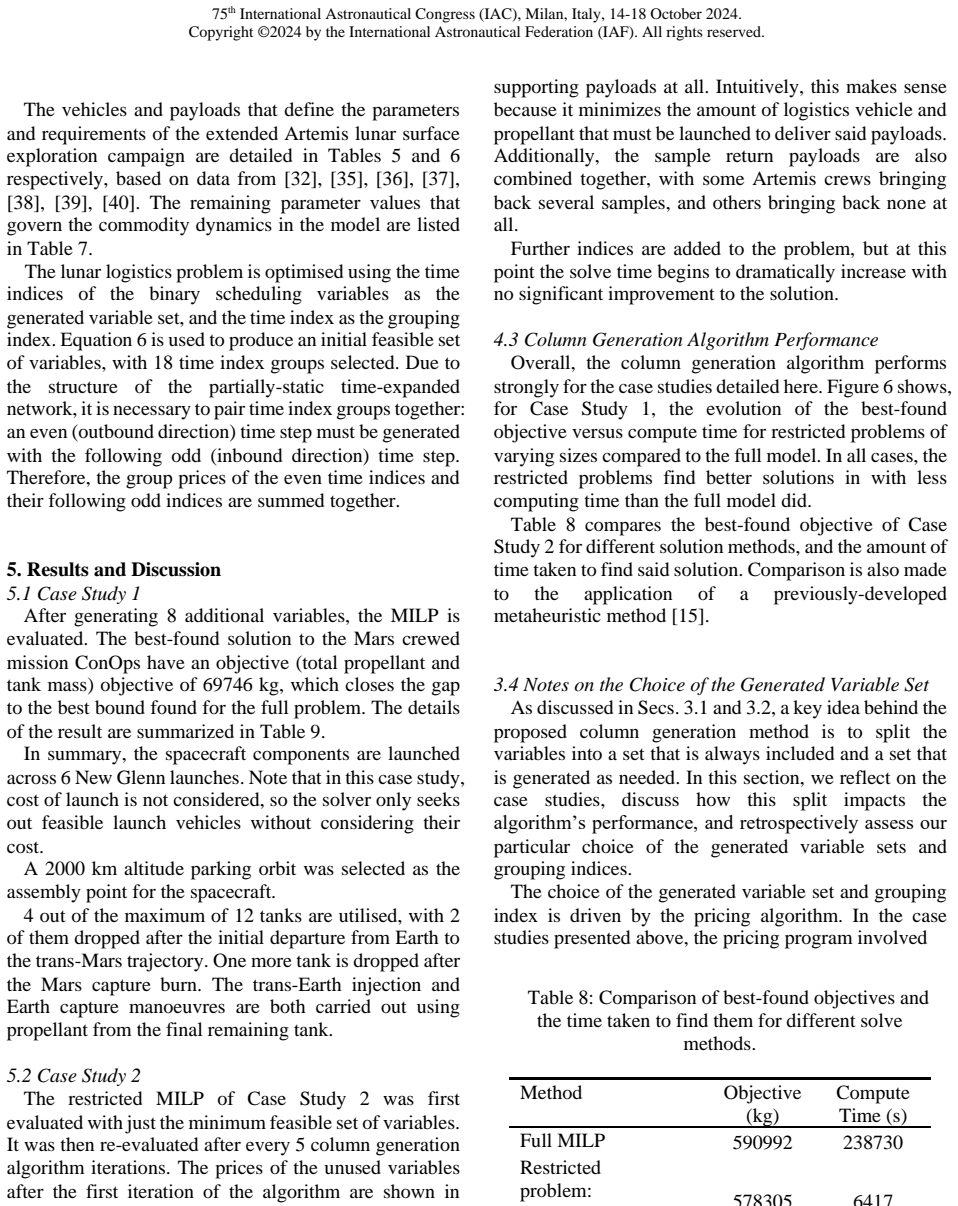
- [§4.3, Table 8] The comparison between the full MILP and restricted problems in Case Study 2 is presented as a comparison of best-found objectives, but the full MILP is reported not to have converged to a proven optimal solution. The table does not state the solver's termination criterion, the MIP gap at termination, or the hardware/solver settings used. Since the claim in the conclusion is that restricted problems can produce solutions 'of equal or greater quality' in less time, the comparison should explicitly report the final optimality gaps of all methods so that the reader can assess whether the improvement is meaningful relative to solution quality rather than just incumbent value.
- [§3.4] The selection of the generated variable set and grouping index is made retrospectively after evaluating several alternatives. The paper does not provide a principled a priori rule for choosing the generated set, aside from the general observations in Section 3.2. This is not an internal inconsistency, and the authors are honest that the method is problem-specific, but it means the case studies demonstrate a successful retrospective application rather than a predictive guideline. The conclusions should be tempered to reflect that the method's success depends on a choice that, in the examples, was made after inspecting the alternative pricing behavior.
minor comments (7)
- [Figures 7-10] The captions of Figures 7-10 appear to have the case study labels swapped: Figure 7 is captioned 'Case Study 1' but describes B_{p,t} variables and time-index grouping from Case Study 2, while Figures 8-10 are captioned 'Case Study 2' but describe x_{t,n,s,v} and ℓ_{v,o} variables from Case Study 1. Please correct the captions.
- [Section numbering and order] The manuscript presents Section 4.3 after Sections 5.1 and 5.2, and Section 3.4 appears after Section 5.2. The numbering and placement should be reorganized so that the methodological discussion follows Section 3 and the case study performance discussion follows the case study sections.
- [Table 2] Table 2 lists manoeuvre numbers 0, 1, 2, 4, and 5 with no manoeuvre 3, and the description 'DSM 2' is assigned to entry 4. Please clarify whether the numbering is intentionally non-contiguous or whether a manoeuvre is missing.
- [Equation 11] The big-M coefficient ℳ in Constraint 1A is described as 'sufficiently large' but its value is never reported. To make the formulation reproducible and to rule out numerical issues, the authors should provide the value used or describe how it was computed from problem data.
- [Table 5 caption] The caption of Table 5 literally contains the placeholder text '[include refs]'. This must be completed with the actual references.
- [Nomenclature] The symbol τ is used both for tank mass fraction in Case Study 1 and for real time-of-flight in Case Study 2. While the section-specific meanings are defined, the dual use is confusing in a paper that relies heavily on notation; consider renaming one of the two quantities.
- [Tables 3-5 ordering] The tables in Section 4.2 appear out of numerical order: Table 5 is printed before Table 4, and Table 7 is printed before the constraints that refer to it. Please renumber the tables and place each near its first citation.
Circularity Check
No circularity: the column-generation demonstrations are empirical computational comparisons, not derivations that reduce to their own inputs.
full rationale
The paper's claimed derivation chain is not circular. It builds on standard, externally established LP duality and reduced-cost theory (Section 2.1), applies a standard Dantzig-Wolfe column-generation framework (Section 2.2, citing Dantzig and Wolfe and the column-generation literature), and then formulates two independent MILP case studies with parameters taken from published vehicle, tank, trajectory, and program data. The central claim — that well-chosen restricted problems can find solutions of equal or better quality than the full problem in less time — is supported by actually solving the restricted and full MILPs and comparing their best-found objectives. Those objective values are computed from the problem data and constraints, not manufactured from the method's own parameters. No fitted constant is relabeled as a prediction: the generated variable sets and grouping indices are design choices of the algorithm, and the reported solutions are solver outputs for those choices. Section 3.4 does retrospectively compare alternative generated variable set choices on the same case studies, which is a methodological limitation regarding external validity or selection bias, but it does not make the reported objective values equivalent to the method's inputs by construction. The paper itself explicitly acknowledges that using reduced costs from the continuous relaxation to price integer variables is heuristic, which is an honest limitation rather than a circular step. The self-citations are not load-bearing: reference [15] is used as a baseline comparator, and the other author self-citations support background modeling choices, not the paper's central conclusion. Finally, the apparent infeasibility of the Case Study 1 result in Table 9 with respect to Constraints 2A/2B is a serious correctness concern, but it is an empirical or modeling error, not a circularity. For these reasons, no specific circular step can be exhibited, and the paper receives a circularity score of 0.
Assumptions & free parameters
free parameters (4)
- Tank mass fraction power-law coefficients =
0.7699 and -0.187
- Tank design sample grid =
30 linearly spaced samples over 5,000 to 40,000 kg
- Big-M coefficient in constraint 1A =
not specified
- C3 value for trans-Mars injection =
16 km^2/s^2
assumptions (6)
- standard math LP duality, reduced costs, and Dantzig-Wolfe decomposition
- domain assumption Rocket equation and Tsiolkovsky mass fraction
- domain assumption Time-expanded network commodity flow model
- ad hoc to paper LP relaxation reduced costs meaningfully guide integer variable selection
- domain assumption Outbound flow only on even time steps and return flow only on odd time steps
- domain assumption Vehicle stack model with combined dry mass and propellant capacities
Cite this review
Pith. "Pith review of Optimisation of Categorical Choices in Exploration Mission Concepts of Operations Using Column Generation Method." pith.science (2026). https://pith.science/paper/VAMXFYNJ
@misc{pith2026241202521,
  author       = {Pith},
  title        = {Pith review of: Optimisation of Categorical Choices in Exploration Mission Concepts of Operations Using Column Generation Method},
  year         = {2026},
  howpublished = {\url{https://pith.science/paper/VAMXFYNJ}},
  note         = {Machine review of arXiv:2412.02521}
}
read the original abstract
Space missions, particularly complex, large-scale exploration campaigns, can often involve many discrete decisions or events in their concepts of operations. Whilst a variety of methods exist for the optimisation of continuous variables in mission design, the inherent presence of discrete events in mission ConOps disrupts the possibility of using methods that are dependent on having well-defined, continuous mathematical expressions to define the systems. Typically, mission architects will circumvent this problem by solving the system optimisation for every permutation of the categorical decisions if practical, or use metaheuristic solvers if not. However, this can be prohibitively expensive in terms of computation time. Alternatively, categorical decisions in optimisation problems can be expressed using binary variables. If implemented naively, commercially available MILP solvers are still slow to solve such a problem. Problems of this class can be solved more efficiently using column generation methods. Here, restricted problems are created by removing significant numbers of variables. The restricted problem is solved, and the unused variables are priced to test which, if any, could improve the objective of the restricted problem if they were to be added. Column generation methods are problem-specific, and so there is no guaranteed solution to these categorical problems. As such, the following paper proposes guidelines for defining restricted problems representing space exploration mission concepts of operations. The column generation process is described and then applied to two case studies: a ConOps for a crewed Mars mission, in which the design, assembly, and staging of the trans-Martian spacecraft is modelled using discrete decisions; and the payload delivery scheduling of translunar logistics in the context of an extended Artemis surface exploration campaign.
Figures
Reference graph
Works this paper leans on
-
[1]
Modeling Interplanetary Logistics: A Mathematical Model for Mission Planning,
C. Taylor, D. Klabjanz, D. Simchi -levi, M. Song, and O. De Weck, “Modeling Interplanetary Logistics: A Mathematical Model for Mission Planning,” in SpaceOps 2006 Conference , Jun
work page 2006
-
[2]
Modeling Space System Architectures with Graph Theory,
D. C. Arn ey and A. W. Wilhite, “Modeling Space System Architectures with Graph Theory,” J. Spacecr. Rockets , vol. 51, no. 5, pp. 1413 –1429, Sep. 2014, doi: 10.2514/1.A32578
-
[3]
Generalized Multicommodity Network Flow Model for the Earth–Moon–Mars Logistics System,
T. Ishimatsu, O. L. de Weck, J. A. Hoffman, Y. Ohkami, and R. Shishko, “Generalized Multicommodity Network Flow Model for the Earth–Moon–Mars Logistics System,” J. Spacecr. Rockets, vol. 53, no. 1, pp. 25 –38, Jan. 2016, doi: 10.2514/1.A33235
doi:10.2514/1.a33235 2016
-
[4]
Dynamic modeling and optimization for space logistics using time -expanded networks,
K. Ho, O. de Weck, J. Hoffman, and R. Shishko, “Dynamic modeling and optimization for space logistics using time -expanded networks,” Acta Astronaut., vol. 105, Oct. 2014, doi: 10.1016/j.actaastro.2014.10.026
-
[5]
Multi -objective optimisation and decision -making of space station logistics strategies,
Y. Zhu and Y. Luo, “Multi -objective optimisation and decision -making of space station logistics strategies,” Int. J. Syst. Sci. , vol. 47, n o. 13, pp. 3132–3148, Oct. 2016, doi: 10.1080/00207721.2015.1091898
-
[6]
B. B. Jagannatha and K. Ho, “Optimization of In - Space Supply Chain Design Using High-Thrust and Low-Thrust Propulsion Technologies,” J. Spacecr. Rockets, vol. 55, no. 3, pp. 648–659, May 2018, doi: 10.2514/1.A34042
-
[7]
H. Chen and K. Ho, “Integrated Space Logistics Mission Planning and Spacecraft Design with Mixed-Integer Nonlinear Programming,” J. Spacecr. Rockets, vol. 55, pp. 1–17, Oct. 2017, doi: 10.2514/1.A33905
doi:10.2514/1.a33905 2017
-
[8]
B. B. Jagann atha and K. Ho, “Event -Driven Network Model for Space Mission Optimization with High -Thrust and Low -Thrust Spacecraft,” J. Spacecr. Rockets, vol. 57, no. 3, pp. 446 –463, May 2020, doi: 10.2514/1.A34628
Show all 41 references
-
[9]
Satellite Constellation Pattern Optimization for Complex Regional Coverage,
H. W. Lee, S. Shimizu, S. Yoshikawa, and K. Ho, “Satellite Constellation Pattern Optimization for Complex Regional Coverage,” J. Spacecr. Rockets, vol. 57, no. 6, pp. 1309 –1327, Nov. 2020, doi: 10.2514/1.A34657
2020 doi
-
[10]
Framework for Modeling and Optimization of On -Orbit Servicing Operations Under Demand Uncertainties,
T. Sarton du Jonchay, H. Chen, O. Gunasekara, and K. Ho, “Framework for Modeling and Optimization of On -Orbit Servicing Operations Under Demand Uncertainties,” J. Spacecr. Rockets , vol. 58, no. 4, pp. 1157–1173, Jul. 2021, doi: 10.2514/1.A34978
2021 doi
-
[11]
Optimization and Modeli ng of Active Debris Removal using a Time -Expanded Network,
J. A. Tepper, Y. Fassi, T. Sarton du Jonchay, K. Ho, and Y. Shimane, “Optimization and Modeli ng of Active Debris Removal using a Time -Expanded Network,” in ASCEND 2022, Las Vegas, Nevada & Online: American Institute of Aeronautics and Astronautics, Oct. 2022. doi: 10.2514/6....
2022 doi
-
[12]
Orbital Facility Location Problem for Satellite Constellation Servicing Depots,
Y. Shimane, N. Gollins, and K. Ho, “Orbital Facility Location Problem for Satellite Constellation Servicing Depots,” J. Spacecr. Rockets, vol. 61, no. 3, pp. 808–825, May 2024, doi: 10.2514/1.A35691
2024 doi
-
[13]
Hierarchical Reinforcement Learning Framework for Stochastic Spaceflight Campaign Design,
Y. Takubo, H. Chen, and K. Ho, “Hierarchical Reinforcement Learning Framework for Stochastic Spaceflight Campaign Design,” J. Spacecr. Rockets, vol. 59, no. 2, pp. 421 –433, Mar. 2022, doi: 10.2514/1.A35122
2022 doi
-
[14]
Integrated transportation system design optimization,
C. P. Taylor, “Integrated transportation system design optimization,” Massachusetts Institute of Technology, 2007. [Online]. Available: https://dspace.mit.edu/handle/1721.1/38644
2007
-
[15]
Hierarchical Framework for Space Exploration Campaign Schedule Optimization,
N. Gollins and K. Ho, “Hierarchical Framework for Space Exploration Campaign Schedule Optimization,” J. Spacecr. Rockets, Apr. 2024, doi: https://doi.org/10.2514/1.A35828
2024 doi
-
[16]
The Decomposition Algorithm for Linear Programs,
G. B. Dantzig and P. Wolfe, “The Decomposition Algorithm for Linear Programs,” Econometrica, vol. 29, no. 4, pp. 767 –778, 1961, doi: 10.2307/1911818
1961 doi
-
[17]
Desaulniers, J
G. Desaulniers, J. Desrosiers, and M. M. Solomon, Eds., Column generation . in GERAD 25th anniversary series. New York: Springer, 2005
2005
-
[18]
A Column Generation Approach to the Multiple-Depot Vehicle Scheduling Problem,
C. C. Ribeiro and F. Soumis, “A Column Generation Approach to the Multiple-Depot Vehicle Scheduling Problem,” Oper. Res., vol. 42, no. 1, pp. 41–52, Feb. 1994, doi: 10.1287/opre.42.1.41
1994 doi
-
[19]
D aily Aircraft Routing and Scheduling,
G. Desaulniers, J. Desrosiers, Y. Dumas, M. M. Solomon, and F. Soumis, “D aily Aircraft Routing and Scheduling,” Manag. Sci. , vol. 43, no. 6, pp. 841–855, Jun. 1997, doi: 10.1287/mnsc.43.6.841. 75th International Astronautical Congress (IAC), Milan, Italy, 14-18 October 2024....
1997 doi
-
[20]
A Technical Review of Column Generation in Integer Programming,
W. E. Wilhelm, “A Technical Review of Column Generation in Integer Programming,” Optim. Eng., vol. 2, pp. 159–200, 2001
2001
-
[21]
Algorithms for two -dimensional cutting stock and strip packing problems using dynamic programming and column generation,
G. F. Cintra, F. K. Miyazawa, Y. Wakabayashi, and E. C. Xavier, “Algorithms for two -dimensional cutting stock and strip packing problems using dynamic programming and column generation,” Eur. J. Oper. Res., vol. 191, no. 1, pp. 61 –85, Nov. 2008, doi: 10.1016/j.ejor.2007.08.007
2008 doi
-
[22]
A Column Generation Algorithm for a Rich Vehicle -Routing Problem,
A. Ceselli, G. Righini, and M. Salani, “A Column Generation Algorithm for a Rich Vehicle -Routing Problem,” Transp. Sci. , vol. 43, no. 1, pp. 56 –69, Feb. 2009, doi: 10.1287/trsc.1080.0256
2009
-
[23]
NASA’s Strategic A nalysis Cycle 2021 (SAC21) Human Mars Architecture,
M. A. Rucker et al. , “NASA’s Strategic A nalysis Cycle 2021 (SAC21) Human Mars Architecture,” in 2022 IEEE Aerospace Conference (AERO) , Mar. 2022, pp. 1 –10. doi: 10.1109/AERO53065.2022.9843237
2021
-
[24]
Analysis of Propellant Tank Masses
S. S. Pietrobon, “Analysis of Propellant Tank Masses”
-
[25]
Sensitivity Analysis of Heat Rejection and Propellant Management Technologies for Nuclear Thermal Propulsion Architectures
R. J. Hetterich, M. A. Rodriguez, and S. J. Edwards, “Sensitivity Analysis of Heat Rejection and Propellant Management Technologies for Nuclear Thermal Propulsion Architectures”
-
[26]
Multidisciplinary Design Optimization Approach to Integrated Space Mission Pl anning and Spacecraft Design,
M. Isaji, Y. Takubo, and K. Ho, “Multidisciplinary Design Optimization Approach to Integrated Space Mission Pl anning and Spacecraft Design,” J. Spacecr. Rockets , vol. 59, no. 5, pp. 1660 –1670, Nov. 2021, doi: 10.2514/1.A35284
2021 doi
-
[27]
NASA Launch Vehicle Performance Website
“NASA Launch Vehicle Performance Website.” Accessed: Jul. 19, 2024. [Online]. Available: https://elvperf.ksc.nasa.gov/Pages/Default.aspx
2024
-
[28]
NASA’s Space Launch System: Capabilities for Ultra -High C3 Missions,
R. Stough, K. F. Robinson, J. B. Holt, D. A. Smith, W. D. Hitt, and B. A. Perry, “NASA’s Space Launch System: Capabilities for Ultra -High C3 Missions,” Bull. AAS , vol. 53, no. 4, Mar. 2021, doi: 10.3847/25c2cfeb.170da7f3
2021 doi
-
[29]
Propulsion Alternatives for Mars Transportation Architectures,
D. Nikitaeva and L. D ale Thomas, “Propulsion Alternatives for Mars Transportation Architectures,” J. Spacecr. Rockets , vol. 60, no. 2, pp. 520–532, Mar. 2023, doi: 10.2514/1.A35506
2023 doi
-
[30]
Global Exploration Roadmap (GER) Supplement August 2020: Lunar Surface Exploration Scenar io Update,
“Global Exploration Roadmap (GER) Supplement August 2020: Lunar Surface Exploration Scenar io Update,” International Space Exploration Coordination Group (ISECG), 2020. [Online]. Available: https://www.globalspaceexploration.org/wp- content/uploads/2020/08/GER_2020_supplement.p df
2020
-
[31]
Global Exploration Roadmap Derived Concept for Human Exploration of the Moon,
R. Whitley et al. , “Global Exploration Roadmap Derived Concept for Human Exploration of the Moon,” 2017
2017
-
[32]
The 2022 Updated Lunar Exploration Scenario for the Global Exploration Roadmap (GER): The Growing Global Effort and Momentum Going Forward to the Moon and Mars,
M. J. Guidi, M. M. Haese, D. M. Landgraf, D. C. Lange, D. S. Pirrotta, and M. Naoki, “The 2022 Updated Lunar Exploration Scenario for the Global Exploration Roadmap (GER): The Growing Global Effort and Momentum Going Forward to the Moon and Mars,” presented at the 73rd Interna...
2022
-
[33]
Optimization of Multi - Mission Space Exploration Campaign Schedules Subject to Stochastic Launch De lay,
N. J. Gollins and K. Ho, “Optimization of Multi - Mission Space Exploration Campaign Schedules Subject to Stochastic Launch De lay,” in AIAA SCITECH 2024 Forum , Orlando, FL: American Institute of Aeronautics and Astronautics, Jan. 2024. doi: 10.2514/6.2024-2718
2024 doi
-
[34]
A Spaceflight Logistics Approach to Modeling Novel Vehicle Concepts,
C. Downs, A. Prasad, B. E. Robertson, and D. N. Mavris, “A Spaceflight Logistics Approach to Modeling Novel Vehicle Concepts,” in AIAA SCITECH 2023 Forum , National Harbor, MD & Online: American Institute of Aeronautics and Astronautics, Jan. 2023. doi: 10.2514/6.2023-1964
2023 doi
-
[35]
Pathways to Sustainability in Lunar Exploration Architectures,
M. Landgraf, “Pathways to Sustainability in Lunar Exploration Architectures,” J. Spacecr. Ro ckets, vol. 58, no. 6, pp. 1681 –1693, Nov. 2021, doi: 10.2514/1.A35019
2021 doi
-
[36]
Griffin Lunar Test Model Complete,
Astrobotic, “Griffin Lunar Test Model Complete,” Astrobotic Technology. Accessed: Nov. 18, 2022. [Online]. Available: https://www.astrobotic.com/griffin-lunar-test- model-complete/
2022
-
[37]
Astrobotic Griffin Lunar Lander Structural Test Model (STM) undergoes Vibration and Direct Field Acoustic Testing,
“Astrobotic Griffin Lunar Lander Structural Test Model (STM) undergoes Vibration and Direct Field Acoustic Testing,” Experior Laboratories. Accessed: Nov. 18, 2022. [Online]. Available: https://experiorlabs.com/astrobotic-griffin-lunar- lander-large-and-heavy-vibration-for-spa...
2022
-
[38]
Blue Moon,
Blue Origin, “Blue Moon,” Blue Moon. Accessed: Nov. 16, 2022. [Online]. Available: https://www.blueorigin.com/blue-moon
2022
-
[39]
ispace Unveils Mission 3 Lander Design, Set to Launch in 2024
ispace, “ispace Unveils Mission 3 Lander Design, Set to Launch in 2024.” Accessed: Nov. 18, 2022. [Online]. Available: https://ispace - inc.com/jpn/news/?p=2042
2024
-
[40]
European Access to the Lunar Surface: EL3,
L. Duvet et al. , “European Access to the Lunar Surface: EL3,” presented at the 72nd International Astronautical Congress, Dubai, UAE: International Astronautical Federation (IAF), Oct. 2021
2021
-
[2006]
doi: 10.2514/6.2006-5735
2006 doi
Reviewed August 11, 2026 · model on record in the stance chip above.
Discussion (0). Continue with ORCID to comment.